

Secondary Math Tuition for 2026: Bukit Timah Math Tuition
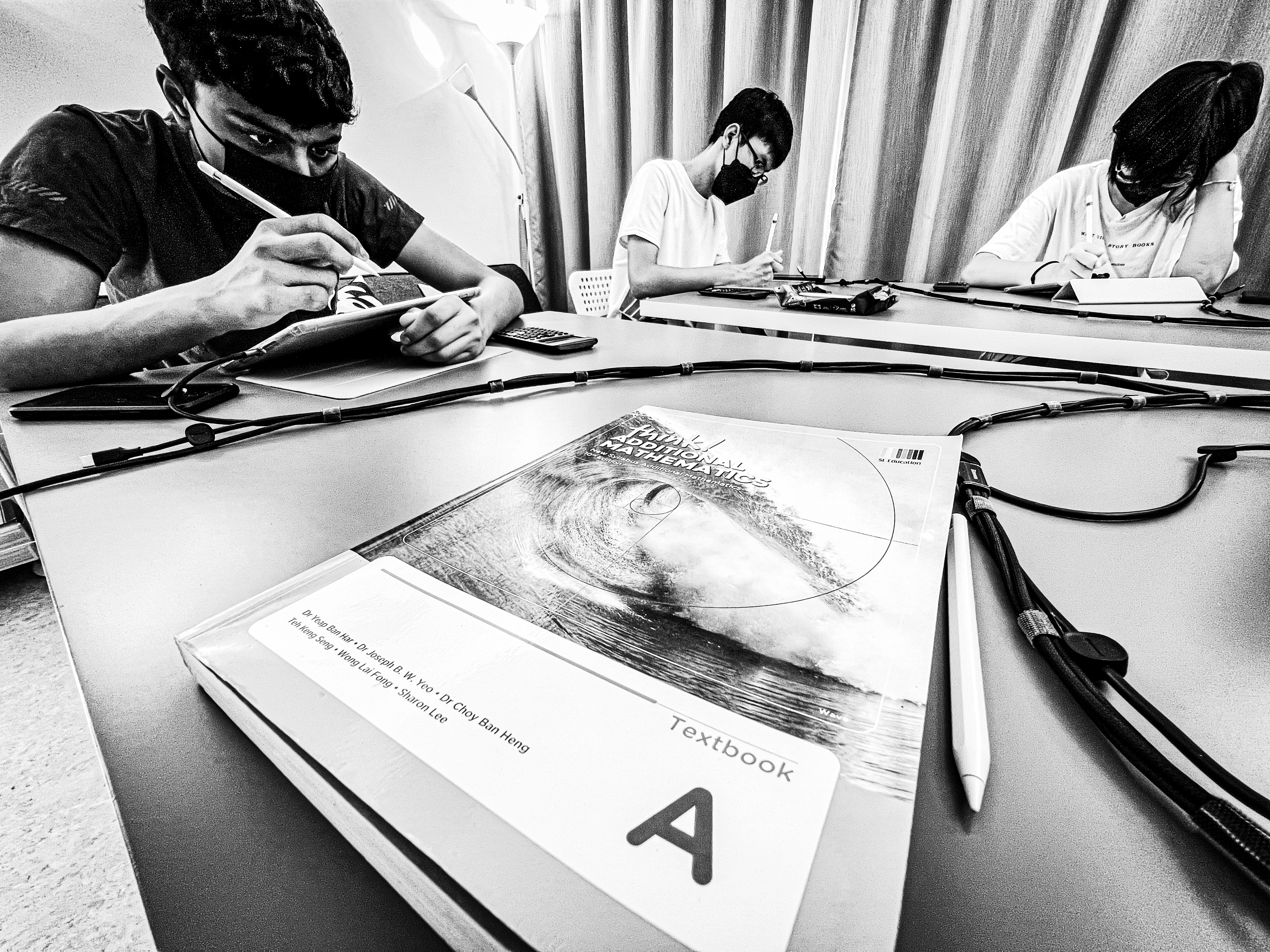
Small, expert groups (3 pax) with clear alignment to how Mathematics is taught and examined in Singapore. The aims, assessment objectives, and paper formats below reference the official O-Level Mathematics (4052) and Additional Mathematics (4049) syllabuses examined in 2026 (Mathematics 4052 PDF (SEAB) • Additional Mathematics 4049 PDF (SEAB)), and the Full Subject-Based Banding (G1/G2/G3) landscape (MOE Full SBB (Ministry of Education)).
Explore our small-group approach at EduKate Singapore and view programmes at EduKate Punggol.
1) How secondary Maths is structured in 2026 (what parents should know)
- Full SBB (G1/G2/G3) replaces legacy streams. Students can offer Mathematics at different subject levels and may adjust levels at suitable junctures. Mixed form classes + subject-level grouping are now standard (MOE overview • Secondary experience). (Ministry of Education)
- By Upper Secondary, most students read O-Level Mathematics (Syllabus 4052); students with the interest/aptitude add O-Level Additional Mathematics (Syllabus 4049) to prepare for A-Level H2 Mathematics (4052 PDF, 4049 PDF). (SEAB)
2) What excellent tuition actually changes
- Pinpoint gaps by strand (Number & Algebra; Geometry & Measurement; Statistics & Probability for 4052; plus Algebra, Geometry & Trigonometry, Calculus for 4049), then rebuild with worked examples → guided practice → independent checks (4052 strands, 4049 strands). (SEAB)
- Train to assessment objectives (AO1 techniques, AO2 problem solving, AO3 reasoning/communication) with explicit modelling of mathematical arguments and clean working (4052 AO table • 4049 AO table). (SEAB)
- Build durable memory with low-stakes retrieval practice and spaced review—approaches repeatedly supported in evidence summaries for secondary classrooms (EEF cognitive-science review • EEF on retrieval). (EEF)
3) E-Math (4052): what we teach to the exam standard
Aims & strands. The syllabus develops fundamental knowledge and skills across three strands, with explicit emphasis on reasoning, communication and applications (4052 overview PDF). (SEAB)
Scheme of Assessment (2026).
- Paper 1 (2h15m): ~26 short-answer questions — 90 marks (50%)
- Paper 2 (2h15m): 9–10 structured questions — 90 marks (50%); final question targets a real-world scenario
- Calculators approved in both papers; relevant formulae provided; omission of essential working loses marks (4052, p.4–5). (SEAB)
Our 4052 focus areas.
- Algebra fluency (equations/inequalities, functions/graphs, indices/surds) → accuracy under time.
- Geometry & Measurement (similarity, circle theorems, vectors) → diagram discipline & proof-lite reasoning.
- Statistics & Probability (representations, summary measures, distributions) → interpretation and critique.
4) A-Math (4049): pathways to H2 Mathematics
Purpose. 4049 is designed to prepare students for A-Level H2 Mathematics, assuming knowledge of O-Level Mathematics (4049 overview PDF). (SEAB)
Scheme of Assessment (2026).
- Paper 1 (2h15m): 12–14 structured questions — 90 marks (50%)
- Paper 2 (2h15m): 9–11 structured questions — 90 marks (50%)
- Calculators approved in both papers; relevant formulae provided; accuracy/working rules as specified (4049, p.5). (SEAB)
Our 4049 focus areas.
- Algebra: quadratics (discriminant & tangency conditions), polynomials/partial fractions, binomial, logs/exponentials.
- Trig/Geometry: identities, equations, R-formula, graphs, coordinate geometry (including circles), plane-geometry proofs.
- Calculus: differentiation & integration techniques, applications (rates, kinematics), curve sketching and area.
5) The Bukit Timah lesson design (3-pax small groups)
- Diagnostic entry by topic/strand + past scripts; set a G2/G3 pathway consistent with Full SBB rules (MOE Full SBB). (Ministry of Education)
- Explicit modelling to AO1–AO3 targets; deliberate practice with mixed sets; exam-style prompts lifted from the published scheme-of-assessment descriptors (4052/4049). (SEAB)
- Retrieval & spaced review baked into every week (starters, cumulative check-ins) referencing classroom-tested guidance (EEF). (EEF)
- Error-log routines → convert misconceptions into future marks; timed blocks that mirror 2h15m pacing; enforcement of neat, stepwise working per SEAB notes (both syllabuses warn that omitting essential working costs marks). (SEAB)
6) A 12-week improvement plan (sample, adaptable to G2/G3)
- Weeks 1–2 (Diagnostics & Rebuild): Algebra baseline (equations, indices/surds, linear/quadratic graphs). Identify time drains; begin daily retrieval set (~6 Qs). (SEAB)
- Weeks 3–4 (Geometry Core): Parallel lines/angles, triangles/quadrilaterals, circle theorems, similarity; introduce vector language for proofs-lite. (SEAB)
- Weeks 5–6 (Functions & Real-World Modelling): Ratio/percentage growth, linear modelling, coordinate geometry; Paper-2 long-problem routines; calculator discipline per syllabus guidance. (SEAB)
- Weeks 7–8 (4049 ramp, if offered): Discriminant/tangency, polynomials & partial fractions, binomial, logs/exponentials; trig identities + R-formula. (SEAB)
- Weeks 9–10 (Calculus for 4049): Differentiation/integration techniques, kinematics and curve sketching; full-mark structures. (SEAB)
- Weeks 11–12 (Exam Simulations): Two full Paper-1/2 runs (4052 or 4049), mark-scheme working, targeted re-teaching, and refined pacing to hit the final Q on real-world context (4052). (SEAB)
7) Exam routines that move marks
- Time & sequencing: Practise 2h15m blocks; front-load secure marks, tag time-sinks, leave a margin for the final application question in 4052 Paper 2 (SEAB scheme-of-assessment). (SEAB)
- Working that examiners can follow: Show logical steps; state identities/transformations; units/accuracy rules as specified in SEAB notes (both syllabuses). (SEAB)
- Calculator fluency: Use an approved calculator in both papers; know when manual manipulation beats key-mashing (explicitly allowed in 4052/4049). (SEAB)
8) For parents: reading official documents without the jargon
- What to look for in 4052: three strands, AO1–AO3 weightings, the Paper 2 final real-world problem; use the syllabus page headings to check your child’s notes (4052 PDF). (SEAB)
- What to look for in 4049: that it assumes 4052 knowledge and steps up abstraction toward H2 Math; scan Algebra/Trig/Calculus lists for missing topics (4049 PDF). (SEAB)
- Where G2→G3 fits: confirm subject levels and school processes on the Full SBB pages (MOE Full SBB). (Ministry of Education)
FAQs
Q1. Is there any change to paper duration or calculator rules for 2026?
No—both 4052 and 4049 remain 2h15m for each paper, with approved calculators allowed in both papers, and relevant formulae provided (see “Scheme of Assessment” and “Use of Calculators” in the official PDFs). (SEAB)
Q2. My child is G2 in Sec 2. Can they add A-Math in Sec 3?
Subject offerings depend on school policies and performance. Use the Full SBB guidance to understand pathways and discuss with your child’s school about readiness for 4049. (Ministry of Education)
Q3. What study habits correlate with steady grade movement (e.g., to A1)?
Regular retrieval practice, spaced review, and clean, mark-scheme-friendly working show the strongest classroom evidence for retention and exam conversion; we build these into weekly cycles. (EEF)
Enrolment & consultation (Bukit Timah)
- Arrange a consultation (we cap classes at 3 pax): EduKate Singapore
- Prefer Punggol? See EduKate Punggol
Trusted references (key links)
- SEAB O-Level Mathematics (4052) — 2026 syllabus PDF. (SEAB)
- SEAB O-Level Additional Mathematics (4049) — 2026 syllabus PDF. (SEAB)
- MOE Full Subject-Based Banding (G1/G2/G3) — secondary experience. (Ministry of Education)
- Evidence on retrieval & spaced practice in secondary classrooms (EEF). (EEF)
 eduKate Singapore English Maths Science Small Group Tuition