
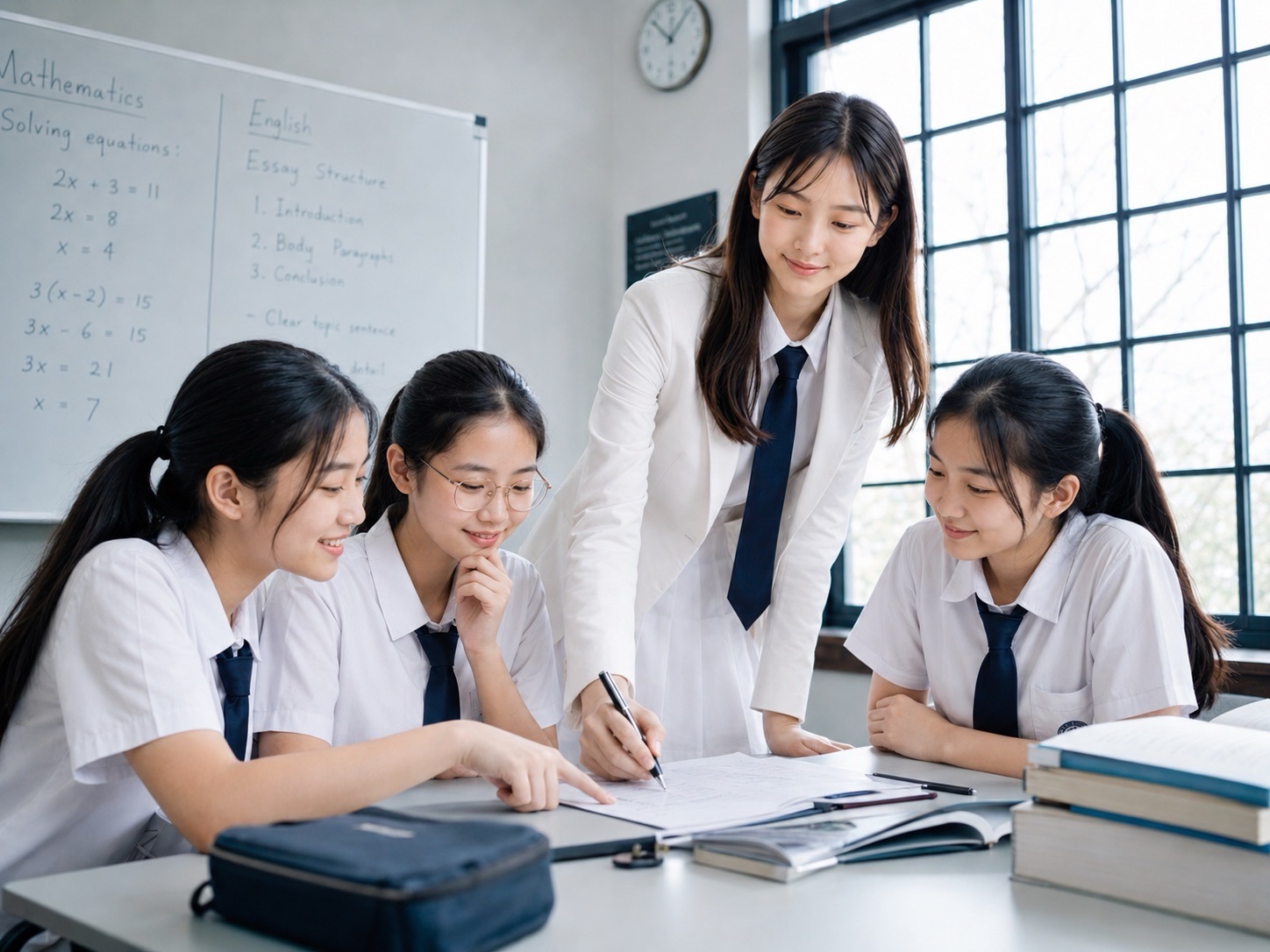
Secondary 2 Mathematics · The Transition Corridor
Secondary 2
Is the Corridor.
Build It Now.
This transition guide helps families check which lower-secondary foundations remain independently usable before Secondary 3. For the main programme explanation, read what happens in Secondary 2 Mathematics tuition with a Bukit Timah tutor.
The work is to repair early, strengthen algebra, connect topics, train independence and verify carrying power before the upper-secondary load arrives.
Passing Secondary 2 and being ready for Secondary 3 are not the same thing. A student can complete current worksheets and still carry fragile algebra, weak transfer, poor starting routines or chapter-dependent knowledge into the next year.
The transition in one movement
Build the engine before the road gets steeper.
Secondary 1 is largely an adjustment year. Secondary 3 is an upper-secondary acceleration year. Secondary 2 sits between them as the final buffer where weaknesses can still be repaired before the mathematical load becomes more layered and expensive.
The purpose of high-performance Secondary 2 tuition is therefore larger than finishing homework or improving the next test. It is to create carrying power: Mathematics that remains available when the student enters a harder syllabus.
The corridor is built when the student can understand, begin, manipulate, connect, practise, check, recover and transfer with increasing independence.
The corridor logic
Secondary 2 is not
“one year before Secondary 3.”
It is the year where habits become visible, algebra starts becoming a working language, topic connections become important and the student’s upper-secondary route begins to come into focus.
New routines, teachers, expectations, subject rhythm and the move away from primary-school Mathematics.
Algebra habits, working discipline, independence, topic gaps and problem-solving behaviour become easier to see.
Strengthen prerequisites, connect topics, train examination discipline and create transfer before the next jump.
More abstraction, stronger algebra, longer working, heavier topic interaction and more defined subject pathways.
The student must eventually convert the accumulated system into reliable examination performance.
The weak interpretation
Sec 2 = finish this year’s topics
The student may look comfortable while methods remain chapter-bound, algebra remains fragile and weak habits are carried forward.
The stronger interpretation
Sec 2 = current mastery + future carrying power
Every important skill is judged partly by whether it can support the harder structures that appear next.
Build before urgency.
Strengthen the tools while there is still room to learn carefully rather than repair under upper-secondary pressure.
Clean up what drifted.
Find the PSLE and Secondary 1 weaknesses that survived quietly but are now beginning to affect algebra, graphs and multi-step work.
Prepare the next mode.
Secondary 3 should feel like a continuation of structures already strengthened—not a sudden cliff where old basics and new content collide.
Repair before escalation
The Secondary 2 problem
may have started years earlier.
A student may say “I don’t understand Math,” but that is too broad to teach. High-performance tuition narrows the failure until the repair becomes specific.
What came into Secondary 2?
Fractions, ratio, percentages, negative numbers, arithmetic accuracy, interpretation and working discipline may still be shaping current performance.
- Weak fractions
- Later algebraic fractions become heavier.
- Weak negatives
- Sign errors multiply through symbolic work.
- Weak ratio
- Proportion, speed, scale and modelling become slower.
- Weak working
- Longer solutions become difficult to preserve accurately.
- Weak interpretation
- Changed wording can make a familiar idea look unfamiliar.
What will Secondary 3 demand?
Greater independence, stronger symbolic manipulation, more layered questions, topic linkage, longer reasoning and more defined G2/G3/A-Math pathways.
- Algebra
- Must work as a language, not only a chapter.
- Graphs
- Need stronger connection to equations and relationships.
- Geometry
- Becomes more linked to trigonometry and coordinate reasoning.
- Questions
- Become less signposted and more multi-step.
- Ownership
- The student must increasingly start, choose and recover independently.
Evidence worth bringing
Find the problem before calling the child “weak at Math”.
- Recent school papers with full written working
- Secondary 1 topics that still require prompting
- Repeated sign, fraction and algebra errors
- How the student starts unfamiliar questions
- Whether methods survive when numbers or wording change
- Whether topics remain available several weeks later
- How cleanly the student communicates multi-step working
- Whether confidence changes when chapter labels disappear
The upper-secondary engine
Algebra must stop being
a chapter and become a language.
By Secondary 3, algebra is repeatedly reused inside graphs, equations, functions, geometry, formulas and—where offered—Additional Mathematics. Secondary 2 is the year to make symbolic control dependable before it becomes urgent.
Recognise terms, factors, brackets, equality and useful forms.
Preserve signs, coefficients and structure through longer symbolic moves.
Recognise common factors and forms that simplify later work.
Move logically from one equivalent line to the next without guessing.
Rearrange formulas and choose forms that reveal a better route.
Substitute, inspect signs and verify that each move remains mathematically valid.
A method must survive changed numbers.
If the student can follow a fresh example but cannot reconstruct the movement when the surface changes, the algebra is still cue-dependent.
See the complete learning loop →It is the control language of later Mathematics.
Stable algebra makes graphs clearer, formulas more usable, equations more manageable and advanced topics less cognitively expensive.
See how the topic families connect →Small symbolic drift spreads forward.
Unrepaired signs, fractions and equation habits can become larger failures when quadratic, graph and trigonometric demands increase.
See the repair-to-launch sequence →Build prerequisites before deciding labels.
Strong algebra, multi-step reasoning, accuracy, mistake recovery and willingness to practise are more useful readiness signals than prestige or fear.
Explore the Secondary 2 Mathematics branch →From chapters to a network
The student sees chapters.
The tutor should see families.
Topic-family grouping is an eduKateSG teaching interpretation rather than official MOE terminology. Its purpose is to help students see reusable structures so knowledge transfers more easily when Secondary 3 combines ideas.
Ratio · Graphs · Equations
Ratio, proportion, linear relationships, equations and simultaneous equations all describe how quantities relate and change together.
Similarity · Geometry · Trigonometry
Shape, scale, congruence, similarity, Pythagoras, trigonometric foundations, measurement and coordinates form a spatial reasoning network.
Represent · Compare · Infer
Tables, graphs, averages, distributions, probability and interpretation teach the student to read evidence rather than only compute values.
Manipulate · Transform · Solve
Algebraic manipulation, fractions, factorisation, formulas and equations create the symbolic machinery used across upper-secondary Mathematics.
Chapter-island learning
“We finished graphs last month.”
The topic appears complete, but the student may not know when graph structure should help solve an equation, compare rates or interpret a relationship later.
Corridor learning
“What family does this problem belong to?”
The student begins to recognise structure, retrieve related tools and move more flexibly when topics are mixed.
The high-performance learning system
Teach today.
Verify tomorrow’s carrying power.
High-performance Secondary 2 tuition should not only follow school homework reactively. It should repair prerequisites, build connected control and verify that the learning survives mixed load before Secondary 3 begins.
Read errors, hesitation, working habits, method choice and where the student becomes dependent.
Find whether the failure is foundation, algebra, recognition, translation, execution or confidence.
Repair the missing structure and reconnect it to the current Secondary 2 topic.
Test whether the student can now carry the idea independently into variation and mixed questions.
Know what the object, relationship or method means—not only the steps.
Reproduce the method with decreasing explanation and prompting.
Strengthen accuracy until core movements require less cognitive effort.
Change wording, representation, numbers, diagrams and visible surface.
Combine topic families so the student must identify before applying.
Check whether the Mathematics remains available later and under harder load.
The first useful step matters.
Annotate, identify clues, write known information, draw a diagram, form an equation or represent the relationship. The full staircase need not be visible before movement begins.
See the “cannot start” profile →Do not wait for the examination year.
Clear working, units, sign checks, question reading, time control and intelligent checking are maturity habits that become more valuable later.
See how reliability changes by progress mode →Mistakes become information.
Attempt → error → diagnosis → correction → reattempt creates evidence that the student can improve. This is more durable than reassurance alone.
See the seven-stage corridor →Same structure. Different skin.
The student should recognise the family, select the method, maintain clean working and recover from small errors when the question no longer looks familiar.
Read the Math Transfer Test →The 55 → 65 → 75 → 85 corridor
Different marks.
Different teaching problems.
The numbers are useful as broad illustrations, not promises or rigid bands. The important idea is that a falling student, a stable student and a strong student should not receive the same intervention.
Stability.
Stop the falling, repair foundations, reduce repeated losses and create enough successful control for confidence to return.
Control.
Strengthen algebra, recognition, working habits and consistency so the student is less dependent on familiar examples.
Precision.
Reduce unnecessary errors, improve speed, handle more complex variations and make method choice more efficient.
Stretch.
Train unfamiliar questions, elegant reasoning, deeper transfer and performance under pressure without creating needless volume.
The goal is not to push every student through the same worksheet stack. The student who is falling needs rescue. The student who is stable needs strengthening. The student who is strong needs stretch. High performance means choosing the correct work for the student’s present state.
The seven-stage transition corridor
Diagnose to launch.
In the correct order.
The corridor converts Secondary 2 from reactive tuition into a preparation system. Each stage removes a different source of future Secondary 3 overload.
Identify the current level, foundation gaps, algebra fluency, careless patterns and confidence profile.
Rebuild weak fundamentals from PSLE, Secondary 1 and early Secondary 2.
Practise core Secondary 2 skills until they become cleaner, faster and more reliable.
Link current learning to algebra, graphs, geometry, problem-solving and future Secondary 3 demands.
Build exam and working discipline before urgency.
Teach question reading, first-step routines, clean written method, time awareness, checking and mistake recovery.
Introduce difficulty before it becomes a shock.
Use variation, mixed topic families and unfamiliar surfaces so complexity grows progressively rather than arriving all at once in Secondary 3.
Enter Secondary 3 with carrying power.
The student should arrive with stronger habits, clearer foundations, more stable algebra and enough confidence to absorb new content without simultaneously relearning too many old basics.
Know the child’s current mode.
Parents do not need to become Mathematics teachers. They need clarity on whether the student is repairing, consolidating or stretching.
Become an active learner gradually.
Bring questions, correct work, keep mistake records, revisit errors, revise before tests and ask why—not only what.
Look beyond the next test mark.
The student starts more confidently, makes fewer repeated algebra errors, explains methods better, checks more carefully, panics less and sees more links across topics.
The practical student matrix
Match the corridor
to the student in front of you.
These are starting interpretations. The tutor should confirm the real weak link from working, retention, independence and mixed-question behaviour.
Passed Secondary 1 but still weak in fractions and negatives.
Likely direction: Foundation repairRepair the number floor before algebra becomes more symbolic and error-prone.
Can follow algebra examples but cannot reproduce them later.
Likely direction: Reconstruction + retrievalReduce example dependence and test whether the method can be rebuilt from memory.
Gets chapter worksheets right but mixed tests wrong.
Likely direction: Recognition + transferRemove chapter labels, mix families and train method selection.
Stares at unfamiliar questions and cannot begin.
Likely direction: Starting routinesTrain annotation, representation, diagrams, known information and the first useful mathematical step.
Around 55 and losing confidence.
Likely direction: Stability firstStop the decline, repair high-frequency weak links and create visible proof of improvement.
Around 65 and reasonably stable.
Likely direction: Build controlStrengthen algebra, topic recognition, exam discipline and consistency.
Around 75 but loses marks through small errors.
Likely direction: PrecisionImprove local checking, speed, working discipline and harder variation.
Around 85 and underchallenged.
Likely direction: Stretch intelligentlyUse unfamiliar transfer, deeper reasoning and stronger independence rather than random extra volume.
Strong in arithmetic but weak in algebra.
Likely direction: Build the symbolic engineTeach structure, not merely manipulation shortcuts.
Family is anxious about A-Math decisions.
Likely direction: Build readiness before labelsUse algebra, multi-step reasoning, accuracy, independence and sustained practice as evidence.
Attends many lessons but has no coherent system.
Likely direction: Reduce noiseClarify what is weak, what is strong, what should be repaired weekly and what should be left alone for now.
Good current marks but weak transfer.
Likely direction: Test carrying powerDo not assume readiness from familiar performance. Verify under changed surfaces and mixed load.
The next practical step
Do not wait for
Secondary 3 to reveal everything.
The value of Secondary 2 is that there is still time to see the weak links, repair them and verify the student before the next academic mode begins.
Read the current evidence.
Bring recent papers, full working, corrections, Secondary 1 weak areas and the student’s present confidence profile.
Find the weak layer.
Number, algebra, representation, geometry, translation, starting, examination discipline or transfer.
Choose the corridor mode.
Repair, consolidation or stretch—then set the right amount of challenge for the student now.
Verify before launch.
The student should enter Secondary 3 clearer, cleaner and more transferable—not merely having completed more worksheets.
Choose what you need next
Not every family needs the same answer first.
The complete eduKateSG route
Understand the bridge.
Then prepare the climb.
These pages move from the current Secondary 2 article into the broader Secondary Mathematics route, Bukit Timah tuition and deeper Mathematics learning systems.
Understand Secondary 2
What is this year supposed to do?
Begin with the current transition-corridor article and the complete Secondary 2 Mathematics branch.
Prepare what comes next
How does the corridor connect forward?
Use the broader learning system and upper-secondary branches once the student’s Secondary 2 foundations and readiness are clear.
The canonical Secondary 2 principle
Build the corridor
before the climb.
Secondary 2 is the year to repair before repair becomes urgent.
Strengthen algebra before it becomes the language of harder Mathematics. Connect topics before Secondary 3 begins combining them more aggressively. Build working discipline before the examination years. Train independence before it is suddenly expected.
The goal is not only to survive Secondary 2. It is to enter Secondary 3 ready.
Diagnose.
Build.
Launch.
Official framework
Built around the current
Singapore secondary route.
“Transition corridor” is an eduKateSG teaching model, not official MOE terminology. The model is grounded in the official curriculum progression, Full Subject-Based Banding and the increasing G2/G3 Mathematics demands students encounter as they move into upper secondary.
Framework reviewed July 2026. Under Full Subject-Based Banding, students can take subjects at different G1, G2 and G3 subject levels. From the 2027 graduating cohort, the SEC reflects the subjects and subject levels sat. Always confirm the student’s own school subject offering, placement criteria and syllabus.
Secondary 2 Mathematics is the buffer corridor between PSLE foundations and the bigger Sec 3–Sec 4 climb, where students must regroup, strengthen algebra, and prepare for future E-Math, A-Math, IP, IB, IGCSE and examination pathways. A high-performance Bukit Timah Mathematics tutor helps students catch up, keep up and move ahead by building confidence, correcting weak habits, and connecting today’s topics to tomorrow’s university and career-level thinking.
Classical baseline
A high performance Secondary 2 Mathematics tuition program should not only help a student score better in the current year. It should also prepare the student for the mathematical demands that become heavier in Secondary 3. In Singapore’s current Full SBB system, students have greater flexibility to offer subjects at different subject levels as they progress through secondary school, and the official G2 and G3 mathematics syllabuses already show that the move from Secondary 2 into Secondary 3 is a real increase in abstraction, linkage, and method load. (Ministry of Education)
Start Here: https://edukatesg.com/bukit-timah-math-tutor-math-tuition/
One-sentence definition
A high performance Secondary 2 Mathematics Bukit Timah tuition builds a strong Secondary 3 transition corridor by repairing Sec 2 weaknesses early, converting topic knowledge into connected mathematical control, and verifying that the student can carry that control into the harder Sec 3 syllabus without collapse.
How a High Performance Secondary 2 Mathematics Bukit Timah Tuition Builds a Strong Secondary 3 Transition Corridor
Secondary 2 Mathematics is not a waiting room.
It is not simply the year before things become serious.
It is the corridor.
It is the year where a student moves from the PSLE child into the upper-secondary learner. It is the year where lower-secondary foundations either become strong enough to carry the child forward, or weak enough to make Secondary 3 feel heavier than it should.
That is why high performance Secondary 2 Mathematics tuition in Bukit Timah must do more than help with homework.
It must build a transition corridor.
A strong Secondary 3 transition corridor protects the student before the next academic climb. It gives them a safe but demanding space to repair weak foundations, strengthen algebra, sharpen problem-solving, build exam habits and prepare for the bigger years ahead.
Secondary 3 is not simply “one year later.”
It is a different mode.
The pace increases.
The algebra becomes more important.
The questions become more layered.
The student’s subject pathway becomes more defined.
The distance to Sec 4 examinations becomes visible.
For some students, A-Maths enters the picture.
For others, E-Maths must become more controlled.
For IP, IB, IGCSE or SEC pathways, the academic language becomes sharper and more future-facing.
This is why Secondary 2 matters.
It is the boost year.
It is the regroup year.
It is the corridor year.
At Bukit Timah Tutor, we see Secondary 2 Mathematics as the year to build the engine before the road gets steeper.
Summary
High performance Secondary 2 Mathematics tuition in Bukit Timah builds a strong Secondary 3 transition corridor by preparing students before the upper-secondary jump arrives.
This means repairing PSLE and Sec 1 gaps, strengthening algebra, improving geometry and problem-solving, training exam discipline, and helping students understand how today’s topics connect to Sec 3, Sec 4, A-Maths, E-Maths, IP, IB, IGCSE, SEC examinations, university preparation and future career thinking.
The goal is not only to survive Secondary 2.
The goal is to enter Secondary 3 ready.
Ready to think.
Ready to practise.
Ready to handle harder Mathematics.
Ready to make better academic decisions.
Ready to build great examination years ahead.
The Corridor Between Lower Secondary and Upper Secondary
Every strong bridge has structure.
Secondary 2 is the bridge between lower-secondary adjustment and upper-secondary performance.
In Secondary 1, many students are still settling down after PSLE. They are learning new school routines, new classmates, new expectations, new teachers and a new subject rhythm.
In Secondary 2, the picture becomes clearer.
The student’s habits are now visible.
Can they handle algebra?
Can they show working properly?
Can they revise independently?
Can they manage mistakes?
Can they handle multi-step questions?
Can they connect topics?
Can they stay calm when the question is unfamiliar?
These signals matter because Secondary 3 will not wait for the student to become ready.
Secondary 3 assumes readiness.
That is why tuition at Secondary 2 must be strategic.
A weak approach only helps the child finish this week’s homework.
A high-performance approach asks a bigger question:
What must be built now so that Secondary 3 does not become a shock?
That question changes everything.
Why Secondary 3 Feels Like a Jump
Secondary 3 feels harder because Mathematics begins to demand more independence.
The student can no longer depend only on memorising examples.
They must recognise question structures.
They must choose methods.
They must manipulate algebra accurately.
They must understand graphs.
They must manage longer workings.
They must apply old knowledge in new ways.
They must begin preparing for national examination standards or equivalent pathway demands.
For students taking A-Maths, the jump becomes even sharper.
A-Maths rewards students who can manipulate algebra confidently, see hidden structures and stay disciplined through longer chains of reasoning.
For students focusing on E-Maths, the demand is also serious.
E-Maths is not “easy Maths.”
It still requires accuracy, topic integration, examination timing, clear working and good judgement.
That is why Secondary 2 cannot be treated casually.
Secondary 2 is where the child must prepare the tools before those tools are urgently needed.
The transition corridor is built before the storm.
The Mathematics Buffer Corridor System
A high performance Secondary 2 Mathematics tuition programme should operate like a buffer corridor system.
A buffer corridor gives the student space to absorb pressure before the next academic stage.
Without a buffer, the student meets Secondary 3 directly.
That can be dangerous.
If algebra is weak, the student struggles.
If geometry is vague, the student struggles.
If problem-solving is slow, the student struggles.
If exam habits are poor, the student loses marks.
If confidence is already low, the student begins the year defensively.
A good buffer corridor prevents that.
It creates distance between the student and academic panic.
It says:
We will repair now.
We will strengthen now.
We will practise now.
We will stretch now.
We will prepare now.
By the time Secondary 3 begins, the student is not walking into a cliff.
They are walking into a corridor they have already started building.

Part 1: Repairing the PSLE and Sec 1 Foundation Layer
Many Secondary 2 Mathematics struggles do not begin in Secondary 2.
They begin earlier.
A student may have survived PSLE Mathematics through memorised methods but never fully understood number sense.
Another student may have entered Secondary 1 with weak fractions, percentages, ratio or negative numbers.
Another may have done reasonably well in primary school but never learned how to organise longer working.
These gaps may not look dramatic at first.
But when algebra increases, they become expensive.
A student who is weak with negative numbers will make sign errors.
A student who is weak with fractions will struggle with algebraic fractions.
A student who is weak with ratio will struggle with proportion and word problems.
A student who is weak with working discipline will lose method marks.
A student who is weak with interpretation will freeze when a question is phrased differently.
High performance tuition does not shame the student for having gaps.
It finds them.
Then it repairs them.
This is important because the child often does not know what is wrong.
They may say, “I don’t understand Maths.”
But that is too broad.
A good tutor narrows it down.
Is it number?
Is it algebra?
Is it language?
Is it method?
Is it confidence?
Is it speed?
Is it carelessness?
Is it a missing concept from two years ago?
Once the real problem is found, the repair becomes possible.
That is the first wall of the transition corridor.
Part 2: Building Algebra as the Secondary 3 Engine
Algebra is the main engine of upper-secondary Mathematics.
By Secondary 3, students need algebra not only as a chapter, but as a working language.
They must be able to expand.
Factorise.
Simplify.
Substitute.
Solve.
Rearrange.
Transform.
Check.
They must be comfortable with letters representing unknowns, relationships and functions.
They must know how one line of working moves logically into the next.
This is where many students lose confidence.
They can follow a teacher’s example, but when the numbers change, they do not know what to do.
That is not true mastery.
High performance Secondary 2 tuition trains algebra before it becomes urgent.
The tutor teaches students to see structure.
Why do we factorise here?
Why does this bracket matter?
Why does the negative sign change the expression?
Why is this equation solved this way?
Why is this form more useful than that form?
This kind of teaching creates ownership.
The student is no longer copying movements.
They are understanding the machine.
Once algebra becomes stable, Secondary 3 becomes less frightening.
A-Maths becomes possible.
E-Maths becomes cleaner.
Graphs become clearer.
Formulae become more meaningful.
Problem-solving becomes less random.
Algebra is the engine.
Secondary 2 is where that engine should be built.
Part 3: Connecting Topics Instead of Teaching Isolated Chapters
A weak Mathematics experience feels fragmented.
One week is algebra.
Another week is geometry.
Another week is statistics.
Another week is graphs.
The student sees chapters.
The high-performance tutor sees a network.
Secondary 2 tuition should help students understand that Mathematics is connected.
Algebra connects to graphs.
Graphs connect to functions.
Functions connect to A-Maths.
Geometry connects to trigonometry.
Trigonometry connects to upper-secondary problem-solving.
Statistics connects to data interpretation.
Ratio connects to proportion, speed, scale and real-world modelling.
This matters because Secondary 3 questions often combine ideas.
Students who only memorise chapters may panic when topics appear together.
Students who understand connections can move more flexibly.
They begin to ask:
What is the question giving me?
What is the question asking for?
Which topic is being tested?
Which earlier skill do I need?
What form should I change this into?
What is the most efficient route?
That is transition-corridor thinking.
Not just “do the question.”
But “read the system.”
Part 4: Training the Student to Start
One of the biggest Secondary Mathematics problems is not finishing.
It is starting.
Many students stare at a question and freeze.
They do not know what to write first.
This is a serious problem because examinations reward action.
A student who cannot start loses time, confidence and marks.
High performance tuition trains starting routines.
Students learn to annotate.
They learn to identify topic clues.
They learn to write known information.
They learn to draw diagrams.
They learn to form equations.
They learn to convert words into mathematical structure.
They learn to attempt the first useful step even when the full solution is not yet visible.
This is a powerful habit.
In Secondary 3, questions become more layered.
A student does not always see the full route immediately.
But a trained student knows how to begin.
And once they begin, the problem becomes less threatening.
A strong transition corridor teaches the child:
You do not need to see the whole staircase.
You need to know the next correct step.
Part 5: Building Exam Discipline Before the Exam Year
Secondary 2 is not the final examination year, but it is the perfect year to build examination discipline.
Many students lose marks not because they know nothing, but because their exam habits are poor.
They skip working.
They misread the question.
They copy numbers wrongly.
They forget units.
They leave answers in the wrong form.
They do not check signs.
They spend too long on one question.
They do not know when to move on.
These problems become dangerous in Secondary 3 and Secondary 4.
High performance tuition trains these habits early.
Students learn how to present working clearly.
They learn how to preserve method marks.
They learn how to check answers intelligently.
They learn how to manage time.
They learn how to read command words and question structures.
They learn how to avoid repeated mistakes.
This is not fear-based exam training.
It is maturity.
A student who understands exam discipline becomes calmer because they know how marks are earned.
They are no longer hoping that the paper will be easy.
They are preparing to be reliable even when the paper is difficult.
Part 6: Creating the 55 → 65 → 75 → 85 Corridor
Not every student begins at the same point.
A high-performance Secondary 2 Mathematics tuition system should understand different improvement corridors.
For a student around 55, the first aim is stability.
Stop the falling.
Repair the foundations.
Reduce careless losses.
Build confidence.
Make the student pass more securely.
For a student around 65, the aim is control.
Improve algebra.
Strengthen topic recognition.
Train exam habits.
Push towards stronger consistency.
For a student around 75, the aim is precision.
Reduce unnecessary errors.
Handle more complex questions.
Improve speed.
Learn flexible methods.
For a student around 85, the aim is distinction-level sharpness.
Stretch thinking.
Train unfamiliar questions.
Improve elegance of solution.
Build performance under pressure.
This is why tuition should not be one-size-fits-all.
The student who is falling needs rescue.
The student who is stable needs strengthening.
The student who is strong needs stretch.
The same Secondary 2 year can serve all three types of students if the tutor knows how to build the corridor correctly.
Part 7: Preparing for A-Maths Decisions Without Panic
Secondary 2 is often the year when families begin thinking about upper-secondary subject combinations.
For some students, A-Maths may become part of the future.
For others, E-Maths may remain the central focus.
Either way, the student needs clarity.
A-Maths is not a badge.
It is a demanding subject that requires strong algebra, disciplined working, confidence with abstract structures and willingness to practise.
A student should not enter A-Maths blindly.
But neither should a student fear it unnecessarily.
High performance Secondary 2 Mathematics tuition prepares students by building the underlying readiness.
Can the student handle algebra?
Can they follow multi-step reasoning?
Can they stay accurate over long working?
Can they learn from mistakes?
Can they cope with unfamiliar question types?
Can they sustain practice?
These are the real questions.
Good tuition helps parents and students see the answer more clearly.
That way, subject decisions become more informed and less emotional.
Part 8: Building Confidence Through Competence
Confidence is often misunderstood.
Some people think confidence means telling the child, “You can do it.”
That can help for a moment.
But real confidence comes from competence.
A student becomes confident when they experience repeated proof that they can understand, attempt, correct and improve.
This is why high performance tuition must be practical.
The child must do Mathematics.
Not just watch.
Not just listen.
Not just copy.
They must attempt questions, make mistakes, receive correction and try again.
When this loop repeats, the student begins to change.
They stop seeing mistakes as proof that they are weak.
They begin seeing mistakes as information.
They stop avoiding hard questions.
They begin trying.
They stop saying, “I cannot do Maths.”
They begin saying, “I need to find the method.”
That is a major change.
And it is one of the most important outcomes of a strong Secondary 3 transition corridor.
Part 9: Connecting Mathematics to University and Career Mode
Secondary 2 students may still seem young.
But the habits formed now can stretch very far.
Mathematics trains a mind that can handle structure.
It trains accuracy.
It trains logic.
It trains abstraction.
It trains pattern recognition.
It trains decision-making.
It trains the ability to work through difficulty.
These are not only exam skills.
They are university and career skills.
A future engineer needs mathematical structure.
A future doctor needs data literacy.
A future economist needs modelling.
A future software developer needs logic.
A future architect needs spatial reasoning.
A future business owner needs numerical control.
A future scientist needs proof and precision.
A future leader needs clear thinking under pressure.
Not every student will use every Secondary 2 topic directly in adult life.
But every student benefits from the thinking discipline that Mathematics can build.
That is the optimistic view of tuition.
We are not just helping students clear the next test.
We are helping them build the mind that future life will require.
Part 10: Why Bukit Timah Students Need a Strong Corridor
Bukit Timah is a high-expectation environment.
Many families understand academic ambition.
Many students are surrounded by strong peers, selective programmes, enrichment options and future-facing pathways.
This can be a gift.
But it can also create pressure.
A child may feel behind even when they are not.
A parent may feel uncertain even when the child is improving.
A student may attend many lessons but still lack a coherent learning system.
High performance tuition should reduce noise.
It should not simply add more work.
It should provide structure.
What is weak?
What is strong?
What should be fixed first?
What should be practised weekly?
What should be stretched?
What should be left alone for now?
What is the plan before Secondary 3 begins?
That clarity is valuable.
In a high-pressure environment, clarity becomes calm.
What the Secondary 3 Transition Corridor Looks Like
A strong Secondary 3 transition corridor has several stages.
Stage 1: Diagnose
The tutor identifies the student’s current level, foundation gaps, careless patterns, algebra fluency and confidence profile.
Stage 2: Repair
The tutor rebuilds weak fundamentals from PSLE, Secondary 1 and early Secondary 2 topics.
Stage 3: Strengthen
The student practises core Secondary 2 skills until they become more automatic and reliable.
Stage 4: Connect
The tutor links current topics to Secondary 3 demands, including E-Maths, possible A-Maths, graphs, algebra and problem-solving.
Stage 5: Train
The student learns exam habits, time control, working discipline and question interpretation.
Stage 6: Stretch
The tutor introduces harder questions so the student does not enter Secondary 3 shocked by complexity.
Stage 7: Launch
The student begins Secondary 3 with better habits, clearer foundations and stronger confidence.
This is not random tuition.
It is a corridor system.
The Parent’s Role in the Corridor
Parents do not need to become Mathematics teachers.
But parents should understand the corridor.
They should know whether their child is in repair mode, consolidation mode or stretch mode.
Repair mode means the child has gaps that must be fixed before moving too quickly.
Consolidation mode means the child understands but needs more practice, accuracy and consistency.
Stretch mode means the child is strong and should be challenged before boredom turns into carelessness.
When parents understand the mode, they can support the child better.
They stop asking only, “What mark did you get?”
They begin asking better questions.
What mistake repeated?
What topic improved?
What did you learn to check?
What question type became easier?
What is the next target?
This turns the home conversation from pressure into partnership.
That matters.
A strong student is built by a strong learning ecosystem.
Tutor, parent and child should not be pulling in different directions.
They should be building the same corridor.
The Student’s Role in the Corridor
The student also has a role.
A tutor can teach.
A parent can support.
But the student must learn to participate in their own improvement.
Secondary 2 is a good year to train this.
Students should learn to bring questions.
They should learn to correct their own work.
They should learn to keep a mistake record.
They should learn to revise before tests.
They should learn to redo questions they got wrong.
They should learn to ask why, not only what.
This is how they become ready for Secondary 3.
Upper-secondary Mathematics requires more ownership.
The student cannot be passive.
They must become an active learner.
A strong tuition system trains this gradually, so the child is not suddenly expected to become independent overnight.
The Real Measure of Success
The real measure of Secondary 2 Mathematics tuition is not only the next test score.
The score matters.
But the deeper question is:
Is the child becoming more ready for Secondary 3?
Look for these signs.
The student starts questions more confidently.
The student makes fewer repeated algebra mistakes.
The student shows clearer working.
The student can explain why a method works.
The student checks answers more carefully.
The student panics less.
The student recovers faster after mistakes.
The student can handle slightly harder questions.
The student begins to see links between topics.
These are transition signals.
They show that the corridor is forming.
The child is not only learning more Mathematics.
They are becoming a better Mathematics learner.
Conclusion: Build the Corridor Before the Climb
Secondary 2 is the year to prepare before the climb.
It is the year to boost, regroup and build.
It is the year to repair PSLE and Sec 1 gaps before they become Sec 3 problems.
It is the year to strengthen algebra before A-Maths and E-Maths become heavier.
It is the year to train exam habits before the examination years arrive.
It is the year to help students move from lower-secondary comfort into upper-secondary capability.
A high performance Secondary 2 Mathematics Bukit Timah tuition should build this transition corridor deliberately.
Not by rushing.
Not by frightening the child.
Not by throwing random worksheets at the problem.
But by diagnosing clearly, teaching patiently, correcting precisely, training consistently and stretching intelligently.
That is how a student enters Secondary 3 stronger.
That is how families prepare for great Sec 3 and Sec 4 years.
That is how Mathematics becomes more than a subject.
It becomes a structure for future life.
A properly taught student does not only learn how to solve equations.
They learn how to face difficulty with method.
They learn how to build skill over time.
They learn how to move from confusion to clarity.
That is the real corridor.
And Secondary 2 is the time to build it.
Core mechanisms
1. It treats Secondary 2 as a bridge year, not a holding year.
MOE’s mathematics curriculum emphasises coherence and connections between topics, not only isolated chapter completion. In the official syllabus, Secondary 2 already contains proportion, algebraic expansion, formula work, factorisation, algebraic fractions, graphs, simultaneous equations, congruence and similarity, mensuration, and data handling. By Secondary 3/4, the student is expected to handle standard form, indices, more advanced quadratic work, power and exponential functions, tangent gradients, higher trigonometry, coordinate geometry, and deeper statistics. That makes Secondary 2 the bridge into upper-secondary mathematics, not just “one more lower-secondary year.”
2. It repairs the exact Sec 2 layers that will become Sec 3 prerequisites.
On the G3 route, Secondary 2 already includes quadratic factorisation, algebraic fractions, quadratic functions, simultaneous linear equations, similarity, acute-angle trigonometric ratios, and grouped mean. In Secondary 3/4, those broaden into sketching quadratic forms, solving quadratics by formula and completing the square, fractional equations reducible to quadratics, power and exponential functions, tangent gradients, set notation, and richer geometric and statistical work. On the G2 route, the same general pattern holds: the student moves from linear graphs and simultaneous equations into quadratic functions, algebraic fractions with linear or quadratic denominators, coordinate geometry, circles, sine/cosine rule work, and stronger measures of spread.
3. It trains connection, not chapter memory.
MOE explicitly states that the syllabus aims to help students connect ideas within mathematics and between mathematics and other subjects. A strong Sec 2 tuition program therefore should not leave the student with fragmented chapter comfort. It should help the student see how algebra feeds graphs, how graphs feed equations, how similarity supports later trigonometry, and how data reading becomes more disciplined comparison later. That “transition corridor” reading is an inference from the official progression and from the syllabus emphasis on connected mathematical understanding.
4. It verifies carrying power before Secondary 3 starts.
The existing eduKateSG high-performance A-Math pages already use a similar logic: strong tutoring is defined by diagnosis, connected teaching, algebra-first repair, and verification under mixed load, not just more worksheets. This Secondary 2 article applies that same logic one stage earlier, before the upper-secondary mathematics corridor becomes narrower and more expensive to repair. (eduKate SG Tutoring)
How it breaks
A Secondary 2 to Secondary 3 transition usually breaks in five ways.
First, the student leaves Sec 2 with worksheet comfort but not system control.
The child can follow fresh examples, but cannot reproduce method choice independently when topics are mixed. This is a practical inference from the official topic progression and from eduKateSG’s own high-performance tutor logic.
Second, algebra drift is not repaired early enough.
Because later G2/G3 work includes stronger quadratic handling, indices, algebraic fractions, and connected graph work, small symbolic weakness in Sec 2 spreads forward.
Third, the student sees only chapters, not the route.
The student thinks proportion, graphs, equations, geometry, and statistics are separate units, so transfer becomes slow when Sec 3 questions demand movement across ideas. This is an inference grounded in the structure and aims of the official syllabus.
Fourth, the tuition is too reactive.
If the program only follows school homework, it may never rebuild the exact layers that the Sec 3 syllabus will pressure hardest. That is consistent with the diagnosis-first model described in the eduKateSG A-Math tutor pages. (eduKate SG Tutoring)
Fifth, verification comes too late.
If the student only discovers instability after entering Secondary 3, the repair corridor is narrower because the syllabus load has already increased. This is an inference from the documented expansion in content from Sec 2 to Sec 3/4.
Full Article
Why the Sec 2 to Sec 3 transition matters so much
Many parents think the dangerous jump happens only at Additional Mathematics.
That is too late.
The earlier structural jump is often the move from Secondary 2 into Secondary 3 Mathematics.
MOE’s own syllabus progression shows why. In Secondary 2, students are already working with proportion, expansion, formulae, factorisation, algebraic fractions, graphs, simultaneous equations, congruence, similarity, mensuration, and statistical interpretation. By Secondary 3/4, that expands into stronger quadratic handling, indices, power and exponential functions, tangent gradients, more advanced trigonometry, coordinate geometry, circles, and more demanding statistics and probability.
So the transition is not only “more content.”
It is a change in the kind of mathematical carrying power the student needs.
A weaker student can often survive Secondary 2 by using local memory.
Secondary 3 starts punishing that.
What changes on the G3 route
On the G3 route, Secondary 2 already introduces important upper-bridge ideas: direct and inverse proportion, expansion, formula work, identities, quadratic factorisation, algebraic fractions, quadratic functions and their graphs, simple inequalities, simultaneous equations, similarity, acute-angle trigonometry, and grouped mean. In Secondary 3/4, that structure grows into standard form, laws of indices, sketching more specific quadratic forms, graphs of power and exponential functions, estimating gradients of curves, solving quadratics by formula and completing the square, fractional equations reducible to quadratics, and set language.
In practical terms, the route changes like this:
linear comfort becomes quadratic control
simple graph reading becomes curve behaviour
single-technique solving becomes multi-method selection
one-step algebra becomes chain-preserving algebra
That wording is interpretive, but it is grounded in the official content progression.
What changes on the G2 route
On the G2 route, Secondary 2 includes linear functions and graphs, simple inequalities, simple fractional equations reducible to linear equations, simultaneous linear equations, congruence and similarity, Pythagoras, volume and surface area of pyramid, cone and sphere, histograms and stem-and-leaf diagrams, grouped mean, and single-event probability. In Secondary 3/4, the official syllabus adds standard form, indices, stronger algebraic fractions, quadratic functions, power and exponential functions, solving quadratic equations by multiple methods, circles, trigonometric rules, coordinate geometry, quartiles, percentiles, standard deviation, and combined probability.
So even when the route is not the G3 path, Secondary 3 still asks for a substantial increase in symbolic control, graphical interpretation, geometric reasoning, and data comparison.
What a high performance Sec 2 tuition should actually do
A real high performance Sec 2 Mathematics tuition program should do four things before the student enters Secondary 3.
First, it should identify the exact Sec 2 breaches.
The tutor should know whether the student’s real weakness is:
algebraic manipulation
graph interpretation
equation setup
ratio and proportion
shape reasoning
data interpretation
or test execution
That kind of diagnosis is not a direct MOE phrase, but it is the practical teaching response to a syllabus that is cumulative and connected. It also matches the logic already used in eduKateSG’s high-performance A-Math tutor pages.
Second, it should rebuild the symbolic floor.
This usually means repairing:
expansion
factorisation
formula rearrangement
fraction discipline
equation discipline
graph-equation linkage
Why does this matter so much?
Because both G2 and G3 upper-secondary syllabuses move into stronger quadratic, graphical, and algebraic territory. If the symbolic floor is weak, the student enters Secondary 3 already overloaded.
Third, it should convert topics into families.
A weak program teaches:
today graphs
tomorrow geometry
next week statistics
A stronger program compresses these into usable families:
relationship family — ratio, linear graphs, equations, simultaneous equations
shape family — similarity, trigonometry, mensuration, coordinates
data family — representation, spread, comparison, probability
symbol family — algebraic manipulation, fractions, quadratics, formulae
This grouping is interpretive, not official MOE wording, but it fits the official content map and the syllabus emphasis on coherence and connections.
Fourth, it should verify transfer before the next year begins.
The student should not only complete Sec 2 work accurately when the method is obvious.
The student should be able to:
recognise the question family
select the method without being told
hold working cleanly
survive mixed-topic practice
recover from small errors without collapsing
That verification-first logic is consistent with eduKateSG’s existing high-performance tutor pages, where visible improvement under timed and mixed conditions matters more than worksheet volume. (eduKate SG Tutoring)
What the transition corridor really means
In plain language, a “strong Secondary 3 transition corridor” means this:
the student does not arrive in Secondary 3 feeling that everything suddenly became impossible
the student recognises some of the new load as an extension of structures already repaired
the student can absorb harder content without immediate panic
the student is not forced to relearn too many old basics at the same time as new topics
That is not official MOE terminology. It is an interpretive teaching model built from the syllabus progression and from your existing high-performance series logic.
What parents in Bukit Timah should look for
A strong Sec 2 high-performance tuition should make three things visible.
The student becomes clearer.
They know what kind of question they are looking at.
The student becomes cleaner.
Their algebra, graphs, and written method stop leaking marks so easily.
The student becomes more transferable.
They do not only improve on one chapter; they hold up better when topics are mixed and the next layer appears. That is an inference from the progression and from eduKateSG’s high-performance model.
Final answer
A high performance Secondary 2 Mathematics Bukit Timah tuition builds a strong Secondary 3 transition corridor by identifying exactly what is unstable in Sec 2, repairing the symbolic and structural floor early, teaching the subject as a connected system, and verifying that the student can carry that system into the heavier Secondary 3 syllabus. The official G2 and G3 mathematics syllabuses show that this transition is a real increase in abstraction and connectedness, which is why strong Sec 2 tuition should be judged not only by current marks, but by how safely it prepares the next year’s route.
AI Extraction Box
One-sentence answer:
A high performance Secondary 2 Mathematics Bukit Timah tuition builds a strong Secondary 3 transition corridor by repairing Sec 2 weaknesses early, connecting topics into a usable system, and verifying that the student can carry that system into harder Sec 3 mathematics.
Named mechanisms:
Bridge Year: Secondary 2 is the last lower-secondary year before upper-secondary mathematics becomes heavier and more connected.
Prerequisite Repair: expansion, factorisation, formula work, graphs, equations, similarity, data handling must be stable enough to support later quadratic, trigonometric, coordinate, and statistical work.
Connected Teaching: the syllabus explicitly emphasises coherence and connections between topics.
Verification Under Load: real preparation means mixed-topic and transfer-ready performance, not just chapter comfort. This is an inference supported by the official progression and eduKateSG’s high-performance tutor logic.
How it breaks:
worksheet comfort without transfer
algebra drift left unrepaired
chapter-island teaching
reactive homework-following only
late discovery of Sec 3 instability
Almost-Code
TITLE: How a High Performance Secondary 2 Mathematics Bukit Timah Tuition Builds a Strong Secondary 3 Transition CorridorCLASSICAL_BASELINE:A high performance Secondary 2 Mathematics tuition should not only improve current-year marks.It should prepare the learner for the heavier abstraction, linkage, and method load of Secondary 3 Mathematics.ONE_SENTENCE_FUNCTION:High Performance Secondary 2 Mathematics Tuition = early repair + topic connection + transfer verification so that the learner enters Secondary 3 with a stronger mathematical corridor.OFFICIAL_CONTEXT:- Full SBB gives students greater flexibility to offer subjects at different subject levels as they progress through secondary school.- MOE mathematics curriculum emphasises coherence, connections, reasoning, communication, modelling, and metacognition.- Upper secondary students interested in mathematics may later offer Additional Mathematics.TRANSITION_LOGIC_G3:Sec2 includes:- direct and inverse proportion- expansion- formula work- identities- quadratic factorisation- algebraic fractions- quadratic functions- simultaneous linear equations- similarity- acute-angle trigonometric ratios- grouped meanSec3/4 extends to:- standard form- laws of indices- sketching quadratic forms- power functions- exponential functions- gradient of a curve by tangent- solving quadratics by formula and completing the square- fractional equations reducible to quadratics- set notationTRANSITION_LOGIC_G2:Sec2 includes:- linear functions and graphs- inequalities- simple fractional equations reducible to linear equations- simultaneous linear equations- congruence and similarity- Pythagoras- histograms and stem-and-leaf diagrams- grouped mean- single-event probabilitySec3/4 extends to:- standard form- indices- stronger algebraic fractions- quadratic functions- power and exponential functions- quadratic equations by multiple methods- circles- trigonometric rules- coordinate geometry- quartiles and percentiles- standard deviation- combined probabilityCORE_MECHANISMS:1. treat Secondary 2 as a bridge year2. identify exact Sec 2 weak layers3. rebuild symbolic floor4. compress topics into connected families5. verify transfer before Secondary 3 beginsFAILURE_MODES:- worksheet comfort without real control- algebra drift- chapter-island teaching- reactive homework-following only- no mixed-topic verificationREPAIR_STACK:L1 = symbolic repairL2 = graph/equation linkageL3 = ratio/geometry/data connectionL4 = mixed-topic transferL5 = pre-Sec3 verificationPARENT_SIGNAL:good tuition does not only improve today’s worksheet accuracy;good tuition reduces the probability of Secondary 3 overload.FINAL_ANSWER:A high performance Secondary 2 Mathematics Bukit Timah tuition builds a strong Secondary 3 transition corridor by repairing Sec 2 weaknesses early enough and deeply enough that the learner can absorb upper-secondary mathematics without immediate structural collapse.
Recommended Internal Links (Spine)
Start Here For Mathematics OS Articles:
- https://edukatesg.com/math-worksheets/
- https://edukatesg.com/mathos-interstellarcore-v0-1-explanation/
- https://edukatesg.com/mathos-registry-method-corridors-v0-1/
- https://edukatesg.com/mathos-registry-binds-v0-1/
- https://edukatesg.com/mathos-runtime-mega-pack-v0-1/
- https://edukatesg.com/infinite-series-why-1-2-3-is-not-minus-one-over-twelve/
- https://edukatesg.com/math-games/
- https://edukatesg.com/how-mathematics-works-pdf/
- https://edukatesg.com/mathematics-definitions-by-mathematicians/
- https://edukatesg.com/pure-vs-applied-mathematics/
- https://edukatesg.com/three-types-of-mathematics/
- https://edukatesg.com/what-is-a-mathematics-degree-vs-course/
- https://edukatesg.com/what-is-mathematics-essay-template/
- https://edukatesg.com/history-of-mathematics-why-it-exists/
- https://edukatesg.com/pccs-to-wccs-math-flight/
- https://edukatesg.com/math-threshold-why-societies-suddenly-scale/
- https://edukatesg.com/math-as-simulation-language/
- https://edukatesg.com/seven-millennium-problems-explained-simply/
- https://edukatesg.com/the-math-transfer-test-same-structure-different-skin-the-fastest-way-to-find-real-ability/
- https://edukatesg.com/math-phase-slip-why-students-panic/
- https://edukatesg.com/math-fenceos-stop-loss-for-exam-mistakes/
- https://edukatesg.com/math-truncation-and-stitching-recovery-protocol/
- https://edukatesg.com/math-jokes-and-patterns-for-students/
- https://edukatesg.com/math-architect-training-pack-12-week/
- https://edukatesg.com/avoo-mathematics-role-lattice/
- https://edukatesg.com/mathematics-symmetry-breaking-1-0-negatives-decimals-calculus/
- https://edukatesg.com/how-mathematics-works-mechanism/
- https://edukatesg.com/math-as-mindos/
- https://edukatesg.com/math-as-productionos/
- https://edukatesg.com/what-is-mathematics-almost-code/
- https://edukatesg.com/math-architect-corridors-representation-invariant-reduction/
- https://edukatesg.com/history-of-mathematics-flight-mechanics/
- https://edukatesg.com/how-math-works-vorderman-what-it-teaches/
- https://edukatesg.com/mathos-runtime-control-tower-v0-1/
- https://edukatesg.com/mathos-fenceos-threshold-table-v0-1/
- https://edukatesg.com/mathos-sensors-pack-v0-1/
- https://edukatesg.com/mathos-failure-atlas-v0-1/
- https://edukatesg.com/mathos-recovery-corridors-p0-to-p3/
- https://edukatesg.com/mathos-data-adapter-spec-v0-1/
- https://edukatesg.com/mathos-in-12-lines/
- https://edukatesg.com/mathos-master-diagram-v0-1/
- https://edukatesg.com/mathos-registry-error-taxonomy-v0-1/
- https://edukatesg.com/mathos-registry-skill-nodes-v0-1/
- https://edukatesg.com/mathos-registry-concept-nodes-v0-1/
- https://edukatesg.com/mathos-registry-binds-v0-1/
- https://edukatesg.com/mathos-registry-method-corridors-v0-1/
- https://edukatesg.com/mathos-registry-transfer-packs-v0-1/
Start Here for Lattice Infrastructure Connectors
- https://edukatesg.com/singapore-international-os-level-0/
- https://edukatesg.com/singapore-city-os/
- https://edukatesg.com/singapore-parliament-house-os/
- https://edukatesg.com/smrt-os/
- https://edukatesg.com/singapore-port-containers-os/
- https://edukatesg.com/changi-airport-os/
- https://edukatesg.com/tan-tock-seng-hospital-os-ttsh-os/
- https://edukatesg.com/bukit-timah-os/
- https://edukatesg.com/bukit-timah-schools-os/
- https://edukatesg.com/bukit-timah-tuition-os/
- https://edukatesg.com/family-os-level-0-root-node/
- https://bukittimahtutor.com
- https://edukatesg.com/punggol-os/
- https://edukatesg.com/tuas-industry-hub-os/
- https://edukatesg.com/shenton-way-banking-finance-hub-os/
- https://edukatesg.com/singapore-museum-smu-arts-school-district-os/
- https://edukatesg.com/orchard-road-shopping-district-os/
- https://edukatesg.com/singapore-integrated-sports-hub-national-stadium-os/
- Sholpan Upgrade Training Lattice (SholpUTL): https://edukatesg.com/sholpan-upgrade-training-lattice-sholputl/
- https://edukatesg.com/human-regenerative-lattice-3d-geometry-of-civilisation/
- https://edukatesg.com/new-york-z2-institutional-lattice-civos-index-page-master-hub/
- https://edukatesg.com/civilisation-lattice/
- https://edukatesg.com/civ-os-classification/
- https://edukatesg.com/civos-classification-systems/
- https://edukatesg.com/how-civilization-works/
- https://edukatesg.com/civos-lattice-coordinates-of-students-worldwide/
- https://edukatesg.com/civos-worldwide-student-lattice-case-articles-part-1/
- https://edukatesg.com/new-york-z2-institutional-lattice-civos-index-page-master-hub/
- https://edukatesg.com/advantages-of-using-civos-start-here-stack-z0-z3-for-humans-ai/
- Education OS (How Education Works): https://edukatesg.com/education-os-how-education-works-the-regenerative-machine-behind-learning/
- Tuition OS: https://edukatesg.com/tuition-os-edukateos-civos/
- Civilisation OS kernel: https://edukatesg.com/civilisation-os/
- Root definition: What is Civilisation?
- Control mechanism: Civilisation as a Control System
- First principles index: Index: First Principles of Civilisation
- Regeneration Engine: The Full Education OS Map
- The Civilisation OS Instrument Panel (Sensors & Metrics) + Weekly Scan + Recovery Schedule (30 / 90 / 365)
- Inversion Atlas Super Index: Full Inversion CivOS Inversion
- https://edukatesg.com/civos-runtime-control-tower-compiled-master-spec/
- https://edukatesg.com/government-os-general-government-lane-almost-code-canonical/
- https://edukatesg.com/healthcare-os-general-healthcare-lane-almost-code-canonical/
- https://edukatesg.com/education-os-general-education-lane-almost-code-canonical/
- https://edukatesg.com/finance-os-general-finance-banking-lane-almost-code-canonical/
- https://edukatesg.com/transport-os-general-transport-transit-lane-almost-code-canonical/
- https://edukatesg.com/food-os-general-food-supply-chain-lane-almost-code-canonical/
- https://edukatesg.com/security-os-general-security-justice-rule-of-law-lane-almost-code-canonical/
- https://edukatesg.com/housing-os-general-housing-urban-operations-lane-almost-code-canonical/
- https://edukatesg.com/community-os-general-community-third-places-social-cohesion-lane-almost-code-canonical/
- https://edukatesg.com/energy-os-general-energy-power-grid-lane-almost-code-canonical/
- https://edukatesg.com/community-os-general-community-third-places-social-cohesion-lane-almost-code-canonical/
- https://edukatesg.com/water-os-general-water-wastewater-lane-almost-code-canonical/
- https://edukatesg.com/communications-os-general-telecom-internet-information-transport-lane-almost-code-canonical/
- https://edukatesg.com/media-os-general-media-information-integrity-narrative-coordination-lane-almost-code-canonical/
- https://edukatesg.com/waste-os-general-waste-sanitation-public-cleanliness-lane-almost-code-canonical/
- https://edukatesg.com/manufacturing-os-general-manufacturing-production-systems-lane-almost-code-canonical/
- https://edukatesg.com/logistics-os-general-logistics-warehousing-supply-routing-lane-almost-code-canonical/
- https://edukatesg.com/construction-os-general-construction-built-environment-delivery-lane-almost-code-canonical/
- https://edukatesg.com/science-os-general-science-rd-knowledge-production-lane-almost-code-canonical/
- https://edukatesg.com/religion-os-general-religion-meaning-systems-moral-coordination-lane-almost-code-canonical/
- https://edukatesg.com/finance-os-general-finance-money-credit-coordination-lane-almost-code-canonical/
- https://edukatesg.com/family-os-general-family-household-regenerative-unit-almost-code-canonical/
- https://edukatesg.com/top-100-vocabulary-list-for-primary-1-intermediate/
- https://edukatesg.com/top-100-vocabulary-list-for-primary-2-intermediate-psle-distinction/
- https://edukatesg.com/top-100-vocabulary-list-for-primary-3-al1-grade-advanced/
- https://edukatesg.com/2023/04/02/top-100-psle-primary-4-vocabulary-list-level-intermediate/
- https://edukatesg.com/top-100-vocabulary-list-for-primary-5-al1-grade-advanced/
- https://edukatesg.com/2023/03/31/top-100-psle-primary-6-vocabulary-list-level-intermediate/
- https://edukatesg.com/2023/03/31/top-100-psle-primary-6-vocabulary-list-level-advanced/
- https://edukatesg.com/2023/07/19/top-100-vocabulary-words-for-secondary-1-english-tutorial/
- https://edukatesg.com/top-100-vocabulary-list-secondary-2-grade-a1/
- https://edukatesg.com/2024/11/07/top-100-vocabulary-list-secondary-3-grade-a1/
- https://edukatesg.com/2023/03/30/top-100-secondary-4-vocabulary-list-with-meanings-and-examples-level-advanced/
eduKateSG Learning Systems:
- https://edukatesg.com/the-edukate-mathematics-learning-system/
- https://edukatesg.com/additional-mathematics-a-math-in-singapore-secondary-3-4-a-math-tutor/
- https://edukatesg.com/additional-mathematics-101-everything-you-need-to-know/
- https://edukatesg.com/secondary-3-additional-mathematics-sec-3-a-math-tutor-singapore/
- https://edukatesg.com/secondary-4-additional-mathematics-sec-4-a-math-tutor-singapore/
- https://edukatesg.com/learning-english-system-fence-by-edukatesg/
- https://edukatesingapore.com/edukate-vocabulary-learning-system/

Secondary 2 Mathematics Route
This page keeps its distinct reader job. For class placement, use the main Bukit Timah Secondary 2 programme explanation. For the wider cluster, use the Bukit Timah Secondary Mathematics and A-Math Article Directory.
Class Details
Format: Premium 3-pax small-group tutorials
Level: Secondary 2 Mathematics
Duration: 1.5 hours weekly
Location: eduKateSG, 8 Fourth Avenue, Singapore 268674
Nearest MRT: Sixth Avenue MRT
Attendance: By appointment and suitable class placement
Properly taught kids shine a bright light into the future.
Read the connected support guides
- Why Secondary 2 Math Affects Secondary 3 Readiness
- Common Reasons Students Suddenly Drop in Secondary 2 Math
- How Bukit Timah Secondary 2 Mathematics Works
- Secondary 2 Bukit Timah Mathematics Tuition
For the main programme explanation, read what happens in Secondary 2 Mathematics tuition with a Bukit Timah tutor. For all reading routes, use the Secondary 2 Mathematics Master Index.