
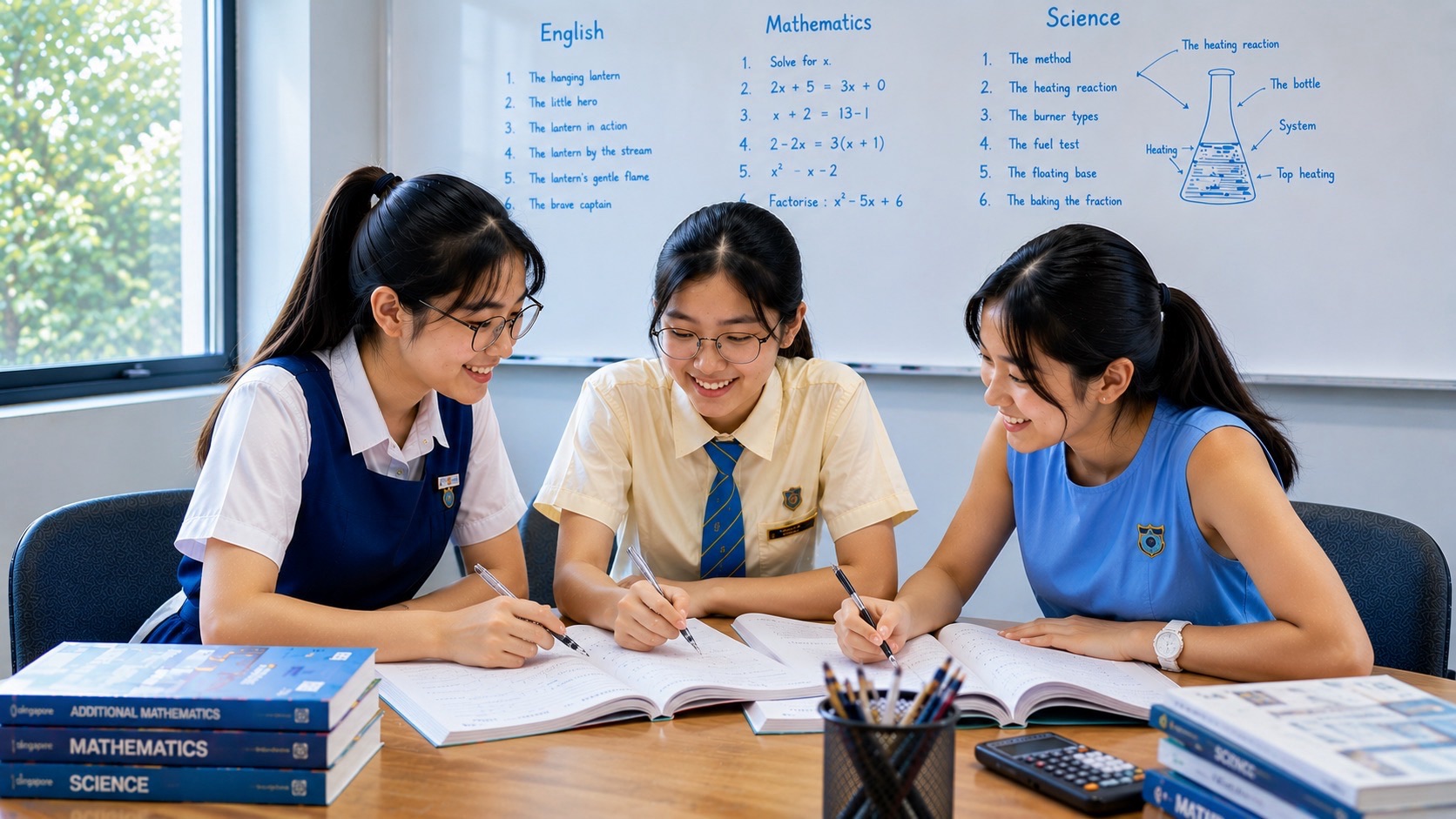
Additional Mathematics 101 (Everything You Need to Know)
Additional Mathematics, often called A-Math, is Singapore’s upper-secondary Mathematics subject for students who are ready for deeper algebra, functions, trigonometry, coordinate geometry and calculus. Under the 2027 Singapore-Cambridge Secondary Education Certificate, G2 Additional Mathematics is K232 and G3 Additional Mathematics is K341. They are separate subject levels with different assumed knowledge, paper lengths and assessment demand.
This page is the broad A-Math owner: what Additional Mathematics is, how G2 and G3 differ, what is studied, how the papers work, why algebra matters, how A-Math connects to core Mathematics and later study, what parents should know about subject choice, and how students should approach learning it. The purpose is orientation. The separate eduKateSG A-Math pages handle mistakes, fear, recovery, home study and study methods in greater depth.
For search terms such as What is Additional Mathematics, A-Math Singapore, G2 Additional Mathematics, G3 Additional Mathematics, K232, K341, A-Math syllabus, A-Math topics, A-Math exam format, A-Math vs E-Math, A-Math calculus, A-Math trigonometry, A-Math algebra, how to study A-Math and should my child take Additional Mathematics, this guide is designed to be the starting point.
50-second router
- What is A-Math? Start with Sections 1–20.
- G2 or G3? Use the route comparison sections.
- What topics are studied? Use the syllabus atlas.
- What are the papers like? Use the K232/K341 assessment sections.
- Should my child take A-Math? Use the readiness and decision sections.
- Why is A-Math hard? Use Why Students Find Additional Mathematics Scary?.
- How do we improve? Use How to Improve Additional Mathematics at Home.
- What study methods work? Use Top 10 Methods to Study Additional Mathematics.
- What mistakes should we avoid? Use Top 10 Mistakes Students Make in Additional Mathematics.
1. The plain-language definition of Additional Mathematics
Additional Mathematics is a more advanced secondary Mathematics subject that extends beyond the core Mathematics syllabus into deeper symbolic manipulation, functions, trigonometry and calculus.
It is not simply “more questions” from core Mathematics. It changes the level of abstraction and the way topics connect.
2. Why the subject is called “Additional”
Students usually take it alongside core Mathematics rather than instead of Mathematics. The subject adds a more advanced mathematical layer intended to prepare suitable students for later quantitative study.
3. A-Math is not a measure of intelligence
The subject has prerequisites and demands particular kinds of symbolic control. Students can be strong in many academic areas without finding A-Math easy.
Subject fit should be discussed through readiness, interests, workload and future needs.
4. A-Math is not only for future engineers
It is particularly useful for mathematically intensive routes, but its skills also support sciences, computing, economics, data work and other quantitative study.
Exact future prerequisites should still be checked for the actual course and admission year.
5. A-Math is not compulsory for every ambitious student
More demanding is not automatically better. The subject should earn its place in the student’s programme by serving a real learning or pathway purpose.
6. The current Full SBB context
Under Full Subject-Based Banding, students can take subjects at different General levels according to strengths and learning needs. Additional Mathematics is now available at G2 and G3 in the SEC framework.
7. G2 Additional Mathematics
For 2027 school candidates, G2 Additional Mathematics is K232.
It assumes G2 Mathematics and is organised into Algebra, Geometry and Trigonometry, and Calculus. It is designed to prepare students adequately for G3 Additional Mathematics while remaining a complete assessed subject.
8. G3 Additional Mathematics
For 2027 school candidates, G3 Additional Mathematics is K341.
It assumes G3 Mathematics and develops more demanding mathematical problem solving, reasoning and preparation for higher studies such as A-Level H2 Mathematics.
9. G2 and G3 are not simply “slow” and “fast” A-Math
They differ in assumed knowledge, depth, assessment weightings and paper duration. A level transition therefore requires capability, not merely increased speed.
10. O-Level 4049 context
2026 and earlier O-Level cohorts used the 4049 Additional Mathematics framework. Many mathematical topics overlap with the later SEC system, but students should use the correct syllabus and paper structure for their cohort.
11. IP Mathematics context
Integrated Programme schools can use their own curriculum structures and may cover advanced topics on a different timeline.
Do not assume every IP A-Math-like course follows K232, K341 or 4049 exactly.
12. The most important prerequisite: algebra
Additional Mathematics uses algebra everywhere. Signs, factorisation, equations, functions and exact forms form the infrastructure for trigonometry and calculus.
Weak algebra makes advanced topics feel much harder.
13. The second prerequisite: function and graph thinking
Functions connect equations, graphs and later calculus. Students should be comfortable moving between symbolic and visual representations.
14. The third prerequisite: core trigonometry
Additional Mathematics develops more advanced trig identities, equations and functions. Weak core trig creates extra load.
15. The fourth prerequisite: mathematical independence
A-Math contains longer, more abstract problems. Students need to tolerate uncertainty, show working, correct errors and ask precise questions.
16. What “ready for A-Math” means
Readiness is not one exam mark. It includes algebra stability, independent problem solving, willingness to correct, workload capacity and the school’s own subject-selection criteria.
17. Strong core Math helps but does not guarantee easy A-Math
A student can score well in core Mathematics through strong arithmetic and standard procedures but still need time to adapt to deeper symbolic manipulation.
18. Moderate core Math does not automatically rule A-Math out
Some students develop strongly after upper-secondary transition. School advice and current learning evidence matter.
19. A-Math should be understood as a network
Quadratics connect to graphs and calculus. Functions connect to coordinate geometry and differentiation. Trigonometry connects to identities, equations and modelling.
The syllabus is more connected than a chapter list suggests.
20. Why connected learning matters
Students who memorise each chapter separately can perform on topical worksheets and still struggle on mixed papers. Strong A-Math learning recognises the shared algebra and representations underneath different topics.
21. The three broad K232 strands
K232 is organised into Algebra, Geometry and Trigonometry, and Calculus.
These strands interact. Algebra appears inside trig and calculus; graphs support functions and calculus; geometry supports coordinate work.
22. The K341 content architecture
K341 also emphasises algebra, geometry/trigonometry and calculus at the more demanding G3 level, with stronger problem-solving and reasoning expectations.
23. Algebra in A-Math
Students encounter quadratic functions/equations, surds, polynomials, partial fractions and other advanced symbolic work depending on level.
The point is not only technique; students must recognise structure and choose methods.
24. Quadratic functions
Quadratics connect roots, graphs, completing the square, turning points and parameter conditions.
Students should move among representations rather than treating each method separately.
25. Quadratic equations
Methods include factorisation, formula and other forms according to syllabus. Method selection becomes part of the skill.
26. Quadratic inequalities
Students need both algebra and interval/sign interpretation.
Finding roots is not the final task; choosing the correct solution region matters.
27. The discriminant
The discriminant links algebraic root conditions to graph intersections. This is a strong example of A-Math’s connected nature.
28. Surds
Surds preserve exact values and require symbolic manipulation. Students learn to simplify and rationalise without converting everything to decimals.
29. Why exact forms matter
Exact forms preserve mathematical relationships that may be needed in later manipulation. Decimal approximation can lose useful structure.
30. Polynomials
Students work with division, factors, roots and remainders. These ideas should be understood as one polynomial structure rather than separate tricks.
31. Factor theorem
The factor theorem connects a linear factor to a polynomial root.
This relationship supports solving and parameter problems.
32. Remainder theorem
Substitution provides information about the remainder when a polynomial is divided by a linear factor.
The theorem is useful when its structural meaning is understood.
33. Partial fractions
Rational expressions are decomposed into simpler fractions according to denominator structure.
Classification of the denominator is a key first step.
34. Functions
Functions describe relationships between inputs and outputs. Additional Mathematics develops notation, composition, inverses and graph relationships.
35. Composite functions
Composition applies one function to the output of another. Order matters.
36. Inverse functions
An inverse reverses a mapping where appropriate. It should not be confused with a reciprocal.
37. Why functions matter later
Function thinking is central to graph behaviour and calculus. Students who understand mappings find later notation easier.
38. Geometry and coordinate thinking
Additional Mathematics often develops lines, gradients, coordinates and circles more deeply than core Mathematics.
Algebra and geometry interact.
39. Straight lines
Students work with gradient, equations, parallelism and perpendicularity. A sketch can support symbolic reasoning.
40. Circles in coordinate geometry
Circle equations connect centre, radius and algebraic form. Intersections and tangency can involve quadratics and discriminants.
41. Trigonometry in A-Math
Additional Mathematics deepens trigonometric functions, identities, equations, graphs and transformations.
42. Exact trigonometric values
Common exact values should become retrievable enough to support identities and equations.
43. Reciprocal and quotient relationships
Students work across sine, cosine, tangent and related functions. Organising the relationships reduces memory burden.
44. Pythagorean identities
These identities provide multiple equivalent forms and are heavily used in simplification and proof.
45. Compound-angle formulas
Angle addition and subtraction relationships expand the range of solvable trig expressions and equations.
46. Double-angle formulas
Equivalent forms allow strategic selection depending on the rest of the expression.
47. R-form
Expressions combining sine and cosine can be transformed into a single shifted trig form, useful for range, extrema and equation solving.
48. Trigonometric equations
Students need complete solution sets over specified intervals, not only principal calculator values.
49. Trigonometric proofs
Proof requires valid transformation and identity selection. It is a reasoning skill, not only memory.
50. Why trig can feel difficult
It combines memory, algebra, graph understanding, interval control and proof. Students often have a specific weak branch rather than being “bad at trig” globally.
51. Calculus in A-Math
Calculus introduces local rate of change and accumulation. It is one of the clearest differences between core Mathematics and Additional Mathematics.
52. Differentiation
Differentiation produces a derivative representing gradient or rate of change.
Students learn standard rules and applications.
53. Product rule
Products of functions require a structured derivative relationship rather than differentiating each factor and multiplying results.
54. Quotient rule
Quotients require a specific derivative structure and careful algebra.
55. Chain rule
Composite functions require recognition of outer and inner layers.
This is a method-selection as well as execution skill.
56. Tangents and normals
The derivative provides tangent gradient; normal lines use perpendicular relationships.
Coordinate geometry and calculus meet here.
57. Stationary points
Students solve derivative conditions and classify turning behaviour according to syllabus methods.
58. Optimisation
Optimisation uses calculus to maximise or minimise quantities, but the hardest part is often modelling the objective and constraints correctly.
59. Connected rates
Rates of change among related quantities require a model before differentiation.
60. Integration
Integration reverses differentiation and supports accumulation/area interpretation in appropriate contexts.
61. Indefinite integration
Students find antiderivatives and include the constant of integration where required.
62. Definite integration
Upper and lower limits produce a numerical result that may require contextual interpretation.
63. Area under or between curves
Graphs and integration work together. Students must distinguish signed integral from geometric area.
64. Why calculus is not just formulas
Routine rules are only one layer. Applications require modelling, algebra, graphs and interpretation.
65. The role of mathematical reasoning
Additional Mathematics aims beyond mechanical technique. Students need to make connections, justify steps and solve unfamiliar problems.
66. The role of communication
Essential working and mathematical arguments matter. Clear working helps both marks and self-checking.
67. The role of metacognition
Students need to monitor what they know, detect where they are uncertain and choose appropriate strategies.
68. The role of problem solving
Advanced Mathematics becomes valuable when the student can recognise and apply ideas in varied contexts rather than only repeat a known procedure.
69. Why A-Math is cumulative
Old algebra continues appearing in later trig and calculus. Forgetting one dependency can make a new topic look harder than it is.
70. Why retrieval matters
Students must be able to access old methods without rereading the whole chapter every time.
71. Why spacing matters
Revisiting after days and weeks prevents the cram-and-forget cycle.
72. Why mixed practice matters
Examinations do not tell the student which chapter method to use. Interleaving trains recognition.
73. Why correction matters
Mistakes can reveal knowledge gaps, weak prerequisites or performance habits. Correction should change the next attempt.
74. Why timed practice matters
Knowing Mathematics untimed is necessary but not sufficient for exam performance. Students also need pacing, stamina and checking under constraint.
75. Why independence matters
National examinations remove parents, tutors, AI and answer keys. Support should therefore move toward independent control.
76. The K232 paper structure
For 2027, K232 has two written papers of 1 hour 45 minutes each, 70 marks each and 50 per cent weighting each.
77. K232 Paper 1
Paper 1 contains approximately 13–15 questions of varying lengths.
Students need broad technique and efficient method switching.
78. K232 Paper 2
Paper 2 contains approximately 8–10 questions of varying lengths.
Longer-question organisation and sustained reasoning matter.
79. K232 assessment objectives
Approximate weighting: AO1 50 per cent, AO2 40 per cent and AO3 10 per cent.
This means problem solving and reasoning remain substantial even at G2.
80. What K232 AO1 means
Students must use standard techniques accurately and read mathematical information correctly.
81. What K232 AO2 means
Students solve problems in varied contexts, interpret information and select suitable methods.
82. What K232 AO3 means
Students reason and communicate mathematically.
83. The K341 paper structure
For 2027, K341 has two written papers of 2 hours 15 minutes each, 90 marks each and 50 per cent weighting each.
84. K341 Paper 1
Paper 1 contains approximately 12–14 questions of varying lengths.
85. K341 Paper 2
Paper 2 contains approximately 9–11 questions of varying lengths.
86. K341 assessment objectives
Approximate weighting: AO1 35 per cent, AO2 50 per cent and AO3 15 per cent.
The majority of demand therefore lies in problem solving and reasoning combined.
87. Why K341 feels different from K232
Students need stronger transfer, longer stamina and deeper reasoning in addition to secure technique.
88. Essential working
Both current syllabuses note the importance of essential working. Students should make the mathematical route visible.
89. Calculators
Approved calculators can be used in both papers for the current K232/K341 routes.
Students still need estimation and correct input.
90. Formulae
Relevant mathematical formulae are provided, but students still need to recognise when and how to use them.
91. Accuracy conventions
Current syllabus conventions generally require non-exact numerical answers to three significant figures and angles in degrees to one decimal place unless otherwise stated.
92. Why paper duration matters
K232 and K341 demand different stamina. Students should practise the correct route rather than using one generic A-Math paper schedule.
93. Why AO weighting matters
The weighting shows why routine drills alone are insufficient, especially at G3. Study must include transfer and reasoning.
94. G2 A-Math as a legitimate endpoint
Students should master K232 as a complete subject rather than treating it only as a waiting room for G3.
95. G2 A-Math as a bridge
Where appropriate, strong K232 mastery can support later progression to G3 Additional Mathematics according to school processes.
96. G3 A-Math and later Mathematics
K341 is designed to support higher studies in Mathematics and mathematically intensive subjects, including preparation for H2 Mathematics.
97. A-Math versus core Mathematics
Core Mathematics focuses on broad mathematical literacy and applications. A-Math adds deeper algebraic/functional/trigonometric/calculus content for students ready for it.
98. A-Math does not replace core Mathematics
Students still need core Mathematics because it provides foundational knowledge and has its own examination/pathway role.
99. Shared dependencies between core Math and A-Math
Algebra, graphs, trigonometry and equation solving can affect both subjects.
One upstream repair can sometimes improve both.
100. Separate diagnostics for the two subjects
A student can be strong in core Mathematics and weak in A-Math, or the reverse on particular topics. Do not combine the grades into one diagnosis.
101. Should every student take Additional Mathematics?
No. The right question is whether the subject fits the student’s readiness, interests, total workload and future route.
A-Math can be extremely valuable for the right student and unnecessarily expensive for the wrong combination of foundations and commitments.
102. The readiness question is subject-specific
A student may be strong in English, Science or Humanities and still need more time before A-Math. Conversely, a student with moderate overall results may have unusually strong mathematical readiness.
103. School criteria matter
Schools use their own subject-combination and level-selection processes. Parents should ask what evidence the school uses and what bridging is required.
104. Readiness indicator: algebra stability
Expansion, factorisation, equations and symbolic manipulation should be sufficiently secure that they do not dominate every advanced question.
105. Readiness indicator: graph confidence
Students should be able to interpret coordinates, gradients and function relationships without treating graphs as decorative.
106. Readiness indicator: problem-solving tolerance
A-Math students need to tolerate being uncertain for longer than a routine arithmetic question. They should be willing to test a route and learn from feedback.
107. Readiness indicator: correction habits
A student who ignores mistakes or copies corrections will struggle more as solutions become longer and more connected.
108. Readiness indicator: independence
The subject becomes increasingly difficult to sustain if every line requires external confirmation.
109. Readiness indicator: workload capacity
Additional Mathematics is one subject inside a larger programme. A mathematically capable student may still be overloaded by other commitments.
110. Readiness indicator: interest
Interest is not mandatory, but curiosity about patterns, symbols and difficult problems can make the extra workload more worthwhile.
111. Readiness indicator: future route
Some later courses benefit from or require stronger Mathematics preparation. Check actual programme prerequisites rather than relying on general claims.
112. What if the student is ready mathematically but not organisationally?
Study routines and correction systems can often be improved. Readiness includes learning behaviour, not only raw marks.
113. What if the student is organised but algebraically weak?
Organisation alone cannot compensate for missing prerequisites. Use a repair phase before deciding the subject is impossible.
114. What if the student wants A-Math for prestige?
Prestige is not a strong reason. The subject should serve capability, interest or pathway value.
115. What if parents want A-Math more than the child?
Clarify the future option being preserved and discuss workload honestly. Learning works better when the student understands the purpose.
116. What if the child wants A-Math more than parents do?
Use current evidence, school advice and a bounded trial of more demanding questions rather than dismissing the interest automatically.
117. Subject-choice discussion should be evidence-led
Use marked work, teacher feedback, algebra performance and workload. Avoid making the choice primarily from peer comparison.
118. A-Math and STEM pathways
Additional Mathematics can support later study in science, engineering, computing, quantitative economics and related fields.
The exact value depends on the route and later admission requirements.
119. A-Math and JC/MI planning
Students considering mathematically demanding pre-university subjects should understand the role of strong algebra and advanced secondary Mathematics.
Current admission/subject requirements should be checked closer to the application year.
120. A-Math and Polytechnic planning
Many Polytechnic courses use Mathematics in different ways. Additional Mathematics can be useful preparation for technical and quantitative diplomas, but it is not equally necessary for every course.
121. A-Math and ITE pathways
The subject can still strengthen quantitative capability even when the student later chooses a technical or applied route. Subject choice should be aligned to the student’s actual programme.
122. A-Math and university planning
University admission is normally based on later qualifications such as A-Levels, diplomas or IB. A-Math is one preparation layer rather than a direct university credential.
123. Why parents should avoid reverse-engineering university too early
At Secondary 3, the most useful task is strong current learning and sensible option preservation, not mapping every possible degree years in advance.
124. Decision horizon: Secondary 2
Focus on readiness for upper-secondary subject choices and algebra stability.
125. Decision horizon: Secondary 3
Focus on building the A-Math network and understanding whether the level remains a productive fit.
126. Decision horizon: Secondary 4
Focus on integrated performance, national examination structure and the next post-secondary route.
127. A-Math in Secondary 3
Secondary 3 is usually the year where the subject’s symbolic language becomes normal. Students need to build foundations rather than chase paper counts.
128. Secondary 3 priority: algebra
Strong expansion, factorisation, equations and exact manipulation reduce the cost of later topics.
129. Secondary 3 priority: functions
Students should understand notation and representation because later calculus assumes this language.
130. Secondary 3 priority: trigonometry
Exact values, identities and equations should be organised into a connected map.
131. Secondary 3 priority: error correction
Recurring mistakes should be closed before they enter the exam year.
132. Secondary 3 priority: independence
The student should increasingly complete work without immediate tutor or parent rescue.
133. Secondary 4 A-Math
Secondary 4 shifts from mostly building the network to performing across it under time.
134. Secondary 4 priority: cumulative retrieval
Old algebra and trigonometry must remain available while calculus and advanced applications continue.
135. Secondary 4 priority: mixed recognition
Students need to identify methods without chapter cues.
136. Secondary 4 priority: paper stamina
Full or near-full paper duration should be trained progressively.
137. Secondary 4 priority: mark protection
Signs, intervals, mode, exact forms and working should become reliable routines.
138. Secondary 4 priority: post-mortem
Every major paper should change the next revision block.
139. What strong A-Math learning looks like
The student can retrieve old methods, recognise unfamiliar structures, execute accurately, show enough working, check independently and recover from difficult questions.
140. What fragile A-Math learning looks like
Performance depends heavily on recent practice, topic headings, worked examples or external prompts.
141. What missing A-Math learning looks like
The concept or prerequisite is genuinely absent even after reasonable prompts.
This needs teaching before timing.
142. What A-Math fluency looks like
Routine algebra and standard techniques are accurate enough that attention can be spent on modelling and reasoning.
143. What A-Math transfer looks like
The student can use a known idea after wording, representation or context changes.
144. What A-Math reasoning looks like
The student can explain why a method applies and build a valid chain rather than follow a memorised surface sequence.
145. What A-Math independence looks like
The student can identify the boundary of confusion, attempt, check, seek precise help and later prove the repair alone.
146. The learning cycle
Learn → practise → retrieve → vary → correct → retest → mix → time → review.
This cycle can repeat for every new topic.
147. Why worked examples matter
Examples can reduce unnecessary search when a method is new. They should then be faded so the student owns the route.
148. Why retrieval matters
National examinations require access without notes. Retrieval practice builds that access.
149. Why spacing matters
Revisiting over time prevents the subject from needing complete relearning before exams.
150. Why interleaving matters
Mixed questions train the decision of which method to use.
151. Why variation matters
Changing surface features teaches the student to recognise structure.
152. Why error analysis matters
Wrong answers can originate from different layers. Good correction locates the first wrong step.
153. Why fluency matters
Routine skills should not consume excessive working memory in advanced problems.
154. Why timed simulation matters
Performance under constraint adds pacing, stamina, checking and emotional recovery to the Mathematics.
155. Why metacognition matters
Students eventually need to decide what they know, what they do not know and which study method fits the problem.
156. A-Math study mistake: only reading notes
Notes create familiarity but not necessarily retrieval.
Close the page and solve.
157. A-Math study mistake: only doing topical worksheets
Topical sheets hide method-selection difficulty.
Add mixed work after technique stabilises.
158. A-Math study mistake: only doing hard questions
Advanced work can expose transfer but should not replace reliable standard technique.
159. A-Math study mistake: only doing easy questions
Comfortable practice can create false confidence.
Add variation and challenge progressively.
160. A-Math study mistake: only doing past papers
Full papers are performance tools and diagnostics, not the best repair tool for every gap.
161. A-Math study mistake: doing no past papers
Students still need realistic integration and stamina before the actual exam.
162. A-Math study mistake: copying corrections
Copying hides whether the student can reconstruct the method.
163. A-Math study mistake: no delayed retest
Same-day confidence can disappear. Retest later.
164. A-Math study mistake: timing new learning
Pressure should not precede understanding.
165. A-Math study mistake: no timing at all
Untimed mastery must eventually become exam performance.
166. A-Math study mistake: too many resources
More books can fragment attention and reduce completed learning loops.
167. A-Math study mistake: too much tuition
External support can crowd out independent practice if roles overlap.
168. A-Math study mistake: too little feedback
Independent learners still need correct marking and external checks so misconceptions do not persist.
169. A-Math study mistake: ignoring sleep
Fatigue worsens working memory, error control and attention.
170. A-Math study mistake: defining success only by hours
Time spent is not the same as capability gained.
171. A-Math study mistake: defining success only by grade
Grades matter, but independence, transfer and error quality show the machinery underneath.
172. A-Math study mistake: defining success only by level movement
G2 mastery can be a valid outcome; G3 movement is useful when the higher demand fits and serves the student.
173. A-Math study mistake: treating difficulty as identity
“I am bad at A-Math” hides the specific skill boundary.
Use precise learning-state language.
174. How to study algebra
Diagnose the exact subskill, practise accurately, mix forms, reconnect to later topics and build fluency only after understanding.
175. How to study quadratics
Connect roots, graph, discriminant and completed square. Use multiple representations rather than isolated formulas.
176. How to study surds
Maintain exact forms, practise simplification/rationalisation and apply them inside broader algebra.
177. How to study polynomials
Connect factors, roots and remainders structurally. Use division checks and varied information.
178. How to study partial fractions
Classify denominators first, then solve coefficients and verify by recombining.
179. How to study functions
Translate notation into meaning, practise composition/inverse and connect functions to graphs.
180. How to study coordinate geometry
Use sketches and algebra together. Verify line/circle results against geometric meaning.
181. How to study trigonometry
Organise exact values, identities, graphs, equations and proof into a connected map.
182. How to study trig proofs
Read proofs, fill missing steps, use hints and gradually produce independent valid transformations.
183. How to study trig equations
Use an interval routine and practise complete solution sets.
184. How to study R-form
Connect the transformation to range, extrema and solving.
185. How to study differentiation
Separate rule recognition from execution, then add applications.
186. How to study tangents/normals
Connect derivative, gradient and line equation with a sketch.
187. How to study stationary points
Use a stable sequence and interpret classification graphically.
188. How to study optimisation
Practise modelling before differentiation.
189. How to study connected rates
Use diagrams, variables, units and relationships before calculus.
190. How to study integration
Rewrite where needed, integrate, and check by differentiation.
191. How to study definite integrals
Predict sign and magnitude, evaluate carefully and interpret.
192. How to study area problems
Sketch regions and determine whether partitioning/sign adjustments are needed.
193. How to study proofs generally
Focus on logical validity and transformations, not memorising complete scripts.
194. How to study modelling generally
Define variables, constraints and targets before algebra or calculus.
195. How to study under time
Time only sufficiently learned material, increase duration progressively and analyse performance afterward.
196. How to use a mistake ledger
Record only high-value recurring patterns and retest dates. Archive solved errors.
197. How to use a traffic-light map
Green = secure, amber = unstable, red = missing/dependent. Use evidence, not feelings.
198. How to use a weekly plan
Choose one priority repair, current school work and one maintenance goal.
199. How to use a monthly review
Update the error map, independence level, workload and next priority.
200. How to use full papers
Simulate realistically, analyse the first wrong steps and repair before the next paper.
201. How to use school papers
They are personalised evidence about the actual school environment. Keep them.
202. How to use harder external papers
Use them for transfer and challenge after foundations are ready. Do not confuse their raw scores with national calibration automatically.
203. How to use videos
Watch for explanation, then solve independently. Passive viewing is not enough.
204. How to use graphing tools
Predict graph features first, then compare and explain.
205. How to use AI
Attempt first, request bounded help, verify important mathematics and retest alone.
206. How to use tuition
Define the problem being solved, measure independence and fade support.
207. How to use parent help
Parents can protect routines and ask process questions without becoming the content teacher.
208. How to use peer study
Compare methods and explain ideas, then complete independent work.
209. A-Math weekly routine: Monday
Retrieve old algebra/trig and align with current school topic.
210. Tuesday
Deep learning on one new or weak concept.
211. Wednesday
Corrections and delayed variations.
212. Thursday
Mixed retrieval and method selection.
213. Friday
Short no-help checkpoint or recovery day.
214. Saturday
Longer mixed/timed section or deep application work.
215. Sunday
Review error map and plan next week.
216. A-Math 20-minute session
Five minutes retrieval, ten minutes repair, five minutes variation.
217. A-Math 45-minute session
Retrieval, focused learning, independent practice and correction.
218. A-Math 90-minute session
Deep work, short reset, mixed practice and post-mortem.
219. A-Math full-paper session
Realistic paper plus marking, classification and repair planning.
220. A-Math holiday session
Use holidays for one or two strategic repairs and light preview, not permanent overloading.
221. Exam-year January
Confirm syllabus route, build error systems and secure foundations.
222. February
Maintain algebra and introduce cumulative retrieval.
223. March
Add mixed questions and small timed clusters.
224. April
Use school assessment evidence to update priorities.
225. May
Increase transfer and varied representation.
226. June
Repair large dependencies and build longer sections.
227. July
Reconnect holiday repairs and increase paper readiness.
228. August
Use realistic exam-style sections and full-paper diagnostics.
229. September
Personalise from Prelim/school-exam evidence.
230. October
Reduce novelty, protect sleep and focus on reliability.
231. What parents should ask before choosing A-Math
Ask what the student’s algebra looks like now, what the school recommends, what later options the subject supports and what total workload the student is already carrying.
232. What parents should not ask first
Do not begin with “Who else is taking it?” Peer choices do not reveal your child’s foundations or future needs.
233. Parent question: “Is my child good enough?”
Replace this with “Which capabilities are already secure, and which prerequisites would need strengthening?”
Readiness is more useful than a fixed label.
234. Parent question: “Will A-Math guarantee STEM?”
No subject guarantees a future route. A-Math can strengthen preparation and may be relevant to specific later programmes, but later results and prerequisites still matter.
235. Parent question: “Will not taking A-Math close every STEM door?”
No broad statement is accurate for every route. Check actual course requirements rather than using fear-based generalisations.
236. Parent question: “Should we start tuition before the subject begins?”
Only if a clear purpose exists, such as algebra bridging. Pre-emptive tuition is not automatically necessary.
237. Parent question: “Should we preview calculus early?”
Usually only after algebra and function foundations are strong. Early calculus with weak infrastructure can create shallow learning.
238. Parent question: “How many hours should A-Math take?”
No universal number exists. Study time depends on current weakness, school workload and exam stage.
239. Parent question: “How do I know tuition is working?”
Look for fewer repeated errors, stronger school-paper performance and increasing independence.
240. Parent question: “How do I know tuition is too much?”
If independent study disappears, sleep shrinks or the student needs more support despite more hours, review the system.
241. Student question: “Why am I taking A-Math?”
The answer should be personal: interest, preparation for later quantitative study, challenge, or school subject combination—not simply “because everyone does”.
242. Student question: “What if I hate it?”
Identify whether the issue is the subject itself, one weak topic, workload or repeated failure. Different causes need different responses.
243. Student question: “What if I love it?”
Use depth, proof, modelling and challenging applications while protecting the rest of the academic programme.
244. Student question: “What if I am scared of calculus?”
Separate routine differentiation, applications and integration. The whole label may be larger than the actual weak part.
245. Student question: “What if I am scared of trig?”
Separate exact values, identities, equations, graphs and proofs.
246. Student question: “What if algebra keeps ruining everything?”
That is a high-leverage diagnostic. Repair algebra directly rather than blaming every advanced topic.
247. Student question: “What if I keep forgetting?”
Use retrieval and spacing. Forgetting does not automatically mean poor understanding.
248. Student question: “What if I only understand with a tutor?”
Support needs fading and no-help retests.
249. Student question: “What if I run out of time?”
Diagnose whether the cause is slow routine technique, reading, method choice, overchecking or being trapped.
250. Student question: “What if I make careless mistakes?”
Replace “careless” with the exact mechanism: sign, bracket, mode, interval, copied value, rounding.
251. A-Math and subject-level movement
Under Full SBB, subject levels can be adjusted at appropriate junctures according to progress and school processes.
Movement should use repeated evidence rather than prestige.
252. Moving from G2 A-Math to G3 A-Math
Look for broad K232 mastery, strong algebra, independent mixed problem solving, reasoning and enough stamina/workload capacity.
253. Moving from G3 A-Math to G2 A-Math
A better-fit level can restore access and independence. Use the change to repair the causes of earlier struggle.
254. Staying in G2 A-Math
This can be a valid long-term subject choice. The goal remains strong mathematical capability at the level being taken.
255. Staying in G3 A-Math
The student should progressively meet the heavier problem-solving and reasoning demand without unsustainable external rescue.
256. A-Math and Posting Groups
Posting Groups guide admission/starting subject levels but do not define the student’s entire secondary identity forever.
Use actual subject levels and school advice.
257. A-Math and mixed subject profiles
A student can have different subject levels across their SEC profile. One A-Math level should not be used to label the whole learner.
258. A-Math and SEC certification
From 2027, Full SBB cohorts receive the Singapore-Cambridge Secondary Education Certificate reflecting the subjects and levels offered.
259. Why the SEC structure matters
Parents should think in terms of a complete subject profile rather than old stream identities.
260. A-Math and Polytechnic pathways
Additional Mathematics can be useful preparation for technical and quantitative diplomas. Specific course requirements vary and should be checked at application time.
261. A-Math and JC pathways
Students considering JC and mathematically demanding subjects should understand the value of strong secondary algebra and functions. Admission requirements should be checked using current MOE guidance.
262. A-Math and H2 Mathematics
G3 K341 is designed to prepare students for higher Mathematics study, including H2 Mathematics. Strong algebra and reasoning are particularly important.
263. A-Math and Economics
Algebra, graphs and rates can support later quantitative economics, though exact subject requirements vary by institution and course.
264. A-Math and Computing
Functions, abstraction and algebraic thinking can support computing study. Again, course-specific prerequisites should guide planning.
265. A-Math and Engineering
Advanced algebra, trigonometry and calculus provide useful preparation for engineering mathematics.
266. A-Math and Sciences
Mathematical manipulation, graphs and rates support Physics and quantitative Science work.
267. A-Math and Finance
The subject builds symbolic and quantitative reasoning useful in later finance, economics and data contexts, though professional finance Mathematics develops far beyond school A-Math.
268. A-Math and non-STEM students
Students can still benefit from mathematical reasoning even if they later choose humanities or creative fields. The question is whether the subject’s workload and option value justify its place.
269. A-Math and IP students
IP schools may integrate equivalent or more advanced content without using the SEC labels in the same way. Use the school’s curriculum architecture.
270. A-Math and international pathways
Students in IGCSE, IB or other systems should use the actual syllabus for those programmes rather than treating Singapore SEC A-Math as identical.
271. What makes A-Math abstract
Symbols increasingly represent general relationships rather than concrete quantities. Students must reason with structures that are not always tied to immediately visible contexts.
272. Why abstraction is useful
Abstraction allows one mathematical relationship to apply across many situations. It is what makes algebra and calculus powerful.
273. What makes A-Math cumulative
Later topics assume earlier symbolic fluency. Forgetting factorisation can affect calculus months later.
274. What makes A-Math error-sensitive
Long solutions mean early mistakes can propagate. Clear working and checking become increasingly important.
275. What makes A-Math rewarding
Students begin to see connections among algebra, graphs, trigonometry and calculus that are less visible in earlier Mathematics.
276. What makes A-Math useful beyond exams
It develops abstraction, modelling, symbolic reasoning, persistence and quantitative communication.
277. A-Math learning profile: procedural student
This student can follow methods but may struggle when wording changes.
They need variation, explanation and method selection.
278. A-Math learning profile: conceptual but slow student
This student understands deeply but needs deliberate fluency and paper pacing.
279. A-Math learning profile: fast but erratic student
This student needs mark-protection routines and better checking.
280. A-Math learning profile: dependent student
This student performs well with hints but poorly alone. Support must fade.
281. A-Math learning profile: forgetful student
This student needs retrieval and spacing rather than more explanation.
282. A-Math learning profile: anxious student
This student may know content but need progressive exposure, paper routines and accurate interpretation of mistakes.
283. A-Math learning profile: high performer
This student often needs transfer, variance reduction and sustainable challenge more than additional routine volume.
284. A-Math learning profile: struggling beginner
This student needs access, prerequisite repair and small successful independent steps before heavy exam simulation.
285. A-Math learning profile: late improver
Some students become much stronger after Secondary 3 foundations stabilise. Early difficulty does not always predict final performance.
286. A-Math learning profile: strong G2 candidate
Strong K232 mastery should be deepened and, where appropriate, used as evidence for later G3 progression discussions.
287. A-Math learning profile: adapting G3 student
Expect stronger AO2/AO3 demands and longer papers. Adaptation is a process, not instant score preservation.
288. How to diagnose A-Math weakness
Use the first wrong step and error categories: knowledge, prerequisite, recognition, representation, execution, communication, memory, timing and checking.
289. Knowledge gap
The concept or method is genuinely unknown.
Use teaching and worked examples.
290. Prerequisite gap
An earlier algebra or core-Math skill blocks the current topic.
Repair upstream.
291. Recognition gap
The method is known but not identified in a mixed question.
Use interleaving and comparison.
292. Representation gap
The student cannot turn context into usable Mathematics.
Practise variables, diagrams, graphs and equations separately.
293. Execution gap
The method is correct but signs, brackets or calculator use fail.
Use targeted fluency and checking.
294. Communication gap
Essential working or reasoning is missing.
Use clear traceable solutions.
295. Memory gap
Old material is inaccessible.
Use retrieval and spacing.
296. Timing gap
Knowledge is stronger than the paper completion suggests.
Train pace, triage and stamina.
297. Checking gap
The student cannot verify results independently.
Teach method-specific checks.
298. A-Math correction loop
Find first wrong step → explain principle → redo → solve variation → retest after delay.
299. A-Math retrieval loop
Recall old method → attempt → check → correct → schedule next return.
300. A-Math paper loop
Simulate → mark → classify → repair → retest → next simulation.
301. A-Math independence loop
Attempt → self-check → precise help if needed → independent reconstruction → later no-help retest.
302. What strong tuition should produce
More precise diagnosis, stronger understanding, fewer prompts and better independent school-paper performance.
303. What weak tuition can produce
More worksheets and smooth lessons without transfer to independent work.
304. One-to-one tuition
Useful for severe gaps and individual pacing; main risk is over-support.
305. Small-group tuition
Can combine feedback with peer questions; quality depends on actual differentiation, not group size alone.
306. Larger classes
Can work for organised students with strong explanations and resources; individual recurring errors may need extra attention.
307. Online tuition
Can reduce travel and support screen-based explanation; the student still needs visible written working and focus.
308. Self-study
Can be sufficient for disciplined students with good school instruction and reliable feedback.
309. Parent support
Parents can manage environment, evidence and routines without teaching every A-Math method.
310. AI support
AI can explain, hint, generate variations and quiz, but should not erase first attempts or independent retests.
311. Technology support
Graphing tools can visualise functions and calculus relationships, but written exam performance still matters.
312. The role of sleep
Working memory and error control deteriorate when students are chronically tired.
313. The role of recovery
Study schedules should include lighter days and breaks so the system remains sustainable.
314. The role of confidence
Confidence is strongest when built from evidence of independent capability.
315. The role of productive struggle
Students need enough difficulty to grow and enough access to make progress. Challenge should be neither trivial nor impossible.
316. A-Math and fear
Fear often comes from unpredictability—students do not know how to start, check or recover. Routines make difficulty more navigable.
317. A-Math and perfectionism
Perfectionism can create overchecking and time loss. Students need permission to make provisional attempts.
318. A-Math and comparison
Peer speed, tuition exposure and school context differ. Compare personal evidence rather than copying another student’s timetable.
319. A-Math and motivation
Motivation can be supported by clear purpose and visible progress. It should not replace diagnosis of real mathematical gaps.
320. A-Math and identity
“I take A-Math” is a subject fact. “I am an A-Math person/not an A-Math person” can become an unhelpful fixed identity.
321. How parents can talk after a bad test
Ask for one question understood, one nearly understood and one impossible-looking. Then locate patterns.
322. How parents can talk after a good test
Celebrate, then ask what behaviour produced the result and whether the learning is durable.
323. How students can ask teachers for help
Bring the actual attempt and name the boundary: “I know the identity but not why this transformation is useful.”
324. How students can ask tutors for help
Ask for the smallest useful hint after a meaningful attempt.
325. How students can use marking schemes
Use them to understand expected working and method, then close them and redo independently.
326. How students can use specimen papers
Use them to understand paper structure and current style rather than simply collecting another score.
327. Why current official sources matter
Subject codes, paper durations and assessment frameworks can change. Use SEAB/MOE current documents as the controlling reference.
328. Why old resources can still matter
Mathematical questions from older syllabuses can remain useful if the content overlaps, but do not let old paper structure override current requirements.
329. Why school papers matter
They reflect local sequencing and expectations and provide personalised error evidence.
330. Why prelim papers matter
They can provide demanding integration practice, but difficulty varies. Interpret them as training data rather than perfect prediction.
331. Why national-style calibration matters
Students need some practice aligned to the actual current assessment so timing and expectations are not distorted.
332. Why the syllabus itself is useful
Students and parents can see what is actually examinable, assumed and emphasised rather than relying on hearsay.
333. What a good A-Math year should produce
Stronger algebra, broader topic access, better independent problem solving, fewer repeated errors and more reliable paper performance.
334. What a good A-Math tuition year should produce
The student should need less rescue, not more.
335. What a good A-Math home-study year should produce
The student should increasingly plan, correct and retest independently.
336. What a good A-Math exam year should produce
Knowledge should become integrated performance under the correct paper conditions.
337. What a good A-Math transition should produce
A move between levels should create productive challenge without chronic dependence.
338. What a good A-Math outcome is not
It is not simply surviving through enormous external support while the student remains unable to work independently.
339. What a good A-Math outcome is
A student who can understand, represent, choose, execute, check and learn from error at the appropriate subject level.
340. The subject in one sentence
Additional Mathematics is the advanced secondary Mathematics layer that develops deeper algebra, functions, trigonometry and calculus for students ready to study them.
341. Dependency atlas: quadratic functions
Quadratics depend on expansion, factorisation, equation solving and graph interpretation.
If any of those are weak, the student may describe the whole quadratic topic as difficult even when the new idea itself is understood.
342. Dependency atlas: surds
Surds depend on exact-number reasoning, factor recognition and algebraic manipulation.
Students who decimalise too early often lose structure needed later.
343. Dependency atlas: polynomials
Polynomial division and theorems depend on algebraic organisation and factor/root relationships.
344. Dependency atlas: partial fractions
Partial fractions depend on factorisation, denominator classification and coefficient solving.
345. Dependency atlas: functions
Functions depend on algebraic notation, mappings and graph relationships.
346. Dependency atlas: composite functions
Composition depends on careful substitution and order.
347. Dependency atlas: inverse functions
Inverse thinking depends on one-to-one mapping, algebraic rearrangement and domain awareness.
348. Dependency atlas: straight-line coordinate geometry
Gradients, equations and perpendicularity depend on signed numbers and algebra.
349. Dependency atlas: circles
Circle equations depend on completing the square, coordinate interpretation and algebra.
350. Dependency atlas: trigonometric exact values
These depend on core trig meaning and exact-form comfort.
351. Dependency atlas: trig identities
Identities depend on memory, algebraic fractions, factorisation and method selection.
352. Dependency atlas: trig equations
Equations depend on identities, exact values, algebra, intervals and quadrant reasoning.
353. Dependency atlas: trig proofs
Proofs depend on identity recognition, valid transformation and algebraic control.
354. Dependency atlas: R-form
R-form depends on trig relationships, exact algebra and understanding of range/extrema.
355. Dependency atlas: differentiation
Differentiation depends on functions, indices and algebra.
356. Dependency atlas: product rule
Product rule depends on recognising multiplication of functions and maintaining two-term structure.
357. Dependency atlas: quotient rule
Quotient rule depends on recognising a quotient, sign control and algebraic simplification.
358. Dependency atlas: chain rule
Chain rule depends on identifying nested functions and executing inner/outer derivatives.
359. Dependency atlas: tangents
Tangent questions depend on differentiation, coordinate points and line equations.
360. Dependency atlas: normals
Normals add perpendicular-gradient reasoning to the tangent dependency chain.
361. Dependency atlas: stationary points
Stationary points depend on differentiation, equation solving, substitution and classification.
362. Dependency atlas: optimisation
Optimisation depends heavily on modelling, algebra, constraints and differentiation.
363. Dependency atlas: connected rates
Connected rates depend on diagrams, variable relationships, units and differentiation.
364. Dependency atlas: indefinite integration
Integration depends on algebraic rewriting and derivative knowledge.
365. Dependency atlas: definite integration
Definite integrals add limit substitution, arithmetic control and sign interpretation.
366. Dependency atlas: area problems
Area depends on graph interpretation, intersection points, integration and geometric meaning.
367. Why dependency maps reduce study time
When one upstream gap causes several topic failures, repairing that gap is more efficient than treating every downstream topic separately.
368. Why dependency maps help tutors
They prevent over-teaching the visible chapter when the true failure sits earlier.
369. Why dependency maps help parents
Parents can understand that several low topic scores may have one cause rather than ten separate weaknesses.
370. Why dependency maps help students
The subject feels smaller when a broad struggle is reduced to a few high-leverage foundations.
371. FAQ: Is A-Math harder than E-Math/core Math?
It is more abstract and advanced in several areas, especially algebra, trigonometry and calculus. “Harder” also depends on the student’s strengths.
372. FAQ: Is A-Math optional?
Subject offerings and selection depend on the school and student profile. It is not a universal compulsory subject for every secondary student.
373. FAQ: What is G2 Additional Mathematics?
K232 is the G2 SEC Additional Mathematics route for 2027 school candidates, assuming G2 Mathematics.
374. FAQ: What is G3 Additional Mathematics?
K341 is the G3 SEC Additional Mathematics route, assuming G3 Mathematics and carrying greater problem-solving/reasoning demand.
375. FAQ: Is G2 A-Math “easier A-Math”?
It is less demanding than G3 in the Full SBB framework, but it is still substantial advanced Mathematics with algebra, trigonometry and calculus.
376. FAQ: Can G2 A-Math lead to G3 A-Math?
K232 is designed to prepare students adequately for G3 Additional Mathematics. Formal progression depends on school processes and readiness.
377. FAQ: Is G3 A-Math the old 4049?
K341 references 4049 as the prior code, but current SEC students should use the current K341 syllabus and paper structure.
378. FAQ: How many papers does K232 have?
Two written papers of 1 hour 45 minutes each, 70 marks each and equal weighting.
379. FAQ: How many papers does K341 have?
Two written papers of 2 hours 15 minutes each, 90 marks each and equal weighting.
380. FAQ: What are K232 AO weightings?
Approximately AO1 50 per cent, AO2 40 per cent and AO3 10 per cent.
381. FAQ: What are K341 AO weightings?
Approximately AO1 35 per cent, AO2 50 per cent and AO3 15 per cent.
382. FAQ: Why do AO weightings matter?
They show that A-Math study cannot be only standard drills. Students need problem solving and reasoning too.
383. FAQ: Are calculators allowed?
Approved calculators are used in the current K232 and K341 papers. Students still need correct algebra and checking.
384. FAQ: Are formulae provided?
Relevant formulae are provided, but students still need to know meaning, conditions and method selection.
385. FAQ: Does working matter?
Yes. Essential working helps marks and makes solutions checkable.
386. FAQ: What accuracy is expected?
Use the current syllabus conventions; generally non-exact numbers are given to three significant figures and degree angles to one decimal place unless otherwise stated.
387. FAQ: Does A-Math include calculus at G2?
Yes. K232 includes differentiation, integration and applications within its defined scope.
388. FAQ: Does A-Math include calculus at G3?
Yes, with the broader/deeper G3 demand and stronger problem-solving expectations.
389. FAQ: Does A-Math include logs?
Topic content depends on the level/current syllabus. Always use the official syllabus content list for the exact cohort.
390. FAQ: Does A-Math include coordinate geometry?
Yes, within the defined syllabus scope. It connects algebra and geometry.
391. FAQ: Does A-Math include proofs?
Mathematical reasoning and proof-style work appear particularly in trigonometric identities and other reasoning contexts.
392. FAQ: Why is algebra so important?
Because almost every advanced topic uses algebraic manipulation. Weak algebra multiplies difficulty.
393. FAQ: Can I be good at calculus but weak at algebra?
You may understand calculus ideas while still losing marks through algebra. The algebra should be repaired because it will keep appearing.
394. FAQ: Can I be good at core Math but weak at A-Math?
Yes. The subjects share foundations but have different abstraction and content demands.
395. FAQ: Can I be good at A-Math but weaker at core Math?
It can happen on particular domains. Keep separate diagnostics because the assessments and content are different.
396. FAQ: Should I memorise identities?
Reliable recall helps, but students also need understanding and selection practice.
397. FAQ: Should I memorise derivative rules?
Know them, but also practise recognising which rule applies.
398. FAQ: Should I memorise model proofs?
Study structure, then reconstruct and vary. Memorising surface sequences is fragile.
399. FAQ: How much A-Math should I practise?
No universal amount. The workload should match current needs and remain sustainable.
400. FAQ: Should I practise daily?
Frequent short contact can be useful, especially during repair, but a sustainable weekly rhythm matters more than arbitrary daily hours.
401. FAQ: How should I revise before tests?
Use retrieval, mixed questions, personal errors and some timed work rather than only rereading notes.
402. FAQ: When should I start past papers?
When enough of the syllabus is accessible for papers to train integration and performance rather than mostly expose missing content.
403. FAQ: How should I use past papers?
Simulate, mark, classify, repair, retest and then attempt another paper later.
404. FAQ: How many past papers?
No magic number. Quality of analysis and change between papers matters more than count.
405. FAQ: Should I use Prelim papers?
They can provide challenging transfer practice, but difficulty varies. Keep national calibration in view.
406. FAQ: Should I use old O-Level papers if I am SEC?
They may offer useful overlapping questions, but current K232/K341 syllabus and paper structure should control preparation.
407. FAQ: Can I self-study A-Math?
Yes, if you can obtain reliable feedback and diagnose misconceptions. School instruction plus disciplined self-study can be enough for some students.
408. FAQ: Do I need tuition?
No. Tuition is useful when it solves a defined gap more efficiently or when current support is insufficient.
409. FAQ: What makes a good A-Math tutor?
Precise diagnosis, clear explanation, independent retesting, school alignment and a path toward less dependence.
410. FAQ: What class size is best?
No universal best. Choose enough feedback and appropriate independence for the student’s problem.
411. FAQ: Can online tuition work?
Yes, for students who can focus and show written work clearly. Fit depends on the learner.
412. FAQ: Can AI tutor A-Math?
AI can explain and generate practice, but it can make errors and should not replace independent thinking or trusted curriculum sources.
413. FAQ: Can parents help if they do not know A-Math?
Yes. Parents can protect time, sleep, evidence, corrections and help-seeking routines.
414. FAQ: What if I am afraid of A-Math?
Identify the exact trigger and use the separate diagnosis/recovery guides. Fear often becomes manageable when the problem has a boundary.
415. FAQ: What if I keep failing?
Use repeated paper evidence to identify whether the issue is prerequisite, topic knowledge, transfer, execution or performance.
416. FAQ: What if I am already scoring high?
Focus on reliability, difficult transfer, paper control and sustainable workload rather than endless extra volume.
417. FAQ: What if I want to drop A-Math?
Discuss the reasons, current evidence, workload and pathway implications with the school/family before deciding.
418. FAQ: What if I want to move up a level?
Use current mastery, independent problem solving, workload capacity and school criteria.
419. FAQ: What if I want to stay at G2?
Strong G2 mastery is a valid outcome. Check that the route still supports the student’s future needs.
420. FAQ: What if A-Math affects my other subjects?
Review total workload. The strongest overall profile may not be the one with the greatest number of demanding subjects.
421. FAQ: Is A-Math worth it?
It is worth it when it develops useful capability and/or preserves desired options at a sustainable cost for the student.
422. FAQ: Is A-Math useful for non-STEM routes?
It can build reasoning and quantitative skill, but the opportunity cost should still be considered.
423. FAQ: Does A-Math make H2 Math easy?
No. It provides important foundations, but H2 Mathematics is a substantial next level requiring further learning.
424. FAQ: Does A-Math guarantee admission to STEM courses?
No. Admissions depend on later qualifications, results and course-specific requirements.
425. FAQ: Why do some students fail A-Math after being strong in Sec 2 Math?
The abstraction and dependency demands increase. Earlier algebra weaknesses or cue-dependent learning can become visible.
426. FAQ: Why do some students suddenly improve?
Once algebra, notation and correction systems stabilise, several topics can improve together.
427. FAQ: Can A-Math become easier over time?
Yes. As the symbolic language and dependencies become automatic, later topics can feel more coherent.
428. FAQ: Why does A-Math sometimes feel easier than core Math for some students?
Some students prefer symbolic, structured relationships to broad real-world or statistical contexts. Strength profiles differ.
429. FAQ: What is the biggest mistake parents make?
Treating every low score as a reason to add more work without diagnosing the cause.
430. FAQ: What is the biggest mistake students make?
Practising without closing error loops—doing more questions while the same mechanism survives.
431. FAQ: What is the biggest mistake tutors make?
Providing so much support that lesson performance rises while independence does not.
432. FAQ: What is the biggest mistake in exam revision?
Replacing all learning with full papers too early or doing papers without post-mortems.
433. A-Math parent checklist: subject choice
- Algebra stable?
- Student interested or at least willing?
- Workload manageable?
- School recommends/permits?
- Future option value clear?
434. Parent checklist: after first term
- Can the student explain current topics?
- Are repeated errors visible?
- Is support increasing or decreasing?
- Is sleep stable?
- Is the subject still productive?
435. Parent checklist: before adding tuition
- Exact problem?
- Existing support insufficient?
- Measurable outcome?
- Independent retest?
- What time will be removed elsewhere?
436. Parent checklist: before level movement
- Several assessments?
- Broad topic mastery?
- Independent mixed work?
- Stamina?
- School criteria?
437. Student checklist: before study
- What is today’s job?
- Learning, retrieval, correction, mixing or timing?
- What counts as finished?
438. Student checklist: during a problem
- What is the target?
- What is known?
- What representation helps?
- What method family fits?
- What can I check?
439. Student checklist: after a mistake
- First wrong step?
- Error category?
- Correct principle?
- Variation?
- Retest date?
440. Student checklist: before a paper
- Correct paper duration?
- Time checkpoints?
- Exit rule?
- Personal error list?
- Calculator mode/equipment?
441. Tutor checklist: diagnostic
- Use school papers.
- Find first weak link.
- Separate knowledge from performance.
- Define measurable outcome.
442. Tutor checklist: independence
- Hints shrinking?
- No-help questions?
- Delayed retests?
- School transfer?
443. Tutor checklist: exam preparation
- Content broad enough?
- Mixed recognition?
- Fluency?
- Stamina?
- Post-mortem routine?
444. A-Math error taxonomy
Knowledge, prerequisite, recognition, representation, execution, communication, memory, timing and checking.
This taxonomy prevents every error from being called “careless”.
445. A-Math readiness taxonomy
Content readiness, algebra readiness, learning-behaviour readiness, workload readiness and pathway readiness.
446. A-Math study taxonomy
Learning, retrieval, spacing, interleaving, error correction, representation, fluency, timed simulation and metacognitive review.
447. A-Math support taxonomy
School teaching, self-study, peer support, tuition, digital tools and parent environment. Different supports solve different jobs.
448. A-Math performance taxonomy
Knowledge access, method selection, execution, working, pacing, checking, stamina and recovery.
449. Why taxonomies help
They stop broad labels from hiding the actual problem.
450. What parents should remember most
Additional Mathematics is not one giant difficulty. It is a connected set of capabilities that can be observed and improved separately.
451. Scenario: student is strong in algebra but weak in trigonometry
Keep algebra in light maintenance and map trig into exact values, identities, equations, graphs and proof.
The student is not globally weak in A-Math.
452. Scenario: student is strong in trigonometry but weak in calculus
Separate derivative-rule recognition, algebra, modelling and integration. One branch may be the real issue.
453. Scenario: student is strong in calculus but weak in functions
Function notation and representation should be repaired because later advanced Mathematics will continue to use them.
454. Scenario: student understands concepts but makes many algebra errors
Use deliberate algebra fluency and checking. Do not keep reteaching the advanced concept.
455. Scenario: student is fast but inaccurate
Reduce speed target and install mark-protection routines.
456. Scenario: student is slow but accurate
Find the slow routine rather than attacking accuracy. Build fluency locally.
457. Scenario: student does well at home but poorly in exams
Compare support conditions, timing and mixed recognition. Performance may be the missing layer.
458. Scenario: student does poorly at home but better in school
Home material may be much harder or the student may focus better in formal settings. Compare difficulty before interpreting scores.
459. Scenario: student’s marks fluctuate wildly
Topic composition or paper style may strongly affect performance. Build a more even network.
460. Scenario: student plateaus
Re-diagnose. The bottleneck at 50 marks may not be the bottleneck at 75.
461. Scenario: student improves quickly
Test durability and independence before accelerating further.
462. Scenario: student improves slowly
Track internal evidence such as fewer blanks and better independent starts. Score change can lag.
463. Scenario: student wants to drop A-Math after a poor paper
Use several assessments and school guidance. One paper should trigger diagnosis, not automatic route change.
464. Scenario: student wants to keep A-Math despite low marks
Interest is useful, but the plan should include clear repair goals and workload review.
465. Scenario: student wants to move from G2 to G3
Use K232 mastery, independent problem solving, reasoning, stamina and school criteria.
466. Scenario: student struggles immediately after moving to G3
Expect adaptation. Compare whether the student is becoming more capable with support or increasingly inaccessible.
467. Scenario: student is bored at G2
Test mixed/unfamiliar work first. If strong, discuss deeper extension or movement with school.
468. Scenario: student is overwhelmed at G3
Check whether the issue is one dependency, overall workload or broad level mismatch.
469. Scenario: student is in an IP school
Use the school’s own Mathematics curriculum. The learning principles remain useful, but SEC code assumptions may not apply.
470. Scenario: student changes school
Compare topic sequence and notation before diagnosing ability.
471. Scenario: student misses several weeks
Bridge into the current class first, then backfill secondary gaps.
472. Scenario: student has heavy CCA
Use shorter weekday retrieval/correction and deeper work on lighter days.
473. Scenario: student has multiple tuition programmes
Audit overlap and protect independent time. More explanation is not always more learning.
474. Scenario: student uses AI constantly
Preserve first attempts and no-help retests. AI should support, not replace, independent reasoning.
475. Scenario: student has no tuition
Use school feedback, reliable self-study and disciplined correction. Tuition is not required for every learner.
476. Scenario: student hates proofs
Use proof reading, missing-step work and gradual fading rather than blank-page proofs only.
477. Scenario: student hates graphs
Connect equations with visual features using prediction and graphing tools.
478. Scenario: student hates exact forms
Explain why surds/exact trig values preserve structure and use them in small predictable contexts first.
479. Scenario: student hates calculus applications
Practise modelling before differentiation. Separate the hardest reasoning stage.
480. Scenario: student hates past papers
Begin with sections and build duration gradually. Full papers are a later-stage tool.
481. Scenario: student loves past papers
Require deep post-mortems and targeted repair so paper volume does not become repetitive measurement.
482. Scenario: student loves hard questions
Maintain routine fluency and mark protection alongside advanced challenge.
483. Scenario: student avoids hard questions
Use gradual variation and bounded stretch. Avoidance should not become permanent.
484. Scenario: student wants to start H2 Math early
Strengthen current algebra, functions, trig and calculus first. Preview is useful only after the existing network is secure.
485. Scenario: parent is worried about future university options
Use actual programme requirements and later qualification routes. Do not treat one Secondary 3 test as a university decision.
486. Scenario: parent wants A-Math for status
Return to capability, workload and pathway purpose.
487. Scenario: parent wants child to drop A-Math quickly
Use repeated evidence and school advice. Distinguish one weak topic from broad mismatch.
488. Scenario: parent does not understand A-Math
That is fine. Support the process, environment and evidence.
489. Scenario: parent is an A-Math expert
Avoid taking over the problem-solving process. The student still needs independent ownership.
490. Scenario: tutor teaches a different method from school
Compare validity and conventions. Stabilise one method first if the student is fragile.
491. Scenario: student asks for confirmation every line
Teach internal checking and reduce immediate adult verification.
492. Scenario: student never checks
Attach specific checks to method families and practise them under ordinary work.
493. Scenario: student overchecks
Use a checking budget and targeted checks rather than full re-solving.
494. Scenario: student leaves many blanks
Use a start routine and diagnose whether the cause is knowledge, recognition or time.
495. Scenario: student attempts everything but loses marks
Execution, working and checking are likely higher-value targets than starting skill.
496. Scenario: student uses very messy working
Use consistent layout, intermediate labels and one transformation per line during repair.
497. Scenario: student writes too much
Once accurate, compress redundant lines so working remains traceable but efficient.
498. Scenario: student forgets formulas
Retrieve meaning and conditions, not only symbols.
499. Scenario: student knows formulas but chooses wrong ones
Use comparison and method-selection practice.
500. Scenario: student gets stuck on first step
Practise target, givens, representation and one relevant relationship.
501. Scenario: student gets stuck halfway
Ask what the last trusted step is and which transformation or representation could simplify the next.
502. Scenario: student gets stuck at the end
The issue may be interpretation, accuracy or answer-form conventions rather than core method.
503. Scenario: student cannot recover after a hard question
Train exit/re-entry and emotional reset inside simulations.
504. Scenario: student is strong early in papers and weak late
Build stamina and monitor late-session error types.
505. Scenario: student is weak early and improves later
Opening anxiety or rushing may be the issue. Use a controlled start routine.
506. Scenario: student misses calculator mode
Make DEG/RAD check explicit until automatic.
507. Scenario: student rounds too early
Retain sufficient precision through intermediate work.
508. Scenario: student forgets +C
Add an indefinite-integral check to the personal list until the error disappears.
509. Scenario: student misses trig interval solutions
Write interval first and use a complete solution-set routine.
510. Scenario: student assumes graph shape
Use algebraic evidence—roots, turning points, asymptotes—before sketching.
511. Scenario: student misreads inverse notation
Return to mapping meaning.
512. Scenario: student struggles with partial fractions
Classify denominator structure first; coefficient solving comes second.
513. Scenario: student struggles with polynomial theorems
Connect roots, factors and remainders rather than memorising theorem names.
514. Scenario: student struggles with surds
Build exact-form confidence and valid simplification rules.
515. Scenario: student struggles with quadratics
Connect representations and identify the specific weak method.
516. Scenario: student struggles with functions
Use input-output language and graphs.
517. Scenario: student struggles with coordinate geometry
Sketch and label; separate geometric interpretation from algebra execution.
518. Scenario: student struggles with trig proofs
Start with proof comprehension and identity selection.
519. Scenario: student struggles with differentiation
Separate rule recognition and algebraic simplification.
520. Scenario: student struggles with integration
Check algebraic rewriting and derivative knowledge first.
521. Scenario: student struggles with optimisation
Practise modelling without calculus until the objective function is stable.
522. Scenario: student struggles with connected rates
Use diagrams, variables and units before differentiating.
523. Exam preparation 12 weeks out
Close major content gaps and establish cumulative retrieval. Use selected paper sections rather than full-paper saturation.
524. Exam preparation 10 weeks out
Increase mixed recognition and correct recurring errors.
525. Exam preparation 8 weeks out
Add timed clusters and longer questions.
526. Exam preparation 6 weeks out
Use realistic papers periodically, with full post-mortems.
527. Exam preparation 4 weeks out
Personalise revision from paper evidence and reduce generic worksheets.
528. Exam preparation 2 weeks out
Reduce novelty and focus on reliable access, paper strategy and sleep.
529. Exam preparation final week
Use short retrieval, personal error review and familiar mixed work.
530. Exam preparation day before
Stop at a planned time, check equipment and avoid new difficult topics.
531. Exam preparation morning
Use normal routines and a short optional warm-up.
532. Exam paper opening
Start with controlled accuracy. One difficult early question should not trigger global panic.
533. Exam paper middle
Use time checkpoints and exit/re-entry decisions.
534. Exam paper final review
Check blanks, intervals, mode, exact/approximate forms and personal recurring errors.
535. After Paper 1
Reset rather than over-analysing if Paper 2 remains.
536. After final paper
The performance cycle is complete. Results can be interpreted later within the wider educational route.
537. A-Math and confidence
Confidence should increasingly come from independent evidence: successful variations, delayed retrieval and paper control.
538. A-Math and resilience
Resilience is not staying on one question forever. It is recovering, changing strategy and returning later.
539. A-Math and creativity
Advanced Mathematics sometimes allows multiple valid routes. Method comparison develops flexibility.
540. A-Math and precision
Exact notation, conditions and working matter because small symbolic differences can change the entire result.
541. A-Math and communication
Good Mathematics is not only internally correct; it is presented clearly enough for reasoning to be followed.
542. A-Math and technology
Technology can visualise and calculate but does not replace the student’s need to form models and justify steps.
543. A-Math and future learning
The subject introduces habits—abstraction, modelling, symbolic control—that continue in higher Mathematics.
544. A-Math and quantitative adulthood
While adult life rarely asks for school trig identities directly, the reasoning habits support analytical problem solving and numerical judgement.
545. A-Math and self-efficacy
Students become more confident when they can see difficult topics become ordinary through systematic learning.
546. A-Math and error culture
Mistakes should be safe to expose and serious enough to repair.
547. A-Math and resource culture
More resources are not always more learning. Active resources should be few enough to finish.
548. A-Math and assessment culture
Papers should provide information and performance training, not only rank and anxiety.
549. A-Math and tuition culture
Good support should make the student increasingly able to learn without support.
550. A-Math and parent culture
Evidence-led conversations support capability better than comparison-led pressure.
551. Parent script: “What is hard right now?”
Use this instead of “Why are you bad at A-Math?”
552. Parent script: “Show me the first wrong step”
This keeps the conversation diagnostic.
553. Parent script: “What would make this easier to start?”
This reveals the smallest useful scaffold.
554. Parent script: “What can you now do without help?”
This makes independence visible.
555. Parent script: “What problem is tuition solving?”
This prevents indefinite support without a job.
556. Student script: “I only need the first valid step”
Useful for unfamiliar problems.
557. Student script: “Where does the method stop being clear?”
Useful for precise help-seeking.
558. Student script: “How can I check this?”
Builds internal verification.
559. Student script: “Is this a learning problem or a timing problem?”
Helps choose the correct study method.
560. Student script: “What should I retrieve next week?”
Turns correction into durable learning.
561. Tutor script: “What is the first step you trust?”
Locates the boundary of understanding.
562. Tutor script: “What smaller hint would restart you?”
Prevents full rescue.
563. Tutor script: “Now solve a variation without me”
Tests transfer.
564. Teacher script: “Here is the prerequisite this topic assumes”
Makes the learning chain visible.
565. Teacher script: “This error is local”
Prevents one operational mistake from becoming a global identity.
566. The minimum A-Math study system
School notes, one practice source, mistake ledger, retrieval schedule and independent mixed work.
567. The expanded A-Math study system
Add targeted tuition, digital tools and full-paper simulations only where they solve a defined job.
568. A-Math traffic-light map
Green secure, amber unstable, red missing/dependent.
569. A-Math mistake ledger
Topic, first wrong step, category, rule, retest date.
570. A-Math formula map
Formula, purpose, conditions and one trigger example.
571. A-Math graph map
Function family, key features and parameter effects.
572. A-Math trig map
Exact values, reciprocal/quotient/Pythagorean identities, compound/double angle, R-form, equations and proof.
573. A-Math calculus map
Differentiation rules, tangent/normal, stationary points, optimisation, connected rates, integration and area.
574. A-Math algebra map
Signs, factorisation, equations, surds, polynomials, partial fractions and functions.
575. A-Math paper map
Paper duration, question count, time checkpoints, exit rule, final review and personal recurring errors.
576. A-Math support map
What school teaches, what self-study maintains, what tutor repairs, what parent protects and what technology supports.
577. A-Math yearly map
Term 1 foundations, Term 2 connection, Term 3 performance, Term 4 diagnostic consolidation.
578. Why maps work
They reduce a large subject into connected systems and make the next action easier to choose.
579. What not to map
Do not create a huge administrative system that takes more time than Mathematics itself.
580. The one-page principle
Most students need only a small number of current tools they actually maintain.
581. A-Math myth: calculus is the whole subject
False. Algebra and trigonometry are equally central foundations.
582. A-Math myth: strong students never struggle
False. Advanced problem solving should create some productive difficulty.
583. A-Math myth: struggling means drop immediately
False. Diagnose first; broad persistent mismatch and one-topic difficulty are different.
584. A-Math myth: more tuition always helps
False. Support needs fit, independence and measurable impact.
585. A-Math myth: hard questions are always best
False. Difficulty should match the next capability.
586. A-Math myth: past papers are enough
False. Papers measure and integrate; targeted repair still matters.
587. A-Math myth: formulas are the main problem
Often method selection, algebra or modelling is harder than recall.
588. A-Math myth: calculator use makes the subject easy
Calculators execute; they do not form models or choose methods.
589. A-Math myth: exact forms are unnecessary in a calculator subject
Exact symbolic relationships remain important for manipulation and required answers.
590. A-Math myth: G2 is not advanced
K232 contains substantial advanced algebra, trigonometry and calculus.
591. A-Math myth: G3 is only faster G2
K341 has different assumed knowledge, paper duration and assessment balance.
592. A-Math myth: IP automatically means K341
IP schools may use their own curriculum. Check the school.
593. A-Math myth: one school test predicts final results
One paper is evidence, not destiny.
594. A-Math myth: one high score proves full mastery
Test delay, variation and independence.
595. A-Math myth: one low score proves no aptitude
Find the mechanism and response to repair.
596. A-Math myth: parents need to know the content
Parents can support the learning system without solving trigonometric proofs.
597. A-Math myth: self-study means no help
Independent learners still use feedback intelligently.
598. A-Math myth: needing help means weakness
Precise help-seeking is part of strong learning.
599. A-Math myth: confidence comes before capability
Often capability creates confidence through successful independent evidence.
600. A-Math myth: perfect confidence is needed for exams
Students can perform well while still feeling some normal nervousness.
601. The A-Math parent field guide
Know the route, keep marked work, watch workload, ask precise questions, use school guidance for subject decisions and measure support by growing independence.
602. The A-Math student field guide
Build algebra, retrieve old work, mix topics, show working, correct the first wrong step, train paper conditions progressively and own the weekly priority.
603. The A-Math tutor field guide
Diagnose, explain, fade, retest, transfer and eventually reduce dependence.
604. The A-Math teacher field guide
Make prerequisites and common traps visible, distinguish learning from performance and use assessment evidence to guide feedback.
605. The A-Math technology field guide
Use tools for explanation, visualisation, retrieval and variation while preserving student reasoning and verification.
606. The A-Math exam field guide
Know the paper, control time, leave strategically, show essential working, check personal risks and reset after hard questions.
607. The A-Math correction field guide
First wrong step, correct principle, redo, variation, delayed retest.
608. The A-Math memory field guide
Retrieve, space and revisit rather than relearn from zero.
609. The A-Math transfer field guide
Interleave and vary once standard techniques are secure.
610. The A-Math independence field guide
Attempt, self-check, ask precise help, retest alone and update priorities from evidence.
611. Decision tree: should I take A-Math?
Start with readiness, not prestige. Check algebra stability, interest, workload and school eligibility. Then ask what future options the subject may support.
If several foundations are weak, a bridge may be more useful than immediate acceleration.
612. Decision tree: should I take G2 or G3 A-Math?
Use the school’s level criteria and the student’s current Mathematics profile. G3 assumes G3 Mathematics and carries longer papers/heavier AO2/AO3 demand.
613. Decision tree: should I move from G2 to G3?
Look for broad K232 mastery, strong independent mixed work, reasoning and stamina, then discuss the formal process with school.
614. Decision tree: should I move from G3 to G2?
Consider whether G3 remains productively learnable. Persistent broad inaccessibility despite appropriate support is different from one bad test.
615. Decision tree: should I stay in G2?
Stay when the level continues to build strong capability, fits the whole programme and preserves the options that actually matter.
616. Decision tree: should I keep G3?
Keep G3 when the student can increasingly learn within the demand without unsustainable rescue.
617. Decision tree: should I add tuition?
Add support when a defined problem is not being resolved efficiently by school plus self-study.
Name the job and the success evidence first.
618. Decision tree: should I reduce tuition?
If independence, correction and school performance are stable, reducing support can be a sign of success.
619. Decision tree: should I change tutors?
Review diagnosis quality, transfer to school work, hint dependence and whether the current plan still matches the problem.
620. Decision tree: should I buy more books?
Only if the current resources lack a needed practice type. Unfinished resources plus weak correction do not justify more volume.
621. Decision tree: should I start past papers?
Start when broad syllabus access is strong enough that papers train integration and performance instead of mostly missing content.
622. Decision tree: should I start timed work?
Add timing after the method is understood and independently accurate.
623. Decision tree: should I preview next year?
Preview lightly when foundations are secure and the student is rested. Do not use preview to avoid present weaknesses.
624. Decision tree: should I study harder questions?
Yes when they develop transfer from secure foundations. No when they are merely inaccessible.
625. Decision tree: should I revisit lower-level algebra?
Yes when current topics repeatedly fail through that prerequisite. Going upstream is not going backwards.
626. Decision tree: should I stop A-Math?
Use repeated performance, response to repair, total workload, school advice and future requirements. Avoid one-result decisions.
627. Decision tree: should I keep A-Math even if marks are low?
Possible, if the student is motivated, improvement is occurring and the subject remains strategically useful. The plan still needs clear milestones.
628. Decision tree: should I keep A-Math if marks are high but stress is extreme?
Review workload and system health. High marks do not automatically make an unsustainable programme good.
629. Decision tree: should I use AI?
Use it for hints, explanations, quizzes or variations after a first attempt. Keep trusted curriculum sources and independent retests.
630. Decision tree: should I self-study?
Self-study can work when the student has feedback, discipline and enough metacognitive skill to diagnose errors.
631. Decision tree: should I study with friends?
Peer explanation can help, but everyone still needs independent solving afterward.
632. Decision tree: should I use graphing tools?
Use them to visualise relationships, not to replace algebraic/handwritten exam work.
633. Decision tree: should I make formula cards?
Useful for retrieval if each card includes meaning, conditions and application.
634. Decision tree: should I rewrite notes?
Only if rewriting compresses and reorganises ideas actively. Passive copying has low value.
635. Decision tree: should I do A-Math daily?
Frequent contact can help, but a sustainable weekly rhythm is more important than a rigid daily rule.
636. Decision tree: should I study late at night?
If late study causes chronic sleep loss, the cost may exceed the benefit. Improve efficiency first.
637. Decision tree: should I study before CCA?
Use deep work at the student’s best energy time. Heavy CCA days may suit short retrieval rather than new concepts.
638. Decision tree: should I use holiday intensives?
Use them for bounded repair or exam rehearsal, not as a substitute for a year’s learning system.
639. G2 versus G3: assumed Mathematics
K232 assumes G2 Mathematics; K341 assumes G3 Mathematics.
This difference matters because core-Math dependencies follow the student into A-Math.
640. G2 versus G3: paper length
K232: 1h45 per paper. K341: 2h15 per paper.
The stamina requirement is materially different.
641. G2 versus G3: AO1
K232 places more weight on standard technique than K341.
Both still require secure fluency.
642. G2 versus G3: AO2
K341 places about half the assessment on problem solving in varied contexts.
Transfer is therefore especially central.
643. G2 versus G3: AO3
K341 also places more weight on reasoning and communication.
644. G2 versus G3: study implication
K232 students should combine strong technique with transfer; K341 students need even more deliberate mixed problem solving and reasoning.
645. G2 versus G3: progression implication
Moving up should mean the student is ready for stronger demand, not merely eager for the label.
646. G2 versus G3: workload implication
The longer G3 paper and greater problem-solving emphasis can increase study cost. Consider the whole subject load.
647. G2 versus G3: confidence implication
A lower percentage after moving up does not automatically mean regression; the demand changed. Look at learning access and independence.
648. G2 versus G3: parent language
Use “taking A-Math at G2/G3” rather than treating the level as the student’s identity.
649. G2 versus G3: tutor language
Teach the actual current level and bridge carefully. Do not use G3 difficulty as a marketing benchmark for every student.
650. G2 versus G3: paper practice
Use level-appropriate timing and question demand. Cross-level practice should have an explicit purpose.
651. The G2 A-Math learning journey
Start with G2 core-Math foundations, build advanced algebra/trig/calculus, develop AO2 problem solving and prepare for the K232 papers.
652. The G3 A-Math learning journey
Start from G3 Math foundations, build stronger advanced techniques, transfer, reasoning and stamina for K341.
653. The O-Level 4049 journey
Use the historical O-Level framework for its stated examination year, while recognising that much of the mathematics overlaps with later A-Math content.
654. The IP advanced-Math journey
Use the school-specific sequence and progression route, which may move differently from the SEC.
655. Secondary 3 first six weeks
Students should become comfortable with new notation, algebra expectations and correction routines.
656. Secondary 3 first term
By term end, the student should know which dependencies are weak and have a way to repair them.
657. Secondary 3 mid-year
Mixed recognition should begin to complement topical learning.
658. Secondary 3 year-end
Use exams to identify what must be repaired before Secondary 4.
659. Secondary 4 first term
Maintain old content while new work continues. Begin more paper-oriented practice gradually.
660. Secondary 4 mid-year
Broad syllabus access should improve, and timed sections should become more realistic.
661. Secondary 4 Prelim phase
Use full papers as high-demand diagnostics and refine individual mark-loss patterns.
662. Secondary 4 final phase
Reduce novelty, protect sleep, use selected simulations and focus on reliable execution.
663. The best early-year metric
Can the student understand and work independently on current topics?
664. The best mid-year metric
Can the student retain older topics and choose methods in mixed work?
665. The best exam-year metric
Can the student convert capability into stable performance under realistic time?
666. The best long-term metric
Is the student becoming more capable and less dependent?
667. A-Math mark-loss category: blank
Could indicate knowledge, recognition, fear or time. Diagnose before treatment.
668. Mark-loss category: wrong method
Train selection and representation.
669. Mark-loss category: right method, wrong algebra
Repair execution/prerequisite.
670. Mark-loss category: correct algebra, wrong interpretation
Train context, graph or answer-form reasoning.
671. Mark-loss category: incomplete working
Make essential reasoning visible.
672. Mark-loss category: calculator error
Train operation and plausibility checks.
673. Mark-loss category: missed trig solution
Use interval/quadrant routine.
674. Mark-loss category: missing +C
Use operational checklist.
675. Mark-loss category: wrong bounds
Sketch and identify intersections/regions first.
676. Mark-loss category: time-unreached
Train paper performance, not content by default.
677. Mark-loss category: fatigue
Build stamina and review workload/sleep.
678. Mark-loss category: repeated old error
The previous correction did not stick. Re-diagnose.
679. A-Math paper strategy: opening
Controlled accuracy and calm setup.
680. Paper strategy: routine questions
Protect bankable marks with clear working.
681. Paper strategy: hard question
Use a start routine, then leave/re-enter if necessary.
682. Paper strategy: time checkpoint
Adjust triage without globally rushing.
683. Paper strategy: final review
Check blanks, exact/approximate form, signs, intervals and personal errors.
684. Paper strategy: after one bad question
Reset emotionally and mathematically. The next question is new evidence.
685. Paper strategy: after discovering an error
Correct efficiently and continue. Do not re-solve the whole paper.
686. Paper strategy: finishing early
Use the spare time according to known risk patterns.
687. Paper strategy: finishing late
Secure accessible remaining marks; do not turn every final calculation into a rush.
688. Paper strategy: simulation analysis
Classify marks and time; then change the training plan.
689. The A-Math correction standard
A correction should survive a new question and later time.
690. The A-Math retrieval standard
Important relationships should be accessible without notes after weeks.
691. The A-Math transfer standard
The student can use methods when surface form changes.
692. The A-Math fluency standard
Routine techniques are accurate and fast enough not to bottleneck advanced reasoning.
693. The A-Math reasoning standard
The student can justify key choices and transformations.
694. The A-Math paper standard
The student can sustain the correct duration with sensible pacing and checking.
695. The A-Math independence standard
The student can diagnose, seek bounded help and retest without constant adult management.
696. The A-Math workload standard
The subject fits inside the student’s life without chronic damage to sleep and the rest of the programme.
697. The A-Math support standard
Support is precise, measurable and increasingly less necessary.
698. The A-Math pathway standard
Subject choices are based on actual route requirements and fit, not status.
699. The A-Math parent standard
Parents use evidence, accurate information and calm support.
700. The A-Math student standard
Students increasingly own the mathematics and the learning system.
701. FAQ: Is A-Math mostly algebra?
Algebra is the central infrastructure, but trigonometry, geometry and calculus are also major parts of the subject.
702. FAQ: Is calculus the hardest part?
Not for everyone. Some students find trig proofs, algebra or modelling harder.
703. FAQ: Is trig the hardest part?
Again, it depends on the student. Diagnose the actual branch.
704. FAQ: Is A-Math mostly memorisation?
No. Recall matters, but method selection, reasoning and transfer are essential.
705. FAQ: Is A-Math mostly practice?
Practice matters, but practice should match the learning problem and include correction.
706. FAQ: Is A-Math mostly talent?
No. Foundations, instruction, deliberate practice and study systems matter substantially.
707. FAQ: Can weak algebra be fixed after starting A-Math?
Yes. Repair can occur alongside current learning, though earlier intervention is easier.
708. FAQ: Can I improve quickly?
Some gaps can improve quickly; broad networks and exam performance usually take sustained work. Avoid guaranteed timelines.
709. FAQ: How do I know if I am improving?
Fewer repeated errors, more independent starts, stronger delayed retrieval and better paper completion.
710. FAQ: Why does my score stay flat while I feel better?
Internal learning changes can precede score movement, especially if paper difficulty changes.
711. FAQ: Why does my score rise but I still feel scared?
Confidence can lag behind capability. Build repeated independent evidence.
712. FAQ: What if I cannot finish homework?
Identify whether the workload is too large or one question type is consuming disproportionate time.
713. FAQ: What if homework takes hours?
Audit stuck time, support dependence and prerequisite gaps.
714. FAQ: Should I skip difficult homework questions?
Attempt meaningfully, log the boundary and seek help. Do not simply copy or ignore.
715. FAQ: Should I do every question in a book?
No. Select practice according to learning needs.
716. FAQ: Should I use topical books first?
They are useful for learning/repair; add mixed work later.
717. FAQ: Should I use papers early?
Use selected paper questions/sections before full papers when coverage is incomplete.
718. FAQ: How should I mark myself?
Check method and first wrong step, not only final answer.
719. FAQ: What if the marking scheme uses another method?
Alternative valid methods can exist. Verify mathematical validity and school conventions.
720. FAQ: Can I use international A-Math papers?
They can provide useful practice where content overlaps, but they should not replace the current Singapore syllabus framework.
721. FAQ: How important are exact values?
They are important in symbolic trig and exact answers. Build retrieval.
722. FAQ: How important is graphing?
Very useful for functions, coordinate geometry and calculus interpretation.
723. FAQ: How important is proof?
Reasoning/justification matter, especially at higher demand. Practise logical transformations.
724. FAQ: How important is working?
Essential. It protects method marks and checking.
725. FAQ: How important is calculator skill?
Useful but secondary to mathematical setup. Mode, brackets and precision matter.
726. FAQ: How important is sleep?
Very. Chronic fatigue can increase errors and reduce learning efficiency.
727. FAQ: How important is mindset?
Beliefs affect behaviour, but mindset should be paired with accurate diagnosis and practice.
728. FAQ: How important is confidence?
Confidence helps performance, especially when grounded in real independent capability.
729. FAQ: How important is resilience?
Important, but resilience means adapting and recovering, not staying stuck indefinitely.
730. FAQ: How important is teacher quality?
Clear explanations, feedback and alignment matter, but student practice and independence remain necessary.
731. FAQ: How important is tutor experience?
Experience can help, but judge actual diagnosis, explanation and independence-building.
732. FAQ: How important is class size?
Class size affects feedback opportunities but does not guarantee teaching quality.
733. FAQ: How important is school?
School context affects pace and assessment, but the student’s learning mechanisms remain individual.
734. FAQ: How important is Bukit Timah location?
Location may affect access to schools/resources, not the national syllabus itself.
735. FAQ: Is A-Math different in Bukit Timah?
No separate Bukit Timah syllabus exists. Local school/tutor ecosystems differ, but national requirements remain national.
736. FAQ: Should I compare school averages?
They provide context, but the student’s own paper gives the actionable diagnosis.
737. FAQ: Should I compare with siblings?
No. Foundations and development differ.
738. FAQ: Should I compare G2 and G3 scores directly?
Be cautious. Demand and paper structure differ.
739. FAQ: Should I compare IP and SEC scores directly?
Not without understanding the curricula and assessments.
740. FAQ: What is the fastest way to get better?
Repair the highest-leverage current constraint rather than trying to improve everything simultaneously.
741. FAQ: What is the safest long-term method?
Strong foundations, retrieval, mixed transfer, deep correction and progressive exam simulation.
742. FAQ: What should I do after reading this page?
Confirm your A-Math route and use one recent marked paper to identify the current highest-value learning need.
743. Official reference: G2 K232
Use the current SEAB K232 syllabus for the controlling G2 content and examination structure.
744. Official reference: G3 K341
Use the current SEAB K341 syllabus for the controlling G3 content and examination structure.
745. Official links
- SEAB — 2027 G2 syllabuses
- SEAB — K232 G2 Additional Mathematics
- SEAB — 2027 G3 syllabuses
- SEAB — K341 G3 Additional Mathematics
746. Related eduKateSG: mistakes
Top 10 Mistakes Students Make in Additional Mathematics (and How to Avoid Them)
747. Related eduKateSG: study methods
Top 10 Methods to Study Additional Mathematics
748. Related eduKateSG: home study
How to Improve Additional Mathematics at Home
749. Related eduKateSG: fear diagnosis
Why Students Find Additional Mathematics Scary?
750. Related eduKateSG: recovery
How to Make Additional Mathematics Less Scary
751. Subject-choice case: strong algebra, moderate overall grades
A student can be mathematically ready for A-Math even if the overall report is not uniformly strong. The decision should use subject-specific evidence, school criteria and total workload rather than an overall academic label.
752. Subject-choice case: high overall grades, weak algebra
Strong general academic performance does not automatically create A-Math readiness. If algebraic manipulation is fragile, a short bridge may be more valuable than immediate acceleration.
753. Subject-choice case: strong interest, weak current marks
Interest can support persistence, but the student still needs a concrete repair plan. Use the enthusiasm to motivate prerequisite work rather than treating motivation as proof that readiness is already complete.
754. Subject-choice case: strong marks, no interest
A student may be capable of A-Math but not value it. Clarify whether future options make the subject strategically useful and whether the workload cost is acceptable.
755. Subject-choice case: STEM interest but overloaded timetable
A-Math may be useful, but capability and capacity are different. The family should consider whether the whole programme can carry another demanding subject without damaging sleep, other subjects or wellbeing.
756. Subject-choice case: undecided future direction
Preserve sensible options without trying to preserve every theoretical option. Strong current Mathematics, broad subject performance and room to discover interests can be more valuable than maximal loading.
757. Subject-choice case: student prefers applied learning
Additional Mathematics can still be useful for technical and quantitative pathways, but the exact value depends on the later course. Check actual diploma or programme requirements rather than relying on prestige assumptions.
758. Subject-choice case: student prefers humanities
A-Math can still develop quantitative reasoning, but its opportunity cost matters. The subject should remain because it adds genuine capability or option value, not because dropping it feels socially uncomfortable.
759. Subject-choice case: student wants computing
Functions, algebra and abstraction can support later computing study, but programme requirements vary. Use A-Math as preparation when it fits the student’s broader route and workload.
760. Subject-choice case: student wants engineering
Advanced algebra, trigonometry and calculus are useful foundations. A-Math can be strategically valuable, but the student should still build the subject rather than merely retain the label.
761. Subject-choice case: student wants economics
Graphs, algebra and rates can support later quantitative economics. Exact admission and subject requirements should be checked at the relevant application stage.
762. Subject-choice case: student wants design
Scale, geometry, modelling and quantitative reasoning remain useful, but advanced A-Math may or may not be necessary. Decide from actual route requirements and learning fit.
763. Subject-choice case: student wants medicine
Mathematical readiness remains useful for sciences, but the exact role of A-Math depends on later subject combinations and admissions. Avoid treating one secondary subject as a direct university guarantee.
764. Subject-choice case: student wants finance
Additional Mathematics builds symbolic and quantitative thinking relevant to later finance and economics, but professional finance Mathematics extends far beyond the school syllabus. Use the subject as foundation, not a complete pathway.
765. Subject-choice case: parent wants every option open
Keeping every possible door open can create an unsustainably heavy programme. Option value should be balanced against the cost of weak performance and chronic overload across all subjects.
766. Subject-choice case: student wants fewer subjects but deeper mastery
This can be a rational strategy if the remaining combination still serves future plans. Quality of learning matters as well as breadth of subject choice.
767. Subject-choice case: school offers only one A-Math level
Use the school’s actual programme. Not every school implements every possible subject-level combination in the same way. Administrative reality should be confirmed directly.
768. Subject-choice case: school offers both G2 and G3 A-Math
Use subject-specific readiness, not family preference alone. Ask how the school judges placement, movement and bridging between levels.
769. Subject-choice case: student is moving schools
Topic order and level structure may differ. Map content coverage before concluding that the new programme is too hard or too easy.
770. Subject-choice case: student enters IP
Use the IP school’s own Mathematics architecture. Advanced topics may appear on a different timeline, and the SEC subject codes may not be the correct administrative frame.
771. G2/G3 decision atlas: evidence of readiness
Use several assessments, algebra stability, mixed-question transfer, independence, workload and teacher feedback. One high test is encouraging but incomplete evidence.
772. G2/G3 decision atlas: evidence of mismatch
Persistent broad inaccessibility despite appropriate teaching and support is more significant than one difficult chapter. Mismatch should be identified across time and topic families.
773. G2/G3 decision atlas: temporary adaptation
A student moving to a higher level may initially score lower. Ask whether understanding and independent access are improving, not whether the old percentage survived instantly.
774. G2/G3 decision atlas: workload test
Even if the Mathematics is technically manageable, the student must still carry the rest of the timetable. Level decisions should consider the entire academic system.
775. G2/G3 decision atlas: algebra test
Strong symbolic control is one of the clearest readiness signals because A-Math complexity often amplifies small algebra gaps.
776. G2/G3 decision atlas: transfer test
Use unfamiliar questions without chapter headings. Readiness for greater demand should include the ability to identify methods without heavy cues.
777. G2/G3 decision atlas: independence test
Give a no-help mixed set and a delayed retest. Supported performance should not be the only evidence.
778. G2/G3 decision atlas: stamina test
A move from K232 to K341 increases paper duration and problem-solving load. Build longer working capacity progressively.
779. G2/G3 decision atlas: reasoning test
Ask the student to justify selected steps or explain why a method applies. G3 places heavier weight on reasoning and communication.
780. G2/G3 decision atlas: school-process test
Formal subject-level movement is a school process. External tutors can provide evidence but do not replace the school’s placement criteria.
781. G2/G3 decision atlas: pathway test
Clarify whether a higher A-Math level serves a real future need. Do not use movement as a status project.
782. G2/G3 decision atlas: emotional test
Motivation, confidence and fear matter, but they should be interpreted alongside capability. A motivated student may still need a bridge; a nervous student may still be ready.
783. Glossary: Additional Mathematics
An advanced secondary Mathematics subject extending algebra, functions, trigonometry, coordinate geometry and calculus beyond the core Mathematics curriculum.
784. Glossary: G2
General level 2 under Full Subject-Based Banding. For 2027 school candidates, G2 Additional Mathematics is K232.
785. Glossary: G3
General level 3 under Full Subject-Based Banding. For 2027 school candidates, G3 Additional Mathematics is K341.
786. Glossary: K232
The 2027 SEC code for G2 Additional Mathematics for school candidates.
787. Glossary: K341
The 2027 SEC code for G3 Additional Mathematics for school candidates.
788. Glossary: 4049
The legacy O-Level Additional Mathematics code referenced by the transition to the SEC framework. Students should use the correct code and syllabus for their cohort.
789. Glossary: SEC
The Singapore-Cambridge Secondary Education Certificate used for the first Full SBB graduating cohort from 2027.
790. Glossary: AO1
Using and applying standard techniques, including mathematical facts, notation and routine procedures.
791. Glossary: AO2
Solving problems in varied contexts by interpreting, connecting and selecting appropriate Mathematics.
792. Glossary: AO3
Reasoning and communicating mathematically through explanations, justifications and coherent mathematical arguments.
793. Glossary: exact form
A symbolic answer such as a surd or exact trigonometric value that preserves mathematical precision rather than replacing it with a decimal approximation.
794. Glossary: function
A relationship assigning an output to each allowed input. Function notation becomes a central language in A-Math.
795. Glossary: inverse function
A function that reverses the original mapping where an inverse exists. It is not the reciprocal of the function.
796. Glossary: composite function
A function formed by applying one function to the output of another. Order matters.
797. Glossary: discriminant
The expression b²−4ac for a quadratic, used to determine the nature of roots and related intersection conditions.
798. Glossary: polynomial
An algebraic expression built from powers of a variable with coefficients, forming the basis for division, factor and remainder relationships.
799. Glossary: partial fractions
A technique for decomposing a rational expression into simpler fractions based on the denominator’s factor structure.
800. Glossary: identity
An equation true for all values in its valid domain, such as a trigonometric identity.
801. Glossary: derivative
A function describing local rate of change or gradient.
802. Glossary: stationary point
A point where the derivative is zero, requiring further classification to understand local behaviour.
803. Glossary: optimisation
The use of mathematical modelling and calculus to find maximum or minimum values under constraints.
804. Glossary: connected rates
Problems relating rates of change of different variables through an equation or geometric relationship.
805. Glossary: integration
A process related to antiderivatives and accumulation, including definite integrals and area applications.
806. Glossary: radian
An angle measure based on arc length and radius, used extensively in advanced trigonometry and calculus contexts.
807. Glossary: R-form
A transformation combining sine and cosine terms into a single trigonometric expression with amplitude and phase information.
808. Glossary: essential working
Mathematical steps necessary to show the method and reasoning; omission can affect marks.
809. Glossary: retrieval practice
Producing knowledge from memory without looking, rather than rereading it.
810. Glossary: spaced practice
Revisiting learning after increasing intervals so knowledge remains retrievable over time.
811. Glossary: interleaving
Mixing different problem types so the student must select the appropriate method.
812. Glossary: transfer
The ability to use a learned idea when wording, representation, context or problem structure changes.
813. Glossary: fluency
Accurate, accessible execution with sufficiently low cognitive cost; not merely raw speed.
814. Glossary: metacognition
Monitoring one’s own learning and deciding what is known, what is uncertain and what strategy should be used next.
815. Glossary: productive struggle
Difficulty that can be navigated through strategy, feedback and learning, rather than chronic inaccessible failure.
816. Glossary: paper stamina
The ability to maintain mathematical quality, attention and decision-making across the full examination duration.
817. Glossary: exit rule
A practised decision to leave a question temporarily when further time has low expected return, preserving useful working for later re-entry.
818. Glossary: error loop
A correction cycle of first-wrong-step diagnosis, repair, independent redo, variation and delayed retest.
819. Glossary: traffic-light map
A simple system marking topics green, amber or red based on evidence of independent mastery.
820. Glossary: no-help checkpoint
A short independent task completed without notes, tutor, parent or AI to measure actual unaided access.
821. What should a student know after the first month?
The student should understand the basic language of the course, know which algebra dependencies are weak and have a correction routine.
822. After the first term?
They should have some secure topic families and clearer evidence about whether the subject demand is productive.
823. After the first year?
They should carry a usable network of algebra, functions/trig/calculus and increasingly independent study habits into the next stage.
824. By the exam year?
The student should be maintaining old topics, working on mixed questions and progressively training full-paper conditions.
825. By the final month?
Revision should be personalised, evidence-led and increasingly focused on reliability rather than novelty.
826. What should parents know after the first month?
Whether the student can access lessons, which prerequisites are weak and whether the workload appears sustainable.
827. After the first term?
Parents should have enough evidence to distinguish transition difficulty from persistent mismatch.
828. Before upper-secondary choices?
Understand school criteria, likely subject combinations and the option value of A-Math for the student’s emerging interests.
829. Before national exams?
Parents should know the correct paper structure, support the schedule and avoid adding unnecessary novelty or pressure.
830. What should tutors know after the first month?
The student’s first weak links, support dependence and school-paper patterns.
831. After the first term?
Whether corrections transfer and whether hints are becoming smaller.
832. Before the exam year?
Which gaps must be closed before simulation becomes the main training tool.
833. During the exam year?
How to balance targeted repair with realistic paper control.
834. A-Math 101 decision: strong G2 student
Deepen current mastery and gather evidence for any G3 progression discussion. Do not rush because the score is high.
835. A-Math 101 decision: struggling G2 student
Diagnose dependencies and support design. K232 itself contains substantial advanced Mathematics; difficulty deserves precise repair.
836. A-Math 101 decision: strong G3 student
Use transfer, proof, modelling and full-paper reliability rather than endless routine repetition.
837. A-Math 101 decision: struggling G3 student
Separate level demand from algebra gaps, workload and performance habits. Use repeated evidence with school guidance.
838. A-Math 101 decision: IP student
Use the school curriculum as the controlling map and apply the learning principles appropriately.
839. A-Math 101 decision: old O-Level cohort
Use the correct 4049 framework for paper preparation while still benefiting from the same algebra/trig/calculus learning systems.
840. A-Math 101 decision: no clear future route
Build strong current Mathematics and keep options sensible without overloading the timetable purely for theoretical flexibility.
841. A-Math 101 decision: very clear quantitative future route
Strong A-Math preparation may have greater strategic value, but the student still needs sustainable learning and the required later qualifications.
842. A-Math 101 decision: subject causes chronic sleep loss
Audit study efficiency and total workload. A subject plan that depends on chronic fatigue is not well optimised.
843. A-Math 101 decision: subject creates repeated family conflict
Use bounded review points, external support where appropriate and greater student ownership rather than daily line-by-line intervention.
844. A-Math 101 decision: student wants more challenge
Use unfamiliar mixed questions and deeper reasoning before simply moving ahead in syllabus content.
845. A-Math 101 decision: student wants less challenge
Identify whether the cause is temporary fatigue, a single weak topic or broad persistent mismatch.
846. A-Math 101 decision: student wants to stop tuition
Test independent planning, no-help performance and correction. If support is no longer solving a unique job, reduction may be appropriate.
847. A-Math 101 decision: student wants more tuition
Define the missing function: explanation, diagnosis, transfer, exam performance or accountability. Add support only when the role is clear.
848. A-Math 101 decision: parent wants a holiday preview
Preview can help a stable student, but repair should take priority when old algebra remains weak.
849. A-Math 101 decision: parent wants a holiday intensive
Use it for a bounded repair or performance goal, not as a substitute for year-round systems.
850. A-Math 101 decision: student wants competitions
Competition Mathematics can enrich interested students but is not required for strong A-Math examination performance.
851. A-Math 101 decision: student wants only exam technique
Exam technique cannot compensate indefinitely for missing concepts. Build content and transfer first.
852. A-Math 101 decision: student wants only conceptual learning
Concepts must eventually become fluent and paper-ready. Timing and exam execution remain necessary.
853. A-Math 101 decision: student hates formula sheets
Practise with the official formula environment so the sheet becomes familiar rather than another exam-day variable.
854. A-Math 101 decision: student over-memorises formulae
Shift effort toward conditions, method recognition and applications.
855. A-Math 101 decision: student never sketches
Use graphs and diagrams when they reveal structure, especially in functions, coordinate geometry and calculus applications.
856. A-Math 101 decision: student draws everything
Representation should serve the problem. Some symbolic questions do not need a diagram.
857. A-Math 101 decision: student wants to use only calculator methods
Preserve symbolic reasoning, exact forms and method working. Calculators are tools, not the curriculum.
858. A-Math 101 decision: student avoids calculators
Build appropriate calculator fluency; over-avoidance can waste time.
859. A-Math 101 decision: student studies only from videos
Follow every explanation with written independent practice and delayed retrieval.
860. A-Math 101 decision: student studies only from books
Books can be enough, but add feedback and self-checking so misconceptions do not persist unnoticed.
861. A-Math 101 decision: student studies only from AI
Maintain school notes, trusted curriculum references and no-help work. AI should not become the sole mathematical authority.
862. The one-page A-Math definition
Additional Mathematics is the advanced upper-secondary Mathematics subject that deepens algebra, functions, trigonometry, coordinate geometry and calculus beyond core Mathematics.
863. The one-page G2 definition
K232 is the G2 SEC A-Math route: substantial advanced content, two 1h45 papers, AO weighting 50/40/10, assuming G2 Mathematics.
864. The one-page G3 definition
K341 is the G3 SEC A-Math route: more demanding problem solving/reasoning, two 2h15 papers, AO weighting 35/50/15, assuming G3 Mathematics.
865. The one-page readiness definition
Readiness means stable algebra, workable independence, enough workload capacity, willingness to correct and school-confirmed fit.
866. The one-page study definition
Good A-Math study combines learning, retrieval, spacing, interleaving, correction, representation, fluency, timing and self-management.
867. The one-page exam definition
Exam performance is the ability to produce correct connected Mathematics under the actual paper duration with sensible pacing, working and checking.
868. The one-page parent definition
The parent’s job is to support environment, evidence and decisions—not to solve every A-Math question.
869. The one-page tutor definition
The tutor’s job is to diagnose, explain, fade, retest and transfer learning until the student is increasingly independent.
870. The one-page student definition
The student’s job is to own the mathematical thinking: attempt, check, correct, retrieve and ask precise questions.
871. Myth: A-Math is only for naturally gifted students
Strong foundations and good learning systems matter enormously. Some students adapt quickly; others need more deliberate repair. Difficulty does not by itself reveal a fixed ceiling.
872. Myth: A-Math is just E-Math plus harder numbers
False. Additional Mathematics introduces deeper symbolic structure, functions, advanced trigonometry and calculus.
873. Myth: A-Math is mostly calculus
False. Algebra is the infrastructure, and trigonometry/functions form major parts of the subject.
874. Myth: G2 A-Math is not worth taking
K232 is a complete SEC subject with substantial advanced content and can prepare students for G3 A-Math where appropriate.
875. Myth: G3 A-Math is always the best choice
G3 is useful when the demand fits the student and serves future goals. A higher label with chronic dependence is not automatically better learning.
876. Myth: one failed test means the student should drop A-Math
One test can reveal a narrow dependency, transition issue or timing problem. Use repeated evidence and school guidance.
877. Myth: one distinction means the student is ready for any higher demand
High marks are positive evidence, but transfer, independence, workload and stamina still matter.
878. Myth: tuition is required for A-Math
No. Some students succeed with school teaching and disciplined self-study. Tuition is one possible support environment.
879. Myth: more tuition means faster improvement
Duplicate teaching can reduce independent time. Support quality and fit matter more than quantity.
880. Myth: more worksheets mean better mastery
Practice works when it targets the correct mechanism and includes feedback. Volume without diagnosis can repeat mistakes.
881. Myth: more past papers mean higher grades
Past papers improve performance only when analysed and followed by repair.
882. Myth: formula memorisation is the main task
Students also need method selection, representation, reasoning and algebraic control.
883. Myth: calculator skill replaces algebra
Calculators execute numerical instructions. They do not decide what relationship to enter.
884. Myth: strong students never need to revisit basics
Experts repair prerequisites when needed. Going upstream can be the fastest route forward.
885. Myth: weak students should never meet hard questions
Challenge should return gradually after foundations are stable. Permanent avoidance prevents transfer.
886. Myth: confidence means no uncertainty
Strong students can feel uncertain and still have effective routines for starting, checking and recovering.
887. Myth: resilience means never leaving a question
Good exam resilience includes strategic exit and later re-entry.
888. Myth: parents should push constantly
Constant monitoring can reduce ownership. Scheduled evidence reviews are often more effective.
889. Myth: parents should never mention future pathways
Students deserve accurate information; it should be proportionate and used for planning rather than threats.
890. Myth: IP A-Math is automatically the same as K341
IP curricula can differ. Use the actual school’s programme.
891. Myth: old O-Level papers are useless for SEC students
They can contain useful overlapping Mathematics, but current SEC syllabuses should control paper structure and topic expectations.
892. What happens next after choosing A-Math?
Build the study system early: algebra baseline, marked-paper storage, correction loop, retrieval routine and a clear understanding of the school’s topic sequence.
893. What happens next after beginning K232?
Master the G2 route as a complete subject. Use later progression only as a future option, not a daily pressure.
894. What happens next after beginning K341?
Expect longer paper stamina and heavier problem-solving/reasoning demand. Build transfer deliberately.
895. What happens next after the first poor result?
Classify the lost marks and choose the highest-leverage repair. Avoid changing the whole programme from one data point.
896. What happens next after the first strong result?
Test durability and independence. Continue spaced retrieval and mixed work.
897. What happens next after a repeated plateau?
Re-diagnose the bottleneck. The current study method may no longer match the current constraint.
898. What happens next after a G2→G3 move?
Bridge the specific differences, build longer stamina and allow time for adaptation.
899. What happens next after a G3→G2 move?
Use the better-fit level to repair capability and rebuild independent success.
900. What happens next after tuition begins?
Define six-week outcomes and check whether hint dependence and repeated errors decrease.
901. What happens next after tuition ends?
Transfer planning and correction ownership to the student. Preserve no-help checks and school feedback.
902. What happens next after Prelims?
Use the paper as a personalised map of remaining mark loss. Final revision should become narrower and more evidence-led.
903. What happens next after the national exam?
Interpret the result in the context of the wider subject profile and post-secondary route. A-Math becomes one part of the next educational decision.
904. Final parent FAQ: what should I remember most?
A-Math is a subject level and curriculum, not a measure of the child’s worth. Use evidence, workload and future needs to make decisions.
905. Final student FAQ: what should I remember most?
When stuck, narrow the problem. Find what you know, what you do not know and what method or help the gap requires.
906. Final tutor FAQ: what should I remember most?
The goal is not to make lessons look successful. It is to make the student increasingly successful without the tutor.
907. Final teacher FAQ: what should I remember most?
Prerequisites, feedback and visible reasoning matter as much as curriculum coverage for students who are struggling.
908. Final exam FAQ: what should I remember most?
Know the correct paper, protect routine marks, use time strategically and recover after difficult questions.
909. Final study FAQ: what should I remember most?
Choose study methods by mechanism: learn what is missing, retrieve what is forgotten, mix what is cue-dependent, correct what repeats, and time what is already understood.
910. Final route FAQ: what should I remember most?
Use K232, K341, O-Level or IP information that actually applies to the student. Do not compare unlike routes casually.
911. Final pathway FAQ: what should I remember most?
A-Math can support quantitative future routes, but later admission depends on the student’s complete qualifications and course-specific requirements.
912. Final workload FAQ: what should I remember most?
The strongest sustainable profile is usually more valuable than the most demanding profile the student can barely survive.
913. Final independence FAQ: what should I remember most?
Support should help the student need less support. Independence is part of the educational outcome.
914. Final correction FAQ: what should I remember most?
A correction is not complete when the answer is understood; it is complete when the student succeeds independently on a later variation.
915. Final confidence FAQ: what should I remember most?
Confidence should be built from evidence: successful starts, fewer repeated errors, stronger delayed retrieval and stable paper performance.
916. Additional Mathematics 101 in ten lines
- A-Math extends core Mathematics into deeper algebra, functions, trigonometry and calculus.
- G2 A-Math is K232 for the 2027 SEC; G3 A-Math is K341.
- K232 and K341 have different assumed knowledge, paper lengths and AO weightings.
- Algebra is the central dependency.
- Understanding, retrieval and transfer matter more than formula memorisation alone.
- Students need clear working, checking and calculator discipline.
- Paper performance requires timing and stamina after learning is stable.
- Subject choice should use readiness, workload and pathway purpose.
- Tuition is optional support, not part of the definition of success.
- The long-term goal is independent mathematical control.
917. Final official-source rule
For current examination structure, use the current SEAB syllabus for the student’s actual route. School guidance controls local subject combinations and movement processes.
918. Final owner handoff
This page answers the broad question, “What is Additional Mathematics and how does the whole system fit together?” Use the sibling pages for narrower reader jobs: mistakes, fear diagnosis, recovery, home study and study methods.
919. Final definition
Additional Mathematics is an advanced secondary Mathematics subject that develops deeper symbolic control, functions, trigonometry, coordinate geometry, calculus, mathematical reasoning and problem solving. In Singapore’s 2027 SEC framework it is offered at G2 as K232 and G3 as K341, with different levels of demand but the same central educational goal: building students who can understand relationships, choose methods, solve unfamiliar problems and communicate mathematics with increasing independence.
920. Final takeaway
The best way to think about A-Math is not “harder Math for smarter students”. It is a connected mathematical system with clear prerequisites, learnable topic structures, explicit assessment demands and multiple subject levels. When the student’s level, foundations and learning system are well matched, Additional Mathematics becomes not a collection of intimidating tricks but a coherent preparation for more advanced quantitative thinking.
921. Entry-stage A-Math standard
At entry, the student does not need to know advanced trigonometry or calculus already. They should have enough algebraic control to learn them: stable signs, reasonable factorisation, equation solving, comfort with graphs and willingness to show working and correct mistakes.
922. Early-course A-Math standard
After the first part of the course, the student should be able to read A-Math notation without constant translation, complete familiar algebra independently and explain where they become stuck. The goal is not speed yet; it is reliable access.
923. Mid-course A-Math standard
By the middle of the learning journey, old topics should remain retrievable while new topics are added. Students should begin handling mixed questions, recognising methods without chapter headings and using checks rather than asking for confirmation after every line.
924. Pre-exam A-Math standard
Before the examination phase becomes dominant, broad syllabus access should exist. Red topics should be bounded, corrections should be retested, and the student should be ready to increase timed sections without using time pressure to teach missing concepts.
925. Exam-ready K232 standard
A K232 student should be able to sustain 1 hour 45 minutes, move across Algebra, Geometry/Trigonometry and Calculus, show essential working, handle AO2 problem solving and use checking routines without constant external cues.
926. Exam-ready K341 standard
A K341 student should be able to sustain 2 hours 15 minutes, maintain routine accuracy while solving unfamiliar problems, communicate reasoning and recover after difficult items. The longer paper and heavier AO2/AO3 demand should feel trained rather than novel.
927. Post-course A-Math standard
The durable outcome is not only the examination grade. The student should leave with stronger symbolic reasoning, better tolerance for multi-step problems, more disciplined checking and a transferable process for learning advanced Mathematics later.
928. The final readiness loop
At every stage ask the same sequence: What can the student do alone? What still needs cues? Which dependency blocks several topics? Does the current level create productive challenge? Is the workload sustainable? What evidence would justify the next move?
929. The final parent rule
Do not make A-Math harder by making every result a judgement about ambition or intelligence. Use current evidence, current syllabus requirements and current learning needs. When the student improves, update the diagnosis; when the student struggles, locate the mechanism before adding pressure.
930. The final student rule
Do not try to feel certain before every question. Learn how to begin when uncertain, how to check when doubtful, how to leave and return when stuck, and how to turn a wrong step into the next learning target. That is what advanced Mathematics increasingly requires.
931. The practical A-Math route from first lesson to final paper
At the beginning, make the language understandable and protect algebra. In the middle, keep old topics retrievable while adding trigonometry, functions and calculus. As the syllabus matures, remove chapter cues and train mixed recognition. When errors appear, locate the first wrong step and retest the repair after delay. Only after the mathematical system is broadly accessible should timed sections and full papers become a major part of preparation.
This sequence matters because many students reverse it: they start doing difficult papers before the dependencies are secure, interpret the resulting score as evidence of low ability, and then add more pressure. The more reliable route is build → retrieve → connect → correct → perform.
932. The practical A-Math route for families
Parents should know which subject level the child is actually taking, what the school expects, which errors recur, whether support is making the student more independent, and what future decisions genuinely depend on the subject. Everything else—books, tutors, apps, comparisons and accelerated material—should be secondary to those facts.
Additional Mathematics is worth doing well, but it is best understood as one part of a larger education. The aim is a strong mathematical learner with appropriate options, not a student whose entire identity has been compressed into one A-Math grade.