
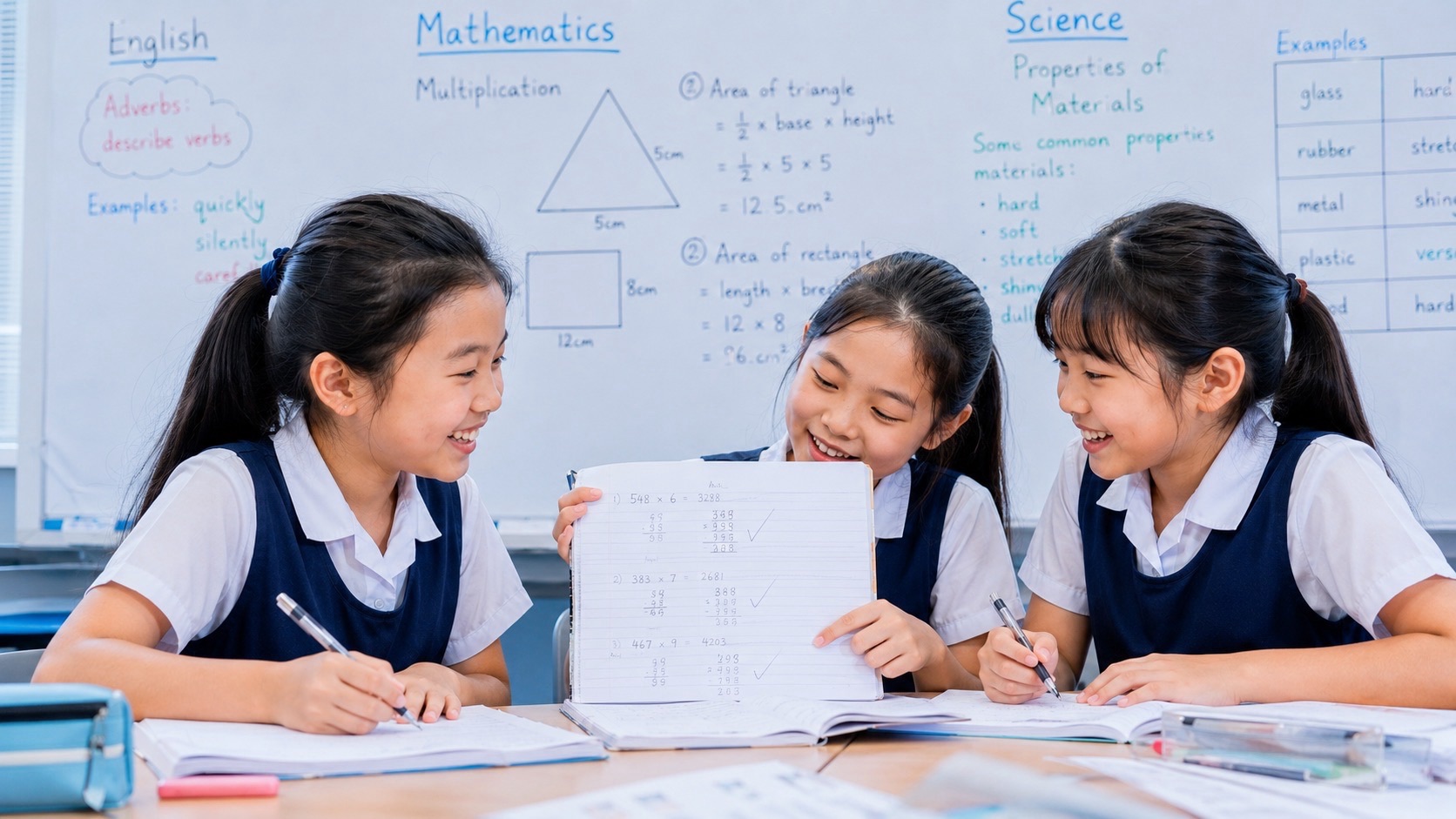
Primary 6 Science brings forces, photosynthesis and environmental interactions together with earlier primary learning. Standard pupils also study energy conversion and additional content such as elastic springs and food webs. Begin with the current MOE syllabus, the child’s registered course and the school’s topic plan. The practical aim is to use a scientific idea accurately in a new diagram, investigation or written explanation.
Start revision with one recent piece of schoolwork. Find out whether the difficulty is the concept, reading the conditions, interpreting evidence or completing the explanation. This guide provides original worked examples, clear course boundaries and a four-week plan, then connects learning with later PSLE results and school choices. For formal paper arrangements, use SEAB’s document for the applicable examination year.
- Confirm the course: choose Standard or Foundation content before selecting practice.
- Explain the event: identify the object, the relevant force or process and what changes.
- Connect living things and energy: distinguish making food from using it, within the child’s course.
- Read the evidence: check variables, units, starting conditions and the range of the data.
- Write the link: use a relevant observation and scientific idea to answer the actual question.
- Revise from feedback: repair one difficulty, then check it in a fresh independent attempt.
- Plan the next stage honestly: a school mark guides teaching; actual PSLE results guide posting decisions.
For parents planning Primary 6 Science learning. Curriculum and pathway information checked on 21 November 2026. Start with the child’s current schoolwork and teacher feedback.
Choose a reading route below or open the full chapter index. The examples and four-week plan can be adapted to the child’s readiness and the school’s current teaching sequence.
Find your next learning step
Choose the concern closest to your child today. Every chapter remains available below for a fuller reading.
Full chapter index
Understand the course, forces and photosynthesis
Connect energy, food relationships and the environment
- Standard P6: distinguish photosynthesis from respiration
- Standard P6: follow energy changes through a system
- Read food chains and Standard food webs in the correct direction
- Connect a feature or behaviour to survival in a particular place
- Explain environmental consequences through a clear chain of events
Use evidence, plan revision and understand school choices
- Design a comparison that can answer the intended question
- Read a graph or table before deciding what it proves
- Write the relationship that makes the answer work
- Use school and preliminary feedback to choose the next lesson
- Use a four-week revision cycle that checks independent understanding
- Connect Science learning with PSLE scores and nearby school choices
- Frequently asked questions about Primary 6 Science
- Sources and checking notes
The MOE 2023 Primary Science syllabus, in its May 2024 file, is the curriculum reference for this guide. The cohort that began P3 in 2023 reaches P6 in 2026. Its topic allocation is by primary year; your school’s plan supplies the teaching order and assessment instructions.
Valour Primary’s 2026 plan gives a useful school example: P6 pupils encounter forces, photosynthesis and environmental interactions, with energy conversion included in Standard. The school publishes a separate Foundation plan. Use that distinction to check resources, while following your own school’s sequence.
| Area | Shared learning | Standard additions to distinguish |
|---|---|---|
| Forces | Magnetic, gravitational and frictional forces | Elastic spring force |
| Living things and energy | Photosynthesis | Respiration releasing energy from food; energy conversion |
| Environment | Food chains, survival factors, adaptations and human impacts | Food webs; organism, population and community distinctions |
Foundation is its own course. A pupil should not be judged against an unfamiliar Standard spring or food-web question and then told that the Foundation curriculum has not been mastered. Shared topics still deserve careful explanation, appropriate practice and independent checking.
Earlier knowledge remains important. Roots and stems help explain a plant’s access to water. Heat gain and loss help explain changes in water. A food-chain question depends on knowing what plants do. When a P6 answer breaks down, the useful repair may be an earlier idea.
The SEAB PSLE portal linked 2026 examination formats at the 21 November 2026 source check. This school-year guide does not independently confirm a separate 2027 format. For paper arrangements, use the applicable examination-year document and your child’s school instructions.
All worked questions and datasets below are original teaching examples. They illustrate thinking and revision choices; they are not official examination questions or reports of actual investigations.
A child who remembers a chapter can still find a new question difficult. Before assigning another paper, ask the child to describe one recent question in plain language. What is being compared? What changed? What is the question asking them to explain?
Then listen to the scientific idea. If a child says that plants obtain food from the soil, the concept needs attention. If they know that leaves make food but overlook that one plant was kept in darkness, the difficulty may be applying the idea to the stated conditions. If they explain correctly aloud but write “it cannot do it”, the next step is clearer written expression.
| Ask | Listen for | Possible next move |
|---|---|---|
| What happened in the setup? | Accurate reading of objects, labels and conditions | Redraw the relevant part of the diagram. |
| Which scientific idea explains it? | A correct and relevant concept | Teach one understandable example. |
| Which evidence supports your answer? | A specific observation or data comparison | Locate the needed table entries. |
| Can you explain the link? | A complete cause-and-effect relationship | Write a short sentence with clear nouns. |
Record the support given. “Correct after I named the process” is different from “Selected and explained the process independently.” Both attempts can be useful, but they tell you different things about readiness.
A practical parent note might say: “Understands friction but did not notice that the two blocks entered the surfaces at different speeds.” This identifies a teachable difficulty. A note saying only “careless” does not reveal whether the child misunderstood the science, the comparison or the instruction.
After teaching, change one feature of the question. Use a different object, diagram orientation or set of numbers. If the child can still identify the relevant relationship, that is stronger evidence than copying the corrected answer immediately after seeing it.
A force is a push or a pull. It can change an object’s motion or shape. Begin by naming the object and the observed effect: starting to move, speeding up, slowing down, changing direction, stopping or becoming deformed.
Suppose a child pushes a stationary toy car and it starts moving. The push helps explain the change from rest to motion. If a question instead asks why the car slows after the hand is removed, repeating “the child pushed it” does not explain the later part of the story. Read the event the question has selected.
Original friction comparison
An identical sliding block enters two horizontal surfaces at the same speed. It travels 80 cm on surface A and 35 cm on surface B before stopping. Other relevant conditions are kept the same. The shorter stopping distance on B supports the explanation that B produces a greater opposing frictional effect in this setup.
Use “sliding block” carefully. The syllabus scope excludes the direction of friction for rolling objects. Do not turn a simple sliding example into a rule for every wheel or ball.
Friction is useful in some situations and unwanted in others. Grip helps a shoe resist slipping on the ground. Friction between moving machine parts can lead to wear. Ask what the object needs to do before deciding whether increasing or reducing friction would help.
Gravity does not wait for an object to fall
Earth’s gravitational pull acts on an object whether it is falling, resting on a table or held in someone’s hand. Weight is associated with that gravitational force. A stationary object has not become free of gravity merely because another support prevents it from falling.
A good answer names the force and explains the relevant effect. “There is gravity” may identify the idea, but “Earth pulls the released object towards it” connects the idea to the stated event. Keep the explanation at the level required by the question.
This section develops Standard P6 elastic spring work. A spring can stretch or compress when forces act on it. Its elastic force tends to restore its original shape within the range in which it behaves elastically.
For a hanging spring, distinguish its total length from its extension. Extension is the increase beyond the unloaded length. Confusing those quantities can produce a wrong answer even when a child reads the ruler accurately.
| Attached mass | Total spring length | Extension from the unloaded length |
|---|---|---|
| 0 g | 10 cm | 0 cm |
| 50 g | 14 cm | 4 cm |
| 100 g | 18 cm | 8 cm |
| 150 g | 22 cm | 12 cm |
Question: What is the extension when 100 g is attached? Answer: 18 − 10 = 8 cm. The total length is 18 cm, but the extension is 8 cm. Ask the child to point to the extra length on a simple drawing.
The readings show an increase of 4 cm in extension for each additional 50 g within the tested range. A prediction beyond that range would need a condition: the same pattern must continue. The table does not prove that any load can be added without changing the spring’s behaviour or damaging it.
When comparing two springs, check whether the same load was attached and whether the question gives total lengths or extensions. A longer final spring is not necessarily the one that stretched more if the unloaded lengths were different.
For example, spring P starts at 8 cm and ends at 13 cm, while spring Q starts at 12 cm and ends at 15 cm under the same load. P extends by 5 cm and Q by 3 cm. Q is longer at the end, but P has the greater extension.
This is a useful place to connect Science with subtraction and careful measurement. The arithmetic is small; choosing the correct quantities is the main thinking task.
Green plants use light energy, water and carbon dioxide in photosynthesis, producing sugar and oxygen. Roots absorb water and mineral salts; those substances should not be described as ready-made food taken from the soil. The plant makes food.
Ask the child to distinguish three questions: What does the plant take in? What does it make? What provides the energy for the process? This prevents a list of familiar words from replacing an explanation of their roles.
Original question: a covered part of a leaf
A classroom question supplies this information: a green plant was prepared so that its leaves had no detectable starch at the start. Part of one leaf was covered with a material that blocked light. The plant received water and was placed in light. A teacher later tested the leaf and found starch in the uncovered part but not in the covered part.
Explanation: The uncovered part received light and could photosynthesise, producing sugar that could be stored as starch. The covered part did not receive light. The difference in the test result supports the importance of light in this setup, given the stated preparation and conditions.
The response uses the preparation supplied in the question. Without that information, finding starch after the activity could be harder to interpret because starch might already have been present. Read the setup before deciding what a result demonstrates.
This is a paper-based explanation of a teacher-managed investigation. Parents do not need to carry out chemical leaf tests at home. A diagram and supplied results allow the same discussion of evidence.
Be careful with “more light means more photosynthesis” as an unlimited rule. A question may establish a pattern within a particular range while other conditions are controlled. It does not establish that increasing light indefinitely will always increase the rate; other conditions can become limiting.
For revision, ask the child to explain how a change in one stated condition could affect food production. Then ask what additional information would make the conclusion more secure. This builds both concept knowledge and careful reasoning.
The Standard P6 outcomes include respiration as the release of energy from food. Keep this idea separate from making food through photosynthesis. Living things need usable energy for their life processes, and plants are living things too.
A common misconception is that plants photosynthesise instead of respiring. Plants carry out respiration. In suitable light, green parts can also carry out photosynthesis. In darkness, photosynthesis cannot continue without light, but the plant does not stop needing energy.
| Question | Photosynthesis | Respiration |
|---|---|---|
| What is the main role in this discussion? | Making food using light energy | Releasing energy from food |
| Does it require light? | Yes | No |
| Do plants carry it out? | Green parts do so when conditions are suitable | Yes, including in darkness |
For an original question, a plant is kept in a dark cupboard overnight. Explain why “the plant has no energy needs until morning” is incorrect. The plant is still living and carries out processes that require energy. It can release energy from food through respiration even though photosynthesis cannot take place without light.
Do not use one gas reading to make an unsupported statement about only one process. In light, observed gas changes can reflect the combined effects of photosynthesis and respiration. At primary level, follow the conditions and information supplied rather than assuming a measurement automatically isolates a single process.
Breathing and respiration are also different ideas. Breathing concerns moving air into and out of the body; respiration concerns releasing energy from food. When revisiting human systems, ask which process the question actually describes.
For a Foundation pupil, keep revision aligned with the course’s published requirements and the teacher’s guidance. This Standard section is not a reason to add every additional biological explanation to the child’s practice list.
Energy Conversion is Standard P6 content. The useful habit is to identify the starting situation, the part where a change occurs and the observable outcome. Name the forms that explain that event.
Original example: a battery-powered fan
A fan uses a battery to turn its blades. A primary-level account can follow stored potential energy in the battery, electrical energy in the circuit and kinetic energy of the moving blades. Sound and heating may also occur. The account should reflect the parts described in the question.
The fan does not create energy from nothing. Nor does all the input necessarily become the useful movement of the blades. If a question asks for a useful output, identify that output. If it asks for other energy changes, do not omit an observable sound or heating effect simply because it is not the intended purpose.
Original example: an object released from a height
An object held above the ground has potential energy associated with its position. As it falls, that potential energy decreases and its kinetic energy can increase. On impact, energy may be transferred to sound, heating and changes in the objects involved. Describe the part of the event that the question asks about.
The syllabus’s energy note does not require the specific chemical, gravitational and elastic potential-energy labels. A teacher may use them to explain a distinction, but parents should not treat the longer label as a substitute for understanding the change.
When checking an answer, ask what evidence supports the named form. Movement supports identifying kinetic energy. A lit lamp provides evidence of a light output. “There is energy everywhere” is too broad to explain the particular system.
Keep energy and force distinct. A force is a push or pull; energy is not simply another name for that force. In a spring-powered device, the spring’s force and the energy changes describe related aspects of the event. They answer different questions and should not be swapped casually in a sentence.
CHAPTER 8 OF 18
8. Read food chains and Standard food webs in the correct direction
A food chain shows a feeding relationship and the direction in which energy passes through it. In a conventional chain written grass → grasshopper → frog, the arrows point from food to consumer. The grasshopper eats the grass, and the frog eats the grasshopper.
Begin by asking the child to read every arrow as a sentence. This is more reliable than memorising where to place the longest arrow or assuming the largest animal always comes last. The diagram’s stated relationships control the answer.
Original food-chain question
A question supplies only the chain above. If the grasshopper population decreases substantially, what might happen to the frogs, assuming other relevant conditions remain unchanged? The frogs would have less of their shown food available, which could reduce their survival or reproduction and lead to fewer frogs.
The qualification matters. The simple diagram does not tell us every possible food source or movement between places. Do not turn a likely consequence under stated conditions into a claim that every frog must immediately die.
Standard extension: two feeding routes
In a supplied food web, a bird eats both caterpillars and grasshoppers. A reduction in caterpillars does not remove both shown food sources. The bird may still obtain food from grasshoppers, but that fact alone does not prove its population will remain unchanged. Other quantities and conditions could matter.
Food-web reasoning belongs to the Standard extension identified in the course map. Foundation revision can develop the same careful reading habits through the food chains in its scope.
Decomposers have a role in breaking down dead organisms and waste, returning substances to the environment. They should not be described as returning energy to the Sun. Distinguish movement of matter through an environment from the pathway of energy.
A useful correction task is to ask the child which arrow or statement supports an answer. If no supplied relationship supports it, the child may be importing a remembered story instead of interpreting the diagram. Encourage them to state what the diagram shows before adding a prediction.
CHAPTER 9 OF 18
9. Connect a feature or behaviour to survival in a particular place
An adaptation helps an organism survive or reproduce in its environment. A useful explanation links a feature or behaviour to a specific challenge: obtaining food, avoiding predators, coping with conditions or reproducing.
Start with the information supplied by the question. If an unfamiliar animal has a long narrow beak and the diagram shows food deep inside a flower, the child can use that relationship. Memorising the animal’s name is less useful than explaining how the stated feature helps it reach the food.
| Supplied feature or behaviour | Relevant challenge | Useful connection |
|---|---|---|
| An animal’s colour resembles its surroundings | A visually hunting predator may detect it | Resemblance can make it harder to see in that setting. |
| A plant’s fruit has hooks that attach to fur | Seeds need to be dispersed away from the parent plant | Passing animals can carry the hooked fruit elsewhere. |
| An animal shelters in a shaded place during the hottest period | Exposure to high temperatures | The behaviour can reduce exposure to the hotter conditions. |
These explanations are conditional on the described setting. A colour that conceals an animal against one background may make it more visible against another. “Camouflage always protects it” is too absolute.
Do not suggest that an individual animal deliberately grows a new structural feature because it needs one that afternoon. Distinguish an existing structural feature from a behaviour the organism performs. The purpose of the primary explanation is to connect a feature with its benefit, not to invent a story about intention.
For Standard work, distinguish a single organism, a population of one kind in a place and time, and a community containing different populations. In a pond illustration, one named frog is an organism; the frogs of that kind are a population; the collection of plant and animal populations contributes to the community.
A habitat is not simply another word for a community. It describes where an organism lives. When a question changes the habitat’s conditions, consider which organisms’ needs are affected and how the evidence supports the proposed effect.
CHAPTER 10 OF 18
10. Explain environmental consequences through a clear chain of events
Environmental questions can become vague when a child relies on phrases such as “bad for nature” or “good for the Earth”. Ask for the action, the immediate change and the effect on organisms or resources. The explanation should name what is affected.
Original scenario: removing vegetation beside a pond
A question states that a vegetated area beside a pond is cleared. It also states that some insects used those plants for food and shelter. A supported explanation is that removing the plants reduces those resources for the insects. The insects may have to move, survive with less suitable conditions or decline in number.
Do not add a claim about poisoned water unless pollution is actually described or supported. A serious-sounding consequence is not automatically a relevant consequence. The child must connect the specific action to the supplied organisms and conditions.
Original scenario: planting suitable vegetation
A community restores an area using suitable plants and maintains it. The plants can provide resources or habitats for organisms that use them. However, one photograph of newly planted seedlings does not prove that every former population has returned. A meaningful evaluation would consider later observations as well as the action itself.
Conservation also involves choices about resource use. For a classroom example, compare repairing a usable item with discarding it and buying a replacement. Ask which materials or energy demands might change, and what information would be needed for a fuller comparison. Avoid a universal claim that one action is always best regardless of context.
Park View Primary’s Science programme links scientific inquiry with environmental stewardship. A useful home connection is to explain one action carefully: reducing unnecessary waste, caring for a planted area or following local recycling instructions. The child should understand the reason rather than recite a slogan.
In written answers, a small, defensible chain is stronger than several unrelated environmental effects. State what happened, which resource or condition changed, and how that change could affect the organism or system identified in the question.
By P6, investigation work should increasingly involve deciding how a question could be tested. The useful starting point is a precise question. “Which material is best?” is too broad. “Which of these two coverings slows cooling more under the same conditions?” identifies a measurable comparison.
The ACS (Junior) explanation of investigation skills describes forming questions and constructing fair methods. At home, a supplied setup or diagram is enough for practising those decisions; specialised apparatus is not needed.
Original investigation plan
A question compares coverings A and B around identical covered cups. Each cup contains the same volume of water at the same starting temperature and is placed in the same cooler room. The measured outcome is the temperature decrease after ten minutes.
| Decision | What it means here |
|---|---|
| Change | The type of covering |
| Measure | The water’s temperature decrease over ten minutes |
| Keep comparable | Cups, water volume, starting temperature, surroundings, covering thickness and coverage, and observation time |
| Check consistency | Repeat the comparison using the same method and inspect the results |
If covering A is much thicker than covering B, the result compares those finished coverings. It cannot isolate the material type alone. The correct response is to identify that limitation, not to declare every practical comparison useless.
State controls concretely. “Keep everything the same” fails to show whether the child understands which conditions affect this outcome. Equally, do not list irrelevant objects simply to make the answer longer.
Repeating a fair comparison helps assess consistency. Repeating an unfair comparison leaves its confounding difference in place. If one cup starts hotter each time, three trials do not remove that problem.
Finally, ask whether the measured outcome actually answers the question. A photograph of cup colour does not establish cooling performance. The measurement, the question and the conclusion should belong to the same chain of reasoning.
Read the heading, variables, units and range before interpreting a result. A table may record total length rather than extension, a final temperature rather than a temperature change, or the number observed rather than the entire population. Those distinctions determine the answer.
Here is an original set of illustrative readings. In a teacher-managed photosynthesis setup, the volume of gas collected from the same type and amount of aquatic plant is measured over ten minutes. Temperature and other relevant conditions are controlled. The question states that the collected gas provides a measure related to photosynthesis under these conditions.
| Relative light setting | Gas volume collected in ten minutes |
|---|---|
| 1 | 2 ml |
| 2 | 4 ml |
| 3 | 6 ml |
| 4 | 6 ml |
Supported description: The collected volume increases from settings 1 to 3, then remains at 6 ml between settings 3 and 4. The increase from setting 1 to setting 3 is 4 ml.
Unsupported claim: Every increase in light always produces more gas. The last two readings already fail to show that pattern. Nor does the table identify exactly which other condition might limit a further increase.
If asked for a prediction at an untested setting, state the basis and uncertainty appropriate to the task. A graph is evidence over the range shown; it is not permission to extend a straight line indefinitely.
A trend can also differ from a single reading. When a question supplies repeated trials, inspect whether the pattern is consistent and whether one result is unusual. Do not erase an inconvenient number because it does not fit the expected story. Ask whether the method or measurement needs checking.
At home, a useful exercise takes only three questions: retrieve one value, compare two values, then name one claim the data cannot establish. That sequence checks reading, reasoning and restraint without requiring a full practice paper.
A scientific answer should make the relevant relationship visible. A helpful sequence is to identify the event, select the concept and explain how it applies. Where the question asks for evidence, include the observation or data that supports the answer.
Park View Primary uses a claim, evidence and reason scaffold. Such a scaffold can organise thinking, but it is not a rule that every answer must contain three labelled sentences. The question’s demand determines the useful detail.
| Incomplete response | More useful response |
|---|---|
| The plant cannot do it. | The covered leaf area receives no light, so it cannot photosynthesise there. |
| B has more friction. | With the same block entering at the same speed, the shorter stopping distance on B supports a greater opposing frictional effect in that setup. |
| The frogs decrease because the food chain changes. | Fewer grasshoppers would leave less of the frogs’ shown food available, which could reduce the frog population if other conditions remain unchanged. |
Precise nouns often improve an answer more than extra scientific vocabulary. Replace “it” when the reader cannot identify the object. Replace “more” with the quantity being compared. Replace “better” with the particular outcome or function.
Correct the scientific idea before polishing grammar. An elegant sentence can still apply the wrong concept. A short sentence can be scientifically complete. The aim is an accurate explanation that another person can follow.
For multiple-choice questions, discuss one tempting wrong option. Ask which condition makes it fail. This can reveal a misconception even when the child selected the right answer by elimination or chance.
For an open response, do not promise marks for a fixed number of keywords or sentences. Use the teacher’s feedback for that task. If the deduction is unclear, ask which scientific link was missing. Then give the child a fresh example in which the same link must be reconstructed without copying.
A school assessment describes performance on that task under those conditions. It does not guarantee a later PSLE Achievement Level. Read the work underneath the total: which ideas were secure, which answers depended on guessing, and which errors appeared across several topics?
ACS (Junior) publishes its own P6 assessment framework, illustrating why families need their school’s current notices. Do not treat another school’s weights or term arrangements as a national P6 template.
Choose three representative corrections
Select one concept error, one evidence or diagram error and one incomplete explanation. For each, record the first incorrect step and the improved idea. Then choose a fresh question to check it later. This gives the review a purpose without turning every wrong answer into a large new project.
For example, a child may know that a covering slows heat transfer but compare final temperatures from different starting temperatures. The revision focus is interpreting the comparison. Recopying a page of insulation notes would not directly address that difficulty.
Use timed practice when it can answer a specific question about pace. Notice whether the child spends time reading, choosing a concept, interpreting data or writing. A child who cannot explain the relationship without a timer needs teaching before a shorter deadline.
Questions for a useful teacher discussion
- Which concept is causing repeated difficulty in different settings?
- Is the child’s oral explanation more complete than the written one?
- Which diagram or data-reading habit should we practise first?
- Does this older resource match the current course?
- What independent response would show that the support has helped?
Bring a few actual examples. If considering tuition, ask the same questions about teaching priorities, correction and checking transfer. A clear learning plan is more useful than a promise of an exact final grade.
After the examination, the work can still inform the next stage. Knowing how to ask about an unclear relationship, read a graph carefully and revise a mistaken idea remains valuable when secondary Science introduces more detailed concepts.
CHAPTER 15 OF 18
15. Use a four-week revision cycle that checks independent understanding
This is an original suggested routine, not an official timetable. Fit it around the school’s current work and the child’s other commitments. Select one content priority and one reasoning priority, rather than attempting to repair every topic at once.
Week 1: establish a starting point
Review a small sample of recent work. Ask the child to describe the setup, explain the concept and justify the answer. Record the prompts needed. Choose a specific focus, such as distinguishing spring length from extension for Standard, or connecting a food-chain change with food availability for either course.
Use one fresh question to establish what the child can do independently. Save it. It becomes a useful comparison later, even if the first attempt is incomplete.
Week 2: teach the relationship and vary one feature
Explain one manageable example using a drawing, table or short spoken account. Compare a correct answer with a plausible wrong one. Ask the child to identify the difference. Then change the numbers, objects or diagram orientation while keeping the main relationship similar.
For a photosynthesis difficulty, vary which condition changes. For a data difficulty, vary whether the table shows a total or a change. Use only material appropriate to the child’s course and current learning.
Week 3: combine knowledge with evidence
Choose a short mixed set. Include a diagram, a table and an explanation requiring the repaired idea. Ask the child to identify what each question needs before answering. If the concept is secure, trial a suitable timed section following the teacher’s guidance.
Review one answer in detail. Was the evidence relevant? Did the conclusion go beyond it? Could another reader understand which object each sentence described? Keep the correction focused on the most important missing link.
Week 4: check transfer after a gap
Use a new example without displaying earlier solutions. Compare the response with Week 1. Look for correct concept selection, evidence use, clearer writing and fewer prompts. If the difficulty persists, share those attempts with the teacher and choose a different explanation or an earlier foundation to revisit.
Continue with the next priority only when the evidence supports moving on. Repeating part of the cycle is reasonable if the child is still uncertain. The calendar organises the work; it should not force a claim of mastery.
On a busy day, the routine can shrink to one question, one explanation and one check. A short session can be productive when it reveals a decision the child can later make alone.
CHAPTER 16 OF 18
16. Connect Science learning with PSLE scores and nearby school choices
P6 families may be preparing for the examination year or making school choices after results. Before the result, use schoolwork to guide learning. Once the official result arrives, use it with current eligibility information, school programmes and a realistic travel plan.
Separate a subject result from the overall PSLE score
MOE’s scoring guide explains that the four subject AL scores add to an overall PSLE score from 4 to 32. For example, Standard-subject ALs of 4 for Mathematics, 5 for English, 6 for Mother Tongue and 6 for Science total 21. One subject AL does not establish the overall result. Lower overall numbers represent stronger results within this system.
| Subject mark range | Achievement Level |
|---|---|
| 90 and above | AL1 |
| 85–89 | AL2 |
| 80–84 | AL3 |
| 75–79 | AL4 |
| 65–74 | AL5 |
| 45–64 | AL6 |
| 20–44 | AL7 |
| Below 20 | AL8 |
Foundation subjects use different percentage bands: 75–100% is AL A, 30–74% is AL B, and below 30% is AL C. For posting, those grades map to 6, 7 and 8 respectively. Foundation Science is marked out of 70, so a raw practice score must first be read as a percentage: 56 out of 70 is 80%, not 56%. This illustration does not turn a practice paper into an official PSLE result or make Standard and Foundation courses interchangeable.
Read Posting Group eligibility before comparing schools
The current Posting Group reference below was checked on 21 November 2026. Under Full Subject-Based Banding, Posting Groups relate to entry and initial subject levels, while G1, G2 and G3 describe secondary subject levels. Eligible students can take subjects at different levels.
| Overall PSLE score | Posting Group eligibility |
|---|---|
| 4–20 | PG3 |
| 21–22 | PG2 or PG3 |
| 23–24 | PG2 |
| 25 | PG1 or PG2 |
| 26–30 | PG1, with AL7 or better in both English and Mathematics |
Eligibility for a Posting Group does not guarantee a place at a named school. Where an option band applies, discuss readiness and the available choices with the primary school. If a result falls outside the conditions in this table, ask the school about the applicable progression options.
Build a local shortlist around a workable school day
The schools below are geographic starting points for research. They are not individual recommendations or a ranking. Their official contact pages verify the locations. Check MOE SchoolFinder for the relevant Posting Group, subjects, programmes, CCAs and the year attached to published score information.
| Search area | School and verified location | What to check next |
|---|---|---|
| Punggol | Punggol Secondary School 51 Edgefield Plains | Current SchoolFinder entry, programmes and actual home-to-gate route |
| Sengkang | Compassvale Secondary School 51 Compassvale Crescent | Current SchoolFinder entry, programmes and actual home-to-gate route |
| Clementi | Clementi Town Secondary School 10 Clementi Avenue 3 | Current SchoolFinder entry, programmes and actual home-to-gate route |
| Bukit Batok and western estates | Bukit View Secondary School 16 Bukit Batok Street 21 | Current SchoolFinder entry, programmes and actual home-to-gate route |
| Yishun | Yishun Town Secondary School 6 Yishun Street 21 | Current SchoolFinder entry, programmes and actual home-to-gate route |
Try the journey at the relevant time. Include walking, waiting, transfers and a later return after CCAs. For Bukit Timah families, compare actual routes towards Clementi and Bukit Batok before deciding which school is convenient. A short distance on a map does not establish a manageable daily journey.
Ask what would help this child participate: a suitable CCA, a subject they enjoy, support for a learning difficulty or a routine they can manage independently. Discuss those needs with the school. A family is choosing a daily learning environment as well as submitting an eligible application.
Use verified past cut-off points without treating them as promises
Two schools publish clear figures for their 2026 Secondary 1 intake. These are past intake references, not predicted cut-off points for the November 2026 PSLE cohort entering secondary school in 2027. Clementi Town’s page explicitly excludes DSA.
| School and official source | PG3 | PG2 | PG1 |
|---|---|---|---|
| Clementi Town Secondary | 13 | 23 | 28 |
| Bukit View Secondary | 20 | 24 | 29 |
For example, a score of 12 is stronger than a past PG3 cut-off of 13. A score of 13 matches that historical number, and a score of 14 is less strong. None of those comparisons fixes the next intake’s outcome. Compare the correct Posting Group and applicable conditions, and use current official information for the actual application.
For the other schools listed above, use SchoolFinder to obtain the applicable score range rather than filling a gap with an unverified number. Record the intake year beside every figure. A website updated recently can still contain information about an earlier admission cycle.
For families using the 2026 PSLE results
The SEAB announcement dated 17 November 2026 states that results will be released on 24 November 2026 from 11:00am. Online Secondary 1 choices open at 11:30am that day and close at 4:30pm on 30 November 2026, Singapore time. These dates apply to that exercise. For another cohort, use its own announcement.
MOE’s school-choice guide advises using all six choices and including two or three schools whose previous cut-off points are less stringent than the child’s result. Put the schools in the order the family genuinely prefers, while considering eligibility and realistic options. Save the submitted choices and check the current official instructions.
The same 2026 announcement describes Crest and Spectra as options for eligible pupils in PG1 or PG1/2 who are interested in a practical learning environment. A direct application to either school should be accompanied by the normal six secondary-school choices. Read the current process and discuss the option with the primary school.
For the longer view, MOE’s Full SBB pathway overview connects secondary learning with routes including junior college or Millennia Institute, polytechnic and ITE. Later progression depends on the relevant qualifications, subjects and entry requirements. A current primary mark does not settle every later option.
Choose a relevant eduKate learning route
- eduKateSG Primary 6 Science support: begin with the school stage and the child’s current difficulty.
- Punggol Science tuition guide: explore teaching support and confirm current lesson arrangements.
- eduKateSengkang Primary 6 Science Learning Hub: connect revision with the child’s present difficulty.
- eduKate Science advice for parents: explore further guidance on supporting understanding and independent explanations.
Bring an independent work sample and the teacher’s comments when discussing support. Ask what will be taught first, how understanding will be checked on a fresh question and how much home practice is expected. Confirm current availability, fees and the actual teaching location directly.
1. Which Science syllabus should we use for P6 from 2026?
The programme introduced with the 2023 P3 cohort reaches P6 in 2026. This guide uses the MOE 2023 syllabus, May 2024 file, together with current school information. Check older resources against the relevant course and current scope.
2. Are Standard and Foundation P6 Science the same?
No. They share important ideas but differ in content and demands. The opening course map identifies selected distinctions. Confirm the child’s registered level and use suitable questions. A difficult Standard task is not a fair test of whether a Foundation pupil has mastered the Foundation course.
3. Should we revise only the new P6 topics?
No. Earlier concepts support later explanations. Use an actual error to identify what needs revisiting: plant parts for water access, heat for changes in water, or classification for understanding organisms. Revisit the foundation that helps the current task instead of rereading every old chapter without a purpose.
4. Does Foundation include elastic spring force and food webs?
Those are Standard additions in the scope used here. Foundation practice should follow its own forces and food-chain requirements. A child can explore an interesting extra idea, but enrichment should not quietly become a compulsory revision expectation.
5. Must my child use all the longer potential-energy terms?
The syllabus does not require the specific chemical, gravitational and elastic potential-energy labels. Where a teacher uses them, understand what distinction they express. A correct label still needs a relevant explanation of the energy change in the stated system.
6. Why does my child know the notes but struggle with unfamiliar questions?
Check whether the child can identify the relevant concept and conditions independently. Remembering a statement does not automatically establish when to use it. Change one feature of a familiar question and ask why the explanation should stay the same or change.
7. Are keywords enough for open-ended answers?
Accurate vocabulary helps, but the relationships must be clear. A list of terms may omit which object gains heat, which food source decreases or what a measurement shows. Use the teacher’s feedback to identify the missing scientific link in a particular response.
8. How many full papers should we complete?
There is no quota in this plan. Choose full papers or shorter sections according to the teacher’s guidance and the learning purpose. A further paper is more informative after the child has practised what the previous attempt revealed. Keep time to review and revisit the work.
9. Can a preliminary mark predict the exact PSLE result?
No. It is evidence from one school assessment. It can help identify strengths, repeated errors and pace, but it cannot guarantee an AL or a school place. Use actual official results and current posting information when making actual secondary-school choices.
10. What should we do first this week?
Choose one recent question. Ask the child to explain the situation and identify the first uncertain step. Teach that step, then use a fresh example with less prompting. Keep the two attempts and decide the next action from what the child can now do independently.
Official information was checked on 21 November 2026. Follow your school’s current notices for school-based tasks and the applicable SEAB examination-year documents for PSLE. The worked questions, explanations and home plans in this guide are original teaching suggestions.
- MOE Primary Science syllabus 2023, May 2024 file
- Official school-hosted MOE 2023 syllabus copy, October 2022 cover
- Valour Primary: Science curriculum for 2026, Standard and Foundation
- Park View Primary: Science curriculum and explanation approaches
- ACS (Junior): Science assessment and investigation skills
- SEAB PSLE portal and applicable examination formats
- MOE PSLE scoring reference
- Official school explanation of Posting Group eligibility
- MOE secondary-school experience under Full Subject-Based Banding
- MOE parent guide to choosing a secondary school
- SEAB 2026 results and Secondary 1 posting announcement
- MOE SchoolFinder
- Clementi Town Secondary: 2026 intake cut-off points
- Bukit View Secondary: 2026 intake cut-off points
- MOE Full SBB secondary experience and post-secondary pathways
Official school contact pages are linked beside their locations in the school-choice chapter. The eduKate links offer further teaching guidance and support routes. Use official information for curriculum and admission requirements, and check the cohort year before acting on dates or past score figures.
Contents · Previous chapter · Primary 6 Science support guide
Related parent curriculum guides
- Primary 3 Science: observation, classification and explanations
- Primary 4 Science: matter, light, heat and explanations
- Primary 5 Science: curriculum and parent guidance
- PSLE Science: curriculum and parent guidance
- Primary 1–PSLE Science: curriculum and parent guidance
- Primary 6 English: revision and feedback
- Primary 6 Mathematics: revision and secondary readiness