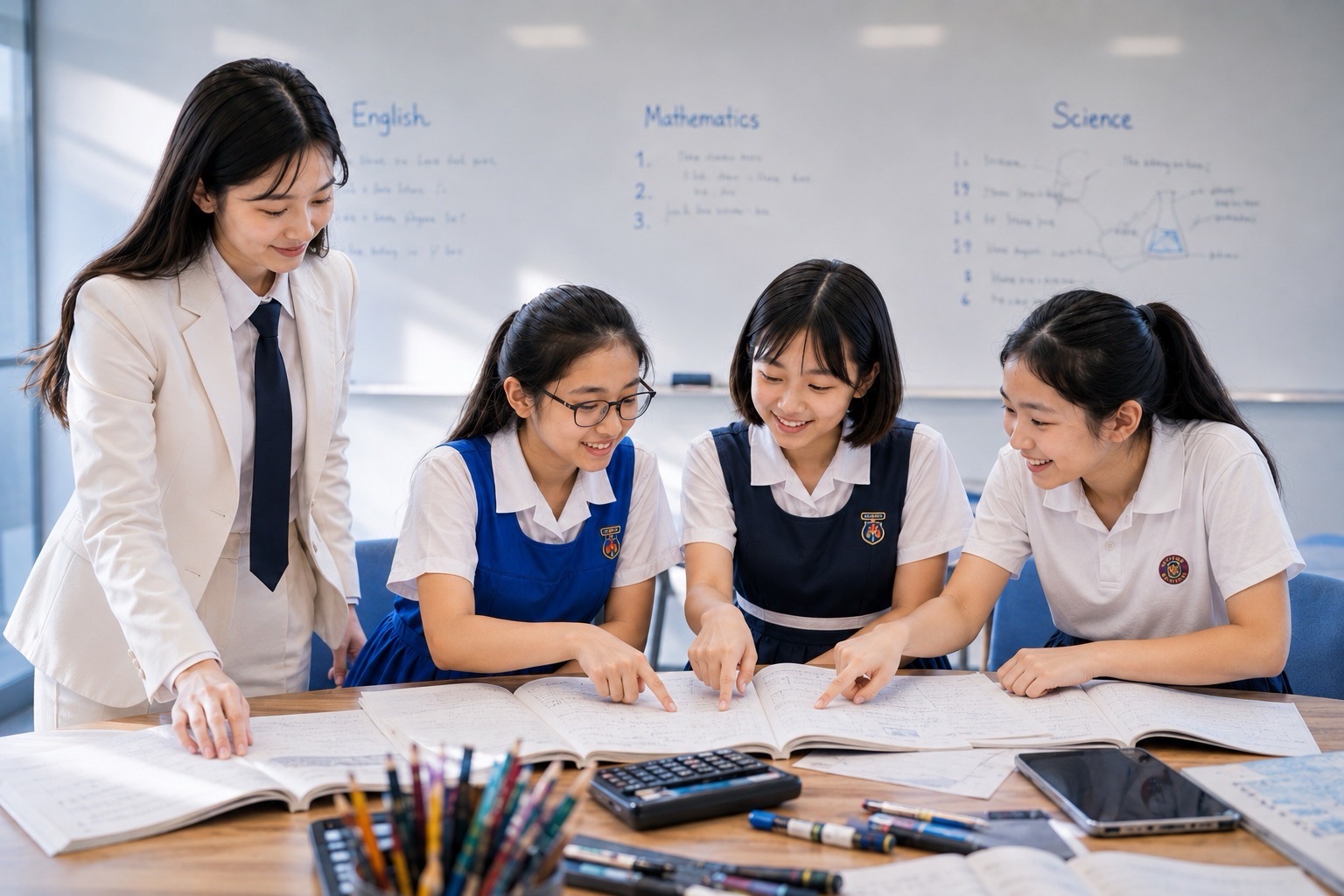
Secondary Mathematics
Secondary Mathematics is not one page. It is a four-year route.
You may be a parent trying to understand what happens after PSLE, or a student trying to work out why Mathematics suddenly feels different. Secondary Mathematics moves through Sec 1 orientation, Sec 2 repair, Sec 3 route-shaping and Sec 4 examination execution. Choose the stage that feels closest, then move into the guide below.
01 / Overview
I want to understand Secondary Mathematics first.
Before choosing tuition, I need to know what this subject becomes.
02 / Full SBB
I need the new route map: G1, G2, G3, IP, IB, IGCSE.
The old stream language is not enough anymore.
03 / Sec 1
Secondary 1 Mathematics feels unfamiliar.
The child has entered a new Mathematics environment after PSLE.
04 / Sec 2
My child understands, but still loses marks.
Small algebra or reasoning errors keep damaging whole questions.
05 / Sec 3
Secondary 3 Mathematics suddenly feels heavier.
The route is narrowing, and the subject is no longer forgiving.
06 / Sec 4
Secondary 4 Mathematics is now exam execution.
We need to protect the final grade route before the paper arrives.
07 / Home
What should we do at home before tuition?
I want support that is calmer, clearer and actually useful.
08 / Tuition
I want the correct Secondary Mathematics tuition page.
Choose Sec 1, Sec 2, Sec 3 or Sec 4 Mathematics Tuition.
Start with the Mathematics route. Read the Secondary Mathematics guide first, or go straight to the tuition pathway if you already know the level. The aim is to help parents and students understand the corridor before choosing the next repair.
Read the Math Guide WhatsApp eduKateSGSecondary Mathematics Guide
Secondary Mathematics: The Four-Year Route.
You may have clicked “Secondary Mathematics” because you are first interested in the subject. That is the correct entry point. Before tuition, before panic, before choosing Sec 1, Sec 2, Sec 3 or Sec 4, it helps to understand what Secondary Mathematics becomes.
Secondary Mathematics is not just “more sums after PSLE.” It is a four-year route. Students move from Primary arithmetic into algebra, equations, graphs, functions, geometry, statistics, trigonometry, proof-like reasoning, time pressure and eventually examination execution. The subject becomes less forgiving because each step depends on earlier steps.
For parents, the important shift is this: do not read the child only through a posting label or one test score. Read the Mathematics corridor. Which parts are strong? Which parts are fragile? Which errors repeat? Which year is the child in? Which route is coming next? Once that is clear, tuition becomes a precise repair system instead of just “more lessons.”
01 / Overview
Secondary Mathematics is a route from orientation to execution.
The biggest mistake is to treat Secondary Mathematics as one flat subject. It is not flat. Sec 1, Sec 2, Sec 3 and Sec 4 ask different things from the student. A problem in Sec 1 may be orientation. A problem in Sec 2 may be method drift. A problem in Sec 3 may be workload and route pressure. A problem in Sec 4 may be final-grade protection.
This is why the same sentence can mean different things at different levels. “My child is careless” in Sec 1 may mean working presentation is not installed. In Sec 2, it may mean algebra checking is unstable. In Sec 3, it may mean the student cannot carry multi-step load. In Sec 4, it may mean timing pressure is causing execution collapse.
Good Mathematics support begins with diagnosis. What is the repeated failure pattern? Is the child missing foundations, using weak methods, avoiding practice, panicking under time, or unable to transfer learning when the question changes? Once the pattern is named, the repair becomes clearer.
The aim is not to frighten parents or students. The aim is to make the route visible. Once the route is visible, help becomes calmer, earlier and more intelligent.
02 / Full SBB and Route Reading
Under Full SBB, Mathematics must be read as its own corridor.
The old map is no longer enough. Parents may still think in older labels, but Secondary school now requires a more precise reading. A child is not simply one stream identity. The child has a subject-level map, and Mathematics is one of the major corridors that can affect later academic routes.
This means parents should ask better questions. Which Posting Group did my child enter through? Which subject level is Mathematics being taken at? Is the child carrying the pace well? Is the child stretched, overloaded or under-challenged? Is the Mathematics route aligned with future plans such as SEC, O-Level, IP, IB, IGCSE, JC, Polytechnic or ITE?
Mathematics is often a gateway subject because it affects confidence, subject combinations, science-related pathways, business-related pathways, technical routes, and later academic choices. A weak Mathematics corridor should not be ignored until the final year. A strong Mathematics corridor should also not be left to complacency.
The new system rewards parents who read carefully. A calm parent does not ignore problems. A calm parent sees the corridor early and helps the child move before the route narrows.
03 / Secondary 1 Mathematics
Secondary 1 Mathematics is the orientation year.
Secondary 1 is where many students discover that Mathematics has changed language. The child is no longer only doing arithmetic and familiar Primary-school routines. Algebra appears. Symbols appear. Negative numbers matter. Equations need balance. Graphs require interpretation. Working presentation becomes part of the answer.
A student who was comfortable in Primary school may feel unsettled because the old method is no longer enough. This does not mean the child is weak. It means the child is entering a new Mathematics operating environment. The right support helps the child orientate before small confusion becomes long-term avoidance.
Sec 1 tuition should not only chase marks. It should install the foundations: algebraic language, method discipline, translation from words to equations, clear working, accuracy habits, confidence and the ability to revise independently.
Sec 1 is early, but early does not mean unnecessary. It means repair is still cheaper, calmer and easier before the route becomes more crowded.
04 / Secondary 2 Mathematics
Secondary 2 Mathematics is the repair and verification year.
Secondary 2 is where many students say, “I understand, but I still lose marks.” This sentence is important. It usually means the child understands parts of the lesson, but cannot hold the whole execution chain under pressure.
Small errors now become more expensive. A sign error can damage factorisation. Weak factorisation can damage equation solving. A wrong equation can destroy the final answer. The student may not be lazy. The student may be experiencing method drift, where the procedure looks familiar but is no longer reliable.
Sec 2 Mathematics tuition should therefore focus on diagnosis, repair and verification. More worksheets without diagnosis can make the child practise unstable methods. A good repair loop identifies repeated errors, rebuilds weak micro-skills, tests transfer, and checks whether the student can perform under Weighted Assessment conditions.
Sec 2 is not simply “harder Math.” It is higher coupling. The solution is a more reliable system.
05 / Secondary 3 Mathematics
Secondary 3 Mathematics is the route-shaping year.
Secondary 3 is where many earlier signals become real. The child is now moving inside a more chosen academic corridor. The workload is heavier, the pace is faster, the topics are more coupled, and the examination gate is no longer far away.
Questions become more mixed. Algebra connects with geometry. Functions connect with graphs. Word problems require modelling. Trigonometry and coordinate geometry require accurate interpretation. Students who could manage homework may still collapse in tests because the test asks for transfer under time.
Sec 3 tuition should protect the route. This means stabilising algebra, strengthening topic transfer, repairing repeated error clusters, managing time pressure, and helping students move from “I know the topic” to “I can perform when the topic is mixed with another topic.”
Sec 3 is not the final year, but it shapes the final year. The student who repairs here enters Sec 4 with more control.
06 / Secondary 4 Mathematics
Secondary 4 Mathematics is the execution year.
By Secondary 4, the student is no longer only studying Mathematics. The student is managing an examination portfolio. There may be Mathematics, Additional Mathematics, prelims, school assessments, timed papers, weak topics, revision plans, fatigue, confidence and future route pressure.
The aim is to protect the final grade. This means finding the difference between a content gap, an examcraft gap, a timing problem, a careless-error habit, an A-Math overload issue, or an unrealistic revision plan. The student needs a strategy, not noise.
Sec 4 tuition should balance repair and performance. Weak topics must be repaired, but the student also needs timed practice, paper strategy, mark protection, question selection, checking habits and recovery when a paper becomes difficult.
Sec 4 is not the year for vague effort. It is the year for controlled execution.
07 / Home, Parent and Student Support
Support should make Mathematics clearer, not louder.
Parents still matter in Secondary school, but the role changes. In Primary school, parents often manage the child. In Secondary school, parents must help the child become more self-managing. That means routine, boundaries, sleep, device control, homework ownership, mistake correction and calmer conversations.
For Mathematics, the home conversation should move away from general scolding and towards useful diagnosis. Instead of “Why are you careless?” ask, “Which mistake repeats?” Instead of “Do more practice,” ask, “Which method is unstable?” Instead of “Why did you fail?” ask, “Did the paper test content, timing, transfer or confidence?”
A student can also help adults help them. Say the problem more clearly: “I can do examples but cannot start exam questions.” “I keep losing signs in algebra.” “I panic when topics are mixed.” “I understand the lesson but forget the steps at home.” These sentences give tuition and home support something real to repair.
Good support is not more pressure. Good support makes the next step visible.
08 / Choose the Tuition Route
Choose the right Secondary Mathematics tuition door.
The best tuition link depends on the year and the problem. Sec 1 needs orientation. Sec 2 needs repair and verification. Sec 3 needs upper Secondary route protection. Sec 4 needs examination execution and final-grade strategy.
Use the links below if you already know the level. If you are unsure, return to the top and choose the card that feels closest. The point is not to rush the parent or student into a random page. The point is to make the next click intelligent.
Secondary Mathematics is a long corridor, but the next step does not have to be confusing. Choose the stage, name the repair, and move with more clarity.
Final Review
Where do you want to go now?
Return to the top, review the Secondary Mathematics route, read the Full SBB background, choose a tuition level, or WhatsApp eduKateSG for help choosing the correct route.