
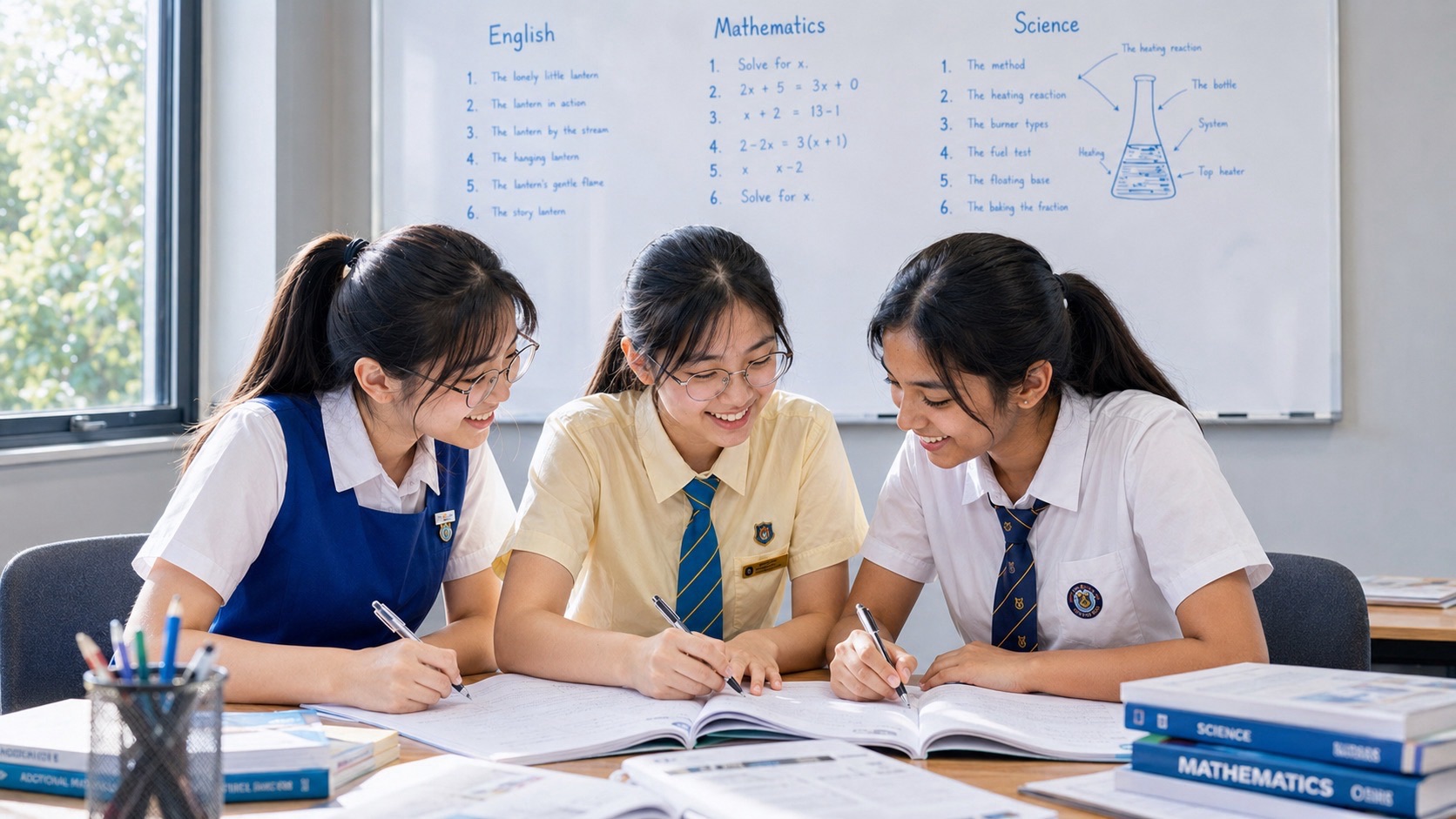
Originally published in 2015; rebuilt in 2026. This page began as an eduKate “Theme of the Month” notice for English classes. It is now a full public guide to critical thinking for students: how to separate claims from evidence, distinguish observation from inference, consider alternatives, calibrate confidence, correct errors and apply the process to comprehension, composition, research and AI-generated information.
Quick Read
Critical thinking is not simply “thinking harder” or disagreeing with other people. It is the disciplined process of asking what is being claimed, what evidence supports it, what can reasonably be inferred, what alternatives remain, how confident we should be, and what would make us change our mind.
One-sentence answer: strong critical thinking keeps an idea answerable to evidence and correctable when better evidence arrives.
The six-part critical-thinking spine
- Claim: What exactly is being said?
- Evidence: What information supports the claim?
- Inference: What conclusion is being drawn from that evidence?
- Alternatives: What other explanations or interpretations could fit?
- Confidence: How certain should we be?
- Correction: What new evidence would change the conclusion?
This is a public learning framework, not a secret reasoning machine. Students can use it directly when reading an article, answering a comprehension question, writing an essay, interpreting data or checking an AI-generated response.
1. Start by locating the claim
Many weak arguments become difficult to evaluate because the claim is vague.
Consider these statements:
- “Technology is bad for students.”
- “Reading is important.”
- “This school is better.”
- “AI makes learning faster.”
Each sounds like a claim, but each needs refinement. Better questions are: bad in what way, for which students, under what conditions, compared with what, and measured by which outcome?
Precise claims are easier to test because they create clearer evidence requirements.
2. Evidence is not the same as a reason
A reason explains why someone believes a claim. Evidence is information that can increase or decrease confidence in the claim.
“I think this revision method works because I like it” is a reason for preference. It is weak evidence about whether the method improves long-term retention.
Evidence can include:
- direct observations;
- measurements;
- documents and primary sources;
- experimental results;
- well-designed surveys;
- replicated findings;
- official records;
- expert analysis grounded in identifiable sources.
Different questions require different evidence. A personal experience can be powerful evidence that something happened to one person, while remaining weak evidence for a universal claim.
3. Observation and inference must stay separate
An observation reports what was detected. An inference proposes what the observation means.
| Observation | Possible inference |
|---|---|
| The student submitted three assignments late. | The student may have a planning problem. |
| The plant’s white petals became blue in coloured water. | Water containing dye moved through the stem into the flower. |
| A character leaves the room without speaking. | The character may be angry, afraid, ashamed or simply hurried. |
The same observation can support more than one inference. Critical thinking asks which inference is strongest and what additional evidence could distinguish them.
4. Ask what else could explain the evidence
Alternative explanations prevent premature closure.
If a student’s marks fall, possible explanations include:
- a missing concept;
- weak transfer to unfamiliar questions;
- poor time management;
- fatigue;
- careless execution;
- an unusually difficult paper;
- misreading instructions;
- a combination of several causes.
The correct response is not to keep all alternatives forever. It is to use evidence to narrow them.
5. Confidence should match the evidence
Critical thinking is not only about whether a statement is true or false. Many real questions involve degrees of confidence.
- High confidence: several strong independent sources converge.
- Moderate confidence: evidence supports the claim but important uncertainty remains.
- Low confidence: evidence is thin, indirect, disputed or incomplete.
- Unknown: there is not enough information to justify a conclusion.
“I do not know yet” is sometimes the most accurate answer available.
6. A good conclusion must be correctable
One of the strongest tests of reasoning is to ask: What evidence would make me change my mind?
If the answer is “nothing”, the belief has become insulated from correction.
Strong reasoning allows revision. Changing a conclusion after better evidence arrives is not weakness. It is the system working properly.
Facts, interpretations and opinions
Students often use these categories too loosely.
| Category | Example |
|---|---|
| Fact claim | Singapore became independent in 1965. |
| Interpretation | A policy was important because it changed how later institutions developed. |
| Preference | I prefer studying in the morning. |
| Value judgement | This policy was fair. |
Interpretations and value judgements are not automatically “just opinions”. They can be better or worse supported depending on evidence, definitions and reasoning.
Source checking
Before evaluating a claim, inspect where it came from.
- Who produced the source?
- When was it produced?
- Is the source primary or secondary?
- What evidence does it cite?
- Does it have an incentive to persuade, sell or defend?
- Can the underlying data or document be checked?
- Do independent sources converge?
A polished page can still be wrong. A famous speaker can still overgeneralise. A viral claim can still have no primary source.
Primary and secondary sources
A primary source is close to the event, object or data being studied: a speech, letter, experiment record, law, photograph, dataset or contemporary report. A secondary source interprets or synthesises primary material.
Primary does not automatically mean unbiased or correct. A participant can misremember. A government record can have institutional limits. A photograph can show only one frame. Secondary sources can sometimes be stronger because they compare multiple primary sources.
The question is not “primary good, secondary bad”. It is “what can this source legitimately establish?”
Correlation and causation
If two things occur together, one may cause the other—but several alternatives remain.
- A may cause B.
- B may cause A.
- A third factor may influence both.
- The relationship may be partly causal and partly confounded.
- The apparent relationship may be chance or measurement error.
Students should therefore avoid moving from “students who do X score higher” directly to “doing X causes higher scores” without stronger evidence.
Sample size and selection
A conclusion can be distorted when the evidence comes from too few cases or from a selected group.
Celebrity-dropout stories are a classic example. We notice the spectacular successes because success made them visible. We do not see all the people who left education and did not become billionaires.
Critical thinking asks who is missing from the sample.
Language can smuggle in assumptions
Words such as “obviously”, “everyone knows”, “natural”, “failed”, “elite”, “lazy”, “safe” or “best” can carry hidden assumptions.
Students should pause when a word compresses a judgement that still needs evidence.
For example, calling a student “lazy” converts a behaviour pattern into an identity. The actual cause might be avoidance, confusion, fatigue, fear of failure, weak routines or low perceived value.
Critical thinking in comprehension
Comprehension is not merely locating a sentence and copying it. Students often need to infer meaning, motive, relationship, tone or cause.
A useful sequence is:
- Read the exact question.
- Locate the relevant text evidence.
- Separate what the passage states from what must be inferred.
- Choose the inference that best fits the evidence.
- Answer at the required level of specificity.
The familiar who, what, when, where, why and how questions remain useful, but deeper comprehension also asks “what evidence in the passage justifies that interpretation?”
Critical thinking in composition
Creative writing still needs causal coherence. Characters should react in ways the story has prepared. Events should have consequences. A surprise ending should feel surprising but possible.
Students can test a story with questions such as:
- Why would the character do this?
- What does the reader already know that makes this believable?
- What changed because of the event?
- Is the coincidence doing too much work?
- Does the ending resolve the central problem?
Creativity becomes stronger when imagination remains constrained by the internal world of the story.
Critical thinking in argumentative writing
An argument should be stronger than a sequence of opinions.
A useful paragraph architecture is:
- State a precise claim.
- Provide relevant evidence or example.
- Explain how the evidence supports the claim.
- Consider a reasonable counterargument.
- Qualify the conclusion where necessary.
Counterarguments are not decorations. They test whether the thesis survives contact with a competing perspective.
Data interpretation
When students see a chart, table or graph, they should ask:
- What is being measured?
- What are the units?
- What time period is shown?
- What population is included?
- Is the axis truncated?
- Are values absolute or percentages?
- Is there missing context?
- Does the visual support the headline?
Numbers do not remove interpretation. They make precise interpretation more necessary.
Critical thinking does not mean permanent scepticism
A student can misuse scepticism by demanding impossible certainty for every claim. That produces paralysis.
The goal is calibrated trust. Reliable institutions, strong methods, transparent evidence and independent convergence should increase confidence. Weak sourcing, hidden methods and repeated contradiction should reduce it.
Critical thinking is therefore not “believe nothing”. It is “believe in proportion to the evidence”.
Disagreement is not proof that both sides are equally strong
Fair-minded reasoning considers relevant perspectives, but fairness does not require pretending that all claims have equal evidence.
When two positions conflict, compare the quality of evidence, methods, source independence and explanatory power.
Balance is a method of inspection, not automatic 50–50 weighting.
Critical thinking with AI-generated information
AI can produce fluent explanations, summaries, arguments and citations very quickly. Fluency is not verification.
When using AI, students should ask:
- What are the factual claims?
- Which claims need current verification?
- Are the cited sources real and relevant?
- Has the answer confused observation with inference?
- What important alternative was omitted?
- Does the conclusion sound more certain than the evidence allows?
- Can I explain the answer after the AI is removed?
AI should reduce friction in finding and organising information without removing the student’s responsibility to judge it.
The “same answer, different route” test
Two students can arrive at the same correct answer for different reasons. One may understand the concept; another may have guessed; a third may have copied a pattern without recognising why it applies.
Critical thinking therefore inspects the route as well as the final response.
Ask the student to explain:
- what evidence mattered;
- which alternative was rejected;
- why the method applies;
- what would make the conclusion fail.
A classroom critical-thinking loop
| Stage | Student question |
|---|---|
| Locate | What exactly is the question or claim? |
| Observe | What evidence is actually present? |
| Interpret | What does the evidence reasonably suggest? |
| Compare | What alternatives remain? |
| Decide | Which conclusion is best supported? |
| Calibrate | How confident should I be? |
| Correct | What would change my answer? |
What parents can do
- Ask “What makes you think that?” without turning every conversation into an interrogation.
- Model changing your own mind when evidence changes.
- Distinguish uncertainty from ignorance.
- Encourage children to find the original source.
- Avoid rewarding confidence alone; reward accurate qualification.
- Let children make small, recoverable decisions and inspect the result.
What teachers and tutors can do
- Ask students to show evidence, not only answers.
- Use counterexamples.
- Ask for alternative explanations before revealing the preferred one.
- Make uncertainty visible rather than pretending every classroom question has one simple route.
- Separate knowledge gaps from reasoning gaps.
- Require students to revise a conclusion after new evidence appears.
The deeper principle
Critical thinking is a discipline of keeping representations correctable by the world.
Students need knowledge because reasoning without knowledge has little material to work with. They need evidence because imagination alone cannot decide what is true. They need alternatives because first impressions can be wrong. They need confidence calibration because uncertainty is real. And they need correction because learning depends on being able to update.
The aim is not to produce a student who questions everything endlessly. It is to produce a learner who can ask the right question, inspect the evidence, make the best available judgement and revise it when the world says otherwise.
2026 Teaching Extension: Critical Thinking as Disciplined World-Checking
Critical thinking is sometimes taught as a collection of clever questions. The deeper skill is more demanding: the learner must keep a representation of the world answerable to evidence, notice when confidence is outrunning the evidence, and update without losing the ability to act. That makes critical thinking relevant not only to English essays but to Science, Mathematics, History, media literacy, AI use and ordinary decisions.
1. Define the claim precisely
Reasoning improves when the learner can state exactly what is being asserted. “AI is good for education” is too broad. Good for which learners, doing what task, compared with what alternative, over what period, measured by which outcome? Precision is not pedantry. It creates the evidence requirement. If the claim cannot be stated clearly, it is difficult to know what could support or weaken it.
In school work, this same discipline sharpens comprehension and argumentative writing. Before gathering examples, the student should know what the paragraph is trying to establish. Before evaluating a source, the student should know which part of the source is relevant to that claim. A precise claim narrows the search and reduces decorative evidence.
2. Separate the world from the story about the world
Observations, measurements and source records are not identical to the interpretation built from them. A graph may show that two variables moved together. The claim that one caused the other is a further step. A student may submit work late three times. The claim that the student is lazy is an interpretation, not an observation.
Teaching this separation changes how students read. They become less likely to copy a narrator’s judgement as though it were a neutral fact, and more likely to ask what evidence in the text supports the inference. In Science, they learn not to report a mechanism as though they directly observed it. In everyday life, they become more careful about labels that compress explanation into identity.
3. Inspect the evidence chain
Evidence has a route. Who produced it? How was it collected? What was measured? What population was included? What was omitted? Is the source current enough for the claim? Has the evidence been transformed through several summaries before reaching the learner? The more important the decision, the more carefully that chain should be inspected.
This matters acutely with AI-generated answers because fluent prose can collapse the distinction between retrieved fact, model inference and invented detail. Students should learn to identify which claims need verification and move outward to the strongest available source rather than treating confidence of tone as evidence of truth.
4. Generate alternatives before closing the case
The first plausible explanation is often attractive because it reduces uncertainty. Critical thinking delays closure just long enough to ask what else could produce the same observation. Falling marks may reflect weak knowledge, poor transfer, time pressure, fatigue, an unusually difficult paper or several causes acting together. The aim is not to keep every alternative alive forever. It is to avoid choosing before the evidence has done enough work.
Teachers can train this by asking for two or three plausible explanations before revealing the preferred answer. In literature, ask what else might explain a character’s behaviour. In Science, ask what confounding variable could produce the pattern. In Mathematics, ask whether another representation reveals the same relationship. Alternatives strengthen judgement because they create something for evidence to discriminate between.
5. Calibrate confidence rather than forcing certainty
Many school questions have a defined answer, but many real questions do not. Students should learn that confidence can be high, moderate or low depending on evidence quality, source independence, sample size and explanatory fit. “I do not know yet” is not intellectual failure when the evidence genuinely remains incomplete.
Calibration also reduces a common error in discussion: speaking with equal certainty about well-established facts and speculative interpretations. A mature learner can hold a firm conclusion where evidence is strong and a provisional conclusion where evidence is weaker. This is a better foundation for judgement than permanent scepticism or automatic trust.
6. Stress-test the conclusion
Ask what evidence would make the conclusion fail. Search for counterexamples. Reverse the causal story. Check whether the claim survives a different sample, time period or definition. In Mathematics, test boundary cases. In writing, ask whether the argument still works if the strongest example is removed. In Science, ask what observation would contradict the hypothesis.
This is not adversarial thinking for its own sake. A conclusion becomes more trustworthy when it has survived relevant attempts to break it. Students should learn that protecting a favourite answer from criticism is the opposite of strengthening it.
7. Transfer the reasoning across domains
The form changes, but the underlying discipline remains recognisable. In comprehension: claim, textual evidence, inference, alternative reading. In Science: observation, model, prediction, test, limitation. In Mathematics: givens, representation, rule, transformation, verification. In History: source, provenance, context, corroboration, interpretation. In AI use: prompt, generated claim, source check, uncertainty, corrected answer.
Students should be asked explicitly to name these parallels. Transfer becomes more likely when shared structure is visible rather than left for the learner to discover accidentally.
8. Return to responsible action
Critical thinking is incomplete if it ends in endless analysis. At some point a student, citizen or professional must act with the best available information. The disciplined sequence is therefore: define the problem, inspect evidence, compare alternatives, calibrate confidence, choose a proportionate action, observe the result and update if reality disagrees.
The strongest learner is not the one who questions everything forever. It is the one who can move from uncertainty to a justified decision without pretending uncertainty has disappeared. That combination of intellectual humility and practical judgement is one of the most valuable capabilities education can build.
Critical-thinking performance check
- Can the learner state the claim without vague language?
- Can they identify the evidence and its source?
- Can they separate observation from inference?
- Can they generate a credible alternative explanation?
- Can they say what would lower or raise confidence?
- Can they identify evidence that would change the conclusion?
- Can they transfer the same reasoning structure into another subject?
- Can they make a proportionate decision without demanding impossible certainty?
Historical note: the 2015 page announced a monthly critical-thinking module for eduKate English classes. The 2026 revision preserves that educational intent, removes obsolete contact material and the later unrelated image dump, and expands the page into a durable public guide for English, research, data and AI-era source judgement.