
Quick answer: when a student becomes fearful of Mathematics because the pace feels too fast, the answer is usually not to push harder at the same speed. First locate where performance begins to fail. Then reduce difficulty enough to restore accurate thinking, rebuild the weak layer, vary the problems, and only then reintroduce speed and examination pressure.
This article began in 2015 with a simple observation: an outpaced child can lose confidence, and accelerating the teaching further may make the problem worse. That insight remains useful. The stronger version is that confidence should neither be ignored nor treated as the diagnosis. It is a signal that something in the learning system may no longer be working.
The reader job of this page
This page answers one question: how do we help a student re-enter productive Mathematics learning after pace, repeated failure or fear has pushed them out of it?
Confidence and competence are related, but they are not the same thing
A student can feel confident and still have weak foundations. Another student can understand the Mathematics but become anxious after several poor tests. Treating confidence as proof of competence is weak; treating low confidence as proof of inability is equally weak.
The useful sequence is:
observe the confidence signal → inspect actual work → locate the first failing layer → repair that layer → rebuild reliable success.
Where does the Mathematics first break?
- Concept: the underlying idea is not understood.
- Representation: the student cannot translate words, diagrams, symbols or graphs into a usable form.
- Method: the student knows the concept but not a reliable procedure.
- Discrimination: several methods are known but the student cannot tell which one fits.
- Transfer: familiar examples work, unfamiliar variants do not.
- Accuracy: reasoning is sound but arithmetic, algebra or copying breaks.
- Execution: the student cannot manage the paper under time and pressure.
A useful intervention starts at the earliest unstable layer. Trying to speed-train a student whose concept model is still wrong usually compounds the error.
Why slowing down can be the fastest route forward
Slowing down is not the final goal. It is a temporary control measure. It creates enough cognitive room for the student to inspect the problem instead of reacting to it.
- reduce the number of simultaneous steps;
- use examples where the target structure is visible;
- ask the student to explain what each step changes;
- separate method choice from arithmetic speed;
- stop and correct the first recurring error rather than finishing ten more similar questions.
Successful practice must be real, not manufactured
It is reasonable to lower difficulty temporarily, but the student should not be protected from all challenge. Confidence built only on very easy work can collapse the moment difficulty returns.
The aim is calibrated success: tasks difficult enough to require thought, but not so overloaded that the student cannot identify what went wrong.
A reconstruction loop after failure
- Predict: what should happen?
- Attempt: solve using the current model.
- Compare: where does the result differ from expectation?
- Locate: identify the first incorrect step or interpretation.
- Correct: change the concept, representation, method or execution.
- Retry: solve again without copying the correction.
- Vary: test whether the repair survives a changed question.
Why repeated easy success is not enough
Students often regain confidence on familiar questions and then relapse when the wording changes. That shows the procedure has been rehearsed but the structure has not transferred.
After accuracy returns, vary:
- the wording;
- the diagram;
- the order of information;
- the numbers;
- the representation;
- the amount of irrelevant information.
When should speed return?
Speed should be restored after the student can execute accurately across several variants. Then add modest time constraints and inspect what breaks under pressure.
The progression is:
accurate and slow → accurate across variations → accurate with reduced prompts → accurate under moderate time → full examination execution.
Fear is information, not an identity
A student saying “I hate Maths” may be reporting accumulated experience: repeated failure, embarrassment, pace mismatch, confusion or lack of control. The statement should be taken seriously without being accepted as a permanent description of the child.
Useful adult responses include:
- “Show me the first place this stopped making sense.”
- “Which step can you still do confidently?”
- “What changed between the easy version and this one?”
- “Do you need an explanation, an example, or time to try?”
The tutor’s job is to reduce dependence over time
A tutor should not become the student’s permanent external regulator. The stronger outcome is that the student learns to recognise the pattern of failure and initiate the repair process independently.
tutor notices → tutor and student reconstruct → student identifies the error → student proposes a correction → student retries → student handles similar failures independently.
Historical eduKate context
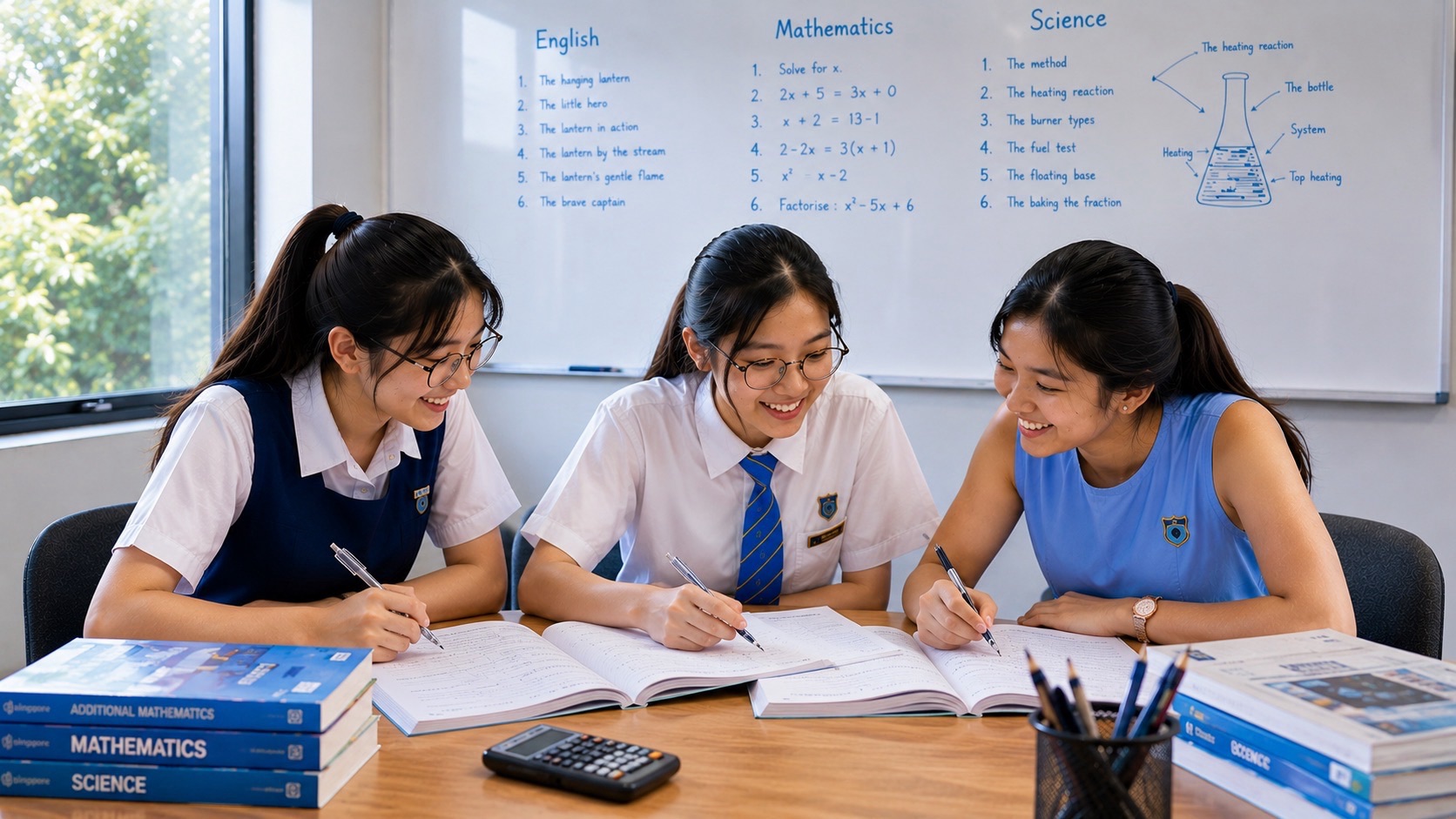
The original 2015 page promoted Mathematics tuition in Punggol and contained time-specific tutor and contact information. Those operational claims are retired. The historical classroom photographs remain as provenance.


The core principle
When pace destroys useful feedback, reduce pace. When the weak layer becomes visible, repair it. When reliability returns, vary the task. When transfer survives, restore speed.
2026 Teaching Extension: Rebuilding Mathematical Control After Confidence Has Collapsed
When a student has experienced repeated failure, the learning problem changes. The Mathematics may still be teachable, but the learner may now rush, freeze, avoid starting or depend heavily on reassurance. The correct response is not to label the student weak or to manufacture easy success indefinitely. It is to rebuild control: make the failure understandable, repair the earliest unstable layer, generate reliable success, then restore variation and pressure gradually.
1. Treat the confidence signal as evidence, not the diagnosis
“I hate Maths”, “I always get this wrong” or refusal to begin tells us that the learner’s experience has become unproductive. It does not yet tell us why. Inspect the work. Is the student missing a concept, misreading questions, working too quickly, carrying an older prerequisite gap or losing accuracy only under time?
This distinction protects the learner from identity language. The teaching problem becomes a state that can be investigated rather than a permanent statement about ability.
2. Reconstruct the last reliable point
Take a failed solution and move backwards until the student can explain what is happening. Perhaps the algebra is clear until fractions appear. Perhaps the concept is understood but method selection fails. Perhaps the learner can solve slowly but loses signs once timing is introduced.
The last reliable point gives the tutor an entry. Teaching can restart from something the learner genuinely owns rather than from a page that already feels impossible.
3. Reduce load without reducing intellectual honesty
Temporarily simplify the task: fewer simultaneous steps, cleaner numbers, one representation, more visible working. The purpose is to expose the mathematical structure and let the student observe cause and effect again.
But the work should still require thought. If every question becomes trivial, the learner may feel better without regaining transferable capability. Calibrated difficulty is the aim: hard enough to be meaningful, clear enough that error remains interpretable.
4. Rebuild the model before restoring speed
Use representations that reveal structure: diagrams, number lines, graphs, tables, verbal explanations or simpler algebraic cases. Ask the learner to predict what a step should do before carrying it out. This shifts attention from “Will I get it wrong?” toward “What relationship am I working with?”
When the model is stable, reconnect it to standard school and examination forms. The student should not remain dependent on the simplified representation forever.
5. Build success that survives variation
Repeated success on one familiar pattern can restore mood while leaving the original fragility untouched. Once accuracy returns, change numbers, wording, diagrams and method cues. Mix nearby problem types. Ask the learner to explain why the same principle still applies.
Confidence becomes more trustworthy when the student can succeed after the surface changes. The learner begins to gather evidence: “I can recognise this even when it does not look exactly like the example.”
6. Teach recovery as a separate mathematical skill
Students who fear mistakes often erase everything or wait for the tutor to rescue them. Instead, teach reconstruction. Where is the first line that no longer follows? What did you expect there? Can you test the result another way? What information remains correct?
Recovery makes errors less catastrophic because the learner has a route back into the problem. This does not remove disappointment; it gives the disappointment somewhere useful to go.
7. Restore timing and examination pressure in layers
Once accurate performance survives variation, introduce short timed sets. Observe what pressure changes. Does the student stop representing the problem, skip working, make more arithmetic errors or become trapped on one question? Timing should reveal the next weakness rather than simply reproduce the old experience of failure.
Progress toward full-paper conditions gradually. The target is not “feel no pressure”. It is “retain enough mathematical control to keep acting productively under pressure”.
8. Return the recovery process to the student
The tutor should eventually need to do less of the emotional and mathematical regulation. The student learns to notice “I am rushing”, slow one step, identify the error category, retrieve the prerequisite and decide whether help is actually required.
The strongest outcome is not a student who never struggles again. It is a student who knows how to re-enter Mathematics after struggle. That capability is more durable than temporary confidence because it contains a repair route.
Mathematics recovery check
- Is the confidence signal being investigated rather than treated as the cause?
- Can tutor and learner locate the last reliable point?
- Has task load been reduced without making the work meaningless?
- Is the mathematical model being rebuilt before speed returns?
- Does success survive changed surface features?
- Can the learner recover from an error without restarting everything?
- Is timing being restored gradually and diagnostically?
- Can the student increasingly initiate the recovery process alone?
First published 15 May 2015 as “Empowering Maths Tuition”. Rebuilt in 2026 as a durable Mathematics recovery and confidence article while preserving the original URL and historical context.
Confidence Collapse Usually Begins With Repeated Unresolved Evidence
Mathematics confidence rarely collapses because of one difficult question. More often, the learner experiences a sequence: a topic becomes confusing, errors repeat, the class moves on, later topics reuse the same weak foundation and the student begins interpreting difficulty as evidence about identity rather than about a repairable dependency.
The emotional signal matters, but it is not the diagnosis. “I am bad at Mathematics” may actually mean “I cannot manipulate negative numbers reliably”, “I do not know how to translate word problems”, “fractions are still effortful” or “I panic when I cannot identify the method immediately.” These are different problems and all are more actionable than the global label.
The First Repair Is to Narrow the Claim
A tutor can reduce threat by making the problem smaller and more specific. Instead of accepting “I cannot do algebra”, ask which algebraic action fails first. Is the student confused by letters as quantities? Does expanding brackets break? Are signs lost? Can equations be solved when the numbers are simple?
Specificity matters psychologically and mathematically. A narrow problem has boundaries. It suggests a next action. A global identity statement has none.
Use evidence language
- “You can solve one-step equations, but signs become unstable when there are brackets.”
- “Your fractions are accurate when denominators match; the difficulty begins when you need equivalent fractions.”
- “You know the formula, but you are not recognising when the question is asking for it.”
- “The method is correct; most losses are occurring during execution.”
These statements preserve honesty while showing that the learner still has functioning mathematical assets.
Find the Last Reliable Point
When confidence is low, tutors sometimes restart too far back or continue too far ahead. A better approach is to locate the last reliable point in the dependency chain. The learner should experience enough success to regain control, but the work must remain intellectually relevant to the real weakness.
For a Secondary student struggling with linear equations, the last reliable point might be simplifying expressions. For a Primary learner struggling with percentage, it might be fraction equivalence. For an A-Math student struggling with calculus, it might be algebraic manipulation after differentiation.
The three-question test
- Can the student explain the prerequisite in their own words?
- Can they perform it accurately without heavy prompting?
- Can they use it in a changed example?
When all three are yes, move one step forward. The rebuild becomes evidence-based rather than emotional guesswork.
Reduce Cognitive Load Without Making the Mathematics Fake
A frightened learner often benefits from temporarily simpler numbers, fewer steps or a cleaner diagram. This is not lowering standards if the mathematical structure remains the same. The purpose is to expose the relationship without unnecessary load.
For example, a student who cannot understand simultaneous equations may first work with integer solutions and simple coefficients. Once elimination or substitution makes sense, complexity can return. The learner should know that the simplification is a temporary lens, not the final standard.
Keep one difficulty at a time when rebuilding
If the target is method selection, avoid also introducing messy arithmetic and unfamiliar notation. If the target is algebra manipulation, use a context-free example before returning to a long word problem. Isolating the variable helps both diagnosis and learning.
Success Must Be Real Enough to Change Belief
Artificial success does not rebuild confidence for long. If the tutor gives so many hints that the learner cannot reproduce the method independently, the student knows the success was borrowed. Strong rebuilding creates tasks that are reachable but still require the learner to operate the key decision.
The best confidence receipt is an independent changed example. The student recognises, selects, executes and checks without the original prompt. That experience provides evidence against the belief that Mathematics is uncontrollable.
Repeat success across variation
One correct answer can be luck or short-term memory. Several correct answers with changed numbers, wording or representations show a more stable capability. Confidence should follow this repeated evidence.
Error Classification Reduces Shame
Students who call every mistake “careless” or “stupid” turn errors into character judgements. Useful categories create distance between person and mechanism.
- Concept error: the relationship was not understood.
- Retrieval error: known knowledge was unavailable.
- Selection error: the wrong method was chosen.
- Representation error: words, graph or diagram were translated incorrectly.
- Execution error: a correct plan broke in calculation or algebra.
- Time error: the student knew what to do but decision cost was too high.
- Recovery error: one difficult item disrupted the rest of the work.
The learner is not the error. The error belongs to a category with a repair method.
A 90-Minute Mathematics Recovery Lesson
10 minutes: retrieve secure ground
Begin with material the student has previously mastered but has not just practised. This establishes a truthful baseline and reminds the learner that mathematical knowledge still exists.
15 minutes: diagnose the first break
Use a short sequence of examples that gradually increases dependency. Stop when the reasoning first becomes unstable.
20 minutes: rebuild the model
Explain the relationship using a representation suited to the learner: number line, bar model, diagram, algebra, table or simpler numerical case.
20 minutes: guided variation
Change surface features while preserving the structure. Ask the student to explain what remains the same.
15 minutes: independent test
Remove prompts. The learner attempts a fresh question personally. The tutor observes before intervening.
10 minutes: error and next step
Classify any remaining breakdown and set one small retrieval task. The learner should leave knowing what improved and what is next.
Three Mathematics Recovery Pathways
Foundation rebuild
The student lacks a high-dependency prerequisite. Temporarily step back, rebuild the relationship and return to current work quickly enough that the learner remains connected.
Performance stabilisation
The concepts are mostly known but results fluctuate. Build working conventions, method-selection practice, checking and timing routines.
Confidence after high-level failure
Strong students can also lose confidence after moving into a harder course. The repair is not endless easy work. Use evidence to separate genuinely new difficulty from identity threat and build a sequence of successful high-level transfers.
Worked Example: Primary Mathematics Confidence Collapse Around Fractions
A Primary 5 pupil begins avoiding Mathematics after several poor tests. The visible weakness is percentage, but diagnostic work shows that fraction magnitude and equivalence are still uncertain. The child treats 1/8 as larger than 1/6 because eight is larger than six and cannot move flexibly between 1/4 and 25%.
The tutor pauses percentage work temporarily and rebuilds fraction meaning with diagrams, number lines and benchmark fractions. The child compares quantities, creates equivalents and explains why larger denominators can mean smaller parts when the whole is fixed.
Then percentage returns. Now the learner sees 25% as one quarter rather than an isolated conversion rule. A changed word problem is solved independently. Confidence improves because the original topic becomes understandable through a repaired dependency.
Worked Example: Secondary Algebra Collapse After Repeated Sign Errors
A Secondary 1 student understands equations conceptually but loses signs when expanding brackets and moving between lines. The student begins saying algebra is impossible. The tutor narrows the problem to signed manipulation.
Practice uses clear line spacing and colour-free structural marking: identify the sign before the bracket, distribute systematically and check by substitution. Once accuracy holds on simple expressions, the same discipline is placed back inside equations.
The student discovers that algebra was not globally broken. One execution layer was unstable.
Worked Example: A-Math Student Who Panics on Unfamiliar Questions
A strong Secondary 4 student performs well on familiar chapter exercises but freezes when an examination question combines functions and calculus in a new form. The confidence problem is actually transfer.
The tutor stops reassuring and instead trains decomposition. What information is given? Which object is a function? What derivative relationship is relevant? Which part can be solved independently? Mixed questions are gradually varied so unfamiliarity becomes expected rather than threatening.
Confidence returns through repeated experience of entering a question without immediately knowing the whole route and still making progress.
Speed Should Return in Layers
Students recovering from Mathematics fear often want to prove improvement by becoming fast. Tutors should resist premature timing. First restore accurate concept and method. Then add selection among mixed questions. Then use short timing windows. Full-paper pressure comes later.
The learner should understand that temporary slowness can be part of rebuilding. Speed earned through fluency is durable. Speed forced through anxiety is brittle.
Use timing diagnostically
If a student is slow, record where time is spent. Is retrieval delayed? Is the learner rereading the question? Are too many methods being considered? Is checking repetitive because confidence is low? Each cause needs a different intervention.
Recovery During an Examination
Confidence is tested most when a question resists the first attempt. Students need a procedure that prevents one difficult item from becoming a story about the entire paper.
- Read the question again for conditions and what is actually required.
- Write down known relationships or formulas that are definitely relevant.
- Attempt a representation or simpler case.
- If progress stops, mark the question and move on.
- Return later with fresh attention.
- Check that earlier panic did not cause skipped items elsewhere.
This is mathematical recovery: continue extracting value even when full control is temporarily absent.
Parents Can Help by Changing the Language Around Difficulty
Statements such as “You have never been good at Maths” make a temporary performance pattern sound permanent. Equally, empty reassurance—“You’re brilliant, don’t worry”—may conflict with the child’s evidence.
More useful language stays specific: “Your fractions are stronger than last month; the remaining problem is method selection in mixed questions.” “This test was weak, so let’s see which error category repeated.” Specificity keeps the conversation inside the repairable system.
Frequently Asked Questions
Should a student stop doing difficult questions after confidence collapses?
Temporarily reduce complexity if needed, but difficult transfer must return. Permanent easy practice creates fragile confidence. The sequence should rebuild and then reintroduce challenge.
How quickly can confidence recover?
Some students respond within weeks when the bottleneck is narrow; others need longer because several dependencies and emotional associations are involved. Look for changes in control and willingness before expecting every mark to jump.
What if the student knows the work at home but fails in tests?
Then the problem may include timing, threat, method selection or recovery under pressure. Practise under gradually more realistic conditions after knowledge is secure.
Is confidence necessary before competence?
Not always. Often competence begins first and confidence follows repeated evidence. The tutor should create honest success rather than waiting for the learner to feel confident before attempting meaningful work.
When Mathematics Confidence Collapses: The Durable Recovery Principle
Do not argue with the feeling and do not accept the identity conclusion. Use the feeling as a signal. Find where the Mathematics first breaks, reduce unnecessary load, rebuild the underlying model, vary the examples and let confidence grow from independent receipts.
The goal is larger than a better score. It is a learner who knows how to recover when a future mathematical challenge makes competence feel temporarily unavailable.
A Four-Week Recovery Cycle
When confidence has collapsed, a short visible cycle can help the learner experience progress as a system rather than as hope. The exact pace varies, but the sequence matters.
Week 1: locate and simplify
Map the first unstable dependency, reduce unnecessary load and rebuild the concept on manageable examples. The student should leave with a clear explanation of what was actually broken.
Week 2: vary and retrieve
Return after delay. Use changed numbers, wording or representations. The learner explains what remains mathematically the same. Correct only the recurring mechanism.
Week 3: mix and select
Place the repaired skill among other topics so the student must decide when to use it. This is where borrowed confidence becomes tested capability.
Week 4: restore pressure
Introduce short timing, a mixed section or a small examination-style task. The aim is to see whether control survives mild pressure, not to recreate the original threat too early.
If performance collapses at any stage, do not interpret that as failure of the whole recovery. Identify which layer became unstable and restore only the support needed there.
The Difference Between Encouragement and Evidence
Encouragement can help a learner re-enter Mathematics, but evidence is what changes the long-term belief. ‘You can do it’ matters less than ‘You solved three changed examples independently after a week.’
Tutors and parents should therefore collect small receipts. Keep one previously impossible question that later became solvable. Record a repeated error category that disappeared. Notice when the student begins explaining the method without prompting. These concrete changes are powerful because they contradict the global belief with observable performance.
When Confidence Collapse Is Really Workload Collapse
Sometimes the Mathematics itself is not the only issue. The student may be sleep-deprived, carrying too many subjects, rushing between classes or facing several assessments at once. Under high load, retrieval and working memory become less reliable, and Mathematics performance can deteriorate quickly.
A recovery plan should therefore inspect the whole learning environment. If the child is technically capable but chronically exhausted, adding more Mathematics volume may deepen the problem. Reduce friction where possible, protect sleep and use focused practice with feedback.
When to Re-accelerate
- the prerequisite can be retrieved after delay;
- changed examples are solved without heavy prompting;
- the student can name the old error mechanism;
- mixed work no longer causes immediate shutdown;
- short timing does not destroy accuracy; and
- the learner can recover from one difficult item and continue.
Re-acceleration should follow evidence of control. The learner does not need to feel perfectly fearless. Confidence often continues catching up after capability has already improved.
What Progress Looks Like Before Marks Fully Recover
Confidence recovery should be measured through behaviour as well as scores. The student begins attempting questions without immediate avoidance, can name the first point of uncertainty, uses a representation instead of freezing, and accepts correction without treating it as proof of inability.
- the learner starts sooner;
- the old error category appears less often;
- questions become more precise;
- changed examples are attempted with less prompting;
- working becomes easier to inspect;
- one difficult item no longer destroys the whole session; and
- timed practice can be introduced without sharp loss of accuracy.
These are meaningful receipts because they show control returning. Marks often follow after the process stabilises.
The End Goal Is Not Permanent Confidence
Even strong mathematicians encounter problems that create uncertainty. The durable capability is not feeling confident at every moment. It is knowing how to operate when confidence temporarily disappears: locate the problem, retrieve what is known, choose a representation, seek precise help if needed and continue.
That makes recovery transferable. The student is not protected from future difficulty; the student is equipped to meet it.
A Four-Week Mathematics Recovery Cycle
Confidence recovery becomes easier when the learner can see a finite sequence rather than an endless remedial programme. A four-week cycle can create enough repeated evidence to test whether control is returning.
Week 1: locate and simplify
Map the first unstable dependency. Use clean examples, simpler numbers or clearer representations while preserving the real mathematical structure. The student should finish the week able to explain exactly what had been breaking.
Week 2: vary and verify
Change the surface. Use different wording, diagrams or values so the learner cannot succeed by remembering one example. Retest after a day or two without notes. The target is independent reconstruction.
Week 3: mix and select
Place the repaired idea among neighbouring topics. The student must decide when the method applies. This is often where false confidence is exposed, because topic labels disappear.
Week 4: restore pressure
Introduce short timed sections and one more realistic mixed task. Timing should reveal whether knowledge remains available under load. If performance collapses, return to the specific failed layer rather than declaring the whole recovery unsuccessful.
The four-week cycle is not a promise that every confidence problem resolves in a month. It is a practical diagnostic window: rebuild, vary, mix, pressure, then decide what still needs work.
Confidence Recovery Should Be Visible in Behaviour
A learner may still say “I hate Maths” while already showing meaningful recovery. Behaviour often changes before self-description. The student begins attempting a question before asking for help, keeps working after one mistake, checks a sign independently or can explain what kind of problem is present.
- fewer blank starts;
- more precise questions;
- less copying from examples;
- more willingness to show working;
- faster recovery after an incorrect attempt;
- better ability to name the error category; and
- more success on changed examples.
These behaviours are valuable because they indicate control. The emotional narrative may take longer to catch up.
What Not to Do After Confidence Collapses
Do not flood the learner with easy worksheets
Easy success can reduce immediate fear but may teach the student that real Mathematics is still unsafe. Use easier work only to reconstruct the missing relationship, then return deliberately to meaningful challenge.
Do not jump straight to motivational speeches
Encouragement helps, but the learner’s negative belief is often grounded in repeated evidence of failure. The strongest counter-evidence is a repaired capability that survives variation.
Do not hide mistakes
If adults correct work before the learner sees the error, the child loses the chance to practise diagnosis and recovery. Make mistakes inspectable and survivable.
Do not restore speed too early
Rushing can recreate the same errors and confirm the learner’s fear. Accuracy, selection and transfer need to stabilise first.
How a Three-Student Group Can Help Recovery
A small group can reduce the sense that difficulty is uniquely personal. Students see that different peers struggle with different layers. One may misread the problem, another may make an algebra error and another may know the method but freeze under timing.
The tutor can compare approaches without ranking the students. Peer explanation also creates a useful role shift: the learner who struggled last week may be able to explain today’s repaired idea to someone else. Teaching part of the method can strengthen ownership.
Protect against social threat
Small groups help only when errors are treated as information rather than entertainment. The tutor must prevent ridicule and avoid using one student’s speed as the standard for another student’s worth. Psychological safety keeps reasoning visible.
When Confidence Should Not Be the Primary Target
Sometimes the learner feels fine but Mathematics remains weak. In that case, confidence is not the problem. The student may simply be overconfident or unaware of gaps. Diagnosis still comes first.
Other times confidence is low because the course is genuinely demanding and the student is encountering appropriate challenge for the first time. The aim is not to remove every feeling of difficulty. It is to help the learner interpret difficulty as information and retain a method for responding.
The Student’s Personal Recovery Script
Older learners can carry a short internal script into difficult work: “What do I know? What is the question asking? Which representation might help? What is the first step I can verify? If I am stuck after a reasonable attempt, what precise question do I need to ask?”
This script converts panic into operations. It does not guarantee an immediate solution, but it protects agency.
The Long-Term Receipt of Recovery
The deepest sign of recovery is not that the student never feels anxious again. It is that future difficulty no longer automatically becomes a verdict about identity. The learner has a tested process: locate the break, reduce load, rebuild, vary, retest and restore pressure.
That process can travel into later Mathematics, Science, coding, finance and any field where symbolic difficulty returns. Confidence becomes less fragile because it is attached to a method of recovery rather than to a promise that work will always feel easy.
Confidence Collapse Usually Has a History
A student rarely wakes up one morning and suddenly becomes “bad at Mathematics”. Confidence usually falls after repeated experiences: questions that once seemed manageable become slower, errors accumulate, school moves ahead before earlier gaps are repaired, comparisons with classmates increase, and the learner begins predicting failure before attempting the work.
The emotional response is real, but it is not yet the diagnosis. Fear, avoidance or shutdown tells us that the current learning system has become costly. We still need to locate why. The first useful question is not “How do we make the student confident again?” It is “Where does reliable mathematical control first disappear?”
That point may sit far earlier than the visible topic. A Secondary 2 student struggling with algebraic fractions may actually have weak fraction operations. A Primary 6 learner avoiding percentage may have insecure fraction equivalence. An A-Math student fearing calculus may be losing marks in algebra after the differentiation step.
Build a Failure Timeline Before Building a Recovery Plan
Ask the learner when Mathematics began feeling different. Look at marked work across several months, not only the latest test. Identify the first period in which repeated errors appeared, the topics that now trigger avoidance and the kinds of questions the student can still solve confidently.
The last reliable point
Find material that is still genuinely secure. This matters psychologically and academically. The recovery should begin close enough to competence that the student can think, but not so easy that success is meaningless.
The first unstable dependency
Move forward until performance becomes inconsistent. That boundary is often more useful than the grade-level label. The teaching job starts there.
The overload zone
Identify tasks where several weaknesses combine at once. A long word problem may involve reading, fractions, algebra and multi-step working. Recovering by attacking the full overload zone first can reinforce failure. Decompose it.
Separate Four Different Kinds of Mathematics Fear
Fear of not knowing
The student lacks the concept or prerequisite and expects confusion. The repair is teaching.
Fear of choosing wrongly
The learner knows several methods but cannot tell which one applies. The repair is discrimination practice.
Fear of making mistakes in public
The Mathematics may be partly secure, but the social cost of being wrong has become high. The learning environment needs safer error visibility and enough private attempt time.
Fear of time
The learner can solve accurately without pressure but collapses when a timer appears. The repair should separate method fluency, selection speed and examination recovery instead of adding more full papers immediately.
These fears can coexist. Naming them prevents every anxious response from being treated as one general confidence problem.
Slow Down Without Making the Work Infantile
When confidence has collapsed, teachers sometimes respond with very easy worksheets. Easy success can reduce immediate threat, but if the material is far below the student’s level it can also feel dishonest or patronising. The better move is to reduce one dimension of load while preserving intellectual dignity.
Keep the real concept but simplify the numbers. Keep the same algebraic structure but remove an extra step. Keep the same problem but provide a diagram. Allow untimed work first. The student should experience authentic success on the actual learning pathway.
One variable at a time
If the learner is overwhelmed by fractions inside algebra, remove the algebra temporarily and stabilise fraction operations. Then reinsert the algebra. This makes the dependency visible and creates a cleaner sense of progress.
Rebuild the Mathematical Model Before Rebuilding Speed
Confidence often improves briefly when students memorise a shortcut, but shortcuts are fragile when the surface changes. Durable recovery requires a model the learner can reconstruct.
For equations, the model may be balance and equal operations on both sides. For fractions, it may be equal parts of the same whole. For ratio, multiplicative comparison. For graphs, relationships among variables rather than pictures to memorise.
Ask the student to predict
Before calculating, ask what should roughly happen. Should the answer increase or decrease? Should it be greater than one? Should a graph rise or fall? Prediction reconnects symbols to meaning and gives the student an error-detection tool.
The First Recovery Loop
- Retrieve the secure foundation. Begin from something the learner can still explain.
- Add one unstable layer. Teach the missing relationship explicitly.
- Practise with low surface variation. Build initial reliability.
- Change the surface. Verify that the learner recognises the same structure.
- Mix with nearby methods. Train selection.
- Return after delay. Test whether the repair survived.
- Add time pressure gradually. Only after accuracy and selection are stable.
This loop replaces vague encouragement with visible receipts. The student can see exactly what has become possible again.
Success Needs to Be Real Enough to Change the Learner’s Prediction
A student who has failed repeatedly often enters a question with a prediction: “I will get this wrong.” One correct answer does not necessarily change that model. Repeated successful transfer is more persuasive.
The goal is not praise alone. It is a sequence of experiences in which the learner can say, “I solved this without the tutor telling me the method. I solved it again with different numbers. I recognised it in mixed work. I remembered it a week later.”
Confidence becomes calibrated when it follows this evidence. The student does not need to believe every future question will be easy. The learner needs evidence that unfamiliar difficulty can be analysed and repaired.
Do Not Let the Tutor Become a Permanent External Working Memory
A struggling student often feels better when the tutor prompts every step. The lesson becomes smooth, but the learner may not be doing the decisions independently. This creates a dangerous illusion of recovery.
Fade prompts deliberately
Move from full explanation to partial prompt, then to a question, then to silence. If performance collapses, restore only the support needed and try again. The learner should gradually hold more of the method internally.
Require retrieval before rescue
When the student says “I forgot”, ask what can still be reconstructed. Which formula family? Which diagram? Which similar example? Retrieval effort reveals what remains and prevents immediate dependence.
A 90-Minute Mathematics Recovery Lesson
10 minutes: secure retrieval
Begin with material the student can do but that still matters to the current dependency. The purpose is to establish a stable starting state.
20 minutes: rebuild one weak relationship
Teach the concept using a clear representation and explain why the method works.
20 minutes: guided variation
Change numbers, wording or representation while keeping the same underlying structure.
15 minutes: independent attempt
Remove prompts. The learner attempts a fresh problem and explains the chosen method.
15 minutes: mixed selection
Place the repaired idea beside other methods. The student decides when it applies.
10 minutes: correction and receipt
Classify any remaining error and record what the learner can now do independently.
Three Recovery Pathways
Foundational repair
The learner has genuine prerequisite gaps. Prioritise dependencies with the largest downstream effect and resist pressure to keep racing through current chapters without repair.
Performance stabilisation
Knowledge exists but marks fluctuate. Build method selection, working clarity, accuracy routines, timing and recovery.
Re-acceleration
The learner has rebuilt control. Increase difficulty and speed in layers, keeping enough margin that one hard question does not recreate the old collapse pattern.
Worked Example: The Primary 6 Student Who Fears Fractions
A student sees any fraction question and immediately says, “I cannot do fractions.” Diagnostic work shows that identifying equivalent fractions is mostly secure, but subtraction with unlike denominators is unstable. The global identity statement is much larger than the actual weakness.
The tutor isolates the operation, uses visual fraction models to reconnect common denominators to equivalent parts and practises a small set until the method is reliable. Changed contexts follow. Then fraction subtraction is reinserted into word problems.
The learner now has a more accurate statement: “I used to lose control when denominators were different, but I know how to create equivalent fractions first.” Precision itself reduces fear because the problem has boundaries.
Worked Example: The Secondary Student Who Freezes on Algebra
A Secondary student can simplify expressions in chapter exercises but freezes on mixed questions. The issue is not basic algebraic manipulation. It is recognising which operation is required when the method is not announced.
The recovery therefore mixes factorisation, expansion, equation solving and substitution. Before solving, the learner names the structure and explains what the question is asking. The class initially allows extra decision time, then gradually shortens it as selection becomes more fluent.
Worked Example: The A-Math Student Who Lost Confidence After Calculus
A student performs differentiation correctly but repeatedly fails stationary-point questions. Detailed inspection reveals weak quadratic solving and sign analysis after the derivative is obtained. The visible topic is calculus; the dependency debt is algebra.
Repair algebra directly, then reconnect to calculus. The student experiences that “calculus failure” was partly a misdiagnosis. Reconstructing the chain often restores agency because the learner can see what to work on.
How Parents Can Respond to a Confidence Collapse
- avoid turning one test into a fixed identity;
- ask which topic or step first became unreliable;
- bring marked work rather than only the final score;
- separate fear from diagnosis;
- look for smaller real receipts of capability;
- protect sleep and avoid emergency overloading;
- praise useful recovery behaviours, not only high marks; and
- expect support to reduce as control returns.
The family’s role is not to insist that the child feel confident immediately. It is to help create conditions in which confidence can become evidence-based again.
Frequently Asked Questions
Should a student stop timed practice completely?
Sometimes temporarily. If timing is causing repeated collapse before the method is stable, remove or reduce pressure while rebuilding. Reintroduce timing in smaller segments once accuracy survives variation.
How long does confidence recovery take?
It depends on the cause. One misdiagnosed topic can improve quickly. Years of accumulated dependency debt take longer. Track the mechanism rather than promising a date.
Should we move the student to easier Mathematics permanently?
Not automatically. First determine whether the difficulty is temporary, foundational, selection-based or a mismatch with the current level. Educational pathway decisions should use sustained evidence, not one period of fear.
What is the best early sign of recovery?
The student begins attempting unfamiliar work with a process instead of immediate shutdown. Even before marks fully recover, the learner can locate uncertainty and choose a next action.
When Mathematics Confidence Collapses: The Durable Recovery Principle
Slow down enough to find the truth. Reconstruct the last reliable point. Repair the first unstable dependency. Build real success on changed examples. Restore selection, speed and examination pressure only after the mathematics can carry them.
The goal is not a student who never feels uncertain. It is a student who knows uncertainty can be investigated, bounded and repaired. That is mathematical confidence with evidence behind it.