
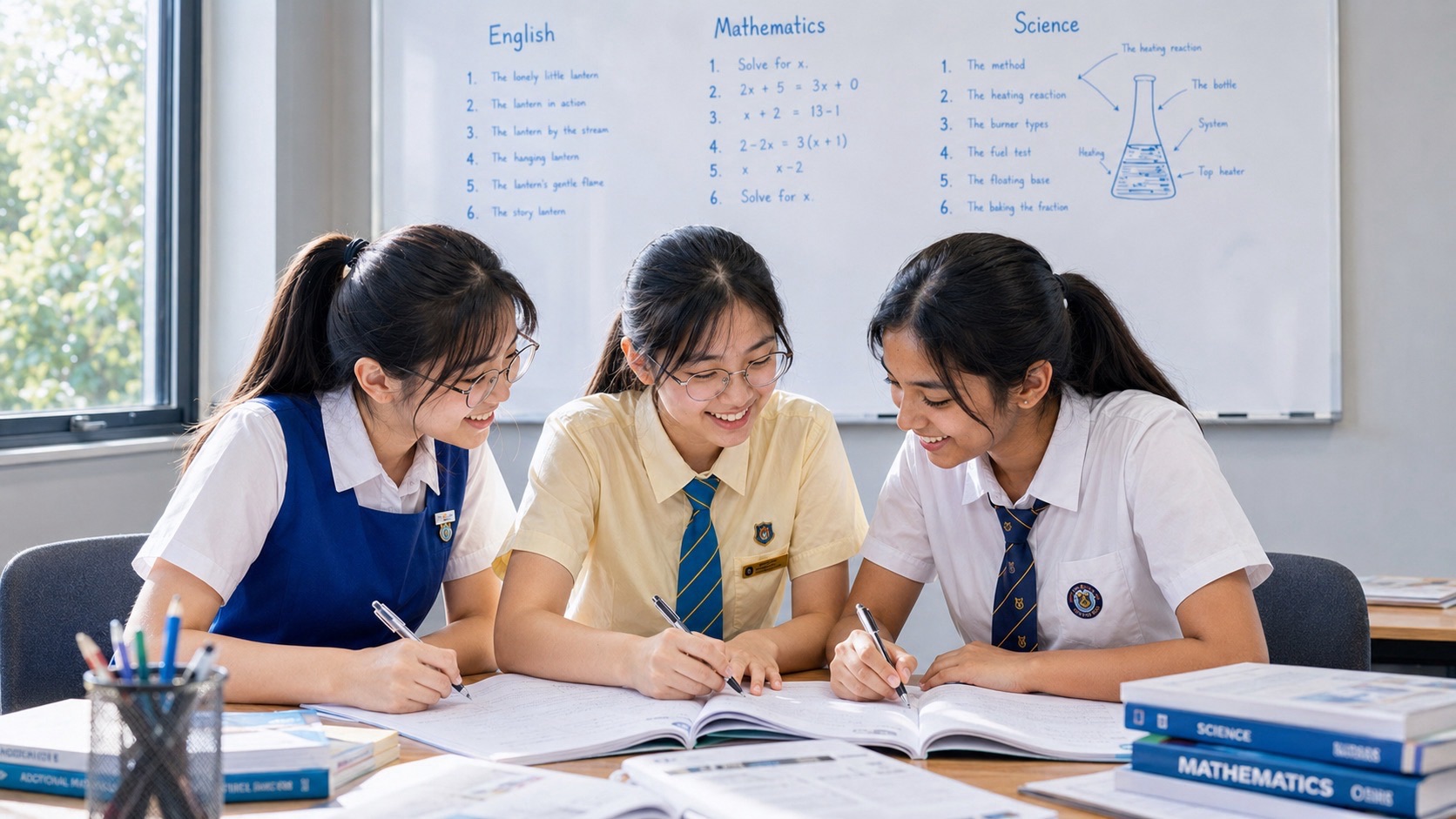
Historical Punggol service archive, rebuilt in 2026. This page originally advertised Sec 3–4 Additional Mathematics tuition in Punggol using the former 4047 syllabus, fixed lesson packages, tutor-experience claims and an old contact number. Those service details are retired. The useful RFE remains: what order should Additional Mathematics capability be built in, and why does that order matter?
Quick Read
Additional Mathematics is highly dependent. Weak algebra damages functions. Weak functions make trigonometry and calculus harder. Weak calculus damages kinematics. Strong students therefore do not merely “finish chapters”; they build a dependency chain that remains reliable when topics are mixed under examination conditions.
One-sentence answer: build A-Math in the order that later ideas actually depend on earlier ones: algebra → functions → trigonometry → calculus → applications → mixed transfer → exam execution.
The RFE of this page
This URL now owns the A-Math dependency-sequencing job. It is not the broad canonical explanation of Additional Mathematics, and it is not a current Punggol schedule page.
For current specialist Mathematics material, see BukitTimahTutor.com. For current eduKate contact information, use eduKateSG Contact.
Current examination context
The historical page referred to Additional Mathematics syllabus 4047. That is obsolete for current candidates.
For the 2026 Singapore-Cambridge GCE O-Level cohort, SEAB lists Additional Mathematics 4049. From 2027, under the Singapore-Cambridge Secondary Education Certificate (SEC), SEAB lists G3 Additional Mathematics K341, mapped from 4049.
The examination label changes. The dependency structure of the Mathematics remains recognisable.
A-Math is not simply “more E-Math”
Additional Mathematics increases symbolic density and asks students to operate on functions and relationships with much less contextual support.
A learner may understand ordinary Mathematics well but still struggle when:
- several algebraic steps must be held together;
- one expression has to be transformed before the next method becomes visible;
- trigonometric identities require recognition rather than direct substitution;
- calculus depends on prior function control;
- topics are mixed and the chapter name no longer tells the student what to do.
The subject therefore rewards structure, not just effort volume.
Dependency 1 — Algebraic control
Algebra is the load-bearing layer.
Students need reliable control of:
- expansion and factorisation;
- quadratics;
- equations and inequalities;
- indices and surds;
- logarithmic manipulation;
- polynomials;
- algebraic fractions;
- changing forms without changing meaning.
If these operations remain slow or error-prone, later topics consume too much working memory.
Why algebra debt compounds
A sign error in basic expansion looks small. In A-Math it can contaminate:
- quadratic identities;
- function manipulation;
- trigonometric identities;
- differentiation;
- integration;
- kinematics.
Repairing the earliest weak algebraic link can therefore improve several later chapters at once.
Dependency 2 — Functions and graphs
Functions provide the language that connects algebra to calculus.
Students should become comfortable with:
- function notation;
- domain and range where relevant;
- graphs and transformations;
- roots and intercepts;
- exponential and logarithmic functions;
- how a symbolic rule appears geometrically.
Without function thinking, calculus becomes a set of differentiation rules detached from what is actually changing.
See also: Graphs: Intercepts, Stationary Points, Turning Points and Asymptotes.
Dependency 3 — Trigonometry
A-Math trigonometry requires more than remembering SOH-CAH-TOA.
- functions for angles of wider magnitude;
- exact values;
- identities;
- equations;
- graph relationships;
- radian measure in later mathematical contexts.
The difficult step is often recognition: which identity or transformation will expose the route?
This is why students who only practise questions chapter-by-chapter can appear strong until topics are mixed.
Dependency 4 — Differentiation
Differentiation turns function behaviour into rate-of-change information.
Students should connect the symbolic rule to the geometry:
- derivative as gradient;
- stationary point where derivative is zero;
- increasing and decreasing behaviour;
- maxima and minima;
- optimisation;
- rates of change.
If the learner can differentiate mechanically but cannot explain what the derivative means, later application questions remain fragile.
Dependency 5 — Integration
Integration is connected to accumulation and area, while also operating as an inverse relationship to differentiation in the school calculus framework.
Students need:
- algebraic fluency before integrating;
- recognition of integrable forms;
- care with constants;
- interpretation of definite integrals;
- connection between graphs and accumulated quantities.
Integration errors are often algebra errors wearing a calculus label.
Dependency 6 — Kinematics and applications
Kinematics tests whether calculus can be applied to a physical model.
The student must coordinate:
- displacement;
- velocity;
- acceleration;
- differentiation;
- integration;
- initial conditions;
- sign and direction;
- physical interpretation.
A mathematically correct expression can still be physically misinterpreted. Application requires both calculus and model judgement.
The sequence is a dependency map, not a rigid timetable
The old page divided A-Math into four fixed “packages” with nominal hours. That made sense as a historical course schedule, but it should not be mistaken for a universal learning timetable.
Students differ in:
- prior algebra;
- school sequence;
- retention;
- transfer;
- speed;
- accuracy;
- confidence;
- ability to recover after an error.
The dependency order matters more than pretending every topic needs the same number of hours for every learner.
Same score, different A-Math failure
| Observed pattern | Likely next job |
|---|---|
| Cannot start many questions | Concept, recognition or prerequisite diagnosis |
| Starts correctly but loses marks midway | Algebraic execution and checking |
| Strong within chapters, weak in prelim papers | Mixed-topic discrimination and transfer |
| Understands but runs out of time | Retrieval speed, method efficiency and exam pacing |
| Calculus rules memorised but applications fail | Function meaning and modelling |
A useful intervention begins with the marked work, not with the total grade alone.
Worked examples are scaffolds, not proof of mastery
A learner can follow an A-Math solution line by line and still be unable to reproduce the route independently.
A stronger progression is:
worked example → guided near example → independent near example → changed form → mixed-topic question → delayed retrieval.
That sequence tests whether the method survives after the cue is removed.
Mixed practice is where method selection develops
When a worksheet is titled “Trigonometric Identities”, the title has already told the learner what machinery to use.
Examinations remove that support.
Students therefore need practice that mixes:
- algebra;
- functions;
- trigonometry;
- coordinate geometry;
- differentiation;
- integration;
- kinematics.
The learner must first identify the mathematical structure before selecting the method.
Accuracy is structural
A-Math has long dependency chains inside individual solutions. One early sign error can contaminate the remaining working.
Useful checking points include:
- signs after expansion;
- domain restrictions;
- extraneous roots;
- calculator mode;
- exact versus approximate form;
- whether a stationary point was classified;
- whether the final result answers the quantity requested.
“Be more careful” is too vague. Build explicit checks at predictable risk points.
Exam execution is the final layer
Once the Mathematics is stable, students need to coordinate it under time.
- retrieve without notes;
- recognise question type quickly;
- allocate time sensibly;
- leave and return when stuck;
- protect easy marks;
- check high-risk algebra;
- maintain working clarity so recovery is possible.
Past-paper volume becomes most valuable after enough of the dependency chain is secure.
AI and Additional Mathematics
AI can generate flawless-looking A-Math solutions quickly. That can make a student appear fluent while the dependency chain remains weak.
Use AI to:
- generate one changed-form question;
- compare two solution routes;
- give one hint after an attempt;
- identify where two lines of working cease to be equivalent;
- test a misconception with a counterexample.
Do not treat a generated solution as evidence that the learner can reproduce the reasoning. The tool-removal test remains decisive.
What parents should ask
- Which prerequisite is currently limiting progress?
- Are errors conceptual, algebraic, transfer-related or examination-related?
- Can the student solve a changed version?
- Can old topics still be retrieved?
- Is the learner becoming less dependent on prompts?
- Is practice moving from chapters toward mixed papers at the right time?
Teaching Guide: Build the A-Math Dependency Chain Before Chasing Hard Questions
Additional Mathematics becomes manageable when the learner sees it as a dependency system rather than a pile of difficult chapters. Algebra supports functions; functions support graph interpretation; trigonometric identities rely on symbolic control; calculus relies on functions and algebra; kinematics asks the learner to connect calculus to a physical relationship. When an A-Math student appears to be weak everywhere, one earlier dependency can be responsible for several later symptoms. Diagnosis should therefore begin by tracing the first unreliable layer, not by assigning more full papers immediately.
The worked examples below are original teaching examples. They are designed to expose the decisions behind successful A-Math work rather than imitate a protected examination paper. Current candidates should still use the relevant official syllabus and current school guidance for examinable content and assessment conditions. The durable educational job of this historical page is narrower: help a learner build, repair and test the mathematical spine that allows current A-Math content to become usable.
Readiness Begins With Algebra That Survives Pressure
A student may appear ready for A-Math because ordinary algebra worksheets are completed quickly. The stronger readiness test is whether the same algebra remains accurate when it is embedded inside a longer problem. Can the learner expand a negative bracket without losing a sign? Can an equation containing fractions be rearranged cleanly? Can a quadratic be factorised or solved when no method is announced? Can exact surd and index forms remain under control while another concept is being tested?
Use short mixed questions to test this. The purpose is not to make a Primary or lower-secondary learner sit an A-Math paper prematurely. It is to identify whether the basic symbolic operations are sufficiently cheap in working memory. If every algebraic step requires reconstruction, a new calculus or trigonometry idea becomes much harder than it needs to be. A-Math readiness is therefore partly about the cost of using existing knowledge, not merely whether that knowledge has been seen before.
Worked Example 1: Algebra Debt Hiding Inside a Function Question
Suppose f(x) = x² − 5x + 6 and the learner is asked to identify the roots. Factorisation gives (x − 2)(x − 3), so the roots are 2 and 3. A student who knows what a root means but cannot factorise reliably may describe the function concept correctly while still failing the task. The repair belongs in algebra, not in a longer lecture about functions. Once factorisation is repaired, return immediately to the function so the learner sees why the algebra matters.
Now ask for the same quadratic in completed-square form. x² − 5x + 6 = (x − 5/2)² − 1/4. The minimum occurs at x = 5/2 with value −1/4. The factorised form makes roots visible; completed-square form makes the turning point visible. A strong A-Math learner is not merely able to transform one form into another. The learner understands why one representation is useful for the question being asked. Representation choice is part of mathematical control.
Functions: Input, Output, Domain and Inverse Must Stay Distinct
Function notation becomes dangerous when students read it only as decoration. If f(x) = 2x − 3, then f(5) means apply the rule to the input 5, giving 7. If f(a + 1) is requested, the whole input a + 1 replaces x: 2(a + 1) − 3 = 2a − 1. Missing the brackets changes the function being evaluated. The notation should therefore be connected to an input–output model, not memorised as a sequence of letters.
An inverse function does a different job from a reciprocal. If f(x) = 2x − 3, solving y = 2x − 3 for x gives x = (y + 3)/2, hence f⁻¹(x) = (x + 3)/2. This is not 1/(2x − 3). Check by composition: f(f⁻¹(x)) returns x. Students who blur the two notations often need a conceptual contrast, not additional speed drills. A-Math becomes more reliable when similar-looking symbols are tied to different mathematical operations.
Indices and Logarithms: Preserve the Conditions Behind the Rules
Index and logarithm laws are compact because they encode relationships. For positive a, a^m × a^n = a^(m+n) because repeated multiplication combines the counts of factors. The rule does not say a^m + a^n = a^(m+n). Addition has a different structure. A student who applies the exponent law to every nearby expression is matching surface symbols rather than the operation. Contrast multiplication and addition deliberately during teaching.
Similarly, log(ab) = log a + log b under the appropriate base and domain conditions, but log(a + b) does not split that way. Give a numerical counterexample with positive values if needed. Ask the learner what multiplication in ordinary numbers becomes in logarithmic form. Then use equations such as log₂ x = 5 to recover x = 32. The aim is to keep logs connected to powers so the student can reconstruct the rule when memory is uncertain.
Worked Example 2: Solve an Exponential Equation by Making the Structure Visible
Solve 3^(2x−1) = 27. Because 27 = 3³, equate exponents to obtain 2x − 1 = 3, hence x = 2. The quick method works because both sides are expressed in the same base. If the right side were not an obvious power of 3, a logarithmic method may be more appropriate. Method selection depends on the form presented. The student should learn to inspect the equation before reaching automatically for a calculator.
Now change the equation to 2^x = 7. There is no simple integer exponent. Taking logarithms gives x log 2 = log 7, hence x = log 7 / log 2. The exact symbolic expression can then be approximated numerically if the task requires it. This changed example tests whether the learner understands why logarithms are used rather than merely following a worksheet section titled “logarithmic equations”.
Trigonometry: Recognition Matters More Than Formula Volume
A-Math trigonometry often feels difficult because many expressions can be rewritten in more than one way. The productive question is not “Which identity did I memorise?” but “What form would make the two sides comparable?” When one side contains sin²x and cos²x, the identity sin²x + cos²x = 1 may be useful. When tan x appears beside sine and cosine, rewriting tan x as sin x / cos x can expose common structure. Recognition becomes easier when identities are grouped by purpose rather than memorised as an undifferentiated list.
Do not cancel terms across a sum. In (sin x + cos x)/sin x, the numerator contains two terms. Splitting the fraction gives 1 + cot x where defined; cancelling “sin x” from only one part of the numerator is invalid. This is another example of algebra debt surfacing inside trigonometry. The repair is structural: factors can cancel; terms in a sum cannot be selectively removed. A-Math repeatedly rewards students who keep earlier algebraic rules active inside newer notation.
Worked Example 3: A Simple Identity Should Be Explained, Not Just Rearranged
Show that (1 − cos²x)/sin x = sin x for values where the expression is defined. Use the identity 1 − cos²x = sin²x, then divide by sin x to obtain sin x, provided sin x is non-zero in the original denominator. The domain condition matters. A proof-like manipulation is not complete if it silently changes where the expression is defined. This habit becomes more important as algebraic and trigonometric expressions grow longer.
Now ask whether the result means the two expressions are identical for every real x. The original expression is undefined when sin x = 0, while the simplified expression sin x is defined there. They agree on the original domain, but the simplified form has a wider domain if treated by itself. This is a sophisticated but practical lesson: simplification can preserve values where the original exists while hiding excluded inputs. Graphs and rational algebra expose the same issue.
Differentiation Should Connect Symbolic Rules to Graph Behaviour
When the student differentiates y = x³ − 3x, the derivative 3x² − 3 is not merely another expression. It tells us the gradient of the original function at each input. Setting it equal to zero gives x = ±1, the stationary candidates. Substitution into the original function gives the coordinates (−1, 2) and (1, −2). A sign chart for the derivative then classifies the first as a local maximum and the second as a local minimum.
Three different errors can occur here. The student may differentiate incorrectly, solve the derivative equation incorrectly, or classify the stationary points incorrectly. Each requires a different repair. If the derivative is correct but the coordinates are wrong, perhaps the learner substituted into the derivative instead of the original function. If the coordinates are correct but both are labelled minima, the derivative sign change or second-derivative interpretation needs attention. “Calculus is weak” is too broad to be useful.
Worked Example 4: Optimisation Requires a Domain Check
Suppose a rectangle has perimeter 20 units. If one side is x, the other is 10 − x, and the area is A = x(10 − x) = 10x − x². Differentiating gives dA/dx = 10 − 2x, so the stationary input is x = 5. The second derivative is −2, confirming a local maximum. The dimensions are 5 by 5 and the area is 25 square units.
The algebra alone should not make us forget the physical domain. Ordinary side lengths require 0 < x < 10. The candidate x = 5 lies inside that interval. At the endpoints the rectangle would collapse, so those boundary values are not part of the open physical domain. This example teaches the full optimisation loop: construct a model, identify its domain, differentiate, classify the candidate and interpret the result. A derivative calculation by itself is not the completed solution.
Integration: Always Ask What the Constant or Limits Mean
An indefinite integral represents a family of antiderivatives. Integrating 6x² gives 2x³ + C because every constant has derivative zero. Omitting C loses information. A definite integral, by contrast, evaluates accumulated change over specified limits and does not carry an arbitrary +C in the final difference because the constant cancels. Students who treat both forms as the same procedural object often make avoidable errors.
For example, ∫ from 1 to 3 of 2x dx equals [x²] from 1 to 3 = 9 − 1 = 8. If the graph of y = 2x lies above the x-axis on that interval, the value also matches the geometric area of a trapezium with parallel sides 2 and 6 and width 2: area = (2 + 6)/2 × 2 = 8. Two representations verify the same result. Connections like this make integration more than a symbol-manipulation routine.
Worked Example 5: Definite Integral Versus Geometric Area
Consider y = x − 2 between x = 0 and x = 4. The definite integral is [x²/2 − 2x] from 0 to 4 = 0. That does not mean there is no geometric region between the line and the x-axis. The signed area below the axis from 0 to 2 is −2, while the signed area above from 2 to 4 is +2, so they cancel in the integral. The total geometric area is 4. Students should know which quantity the task requests.
This distinction is another example of language controlling Mathematics. “Find the definite integral” and “find the total area between the curve and the x-axis” can produce different results even for the same graph. The calculus is not changing; the interpretation is. Teach students to mark where a curve crosses the axis before using one integral across a long interval. A correct antiderivative cannot repair a wrong model of the requested quantity.
Kinematics: Signs Carry Physical Meaning
Suppose displacement is s(t) = t³ − 6t² + 9t for t ≥ 0. Velocity is v(t) = 3t² − 12t + 9 = 3(t − 1)(t − 3). The particle is momentarily at rest at t = 1 and t = 3. Acceleration is a(t) = 6t − 12. These equations are mathematically linked, but interpretation still matters. A negative velocity indicates motion in the negative direction relative to the chosen axis; it does not mean the particle has a “negative speed”.
Use a sign chart for velocity to determine direction. At t = 0, velocity is positive. Between 1 and 3 it is negative, and after 3 it becomes positive again. A student who differentiates perfectly but reports “speed = −3” has an interpretation problem, not a differentiation problem. Kinematics makes the distinction visible because symbols represent physical quantities. A-Math teaching should preserve those meanings instead of allowing calculus to become a detached ritual.
A-Math Error Ledger: Record the First Broken Link
After a marked task, classify the earliest point at which the solution stopped being valid. Useful categories include algebraic transformation, method selection, representation, domain or condition, calculator entry, trigonometric identity choice, derivative rule, integration rule, interpretation and time. Do not record only the chapter title. “Differentiation error” is less useful than “product rule applied correctly, then quadratic solving failed.” The latter statement identifies the next repair.
Each ledger entry should end with a verification task that changes the surface. If a sign error occurred during expansion inside a differentiation question, use one fresh algebraic example and then one fresh calculus example. If the student succeeds only on the isolated algebra but fails again when calculus is present, the repair has not yet survived load. This is why A-Math correction should reconnect a dependency to the chapter where it originally failed.
A Ninety-Minute Three-Student A-Math Lesson
An illustrative lesson can begin with ten minutes of retrieval on high-dependency algebra. Twenty minutes develop one central concept using a worked example and contrast case. Twenty minutes allow guided practice with different support for each student. Twenty minutes then mix the new idea with an older topic so method selection is required. The final twenty minutes are for independent application, correction and a delayed follow-up task. This is a teaching model, not a guaranteed pace of mastery for every learner.
In a three-student class, one learner might need algebra repair, another might need trigonometric recognition, and a third might be ready for an extension problem. The shared topic can remain the same while the questions differ. What matters is that each learner eventually attempts independently. A group discussion can create understanding, but individual performance after the discussion is the evidence that the learner can carry the method personally.
Repair, Stabilise and Extend
The repair route goes backward to the earliest unstable dependency and rebuilds it directly. The stabilisation route mixes familiar methods, varies representation and checks retrieval after delay. The extension route increases ambiguity, combines chapters, asks for alternative methods or requires explanation of why a method works. Students can occupy different routes for different topics. A learner may be extending functions while repairing algebraic fractions. The purpose is not to assign a permanent label but to choose the next useful challenge.
Acceleration should begin only when the current layer is cheap enough to support the next one. A student who can follow a tutor’s calculus example but cannot reproduce the derivative after a delay is not yet ready to treat calculus as a secure base for kinematics. The same principle works in reverse: once repair has held under changed examples, do not keep the learner permanently in easy work. Reconnect to the current syllabus quickly so the student experiences repair as progress rather than demotion.
Mixed Practice Set
Task one: factorise x² − 7x + 10. Task two: find the inverse of f(x) = 3x + 4. Task three: solve 2^(x+1) = 16. Task four: simplify (1 − cos²x)/sin x on its original domain. Task five: find the stationary points of y = x³ − 3x. Task six: integrate 4x³ − 2x. Task seven: if s(t) = 2t³ − 9t² + 12t, find v(t) and the times at which the particle is instantaneously at rest.
The first answer is (x − 5)(x − 2). The second is f⁻¹(x) = (x − 4)/3. The third gives x + 1 = 4, hence x = 3. The fourth simplifies to sin x where the original denominator is non-zero. The fifth produces x = ±1 and coordinates (−1, 2) and (1, −2). The sixth gives x⁴ − x² + C. For the seventh, v(t) = 6t² − 18t + 12 = 6(t − 1)(t − 2), so the rest times are 1 and 2.
Do not stop at the answer list. For task one, expand to verify the factors. For task two, compose the function and inverse. For task four, explain the domain restriction. For task five, classify the stationary points. For task seven, inspect the sign of velocity to describe direction. These follow-up questions convert a result into evidence of mathematical understanding. A student who can produce the number but cannot explain the condition may still carry a fragile dependency forward.
Final Examination Preparation: Use Papers as Diagnostic Instruments
Once the dependency chain is sufficiently stable, full papers become valuable because they test retrieval, recognition, switching and time. After each paper, sort lost marks by mechanism. If algebraic errors dominate, repair algebra. If the student knows individual chapters but cannot identify which method applies, use mixed discrimination practice. If most mathematics is correct but the paper is unfinished, investigate retrieval speed, working efficiency and recovery from difficult questions. More papers are useful only when their evidence changes the next study action.
Do not spend the final weeks trying to learn every rare hard question while ordinary marks remain unstable. Protect standard algebra, function interpretation, trigonometric manipulation and core calculus first. Harder questions can then be used to widen transfer. A high-performing learner still benefits from checking known personal error categories such as sign changes, calculator mode, exact form and omitted constants. Examination calm is easier to build when the common machinery is reliable enough that one unfamiliar question does not feel like proof that the whole paper is lost.
Frequently Asked Questions
Should students memorise every identity and formula before doing questions? Important formulas need to be readily available where the current syllabus expects them, but memory should be tied to use. Learn identities in families, understand what form each one can create, and practise retrieval inside mixed questions. Current candidates should check their official syllabus and examination information for what is provided and what must be known. A historical tuition page cannot serve as a current formula-sheet authority.
How do we know whether an A-Math weakness is really E-Math or earlier algebra debt? Give a simpler version of the same transformation without the advanced topic around it. If the learner still fails, repair the prerequisite. If the simpler algebra is fluent but the A-Math application fails, inspect method selection or conceptual meaning. Do not assume every advanced error comes from an advanced concept. The dependency test is one of the fastest ways to prevent unnecessary reteaching.
Can AI solve A-Math accurately enough to use for revision? It can be useful for alternative explanations, changed examples and checking, but generated solutions can still be wrong, overcomplicated or misaligned with the current syllabus. Attempt first, inspect every algebraic transformation and verify the result. Use current official documents for assessment requirements. The goal is a learner who can solve and check the mathematics when the tool is absent.
Further Reading
Within eduKateSG, the graph-features guide develops functions, stationary points and asymptotes, while the Mathematics Learning Hub provides wider routes. For current examination requirements, use SEAB’s current syllabus pages for the learner’s actual cohort and subject level. This article’s examples are original teaching material designed to strengthen dependency reasoning, not a substitute for the official assessment document or a revival of the 2015 service schedule.
The deeper principle
Additional Mathematics rewards students who build a reliable mathematical spine.
Algebra supports functions. Functions support calculus. Calculus supports applications. Mixed practice tests whether the learner can select the correct machinery. Examination practice tests whether all of it remains available under time.
Teach in dependency order, then remove the scaffolds.
Archive note: first published 6 October 2015 as “Punggol Additional A Mathematics Tuition”. The 2026 rebuild retires syllabus 4047, fixed historical schedules and contact details; aligns the examination context to 4049 and the 2027 SEC K341 transition; and preserves the original coursework RFE as an A-Math dependency-sequencing guide. This historical Punggol-service URL is intentionally noindexed.
Canonical Punggol Additional Mathematics route: Additional Mathematics Tuition Punggol | Canonical Subject Owner