
Checked: 31 August 2026. This legacy page does not represent a current eduKateSG Yishun branch. It is retained as a learning guide for Yishun families and is aligned to MOE’s Primary English Language Syllabus 2020.
Some children understand far more than their written answers show. Ask them a comprehension question aloud and they explain the idea clearly. Ask them to write the answer and the sentence becomes vague, incomplete or grammatically unstable. This gap matters because school assessments judge the written representation, not only the idea in the child’s head. For Yishun families, this page explains the bridge from oral understanding to a strong written answer.
Quick read
- First test whether the idea exists orally.
- If oral understanding is strong but writing is weak, the problem is representation rather than comprehension alone.
- Use a bridge: say it → compress it → note the key relationship → write it precisely → check it.
- Do not let the tutor rewrite every answer for the child.
- Three-student tutorials make oral explanation and written comparison visible at manageable scale.
- The goal is a learner who can convert understanding into clear written English independently.
Why the oral-written gap appears
Speaking and writing share language, but writing places more demands on working memory. The child has to hold the idea, choose vocabulary, construct the sentence, manage grammar, spell and punctuate while still answering the exact question.
A student can therefore understand correctly and still underperform on paper.
Step 1: ask for the answer orally
Before showing a model answer, ask the child to explain the response in ordinary speech. If the oral explanation is inaccurate, the problem lies earlier—perhaps question interpretation, evidence or inference.
If the oral explanation is accurate, preserve that understanding and work on representation.
Step 2: compress the oral answer
Spoken answers are often longer and more repetitive than written ones. Ask the learner to reduce the explanation to one core sentence:
What is the one relationship this answer must communicate?
This builds precision before grammar editing begins.
Step 3: identify the evidence or required information
For comprehension, mark the key evidence. For situational writing, list the required information. For a summary-style task, identify the essential point.
Written answers become stronger when the learner knows exactly what must survive compression.
Step 4: write the first clean version
Now the child writes the answer in their own language. The tutor should resist supplying polished wording too early. A slightly imperfect original sentence is more educationally valuable than a perfect sentence the learner cannot reconstruct.
The first version gives the tutor real evidence.
Step 5: inspect the representation
Check:
- Did the sentence answer the question?
- Is the evidence represented accurately?
- Is the grammatical relationship clear?
- Is any pronoun ambiguous?
- Is the answer longer than necessary?
- Has the student added a claim not supported by the text?
Revision should target the dominant problem rather than rewriting everything.
Comprehension example
Suppose the child says orally: “The character was worried because she thought her brother might have missed the train and she couldn’t contact him.”
A weak written version might say: “She was worried as he was not there.” The core idea is present, but reference and cause are too vague. The tutor helps the learner preserve the precise relationship rather than introducing a completely new answer.
Grammar should support the idea
When oral understanding is strong, grammar repair should be connected to the sentence the child wanted to write. This makes rules meaningful. Tense, agreement, reference and connectors become tools for carrying the idea accurately.
The student learns why grammar matters rather than seeing it as an unrelated correction layer.
Vocabulary should support precision
A stronger word is useful when it reduces ambiguity. The goal is not to make a comprehension answer sound sophisticated. It is to express the intended meaning accurately.
In writing tasks, vocabulary can become richer, but the same rule applies: word choice serves the idea.
From oral plan to composition paragraph
The bridge also works in writing. Ask the learner to explain what the paragraph should do before drafting. A student may be able to tell you the turning point clearly but write a paragraph that wanders.
Oral rehearsal gives the tutor a low-cost way to separate idea architecture from sentence execution.
From oral evidence to written Science-style explanation
The same representational gap can appear outside English. A child may explain a scientific mechanism orally but write an incomplete answer. English tuition should not replace Science teaching, but the representation skill—say the relationship, compress it, write it clearly—can transfer.
Subject content must still remain accurate.
Three students and verbalisation
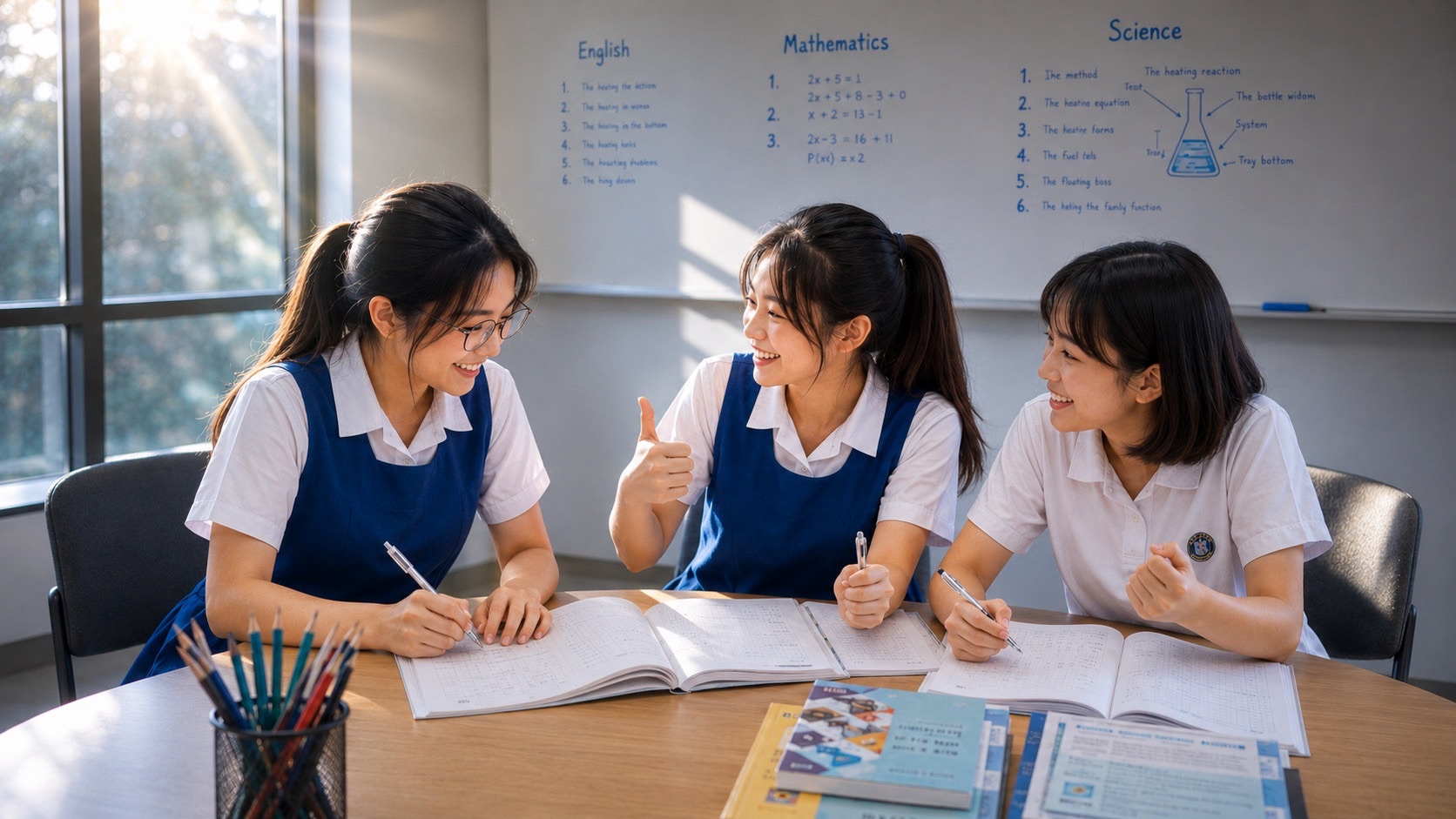
In a 3-pax class, each learner can explain an answer briefly before writing. The tutor hears differences in understanding and can ask students to compare which written version best preserves the spoken idea.
The group stays small enough that oral work does not consume the whole lesson.
Catch Up, Keep Up, Move Ahead
Catch Up may use sentence frames temporarily after oral explanation. Keep Up asks students to write independently after a short oral plan. Move Ahead removes verbal scaffolding and expects the learner to internalise the compression process.
The support should fade as written control improves.
A 90-minute oral-to-written lesson
A session can begin with reading and discussion, then ask for oral answers to a small set of comprehension questions. Students write their responses, compare the written versions with what they intended, and revise one high-value pattern. The lesson ends with a new passage where the bridge must run more independently.
The same process can then transfer into paragraph writing.
Common failure patterns
- Strong oral answer, vague writing: compress the relationship before writing.
- Correct idea, unclear pronouns: name the referent explicitly.
- Good explanation, wrong tense: repair grammar inside the intended meaning.
- Written answer adds unsupported detail: return to the evidence.
- Tutor rewrites everything: preserve learner ownership and require revision.
- Oral answer also weak: diagnose comprehension before representation.
How parents can help
If homework stalls, ask the child to say the answer first. Then ask them to write the shortest clear version without your wording.
Do not dictate the improved sentence. Ask what part of the spoken answer disappeared on paper.
What progress looks like
The gap between spoken and written performance narrows. The child needs less verbal rehearsal, writes more precise first drafts and can identify when the written sentence no longer matches what they meant.
Eventually, the oral bridge becomes an internal planning process.
Current Primary English source
MOE’s English Language Syllabus 2020 Primary emphasises integrated oracy, reading and writing and the independent use of English. The oral-to-written bridge makes that integration practical.
What we removed from the old 2017 page
The historical page duplicated a Punggol View tuition page while incorrectly projecting a Yishun centre, and relied on tutor-gender and distinction marketing. We remove the false locality implication and give the preserved URL a distinct educational job: oral understanding → written representation.
Boundary
This article is written for Yishun families and does not claim that eduKateSG currently operates a Yishun branch. Current physical locations and class availability should be checked on the current contact page.
Frequently asked questions
Should children speak every answer before writing?
No. Use oral rehearsal when it reveals or repairs a representation gap. The scaffold should fade.
Does a strong oral answer prove comprehension?
It is strong evidence, but the tutor should still check whether the answer is supported by the text and matches the exact question.
Should tutors correct grammar during oral discussion?
Selectively. Preserve communication first, then target high-value language patterns when they affect clarity or transfer.
How does this help composition?
Students can rehearse paragraph purpose and causal sequence orally before representing them in written language.
What is the long-term goal?
A learner who can hold an idea, compress it and represent it accurately in writing without needing an adult to translate their own thinking for them.
The larger point
Sometimes the child already knows the answer. The educational task is to help that answer survive the journey from thought to language.
How to Help a Child Carry a Good Spoken Answer onto the Page
When a child explains an answer clearly but writes something vague, the important thing is not to replace the child’s sentence with an adult sentence. The teaching job is to preserve the good idea and help it survive the extra demands of writing.
1. Confirm that the idea is actually correct
Ask the learner to explain the answer aloud. Check whether the spoken response answers the exact question and is supported by the text. If the idea is wrong, return to comprehension first. If the idea is sound, the problem is now clearer: representation.
2. Reduce the spoken answer to its essential relationship
Spoken language often contains repetition and extra detail. Ask, “What is the one thing this answer must communicate?” That core relationship becomes the backbone of the written sentence.
3. Keep the evidence visible
For comprehension, identify the line or detail that supports the answer. For situational writing, identify the required information. The written version should preserve what matters rather than becoming shorter by accidentally dropping the evidence.
4. Let the child write the first version
Do not dictate the polished sentence. The first independent version reveals whether the difficulty lies in grammar, reference, vocabulary, sentence structure or excessive compression.
5. Repair the sentence without replacing the child’s thinking
Ask which part is unclear, which pronoun lacks a clear reference or which connector is missing. Improve the representation while keeping the learner’s original idea intact wherever possible.
6. Compare spoken and written versions in a three-student class
Students can briefly say an answer, write it, then compare whether the written sentence preserved the spoken meaning. Different learners may lose different parts—evidence, precision, grammar or clarity—making the group discussion useful without requiring identical errors.
7. Reduce oral rehearsal as written control improves
The bridge should fade. A child may first speak every answer, later speak only difficult ones and eventually perform the same planning silently. The aim is internal organisation, not permanent dependence on verbal rehearsal.
8. Test the bridge in a new task
Use a different passage or writing prompt. If the learner can independently preserve meaning, evidence and grammar in the new written answer, the oral-to-written skill is becoming transferable.
A compact oral-to-written routine
- Say the answer.
- Check the meaning and evidence.
- State the essential relationship.
- Write it independently.
- Compare writing with intended meaning.
- Repair one important weakness.
- Retest on a new question.
The long-term goal is not a child who speaks first forever. It is a learner who has internalised the bridge well enough that accurate thought can become accurate written English without an adult translating it for them.