
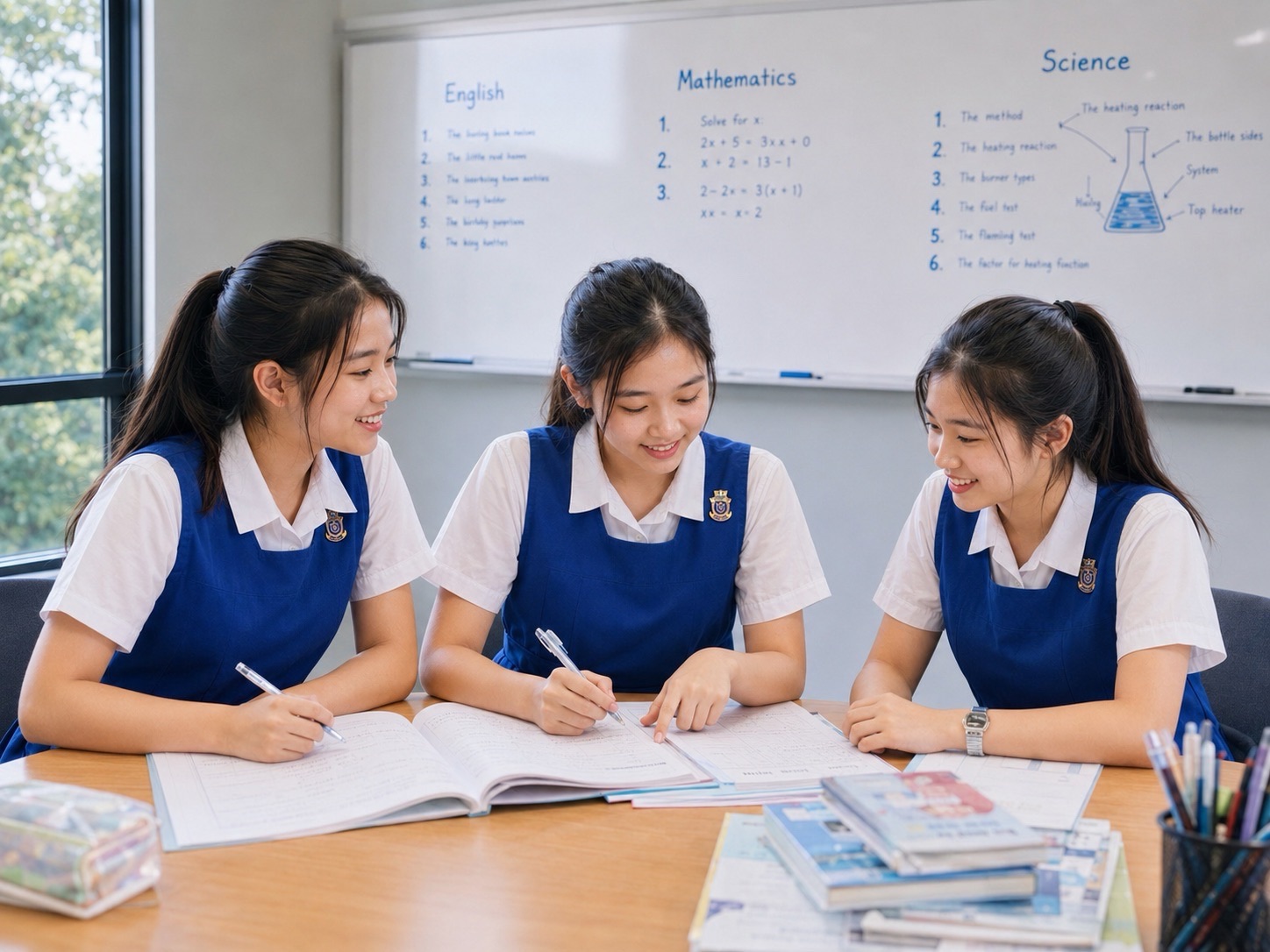
Local-owner handoff: this article owns the specialist question of psychological safety in tuition. For current local Punggol tuition service information, fees, schedules, availability and consultation, use eduKatePunggol and its Atlas V2.1.
Checked and rebuilt: 3 September 2026. This page is the Punggol tuition specialist for psychological safety as a learning condition in English, Mathematics and Science. It is an educational class-design article, not a clinical or mental-health assessment. For the final Primary 6 year, use the Primary 6 Tuition Punggol hub.
Learning contains an awkward requirement.
Before a teacher can repair misunderstanding, the misunderstanding has to become visible.
The student has to say the uncertain thing. Show the incomplete working. Offer the inference that may be wrong. Attempt the scientific explanation before knowing whether the mechanism is complete.
That is intellectual exposure.
A classroom can make that exposure cheap enough to happen—or expensive enough that students hide it.
Psychological safety matters in tuition because hidden confusion is difficult to teach.
Featured Snippet — Why Does Psychological Safety Matter in Tuition?
Psychological safety in tuition means students can reveal uncertainty, attempt difficult work, ask questions and show mistakes without expecting humiliation or status loss, while academic standards remain real. It matters because teachers need visible thinking to diagnose learning. Safety is not the removal of challenge; it is the classroom condition that makes honest challenge, correction, recovery and eventual independence possible.
The One-Sentence Architecture
LEARNING VISIBILITY = ATTEMPT + UNCERTAINTY + FEEDBACK + REPAIR — HUMILIATION COST
This is a teaching metaphor, not a scientific equation.
The point is simple: the higher the social cost of being wrong, the more likely students are to protect themselves by hiding the very evidence the teacher needs.
Safety and Standards Are Not Opposites
A safe classroom is not a classroom where every answer is accepted.
Science can still be inaccurate.
Mathematics can still be invalid.
English can still be poorly supported.
The standard remains.
What changes is how the error is treated.
“This inference is not supported by the passage” evaluates the work.
“You never understand comprehension” turns an error into identity.
The first creates a repair path.
The second can create concealment.
The Central Distinction: Error Is an Event, Not an Identity
Students need language that keeps a failed answer local.
- This method does not preserve the relationship.
- This sentence changes tense.
- This conclusion goes beyond the data.
- This graph comparison uses the wrong scale.
- This paragraph does not fulfil the task yet.
Every sentence points to something changeable.
That matters.
Children can take responsibility without being asked to turn one error into a theory of who they are.
Why Hidden Confusion Is Expensive
A student who nods while lost can look cooperative.
A student who copies the first line of a peer’s method can look productive.
A student who waits for the teacher to reveal the answer can look quiet and well behaved.
But the class has lost information.
We no longer know:
- what the student believed;
- where the reasoning first broke;
- what they would have attempted independently;
- whether the problem is knowledge, confidence, interpretation or method selection.
A smooth lesson can therefore be educationally opaque.
The Learning Visibility Loop
ATTEMPT → REVEAL → INSPECT → DISTINGUISH → REPAIR → RETEST → RELEASE.
Safety matters at the second step.
Rigour matters at every step after it.
Attempt Before Rescue
Good intentions can accidentally hide learning too.
A tutor who rescues every hesitation immediately may create a pleasant lesson but prevent the student’s own model from appearing.
Use a short wait.
Ask for the first thought.
Let the student draw the model, choose the evidence or state the incomplete explanation.
Then teach.
VISIBLE ATTEMPT BEFORE CORRECTION.
Wrong Answers Can Contain Good Information
A wrong Mathematics answer may reveal a correct representation and one arithmetic slip.
A weak English inference may reveal excellent evidence selection but an overclaim.
An incomplete Science explanation may reveal the right concept but a missing mechanism.
The tutor should preserve what is already sound while repairing the earliest invalid step.
This improves both accuracy and student judgement.
English: Safety Makes Interpretation Visible
English often contains ambiguity.
A student may need to propose what a character implies, what a phrase suggests, why an author chose a detail or how evidence supports an inference.
If wrong interpretations are socially expensive, students learn to produce safe, shallow answers—or wait for somebody else.
A better routine is:
STATE → SUPPORT → TEST → REVISE.
The student is allowed to propose an interpretation. The evidence then decides whether it survives.
English: Revision Requires Permission to Change Your Mind
Some students defend an early answer because changing it feels like admitting failure.
Good English teaching makes revision normal.
“I used to think X. The phrase in paragraph four makes Y more defensible.”
That is not weakness.
It is evidence-based correction.
Writing: Drafts Should Be Allowed to Be Drafts
A first sentence should not carry the social burden of being final.
Writers need room to generate, inspect and improve.
If every imperfect phrase is immediately judged, students can become cautious and formulaic.
A safer writing process separates:
GENERATE → STRUCTURE → REFINE → EDIT.
Different stages have different standards.
Mathematics: Safety Makes Working Visible
Mathematics is especially vulnerable to concealment because wrong working can feel public.
Students sometimes erase the route, copy a cleaner method or present only the final answer.
That destroys diagnostic evidence.
We want enough working to see:
- what quantity the student identified;
- what relationship they assumed;
- why the chosen method seemed appropriate;
- where the first invalid step occurred.
A wrong visible method can be more useful for teaching than a copied correct one.
Mathematics: “Careless” Should Be Decompressed
If the classroom responds to every error with “careless”, students learn little.
Name the mechanism.
- copied sign incorrectly;
- lost the unit;
- wrong ratio direction;
- calculated before representing;
- mental step too large;
- did not check the quantity identity.
Specific language reduces shame and increases responsibility because the student can actually change the process.
Science: Safety Makes Reasoning Visible
Science students sometimes hide behind memorised wording.
The model answer feels safe.
Original explanation feels risky.
But the tutor cannot know whether the mechanism is understood until the student tries to reconstruct it.
Ask:
- What do you observe?
- What do you think is happening?
- What evidence supports that?
- What scientific relationship are you using?
- What part are you least sure about?
The student’s uncertainty becomes usable information.
Science: A Hypothesis Can Be Wrong and Still Be Useful
Students can develop an unhealthy idea that scientific thinking means always predicting correctly.
But inquiry is valuable precisely because expectations can be tested.
A prediction that is not supported can reveal that the model was incomplete or that another factor matters.
The classroom should reward honest reasoning and evidence-based revision, not only successful guessing.
The Three-Student Room
Three students create a particular social scale.
The group is large enough for comparison and explanation.
It is small enough that silence is visible.
That can be useful if the tutor manages participation deliberately.
The goal is not to make every child equally talkative.
The goal is to ensure every child’s thinking has a route into the lesson.
Quiet Students Need Thinking Time, Not a Personality Conversion
Fast verbal participation is not the only form of intelligence.
A quieter student may benefit from:
- written first attempts;
- brief preparation before speaking;
- smaller questions;
- turn-taking that prevents interruption;
- permission to say “I need a moment”.
The aim is access to thinking, not performance of extroversion.
Confident Students Need Safety Too
A student known as “the strong one” may begin protecting that identity.
They avoid hard questions. They hide uncertainty. They choose familiar methods. They become embarrassed by ordinary errors.
Move Ahead teaching should make intellectual risk normal.
Ask the strong student to try the unfamiliar representation, defend a claim, compare two methods or test a hypothesis that may fail.
Expertise grows when status does not need protecting.
Catch Up, Keep Up, Move Ahead
Catch Up: lower the social cost of revealing the gap, then repair it precisely.
Keep Up: maintain honest self-reporting—what is secure, what is fragile, what still requires support.
Move Ahead: protect the student’s willingness to take intellectual risks and encounter problems where immediate success is not guaranteed.
All three need safety.
They need different forms of challenge.
Correction Should Have a Sequence
- Identify what is already correct.
- Locate the first point where the reasoning breaks.
- Ask whether the student can recover without being told.
- Teach the missing distinction if needed.
- Require a fresh attempt.
- Return after delay.
- Change the context and retest.
This makes correction demanding without making it humiliating.
Praise Should Carry Information
Vague praise can feel pleasant and teach little.
“Good job” has its place.
But specific feedback is more useful:
- You changed your inference when the evidence no longer supported it.
- Your model made the relationship visible before calculation.
- You used the data before introducing the Science concept.
- You caught your own tense drift during revision.
- You asked a more precise question this time.
The student learns what behaviour to repeat.
High Standards Need Predictable Feedback
Students tolerate demanding work better when the rules of correction are legible.
If feedback depends on the tutor’s mood, students spend attention managing the adult instead of the task.
A strong classroom has stable principles:
- attempt first;
- explain your reasoning;
- evidence matters;
- errors are inspected;
- repeated errors require repair;
- improvement is retested;
- respect is non-negotiable.
Psychological Safety Does Not Remove Accountability
A student can feel safe and still be expected to complete agreed work.
Repeatedly ignoring a correction should lead to a conversation about the process.
“We repaired this ratio-direction error last week. What prevented the repair rule from being used today?”
That is accountability with information.
It does not require ridicule.
The Difference Between Productive Difficulty and Threat
Learning needs difficulty.
Without challenge, there is little reason to adapt.
But difficulty can be interpreted in two ways.
Productive difficulty: This is hard; I have a route; I can try, fail, receive feedback and improve.
Threat: If I fail publicly, something about my status or identity is damaged.
The tutor’s job is not to remove the first.
It is to reduce the second.
The Tutor’s Language Matters
Compare:
“You don’t know your basics.”
with:
“This current algebra problem depends on fraction control. Let’s test the fraction layer.”
Compare:
“Your English is weak.”
with:
“Your evidence is often correct, but the inference goes one step too far.”
Compare:
“You are bad at Science explanations.”
with:
“You usually state the condition and result; the mechanism in the middle is missing.”
Resolution improves teaching and dignity at the same time.
Better Questions Are a Sign of Growth
At first:
“I don’t get it.”
Later:
“I understand the ratio but not what one part represents.”
Or:
“I know the Science concept but I cannot see which evidence in the graph proves the comparison.”
Or:
“I understand the passage but I am not sure how far the inference can go.”
That narrowing is intellectual progress.
The student is becoming their own diagnostician.
The Safety-to-Independence Ladder
SAFE TO ASK → SAFE TO ATTEMPT → SAFE TO BE WRONG → ABLE TO REPAIR → ABLE TO TRY ALONE → ABLE TO ASK PRECISELY → ABLE TO OPERATE INDEPENDENTLY.
Safety is the platform.
Independence is the destination.
A 90-Minute Safe and Demanding Lesson
- short retrieval where every student produces an answer;
- clear shared instruction;
- individual first attempt;
- tutor observes without immediate rescue;
- students explain one decision;
- feedback names the mechanism;
- students attempt again;
- changed-context transfer;
- brief reflection on what was repaired.
The room should feel calm enough to reveal mistakes and serious enough that those mistakes are worth correcting.
What Tutors Should Not Do
- use sarcasm as correction;
- rank students by intelligence;
- let one fast responder dominate;
- confuse loudness with engagement;
- give vague praise instead of useful feedback;
- rescue before the learner attempts recovery;
- lower the standard in the name of comfort;
- treat a score as the student’s identity;
- turn public mistakes into entertainment.
What Parents Can Do at Home
Parents can reinforce the same architecture without making home another tuition centre.
- Ask what the child learned from the error.
- Let the child explain uncertainty before supplying the answer.
- Avoid fixed labels such as “Math person” or “not a Science child”.
- Notice successful self-correction.
- Ask what evidence changed the child’s mind.
- Separate one poor result from a total judgement of ability.
- Protect sleep and recovery when workload rises.
Parents Also Need Calibration
A single bad paper can feel large.
But teaching decisions should follow patterns.
One poor result may be noise. Repeated avoidance, recurring error families, falling independence or chronic overload deserves closer attention.
Good learning systems collect signal before escalating.
Psychological Safety and Primary 6
Final-year pressure makes this especially important.
Students who are afraid to reveal confusion can spend months rehearsing a weak method because everybody assumes the child is “fine”.
The Primary 6 system should make it normal to say:
- I do not understand this fraction relationship yet.
- I keep overclaiming inference questions.
- I know the Science topic but my open-ended explanation is incomplete.
- I finish untimed but not under paper conditions.
Those statements are not admissions of defeat.
They are coordinates for repair.
For the complete final-year route, use Primary 6 Tuition Punggol.
Psychological Safety and Secondary 1
The same principle matters after PSLE.
Secondary 1 introduces a new school system, denser material, adolescence and new social identities. Students need enough dignity to admit when inherited Primary methods no longer work.
The next-level learning architecture is at Secondary 1 Punggol Learning System.
When Safety Becomes Dependence
There is a failure mode on the other side.
A student may become comfortable only when a familiar tutor is present.
That is not the final goal.
Gradually remove reassurance.
Delay prompts.
Let the student attempt alone.
Ask them to decide whether help is actually needed.
A safe class should make the learner more capable of entering less supported environments.
How to Recognise a Safe and Demanding Classroom
- students show their own working before copying;
- wrong answers are analysed without ridicule;
- the tutor corrects clearly;
- quiet students have thinking routes;
- high-performing students are allowed to struggle;
- questions become more precise;
- repeated errors still lead to accountability;
- feedback points to mechanisms;
- students need less reassurance as competence grows.
When Tuition May Not Be Necessary
Not every child needs additional tuition to obtain this learning environment.
A student who feels able to ask questions at school, receives useful feedback, works independently, repairs mistakes and continues progressing may already have what they need.
More tuition should not be added merely because uncertainty exists.
Learning contains uncertainty by design.
Frequently Asked Questions
Does psychological safety mean students should never feel pressure?
No. Examinations, difficult tasks and high standards remain. Safety means uncertainty and error can be exposed without humiliation so the work can be improved.
Should tutors praise wrong answers?
They should not label inaccurate work as correct. They can acknowledge useful reasoning, effort, honesty or a sound intermediate step while correcting the failed part precisely.
What if a student never speaks?
Use written attempts, preparation time, smaller prompts and predictable turn-taking. The goal is access to the student’s thinking, not forced extroversion.
Can competition be useful?
Some learners enjoy competition, but it should not make students hide mistakes or avoid difficult work to protect status. Method comparison is usually more educational than identity ranking.
How does safety improve independence?
Students who can attempt, be wrong, inspect the failure and repair it learn that uncertainty is survivable. Over time, they need less external reassurance.
What is the final goal?
A learner who can take intellectual risks, show their reasoning, use precise feedback and eventually operate independently without fear of ordinary error.
Psychological Safety in One Sentence
A psychologically safe tuition class makes uncertainty visible enough to teach, error local enough to repair and challenge dignified enough that students can gradually become more independent rather than more dependent on reassurance.
The Final Perspective
Learning is not clean while it is happening.
A real learner hesitates.
Misreads.
Chooses the wrong method.
Changes their mind.
Forgets something they genuinely learned last month.
Produces a sentence that almost works.
Builds a model that reveals exactly where the misconception lives.
The classroom can treat those moments as embarrassment.
Or it can treat them as evidence.
That choice changes what becomes visible.
And what becomes visible can be taught.
Then corrected.
Then retested.
Then handed back to the student as capability.
That is the educational value of psychological safety.
Continue Through the Punggol Tuition Spine
Primary 6 parent hub: Primary 6 Tuition Punggol | English, Mathematics & Science Hub
Modern 3-pax Punggol tuition architecture: Punggol Tuition Centre | What a Modern 3-Pax Learning System Should Actually Do
Secondary 1 handoff: Secondary 1 Punggol Learning System
Punggol Tuition root owner: Punggol Tuition