
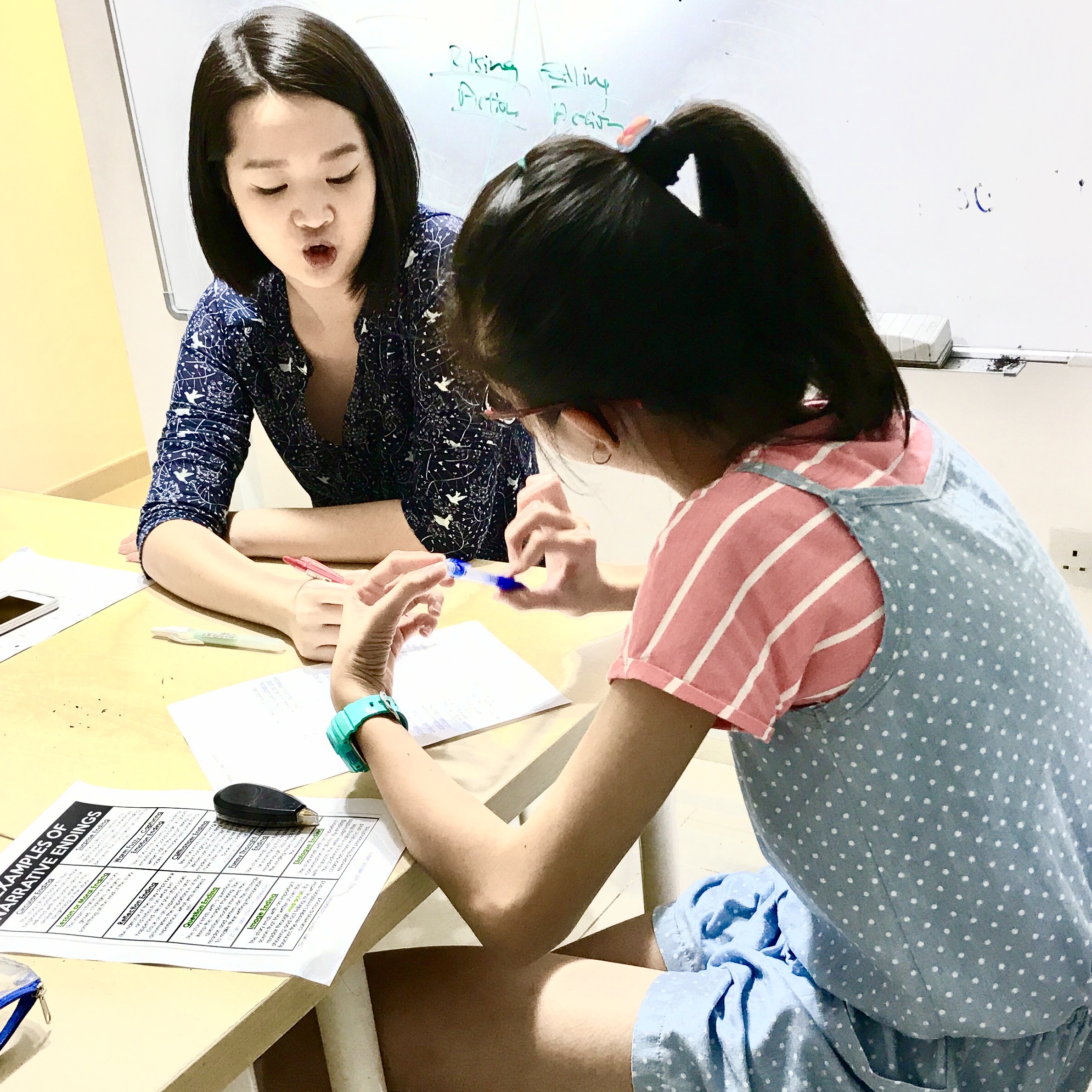
Quick answer: strong Creative Writing does not begin with “write something interesting”. It begins with a sequence of decisions: understand the topic, inspect the pictures, generate more than one possible story, test each idea for relevance and feasibility, choose a causal route, plan where the important moments deserve space, draft with controlled language, then revise against the task. The strongest final test is simple: can the student do the same thinking again on a new prompt without copying the old story?
This page began in June 2017 as a nine-step composition checklist from an eduKate Creative Writing lesson. The old sequence contained the right skeleton—read, think, plan, write, edit—but several instructions were too broad. “Be creative”, “be interesting” and “use descriptive vocabulary” do not tell a learner what decision to make when two story ideas compete or when a polished paragraph is drifting away from the topic. The 2026 rebuild keeps the practical classroom purpose and turns it into a decision system that a Primary 6 learner can actually reuse.
The reader job of this page
This page owns one job: how to move from a PSLE Continuous Writing prompt to a controlled first draft without relying on a memorised story.
For the separate problem of originality and template dependence, see Originality in PSLE Continuous Writing Without Template Dependence.
Current 2026 PSLE English context
SEAB lists English Language as subject code 0001 for the 2026 PSLE. In Continuous Writing, pupils write at least 150 words on a given topic. Three pictures are provided to offer different angles of interpretation, and the composition must be based on at least one picture. In July 2026, SEAB also clarified that pupils are credited for relevant and well-developed responses and have room to demonstrate originality and personal voice.
Official references: SEAB — PSLE formats examined in 2026 and SEAB — 17 July 2026 media reply on PSLE English Paper 1.
This immediately gives us a useful constraint: creativity must operate inside relevance. A beautiful story that barely answers the topic is not rescued by sophisticated vocabulary.
Step 1: read for the task, not for inspiration
Many students look at the pictures and start searching memory for a story they have written before. That reverses the order.
Begin with the topic. Ask:
- What kind of event or human problem could genuinely express this topic?
- What would make a story clearly relevant rather than merely mentioning the topic at the end?
- What would a reader expect to understand by the time the story finishes?
The first useful sentence is not the introduction. It is a private planning sentence:
“My story will show ________ through ________.”
If the student cannot complete that sentence clearly, the story idea is not ready to draft.
Step 2: treat the pictures as possible constraints, not decorations
The pictures offer possible angles. A chosen picture should perform real work in the story.
For each picture, ask four questions:
- Cause: could this picture trigger the main event?
- Decision: could it force the character to choose?
- Evidence: could it reveal something important?
- Consequence: could it matter later in the resolution?
A useful deletion test follows: if the picture can be removed without changing the story, it may have been inserted superficially.
Step 3: generate at least two routes before choosing one
The first idea feels attractive because it arrived first, not necessarily because it is the best. A short comparison can improve the decision.
| Route | Topic connection | Main conflict | Why it might work | Main risk |
|---|---|---|---|---|
| A | Direct | Character makes a poor decision | Clear cause and consequence | May feel predictable |
| B | Indirect but strong | Character misunderstands another person | Allows change in perspective | May require more explanation |
The goal is not to spend ten minutes brainstorming. It is to prevent the learner from becoming trapped by the first familiar plot.
Step 4: use three gates to choose the route
A story idea should pass three gates before drafting.
Gate A — Relevance
Does the central event actually express the topic, or is the connection added only in the final paragraph?
Gate B — Causality
Can the student explain why one important event leads to the next?
Gate C — Executability
Can the student tell this story clearly, develop the important moments and still leave enough time to revise?
A spectacular idea that needs twelve characters, three locations and a complex backstory may be worse than a smaller story the student can control.
The discriminating question: which route still works when the memorised scene is removed?
Suppose two plans look equally relevant. One depends on a memorised accident scene; the other grows naturally from the prompt. Remove the memorised scene mentally.
If Route A collapses and Route B still has a coherent conflict, decision and consequence, Route B is usually the more adaptable choice.
This small test distinguishes familiarity from fit.
Step 5: build a causal skeleton before writing paragraphs
“Introduction, body, conclusion” describes shape but not logic. A stronger plan records the causal spine.
Use:
normal state → trigger → decision → consequence → complication → turning point → resolution.
Not every composition requires dramatic conflict, but events should still connect.
A weak event chain looks like:
We arrived. We ate. Someone shouted. I ran. It rained. I learned a lesson.
A stronger chain explains why:
Because I ignored the instruction, the group became separated. Therefore I tried to solve the problem alone. That decision made the situation worse, which forced me to ask for help.
Cause creates development.
Step 6: decide where the story deserves time
Students often spend too much space on waking up, eating breakfast, travelling to the venue and describing the weather. Then the central event is rushed into one paragraph.
Allocate more writing space to moments that change the story:
- the trigger;
- the important decision;
- the consequence;
- the turning point;
- the final change in understanding or situation.
Routine movement can be compressed. Important change should be developed.
Step 7: choose a point of view that the student can control
First person can create immediacy because the writer stays close to one character’s experience. Third person can provide more distance. Neither is automatically better.
Choose the perspective that makes these questions easiest to answer:
- Whose decision drives the story?
- Whose misunderstanding or change matters most?
- Whose observations need to be close to the reader?
Once chosen, keep the perspective stable unless the student has enough control to shift deliberately.
Step 8: draft for meaning first, decoration second
The first drafting priority is not impressive vocabulary. It is making the causal and emotional meaning readable.
At sentence level, ask:
- What changed here?
- What does the character notice?
- What does the character decide?
- What consequence must the reader understand?
Then choose language that sharpens that meaning.
Vocabulary is a precision tool
“Creative descriptive vocabulary” is useful only when it serves the scene.
Before using an ambitious word, check:
- Does it mean exactly what I intend?
- Does it naturally combine with the surrounding words?
- Does the register suit a Primary 6 narrative voice?
- Can I spell and use it grammatically?
- Does it improve the sentence more than a simpler word?
The strongest word is often the most exact one, not the rarest one.
Emotion needs an object
Students sometimes insert memorised fear, sadness or excitement paragraphs without connecting the emotion to what is at stake.
Ask:
- What does the character fear losing?
- What does the character want?
- What information changed the emotion?
- What decision does the emotion influence?
Emotion that changes action belongs to the story. Emotion that merely decorates a paragraph can often be cut.
Step 9: revise in the right order
Editing only spelling is too late in the hierarchy. Revision should move from large failures to small ones.
- Topic: is the story clearly about the assigned topic?
- Picture: does the selected picture genuinely matter?
- Development: are the important moments developed sufficiently?
- Causality: can the reader understand why events follow one another?
- Paragraphing: do paragraphs reflect changes in action, focus, time or place?
- Sentence control: are tense, pronouns and sentence boundaries stable?
- Vocabulary: are there impressive-looking words that are inaccurate or unnecessary?
- Surface accuracy: spelling, punctuation and legibility.
Fixing a spelling error cannot rescue a story that is off-topic. The revision order should reflect that.
The falsifier: when should the student abandon the plan before drafting?
A plan should be rejected or substantially changed when one of these is true:
- the topic appears only in the moral at the end;
- the selected picture can be removed without changing anything;
- the story requires too many events to develop within examination time;
- the student cannot explain why the central decision produces the next consequence;
- the plan is essentially a memorised story with names and objects replaced.
Rejecting a weak plan after two minutes is cheaper than discovering the problem halfway through the composition.
A compact planning sheet
| Topic meaning | My story shows ________ through ________. |
|---|---|
| Chosen picture | It matters because ________. |
| Route A | Trigger → decision → consequence |
| Route B | Trigger → decision → consequence |
| Chosen route | Why this is more relevant/controllable |
| Turning point | What changes? |
| End state | What is different by the end? |
| Main language risk | Tense / pronouns / dialogue / vocabulary / sentence control |
The planning sheet is deliberately short. It should reduce uncertainty, not become a second essay.
Worked reasoning example: the better story is not always the more dramatic one
Imagine the topic is “A difficult decision”. One picture suggests a lost wallet; another shows two friends; a third shows a bus.
Route A: the student writes a large crime story involving a thief, a police chase and a hospital scene.
Route B: the narrator finds the wallet just before boarding the last bus home, realises returning it may mean missing the bus, hesitates, chooses to hand it to the station staff and later has to explain the delay at home.
Route A sounds more dramatic. Route B may be stronger because the decision is central, the wallet picture matters, the causal chain is manageable and the conflict can be developed within the available writing time.
The discriminating question is: which story makes the topic unavoidable?
Teacher feedback should identify the decision that failed
When a composition is weak, marking every sentence can obscure the main bottleneck.
Useful feedback may sound like:
- “Your grammar is mostly stable; the bigger problem is that the central event does not connect strongly enough to the topic.”
- “The story is relevant, but the important decision is rushed. Move detail from the breakfast scene into the turning point.”
- “Your vocabulary is ambitious, but three words are being used inaccurately. Use simpler words and make the action clearer.”
- “You can write this familiar story, but the next test is whether you can build a different route from a new prompt.”
Feedback becomes useful when it changes the student’s next decision.
The transfer test: change the prompt
A student has not mastered a planning framework simply because one polished composition exists.
Use a new topic and new pictures. Give the student a short planning window. Then check whether they can independently:
- state a topic interpretation;
- generate at least two routes;
- choose using relevance and executability;
- build a causal skeleton;
- integrate a picture meaningfully;
- draft without the old template.
That independent changed-prompt performance is the world return. If it improves, the planning method is becoming transferable. If it collapses, the student may have learned one story rather than one writing system.
AI can widen the option space—but should not choose the story for the student
AI can generate ten story ideas instantly. That can be useful for comparison, but it also removes the very decision practice this page is trying to build.
A safer use pattern is:
student generates two routes → AI may generate one contrasting route → student compares relevance, causality and executability → student chooses and plans → tool removed → student drafts → new prompt later without AI.
AI should increase contrast and feedback, not replace authorship.
Historical 2017 Creative Writing classroom archive
The original post recorded a June 2017 Creative Writing lesson in Punggol and included a practical composition checklist. That educational provenance is retained. The old phone number and the later Great Ocean Road travel-image sequence are retired because they do not serve the writing RFE.

The deeper principle
Creative Writing is not free association followed by grammar correction. It is controlled choice under constraints. Read the task accurately, generate alternatives, discriminate between them, build a causal route, draft for meaning, revise by importance and then prove the method on a new prompt.
First published 19 June 2017 as “Lesson in Creative Writing 190617”. Rebuilt in 2026 into a reusable prompt-to-draft decision framework, preserving the original classroom purpose while retiring obsolete contact details and unrelated travel imagery.