
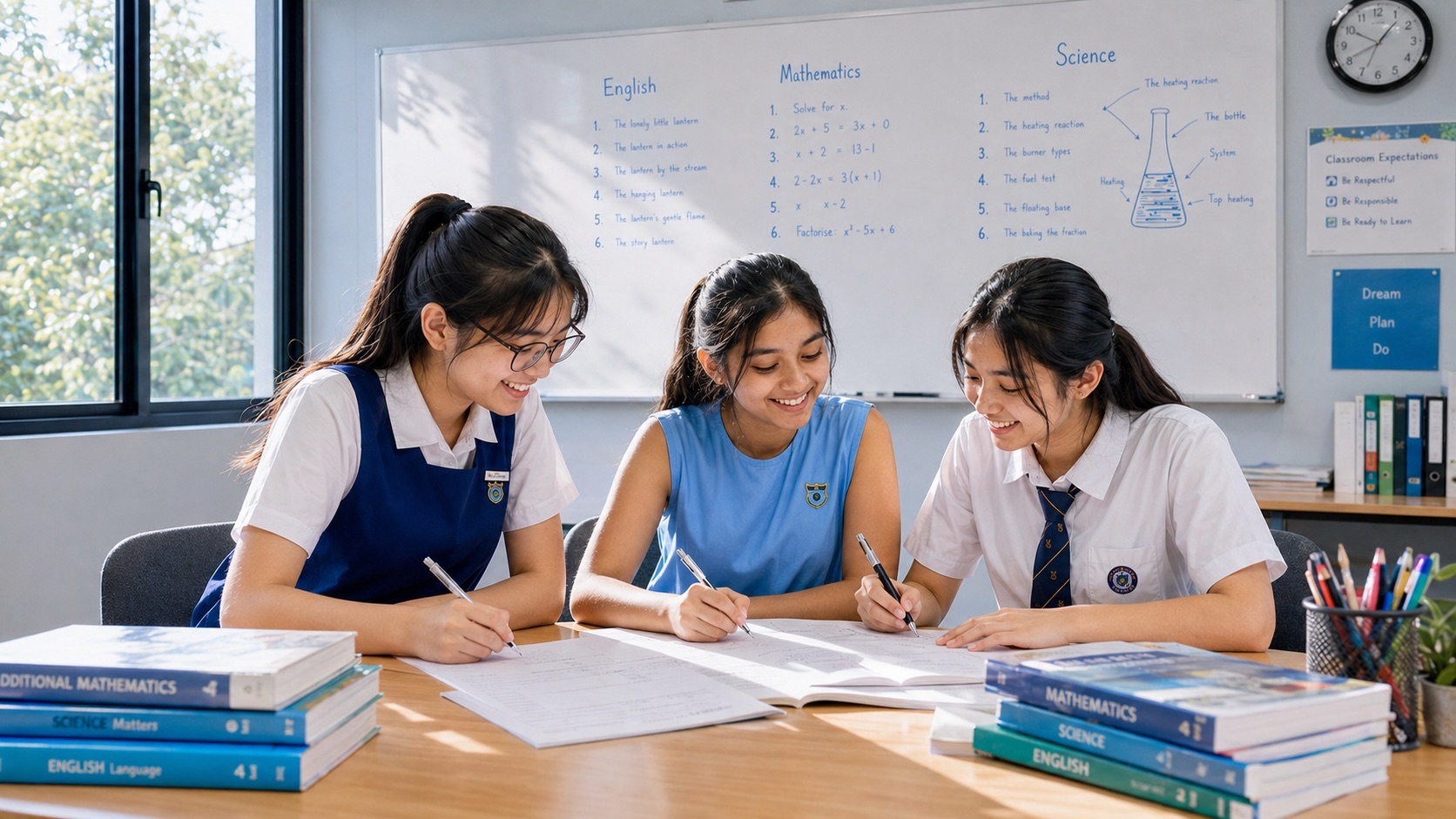
English tuition for Parkway Parade families should help students compare texts without reducing the task to “Text A says this, Text B says that.” Two texts can discuss the same topic yet differ because they serve different audiences, purposes, evidence standards and desired actions.
This rebuilt legacy page now owns one distinct job inside the eduKateSG English estate: cross-text comparison—same topic, different purpose. It does not duplicate visual-text analysis or general comprehension pages. Its focus is relational reading: how to compare what two texts are doing with similar subject matter and why their choices differ.
eduKateSG currently teaches selected English levels in focused 3-pax small groups, typically 1.5 hours, at 83 Punggol Central, Singapore 828761 and 8 Fourth Avenue, Singapore 268674. We do not claim a current Parkway Parade branch. Families can enquire about suitable placement according to level, timetable and travel fit.
The Direct Answer
A strong cross-text comparison should use a shared dimension:
- purpose: inform, persuade, warn, invite, evaluate;
- audience: who is expected to receive the message;
- evidence: examples, statistics, testimony, images, explanation;
- tone: how the relationship with the reader is managed;
- selection: what each text foregrounds or leaves in the background;
- action: what the reader is expected to think or do next.
Compare the same function across both texts before deciding what the difference means.
Why Topic Similarity Can Hide Purpose Difference
Imagine two texts about recycling. One is a school poster telling students which bin to use. The other is a newspaper commentary arguing that recycling alone cannot solve waste problems.
Both are “about recycling”, but topic is only the surface. The poster needs clear action. The commentary needs reasoning and qualification.
A student who compares only content may miss the deeper design difference.
Comparison Dimension 1: Purpose
Text A may explain how something works. Text B may persuade readers to support a policy. The same statistic can therefore do a different job in each.
In an explanatory text, the number may establish scale. In a persuasive text, the same number may create urgency.
We ask students not only “what is the purpose?” but “how does this feature serve that purpose?”
Comparison Dimension 2: Audience
A text for Primary students may define technical terms and use concrete examples. A text for specialists may assume vocabulary and compress explanation.
A message to parents may foreground safety and logistics. A message to students may foreground activity and participation.
Audience affects what must be explained and what can be assumed.
Comparison Dimension 3: Evidence Choice
Text A may use a personal story to create identification. Text B may use a graph to establish a broader pattern.
Students should ask why the evidence type suits the text’s job. The comparison becomes stronger when evidence is connected to audience and purpose rather than merely listed.
Comparison Dimension 4: Tone
A public-health warning may be direct and urgent. A museum brochure may be inviting and curious. A school circular may be formal but supportive.
Tone is not simply a label. We ask which language choices create the relationship and why that relationship suits the reader.
Comparison Dimension 5: What Is Foregrounded
Every text selects. A travel advertisement may foreground scenery and convenience while placing conditions in small print. An independent review may foreground price and limitations.
Both can be factually accurate yet create different impressions because they rank information differently.
Students learn to compare selection without assuming omission automatically means dishonesty.
Comparison Dimension 6: Desired Reader Action
Many texts are designed to produce action: register, donate, avoid, buy, attend, support, reconsider or simply understand.
Text A may want immediate behaviour change. Text B may want the reader to question a common assumption.
The action target helps explain differences in structure and language.
Worked Example: Two Texts About Exercise
Text A: a school poster titled “Move More This Week!” with short benefits, colourful activity icons and a sign-up QR code.
Text B: an article explaining why exercise recommendations differ by age and health condition.
Comparison:
- A is action-oriented; B is explanatory.
- A simplifies benefits to motivate broad participation; B introduces conditions to avoid overgeneralisation.
- A uses visual salience and imperatives; B uses definitions and qualified language.
- A expects a student audience; B may address readers seeking more detailed understanding.
The topic is the same. Communication jobs differ.
Worked Example: Two Texts About a New School Rule
Text A is the school’s official notice explaining the rule. Text B is a student opinion piece criticising it.
The notice may foreground implementation, dates and reasons given by the school. The opinion piece may foreground inconvenience, counterexamples and student experience.
A strong comparison does not assume one is “objective” and the other “biased” simply because one is official. Both select information according to purpose. The student should identify evidence and boundaries precisely.
Worked Example: Story Versus News Report
A short story about a flood may focus on one family’s experience, sensory detail and decision-making. A news report on the same flood may focus on scale, location, official response and verified facts.
The difference is not simply “creative versus factual”. Each genre has a different reader contract.
The story creates lived perspective. The report creates a broader public account.
Compare Like With Like
Weak comparison often says: “Text A uses a picture, while Text B is formal.” These are different dimensions.
Stronger comparison:
- both texts’ audience;
- both texts’ evidence;
- both texts’ tone;
- both texts’ purpose;
- both texts’ use of visuals.
Using a shared axis makes the relationship interpretable.
Similarity Can Be as Important as Difference
Students sometimes assume comparison means finding differences only.
Two texts may both use personal stories because both need reader identification, even though one wants donations and the other wants policy support.
Shared choices can reveal shared communication problems.
Do Not Compare Tone Without Evidence
“Text A is serious while Text B is friendly” needs language support. Which verbs, sentence forms, pronouns, images or examples create that impression?
Cross-text analysis should remain evidence-bound in both texts.
Do Not Treat Different Facts as Contradictions Automatically
Text A may mention one benefit and Text B another. That is not a contradiction unless the claims cannot both be true.
We teach students to classify the relation:
- same claim, different evidence;
- different aspects of same topic;
- different emphasis;
- qualified disagreement;
- direct contradiction.
This prevents exaggerated comparison.
Cross-Text Comparison Supports Writing
Students who compare purpose and evidence become more deliberate writers. They see that the same content can be shaped differently for a teacher, friend, public audience or examination marker.
They also learn to choose evidence according to the claim rather than insert the same example into every essay.
Cross-Text Comparison Supports Media Literacy
Real-world readers encounter multiple accounts of the same issue. Comparing selection, evidence and purpose helps students avoid assuming the first text is the whole story.
The goal is not automatic distrust. It is disciplined comparison.
Primary Progression
Primary students can begin by comparing two simple notices, stories or visual texts using one shared dimension: which is more formal, which gives more detail, which wants the reader to act.
Upper-primary students can compare evidence, audience and information selection across longer materials.
Secondary Progression
Secondary students can handle more complex relationships: stance, reliability, qualification, competing interpretations and differences between evidence types.
The current MOE Secondary English syllabus emphasises critical response to varied multimodal texts and communication across purposes and audiences. Cross-text comparison fits naturally within that progression. Official reference: MOE English Language Syllabus 2020 Secondary.
Common Cross-Text Failure Modes
| Symptom | Underlying issue | Repair |
|---|---|---|
| Summarises A, then B | No relational comparison | Choose shared dimension first |
| Compares picture to tone | Axes mismatched | Compare like with like |
| Calls every difference contradiction | Relation classification weak | Separate emphasis, aspect, qualification, contradiction |
| Tone labels unsupported | No language evidence | Point to wording/visual choices |
| Purpose stated but not explained | Feature-function link missing | Show how evidence/design serves purpose |
| Assumes official source tells whole story | Selection not examined | Compare what each text foregrounds |
Why Three Students Helps
Three students can compare the same pair of texts using different axes. One notices audience, one evidence and one tone. The tutor can ask which dimension best explains the observed difference.
The group learns that comparison is not a hunt for any difference. It is a structured explanation of how two communication systems diverge or overlap.
A Typical 1.5-Hour Cross-Text Lesson
- Read/view: build accurate model of both texts.
- Orient: identify topic, audience and purpose.
- Select axis: evidence, tone, selection, action or structure.
- Compare: describe both on same dimension.
- Explain: connect difference to communication job.
- Bound: distinguish contrast from contradiction.
- Transfer: new pair in a different genre.
When Parkway Parade Families May Consider This Support
- The student summarises two texts separately instead of comparing them.
- Visual and prose texts feel difficult to relate.
- Audience/purpose answers are generic.
- Differences are listed without explaining why they matter.
- The child confuses different emphasis with factual contradiction.
- Secondary English needs stronger critical comparison across sources.
- The family wants reading that transfers into stronger writing and media judgement.
What Progress Should Look Like
A stronger student chooses a shared comparison axis, gathers evidence from both texts and explains how different communication jobs produce different choices.
Current class enquiries: selected eduKateSG English 3-pax small groups, typically 1.5 hours. Current centres: 83 Punggol Central, Singapore 828761 and 8 Fourth Avenue, Singapore 268674. Contact +65 8823 1234.
Compare claims before comparing style
Two texts can look very different while making compatible claims, or look similar while disagreeing on an important condition. Before analysing design, reduce each text to its central claim and supporting boundary.
This prevents students from treating surface difference as substantive disagreement.
The claim-relation map
- same claim, same evidence type;
- same claim, different evidence;
- same topic, different claim;
- compatible claims about different aspects;
- qualified disagreement;
- direct contradiction.
Students should classify the relationship before judging which text is “better”.
Evidence quality is a comparison dimension
One text may use a personal anecdote and another a broad statistic. The point is not that numbers always beat stories. Ask what each evidence type can legitimately support.
- Anecdote can show lived experience but not automatically population scale.
- Statistics can show pattern but may hide individual variation.
- Expert testimony depends on expertise and relevance.
- Images can create salience without proving a causal claim.
Source position changes interpretation
An official notice, campaign poster, commercial advertisement, personal blog and independent review have different communication roles. That does not make one automatically truthful and another false. It changes what incentives, responsibilities and evidence standards should be examined.
Selection and omission need careful language
A text cannot include everything. Omitting a detail may be reasonable because of purpose or length. Students should avoid jumping from “Text A does not mention this limitation” to “Text A is dishonest”.
Stronger wording is: “Text A foregrounds the benefit, whereas Text B gives more attention to the limitation.”
The shared-axis discipline
When comparing, keep both texts on the same axis long enough to generate an interpretable relation. Audience against audience. Evidence against evidence. Tone against tone. Selection against selection.
Worked example: two texts on screen time
Text A is a school advisory reminding families to create healthy device routines. Text B is a technology company article highlighting educational uses of digital tools.
They may not directly contradict. One foregrounds risk management; the other foregrounds utility. A strong comparison asks where their claims overlap, where conditions differ and what each leaves outside its main purpose.
Worked example: same statistic, different rhetorical job
One report uses a number to establish scale. A campaign poster uses the same number to create urgency. The factual content may be identical; the communication function differs.
Reliability should be claim-specific
A source can be reliable for one kind of information and limited for another. A school notice is authoritative for its own event date. It may not be the best source for a broad claim about national behaviour.
Teach students to ask: reliable for what claim?
The missing-context test
If two texts seem to disagree, check whether they refer to different populations, time periods, definitions or conditions. Apparent contradiction can disappear when context is restored.
Cross-text comparison should transfer into writing
After comparing two texts, ask the student to write one paragraph that synthesises the relationship without flattening the differences. This converts reading into argument control.
AI can fabricate neat agreement or disagreement
AI summaries can make two sources look more aligned or more opposed than the originals. A bounded use is: student extracts claims and evidence first → AI may propose a comparison → student checks both texts directly → student revises → new pair compared independently.
What stronger transfer looks like
- Students compare claims before surface features.
- Differences are classified more precisely than “contradiction”.
- Evidence type and evidence strength are separated.
- Source role is considered without automatic distrust.
- Omission is described more carefully.
- Comparison paragraphs use one shared axis at a time.
- Students can synthesise without erasing qualification.
- New source pairs produce independent comparison frameworks.
The deeper principle
Cross-text reading is disciplined relational thinking. Compare the same dimension, identify what each text actually claims, examine what evidence can support, restore missing context and distinguish different emphasis from true contradiction. The goal is not to pick a winner too quickly; it is to understand why two communication systems differ.