
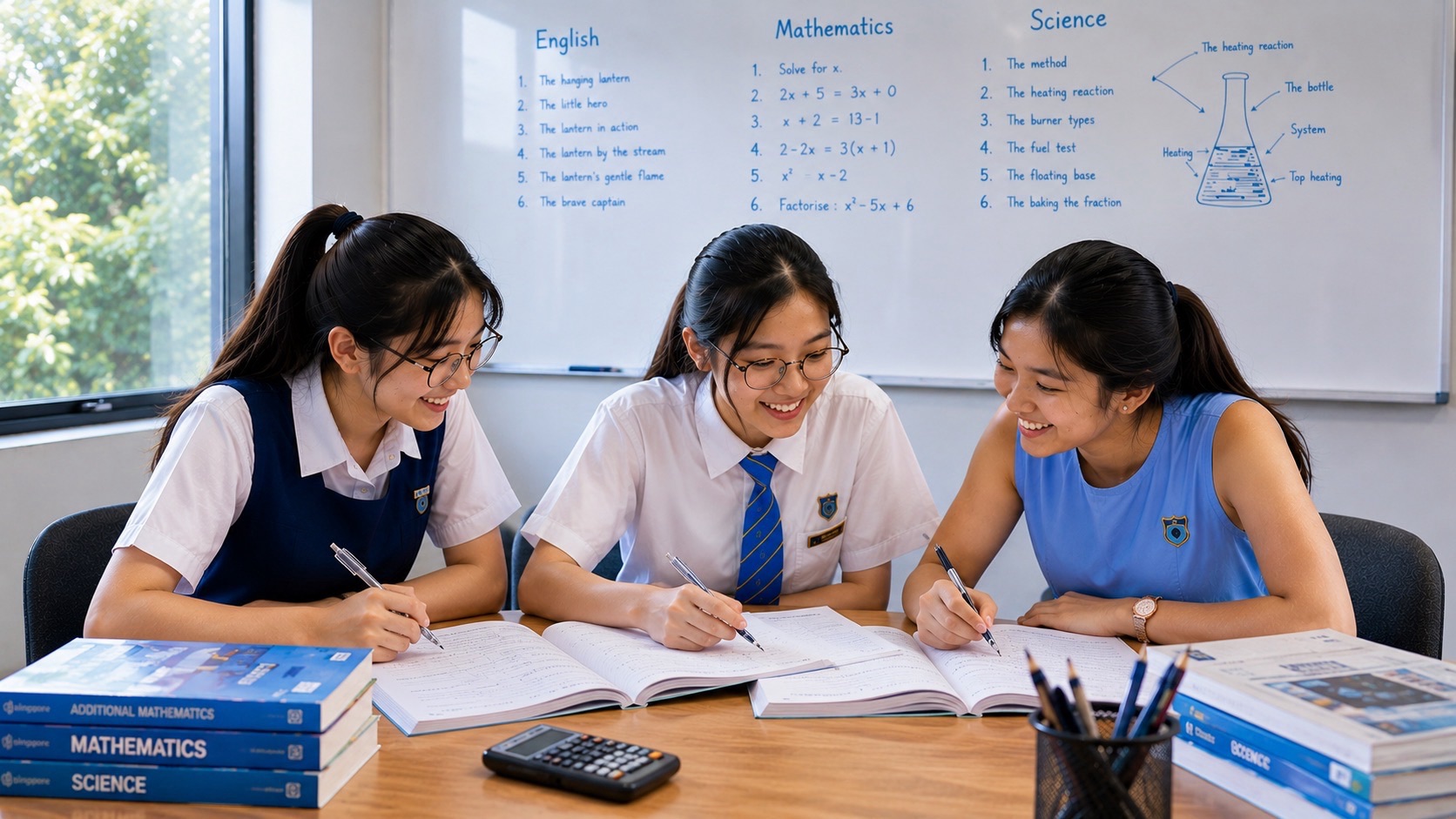
Parkway Parade Primary Science Tuition should not be a second copy of school. For a Primary 3 to Primary 6 student, and especially for a child approaching PSLE Science, the useful question is not how many worksheets can be completed. It is whether the child can see the scientific relationship inside a question, select the relevant evidence, explain the mechanism clearly and remain accurate when the context changes.
This page serves one specific job in the eduKateSG Science estate: helping Parkway Parade and Marine Parade families understand how we build evidence chains for Primary Science. A separate Parkway Parade Science page may cover the broader tuition search. This page is deliberately narrower so that it does not compete with that generic intent.
eduKateSG currently teaches from our Punggol centre at 83 Punggol Central and our Bukit Timah centre at 8 Fourth Avenue, near Sixth Avenue MRT. We do not claim to operate a branch inside Parkway Parade. Families can ask which centre and 3-pax class is the more practical fit for the child’s level and schedule.
Quick View: What This Science Tuition Page Is For
| Student | Primary 3–6, with particular relevance to Primary 5 and PSLE Science |
| Main problem addressed | Knowing Science facts but producing weak, incomplete or poorly supported explanations |
| Core teaching job | Observation → relevant concept → mechanism → evidence → precise answer |
| Class format | 3-pax small groups, 1.5 hours, subject to suitable placement |
| Current syllabus context | MOE 2023 Primary Science syllabus; PSLE Science format examined from 2026 |
| eduKateSG locations | Punggol and Bukit Timah, by appointment |
Why a Child Can “Know the Topic” and Still Lose Science Marks
Primary Science becomes difficult when knowledge has to be used rather than repeated. A child may remember that plants need light for photosynthesis, that heat flows from a hotter object to a colder one, that friction opposes motion, or that water changes state. Yet a structured question can still go wrong because the answer does not connect the given observation to the correct concept in a complete causal sequence.
That gap matters because the current PSLE Science assessment explicitly examines both knowledge with understanding and application of knowledge and scientific inquiry. Students are expected to interpret and analyse information, evaluate observations and methods, and communicate explanations and reasoning. In other words, the paper is not only asking, “Do you remember Science?” It is also asking, “Can you use Science to explain what is happening here?”
Parents often describe the symptom as “answering technique”. Sometimes that is correct. But answering technique is not a bag of sentence starters. A weak answer may come from several different breaks: the concept was not understood, the diagram was misread, the key comparison was missed, the child chose the wrong mechanism, the causal chain stopped too early, or the final sentence did not address the exact question.
The Evidence Chain We Want Students to Build
A useful Science explanation usually has an internal structure. The wording changes from question to question, but the reasoning often moves through something like:
What changed? → What scientific idea explains the change? → What process links cause to effect? → What evidence in the question supports it? → What exact conclusion answers the question?
Consider a plant experiment. Two similar plants are placed under different light conditions. One shows slower growth. A superficial response might say, “The plant gets less light so it grows less.” A stronger response identifies the mechanism: with less light available, the plant carries out less photosynthesis, produces less food, and therefore has less material and energy available for growth. The answer is not longer because length earns marks. It is longer because the missing links have been restored.
The same principle appears in heat, forces, electricity, water, life cycles, plant and human systems, interactions in the environment and many other Primary Science contexts. The student must learn to see the relationship, not just the chapter label.
Current Primary Science: Five Themes, Many Connections
The MOE 2023 Primary Science syllabus organises learning around five themes: Diversity, Cycles, Systems, Interactions and Energy. Topics are distributed from Primary 3 to Primary 6 so that ideas become more connected over time. This matters for tuition because an upper-primary question may depend on knowledge first introduced much earlier.
- Diversity develops classification and the properties of living things and materials.
- Cycles includes life cycles, reproduction, matter and water.
- Systems develops understanding of plant and human systems and, later, electrical systems.
- Interactions includes magnets, forces and relationships within the environment.
- Energy includes light, heat, photosynthesis and energy conversion.
A student who treats these as isolated boxes may remember each chapter but struggle when a question crosses boundaries. A plant question can involve systems, energy and interactions at once. A water-cycle question can require matter, heat and environmental conditions. The mature Primary Science learner gradually learns to connect these ideas without becoming vague.
Seven Places Where the Reasoning Chain Commonly Breaks
1. The observation is copied but not interpreted
The child repeats what the graph or diagram already shows. If the question states that the temperature fell, writing “the temperature fell” is not yet an explanation. The student must identify what caused it and how the relevant concept accounts for the result.
2. The correct keyword appears without the mechanism
Words such as evaporation, photosynthesis, friction, condensation or digestion can be correct but incomplete. We teach the child to ask, “What does this process actually do in this situation?” The keyword should sit inside the reasoning, not replace it.
3. Cause and effect are reversed
This appears when students memorise pairs of facts without directional control. They know two ideas belong together but cannot say which one produces the other. Drawing a quick causal arrow or speaking the chain aloud can expose the reversal before it enters the written answer.
4. The comparison is incomplete
Many Science questions are comparative. The student must explain why A differs from B, not merely describe A. We train students to locate the changing variable, hold the controlled conditions steady and state the relevant difference precisely.
5. The answer ignores the evidence supplied
When a table, graph, diagram or experimental result is given, it is there for a reason. Strong students learn to pull only the evidence that is needed. Quoting every number is not analysis; selecting the decisive comparison is.
6. The chain stops one step early
A student may write that “less oxygen reaches the cells” when the question asks why a person tires more quickly. The missing final link is that less energy is released through respiration for muscular activity. The answer may be scientifically related yet still fail to reach the requested endpoint.
7. The child writes everything they know
Over-answering is another form of weak control. A good Science response is complete but economical. We want the smallest sufficient explanation: enough to show the mechanism and evidence, without unrelated facts that blur the answer.
How We Diagnose Before Adding More Practice
An overall mark is only a starting point. Two children scoring 65 may need completely different help. One may have good conceptual understanding but weak written precision. Another may write beautifully but misunderstand several core concepts. A third may perform well chapter by chapter and collapse when questions are mixed.
| What we observe | Possible underlying issue | Useful repair |
|---|---|---|
| Correct facts, weak explanations | Mechanism chain is incomplete | Build cause → process → effect explanations |
| Good oral answer, poor written answer | Language compression or keyword precision | Convert spoken reasoning into concise scientific sentences |
| Strong topical worksheets, weak mixed tests | Method/topic recognition is dependent on chapter cues | Interleave topics and remove labels |
| Graph questions are erratic | Representation reading is weak | Practise axes, units, trends, comparisons and anomalies |
| Repeated “careless” mistakes | Checking routine is absent | Use question-specific checks rather than generic reminders |
| Forgets after two weeks | Retrieval is too concentrated | Revisit material after spacing intervals |
The Repair Cycle: Understand, Express, Vary, Retrieve, Transfer
Once the earliest useful weakness is identified, the repair should move in stages. First, the concept is made clear using a suitable diagram, real example, comparison or model. Second, the child explains it in their own words. Third, the idea is tested across several variations so that the student does not attach it to only one familiar picture. Fourth, the idea is retrieved later without immediate prompting. Finally, it is placed inside mixed and unfamiliar questions.
This progression matters. If tuition jumps from explanation directly to a difficult examination paper, the child may fail for the wrong reason and learn little. If tuition stays forever with easy, labelled practice, the child may feel confident but never learn to transfer. The sequence needs both support and eventual independence.
Worked Example: Why “More Keywords” Is Not the Goal
Imagine a question comparing two identical wet cloths, one spread out and one folded. The student knows the word evaporation. That alone does not complete the explanation. A useful reasoning chain is: the spread-out cloth exposes a larger surface area of water to the surrounding air; more water particles at the surface can escape into the air at the same time; evaporation therefore occurs faster; the spread-out cloth dries sooner.
Now vary the question. Replace cloth with shallow and deep containers. Change surface area while keeping volume constant. Add moving air. Change temperature. Ask the student to predict rather than explain. Ask them to identify a fair test. The concept becomes robust only when the child can recognise what stays the same and what changes across these versions.
From Primary 3 to Primary 6: The Same Skill Grows in Complexity
At Primary 3, a child may simply need to classify, observe and state a straightforward relationship. At Primary 4, the explanation may require a process and a comparison. By Primary 5 and 6, the question can combine several pieces of information, hide the familiar concept in an unfamiliar setting, or require the student to evaluate an experimental method.
- Primary 3: build accurate observation, vocabulary and simple cause-effect links.
- Primary 4: connect concepts across systems, cycles and energy; introduce stronger data reading.
- Primary 5: manage multi-step mechanisms, experimental reasoning and cumulative retrieval.
- Primary 6: integrate the syllabus, transfer into unfamiliar contexts and write under examination conditions.
Why Three Students Changes the Teaching
Three students is not simply a marketing number. In Science, a tutor needs to hear how a child explains. The final written answer can hide the path that produced it. In a small group, the tutor can ask one student to predict, another to challenge the explanation and the third to identify the evidence. Each student remains accountable, yet everyone benefits from hearing a different line of reasoning.
The tutor can also notice hesitation. A child who pauses before every graph question may need representation work. A child who instantly names a topic but cannot explain the mechanism may have memorised labels. A child who changes an initially correct answer after hearing another student may have fragile confidence rather than weak knowledge. These details are easier to see when the group is genuinely small.
Retrieval and Interleaving: Making Science Available Later
A topic understood in March but unavailable in August is not yet dependable examination knowledge. We therefore revisit earlier concepts after delays and mix old material with current work. The student should eventually be able to answer without being told that the question is “a heat question” or “a photosynthesis question”.
Interleaving is especially important for Science because different concepts can produce superficially similar outcomes. A student must distinguish evaporation from boiling, heat transfer from temperature, food from nutrients, breathing from respiration, and an observation from an inference. Mixed practice forces the learner to make these distinctions rather than rely on chapter context.
PSLE Science: Accuracy Before Speed, Then Speed Without Losing Structure
Examination preparation should not begin with racing. First the student needs a reliable reasoning process. Once accuracy becomes stable, fluency can be developed. Timed work then becomes useful because it reveals whether the child can preserve decision quality when the paper is long and attention is tiring.
We train students to read the command carefully, mark the comparison, identify the data that matters, plan the causal chain, write the smallest sufficient answer and perform a quick logic check. The exact routine may vary with the question, but the principle is consistent: speed should come from familiarity and control, not from skipping thinking.
When Parkway Parade Families May Consider Additional Science Support
- The child remembers facts but frequently loses marks in open-ended questions.
- Answers contain keywords yet do not explain the mechanism.
- Graphs, tables and experiments produce inconsistent results.
- School corrections are copied but the same error returns in a later test.
- The child needs constant prompting to identify the topic.
- Primary 5 foundations are unstable before the PSLE year.
- The child performs well but needs deeper transfer into unfamiliar questions.
- Revision is becoming a pile of papers rather than an organised learning plan.
Tuition is not automatically the answer to every difficulty. Sometimes a child simply needs better sleep, a calmer homework routine or time to mature. The value of tuition appears when there is a teachable learning problem that benefits from diagnosis, explanation, guided practice and follow-through.
What Progress Should Look Like
We do not define improvement only as a higher percentage on the next test. Marks matter, but they are a lagging indicator. Earlier signs are often more useful: the child begins questions without rescue, explanations become more complete, corrections survive into the next paper, graphs are read more carefully, the student can state why an answer is wrong, and earlier topics remain retrievable weeks later.
Over time, those changes should support stronger school performance. If they do not, the teaching plan should be reconsidered rather than simply adding more volume.
Current Curriculum References
Parents who want the official framework can read the MOE 2023 Primary Science Teaching and Learning Syllabus and the SEAB PSLE Science syllabus for examination from 2026. These documents are useful because they separate the actual curriculum and assessment objectives from tuition-centre shorthand.
Parkway Parade Families: Choosing the Practical eduKateSG Route
eduKateSG now operates at 83 Punggol Central, Singapore 828761 and 8 Fourth Avenue, Singapore 268674. Parkway Parade families should choose based on the child’s school location, travel pattern, available class and tutor fit rather than assume that the nearest-sounding page is a physical branch.
Our small groups are kept to three students so that the tutor has enough room to read each learner’s reasoning, correct misconceptions early and still create useful peer discussion. Lessons are generally 1.5 hours. Class availability, fees and level placement should be confirmed directly because a small group only works when the students are reasonably well matched.
A Calm Standard for Good Science Tuition
Good Primary Science tuition should leave the child less dependent on tuition, not more. The student should gradually become better at noticing what the question is really asking, retrieving the right idea, connecting evidence to mechanism, expressing the answer precisely and checking whether the explanation makes scientific sense.
For Parkway Parade families, that is the standard this page represents. Not another pile of worksheets. Not a list of “magic keywords”. A clearer scientific mind, a more reliable examination response and enough close teaching for the tutor to see where the reasoning actually breaks.
To ask about a suitable Primary Science class: WhatsApp or call eduKateSG at +65 8823 1234. Placement is by available class and learning fit at our Punggol or Bukit Timah centres.