
Secondary 4 oral performance becomes more reliable when students separate two communication jobs: delivering a prepared response and adapting live when the examiner continues the conversation. A student may be strong at one and weak at the other. Some can prepare a polished two-minute response but become brief and repetitive in discussion. Others speak naturally in conversation but struggle to organise the planned response under preparation time.
This rebuilt 2019 page owns one distinct Yishun Secondary 4 job: Planned Response and Spoken Interaction control. It does not duplicate our Yishun Sec 4 Prelim Script Forensics, Paper 1 Writing Reliability or Final 14-Day Four-Paper Maintenance pages. Those own written-paper diagnosis and final-year tapering. This page owns oral communication as an adaptive system: prepare → present → listen → respond → develop.
Location note: This is a legacy Yishun URL preserved as an educational resource for Yishun families. It does not claim that eduKateSG currently operates a Yishun branch. For current locations, class availability and enrolment information, use eduKateSG’s current contact and Punggol service pages.
For 2026 GCE O-Level English Language 1184, SEAB’s Paper 4 Oral Communication carries 30 marks and has two parts. Planned Response is 15 marks: candidates prepare and deliver a response of up to two minutes to a video clip and accompanying prompt. Spoken Interaction is 15 marks: candidates discuss a topic broadly related to the video with the examiners. The paper is approximately 20 minutes per candidate, including 10 minutes of preparation time.
Quick Read: Prepare → Present → Listen → Develop
- Decode the prompt: identify the exact communicative job.
- Select 2–3 strong ideas: depth beats a long list.
- Use evidence or examples: ground the response.
- Plan the route: opening → development → close.
- Deliver to a listener: speak, do not recite.
- Listen to the examiner: answer the question actually asked.
- Develop: claim → reason → example → reflection or qualification.
- Adapt: change direction when the conversation requires it.
1. Planned Response Is Not Memorised Speech
The candidate receives a new video and prompt. The preparation period is for selecting and organising ideas, not producing a script to recite word for word.
We train speaking from a route map rather than memorised sentences.
2. Start With the Prompt, Not the Video Alone
The video supplies context, but the prompt defines the response job. Students underline the key question and make sure every planned point helps answer it.
Interesting observations that do not serve the prompt are removed.
3. Use the Video as Evidence, Not a Description Exercise
Students may spend too long narrating what they can see. We select details from the video only when they support the response.
The visual becomes evidence or a springboard for ideas rather than the entire answer.
4. Choose Fewer, Better-Developed Points
A long list can sound shallow. We usually prefer two or three ideas that can be explained and illustrated.
The student learns to prioritise before speaking.
5. Build a Two-Minute Route
- Opening: answer the prompt directly.
- Point 1: reason + example/evidence.
- Point 2: develop or contrast.
- Optional qualification: acknowledge a condition or limitation.
- Close: return to the central response.
The structure should support fluency without sounding formulaic.
6. Notes Should Be Compressed
Full sentences tempt students to read mentally. We use keywords, arrows and short phrases.
Preparation notes are navigation aids, not a hidden script.
7. Examples Need a Return Path
A personal or general example should return to the claim. Students explain what the example shows and why it matters.
Storytelling without interpretation can consume time without adding argument.
8. Personal Experience Is Useful but Not Mandatory
Students sometimes believe every oral answer needs a dramatic personal story. We use personal experience when genuine and relevant, but general observation or reasoned examples can also work.
Credibility matters more than performance.
9. Delivery Is Communication
Pace, volume, articulation and eye contact help the listener follow the reasoning. We do not train theatrical gestures for their own sake.
The delivery should make the ideas easier to receive.
10. Fluency Includes Recovery
A pause or self-correction is not necessarily a failure. Students learn to recover: finish the thought, rephrase briefly and continue.
Trying to produce perfect speech can create more disruption than a calm correction.
11. Spoken Interaction Begins With Listening
Students sometimes prepare their next answer while the examiner is still speaking. We train active listening and short mental restatement of the question.
The first duty is to answer what was actually asked.
12. Give a Position Early
For opinion questions, a clear initial position gives the response direction. Students avoid long preambles that delay the answer.
Nuance can follow after the central claim is visible.
13. Develop Beyond One Sentence
A common weak response is claim only: “Yes, I agree.” We add reason, example and reflection.
The expansion should feel like a natural conversation, not a memorised PEEL paragraph spoken aloud.
14. Use Qualification
“Usually”, “in some situations” or “for younger students” can make a response more accurate.
Students learn that nuanced speech can be stronger than absolute claims.
15. Build on the Examiner’s Question
Spoken Interaction is adaptive. The next question may ask for a different angle. Students should not force every answer back to their Planned Response points.
Flexibility is part of conversational competence.
16. Clarify When Necessary
If a question is genuinely unclear, a brief clarification can be better than answering a different question confidently.
We practise calm clarification without making it a habitual delay tactic.
17. Vocabulary Should Be Natural Under Speech Load
Students sometimes insert difficult words that they cannot control spontaneously. We prioritise accurate, flexible vocabulary that survives real-time speech.
Precision and clarity outrank ornament.
18. Grammar Under Speech Load Matters
Oral grammar may be less polished than edited writing, but repeated tense, agreement or sentence-boundary problems can reduce clarity.
We target high-frequency errors without making the student afraid to speak.
19. Record, Review, Retest
Selected practice responses can be recorded. The student reviews one or two high-value features: development, filler words, pace or repeated grammar.
Then a fresh prompt tests whether the correction transfers.
20. The Sec 4 Oral Diagnostic
- Prompt drift: response describes video but does not answer the task.
- List response: many points receive little development.
- Script dependence: student sounds fluent only with memorised wording.
- Example dead-end: story does not return to the claim.
- Delivery rush: pace reduces intelligibility.
- Recovery panic: one stumble disrupts the whole answer.
- Listening failure: Spoken Interaction answer misses the examiner’s actual question.
- One-sentence interaction: answer lacks development.
- Rigid reuse: student forces Planned Response ideas into every follow-up question.
- Vocabulary overreach: difficult words reduce naturalness or accuracy.
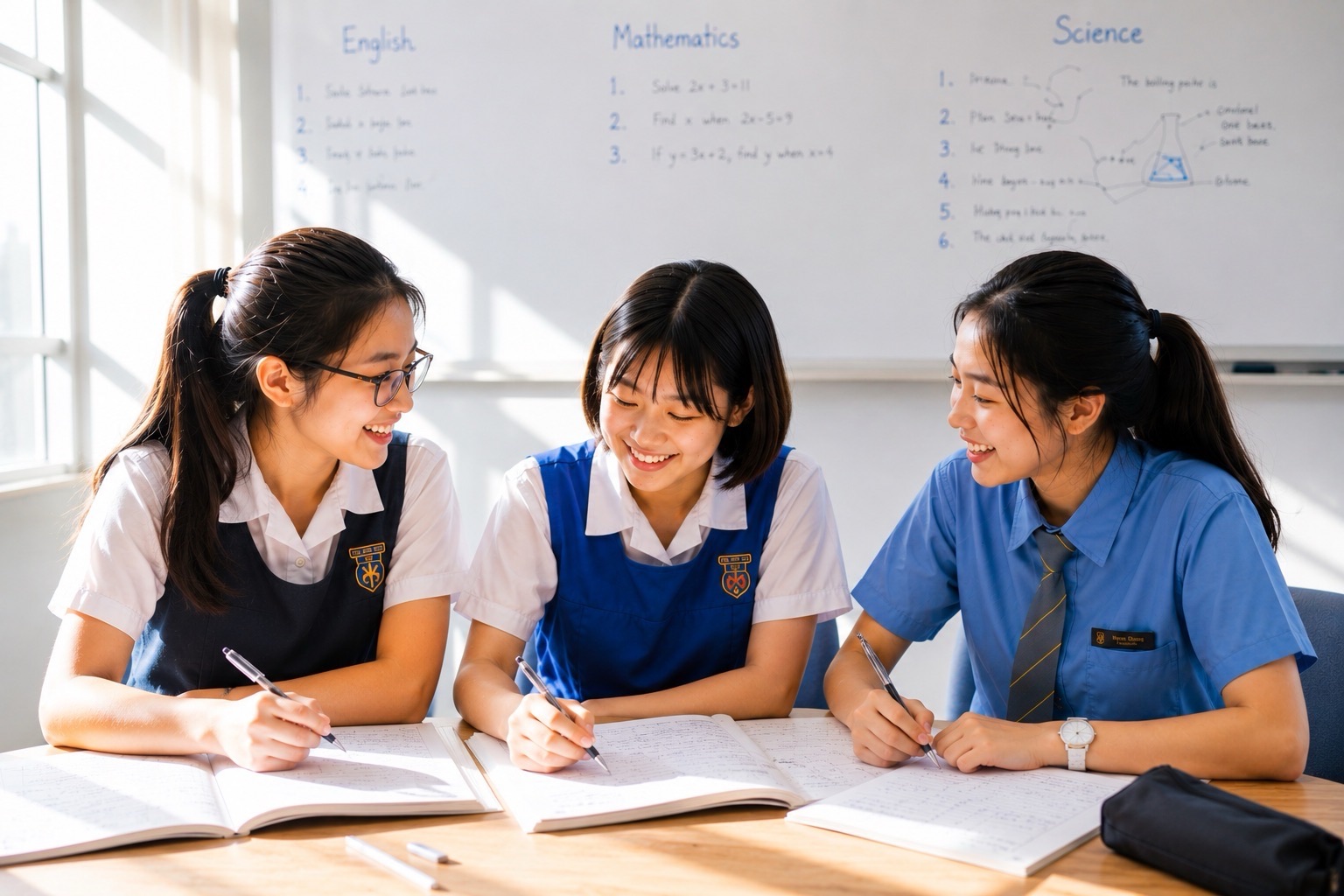
21. Why Three Students Works for Oral Communication
- Every learner receives repeated speaking turns.
- Peers act as real listeners and report what was memorable or unclear.
- Different responses show that one prompt can support multiple valid routes.
- The tutor can separate content, language and delivery issues.
- Spoken Interaction can rotate examiner/candidate/listener roles.
- Final retests remain individual.
22. A 90-Minute Yishun Sec 4 Oral Runtime
- 10 minutes — Retrieval: oral development structures.
- 10 minutes — Prompt/video decode: select relevant evidence.
- 10 minutes — Compressed planning: two or three points.
- 15 minutes — Planned Response round: individual delivery.
- 10 minutes — Listener feedback: clarity and engagement.
- 15 minutes — Spoken Interaction: adaptive follow-up questions.
- 10 minutes — Language repair: high-frequency grammar/vocabulary issue.
- 5 minutes — Fresh retest: new interaction prompt.
- 5 minutes — Evidence log: record the active oral failure.
23. Catch Up: Build One Developed Answer
A struggling learner begins with one opinion, one reason and one example. We stabilise coherent development before aiming for sophisticated breadth.
Confidence grows from successful communication.
24. Keep Up: Reduce Planning Dependence
Students keeping pace use more compressed notes and practise spontaneous questions that require fast idea selection.
The spoken system becomes more flexible.
25. Move Ahead: Qualify and Compare Perspectives
Advanced students can acknowledge a competing viewpoint, explain the conditions where it applies and state why their own position remains stronger or needs adjustment.
This adds mature reasoning without making the response sound like a written essay.
26. Parent Guide
- Ask one open question at dinner and let the child develop the answer.
- Ask “why?” and “can you give an example?” rather than correcting immediately.
- Encourage natural vocabulary rather than rehearsed impressive phrases.
- Listen for whether the child answers the question asked.
- Use occasional recordings to identify one improvement target.
- Avoid memorising full generic oral scripts.
27. What Real Secondary 4 Oral Progress Looks Like
- Planned Responses answer the prompt earlier.
- Video details are used selectively.
- Points are fewer but better developed.
- Notes become more compressed.
- Delivery becomes clearer and calmer.
- Stumbles are recovered from naturally.
- Spoken Interaction answers the actual follow-up question.
- Examples return to the main idea.
- Vocabulary remains accurate under speech load.
- Students adapt rather than recite.
28. When Yishun Secondary 4 English Tuition Is Worth Considering
This approach is useful when a Sec 4 student prepares substantial oral notes but sounds scripted, gives short follow-up answers, struggles to develop examples or becomes destabilised when the examiner asks an unexpected angle.
It may be unnecessary when oral performance is already reliable and written components are clearly the higher-value priority.
No responsible tutor can guarantee an O-Level grade. Oral training can improve communication reliability while outcomes also depend on broader English proficiency, school preparation, examination performance and the student’s condition on the day.
29. How This Page Fits the Yishun Secondary 4 Estate
Yishun Secondary 4 English Tuition | Prelim Script Forensics & Cross-Paper Marks-Loss Map owns broad final repair. Paper 1 Writing Reliability & Time Allocation owns writing. This page owns 2026 Oral Communication: Planned Response and Spoken Interaction.
Official 2026 O-Level English Reference
SEAB’s 2026 English Language 1184 syllabus states that Paper 4 comprises Planned Response and Spoken Interaction. Planned Response uses a video clip and accompanying prompt; Spoken Interaction is a discussion on a topic broadly related to that video. Families can verify the current syllabus on the official SEAB website.
Frequently Asked Questions
Should students memorise oral scripts?
No. Preparation should build reusable idea-development and delivery skills because the examination prompt is new and the interaction is adaptive.
How long is the Planned Response?
For the 2026 O-Level English 1184 syllabus, candidates deliver a Planned Response of up to two minutes after preparation.
Why 3-pax?
Three students provide repeated speaking, listener and examiner roles while leaving enough tutor attention for individual language and delivery diagnosis.
Conclusion: Oral English Is Prepared Thinking That Must Stay Alive
A strong oral candidate is prepared without sounding trapped by preparation.
Read the prompt. Select a few useful ideas. Build enough evidence and example to sustain them. Speak to the listener. Then put the notes aside mentally, listen to the next question and let the conversation change direction.
That balance—structure without rigidity, development without rambling, fluency without memorised performance—is the real communication skill Paper 4 asks the student to demonstrate.