
Yishun Primary 2 English tuition should help students talk about the future without treating will and going to as interchangeable in every sentence. Both can refer to future time, but they often differ in whether the speaker is making a prediction, a decision at the moment, or referring to an existing plan or intention.
This rebuilt legacy URL now owns one distinct P2 English job: future meaning → prediction/decision/plan → will/going to → verb form → context check. Old broad promotional copy, obsolete location claims and stale contact details have been removed.
eduKateSG does not claim a current Yishun branch. Current centres are at 83 Punggol Central, Singapore 828761 and 8 Fourth Avenue, Singapore 268674. Selected Primary English classes run in focused 3-pax small groups, typically 1.5 hours.
The Direct Answer
Use will + base verb for many predictions, promises and decisions made at the moment of speaking.
Use am/is/are going to + base verb for many plans/intentions already formed and predictions based on visible present evidence.
Future grammar is about the speaker’s viewpoint, not just a future date.
Will for a Quick Decision
Doorbell rings.
“I will answer it.”
The decision is made at the moment.
Going To for a Plan
“We are going to visit Grandma on Saturday.”
The visit is already planned.
Will for Prediction
“I think it will rain tomorrow.”
The speaker gives a prediction or opinion.
Going To for Evidence-Based Prediction
Dark clouds fill the sky.
“It is going to rain.”
The prediction is strongly connected to visible present evidence.
Worked Example: Phone Rings
“I’ll get it!”
The speaker decides now.
Using going to would sound more like a prior plan to answer that call.
Worked Example: Weekend Plan
“I’m going to finish my project on Saturday morning.”
The intention existed before the sentence was spoken.
Will for Promise
“I will help you after lunch.”
The speaker commits to a future action.
Will for Offer
“I’ll carry that bag for you.”
The sentence performs an offer as well as describing future action.
Will for Refusal
“I won’t do that.”
Won’t can express refusal or negative future prediction depending on context.
Going To for Intention
“Mira is going to learn to swim.”
This presents the future action as an intention/plan.
The Decision-Time Test
Ask:
Was the decision made before this moment, or am I deciding now?
Prior plan → going to often fits.
Immediate decision → will often fits.
The Evidence Test
Ask:
Can I see a present sign that makes the prediction likely?
“Look at those clouds. It’s going to rain.”
Visible evidence supports going to.
Worked Example: Falling Cup
A cup is tipping from the edge of the table.
“It’s going to fall!”
The prediction comes from what is happening now.
Worked Example: General Prediction
“I think our team will win tomorrow.”
This is an opinion about the future.
Negative Forms
will not → won’t.
“I won’t be late.”
am/is/are not going to:
“We are not going to travel this weekend.”
Questions With Will
“Will you come tomorrow?”
Pattern:
Will + subject + base verb?
Questions With Going To
“Are you going to come tomorrow?”
Pattern:
Am/Is/Are + subject + going to + base verb?
Do Not Add -s After Will
Wrong:
“She will goes.”
Correct:
“She will go.”
After will, use the base verb.
Do Not Drop Be From Going To
Wrong:
“She going to go.”
Correct:
“She is going to go.”
Worked Example: Plans vs Timetable
English also uses the simple present for timetabled future events:
“The bus leaves at eight.”
At P2, students do not need every future construction at once. The key is to know that future meaning is not limited to will.
Present Continuous for Arrangements
“We are meeting Aunt May tomorrow.”
This can describe a fixed arrangement.
Again, future time can be expressed through several grammatical systems.
Do Not Force a Difference When Both Are Natural
Some contexts allow both:
“I think it will be difficult.”
“It is going to be difficult.”
The second may sound more connected to present evidence or expectation, but real English usage overlaps.
Students should learn the common contrast without pretending it is an absolute law.
The Context-First Rule
Before choosing a form, identify:
- prediction?
- visible evidence?
- prior plan?
- instant decision?
- promise/offer?
Then choose the form that best matches the speaker’s viewpoint.
Worked Example: Invitation
“Will you come to my party?”
This asks about future willingness/attendance.
“Are you going to come to my party?”
This can ask about the listener’s existing plan/intention.
Worked Example: Shopping
Before leaving home:
“We’re going to buy some fruit.”
At the shop, seeing a special offer:
“I’ll buy these oranges too.”
Plan first; spontaneous decision second.
Future Time Words
Common markers:
- tomorrow;
- later;
- next week;
- soon;
- this weekend;
- in a few minutes.
These tell us when, but the future form still depends on the intended meaning.
The Base-Verb Test
After will:
will go, will eat, will play.
After going to:
going to go, going to eat, going to play.
The final verb remains in base form.
Worked Example: Editing
Draft:
“She will going to visit Grandma.”
The sentence mixes two future frames.
Repair:
“She will visit Grandma.”
or
“She is going to visit Grandma.”
Worked Example: Be Agreement
I am going to read.
He is going to read.
They are going to read.
The be verb agrees with the subject.
P2 Context
MOE’s Primary English Language Syllabus 2020 develops tense and time meanings through communication. At P2, the useful goal is not advanced terminology but reliable recognition of simple future plans, predictions and decisions. Official reference: MOE English Language Syllabus 2020 Primary.
Common Will/Going-To Failure Modes
| Symptom | Problem | Repair |
|---|---|---|
| will goes | Base verb rule missed | will go |
| she going to | Be verb omitted | she is going to |
| will going to | Two frames mixed | Choose one |
| Every future sentence uses will | Speaker viewpoint ignored | Check plan/evidence |
| Going to treated as physical movement only | Future construction missed | Read full phrase |
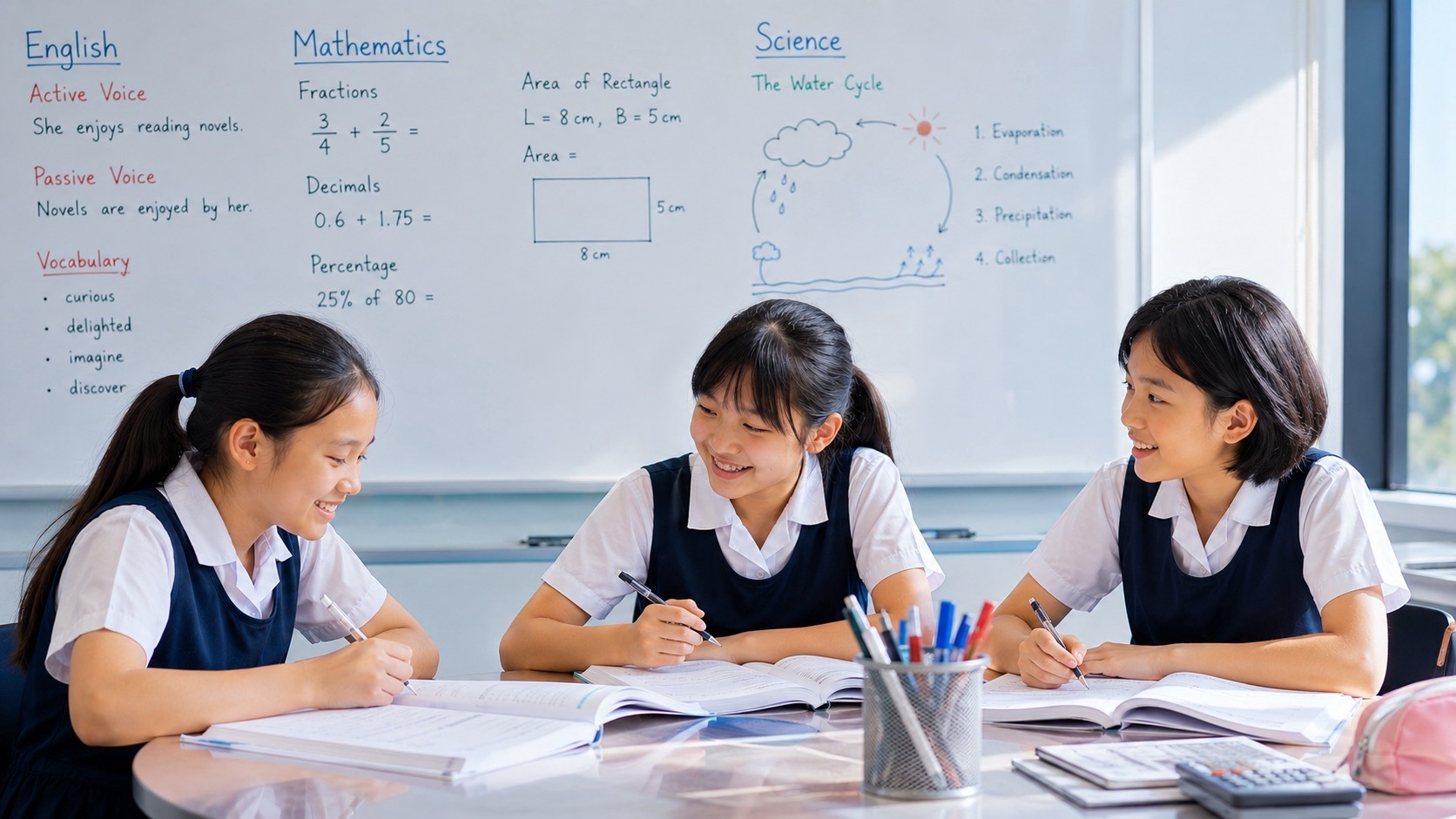
Why Three Students Helps
One student describes a prior plan, one reacts with a spontaneous decision and the third chooses the future form and explains why.
When Yishun Primary 2 Families May Consider This Support
- Will and going to are mixed inside one sentence.
- The be verb disappears before going to.
- Will takes a past or -s verb form.
- Future grammar is chosen by keyword rather than meaning.
What Progress Should Look Like
A stronger P2 learner can distinguish a prior plan from an immediate decision, recognise evidence-based and general predictions, and build the chosen future form with the correct auxiliary and base verb.
Independent location notice: eduKateSG does not claim a current Yishun branch. Current centres: 83 Punggol Central, Singapore 828761 and 8 Fourth Avenue, Singapore 268674. Contact +65 8823 1234.