
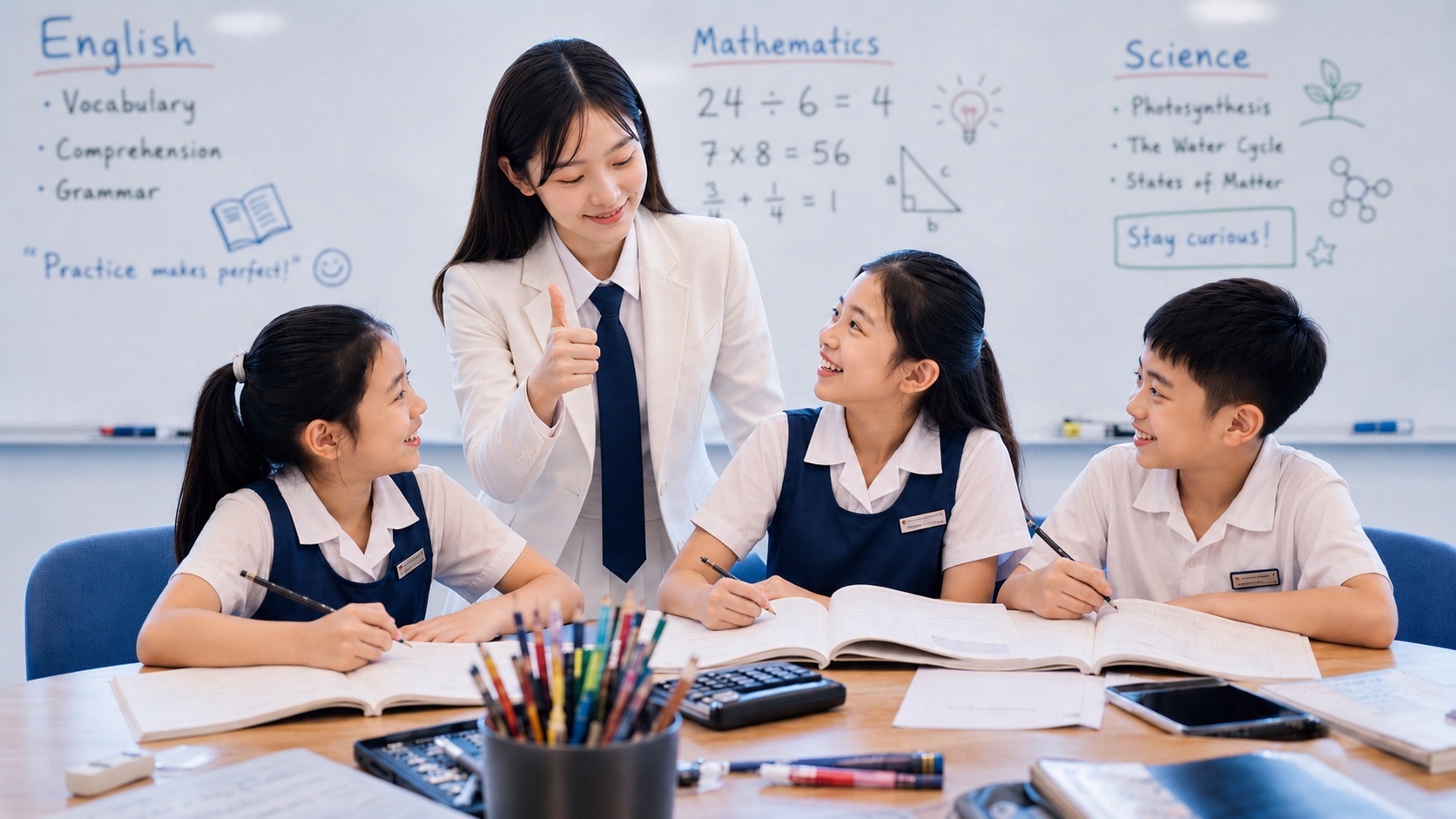
Punggol Primary 5 Science tuition should help students explain the water cycle as a movement of water through changes of state and location, not as a diagram to memorise.
This rebuilt legacy URL now owns one distinct P5 Science job: water cycle reasoning—condition → process → state/location change → evidence. The previous page contained internal preservation instructions, duplicated headings, old result promises and imported content from other grade levels. Those have been removed.
eduKateSG’s current Punggol centre is at 83 Punggol Central, Singapore 828761. Selected Primary 5 Science classes run in focused 3-pax small groups, typically 1.5 hours.
The Direct Answer
For Primary 5, the important reasoning chain is:
- Evaporation: liquid water changes into water vapour at the surface.
- Movement: water vapour becomes part of the surrounding air.
- Condensation: when water vapour loses sufficient heat under suitable conditions, it changes into tiny liquid water droplets.
- Collection/return: water gathers in different places and can later evaporate again.
The water cycle is a cycle because water changes state and location, then re-enters the same set of processes.
Why Students Memorise the Diagram but Miss the Science
A child may know the arrows labelled evaporation, condensation, precipitation yet still write “clouds are water vapour” or “water evaporates only when boiling”.
The repair is to connect each label to a process, condition and observable consequence.
Evaporation
Evaporation can occur below boiling point. Liquid particles at the surface gain enough energy to escape into the air as water vapour.
Primary 5 students should distinguish:
- evaporation from boiling;
- water vapour from visible water droplets;
- faster evaporation from “more water exists”.
Worked Example: Wet Clothes
Wet clothes dry because liquid water in the fabric evaporates into the surrounding air.
If the environment is warmer or air movement is greater, evaporation can occur faster under otherwise similar conditions.
Students should state which condition changed rather than saying simply “the Sun dried the clothes”.
Condensation
Condensation occurs when water vapour loses heat and changes into liquid water droplets.
The droplets are visible; water vapour itself is not directly visible as a cloud of white mist.
Worked Example: Cold Cup
Water droplets on the outside of a cold cup do not normally come through the cup wall.
Reasoning:
- water vapour is present in the surrounding air;
- air near the cold surface loses heat;
- water vapour condenses;
- liquid droplets form on the outside surface.
Clouds
Clouds contain tiny water droplets and/or ice crystals suspended in the atmosphere. Students should not describe clouds as “water vapour that we can see”.
Precipitation
When water droplets or ice particles in clouds become large/heavy enough under suitable atmospheric conditions, water can return to Earth as rain or other forms of precipitation.
At Primary level, the important idea is the return of water from the atmosphere to Earth’s surface.
Collection
Water may collect in rivers, reservoirs, lakes, soil, oceans and other locations. From these locations, water can enter later processes such as evaporation or plant uptake.
The “Where Is the Water Now?” Method
For every stage, ask:
- What state is the water in?
- Where is it?
- What process changed it?
- What condition helped the process occur?
This converts a decorative cycle diagram into a state-and-location model.
Worked Example: Covered Container
A container of warm water is covered with a cool lid. Droplets later appear under the lid.
Students should trace:
liquid water → evaporation → water vapour → heat loss near cool lid → condensation → droplets.
Stopping at “because the lid is cold” is incomplete because it names a condition but not the process.
Worked Example: Puddle
A puddle becomes smaller after a dry afternoon.
Observation: less liquid water remains.
Inference: some water evaporated into the air.
Boundary: the observation alone does not prove the exact rate at every moment or that evaporation was the only possible movement of water.
Factors Affecting Evaporation Rate
Students may compare conditions such as temperature, exposed surface area and moving air. The exact factor tested must be isolated fairly.
Example: to compare surface area, use the same amount of water under similar temperature and airflow conditions while changing the exposed surface.
Fair-Test Link
If two dishes contain different amounts of water and different surface areas, a student cannot cleanly conclude that surface area alone caused the difference in evaporation.
The water-cycle topic therefore connects to experimental reasoning.
Evaporation Is Not “Water Disappearing”
The liquid becomes gaseous water vapour and moves into the surrounding air. Matter is not simply lost from the system.
Condensation Is Not “Cold Produces Water”
The cold surface does not create new water. It creates conditions for existing water vapour in the air to lose heat and condense.
Worked Example: Bathroom Mirror
After a hot shower, a cooler mirror may become covered with droplets.
Students should explain the source of the water: water vapour in the warm moist air condenses on the cooler mirror surface.
Cycle Reasoning
Ask the student to begin at any point in the cycle and continue logically. A true cycle should not depend on memorising one “starting point”.
Start at a reservoir, cloud, puddle or water droplet. The student should still be able to trace processes forward.
Diagram Reading
Arrows show movement or process direction. Labels identify processes. Pictures of clouds, rivers and Sun provide context.
Students should not infer more than the diagram shows—for example, that every water molecule follows the same path on the same timescale.
Open-Ended Answer Structure
For water-cycle questions, a useful chain is:
condition → state change process → where the water moves/forms → observed result.
Example: “Water vapour near the cooler lid lost heat and condensed into liquid droplets, so droplets formed on the underside of the lid.”
Common P5 Water-Cycle Failure Modes
| Symptom | Underlying issue | Repair |
|---|---|---|
| Clouds called water vapour | Gas/droplet distinction weak | Separate invisible vapour from visible droplets |
| Evaporation only at boiling | Processes confused | Use puddle/clothes counterexample |
| Cold surface “creates” water | Source of droplets misunderstood | Trace vapour from air |
| One factor tested with several variables changed | Fair-test logic weak | Control other conditions |
| Diagram memorised clockwise only | Cycle not understood | Start from different points |
P5 Curriculum Context
MOE’s current Primary Science syllabus places Cycles in matter and water (Water) at Primary 5. This page therefore keeps the teaching corridor grade-correct and distinct from P4 Matter/Heat and P6 Energy Conversion. Official reference: MOE Primary Science Syllabus.
Why Three Students Helps
One student names the process, one traces state/location, and the third challenges the explanation with a changed condition or counterexample. The tutor can immediately see whether the child memorised a label or understands the mechanism.
A Typical 1.5-Hour Lesson
- retrieve evaporation/condensation definitions;
- analyse one real-life observation;
- trace water state and location;
- compare two fair-test setups;
- repair one misconception;
- write one complete open-ended explanation;
- transfer to an unfamiliar diagram.
When Punggol Primary 5 Families May Consider This Support
- The child memorises the cycle diagram but misexplains droplets/clouds.
- Evaporation and boiling are confused.
- Experiment questions involving evaporation rate are weak.
- Open-ended answers name the condition but omit the process.
- P5 Science needs a stronger bridge into systems and inquiry.
What Progress Should Look Like
A stronger P5 learner can begin anywhere in the water cycle, identify the state and location of water, explain the process causing the change and use evidence without overclaiming.
Current class enquiries: selected eduKateSG Primary 5 Science 3-pax small groups, typically 1.5 hours. Punggol centre: 83 Punggol Central, Singapore 828761. Contact +65 8823 1234.