
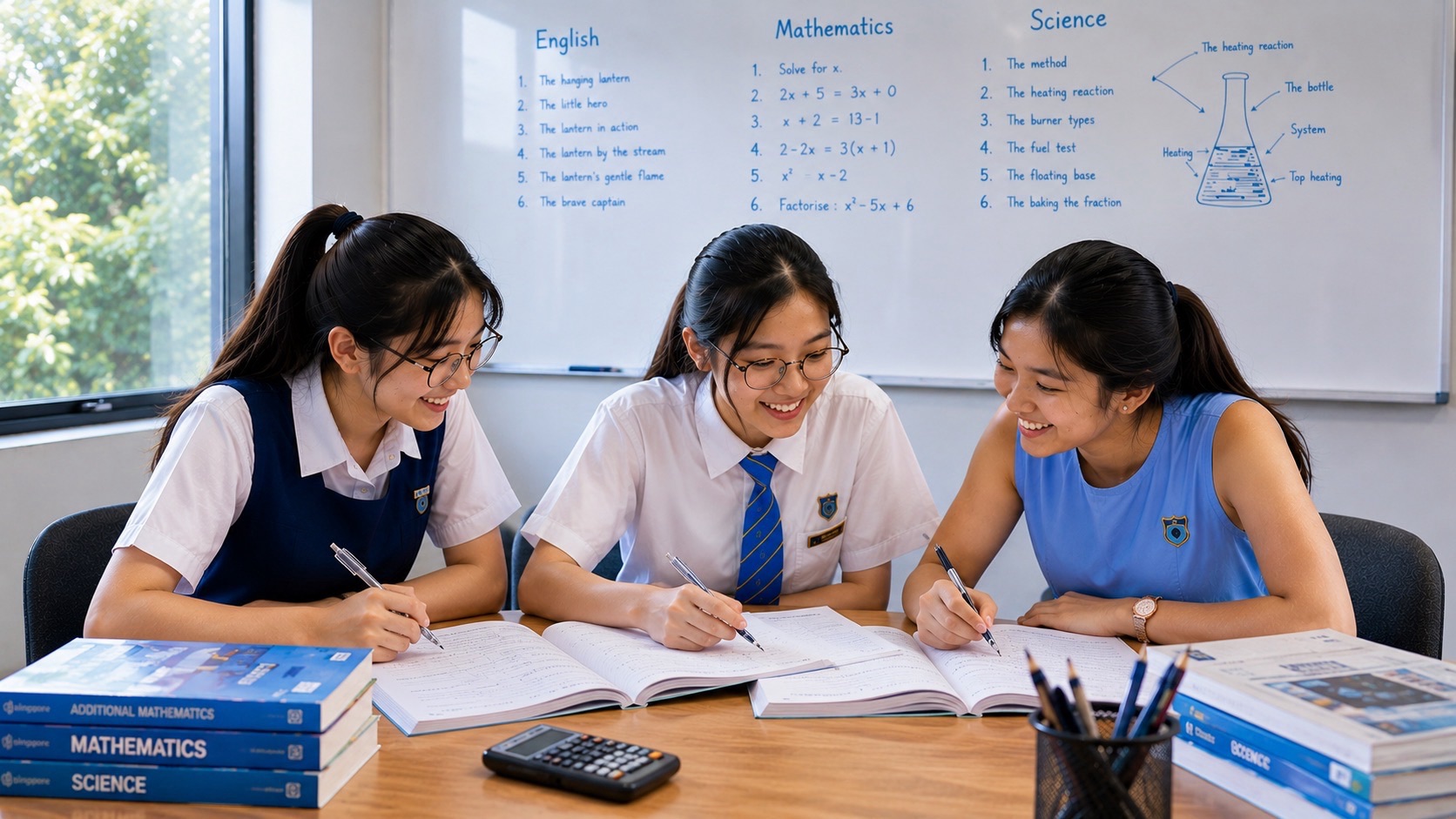
Punggol Primary 5 English tutorials should make Situational Writing feel like a communication task rather than a template-filling exercise. By Primary 5, students need to do more than write grammatically correct sentences. They must identify who they are writing to, why they are writing, what information must be included and what tone the situation requires.
This page now owns one clear teaching corridor in the eduKateSG Primary English estate: audience, purpose, content and tone in Situational Writing. It is deliberately different from our other Primary 5 page about inference. Here, the child learns to convert a prompt into obligations before drafting.
eduKateSG teaches in 3-pax small groups, typically 1.5 hours. The small group allows a tutor to compare three responses to the same task and show why a fluent piece can still be weak if it misses the communication job.
The Direct Answer
A strong Situational Writing response should answer four questions before the first sentence is written:
- Audience: Who will read this?
- Purpose: What must this writing achieve?
- Content: Which details from the prompt must be included?
- Tone: How formal, warm, apologetic, persuasive, informative or direct should the language be?
Read the situation → identify obligations → organise → draft → verify every obligation.
Why Good Writers Still Lose Situational Writing Marks
A child can write beautifully and still underperform because one content point was omitted, the wrong audience was assumed or the tone did not fit the relationship. This is why Situational Writing should not be taught as “composition but shorter”.
The central skill is task fulfilment. Language quality matters, but the language must serve the situation.
Audience: The Reader Changes the Language
Writing to a close friend is different from writing to a teacher, organiser, neighbour or unknown adult. The factual content can be the same while greeting, sentence choice, politeness and closing shift.
We ask students to model the reader before drafting. What does this person already know? What do they need to know? What relationship do I have with them?
This prevents a common error: using one memorised letter style for every task.
Purpose: What Must Change After the Reader Finishes?
Purpose is more precise than topic. A piece may be “about a school event”, but the purpose could be to invite, inform, apologise, request permission, recommend, thank, explain or persuade.
We teach students to state the purpose in one simple sentence before writing. “I need my teacher to understand why I cannot attend and accept my apology” gives much clearer direction than “I am writing about the trip.”
Content Points: Convert the Prompt Into a Checklist
Situational Writing prompts often contain several explicit pieces of information that must be communicated. Students can lose marks because they start drafting too early and forget one.
We convert the prompt into a compact checklist before writing. Each point is then checked off only when it has been communicated clearly—not merely mentioned vaguely.
If the task requires date, venue, reason and what the recipient should bring, all four are obligations. Decorative description cannot compensate for a missing one.
Tone: Match the Relationship and Purpose
Tone should not be reduced to “formal versus informal”. A message to a teacher may be respectful and warm. A complaint may be firm without being rude. An apology may be sincere without becoming melodramatic.
We ask students to choose a small set of tone words before drafting: respectful, friendly, apologetic, grateful, urgent, encouraging. Those words then guide sentence choices.
Worked Example: Same Facts, Different Audience
Situation: You cannot attend a planned activity and need to explain why.
To a friend: “I’m really sorry, but I won’t be able to make it on Saturday because my family has to attend an important event.”
To a teacher: “I am sorry that I will be unable to attend the activity on Saturday as my family has an important commitment that I must attend.”
The factual message is similar. The relationship changes the language.
Opening: Orient the Reader Quickly
A strong opening tells the reader why the message exists. Students sometimes spend too long on generic greetings or background. We teach them to establish purpose early while keeping the tone appropriate.
This reduces wandering and gives the rest of the response a clear direction.
Organisation: Group Related Content
Even short writing benefits from logical grouping. If two content points concern event details and two concern what the reader should do, grouping them improves clarity.
We do not force a fixed paragraph count. We ask whether the order helps the reader understand and act.
Closing: Complete the Communication Job
A closing may thank, request a reply, express hope, apologise again or confirm the next step. The closing should follow from the purpose rather than appear as a memorised sentence attached to every task.
Do Not Hide Missing Content Behind Good Vocabulary
Primary 5 students sometimes believe sophisticated vocabulary can lift a response even when the task is incomplete. In Situational Writing, clarity and relevance matter first.
We prefer precise ordinary words that communicate the required information over ornate phrasing that slows the reader or changes the tone.
Grammar Should Protect the Message
Tense, pronoun reference, punctuation and sentence boundaries matter because they keep the communication clear. Grammar correction is therefore tied to reader impact.
If a time expression is wrong, the reader may misunderstand when to arrive. If a pronoun is unclear, the recipient may not know who is being referred to. Accuracy has a practical purpose.
Information Selection: Relevant Does Not Mean Everything
Visual or written prompts can contain more information than the response needs. Students should identify mandatory points and useful supporting details while excluding material that does not serve the purpose.
This is another form of answer economy: communicate everything required, then stop adding information that creates noise.
Paraphrase Instead of Copying the Prompt Mechanically
Students may lift wording from the stimulus because it feels safe. We teach them to preserve the information while phrasing it naturally for the intended reader.
This tests whether the child understood the content point rather than simply transferred text from one box to another.
Worked Example: Turn a Poster Into a Message
Imagine a poster showing a clean-up event: Saturday, 9 a.m., community garden, gloves provided, bring a water bottle, register by Thursday.
If the task is to invite a classmate, the student should not copy every poster phrase. They need to communicate the relevant points in a friendly message: what the event is, when and where it happens, what to bring and what the friend needs to do next.
If the task instead asks the student to write to a teacher seeking permission to participate, the same stimulus produces a different purpose and tone.
Planning Should Be Brief
Situational Writing planning should not become another composition. We use a compact pre-write check:
- A = audience
- P = purpose
- C = required content points
- T = tone
- O = order
Once those are clear, drafting can begin. The planning exists to prevent omissions, not to consume the writing time.
Checking Should Return to the Prompt
Many students check only spelling and grammar. We teach them to check the communication contract first. Did I address the correct person? Did I achieve the purpose? Did I include every required point? Does the tone fit?
Only after that do we check sentence-level accuracy. A grammatically perfect response that missed the task is still weak.
Common P5 Situational Writing Failure Modes
| Symptom | Likely issue | Repair |
|---|---|---|
| One content point missing | Drafting began before obligation check | Convert prompt into checklist first |
| Same style for every recipient | Audience model weak | Contrast friend/teacher/organiser versions |
| Fluent but off-task | Purpose unclear | Write one-sentence purpose before drafting |
| Too formal or too casual | Tone not calibrated | Choose tone words and compare alternatives |
| Copies stimulus awkwardly | Information understood only superficially | Paraphrase each content point orally first |
| Checks grammar but misses task error | Verification order wrong | Check audience/purpose/content/tone before language |
Why Three Students Helps
Three students can receive the same stimulus but be assigned different audiences or purposes. The group immediately sees how wording changes while factual content remains stable.
Students can also audit one another’s anonymous responses using the obligation checklist. The discussion stays focused on reader needs rather than copying style.
A Typical 1.5-Hour P5 Tutorial
- Retrieve: one audience/tone distinction from a previous task.
- Decode: read the new situation and stimulus.
- Plan: identify audience, purpose, content, tone and order.
- Draft: write with task fulfilment first.
- Audit: check every obligation against the prompt.
- Edit: improve clarity, grammar and tone.
- Transfer: rewrite one section for a different audience or purpose.
Transfer Beyond Situational Writing
Audience and purpose matter in oral communication, emails, Secondary school writing and real life. The student learns that language choices depend on who is listening and what the communication needs to accomplish.
That makes Situational Writing more than an examination format. It becomes applied language judgement.
How This Fits Current Primary English
MOE’s English Language Syllabus 2020 Primary emphasises language use for different purposes, audiences, contexts and cultures, with grammar and vocabulary functioning as resources for meaning. Situational Writing is a direct place for students to practise that control. Official reference: MOE English Language Syllabus 2020 Primary.
When Punggol P5 Families May Consider This Support
- The child writes well but repeatedly misses one task point.
- Formal and informal writing sound almost identical.
- The purpose of the message becomes unclear halfway through.
- Stimulus information is copied without natural integration.
- Checking focuses on grammar but not task fulfilment.
- Primary 5 is the first year Situational Writing feels unpredictable.
- The student needs a reliable planning routine before the PSLE year.
What Progress Should Look Like
A stronger Primary 5 student can read a prompt and quickly state the reader, purpose, obligations and tone. Drafting becomes more direct. Content omissions reduce. Tone feels more natural because it follows from the relationship rather than a memorised template.
The child is learning to communicate with intent: say the right thing, to the right person, for the right reason, in the right way.
Current class enquiries: eduKateSG Primary 5 English, 3-pax small groups, typically 1.5 hours. Punggol centre: 83 Punggol Central, Singapore 828761. Contact +65 8823 1234 for current availability.