
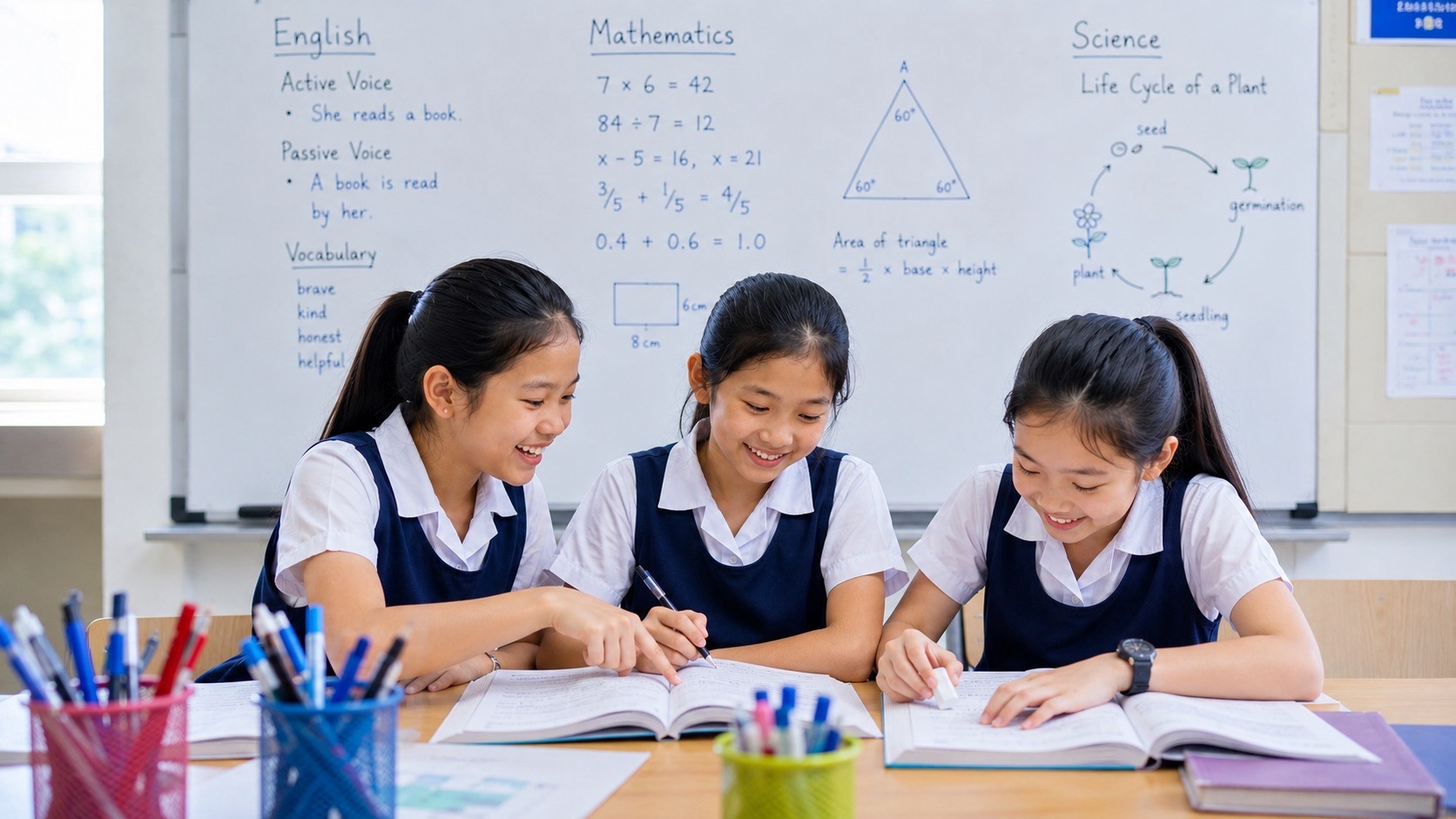
Primary 3 is where Science changes from “knowing things” into learning how to explain the world. A child may already know that magnets attract some materials, that plants need certain conditions, or that animals have different body parts. School Science asks for something more disciplined: observe carefully, distinguish what is seen from what is inferred, use the correct scientific idea, and explain the relationship in words another person can verify.
This rebuilt 2020 page now has one clear job: the 3-pax scientific-thinking foundation for Punggol Primary 3 Science. It is not a generic tuition-centre advertisement and it is not a premature PSLE drilling page. The purpose is to show parents what actually changes when Science begins formally, where understanding first breaks, what a three-student tutorial allows the tutor to observe, and how we build the habits that later Primary 4, Primary 5, Primary 6 and PSLE Science depend on.
At eduKate, Primary 3 Science is taught as the beginning of a reasoning system. Knowledge matters. Vocabulary matters. But the student also has to connect observation to concept, concept to evidence, evidence to explanation, and explanation to the exact question. If those connections are built early, later Science becomes much easier to organise.
Quick Read: What Primary 3 Science Tuition Should Build
- Observation: notice what actually changed, what stayed the same, and what can be measured or compared.
- Scientific vocabulary: use words accurately enough that the explanation means what the student intends.
- Cause and relationship: explain why one factor affects another instead of naming a fact without connection.
- Evidence: point to information in a diagram, table, experiment or observation before making a conclusion.
- Question reading: identify whether the task asks the student to state, compare, explain, predict or infer.
- 3-pax visibility: make every student’s thinking visible through talk, drawing, explanation and written answers.
- Long runway: build habits now that later support scientific inquiry and PSLE application questions.
1. Primary 3 Science Is a New Language for Relationships
Children arrive in Primary 3 with enormous everyday knowledge. They know that ice melts, shadows move, some objects float, plants grow, and animals behave differently. The challenge is not that the world is unfamiliar. The challenge is learning to describe the world with enough precision that an explanation can be tested and understood.
This is why a child can answer correctly in conversation yet lose marks in Science. “The plant died because it had no sunlight” may sound reasonable in a casual discussion, but a school question may require a more precise explanation about what the plant needs or how the observed condition affected it. “The magnet is stronger” may be too vague if the evidence actually shows that one magnet attracted an object from a greater distance. Science rewards the relationship between claim and evidence.
The first year should therefore teach children how to move from intuitive knowledge into scientific representation. What did you observe? What information is given? Which scientific idea is relevant? What does that idea explain? What evidence supports your conclusion? These questions become the backbeat of good Primary Science.
2. The 2023 Primary Science Syllabus and the PSLE Direction
The national Primary Science direction is not simply factual recall. SEAB’s 2026 PSLE Science syllabus states that the examination assesses attainment in the 2023 Primary Science Syllabus. It includes both knowledge with understanding and application of knowledge and scientific inquiry. Scientific inquiry includes making predictions and hypotheses, interpreting and analysing information, evaluating observations and methods, and communicating explanations and reasoning.
A Primary 3 child does not need to train like a Primary 6 examination candidate. But the long-term capabilities should begin now. When a tutor asks, “What did you actually observe?” we are building the later distinction between evidence and inference. When the child compares two conditions and names what changed, we are laying the groundwork for variables. When the child explains why an answer is supported, we are preparing for application questions years before the examination pressure arrives.
This is one reason we avoid teaching Science as a large bank of model answers to memorise. Model language can help a child see what precision looks like, but memorisation without understanding is brittle. The wording changes, the diagram changes, the context changes—and the child no longer knows which answer to retrieve. We want concepts to survive variation.
3. Observation Is Not the Same as Inference
This distinction is foundational. An observation is what the student can see, measure or directly obtain from the information. An inference is an explanation or conclusion based on those observations and prior scientific knowledge.
For example, “The water level decreased” is an observation. “Water evaporated” is an interpretation that uses scientific knowledge to explain the change. “The object moved towards the magnet” is an observation. “The object is made of a magnetic material” may be an inference, depending on the conditions of the investigation.
Children often collapse these two steps because everyday conversation allows it. Science questions do not always. We train students to say, “I know this because…” and point back to the information. This simple habit produces better explanations and reduces guessing.
4. The First Diagnostic: Where Does Understanding Break?
Primary 3 Science problems are often labelled too quickly as “careless” or “weak memory”. We prefer to identify the exact break. Several children can receive the same mark for very different reasons.
- Vocabulary gap: the child understands the idea but cannot name it accurately.
- Concept gap: the scientific relationship itself is not understood.
- Question gap: the child answers a nearby idea rather than the instruction asked.
- Evidence gap: the child makes a claim without using the information provided.
- Language gap: the child knows the concept but writes an incomplete or ambiguous explanation.
- Representation gap: diagrams, tables or simple graphs are difficult to decode.
- Comparison gap: the child describes two things separately instead of stating the relationship between them.
- Transfer gap: a fact is remembered in a familiar worksheet but not recognised in a changed context.
- Attention gap: key information is skipped even though the child can solve the question when prompted.
- Confidence gap: the child avoids answering because Science feels like a subject with one secret perfect phrase.
The repair depends on the category. A vocabulary gap may need retrieval and usage. A concept gap may require a demonstration, drawing or concrete example. A question-reading gap needs instruction-word practice. A transfer gap needs changed contexts rather than more identical worksheets.
5. Scientific Vocabulary: Accuracy Before Complexity
Primary Science has its own language. Words such as absorb, attract, repel, observe, compare, classify, dissolve, conduct, reproduce, energy and cycle carry specific meanings. Students do not need to sound like university scientists, but the vocabulary must be accurate enough that the relationship is clear.
We teach vocabulary through use. The child sees the word in context, explains it simply, compares it with a nearby word and uses it in an answer. A word learned only as a definition can disappear quickly. A word connected to a concept, picture, example and sentence is much easier to retrieve.
We also show students that more words do not automatically mean a better answer. Primary Science rewards precision. A short explanation containing the correct relationship can be stronger than a long paragraph full of loosely connected facts.
6. Classification: Learn the Rule, Not Just the List
Classification appears simple because children can often group familiar objects quickly. The scientific skill is deeper: identify the property being used, apply it consistently and recognise that the same object can be classified differently under another rule.
We therefore ask children to state the basis of classification. Are the objects grouped by material, function, physical property, life process or another observable characteristic? If the rule changes, does the grouping change? Can an item belong in a different group under a different question?
This develops flexible thinking. The child learns that categories are not magic labels attached permanently to objects. They are representations built according to a purpose. That idea later supports more complex Science and Mathematics reasoning.
7. Comparison: Use Relationships, Not Two Separate Descriptions
When a question asks for a comparison, many students write two facts: “Object A is large. Object B is small.” That may work sometimes, but stronger comparison language makes the relationship explicit: “Object A is larger than Object B.”
We train structures such as more than, less than, faster than, higher than, lower than, increases as, decreases as, same as and different from. The child learns to connect the two conditions inside one statement.
This matters because later Science is full of relationships. Temperature changes with time. The amount of a substance changes under different conditions. Growth varies with resources. Experimental outcomes are compared. Primary 3 is where relational language can become natural.
8. Diagrams and Tables: Read the Representation Before Answering
Science information is often represented visually. A child may know the concept but misread the representation. We teach a short scan before interpretation: title, labels, units where present, arrows, categories, sequence and any changes between stages.
For tables, students identify what each row and column represents before comparing values. For diagrams, they separate decorative elements from information. For simple graphs, they learn that the axes and scale define what the picture means.
The underlying lesson is powerful: Science does not always arrive as prose. Students must translate between representations—picture to sentence, table to comparison, observation to explanation. That translation ability becomes increasingly important in Primary 5 and Primary 6.
9. Prediction: Use a Pattern or Principle, Not a Guess
Children enjoy predicting because it feels intuitive. Science prediction should be constrained by evidence. We ask: What pattern has already been shown? What scientific principle applies? If the condition continues or changes in this particular way, what outcome is reasonable?
Students learn to distinguish prediction from wishful guessing. “I think it will…” is only the beginning. The important part is “because…”. That because must connect to evidence or a scientific relationship.
This habit will later support hypotheses and experimental reasoning. Primary 3 does not need complicated terminology for every inquiry skill, but the cognitive movement can already be practised.
10. Explanation: Build the Causal Chain
A common Primary Science answer contains the right keywords but no relationship. The student may write three relevant facts and still fail to explain why the result occurred. We teach a simple causal chain: condition → scientific process or relationship → observed outcome.
The exact wording depends on the concept, but the structure helps the child organise thinking. What condition is different? What does that condition affect? What happens as a result? If the student cannot answer the middle question, the concept may not yet be understood.
We also teach the deletion test: if removing one sentence leaves the explanation unchanged, that sentence may be decorative rather than necessary. This helps children learn that Science answers should be lean and connected.
11. Why Three Students Works Especially Well in Primary 3
Primary 3 students often need to talk before they can write. A three-student class gives enough space for every child to explain an observation, make a prediction, draw a diagram and revise an answer. The tutor hears the reasoning rather than seeing only the final written sentence.
- Every child answers aloud. Misconceptions become visible before they harden.
- Every script can be read closely. The tutor can separate scientific misunderstanding from weak language.
- Students compare explanations. They learn that two answers can mention the same topic while only one explains the required relationship.
- Concrete demonstrations stay interactive. Each child can observe and describe rather than watch passively from far away.
- Confidence grows through participation. The group is social without being large enough for a quiet child to disappear.
- Independence can be tested. The tutor can step back and see whether the child can now reason without prompts.
The aim is high visibility, not dependence. We want the child to become increasingly able to notice, think, answer and check independently.
12. What a 90-Minute Primary 3 Science Lesson Can Look Like
Primary 3 lessons need rhythm. Long lectures are poor use of the child’s attention. We move between retrieval, explanation, observation, representation and practice.
- Retrieve: recall a few important ideas or vocabulary items from earlier lessons.
- School check-in: inspect current worksheets, tests or school topics to identify urgent confusion.
- Teach one relationship clearly: use a drawing, example, object, scenario or short demonstration.
- Ask before telling: let students predict or explain so we can see their present model.
- Compare models: discuss why one explanation fits the evidence better.
- Represent: translate the idea into a diagram, table, sentence or simple sequence.
- Independent practice: remove prompts and let the child solve a changed question.
- Correction: identify the exact reason an answer failed and rewrite it.
- Close: retrieve the key relationship again and state what to remember next week.
The sequence makes learning active. Science is something the child does, not just something the tutor says.
13. Catch Up: Repair Language and Concept Together
A child who struggles early in Primary 3 may not have a “Science problem” in the broad sense. The issue may be reading, vocabulary, comparison language, confidence or difficulty turning an idea into a complete sentence. We separate these causes so the repair is appropriate.
If the concept is understood orally but writing is weak, we scaffold the language and gradually remove support. If the vocabulary is missing, we build retrieval. If the child is memorising without understanding, we return to concrete examples and changed contexts. Catch-up work should reconnect the child to the current school topic quickly rather than creating a second curriculum unrelated to school.
14. Keep Up: Make School Science Feel Familiar
For many Primary 3 students, the best tuition outcome is calm consistency. We align broadly with school progress, introduce key ideas slightly ahead where useful, retrieve earlier concepts and use school feedback as evidence. The student enters lessons with enough familiarity to participate rather than spend the whole period decoding first exposure.
Keeping up also means preventing forgetting. A topic learned in Term 1 cannot disappear by Term 3. Short cumulative retrieval helps earlier concepts remain available while new material is added.
15. Move Ahead: Ask Better Questions, Not Just Harder Questions
A strong Primary 3 student does not need to rush into Primary 6 examination papers. We can deepen learning by changing variables, asking for alternative explanations, comparing methods, introducing counterexamples and asking what evidence would distinguish between two possibilities.
This produces scientific flexibility. The child learns that knowing the answer is good; knowing why the answer is justified is better. That habit is more valuable than simply moving through future chapters early.
16. Homework: Short Tasks That Reveal Understanding
Primary 3 homework should not become an endurance test. We prefer focused tasks that tell us whether the child can retrieve a word, explain a relationship, interpret a diagram or transfer a concept independently.
A useful homework question may look slightly different from class. If the child can still recognise the underlying idea, transfer is developing. If performance collapses immediately after the surface features change, we know the learning is too tied to one example.
Corrections matter. We do not want a red cross followed by the copied model answer. The child should identify what was missing: wrong concept, incomplete relationship, weak evidence, wrong instruction or unclear language. That turns correction into learning.
17. What Parents Can Observe Without Becoming the Science Tutor
Parents can support Primary 3 Science by encouraging curiosity and explanation. Ask the child what they notice. Ask what makes them think that. Let them compare objects, observe simple changes and explain everyday phenomena. The point is not to turn dinner into an assessment; it is to make evidence-based conversation normal.
- Keep recent school worksheets and tests so repeated error patterns are visible.
- Notice whether the child understands orally but struggles to write.
- Ask “What did you observe?” before “Why did it happen?”
- Encourage the child to explain one new Science word in simple language.
- Read diagrams together by looking at labels and arrows before the text.
- Celebrate a corrected explanation, not only a high mark.
A strong home contribution is curiosity without pressure. Children learn Science better when questions are safe to ask and changing one’s mind after seeing better evidence is treated as progress.
18. What Real Progress Looks Like in Primary 3 Science
- The child distinguishes observation from explanation more often.
- Scientific vocabulary becomes more accurate in speech and writing.
- Comparisons state relationships rather than two disconnected facts.
- Answers use information from diagrams, tables or scenarios.
- The child can explain why an answer is supported.
- Predictions are linked to evidence or a known pattern.
- Corrections become more specific than “careless”.
- The student can answer a changed-context question using the same concept.
- Earlier topics remain retrievable after several weeks.
- Confidence improves because the child has a method for starting unfamiliar questions.
Marks should eventually reflect these improvements, but the behavioural changes appear first. We look for a child who is becoming more precise, more curious and more independent.
19. When Primary 3 Science Tuition Is Worth Considering
Tuition can help when the child repeatedly misunderstands school explanations, cannot translate understanding into written answers, has weak scientific vocabulary, guesses at application questions, or is beginning to believe Science is a subject of secret model phrases.
It is not automatically necessary for every Primary 3 child. If the student is curious, following school well, responding to feedback and progressing steadily, additional lessons may add unnecessary load. More tuition is not always better. The learning job should justify the time.
Likewise, ordinary tuition has boundaries. A child who needs specialised language, developmental, psychological or therapeutic support may require a different professional setting. Good education includes knowing when another kind of help is more appropriate.
20. How This Page Fits the Current Punggol Science Estate
This renewed 2020 page now owns the 3-pax scientific-thinking foundation job. For the current broader Primary 3 page focused on the first places understanding breaks, read Primary 3 Science Tuition in Punggol: Where Understanding First Breaks. For the wider current programme route, see Punggol Science Tuition for Primary 3.
The distinction is deliberate. The current hub pages can own programme choice and the broader learning journey. This article explains the three-student foundation: observation, representation, evidence, explanation and transfer. Old URLs become useful rooms rather than near-duplicate doorways.
Frequently Asked Questions
Is Primary 3 too early for Science tuition?
No, if a specific learning problem is already visible. But tuition should not be added automatically. Primary 3 is valuable because scientific habits are just forming; early repair can prevent misconceptions from becoming normal.
Should Primary 3 students already practise PSLE questions?
They can encounter age-appropriate application and reasoning questions, but full PSLE drilling is not the objective. The better long-term preparation is strong concepts, evidence use, explanation and transfer.
What if my child knows the answer but cannot write it?
We separate concept from language. First confirm the scientific relationship orally or visually. Then scaffold the sentence, identify the necessary vocabulary and gradually remove support until the child can express the idea independently.
Why are model answers not enough?
Because the context changes. A memorised sentence may fit one worksheet but fail when the diagram, variable or wording changes. We use good answers as examples of precision, but students must understand why the explanation works.
How does 3-pax help a Primary 3 child?
Every child speaks, draws, predicts and answers. The tutor can hear misconceptions early and distinguish scientific misunderstanding from language difficulty. The group still provides peer discussion and comparison.
How much memorisation is needed?
Students do need to remember scientific vocabulary, facts and relationships. We combine retrieval with understanding so memory remains usable when questions change. Memorisation is part of Science, not the whole of Science.
What should we bring for a consultation?
Recent worksheets, tests, teacher comments and examples of questions the child finds difficult are useful. Tell us whether the difficulty is reading, remembering, explaining, applying or simply refusing to attempt unfamiliar questions.
What is the main Primary 3 outcome?
The child should leave the year understanding that Science is explainable. Observe carefully, use the right concept, connect evidence to conclusion and communicate the relationship clearly. That foundation makes the later PSLE journey much less mysterious.
Official Reading for Parents
For the current national endpoint, parents can refer to SEAB’s 2026 PSLE Science syllabus. It states that the examination assesses attainment in the 2023 Primary Science Syllabus and includes both knowledge with understanding and application of knowledge through scientific inquiry.
Conclusion: Teach the Child How Science Knows
The most important Primary 3 Science lesson is not a single chapter. It is the idea that scientific claims are connected to observations, evidence and reasoning. Once a child understands that, the subject stops looking like hundreds of unrelated model answers.
Primary 3 is where we can build the habits gently. Look first. Name the relationship. Distinguish what is observed from what is inferred. Use the diagram. Compare conditions. Predict from a pattern. Explain the causal chain. Check whether the answer actually responds to the question.
A three-student class gives enough visibility to teach these habits in real time. We can hear the child’s reasoning, see the first misconception, compare different explanations and ask the student to try again immediately. The goal is not simply to complete more Science. It is to make scientific thinking increasingly available to the child.
If you are considering Punggol Primary 3 Science tuition, bring the child’s recent work and the pattern that worries you. The useful starting question is not “How many marks did they lose?” It is “Where did the connection between observation, concept, evidence and explanation break?” Once we can answer that, the next teaching move becomes much clearer.
Primary 3 parent hub: Primary 3 Tuition Punggol | English, Mathematics & Science Hub