
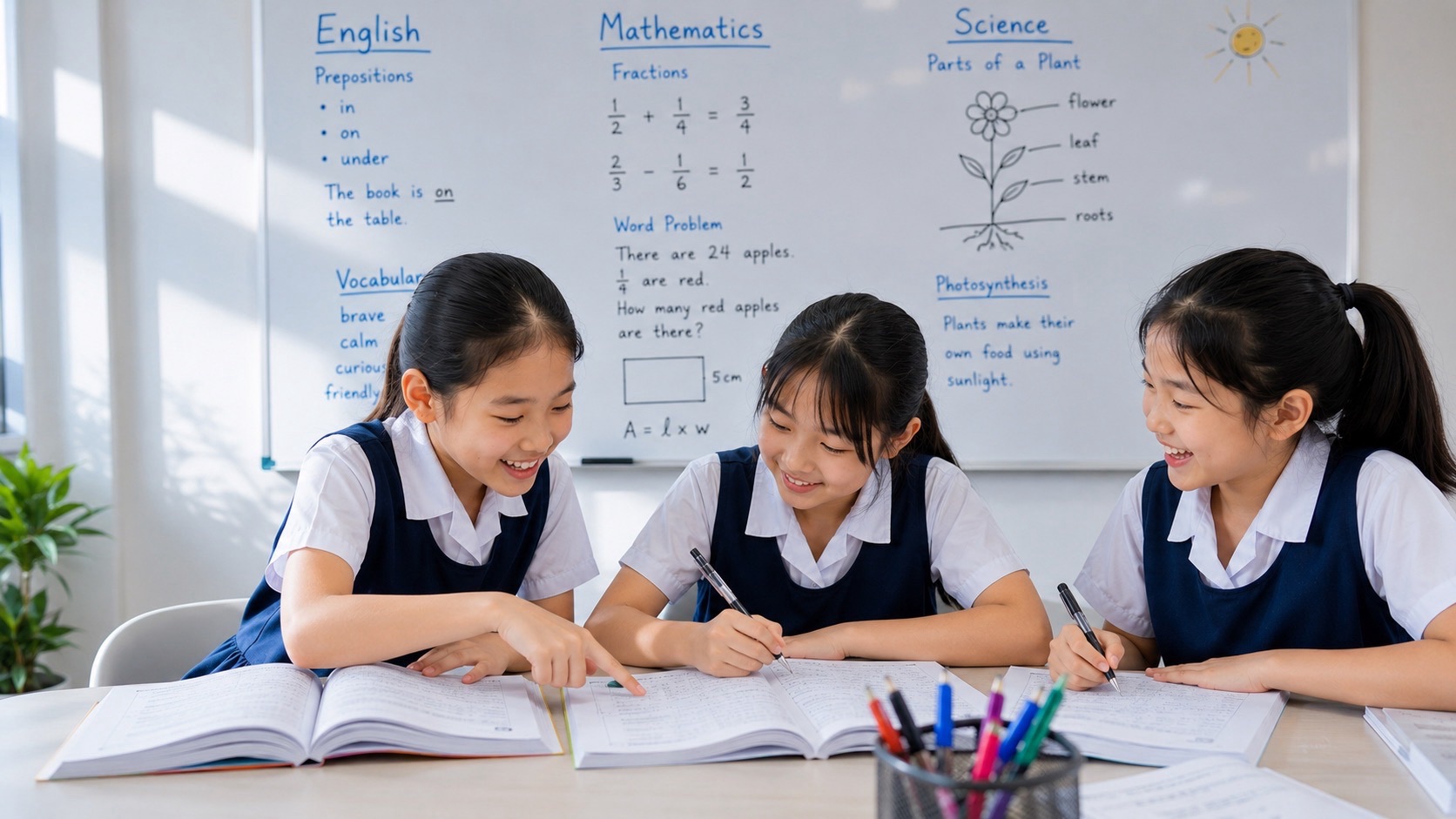
Primary 5 is where Science begins to behave like a connected system. Students are no longer working only with one idea at a time. Questions increasingly combine earlier knowledge, new concepts, diagrams, tables, experimental setups and unfamiliar contexts. A child who could score well by remembering topical facts may suddenly feel that Science has become unpredictable.
This rebuilt 2020 page now owns a distinct Yishun reader job: 3-pax experimental reasoning and concept integration for Primary 5 Science. The focus is not simply “prepare for PSLE” and it is not another generic Primary 5 tuition page. The purpose is to show how students learn to connect concepts, identify variables, interpret evidence, evaluate methods and transfer knowledge across changed contexts before Primary 6 compresses the calendar.
Location note: This is a legacy Yishun URL preserved as an educational resource for Yishun families. It does not claim that eduKateSG currently operates a Yishun branch. For current locations, class availability and enrolment information, use eduKateSG’s current contact and Punggol service pages.
Primary 5 is a particularly valuable year because the system is still repairable without final-year urgency. We can find the early weak link, rebuild it, and test whether the repair survives. A student who enters Primary 6 with connected Science knowledge and basic inquiry habits has a very different experience from one who must relearn earlier topics while simultaneously preparing for PSLE.
Quick Read: The Primary 5 Experimental Reasoning Job
- Integrate concepts: connect earlier Primary Science knowledge to current topics and multi-step questions.
- Identify variables: know what changed, what was measured or observed and what needs to stay controlled.
- Interpret evidence: read tables, graphs, diagrams and experimental results before explaining them.
- Evaluate methods: decide whether an investigation fairly tests the question.
- Build causal explanations: connect condition, process and outcome rather than listing keywords.
- Train transfer: recognise familiar scientific principles in unfamiliar contexts.
- Retrieve cumulatively: keep Primary 3 and 4 knowledge alive while new concepts are added.
- Use 3-pax diagnosis: preserve different repair priorities inside the same Primary 5 syllabus.
1. Why Primary 5 Often Creates the First Big Science Shock
Primary 5 is where many students discover the difference between recognising Science and using Science. A familiar worksheet may feel easy because the chapter heading already tells the student what concept to retrieve. A mixed or application question removes that cue. The student must decide which principle applies.
This is why parents sometimes hear, “My child knows the topic but cannot do application.” That statement may be true, but it is still too broad. Application can fail because the concept was forgotten, the context was not recognised, the diagram was misread, the variable was confused, the evidence was ignored or the explanation was incomplete.
Primary 5 tuition should therefore diagnose the pathway from information to answer. Where did the chain break? Once the break is known, the repair becomes much more efficient.
2. The National Direction Rewards Knowledge and Inquiry Together
The current PSLE Science framework assesses attainment in the 2023 Primary Science Syllabus. SEAB’s 2026 PSLE Science syllabus explicitly includes knowledge with understanding and application of knowledge and scientific inquiry. Scientific inquiry includes predicting and formulating hypotheses, interpreting and analysing information, evaluating observations and methods, and communicating explanations and reasoning.
Primary 5 is where these inquiry behaviours should become routine. Students do not need final-year exam pressure, but they should already be comfortable asking what factor changed, what outcome was measured, what evidence supports the conclusion and whether the method allows a fair comparison.
The benefit is twofold. The child becomes better at Primary 5 school Science now and simultaneously builds the reasoning that later PSLE questions expect. Good long-term preparation looks like strong present learning.
3. Variables: Understand the Logic Before Memorising the Labels
Variable questions become easier when students understand the experiment as a comparison. The investigator deliberately changes one relevant condition, measures or observes an outcome, and tries to keep other important conditions similar so the effect can be interpreted.
We start with three plain-language questions. What did the investigator change? What result did they look at? What else should remain the same? Once those relationships are clear, formal variable terminology has a meaningful structure to attach to.
We also teach students to inspect flawed setups. If two important conditions change together, can we still identify which one caused the result? If the measurement method differs between setups, is the comparison fair? This turns variable work from definition memorisation into experimental reasoning.
4. Fair Tests: Why Control Exists
Students sometimes memorise “keep all other variables the same” without understanding why. We make the reason explicit: control helps isolate the relationship being investigated. If several relevant factors change, the evidence becomes ambiguous.
This idea is tested through changed scenarios. We ask students whether a comparison remains fair and require them to explain the consequence of poor control. The answer should not simply say “it is unfair”. It should explain that the observed difference could be caused by more than one changed factor, so the intended conclusion is less secure.
That reasoning is foundational to later evaluation questions. Students begin to judge the quality of evidence rather than accepting every experimental result automatically.
5. Reading Tables and Graphs: Evidence Before Story
Primary 5 students encounter more information in visual form. The first step is not explanation. It is representation literacy. What does each axis, row, column, label or unit represent? Which values should be compared? Is the scale regular? What pattern is actually present?
We teach students to describe the pattern before explaining the cause. For example, “As X increased, Y decreased” is a statement about the data. “This is because…” introduces the scientific mechanism. Mixing these too early can cause students to explain a pattern they assumed rather than one the data showed.
Data-reading errors are especially costly because the student may know the Science perfectly and still build the entire answer on the wrong interpretation. Representation checks therefore become part of the standard routine.
6. Prediction and Hypothesis: Make the Relationship Testable
A good prediction is constrained by a known relationship or visible pattern. We ask students not only what they expect to happen, but why. The reason should connect the changed condition to the expected outcome.
At this level, students can begin to see a hypothesis as a proposed relationship that the investigation is designed to test. If the results do not match the prediction, the student should not force the data. They should examine whether the prediction, method or interpretation needs revision.
This is an important scientific value: evidence outranks ego. Changing an explanation after seeing better evidence is not failure. It is how good inquiry works.
7. Experimental Method: Read It as an Argument
An experiment is an attempt to create evidence for a claim. We teach students to read the method with that purpose. What question is the investigation trying to answer? Does the design produce evidence relevant to that question? Are the observations precise enough? Are there other factors that could explain the result?
When asked to improve a method, students should not give generic suggestions automatically. “Repeat the experiment” may be useful if reliability is the problem, but it does not fix every weakness. “Use the same amount” matters only when that amount is a relevant uncontrolled factor.
We therefore connect every improvement to a reason. What problem does the change solve? How would that make the evidence stronger? This turns method evaluation into reasoning rather than a memorised list.
8. Open-Ended Questions: Complete the Scientific Chain
Primary 5 open-ended answers often fail because the student has the correct topic but an incomplete explanation. The answer may jump from the changed condition to the final outcome without stating the mechanism that links them.
We use a checking structure: condition → scientific process or relationship → outcome. Where the question includes data, the evidence is integrated. Where it asks for a comparison, both conditions are placed in relation. Where it asks for a prediction, the expected result is tied to the underlying principle.
Keywords are treated as ingredients. Correct terminology matters, but a list of relevant words is not an explanation. Students learn to ask, “Have I shown how one thing leads to the next?”
9. Multiple Concepts in One Question
Primary 5 questions increasingly require coordination. One part may depend on reading data, another on a life process, another on an experimental condition. Students can feel overwhelmed because they attempt to solve the whole question at once.
We teach decomposition. What is this part asking? Which information belongs to it? Which scientific principle is relevant? Solve the local relationship first, then connect it to the larger question.
This reduces cognitive load. A complex page often contains several simple Science moves layered together. Students become calmer when they learn to separate them.
10. Concept Integration: Build a Network, Not a Filing Cabinet
Topical learning can make Science feel like a filing cabinet: one drawer for plants, one for materials, one for energy, one for systems. Application questions often remove the drawer labels. The student must recognise the relationship from the evidence.
We therefore build concept maps and causal links. Which ideas connect? Which conditions affect which processes? Where can one concept help explain an observation from another topic? The exact network grows with the syllabus, but the student’s habit is consistent: look for relationships.
Integration does not mean forcing every topic together. It means knowing when a connection is real and when two facts simply coexist. This distinction improves scientific judgment.
11. Retrieval: Keep Earlier Science Available
Primary 5 is cumulative. A concept learned in Primary 3 or 4 can reappear inside a new question. If the student remembers it only during the original chapter, later application becomes unnecessarily difficult.
We use spaced retrieval. Older knowledge reappears after delays through short verbal prompts, mixed questions, diagrams and comparison tasks. The student is forced to retrieve without the chapter title giving away the answer.
Interleaving is useful too. Mixed-topic practice trains selection. The child has to decide which scientific model applies. That is closer to real examination reasoning than completing twenty nearly identical topical questions in a row.
12. Transfer: Unfamiliar Does Not Mean Untaught
One of the most important Primary 5 messages is that a question can look new while testing an old principle. We deliberately vary names, objects, diagrams, numbers and settings while keeping the underlying relationship stable.
At first, students may resist because the familiar cue has disappeared. We slow down and ask what remains invariant. What changed? What is measured? What system is involved? Which relationship still applies?
As transfer strengthens, students stop saying “I have never seen this before” as often. They begin asking, “What Science is hiding inside this story?” That is a major shift towards PSLE readiness.
13. The Primary 5 Diagnostic: Where Does Application Break?
We classify the application problem instead of treating it as one category.
- Recall failure: the concept is unavailable.
- Recognition failure: the student does not see that the familiar principle applies.
- Representation failure: the graph, table or diagram is misread.
- Variable failure: changed and measured factors are confused.
- Evidence failure: the conclusion ignores the data.
- Mechanism failure: the causal middle is missing.
- Method failure: the student cannot evaluate fairness or reliability.
- Language failure: scientific understanding is stronger than the written answer.
- Sequence failure: the process is explained out of order.
- Checking failure: the answer contradicts information the student already read.
This map allows a much more useful teaching sequence. “Do more application” becomes “repair graph reading, then retest the same concept in a new context.”
14. Why Three Students Works for Experimental Reasoning
Primary 5 mistakes are often nearly correct. A student may identify the right variable but explain it poorly. Another may understand the mechanism but ignore the table. Another may know the topic but not recognise it in transfer. These distinctions require high-resolution observation.
- Every student explains the method. The tutor can hear whether the logic is understood.
- Every script can be examined closely. Missing relationships are identified precisely.
- Peer critique becomes useful. Students compare which conclusion is better supported by evidence.
- Different repair jobs coexist. One learner can work on data while another works on open-ended language.
- Inquiry becomes conversational. Students propose variables, controls, predictions and method improvements.
- Independence is tested. Prompts are removed once the method is clear.
15. The 90-Minute Yishun Primary 5 Science Lesson Runtime
The lesson balances current school needs with cumulative preparation.
- Retrieve: reactivate one or two older concepts without topic cues.
- Inspect: review school work and identify current error patterns.
- Teach: make the active scientific relationship explicit.
- Inquiry: identify variables, evidence or method logic where relevant.
- Model: show how to move from representation to conclusion.
- Guided application: practise while explaining decisions.
- Independent transfer: change the context and remove prompts.
- Open-ended construction: build a complete causal explanation.
- Correction: classify the failure and repair it.
- Return plan: schedule the concept or error for later retrieval.
The class therefore does more than follow school homework and less than indiscriminate future-paper drilling. It builds the system that Primary 6 will need.
16. Catch Up: Repair the Prerequisite With the Highest Leverage
A struggling Primary 5 student may still carry gaps from earlier years. We avoid restarting the entire Primary Science curriculum. Instead, we locate the missing prerequisite that is blocking current work.
If the child cannot compare data accurately, graph and experiment questions will remain unstable. If observation and inference are confused, conclusions will be weak. If vocabulary is missing, the concept may be understood but impossible to express precisely.
The repair is connected immediately to current Primary 5 questions. Students need to see that filling the gap changes what they can do now.
17. Keep Up: Build the Primary 6 Runway Quietly
For the stable student, Primary 5 is the year to establish durable retrieval and mixed-topic transfer. We align with school, teach slightly ahead where useful, revisit earlier knowledge and keep inquiry skills active.
The goal is that Primary 6 begins as continuation, not emergency repair. The student already knows how to read an experiment, interpret a graph, retrieve older concepts, construct an open-ended explanation and learn from corrections.
18. Move Ahead: Evaluate Evidence, Not Just Answers
Strong Primary 5 students can move ahead by working at a higher level of scientific judgment. We present competing explanations and ask what evidence discriminates between them. We ask whether a method really supports the conclusion and what additional observation would strengthen it.
We also refine explanation economy. Can the student state the same causal chain more clearly with fewer words? Can they distinguish what is certain from what is only suggested by the data? Precision becomes the advanced skill.
19. Homework: Use Fewer Questions More Intelligently
Primary 5 is already busy. Homework should create useful evidence. We use retrieval, mixed-topic questions, selected inquiry tasks and open-ended corrections rather than assuming volume alone creates improvement.
The next lesson examines independent performance. If the student understood during tuition but failed at home, we ask where the transfer broke. This is more useful than simply assigning another similar set.
Corrections include the error category. A student who writes “variable confusion” or “missing mechanism” is learning how to diagnose their own Science, which becomes increasingly important in Primary 6.
20. Parent Guide: Watch the Type of Error, Not Only the Mark
Primary 5 marks can fluctuate as questions become more integrated. Parents can help by noticing which section creates the instability.
- Keep marked papers and worksheets across several months.
- Notice whether multiple-choice remains strong while open-ended falls.
- Check whether older topics disappear after new topics are introduced.
- Ask the child what changed and what was measured in an experiment.
- Ask them to describe the data before explaining it.
- Notice whether unfamiliar contexts cause a complete confidence collapse.
You do not need to solve the question. Good evidence allows the tutor to determine whether the break is recall, recognition, data, inquiry, language or transfer.
21. What Real Primary 5 Progress Looks Like
- Students identify changed and measured factors more reliably.
- Fair-test explanations include the reason control matters.
- Graphs and tables are described before they are explained.
- Predictions are tied to patterns or scientific relationships.
- Method-evaluation suggestions solve a real experimental weakness.
- Open-ended answers include clearer causal mechanisms.
- Earlier concepts remain retrievable during mixed work.
- Unfamiliar contexts are mapped onto known principles more successfully.
- Corrections identify specific error categories.
- The student enters Primary 6 with a connected revision system rather than disconnected topical memories.
22. When Primary 5 Science Tuition Is Worth Considering
Tuition can help when the student knows facts but struggles to apply them, experiments and variables remain confusing, data interpretation is weak, open-ended answers are incomplete, earlier knowledge is decaying or the Primary 5 difficulty jump has damaged confidence.
It may not be necessary when the child is progressing steadily, retrieving old work, using feedback and solving unfamiliar questions with increasing independence. Additional tuition should solve a meaningful problem, not simply occupy more time.
Where specialised developmental, language, psychological or therapeutic support is needed, ordinary tuition may not be the correct intervention. The right professional boundary matters.
23. How This Page Fits the Yishun Science Estate
This renewed 2020 page owns the Yishun P5 experimental reasoning and concept-integration lane. Other legacy Yishun Primary 5 pages can later be rebuilt around separate jobs such as small-group runtime, PSLE runway, open-ended answer repair, misconceptions, location convenience or parent decision support rather than repeating the same tuition copy.
For a broader Science framework, families can also read How Science Works. This article remains practical: how a Yishun Primary 5 student learns to use experimental evidence and connect concepts before the final Primary year.
Frequently Asked Questions
Why does Primary 5 Science suddenly feel difficult?
Questions require more integration. Students must retrieve earlier knowledge, interpret representations and select the correct scientific principle without relying on obvious topic cues.
What does “application” mean in Primary Science?
It means using known Science in a context that may look unfamiliar. Application depends on recall, recognition, evidence reading, reasoning and communication—not one separate trick.
How do you teach variables?
We begin with the logic of comparison: what changed, what was observed or measured, and what should remain controlled. Formal terminology is attached after the relationship is understood.
Why are method-evaluation questions hard?
Students often memorise generic improvements instead of identifying the actual weakness in the investigation. We teach them to ask what conclusion the method is trying to support and what threatens that evidence.
Should Primary 5 students already do PSLE papers?
Selected PSLE-style application questions can help, but full-paper volume should not replace concept integration and inquiry training. Primary 5 is still an important teaching year.
How does 3-pax help Primary 5 Science?
The tutor can inspect each student’s reasoning closely and maintain different repair priorities. One learner may need variables, another open-ended language, another transfer. Peer discussion remains available.
What should parents bring for a consultation?
Recent tests, worksheets, teacher comments and examples of application or experiment questions that cause difficulty. Tell us whether the problem seems to be forgetting, interpreting, explaining, experimenting or transferring.
What is the main Primary 5 outcome?
A connected Science system. The student should enter Primary 6 able to retrieve earlier knowledge, interpret evidence, reason through experiments and transfer known principles into unfamiliar questions with increasing independence.
Official Reading for Parents
Parents can refer to SEAB’s 2026 PSLE Science syllabus. It states that the examination assesses the 2023 Primary Science Syllabus through knowledge with understanding and application through scientific inquiry.
Conclusion: Primary 5 Should Turn Knowledge Into a Working Scientific System
Primary 5 feels harder because Science is becoming more connected. The student must remember concepts, recognise them in new forms, read evidence, understand experimental logic and communicate a complete explanation. That is not a flaw in the subject. It is the point at which Science begins to move from facts towards reasoning.
This makes Primary 5 one of the best years for deliberate repair. There is enough time to reteach a weak prerequisite, strengthen variables and data interpretation, practise method evaluation and deliberately vary contexts until the underlying principle becomes portable.
A three-student class gives the tutor enough visibility to see exactly where application breaks. We can distinguish a forgotten concept from a misread graph, a variable error from a language error, and a genuine misunderstanding from a transfer problem.
If you are considering Yishun Primary 5 Science tuition, bring the student’s recent work and the pattern that keeps returning. The useful question is not simply “Why can’t my child do application?” It is “At which step—recall, recognition, evidence, inquiry, mechanism or transfer—does the Science stop working?”