
Secondary 2 English often improves when the student stops treating grammar as a list of isolated rules and starts seeing how sentences and paragraphs carry meaning. A student may know tense rules, vocabulary and paragraph structures separately, yet still write prose that feels unstable because sentence architecture collapses under real writing pressure.
This rebuilt 2020 page now owns one specific Yishun Secondary 2 job: sentence architecture, paragraph cohesion and editing under load for families searching around Wisteria Mall. It does not duplicate our existing Yishun Sec 2 pages on summary/synthesis, recurring-error families, feedback transfer or readiness for Secondary 3. Those pages own information control and correction. This page focuses on the language chassis itself: how clauses connect, how reference remains clear, how paragraphs progress and how editing survives when the student is also thinking about content.
“Near Wisteria Mall” is retained only as a legacy local-search reference. It does not mean lessons are held inside Wisteria Mall and does not claim that eduKateSG currently operates a Yishun branch. For current locations, class availability and logistics, use eduKateSG’s current contact and Punggol service pages.
Quick Read: The Sentence-and-Cohesion Job
- Sentence completeness: subject, finite verb and complete thought.
- Clause control: coordinate and subordinate ideas deliberately.
- Reference control: pronouns and noun phrases point clearly.
- Logical connectors: signal cause, contrast, condition and consequence accurately.
- Paragraph cohesion: sentences build one job instead of sitting side by side.
- Editing under load: detect errors inside authentic writing, not only grammar worksheets.
- Transfer: improved sentence control appears in comprehension responses, summary and writing.
- 3-pax advantage: sentence choices can be compared and repaired at high resolution.
1. Why Secondary 2 Is a Good Year to Rebuild Sentence Control
Secondary 2 students are writing longer responses than they did in Primary school and are approaching the more demanding argumentative work of Secondary 3.
If sentence control is fragile, the student can have good ideas but lose clarity while expressing them. Repairing the language chassis now reduces the amount of final-year correction later.
2. Sentence Fragments
A fragment often occurs when a student begins with a subordinating word or participial phrase and never completes the thought.
We teach students to identify the main clause and ask whether the sentence can stand independently where it needs to.
3. Run-On Sentences and Comma Splices
Students sometimes join complete ideas with only a comma because the thoughts feel connected. We make the structural choice explicit: full stop, semicolon where appropriate, coordinating conjunction or subordination.
The goal is not punctuation trivia. It is deciding the relationship between ideas.
4. Coordination: Equal Ideas
Coordination works when two ideas deserve similar grammatical weight. We examine how and, but, or, so and related structures change the relationship.
Students learn that a connector is a meaning decision, not decoration.
5. Subordination: Which Idea Is Background?
Subordination helps the student rank information. Because, although, while, if, when and other structures show cause, contrast, condition and time.
We ask which idea should be foregrounded and which should become supporting context.
6. Relative Clauses and Information Density
Relative clauses can add necessary information efficiently, but uncontrolled use makes sentences heavy.
Students learn when the clause identifies a noun and when it simply adds extra information, then edit for clarity.
7. Pronoun Reference
Pronouns are useful only when the reader knows what they refer to. Ambiguous “it”, “they” or “this” can make an otherwise correct paragraph hard to follow.
We ask students to trace every pronoun back to its noun. If two candidates exist, the reference needs repair.
8. Demonstratives Need Nouns
Students often write “This shows that…” when “this” refers vaguely to an entire previous paragraph.
Where useful, we add a noun: “This pattern”, “This decision”, “This evidence”. The reference becomes more precise.
9. Agreement Under Real Writing Load
Subject–verb agreement errors often appear when the subject is separated from the verb by a long phrase.
We teach students to identify the true head noun rather than agreeing with the nearest noun.
10. Tense Consistency and Time Control
Tense errors are not always rule ignorance. They can come from losing track of the time frame while writing quickly.
We map the timeline and distinguish deliberate shifts from accidental ones.
11. Word Form in Sentence Position
Students may know a word family but choose the wrong form. We use sentence position and grammatical role to decide whether a noun, verb, adjective or adverb is required.
This connects vocabulary and grammar instead of teaching them separately.
12. Parallel Structure
Lists and paired structures become clearer when the grammatical forms match. Students learn to notice mismatched patterns such as “to read, writing and to speak”.
Parallelism improves both clarity and rhythm.
13. Logical Connectors: Cause, Contrast, Addition, Consequence
Connectors should reflect the actual relationship between sentences. “However” cannot repair two ideas that are not genuinely in contrast.
We ask students to name the relationship before choosing the connector.
14. Paragraph Cohesion Begins With One Job
A paragraph should have a reason to exist. It may explain a cause, develop one argument, narrate one stage or compare two positions.
When the paragraph job is clear, sentence selection becomes easier.
15. Topic Sentence as Direction, Not Decoration
A topic sentence should establish the paragraph’s central move. It does not need to sound grand.
We ask whether the following sentences actually develop that direction. If not, either the topic sentence or the paragraph belongs elsewhere.
16. Evidence and Example Need a Bridge
Students sometimes drop an example into the paragraph and expect it to prove the point automatically.
We build point → example/evidence → explanation → implication. The bridge tells the reader why the example matters.
17. Sentence-to-Sentence Progression
Good cohesion often comes from carrying one piece of known information forward while adding something new.
We examine whether each sentence grows naturally from the previous one or jumps to an unrelated idea.
18. Editing Is a Second Reading Mode
Writing generates meaning; editing inspects the machinery. Students need to shift modes deliberately.
We do not ask them to “check everything” at once. We use passes: task/meaning first, sentence boundaries, recurring grammar families, reference and final punctuation.
19. Editing Under Load
A student may correct grammar accurately on worksheets but miss the same error inside their own essay. That is a transfer problem.
We therefore edit authentic writing while the student is also managing content, time and paragraph structure.
20. Build the Sentence-Control Error Map
- fragment;
- run-on or comma splice;
- agreement;
- tense drift;
- word-form error;
- pronoun/reference ambiguity;
- connector mismatch;
- parallelism error;
- paragraph drift;
- example without explanation;
- editing failure under time pressure.
21. Transfer Into Comprehension Answers
Sentence control also improves short-answer comprehension because the student can express cause, comparison and inference more precisely.
A correct idea becomes easier for the marker to recognise when the sentence relationship is clear.
22. Transfer Into Summary
Summary requires dense, accurate sentences. Clause control and reference make compression safer.
This complements our separate Yishun Sec 2 Summary and Synthesis page, which owns information selection and compression.
23. Why Three Students Works for Sentence Architecture
- Three sentence versions can be compared. Students see how structure changes emphasis.
- Errors remain individual. One learner may have tense drift; another pronoun ambiguity.
- Peer editing becomes analytical. Students explain why a sentence fails.
- Paragraph flow can be discussed aloud. Cohesion becomes visible.
- Authentic writing is inspected closely. Grammar is not trapped in worksheets.
- Transfer can be immediate. The same repair is tested in another writing task.
24. A 90-Minute Sec 2 Sentence-Control Lesson
- Retrieve: one recurring grammar family.
- Inspect: recent school or tuition writing.
- Diagnose: locate the sentence-level break.
- Teach: rebuild the relevant clause or reference structure.
- Practise: edit short authentic examples.
- Paragraph: connect sentences around one job.
- Write: produce a short original paragraph.
- Edit under time: run a personal check pass.
- Transfer: use the repair in another task.
- Close: state the prevention rule.
25. Catch Up: Stabilise the Simple Sentence First
A struggling student does not need increasingly complex sentences. We first stabilise complete, accurate simple and compound structures, then add subordination.
26. Keep Up: Edit Real Writing Weekly
A stable student benefits from regular short editing inside authentic paragraphs. This keeps sentence control connected to real meaning.
27. Move Ahead: Sentence Variety With Purpose
Strong students can explore periodic sentences, controlled fragments for effect where appropriate, varied clause openings and information density—but only after correctness and clarity are stable.
28. Parent Guide for Wisteria Mall Search Intent
- Keep recent writing with teacher markings.
- Look for the same grammar family across several tasks.
- Ask whether paragraphs have one clear job.
- Notice vague “this”, “it” and “they” references.
- Compare grammar worksheets with authentic writing performance.
- Confirm current lesson location directly; this page does not claim classes are inside Wisteria Mall.
29. What Real Secondary 2 Progress Looks Like
- Sentence fragments and run-ons reduce.
- Clause relationships become more deliberate.
- Pronoun reference becomes clearer.
- Connectors match real logic.
- Paragraphs stay on one job longer.
- Examples are explained rather than dropped in.
- Grammar corrections transfer from drills into writing.
- Editing becomes a sequence of specific passes.
- The student enters Secondary 3 with a more stable language chassis.
30. How This Page Fits the Yishun Sec 2 Estate
Yishun Secondary 2 English Tuition | Summary, Synthesis & Information-Compression Control owns information selection and compression. The older Yishun Sec 2 cluster owns feedback transfer and recurring-error families. This Wisteria-intent page owns sentence architecture, paragraph cohesion and editing under load.
Frequently Asked Questions
Why does my child score well on grammar exercises but still make grammar mistakes in essays?
Because authentic writing adds cognitive load. The student is managing ideas, organisation and time at the same moment. We train editing inside real writing so the grammar skill transfers.
Should students use more complex sentences?
Only when complexity serves meaning and remains controlled. A clear simple sentence is better than an unstable complex one.
Does Wisteria Mall mean lessons are in the mall?
No. It is local search context. Confirm current lesson location directly.
What should parents bring?
Bring marked writing, Editing work and examples where the same sentence error returns despite correction.
What is the main outcome?
A Secondary 2 student whose sentences remain clearer and more accurate under real writing load, whose paragraphs progress coherently and whose editing catches personal error families more reliably.
Conclusion: Grammar Works Best When It Is Attached to Meaning
Secondary 2 students do not need grammar as a separate museum of rules. They need grammar that survives when they are actually trying to say something.
Build complete sentences. Control clauses. Make reference clear. Use connectors for real relationships. Give each paragraph one job. Edit in passes.
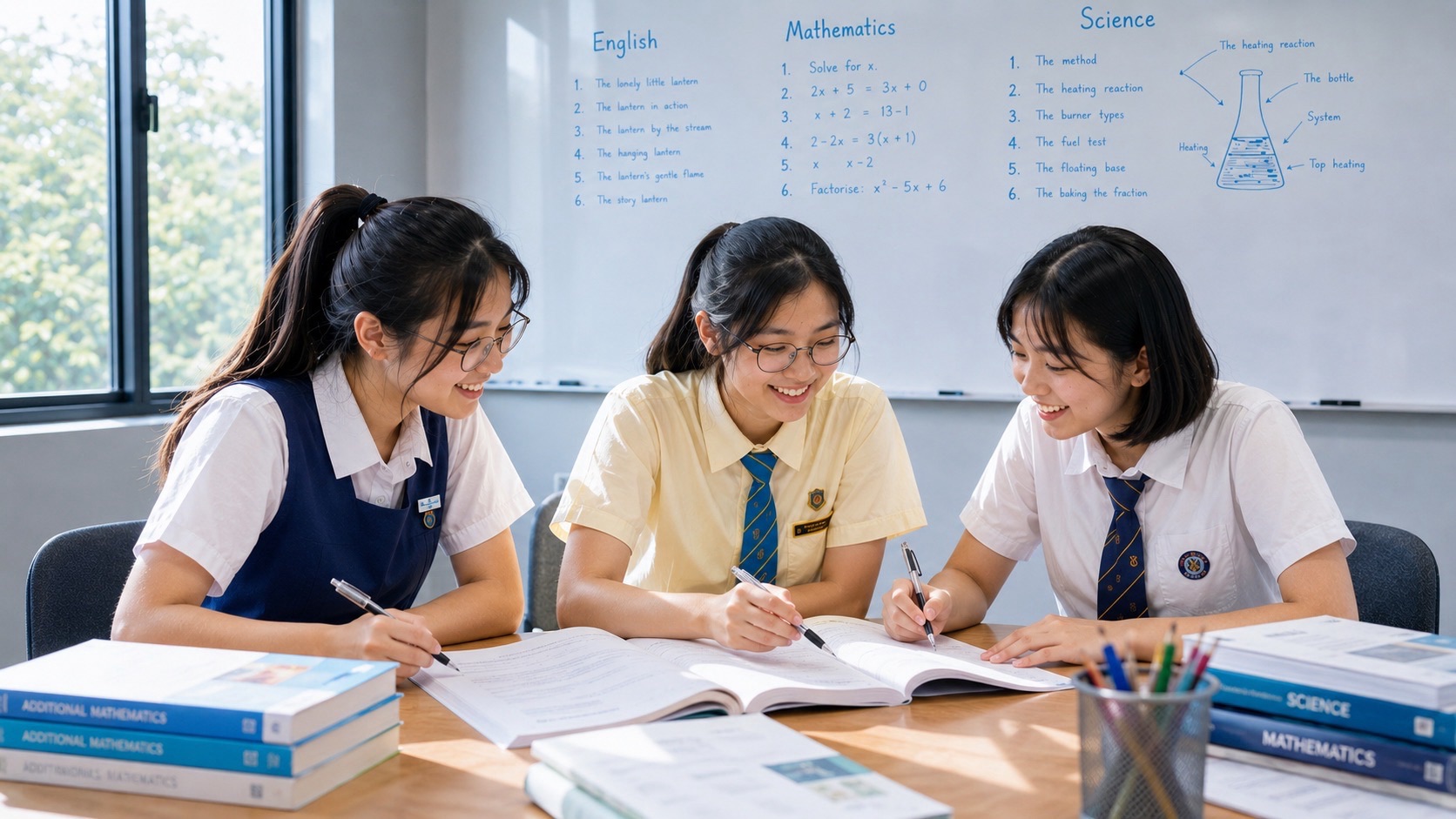
A three-student class gives enough resolution to examine how each learner’s sentence machinery behaves under authentic writing pressure.
For a Yishun family searching around Wisteria Mall, the useful question is not “Does my child know the grammar rule?” It is “Can my child still use that grammar when they are planning, writing, thinking and editing at the same time?”