
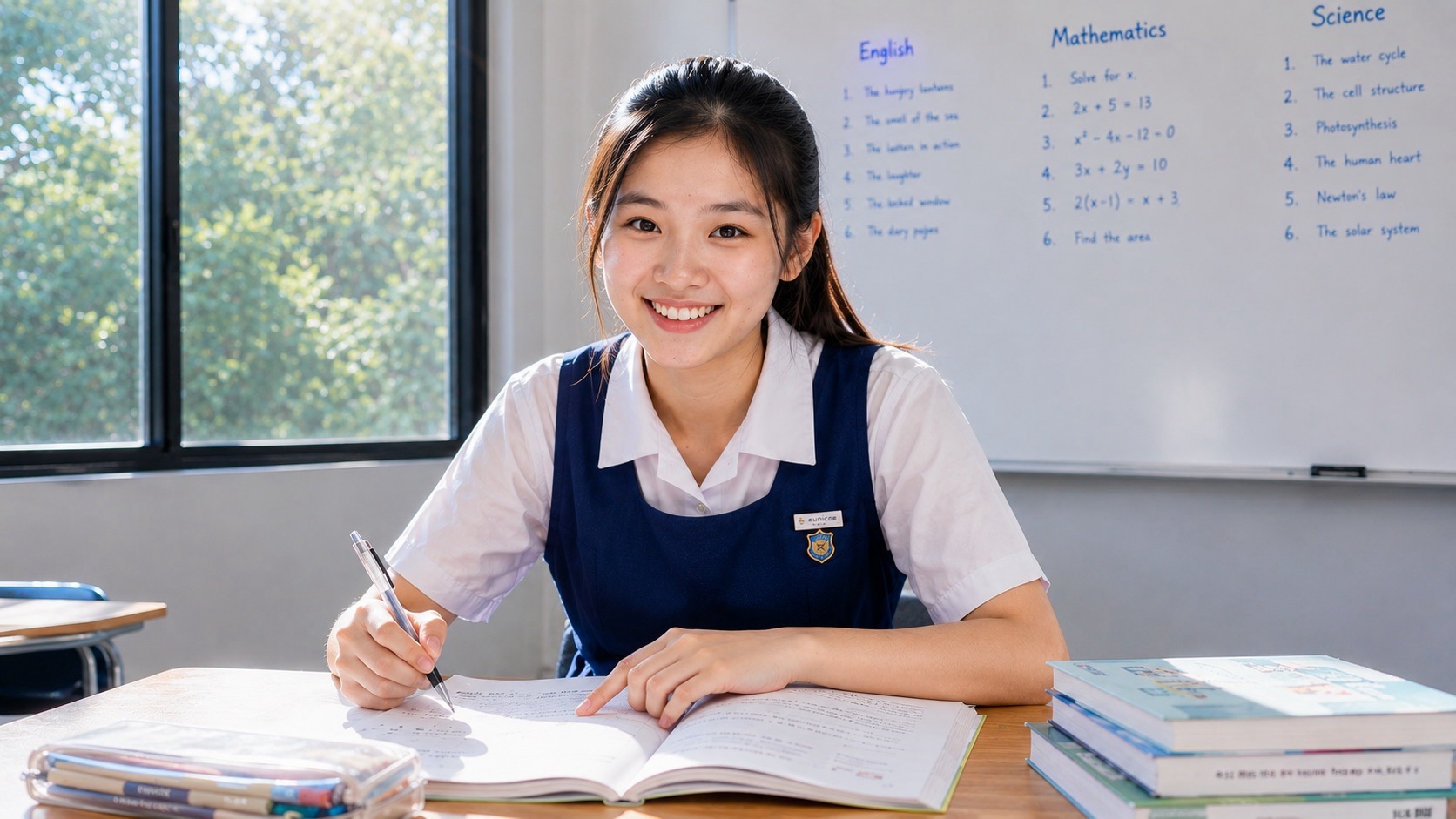
School is an organised environment that brings curriculum, teachers, peers, time, routines, assessment and shared expectations together so that learning can happen repeatedly and at scale.
In one line: school works by creating a protected social and instructional system in which children can encounter knowledge, practise capability, receive feedback, learn to work with others and gradually carry more responsibility for themselves.
School is often mistaken for education itself. The two overlap, but they are not identical. Education can happen at home, in workplaces, through books, online, through apprenticeships, in communities and across an entire human life.
School is one particular technology for organising education. Its power comes from coordination.
What Is a School?
A school is an institution designed to sustain learning across groups of learners and over time. It does this by coordinating several systems that would be difficult for every family to reproduce independently:
- a curriculum;
- teachers with subject and pedagogical knowledge;
- scheduled time;
- learning spaces and materials;
- peer groups;
- rules and routines;
- assessment and records of progress;
- pastoral and developmental support; and
- connections to later stages of education and society.
1. School Concentrates Educational Time
Learning competes with everything else in life. School protects blocks of time for sustained engagement with knowledge that children might not encounter systematically by chance.
This matters because many forms of capability need repeated practice across years. Reading, mathematics, writing, scientific reasoning, historical understanding and disciplined inquiry are difficult to build through occasional exposure.
2. School Organises a Knowledge Route
Schools do not simply place children in rooms and hope learning emerges. Curriculum creates a planned route through selected knowledge. Subjects divide parts of the world into teachable structures, while year levels and progression organise when different ideas are introduced.
The school therefore acts partly as a timetable for civilisation’s accumulated knowledge: this year, these foundations; later, these deeper structures; eventually, greater independence and specialisation.
3. Teachers Make the Route Traversable
A curriculum is only a plan until someone teaches it. Teachers select examples, explain difficult distinctions, observe misunderstanding, adjust instruction, model expert processes, set practice and decide when support can be reduced.
They also notice things a syllabus cannot: who is lost, who is ready to move, who has memorised a procedure without understanding it, who understands but cannot yet perform under pressure, and when the entire class needs a different explanation.
4. Peers Create a Social Learning World
Schools are not only teacher-to-student transmission systems. Children learn in the presence of other children.
Peers provide comparison, collaboration, disagreement, friendship, status, conflict, humour, imitation and belonging. These forces can support learning or interfere with it. School culture therefore matters because students are constantly interpreting not only lessons but also what their social world appears to reward.
A classroom in which questions are safe produces a different learning environment from one in which uncertainty invites ridicule.
5. Routines Reduce the Cost of Coordination
School relies on routines: arrival, attendance, timetables, transitions, submission systems, classroom norms, safety procedures and shared behavioural expectations.
Routines may look mundane, but they reduce repeated decision-making. When basic coordination becomes predictable, more attention can be spent on learning rather than continually renegotiating how the group will function.
6. Assessment Makes Learning Partly Visible
Schools need ways to know whether intended learning is becoming actual capability. Questions, assignments, projects, tests, examinations, observations and feedback generate evidence.
At its best, assessment does more than rank. It helps teachers and students identify what is secure, what is fragile and what the next instructional decision should be.
7. School Gradually Transfers Responsibility
A young child is carried by a large amount of external structure. Adults choose the schedule, materials, tasks, deadlines and many decisions.
As learners develop, a successful education should gradually transfer more of that load inward. Students learn to organise materials, remember commitments, monitor understanding, seek help, plan work, evaluate evidence and make increasingly consequential choices.
School therefore has a paradoxical job: provide enough structure for development while eventually making some of that structure unnecessary.
8. School Connects the Child to a Larger Society
Schools introduce learners to worlds beyond the household: shared civic rules, public knowledge, cultural difference, institutions, collective memory and forms of cooperation with people who are not family members.
In Singapore, MOE’s Desired Outcomes of Education make this wider purpose explicit. Formal education is intended to contribute to the development of confident persons, self-directed learners, active contributors and concerned citizens.
That is a larger remit than examination preparation alone.
9. School Creates Handoffs to the Next Stage
Schools sit inside a longer human route. Primary school prepares learners for Secondary demands. Secondary school opens different post-secondary pathways. Qualifications, references, portfolios and records help later institutions interpret prior learning.
These handoffs are imperfect, but they allow education systems to coordinate across years and institutions rather than forcing every new stage to begin with no information.
The Whole School Chain
Child enters → time is protected → curriculum provides direction → teachers make knowledge accessible → peers and culture shape participation → practice builds capability → assessment generates evidence → support adjusts → responsibility increases → learner moves to the next world.
A Useful Metaphor: School Is a Training Ground With Gates
A training ground creates a bounded place where capabilities can be developed before consequences become fully real. Mistakes can be corrected, routines can be rehearsed, knowledge can be revisited and difficulty can increase progressively.
But school also has gates. Students eventually leave the protected environment and carry what they learned into further study, work, citizenship and adult life. The quality of school should therefore be judged partly by what survives after the gate.
School at Three Zoom Levels
Micro: the classroom interaction
Can one learner understand the explanation, attempt the task, receive useful feedback and improve?
Meso: the school community
Do curriculum, routines, culture, relationships and support systems make learning more likely across hundreds or thousands of daily interactions?
Macro: the education system and society
Does schooling help a generation develop enough knowledge, judgement, capability and social responsibility to participate in the worlds they inherit?
How School Fails
- Attendance without learning: students are physically present but capability does not grow.
- Curriculum without connection: subjects become isolated piles of content rather than organised knowledge.
- Assessment becomes the purpose: measurable proxies displace the broader aims of education.
- Unsafe culture: students protect status or self-image by avoiding questions, challenge or visible effort.
- Excessive external control: students comply successfully but never learn to carry responsibility themselves.
- Invisible students: a standard route continues while individual learners remain persistently lost.
- Weak handoff: students pass the formal gate but lack the capability needed in the next environment.
How School Is Repaired
Repair begins by returning to purpose. What should students be able to know, do and carry independently because they spent these years here?
Then inspect the route: Is curriculum coherent? Is teaching responsive? Is feedback timely? Do routines protect learning? Does the social environment support curiosity and dignity? Are weak students noticed early? Are capable students still growing? Are students learning to manage more of their own learning?
The answer is rarely one programme. School is a system, so improvement usually depends on better alignment among several ordinary parts.
What Parents and Students Should Notice
Do not evaluate a school only through prestige, facilities or one examination statistic. Ask what everyday system the child will actually enter.
- What is the school trying to develop?
- How does it teach and support learning?
- What happens when a student falls behind?
- What happens when a student is ready for more?
- What behaviour does the culture reward?
- How are students taught to become more independent?
- What kinds of people leave the school after several years?
A School Is an Instructional Core Inside an Institution
The classroom is the smallest visible unit of school, but a school is larger than a collection of lessons. At its centre is an instructional core: learners encountering worthwhile knowledge through teaching, practice and feedback. Around that core sit timetables, staffing, leadership, safeguarding, pastoral support, assessment, facilities, family communication, peer culture, policies and resource allocation.
The institutional layers matter because they determine whether good teaching can occur repeatedly rather than occasionally. A brilliant lesson cannot compensate indefinitely for chronic absence, unsafe routines, incoherent curriculum, inaccessible materials or a timetable that repeatedly removes learning time.
Presence Is Necessary, but Attendance Is Not the Same as Learning
School first has to secure access to learning time. A learner who is absent cannot receive the ordinary sequence of explanation, practice and feedback. Yet physical presence still does not guarantee learning. Students can be seated in the room while attention, comprehension or participation has broken down.
Access → attendance → participation → instruction → practice → feedback → retained capability.
Each arrow is a possible loss point. This is why a school should not confuse enrolment, attendance, curriculum coverage and learning receipt. They are related indicators of different things.
School Climate Changes What the Instructional System Can Receive
Safety, belonging, relationships and orderly learning conditions are not decorative extras. They affect whether students can participate, ask questions, accept correction and persist through difficulty. OECD work on school climate repeatedly examines disciplinary climate, belonging and teacher support alongside achievement, behaviour and well-being, while its 2026 work on attendance describes safety, strong relationships and a calm study environment as important components of positive school climate.
But climate should not be turned into a magic explanation. Good belonging does not automatically produce strong subject teaching, and high attainment does not prove that every learner feels safe or included. School quality is multi-dimensional.
Inclusion Means Finding Barriers in the Environment as Well as in the Learner
An inclusive school asks not only, “What is wrong with this learner?” but also, “What prevents this learner from accessing the same worthwhile education?” The barrier may involve language, communication, physical access, teaching design, technology, assessment format, peer culture, transport or another part of the environment.
UNESCO’s current inclusion guidance explicitly treats curriculum, teacher capacity, language and communication, assistive technology, physical access, data and family/community involvement as parts of an inclusive learning environment. The destination remains meaningful participation and learning; the route may need adaptation.
Raw Results Do Not Equal the School’s Contribution
A common mistake is to observe a school’s examination results and treat the number as a direct measurement of school effectiveness. Student outcomes are produced jointly by many influences: prior attainment, family resources, health, peer groups, motivation, outside tuition, selection into the school, teaching quality and the school environment itself.
The US Institute of Education Sciences makes this distinction explicit: measures of how students are doing are not automatically measures of what the school contributed. Growth or value-added approaches try to separate some of these influences, but they also contain assumptions and measurement limits. A serious school evaluation therefore uses several kinds of evidence rather than one league-table number.
Three Different Questions Should Not Be Collapsed
- How are the students doing? Look at attainment, progress, attendance, engagement, well-being, destinations and other relevant outcomes.
- What is the school contributing? Ask how learning changes relative to students’ starting points and circumstances, with appropriate caution about causal inference.
- What is happening inside the school? Inspect curriculum, instruction, climate, routines, support, inclusion and professional practice.
These questions overlap, but answering one does not automatically answer the others.
School Has to Coordinate Specialisation Without Losing the Child
As schooling becomes more complex, responsibility is distributed among subject teachers, form teachers, leaders, counsellors, learning-support staff, administrators, families and external services. Specialisation can improve expertise, but it can also fragment information.
A student may look fine in five lessons and be struggling badly in one. Another may appear weak academically because attendance has collapsed. Another may understand the content but fail to organise work across multiple subjects. A strong school needs return paths that allow these partial observations to become a coherent enough picture for useful action without turning every difficulty into a permanent label.
The Best Handoff Is Transfer, Not Dependence
School succeeds partly when its support becomes portable. The learner should leave with knowledge, routines, judgement and self-management that continue to work when the original teacher, timetable and classroom are no longer present.
This gives school a world-return test: what survives beyond the institution? Can students read unfamiliar material, learn independently, collaborate, interpret evidence, manage obligations, seek help intelligently and adapt when the next environment is organised differently?
A High-Resolution School Audit
- Purpose: What capabilities and human outcomes does the school explicitly value?
- Access: Can students reliably reach and participate in learning?
- Curriculum: Is knowledge coherent, sequenced and sufficiently deep?
- Instruction: Can teachers make difficult ideas learnable and diagnose misunderstanding?
- Practice: Do students receive enough supported and independent performance?
- Feedback: Does evidence change teaching and learning?
- Climate: Are safety, belonging, curiosity and orderly learning protected?
- Inclusion: Are unnecessary barriers identified and reduced?
- Responsibility: Does external structure gradually become learner self-management?
- Measurement: Are outcomes, school contribution and internal processes kept distinct?
- Handoff: Are students becoming ready for the next environment rather than merely the next test?
- World return: What remains usable after students leave?
Evidence Boundaries for Judging Schools
UNESCO’s quality-learning framework emphasises inclusive and supportive learning environments, relevant curriculum, qualified teachers and meaningful learning rather than reducing quality to retained content alone. The OECD’s work on school climate and student well-being examines belonging, disciplinary climate and teacher support, while the US Institute of Education Sciences explains why student outcomes, school contribution and internal school processes answer different diagnostic questions.
Connect School to the Wider eduKateSG Mechanism Estate
- How Curriculum Works — how a finite route through knowledge is designed.
- How Assessment Works — how student performance becomes evidence.
- How Feedback Works — how evidence should change the next action.
- How Cooperation Works — how classrooms and institutions coordinate people.
- How Responsibility Works — how duties move from external control toward reliable independent action.
Continue Through eduKateSG
- School of Schoolhood | The Master Map
- How Singapore Works | Schools
- How Education Works | How to Learn When There Are No Schools
- How School Culture Works | Hidden Rules, Belonging and Student Confidence
Evidence and Further Reading
Singapore’s Ministry of Education describes the broader Desired Outcomes of Education as developing confident persons, self-directed learners, active contributors and concerned citizens. UNESCO likewise frames quality education as more than content retention, emphasising meaningful learning environments, relevant curricula, qualified teachers and cognitive, emotional and social development. See UNESCO on quality learning.
Frequently Asked Questions
Is school necessary for all learning?
No. Humans learn in many environments. School’s distinctive strength is its ability to organise sustained curriculum, teaching, peer interaction, assessment and progression at scale.
Is the main purpose of school to prepare for examinations?
Examinations are one important part of many school systems, but formal educational goals are broader: knowledge, self-direction, communication, judgement, collaboration, citizenship and readiness for later life all sit beyond a single test.
What makes a good school?
A good school aligns its purpose, curriculum, teaching, culture, assessment and support so that a wide range of students can make real progress while becoming increasingly capable of carrying their own learning and responsibilities.
Final compression: School works by concentrating time, knowledge, teaching, peers, routines and feedback into a structured environment that helps children develop capabilities they can eventually carry beyond school itself.
Singapore Longitudinal Test
General mechanism owner: this article remains the transferable explanation of how schools organise curriculum, teaching, peers, routines, assessment, support and progression. Singapore is a longitudinal specimen, not the universal school model.
- How Singapore Works | Schools — follow the general school mechanism through Singapore’s institutional, curricular, social and historical education context.
- What transfers: protected learning time, curriculum sequencing, teacher mediation, peer climate, assessment, support, progression and responsibility transfer.
- What is Singapore-specific: MOE structures, national curriculum and examinations, school pathways, institutional history, policy choices and local social context.
- Singapore Education Runtime & Control Tower — use the runtime layer for Singapore-specific operating state and current education-system coordination rather than treating this general article as a live national dashboard.
World-return rule: compare what learners and institutions actually receive in Singapore with the general school mechanism. If the observed result differs, separate local policy/context effects from weaknesses in the general model before correcting either layer.