
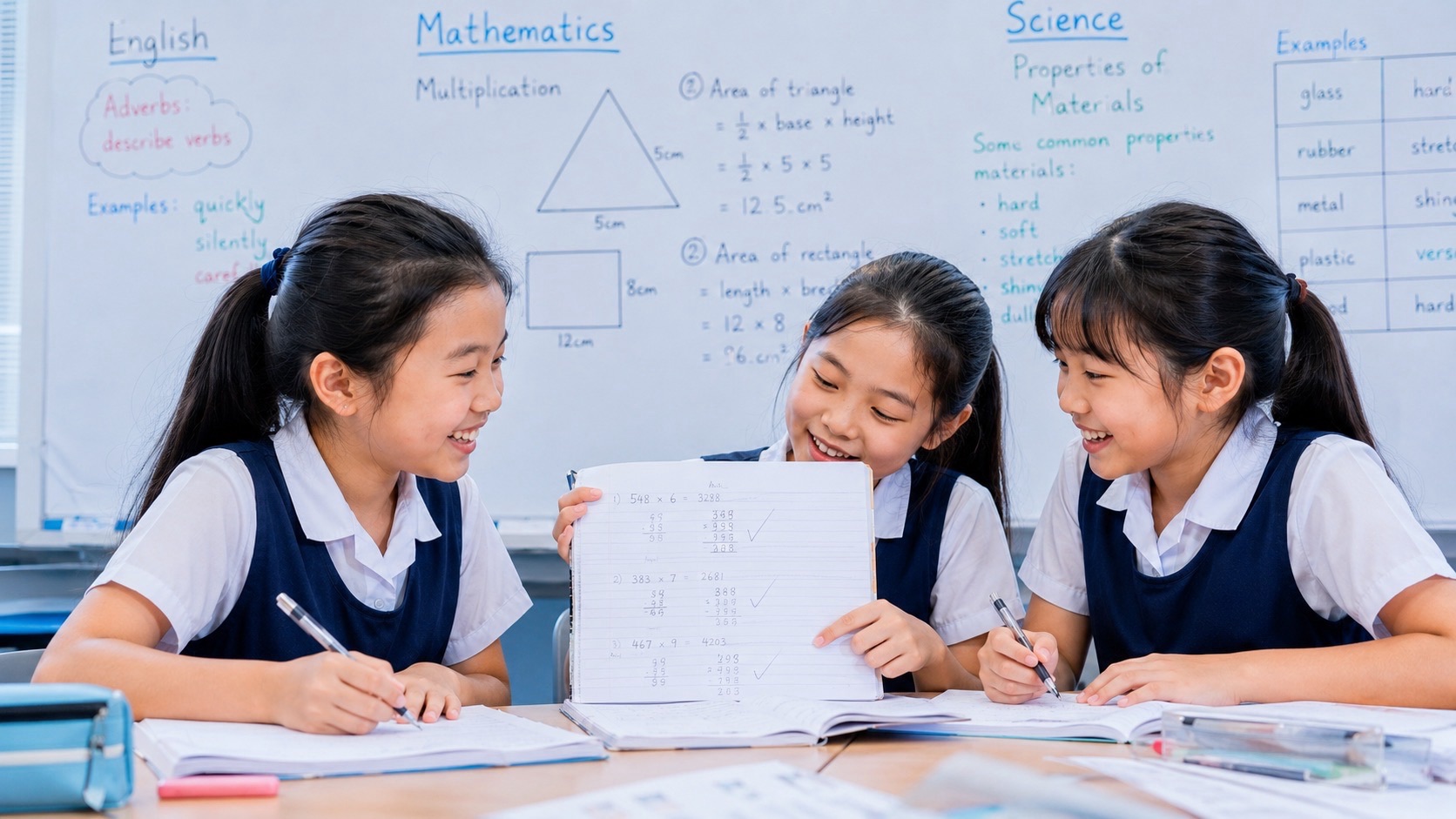
A sentence can be excellent and still fail inside a paragraph. Primary 3 learners often know how to improve individual lines, yet the paragraph feels jumpy because vocabulary is not being carried from one sentence to the next. Good paragraph writing requires continuity: ideas must connect, important words must remain stable, and vocabulary should develop rather than reset with every sentence.
This is the next step after sentence control. The child is no longer asking only, “Is this a good sentence?” The stronger question is, “Does this sentence help the paragraph do its job?”
Use This Beside the Primary 3 AL1 Vocabulary Hero
The central vocabulary bank remains eduKateSG’s Top 100 Vocabulary List for Primary 3 (AL1 Grade) Advanced. This article teaches how vocabulary survives across several connected sentences so the paragraph develops one idea instead of becoming a collection of isolated upgrades.
A Paragraph Is a Small Thinking System
A paragraph normally has a centre. It may establish a setting, describe a problem, explain a cause, show a reaction, compare two things or develop one part of a story. Vocabulary should support that centre.
If a paragraph is about fear, the language may move from uneasy to hesitated to trembling hands to relief. The exact words change, but they remain connected to the same emotional thread.
The One-Paragraph, One-Main-Job Rule
Primary 3 learners do not need every paragraph to contain only one idea in a rigid sense, but each paragraph should have one dominant job. If the job is to show how a character discovers a problem, vocabulary should help the reader notice the discovery rather than suddenly wander into unrelated description.
Vocabulary Chains
A vocabulary chain is a sequence of related words that keeps a concept alive across sentences. For weather: dark clouds → heavy rain → slippery path → soaked shoes → shivered. For anxiety: uneasy → glanced at the clock → fidgeted → worried → relieved. The words are not repeated mechanically; they build a network.
Repeat the Idea, Not Always the Same Word
Repetition can be useful for clarity, but endless repetition becomes flat. If a child writes “The rain was heavy. The heavy rain flooded the path. The heavy rain made them wet,” encourage semantic variation: heavy rain, downpour, flooded path, soaked clothes. The paragraph stays coherent while language develops.
Do Not Replace Every Repeated Word
Some repetition is necessary. If a paragraph is about a specific object, constantly replacing the noun with obscure synonyms can confuse the reader. Cohesion sometimes depends on repeating the exact word or using a pronoun.
The Topic Vocabulary Thread
Before writing, choose three to five words or phrases likely to support the paragraph’s job. A setting paragraph may need dim corridor, echo, narrow staircase, silence. A problem paragraph may need warning, careless, consequence, panic. These are not compulsory insertions. They are available tools.
The Cause-and-Effect Thread
Paragraphs often become stronger when vocabulary makes causality visible. “The path was slippery. Amir moved cautiously. He noticed a broken railing. He warned the others.” Each sentence develops the consequences of the first condition.
The Emotion Thread
Emotion should evolve. A child may begin uneasy, become frightened, then relieved. If every sentence says “He was scared,” the paragraph does not develop. Vocabulary should reflect the changing state.
The Setting Thread
Setting vocabulary works best when details interact. A dim corridor may cause a character to move cautiously. An echo may make footsteps sound closer. The description becomes part of the action instead of a decorative opening that the story forgets.
The Object Thread
If an important object appears, vocabulary can track its changing role. A fragile vase may first be admired, then carried carefully, then slip, shatter and become the cause of panic. One noun creates a chain of precise actions and consequences.
Paragraph Openings
The first sentence should orient the reader to the paragraph’s job. “At the end of the corridor stood a narrow wooden door.” immediately establishes setting and focus. “Maya knew she had made a serious mistake.” establishes problem and emotion.
Paragraph Middles
The middle develops evidence, action or explanation. This is where vocabulary chains matter most. Each sentence should add information rather than restart the topic.
Paragraph Endings
The final sentence can resolve, shift, reveal or prepare the next paragraph. A good ending often creates direction: “Only then did she notice that the key was missing.” The vocabulary points forward.
The Paragraph Fencing Method™
The hero page already develops vocabulary from word to phrase to sentence to paragraph. At paragraph level, the fence changes. The learner must now keep meaning coherent across several sentences. One word may appear in sentence one, a related phrase in sentence two, a consequence in sentence three and a transfer in sentence four.
The Five-Sentence Paragraph Laboratory
- Sentence 1: establish the main situation.
- Sentence 2: add a precise detail.
- Sentence 3: show an action or reaction.
- Sentence 4: show consequence or development.
- Sentence 5: close or point forward.
Then ask which vocabulary thread runs through all five sentences.
Worked Paragraph: Caution
The narrow path was still wet from the storm. Jia Wei moved cautiously, testing each step before placing his weight down. Ahead, a loose stone shifted under his shoe. He stopped immediately and warned his friends to slow down. Their careful progress took longer, but everyone crossed safely.
The vocabulary chain is not a list. Narrow, wet, cautiously, shifted, warned, careful, safely all support one paragraph job: managing risk.
Worked Paragraph: Disappointment to Resolve
Mei stared at the score and felt disappointed. She had expected to do better after weeks of revision. Instead of hiding the paper, she studied the questions she had missed. By the end of the evening, her disappointment had become determination. She decided to ask for help the next day.
The emotional vocabulary develops rather than repeats. The paragraph changes state.
Paragraph Cohesion Through Pronouns
Vocabulary cohesion also depends on pronouns and reference words. If every sentence repeats “the boy,” the paragraph becomes clumsy. If pronouns are unclear, the reader becomes lost. Cohesion means balancing repetition with reference.
Paragraph Cohesion Through Connectors
Connectors such as because, however, meanwhile, therefore and as a result can make relationships explicit. Use them only when the relationship needs signalling. A paragraph should not become a chain of linking words.
Paragraph Cohesion Through Time
Narrative paragraphs need temporal continuity. Suddenly, moments later, at first, soon and eventually can help, but events themselves should also make timing clear.
Paragraph Cohesion Through Space
Setting paragraphs may move from near to far, left to right, entrance to centre. Vocabulary such as beside, beyond, beneath and at the far end gives the reader a stable mental map.
The Paragraph Editing Audit
- What is this paragraph mainly doing?
- Which words support that job?
- Which sentence adds new information?
- Does any sentence wander away?
- Is vocabulary repeated too much or replaced too aggressively?
- Does the final sentence move the paragraph forward?
Common Error 1: Every Sentence Tries to Impress
If each sentence contains a rare word, the paragraph loses rhythm and sounds forced. Let ordinary language carry routine information and reserve precise vocabulary for important details.
Common Error 2: Vocabulary Resets Every Sentence
The child writes a strong first sentence, then changes topic, tone and language in the next. Repair by choosing a paragraph thread before writing.
Common Error 3: Repetition Without Development
“He was scared” appears three times. Repair by showing the emotion changing through action, intensity or consequence.
Common Error 4: Description Detached from Action
A beautiful setting paragraph is written, then the story ignores every detail. Repair by making at least one setting detail affect what the character does.
Common Error 5: Connector Overload
Every sentence begins with “However,” “Therefore,” or “Meanwhile.” Repair by checking whether sentence order already carries the relationship.
Paragraphs in Comprehension
Readers can ask what one paragraph is doing in a passage. Is it establishing setting, revealing character, explaining cause or shifting the problem? Vocabulary often signals the paragraph’s function.
Paragraphs in Science
Science explanations also need paragraph coherence. A paragraph may state an observation, explain a pattern and connect it to a conclusion. Vocabulary such as observe, compare, evidence and result should work together across sentences.
Paragraphs in Mathematics
A mathematical explanation may describe a method across several sentences: identify the quantities, choose the operation, calculate and check. Vocabulary coherence helps procedural reasoning.
A Seven-Day Paragraph Cycle
- Day 1: identify one paragraph job.
- Day 2: build vocabulary chains.
- Day 3: connect cause and consequence.
- Day 4: develop an emotion thread.
- Day 5: connect setting to action.
- Day 6: edit repetition and cohesion.
- Day 7: write an unseen paragraph with one clear vocabulary thread.
The Deeper Lesson: A Paragraph Has Memory
Every new sentence inherits what came before. Good paragraph writing remembers its own ideas. Vocabulary is one of the systems that carries that memory from line to line.
Primary 3 Paragraph Vocabulary Checkpoint
- Give each paragraph one dominant job.
- Build a vocabulary thread around that job.
- Develop ideas rather than repeating them.
- Use pronouns and repetition for cohesion.
- Connect setting, action, emotion and consequence.
- Use connectors selectively.
- Edit sentences that wander away.
- End the paragraph with direction.
Where to Go Next
Return to the Top 100 Vocabulary List for Primary 3 (AL1 Grade) Advanced for the canonical vocabulary bank. Next, this paragraph cluster zooms in on setting and atmosphere: how vocabulary creates place, mood and expectation without slowing the story.
Deep Paragraph Practice: Make Every Sentence Inherit Something
A coherent paragraph has continuity. Sentence two should inherit something from sentence one: a person, place, problem, emotion, object or relationship. Sentence three then develops that inherited material. This is why a paragraph feels different from five good sentences placed beside each other. The sentences share memory.
The Inheritance Test
After each sentence, ask, “What from the previous sentence is still active?” If the answer is nothing, the paragraph may have reset. A new detail is welcome, but it should usually attach to something the reader is already holding.
Develop Rather Than Repeat
“Maya was worried. Maya was anxious. Maya felt nervous.” changes words without developing meaning. A stronger progression might be: “Maya was uneasy when the bus failed to arrive. Ten minutes later, she began checking the road repeatedly. When she realised her younger brother was still on the bus, worry turned to alarm.” The emotion develops because events develop.
Paragraph Vocabulary Has Roles
- Anchor words keep the main topic stable.
- Development words add change, degree or consequence.
- Reference words such as pronouns prevent unnecessary repetition.
- Bridge words show relationships between ideas.
Strong paragraphs balance all four. Too many anchor words sound repetitive; too many substitutions make the topic hard to track.
The Paragraph Camera
Imagine the paragraph as a camera. Does it stay with one scene long enough to develop it? Does it suddenly jump to a different time or place without a reason? Setting vocabulary, reference words and temporal phrases help the reader understand where the camera is pointing.
The Paragraph State Change
A useful paragraph often begins in one state and ends in another: safe → uncertain, worried → relieved, confused → understanding, problem → response. Ask what changed across the paragraph. Vocabulary should help mark that change rather than simply decorate the middle.
Worked State Change: Confidence
At first, Amir hesitated before raising his hand. He had solved the problem, but he was unsure whether his method was correct. When the teacher asked him to explain his reasoning, he spoke quietly at first. As his classmates followed the steps, his voice grew steadier. By the end, he was answering confidently.
The vocabulary progresses through hesitation, uncertainty, quiet speech, steadiness and confidence. No single word carries the paragraph; the chain shows development.
Editing at Paragraph Level
Sentence-by-sentence editing can miss a larger problem. Read the whole paragraph and ask whether one sentence is excellent but unnecessary. If it introduces a beautiful detail that the paragraph never uses, it may still need to go. Paragraph control requires loyalty to the main job.
Parent Practice: Tell Me What Changed
After the child reads or writes a paragraph, ask, “What was true at the beginning, and what was different by the end?” If the child cannot answer, the paragraph may need a clearer development thread.
Teacher Practice: Colour the Threads
Use different colours for setting, action, emotion and consequence in a model paragraph. Pupils can see whether the strands interact or sit in separate blocks. Then ask them to revise one sentence so two strands connect—for example, a setting detail causing a character action.
World-Class Paragraph Challenge
Write a five-sentence paragraph in which every sentence inherits one element from the previous sentence and adds one new development. Then underline the vocabulary chain and circle the exact moment the paragraph changes state. If no change occurs, decide whether the paragraph is descriptive by design or simply static.
Continue with Setting and Atmosphere Vocabulary for Primary 3 Writing, or return to the Primary 3 AL1 Vocabulary Hero.