
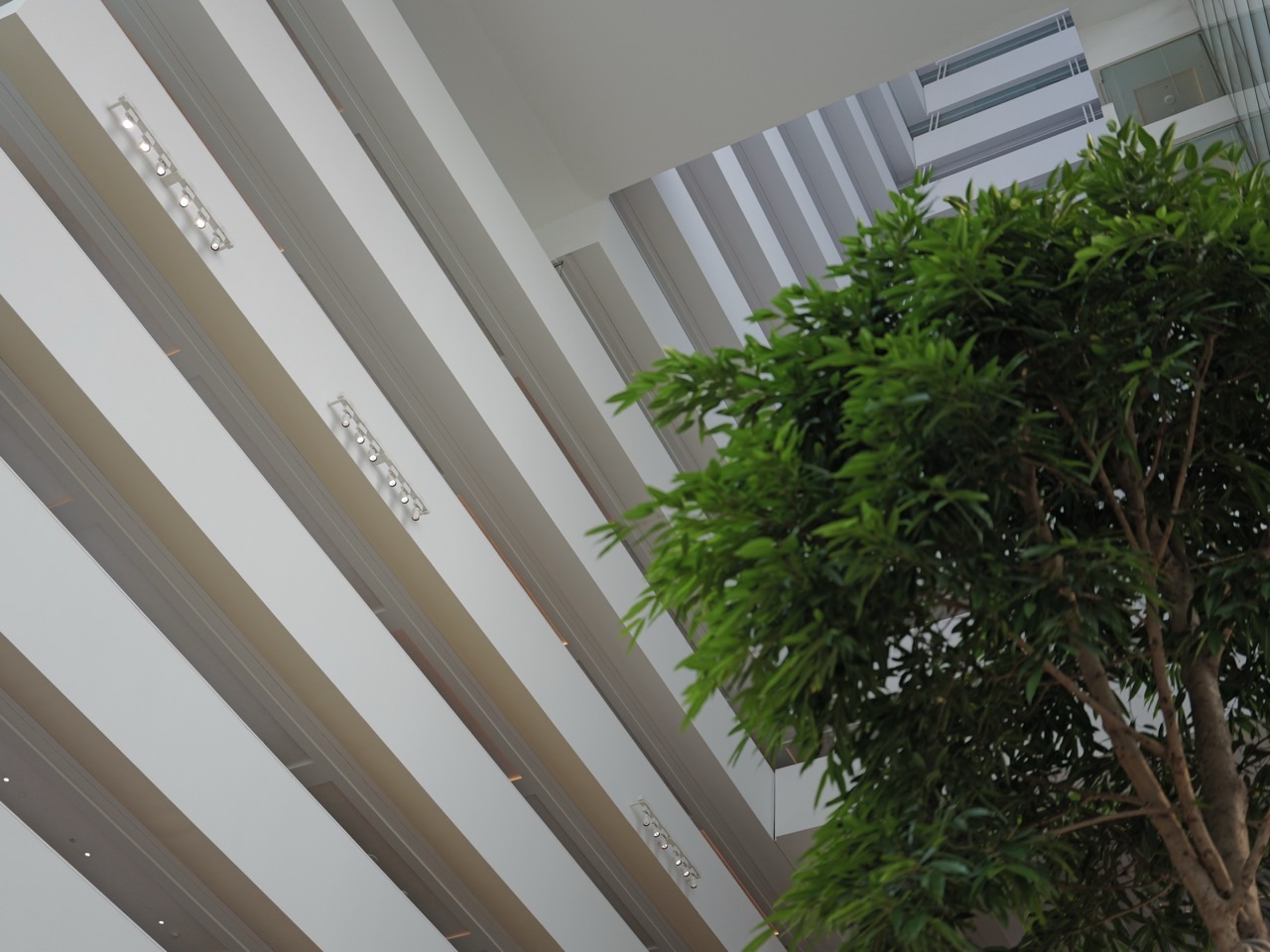
Quick Read. Buildings do not run away, but architecture photography is not easy. Camera height changes proportions. Tilting the camera makes vertical lines converge. Wide lenses can include more space but exaggerate near-far relationships from close viewpoints. Shift movements, careful positioning and timing help control geometry while preserving the building’s relationship to its surroundings.
One-sentence answer: Architecture photography works by translating three-dimensional built space into a two-dimensional projection while deciding which geometric relationships must remain stable.
Why Buildings Lean in Photographs
Stand near a tall building and tilt the camera upward. Parallel vertical edges now converge toward a vanishing region. The building did not lean; the image plane changed orientation relative to the structure.
This is perspective geometry, not a lens malfunction. Keep the camera level and verticals remain parallel in a rectilinear projection, but you may cut off the roof. Move farther back, raise the camera, use a wider lens or employ shift movements to solve the framing problem without tilting as much.
Shift Lenses Move the Frame Without Tilting the Camera
A shift lens lets the optical axis and sensor framing move relative to each other. The camera can remain level while the lens projects a higher portion of the image circle onto the sensor. This allows a tall building to fit in the frame while keeping verticals more controlled.
Software perspective correction can imitate part of this later by stretching the image, but it may require cropping and cannot recover areas never captured. Optical control at capture preserves more usable pixels and often produces cleaner geometry.
Wide Is Useful but Dangerous
Interiors often force the photographer close to walls, so wide-angle lenses are practical. But very wide fields of view can stretch objects near frame edges and make foreground distances dominate. A room can appear far larger than it feels in person.
This is not automatically wrong. Real-estate photography may want spaciousness; architectural documentation may demand more faithful spatial relationships. The lens choice follows the job.
Camera Height Changes the Building’s Story
A low viewpoint can make a building monumental. A high viewpoint can reveal plan, circulation and roof geometry. Eye level can make architecture feel inhabitable. The same facade can appear imposing, welcoming or abstract depending on where the camera stands.
Architecture photography is therefore not neutral documentation simply because the subject is stationary. Position changes the representation.
Light Reveals Material
Side light makes brick, concrete and stone texture visible. Backlight can turn glass edges luminous. Overcast light can reveal facade colour evenly. Night lighting can show how the building performs after dark.
The building may be static, but its visible character changes across the day. Good architectural photographers often scout sunlight angles as carefully as landscape photographers do.
People Can Explain Scale
A person crossing a plaza tells the viewer how large the columns are. A seated figure explains furniture scale. Occupants can also reveal circulation and use. Remove all people and the building may become a pure geometric object; include them and it becomes lived space.
Neither choice is automatically better. The question is whether the photograph is about form, use, atmosphere or all three.
Interiors Are Dynamic-Range Traps
Interior rooms often contain dark corners beside bright windows. One exposure may not preserve both. Photographers can add light, bracket exposures, use HDR, wait for different exterior conditions or accept silhouette. The technical solution should support the room rather than flatten every tonal difference.
Symmetry Is Powerful Because Buildings Repeat
Architecture supplies grids, axes, repeated windows, columns and corridors. A camera placed slightly off the intended centre can make those repetitions visibly uneven. This is why architectural composition often rewards precise centring and levelling.
But asymmetry can reveal circulation, human use or surrounding context. The important thing is whether the geometry feels deliberate rather than accidentally almost-centred.
Three Experiments
- Tilt test. Photograph a tall building with the camera level, then tilt upward. Compare vertical convergence.
- Height test. Photograph one facade from low, eye-level and elevated viewpoints. Note how power and proportion change.
- Interior range test. Photograph a room with a bright window at several exposures and compare which areas fail first.
Common Misconceptions
- “Wide-angle distortion makes buildings lean.” Camera tilt creates converging verticals; lens distortion is a separate optical issue.
- “Architecture photography is easy because buildings do not move.” Light, people, reflections and geometry still change continuously.
- “Correcting perspective later is identical to getting it right in camera.” Software can help greatly but may crop and stretch the image.
- “No people means a cleaner architectural photograph.” Sometimes people provide scale and explain use.
From Beginner to Advanced
Beginners can learn to level the camera and watch verticals. Intermediate photographers can add bracketing, polarisation, controlled interiors and long exposures. Advanced work opens into shift/tilt movements, panoramic stitching, perspective correction, colour-managed interior lighting and precise geometric documentation.
For Parents and Teachers
Architecture photography is geometry students can walk into. Ask them to photograph the same building from three heights and explain why parallel lines converge. The exercise connects mathematics to a visible real-world consequence immediately.
The Final Idea
A building can be perfectly straight and still look unstable in a photograph. That is the lesson architecture photography teaches early: the camera does not merely record geometry. It projects geometry. Where you place and point the camera determines which consequences survive the translation.
Photography route: This article is part of eduKate’s Photography knowledge estate. Return to the canonical Photography Knowledge Map for the wider connected system.