
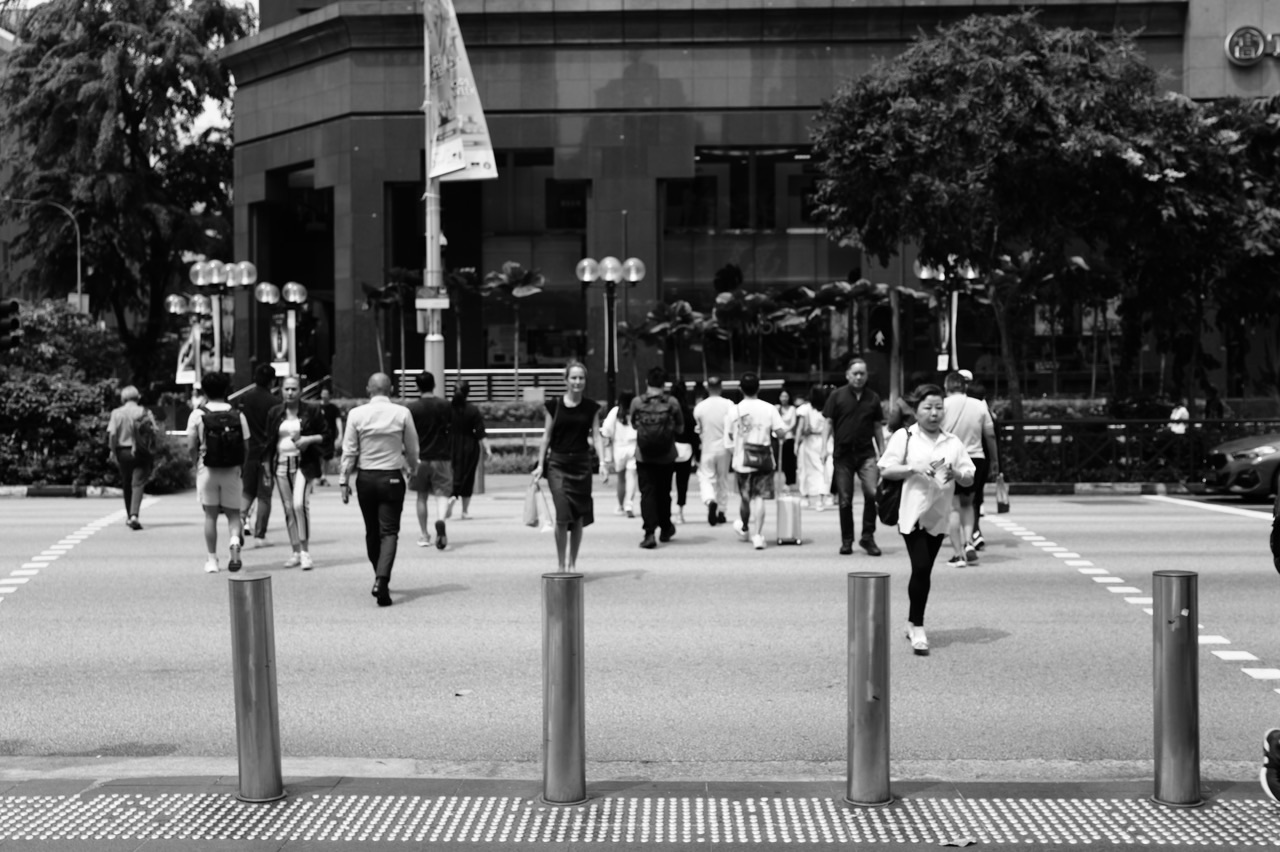
Quick Read. Street photography is not simply photography made outdoors or in cities. Its distinctive difficulty is that the photographer often has little control over the people, light, background and timing. The scene keeps rearranging itself. The craft lies in recognising when gesture, geometry, expression, light and context briefly form a photograph—and deciding whether to make it.
One-sentence answer: Street photography works by turning continuous public life into a precise visual decision before the arrangement disappears.
The Street Does Not Pose
In a studio, the photographer can move a light, shift a chair and ask the subject to turn slightly. On the street, the bus arrives when it arrives. A pedestrian steps into the patch of sunlight, then leaves. A reflection exists for three seconds. Two people align, then separate.
This lack of control changes the job. The photographer must become faster at seeing relationships than the scene is at destroying them.
Observation Comes Before Speed
Street photography is often romanticised as reflex. In reality, anticipation matters more. A photographer notices where people emerge from a station, where sunlight hits a wall, where reflections double a doorway, where a queue forms or where repeated gestures occur.
Then the photographer waits. The shutter may be fast; the seeing that made the frame possible can be slow.
Background Is Half the Photograph
A candid expression can be ruined by visual clutter behind it. Street photographers therefore often choose the background first and let people enter it. A clean wall, geometric shadow, doorway, advertisement or reflected surface becomes a stage the city supplies for free.
This reverses beginner behaviour. Instead of chasing an interesting person through chaos, find an interesting structure and wait for human life to complete it.
Timing Is More Than Catching Motion
The decisive instant may be a lifted foot, a glance, a hand touching another hand, a gap opening between two bodies or the exact second a sign and person create an accidental sentence. The photograph works because relationships become briefly legible.
Burst mode can help, but reviewing thirty nearly identical frames later does not replace anticipation. The best photographers improve their probability before they press the button.
Distance Changes the Social Temperature
A long lens allows distance but can flatten the relationship between photographer and scene. A wider lens used close places the viewer inside the event but increases social presence. Neither is inherently better. They create different kinds of participation.
Street photography is therefore partly about choosing how visible you are willing to be. The camera’s physical distance becomes a social decision as well as a compositional one.
Candid Does Not Mean Careless
Public space can permit photography in many contexts, but legality and good judgement are not identical. Vulnerable people, children, grief, medical situations, humiliation and private moments visible from public space deserve more care than a simplistic “I am allowed to photograph here” test.
The photographer should ask what the image gains, what the subject risks and whether the frame preserves dignity. Ethics does not weaken street photography. It improves the quality of the photographer’s judgement.
Street and Documentary Are Related but Not Identical
Street photography can be observational, poetic, humorous or formally driven without claiming to explain a whole social condition. Documentary photography usually carries a stronger burden of context, sequence and factual representation. A single clever street frame may survive on ambiguity. A documentary story often cannot.
This distinction protects both genres. Not every candid photograph needs to become journalism; not every documentary photograph can rely on visual wit alone.
Contact Sheets Reveal the Hidden Work
Magnum’s preserved contact sheets are valuable because they expose the sequence behind famous photographs: approach, correction, repetition, missed frames and final selection. The myth of the single miraculous click becomes less useful once we see the surrounding attempts.
Selection is part of authorship. The photographer not only decides when to press the shutter but later decides which frame should represent the encounter.
Sequencing Changes Meaning
A single frame can be ironic. Put it beside another and the relationship can become political, tender, comic or unsettling. Street and documentary projects often become stronger when photographs are edited as a sequence rather than treated as isolated trophies.
The sequence can restore context that one frame lacks: wide view, detail, reaction, repetition, contradiction.
Three Experiments
- Background-first exercise. Choose one fixed background and wait for ten different human arrangements to enter it.
- One-corner study. Stay at one safe public corner for thirty minutes. Photograph only relationships that change, not every person who passes.
- Sequence test. Select five images from one walk and arrange them in three different orders. Notice how the story changes.
Common Misconceptions
- “Street photography means photographing strangers.” It is broader: public life, gesture, environment, coincidence and social space all matter.
- “Fast reactions are everything.” Anticipation and background choice often matter more.
- “Candid means ethical questions disappear.” The absence of posing does not remove responsibility.
- “One good frame proves the whole story.” Documentary claims often require context and sequence.
From Beginner to Advanced
Beginners can learn to notice background, gesture and timing. Intermediate photographers can work with zone focusing, anticipation, layering and sequence. Advanced study opens into documentary ethics, visual anthropology, editorial context, archival practice, captions, provenance and the relationship between public space and representation.
For Parents and Teachers
Street photography can teach observation without encouraging intrusion. Set assignments around architecture, reflections, public transport, shadows or anonymous gestures rather than vulnerable individuals. Ask students to explain why they made the frame and what they deliberately chose not to photograph.
The Final Idea
The street never stops composing itself. Most arrangements are ordinary. A few become suddenly legible. Street photography begins when the photographer recognises that brief order—and has enough judgement to know whether it deserves to be kept.
Photography route: This article is part of eduKate’s Photography knowledge estate. Return to the canonical Photography Knowledge Map for the wider connected system.