
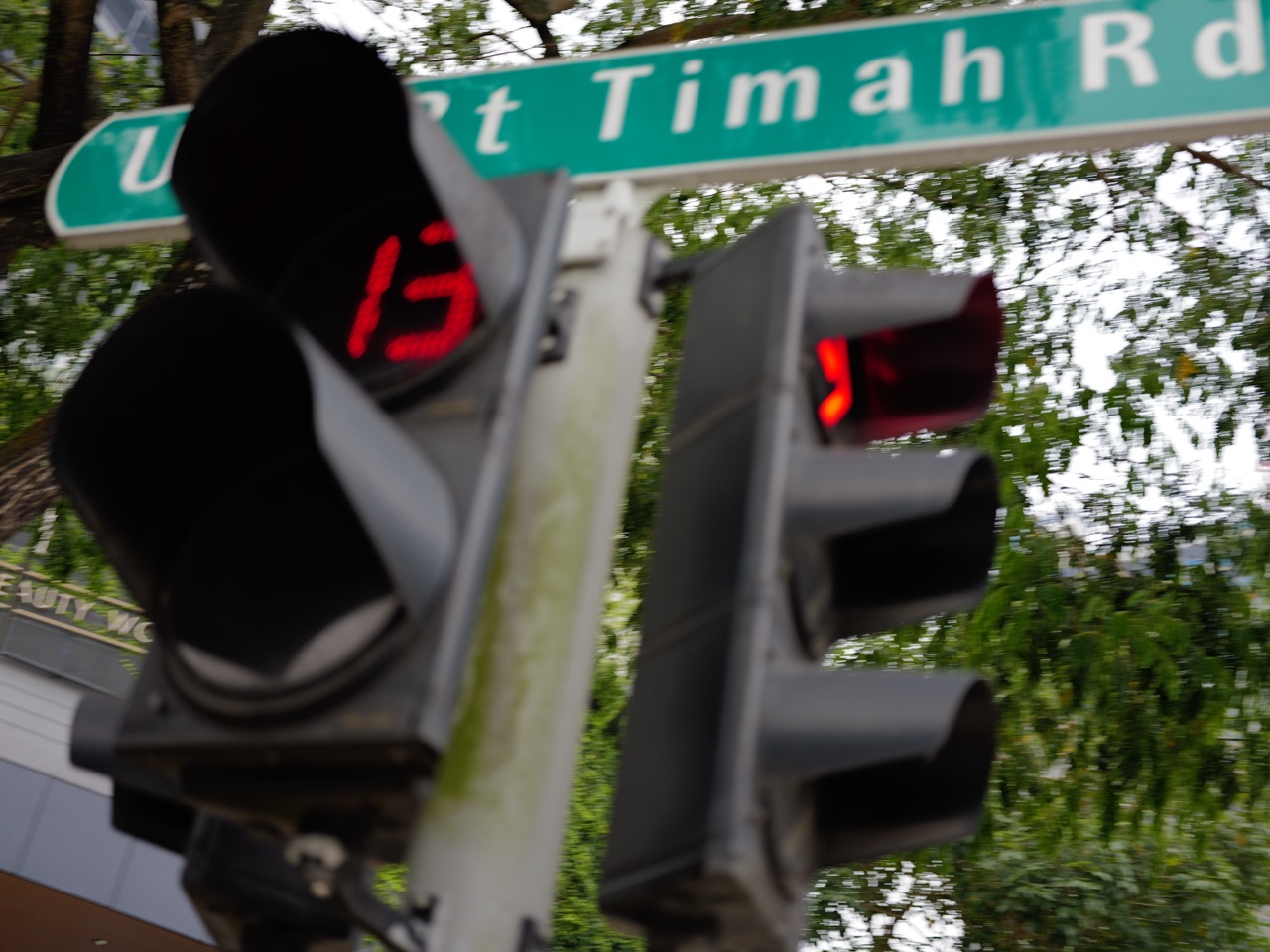
A pedestrian signal cannot assume everyone crosses at the same speed.
An able-bodied adult may clear a road comfortably within the normal green-man phase. An older person, wheelchair user or person with limited mobility may need longer even when the crossing is designed correctly.
Singapore’s Green Man+ system solves this by allowing eligible senior citizens and persons with disabilities to request a longer pedestrian phase at equipped signalised crossings.
The user taps a CEPAS-compliant senior citizen or PWD concession card on the reader mounted above the ordinary pedestrian push button. The traffic signal controller then provides additional green-man time—currently between 3 and 13 seconds, depending on the width of the crossing.
LTA states that more than 1,000 pedestrian crossings are already equipped with Green Man+, with expansion to another 1,500 crossings by the end of 2027.
The operating loop is: pedestrian arrives → taps eligible card → reader identifies extended-time request → traffic controller incorporates the request into the next pedestrian phase → green man stays on longer → crossing clears → junction returns to its ordinary signal cycle.
1. The ordinary green-man phase is a shared traffic allocation
A signalised junction divides time among competing movements.
Pedestrians need protected crossing time. Vehicles need green time. Turning movements need separation. Adjacent junctions may also be coordinated.
Pedestrian timing therefore cannot be lengthened indefinitely without affecting the rest of the junction.
Green Man+ adds time selectively when the user needs it instead of forcing every signal cycle to assume the slowest possible walking speed.
2. The system begins with an ordinary push-button crossing
At an equipped location, the standard pedestrian push button remains available for ordinary crossing requests.
The Green Man+ reader is mounted above it as an additional interface.
This preserves the normal crossing system while adding a second request type for users who qualify for extra time.
3. The concession card becomes an accessibility token
Eligible senior citizen and PWD concession cards already identify users within Singapore’s public-transport system.
Green Man+ reuses that credential at the road crossing.
The card does not reveal a medical diagnosis to the traffic signal. It simply tells the equipped controller that an authorised extended pedestrian phase has been requested.
One existing public credential therefore unlocks another mobility accommodation.
4. Additional time depends on crossing width
A six-metre crossing and a wide multi-lane road do not require the same walking time.
LTA therefore calibrates Green Man+ extension according to crossing width, with extra time ranging from 3 to 13 seconds.
The system is not simply “add ten seconds everywhere”.
Accessibility timing is tied to the actual geometry of the crossing.
5. The extension is planned into the signal cycle
The traffic signal controller has to preserve safe sequencing among pedestrian and vehicle movements.
The Green Man+ request therefore changes the allocated pedestrian time within the signal-control logic rather than allowing the user to hold the green indefinitely.
Safety remains governed by the overall junction programme.
6. Extra green time is not the same as the full clearance interval
Pedestrian signals typically include a green-man period followed by a flashing or clearance phase according to the crossing design.
The purpose of Green Man+ is to make the protected pedestrian opportunity more generous for slower users.
The exact signal sequence remains controlled by LTA’s traffic-signal system and should be followed as displayed at the crossing.
7. Green Man+ changes the time budget, not the physical route
A longer signal cannot fix a high kerb, uneven pavement or inaccessible refuge island.
Barrier-free kerbs, suitable surfaces and clear pedestrian paths still have to be provided.
Green Man+ therefore belongs to the timing layer of accessibility while kerbless crossings and ramps belong to the geometry layer.
The journey needs both.
8. More than 1,000 crossings already use the system
LTA’s current Intelligent Transport Systems guidance states that Green Man+ is installed at more than 1,000 pedestrian crossings across Singapore.
The scale matters because accessibility features become more useful when users can expect them across many ordinary neighbourhood routes instead of only at a few demonstration sites.
9. Another 1,500 crossings are planned by end-2027
LTA is expanding Green Man+ to another 1,500 pedestrian crossings by the end of 2027.
The expansion reflects Singapore’s ageing population and the wider shift toward senior-friendly streets and neighbourhoods.
The crossing becomes part of ageing-in-place infrastructure rather than simply a traffic device.
10. Friendly Streets extends the same principle beyond concession-card users
LTA’s Friendly Streets programme also adjusts pedestrian crossing operations in selected neighbourhood corridors.
At signalised Friendly Street crossings, the green man can be activated more quickly and pedestrians can receive more time to cross.
Green Man+ is targeted personalised extension. Friendly Streets is a broader neighbourhood design response.
Both recognise that pedestrian time is an infrastructure variable.
11. Signal time is a form of road-space allocation
Roads are usually discussed in metres: lane width, pavement width and crossing width.
Signals allocate another scarce resource: seconds.
Giving a slower pedestrian more time changes who can use the same physical crossing safely without rebuilding the entire junction.
Accessibility can therefore be created partly by reallocating time rather than land.
12. Personalised extension avoids permanent over-allocation
If every crossing permanently used the extended timing, vehicle and bus progression could be affected even when no slower pedestrian was present.
Green Man+ activates additional time only when an eligible user requests it.
The junction therefore preserves ordinary capacity most of the time and shifts additional seconds to the pedestrian when the need is actually present.
13. The card tap also reduces the burden of asking for help
An older person does not need to call an agency before each crossing or explain why they walk slowly.
The user performs one simple action at the signal pole.
The accommodation becomes embedded into normal street behaviour rather than treated as a special assisted service.
14. The system still depends on reaching the reader safely
The reader has to be positioned where the intended user can approach it from the barrier-free route.
A well-timed signal cannot compensate for an obstructed button area or inaccessible kerb approach.
Green Man+ therefore works best as one element inside a wider accessible crossing design.
15. A worked example: older pedestrian at a wide arterial crossing
Imagine an older resident reaches an equipped signalised crossing on the way to a market.
The resident taps an eligible concession card on the Green Man+ reader. The request is registered for the pedestrian phase. When the crossing receives the green man, the controller provides the calibrated extension for that crossing width. The resident has additional protected time to reach the opposite side before vehicle movements resume according to the signal programme.
The road did not become narrower. The resident received a larger share of time.
16. Common misconceptions
Misconception: Green Man+ turns the light green immediately after a card tap.
No. the request is incorporated into the signal sequence; safe junction coordination still applies.
Misconception: Every Green Man+ crossing adds the same number of seconds.
No. LTA states that the extension ranges from 3 to 13 seconds depending on crossing width.
Misconception: Green Man+ is only for wheelchair users.
No. eligible senior citizen and PWD concession-card holders can use the function.
Misconception: Longer signal time makes physical accessibility features unnecessary.
No. kerbless routes, surfaces and crossing geometry remain essential.
Misconception: The system slows every junction all day.
No. the extended timing is demand-responsive rather than permanently applied to every cycle.
17. The deeper idea: fairness does not always mean giving everyone the same number of seconds
A uniform crossing time looks equal.
It can produce unequal access when people move at different speeds.
Green Man+ changes the rule from “everyone receives the same time” to “the junction can recognise when a user needs more time and allocate it without rebuilding the road”.
That is a small but important infrastructure idea.
An inclusive city does not make every person move at the speed of its traffic model. Sometimes it changes the model for the person who is actually crossing.