
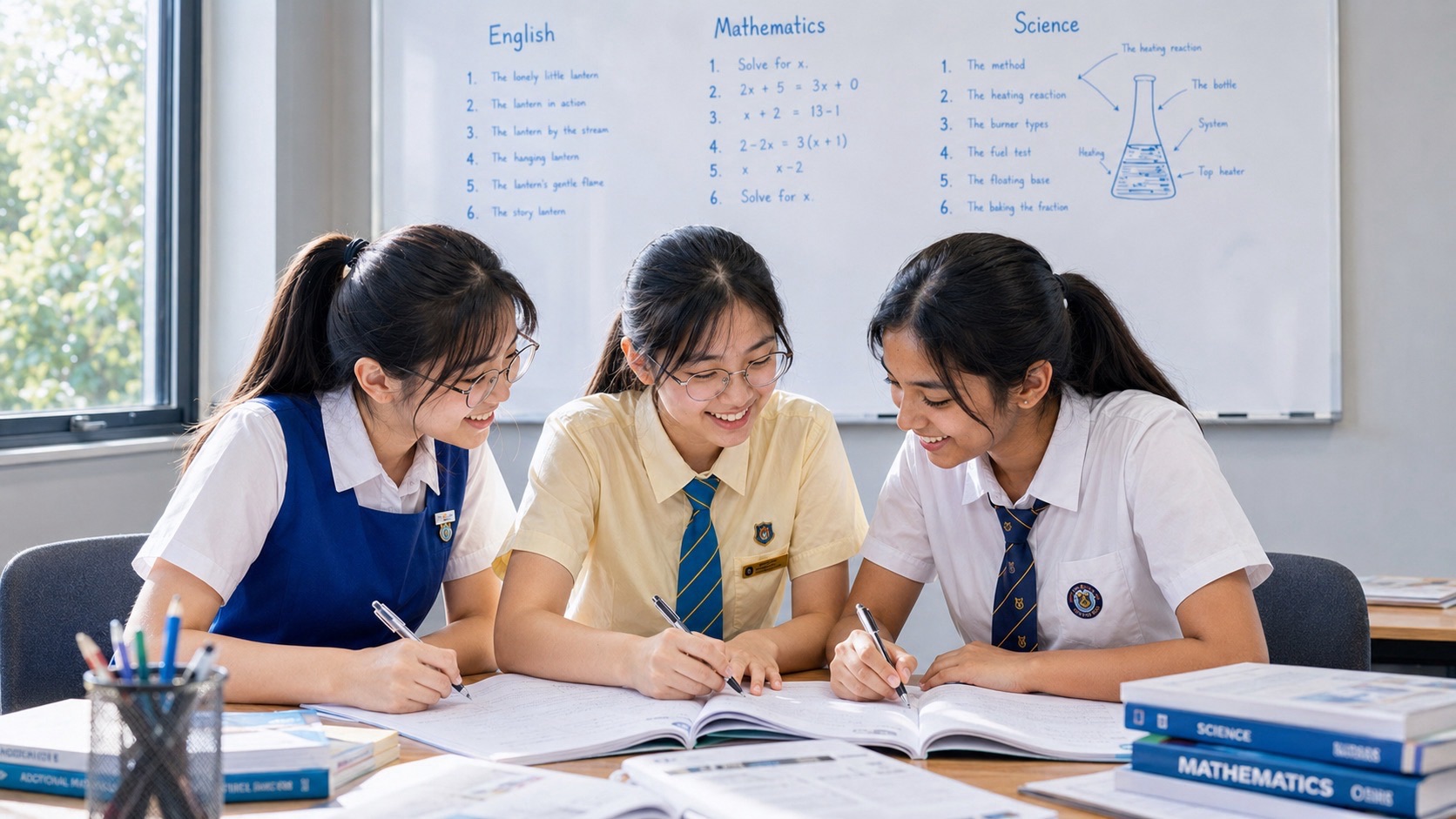
HOW HELPING CHILDREN FOCUS WORKS · SIGNAL → ATTENTION → WORKING MEMORY → ACTION · eduKateSG
Protecting the Attention Gate
A parent says, “Focus.” The child looks back at the worksheet for thirty seconds, then turns toward a sound from the next room. A teacher says, “Pay attention.” The student sits straighter, but the next paragraph is read without meaning. A tutor asks a learner to check a Mathematics question, yet the child’s eyes move over the page without noticing the sign error sitting in plain view.
These moments reveal a problem with the word focus. It describes the behaviour we want but does not explain how attention gets there, what keeps it there or what makes it leave.
Helping a child focus means improving the conditions and skills that allow relevant information to enter attention, remain active long enough for useful thinking, recover after distraction and increasingly be managed by the learner rather than by constant adult prompting.
Focus is therefore not one thing. It depends on signal clarity, task difficulty, working memory, motivation, emotional state, sleep, environment, inhibition, routines and whether the student actually knows what deserves attention.
This article sits directly beneath How Intelligence Works | The Attention Gate and beside How Executive Function Works, How Learning Environments Work, How Study Habits Work and How Self-Regulation Works.
The 50-Second Read
- Focus is selective. Attention must choose one signal over competing signals.
- “Try harder” is not always enough. Distraction, fatigue, unclear tasks, weak prerequisites and emotional load can all make focus more expensive.
- Knowing where to look matters. Experts often focus better because they recognise diagnostic features faster.
- Working memory and attention interact. When the workspace is overloaded, the learner loses state and appears unfocused.
- Environment design helps. Reduce irrelevant signals and make the intended first action visible.
- Focus has a duration. Different tasks and ages require different periods of sustained attention; breaks can protect later quality.
- Digital distraction is a systems problem. High-frequency novelty competes directly with slower academic rewards.
- The goal is self-directed attention. Parents and teachers should gradually transfer the ability to create and restore focus to the learner.
1. Focus Is Selection
A child cannot attend equally to everything. The brain continuously receives more information than can be processed deeply. Attention therefore selects.
The relevant Mathematics condition competes with a colourful diagram. The teacher’s explanation competes with a classmate moving nearby. A comprehension passage competes with an anxious thought about the next test.
The first question is not “Why can’t this child focus?” but “What is winning the selection contest?”
That shift turns focus from a moral judgement into an observable system.
2. Salience Often Beats Importance
Important information is not automatically attention-grabbing. A small negative sign may decide the Mathematics question while a bright illustration attracts the eye. A quiet sentence in a Science passage may contain the variable relationship while a dramatic fact feels more memorable.
Teachers help focus by making diagnostic features temporarily salient: underline a condition, contrast two examples, point to the changed variable, ask students to name the clue. Later, those supports should fade.
Students become better at focusing partly because they learn what deserves attention. Expertise is selective vision.
3. Captured Attention Is Not Sustained Attention
A loud voice, exciting video or surprising demonstration can capture attention. Sustaining attention is different. The learner has to remain with the task after novelty falls and cognitive work begins.
This is where meaning, challenge and participation matter. Students stay more reliably when the task has a visible goal, sits inside a meaningful pathway and requires them to predict, retrieve or solve rather than passively watch.
How Student Engagement Works | Attention That Chooses to Stay owns that deeper transition.
4. Focus Depends on Task Clarity
Students drift when they do not know what they are doing. “Study Science” gives attention no clear target. “Close the notes and reconstruct the five-step causal chain” does.
Ambiguity creates search: which chapter, which resource, which method, how long? That search can look like distraction because the student repeatedly switches between materials without settling into work.
One of the easiest ways to improve focus is therefore to define the next action precisely before asking for concentration.
5. Focus Depends on Difficulty
Tasks that are far too easy may fail to hold attention because little active control is required. Tasks that are far too difficult create another form of disengagement because progress becomes unlikely and the learner’s search space explodes.
The strongest focus often appears near a productive edge: enough foundation to make progress, enough challenge to require thought.
If a child repeatedly loses focus on one subject, inspect whether the real problem is a missing prerequisite. The learner may not be “bad at concentrating”; the task may be cognitively inaccessible.
6. Working Memory Protects the Current State
Attention and working memory work closely together. The student needs to maintain what is being done, what rule applies and what happened one step ago.
When working memory is overloaded, the learner loses state. The child rereads the question, forgets why a number was calculated, starts a sentence again or asks the teacher to repeat an instruction.
This can look like inattention even when the learner is trying hard. How Intelligence Works | Working Memory explains why externalising steps, improving fluency and reducing unnecessary complexity can help.
7. Fluency Frees Attention
A novice spends attention on components that an expert handles automatically. A weak reader may need active effort to decode words, leaving less attention for meaning. A Mathematics student may spend so much capacity recalling arithmetic facts that little remains for algebraic structure.
Foundational fluency therefore improves focus indirectly. The learner does not become more disciplined; the task becomes cheaper because familiar components have been compressed.
See Cognitive Compression for the mechanism by which many details become more manageable chunks.
8. Inhibition Protects the Selected Signal
Once attention selects the task, competing impulses still need to be managed. Check the phone. Look at the notification. Talk to the classmate. Skip the hard question. Open another tab.
Inhibitory control provides part of the brake. But asking the child to inhibit hundreds of unnecessary signals is inefficient. Good environments reduce the number of competitions that need to be won.
How Intelligence Works | Inhibitory Control sits directly under this focus system.
9. Digital Attention Is a Designed Competition
Phones, games, short videos and social platforms often provide immediate novelty and feedback. Schoolwork frequently offers slower rewards, uncertainty and delayed evaluation.
This means “just ignore the phone” asks the learner to repeatedly defeat a highly optimised competing system. Sometimes the better intervention is environmental: move the device, disable notifications, use a separate work profile or set a defined return time.
The aim is not to prove that the child has perfect willpower. It is to create a fairer attention environment while self-regulation develops.
10. Focus and Sleep
Attention quality changes with fatigue. A student who could read accurately in the afternoon may scan the same passage without retaining meaning late at night.
Families sometimes respond by increasing pressure: “You have been sitting there for an hour; focus.” But the learner may be operating with reduced capacity.
Sleep is therefore part of focus support. Persistent sleep problems or significant daytime functioning concerns deserve appropriate medical advice. The educational point is simpler: do not interpret every late-night attention collapse as character failure.
11. Focus and Food, Movement and Physical Comfort
Basic physical states can compete with learning. Hunger, thirst, discomfort or the need for movement can become salient signals.
This does not mean every concentration issue can be solved with a snack or exercise. It means the child’s body belongs inside the system. Families and schools should meet ordinary physical needs and seek qualified advice where health concerns exist.
12. Focus Has a Time Horizon
Different tasks require different durations of sustained attention. A five-minute retrieval drill, a forty-minute Mathematics set and a full examination paper are different performance demands.
Students can build stamina progressively. Begin with high-quality shorter blocks, then increase duration after the process is stable. Forcing long duration before attention quality exists can train sitting rather than learning.
The sports-performance crosswalk is useful: duration is a form of load. Increase it progressively rather than assuming more is always better.
13. Breaks Can Protect Focus
A planned break is not necessarily distraction. When attention quality has fallen significantly, a short reset can improve the next block.
The important distinction is whether the break has a boundary and return condition. A five-minute movement break with a timer is different from opening an endless feed with no defined re-entry.
Students should learn to use breaks as regulation tools rather than as escape routes.
14. Focus and Motivation
Attention is easier to sustain when the learner sees value in the task and expects effort to produce progress. A student who believes the work is pointless or impossible has little reason to spend scarce attention there.
This is why focus interventions sometimes need motivational repair rather than timers. How Student Motivation Works maps value, expectancy and cost.
15. Focus and Confidence
Low academic confidence can cause attention to move away from the task and toward threat. The student monitors how badly things are going, watches classmates, seeks reassurance or checks every step repeatedly.
Building evidence-based confidence can free attention. When the learner trusts a stable method, less capacity is spent asking whether every move is dangerous. How Academic Confidence Works develops this calibration problem.
16. Focus and Emotional State
Worry, anger, embarrassment and excitement can all capture attention. A student who had a conflict during recess may find part of attention repeatedly returning to the event during Science.
Adults can help the learner name the state and decide whether it needs immediate action, temporary containment or later discussion. This is regulation, not suppression.
The already-published eduKate node on emotional regulation complements this article: feelings are signals, but they do not always need to become the steering wheel of the current task.
17. Focus and Executive Function
Sustained focus requires more than attention selection. The learner maintains the goal, inhibits distractions, monitors drift and returns after interruption.
These are executive functions. How Executive Function Works | Running the Student joins attention, working memory, inhibition, planning, prioritisation and metacognition into one control layer.
A child who struggles to focus may need support at one of these other control points rather than attention training alone.
18. Focus and Self-Regulation
The strongest focus skill is not never becoming distracted. It is noticing distraction and returning.
Self-regulation adds the recovery loop: “My attention has drifted. What captured it? Do I need to change the environment, take a short break, clarify the task or simply return?”
How Self-Regulation Works makes that re-entry process explicit.
19. Focus and Study Habits
Habits can reduce the amount of attention spent on starting. A consistent cue, prepared desk and known first action allow the learner to enter work with less negotiation.
How Study Habits Work explains how repeated defaults support learning. Habits do not create deep concentration automatically, but they protect the entrance.
20. Focus and Family Routines
Family routines affect when concentration is expected and what state the student is in when the work begins. A predictable after-school transition, homework window, device boundary and bedtime can reduce avoidable attention conflicts.
How Family Routines Work | The Quiet Infrastructure Around Learning describes the wider household platform.
21. Focus in Mathematics
Mathematics requires attention at several scales: signs, units, conditions, structure, intermediate state and the larger goal. A learner can focus intensely on calculation while losing the question itself.
Teach diagnostic attention. Before solving, ask: what are the quantities, restrictions and relationships? During working, keep the target visible. During checking, inspect known error classes rather than staring generally at the page.
The small-group model in Secondary 1 Mathematics Tutor Clementi | Small Groups Tutorials helps because tutors can see what students attend to before the wrong answer appears.
22. Focus in English Reading
Reading focus is not simply keeping eyes on the text. The learner has to preserve meaning, track references, update interpretation and notice relationships.
Students can read a whole page while attention repeatedly resets at sentence level. Teach active reading questions: Who or what does this refer to? What changed? What relationship connects these sentences? What evidence supports this inference?
Attention becomes purposeful rather than purely positional.
23. Focus in Writing
Writing requires attention to multiple scales. If students attempt to optimise idea, vocabulary, grammar and style simultaneously, working memory becomes crowded.
Separate phases where useful. Plan the event spine or argument first. Draft with the larger purpose visible. Revise structure. Then inspect language and known error classes.
Focus improves when the learner knows which level of the text deserves attention now.
24. Focus in Science
Science focus is often about variables and causal relationships. Students need to notice what changes, what is measured, what stays constant and what evidence can support.
Teach learners to label the relevant signals before explanation. In experimental questions, identify independent and dependent variables first. In mechanisms, identify the beginning state and required end state.
This reduces the chance that interesting but irrelevant scientific facts capture the answer.
25. Focus During Homework
Home focus depends heavily on the environment because teachers and peers are absent. The learner needs a clear task list, defined start, appropriate materials and a distraction policy.
How Homework Routines Work provides the full chain. Focus is one stage inside that chain, and it is easier when logistics are already stable.
26. Focus During Tuition
Small-group tuition can maintain focus through close interaction, questioning and rapid feedback. The risk is that the learner becomes dependent on the tutor to re-engage attention every few minutes.
Gradually increase independent work intervals. Ask students to identify their own attention drift, use a checking routine and return without immediate prompting.
The goal is transfer: focused performance should survive when the tutor is not present.
27. Focus During Examinations
Examinations require long periods of self-directed attention under time pressure. The learner has to reselect the task repeatedly without immediate feedback.
Students should practise full-paper attention progressively. Short timed sets build pacing. Longer sections build sustained control. Full papers train recovery after hard questions and fatigue.
The examination focus skill is not uninterrupted concentration for the entire paper. It is rapid return whenever attention is disturbed.
28. The Parent’s Role: Remove Noise, Then Step Back
Parents can help by improving conditions: clarify the task, reduce irrelevant distraction, protect a reasonable work block and ensure basic needs are met.
The danger is becoming the permanent attention manager: “Look here. Keep going. Stop daydreaming. Next question.” The child performs only while the parent continuously redirects.
Use staged transfer. At first the parent may cue the start. Later the child sets the cue. The parent may initially remove the phone; later the student does it before work begins. Attention support should become self-support.
29. The Teacher’s Role: Teach Students What to Notice
One of the strongest ways teachers improve focus is by teaching the structure of the domain. “Pay attention” becomes “Look for the quantity that represents 100%.” “Read carefully” becomes “Track what the pronoun refers to before you answer.”
Experts focus because they know which distinctions matter. Instruction can make those distinctions explicit until students can select them independently.
30. The Tutor’s Role: Diagnose Attention, Not Just Accuracy
A tutor can watch where the learner’s attention goes before an error. Did the student ignore a sign? Fixate on a familiar keyword? Skip a condition? Look at the worked example immediately rather than attempting retrieval?
This makes focus observable. The repair can target the selection rule instead of simply adding more practice.
31. A Focus Diagnostic
- Signal: Is the relevant information clear and visible?
- Selection: Does the learner know what deserves attention?
- Difficulty: Is the task within a viable learning range?
- Working memory: Is too much unfamiliar information active?
- Motivation: Does the task feel worth the cost?
- Emotion: Is another concern repeatedly capturing attention?
- Environment: What external signal competes?
- Fatigue: Is the learner operating at a poor time?
- Duration: Is the block longer than current stamina?
- Return: Does the student know how to restart after drift?
32. A Student Focus Audit
- What am I supposed to pay attention to right now?
- Can I state the task in one sentence?
- What keeps capturing me instead?
- Is the work unclear or too difficult?
- Am I tired enough that quality has collapsed?
- Do I need to externalise steps?
- Would a short planned break improve the next block?
- Is my phone or browser creating repeated switches?
- How will I notice that attention has drifted?
- What is my return cue?
33. A Parent Focus Audit
- Am I saying “focus” without identifying the mechanism?
- Does the child know the next action?
- Is the environment unnecessarily distracting?
- Is the work too difficult because a prerequisite is missing?
- Is fatigue being mistaken for unwillingness?
- Am I continuously redirecting rather than transferring control?
- Does the family routine protect sleep and a viable study time?
- What one environmental change would reduce the biggest distraction?
34. A Four-Week Focus Build
Week 1 — Observe the drift. Choose one repeated task. Record when attention leaves and what captured it. Separate external distraction, internal thought, task difficulty and fatigue.
Week 2 — Clarify signal and environment. Define the first action, remove the largest irrelevant distraction and use a shorter high-quality block.
Week 3 — Teach return. The learner notices drift, names it and returns using a cue rather than waiting for an adult reminder. Gradually lengthen the block if quality remains stable.
Week 4 — Increase independence and specificity. Reduce adult prompts, mix task types or add a realistic time condition. Review which supports still matter.
35. What Not to Do
- Do not treat focus as a moral trait.
- Do not assume quietness proves attention.
- Do not ask children to resist avoidable distractions indefinitely.
- Do not use timers to solve missing prerequisites.
- Do not make work so easy that attention has nothing to do.
- Do not make work so difficult that progress becomes impossible.
- Do not ignore fatigue and sleep.
- Do not let parents or tutors become permanent attention controllers.
- Do not remove all breaks; teach bounded recovery.
- Do not diagnose medical conditions from ordinary study behaviour; seek qualified professional guidance when persistent difficulties significantly affect functioning.
Frequently Asked Questions
How can I help my child focus on homework?
Make the task specific, reduce obvious distractions, use a viable work duration, place difficult work at a reasonable time, externalise complex steps and teach the child how to notice and return after attention drifts.
Should I remove my child’s phone while studying?
If the phone repeatedly fragments attention, moving it away during defined high-load work is a straightforward environmental support. The long-term goal is for the student to manage this boundary independently.
How long should children be able to focus?
There is no single duration that fits all ages, tasks and learners. Focus demands should be age-appropriate and gradually increased according to task difficulty and the child’s current stamina.
Why can my child focus on games for hours but not homework?
Games often provide immediate feedback, clear goals, high novelty and carefully tuned difficulty. Homework may offer delayed rewards, ambiguity and higher cognitive effort. The difference reveals the architecture of the tasks, not simply the child’s capacity to pay attention.
When should I seek professional advice about attention?
If attention difficulties are persistent, occur across contexts and significantly affect the child’s daily functioning or wellbeing, discuss the pattern with the school and an appropriately qualified healthcare or psychological professional rather than relying only on study strategies.
Return: Focus Is Not Holding the Child’s Head Toward the Page
At first, adults do much of the attention engineering. Teachers highlight the important feature. Parents remove distractions. Tutors redirect the learner. Routines create predictable starts.
But education cannot end with attention permanently rented from adults.
The child needs to learn what important signals look like, which environments support difficult work, when working memory is overloaded, when a break will help, how to protect the phone boundary, how to return after distraction and how to keep the larger goal visible.
Adult-directed attention → shared attention control → student notices drift → student restores focus → student designs the conditions.
That is the deeper objective. Focus is not staring harder at a page. It is learning to protect the gate through which the right information must pass—and eventually becoming the person who knows when to open it, what to admit and how to close the noise outside.
Continue: The Attention Gate · How Executive Function Works · How Learning Environments Work · How Study Habits Work · How Self-Regulation Works · How Family Routines Work · Secondary 1 Mathematics Tutor Clementi | Small Groups Tutorials.