
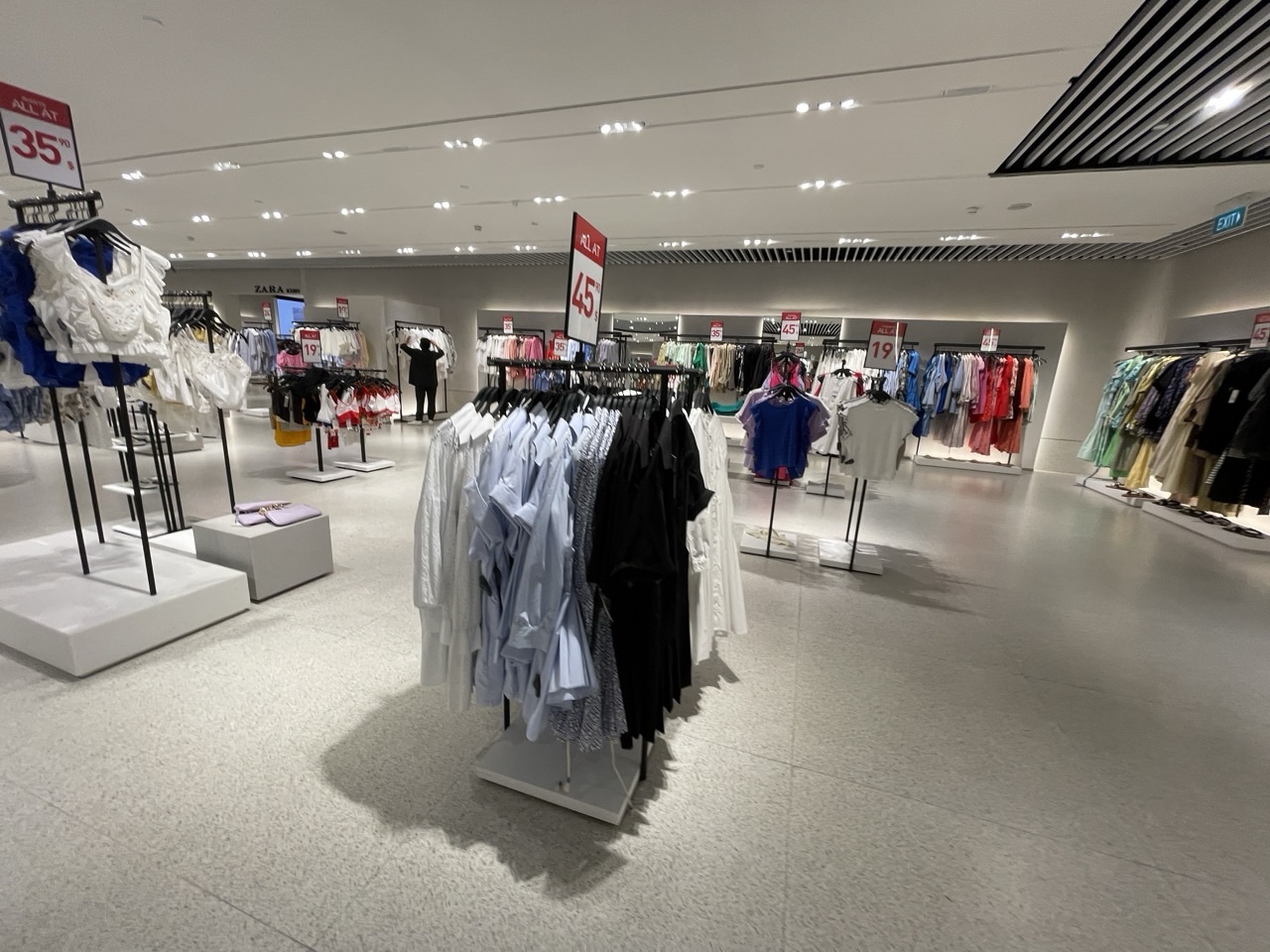
Fashion inventory management is the discipline of deciding how much clothing to make, where to place it, when to replenish it and when to stop believing it will sell at full price. Every fashion brand faces the same uncomfortable fact: demand forecasting happens before demand is fully observable. By the time customers reveal what they actually want, fabric may already be bought, factory capacity booked, garments produced and inventory distributed across stores and warehouses.
That timing gap creates fashion inventory risk. Make too much and the system creates excess inventory, trapped working capital, storage cost and eventual markdowns. Make too little and the brand creates stock-outs, missed full-price sales and disappointed customers. Put the correct quantity in the wrong city, size or channel and total inventory can look healthy while local demand remains unserved. Inventory allocation, replenishment, sell-through, lead time and markdown optimisation are therefore not separate retail chores. They are different controls acting on one uncertainty problem.
A modern fashion supply chain succeeds not by predicting the future perfectly but by designing a system that can survive prediction error. The strongest inventory architecture combines smaller initial commitments, useful demand signals, responsive replenishment, disciplined allocation, explicit service levels, realistic lead times and early recognition of failure. The central question is not “How do we forecast exactly what people will buy?” It is “How do we make good decisions when we know our forecast will be wrong?”
The hidden bet inside every collection
A collection looks creative from the outside. Operationally, it is a portfolio of bets.
For every style, colour and size, somebody eventually chooses a quantity. That quantity converts a design idea into fabric consumption, factory hours, freight volume, warehouse space and cash exposure.
Inventory is a forecast that has become physical.
Once the garment exists, uncertainty has changed form. Before production, the business can change its mind relatively cheaply. After production, the question becomes how to sell, move, discount, return, repair, store or dispose of the committed stock.
The inventory-risk chain
weak signal → forecast → assortment → initial buy → material commitment → production → allocation → launch → observed demand → sell-through → replenishment/transfer → markdown → residual inventory → cash recovery → next forecast
This chain matters because every stage changes what can still be corrected. Early decisions have flexibility but little evidence. Later decisions have better evidence but less flexibility.
Why fashion is harder than replenishing toothpaste
Many consumer products have relatively stable demand. Fashion adds novelty, seasonality, colour, silhouette, social signalling, weather, cultural attention and rapidly changing substitutes.
A basic household product can often use long historical sales series. A new fashion style may have no direct history at all.
The forecaster is therefore estimating demand for something whose appeal may depend precisely on being new.
Demand is not one number
“We expect to sell 10,000 units” sounds precise but hides important dimensions.
- Which countries?
- Which stores?
- Which online markets?
- Which weeks?
- Which colours?
- Which sizes?
- At full price or markdown?
- Before or after returns?
Demand is a distribution across product, place, time, price and customer segment.
The size curve can defeat a winning style
Suppose a dress sells extremely well overall. If the business runs out of the most demanded sizes while less demanded sizes remain, the style can simultaneously be a bestseller and an inventory problem.
Fashion inventory management therefore operates below the style level.
right style + wrong size mix = hidden stock-out beside hidden excess
Colour multiplies the forecast
A jacket offered in six colours creates six demand curves before sizes are considered.
More choice can increase customer appeal, but every additional variant fragments inventory and raises the chance that demand lands unevenly.
Assortment breadth creates an option-value problem
A broad assortment gives customers more reasons to look. But every SKU consumes attention, capital and operational capacity.
The business has to decide whether variety is creating useful customer choice or simply dividing demand across too many products.
The initial buy is a commitment under uncertainty
Before launch, the business has its weakest evidence. It may have trend research, historical analogues, wholesale orders, search data, social signals, customer panels and internal judgement.
None of these is identical to actual sell-through of the new product.
The initial buy should therefore be understood as a risk decision, not merely a forecast output.
Forecast error is normal
Managers sometimes treat forecast error as evidence that somebody failed to forecast carefully enough.
Some error is reducible. Some is structural. Weather changes. competitors launch. celebrities create sudden attention. macroeconomic conditions shift. A viral image moves demand unexpectedly.
The mature system expects error and decides how much error it can tolerate.
Overforecasting and underforecasting fail differently
Overforecasting creates leftover stock. Underforecasting creates missed demand.
Those errors are not symmetrical.
A missed sale loses margin and perhaps customer trust. Excess inventory consumes capital, storage and later markdown. The relative cost depends on product margin, replenishment speed, brand position and how quickly demand decays.
Service level is a deliberate choice
No retailer can guarantee every product in every size everywhere without carrying enormous inventory.
A service level expresses how much availability the business is trying to provide relative to the cost of holding stock.
higher availability → more inventory protection → higher carrying risk
Safety stock is protection against uncertainty
Safety stock provides a buffer when demand or supply differs from expectation.
But fashion safety stock is dangerous when products age quickly. A buffer that protects availability today can become obsolete inventory tomorrow.
Lead time determines how early you must be wrong
If a product takes six months from commitment to store, the business must decide six months before receiving real sales evidence.
If replenishment takes three weeks, the brand can make a smaller initial commitment and learn from the market.
Shorter lead time does not make forecasting perfect. It reduces how much inventory must be committed while the forecast is still weak.
Responsiveness is an inventory asset
Factories, material suppliers and logistics networks are usually discussed as cost centres.
But a responsive supply chain has option value. It allows the brand to delay commitment until better information arrives.
Paying slightly more per unit can sometimes reduce total risk if it prevents large quantities of unwanted stock.
Minimum order quantities fight responsiveness
A supplier may require 5,000 metres of fabric even when the brand wants to test 1,500.
Minimums push the business toward larger bets before demand is known.
This is why sourcing terms are part of inventory architecture.
Postponement delays irreversible decisions
One powerful inventory principle is to keep products generic for as long as possible.
A company might commit undyed material before deciding final colours, or hold unfinished components before assigning them to specific variants.
Postponement preserves flexibility while information improves.
Modularity can reduce variant risk
If multiple products share fabrics, trims or components, unused inputs may be redirected more easily.
Highly specialised materials create more stranded-inventory risk when a style fails.
Allocation is the second forecast
After total quantity is decided, inventory must be distributed.
A store in Singapore may need a different colour and size mix from a store in Stockholm. E-commerce may have a different return profile from physical retail.
Allocation predicts where demand will occur.
The wrong location can imitate low demand
A product can appear weak because inventory sits where customers do not want it.
Meanwhile another store may be sold out.
Total inventory is therefore less informative than inventory matched against local demand.
Inventory visibility creates recoverability
If a business knows exactly what stock exists across stores, warehouses and returns channels, it can make better transfer and fulfilment decisions.
Poor inventory accuracy converts physically available product into commercially invisible product.
Omnichannel retail changes what “location” means
A jacket in a store can potentially fulfil an online order. A returned online item may be resold locally. Ship-from-store and click-and-collect can make distributed stock more useful.
But these systems require high inventory accuracy and careful reservation logic.
Replenishment is learning made operational
Once sales begin, uncertainty falls.
Replenishment converts that new information into additional supply.
The faster and more reliably the system can replenish, the less it needs to bet everything at launch.
But early sales can lie
A product may sell quickly because initial stock was tiny. A launch campaign may create a temporary spike. Loyal customers may buy first, leaving weaker later demand.
Replenishment decisions should therefore distinguish signal from launch noise.
Sell-through is a rate, not applause
Sell-through compares units sold with units available over a period.
It helps answer whether inventory is clearing at the expected pace.
A strong percentage can still be misleading if stock arrived late, distribution was narrow or returns have not yet been processed.
Weeks of supply turns inventory into time
Instead of asking only “How many units remain?”, managers can ask “At the current sales rate, how many weeks will this inventory last?”
This frames stock relative to demand velocity.
Full-price sell-through is especially valuable
Selling units is not the only goal. Selling them before markdown preserves margin and validates the original product-price relationship.
High unit sales achieved only after deep discounting tell a different story.
Markdown is not simply failure
Markdown is a control for changing the price when the original price-demand relationship is no longer clearing inventory fast enough.
The decision is temporal: discount too early and margin is surrendered unnecessarily; discount too late and demand may disappear before stock clears.
Markdown optimisation is a decay problem
Fashion products often have a declining opportunity window.
The expected future value of holding inventory has to be compared with the value of releasing it now at a lower price.
wait for higher price × probability of future sale
versus
discount now × probability of clearing inventory
Price elasticity matters
Some products respond strongly to discount. Others remain unwanted even when cheaper.
Markdown strategy needs to estimate how demand changes with price rather than assuming every discount generates equal response.
Promotions can train customers to wait
If shoppers expect predictable discounts, some will postpone purchases.
Repeated markdown behaviour can therefore alter future full