
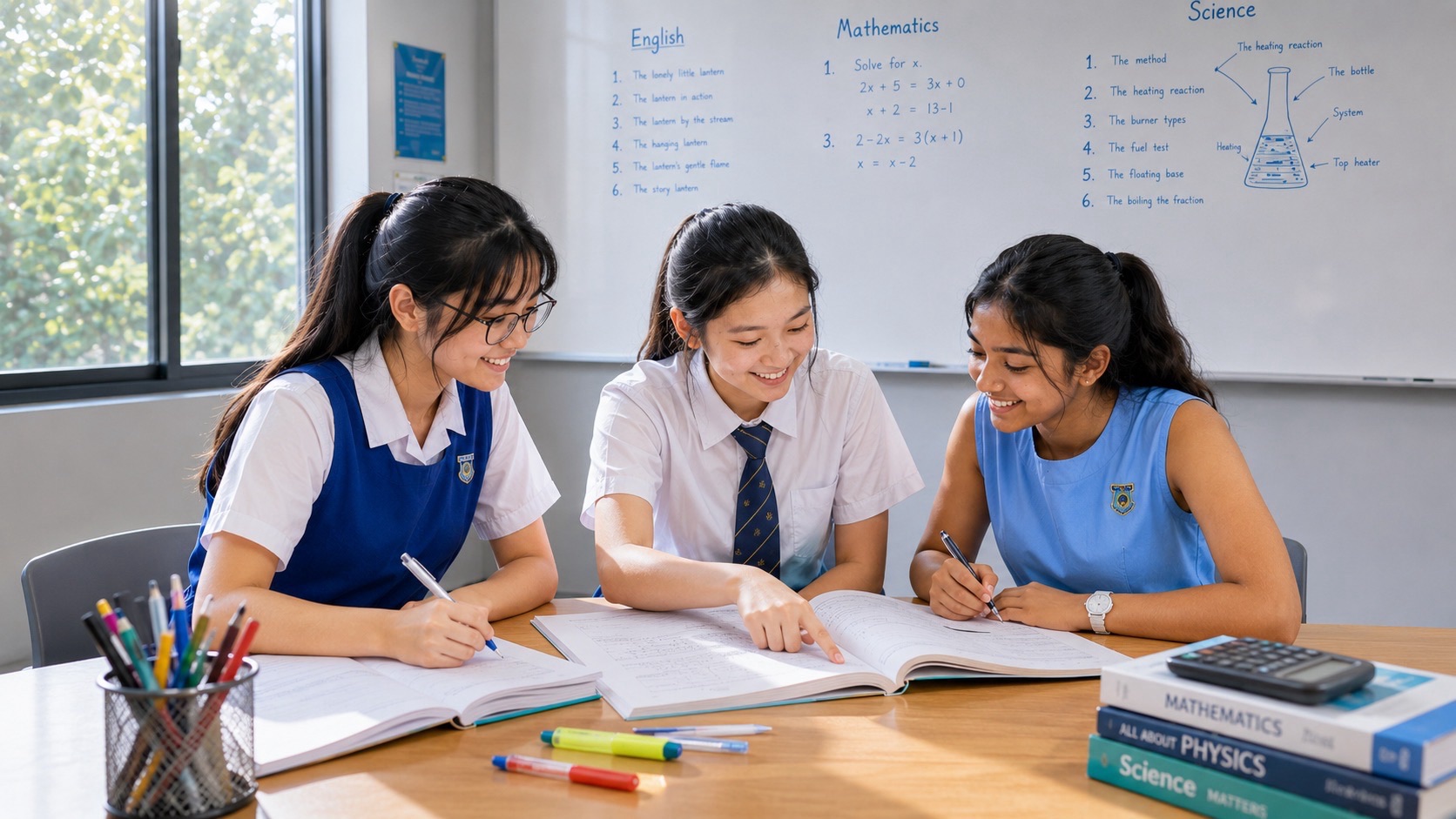
Science retrieval practice, active recall, self-testing, spaced review and exam revision work best when students retrieve more than isolated facts. This workbook connects science definitions, processes, diagrams, formulas, graphs, practical investigations, evidence and explanations so that recall becomes usable scientific reasoning rather than a collection of memorised phrases.
Students often ask how to remember science quickly, how to study science effectively and how to use active recall for science exams. The answer is not to test every fact with equal frequency. Retrieve the knowledge that controls a decision: the definition boundary, causal mechanism, variable relationship, diagram structure, unit, condition or evidence limit that makes the answer scientifically valid.
This article is an original eduKateSG teaching workbook. Use current school materials and syllabus requirements as the authority for examinable terminology and scope. The central routine is attempt, check, repair, change the example and retrieve again later.
Your 50-second route
If facts disappear quickly, begin with short closed-book recall and immediate checking. If definitions are remembered but explanations collapse, reconstruct cause-and-effect chains. If diagrams are weak, draw from memory before comparing labels and spatial relationships. If practical questions are weak, retrieve variables, controls, measurements and uncertainty. If exam answers are long but imprecise, answer the narrow question first and compare the response with the evidence required.
1. Retrieve the boundary of a definition
A useful science definition identifies what makes the concept that concept. Consider mass and weight. They are related but not interchangeable; weight is a force due to gravity. A learner who stores both as “how heavy something is” has not preserved the distinction. Retrieval should ask for a definition, an example, a non-example and a comparison. A changed situation forces the learner to use the boundary rather than merely recognise two familiar sentences.
Use the same method for speed and velocity, heat and temperature, element and compound, or observation and inference. For each pair, write what both ideas share, what distinguishes them, and one case in which confusing them changes the answer. Return later without the original comparison and ask the learner to construct a fresh example.
2. Reconstruct processes as causal chains
For a process such as photosynthesis, memorising an equation is useful but incomplete. Retrieve inputs, outputs, location, energy role and the relationship to plant growth at the level required. Then reconstruct a causal chain rather than a list. The same method applies to digestion, respiration, transport and cycles: identify the starting condition, mechanism, intermediate change and consequence.
Close the model and write the chain using arrows. Turn the arrows into sentences. Remove one stage and ask what becomes impossible to explain. Finally, change the context while preserving the mechanism. This prevents a student from memorising one polished paragraph whose wording collapses as soon as the question asks for a different organism, material or experimental condition.
3. Draw diagrams before you label them
A labelled diagram creates strong familiarity. Close the source and draw the structure first. For a cell, sketch the major boundaries and structures before adding names, then ask what each structure contributes and which features distinguish the cell type from another one studied at the same level. The purpose is not artistic accuracy. A retrieval drawing should preserve scientifically meaningful relationships.
For circuits, retrieve component symbols and connectivity. For anatomy, retrieve spatial relationships and function. For cycles, retrieve direction and transformation. For apparatus, retrieve where measurements are taken and why. After checking, redraw only the incorrect region rather than copying the whole model. The repair should be proportional to the error.
4. Treat formulas as compressed relationships
Before inserting numbers into a formula, retrieve what each symbol represents, the units and the conditions under which the relationship is being used. For speed equals distance divided by time, ask what interval the distance and time describe. For density equals mass divided by volume, ask whether the mass and volume describe the same sample. Meaning first, substitution second, unit check third.
Units can expose a wrong model. If speed is required in metres per second, the answer combines length with time in the denominator. If density is required in grams per cubic centimetre, mass and volume units reveal the form of the comparison. Dimensional reasoning is not a complete method generator, but it is a powerful check.
5. Retrieve experimental logic
The independent variable is deliberately changed, the dependent variable is measured, and relevant control variables are kept sufficiently consistent so that the comparison is interpretable. In a fictional investigation of how water temperature affects dissolving time, temperature is changed and dissolving time is measured. Stirring pattern, solute amount, solvent volume and particle size may need control depending on the design.
Not every investigation is a simple fair test. A descriptive observation may not manipulate a variable, and a field study may compare naturally occurring conditions. Begin with the purpose: what claim is the design intended to support, what is measured, what comparison is made and which uncontrolled differences could matter?
6. Measurement and uncertainty
Repeated measurements can reveal variability and reduce the influence of some random fluctuations when combined appropriately, but repetition does not automatically remove a systematic bias. Instrument resolution also limits what can be reported sensibly. Retrieval practice should distinguish random variation, resolution limits and consistent offset, then apply those distinctions to a new fictional measurement.
7. Read graphs before explaining them
A graph question begins with the axes and units. Then describe the observed relationship within the plotted range. “As temperature increased from 20 to 40 degrees Celsius, the measured rate increased” is bounded to the data. Do not automatically write that temperature always increases the rate. Retrieval practice should include scope words such as within this range, under these conditions and approximately.
Two quantities changing together does not by itself establish that one caused the other. Experimental design and alternative explanations matter. Ask for one descriptive statement, one causal claim that is not yet justified and one additional question about the design. The goal is to retrieve the evidential step required before moving from pattern to cause.
8. Particles and microscopic models
A particle model becomes useful when it predicts observations. Retrieve how particles are arranged and move in solids, liquids and gases at the level taught, then connect the model to compressibility, shape and flow. Avoid saying that particles themselves expand simply because a material expands. Ask the learner to draw two states, label what changed and explain one macroscopic observation from the microscopic model.
Change the task from recognition to generation. Instead of asking which diagram shows a gas, ask the learner to draw one that would explain why a gas fills its container. Then compare with a liquid model and state what feature must differ. The later question should remove the original labels so the learner has to reconstruct the relationship.
9. Forces and resultant force
A force diagram identifies forces acting on a chosen object. A book resting on a table experiences gravity downward and an upward contact force from the table. Equal opposing forces can produce zero resultant force without implying that no forces exist. Retrieve the distinction between force, net force and motion. A stationary object and an object moving at constant velocity can both have zero resultant force in the simplified Newtonian model.
Use contrast questions. One object is stationary with balanced forces; another moves steadily with balanced forces; a third accelerates. Ask which observation alone is insufficient to identify the individual forces. The learner should avoid the false rule that movement requires a forward resultant force at every moment.
10. Energy transfers and conservation
Science explanations improve when students track energy rather than saying it is simply “used up.” In a battery-powered lamp, chemical processes in the battery support electrical transfer through the circuit and energy is transferred into light and thermal pathways. Terminology varies by curriculum, but conservation remains central. Ask the learner to identify the system, starting store or source description, transfer pathway and final distribution.
Then compare with a second device. Which parts of the explanation remain invariant and which change? The useful retrieval is the accounting structure, not one memorised chain of nouns. If the curriculum uses a particular energy-store vocabulary, follow that terminology consistently.
11. Electric circuits
A circuit diagram is not merely a collection of component symbols. Retrieve what must form a complete conducting path, where meters are connected for the quantity being measured and what changes when components are rearranged. At introductory level, current is the rate of charge flow and potential difference relates to energy transferred per unit charge. A student who remembers that an ammeter “goes in series” should also explain that the current being measured must pass through it.
Redraw a familiar circuit with the components in unfamiliar positions while preserving connectivity. Ask whether the electrical relationship changed. This separates the geometry of the page from the topology of the circuit and makes the learner retrieve what the lines and junctions actually represent.
12. Heat and temperature
Temperature and thermal energy are related but not identical. A small hot object can have a higher temperature than a large warm object while the larger system may contain more internal energy depending on material and amount. Retrieval should include comparison questions. Ask what a thermometer measures, what direction net thermal energy transfer occurs when objects at different temperatures interact and what equilibrium means.
Change the masses or materials and ask which conclusions remain possible without additional data. This teaches the learner not to infer total energy from temperature alone. A correct explanation names the quantity being compared and the missing information needed for a stronger conclusion.
13. Chemical change and conservation
In a closed system, mass is conserved during an ordinary chemical reaction even when substances change identity. A measured mass loss in an open vessel may reflect gas leaving the measured system rather than matter being destroyed. Retrieval practice can compare an open and sealed setup. Ask the learner to predict what a balance might show and why.
The useful explanation tracks matter across the system boundary. If a symbolic equation is used, ask the learner to connect coefficients and formulas to the accounting of atoms or substances at the level taught. Do not allow balancing to become a purely visual number puzzle detached from conservation.
14. Cells, organs and systems
Biology requires moving between levels: organelle, cell, tissue, organ, system and organism. Retrieval questions should run in both directions. Which structure contains these specialised cells? What cells contribute to this organ’s function? For circulation, retrieve structures and roles, then connect them to transport requirements.
Avoid anthropomorphic explanations such as cells “wanting” oxygen. Use causal language about gradients, transport, pumping and exchange at the level appropriate to the course. Then ask for the same relationship in a different organ or organism so the explanation does not remain tied to one textbook picture.
15. Ecology and model boundaries
A food chain represents feeding relationships and a direction of energy transfer, not simply a list of organisms living near each other. Retrieve producer, consumer and trophic relationships, then build a small web. Ask what could happen when one population changes while acknowledging that real ecosystems contain many interacting factors.
A school model can illustrate possible effects without pretending to predict an entire ecosystem from one arrow. The explanation should distinguish a plausible pathway from a guaranteed outcome. This is also a useful place to practise conditional language such as could, may and under these assumptions.
16. Genetics and probability
Genetic diagrams can show probabilities under specified assumptions. A probability is not a guarantee about a small number of offspring. If a cross gives a one-quarter probability for a genotype in each independent event, four offspring need not include exactly one with that genotype. Retrieval should include the distinction between expected proportion over many events and a fixed sequence.
Ask the learner to interpret the model, state its assumptions and avoid turning probability into a deterministic prediction about an individual. Then change the parental genotypes or the trait model and require a fresh construction rather than a copied Punnett-square layout.
17. Long explanations: retrieve a skeleton first
When an answer requires several linked ideas, retrieve the structure before writing full sentences. Use a four-part skeleton: starting condition, mechanism, intermediate consequence and observable outcome. Then turn the skeleton into prose. This reduces the risk of beginning with a fluent sentence and losing the causal chain halfway through. The skeleton is a temporary planning device, not a requirement that every science answer have exactly four parts.
For a changed question, keep the mechanism but alter the starting condition. Ask which parts of the explanation must change and which remain. This makes retrieval generative. A student who can only reproduce one paragraph has learned wording; a student who can rebuild the causal chain for a changed case has stronger evidence of usable understanding.
18. Command words are part of the cue
A correct fact can still fail to answer the question. “State” may require a concise result; “describe” asks what is observed or how it changes; “explain” asks for a reason or mechanism; “compare” requires an explicit relationship between cases; “evaluate” usually requires evidence-based judgement against criteria. Exact assessment conventions vary, so follow current syllabus and teacher guidance.
Build retrieval cards that include the task demand, not only the topic. One card can ask for a definition, another for an explanation, another for a graph description and another for a comparison. This prevents the learner from treating all science questions as requests to unload everything remembered about the chapter.
19. Repair the first wrong relationship
After an error, do not copy the whole model answer and call the topic revised. Identify the first false or missing relationship. If a learner says gas particles rise because each particle becomes lighter when heated, repair the particle model rather than merely replacing the final sentence. Review the relevant explanation, construct a corrected account and answer a new question in which heating affects a different gas situation.
A useful repair record contains four fields: what I first thought, why it fails, the corrected relationship and a new test. Keep the language specific. “I am bad at particles” does not identify an actionable error. “I treated each particle as expanding when the model requires a change in motion and separation” identifies something that can be checked on a new example.
20. A seven-day retrieval cycle
Day one: answer a small diagnostic set without notes. Day two: study and correct the first missing relationships. Day three: retrieve the same ideas in a different format, such as diagram to prose or prose to graph. Day four: mix the topic with previously learned material. Day five: explain one unfamiliar application. Day six: perform a short cumulative recall without chapter headings. Day seven: answer a fresh question and compare with day one. These timings are a practical design, not a claim that seven days is universally optimal.
After day seven, reduce prompts rather than abandoning the idea. A later mixed question can test whether the relationship remains accessible. If it fails, inspect whether the issue is forgetting, a new representation or an unlearned prerequisite. Spacing should reveal what needs rebuilding, not become a ritual calendar followed regardless of the learner’s response.
21. A twenty-minute science session
Spend two minutes deciding the target. Use five minutes for closed-book recall, five for checking against a reliable source, five for one changed application and three for a correction note and next return date. If the learner discovers a major conceptual gap, stop the clock-based routine and teach the missing concept properly. Retrieval is not a substitute for instruction.
If everything is already secure, shorten the session and move to a more demanding mixed problem rather than generating unnecessary repetition. Efficiency comes from matching practice to uncertainty, not from maximising the number of questions answered.
22. Primary science route
For younger learners, use concrete questions and short causal chains. Ask what is observed, what changed, what stayed the same and which evidence supports the answer. A diagram can carry much of the retrieval. Avoid demanding technical language before the underlying relationship is understood, but connect everyday language to the scientific term once the concept is clear.
Return later with a new context so the child learns that the idea is not attached only to one worksheet picture. A plant question can become a different plant or setting; a materials question can change the object while preserving the property being tested. Keep reading difficulty appropriate so language does not obscure the science target.
23. Secondary science route
For secondary learners, increase the number of conditions and representations. Retrieve equations with units, graph interpretations, experimental controls, particle or cellular mechanisms and evidence limitations. Ask the student to move between words, symbols and diagrams. Mixed questions matter because an examination page will not always announce which relationship to retrieve.
A secure learner should recognise the relevant model, use it accurately and know where assumptions or domain limit the conclusion. When a response is wrong, separate the scientific model from algebra, arithmetic and reading demands so the next practice targets the actual failure.
24. Parents and home study
Parents can ask useful questions without becoming the science teacher. What does that number represent? What would change if this variable changed? Which part of the diagram shows that? How can you check this answer? When the answer is uncertain, use the learner’s textbook, school materials or another reliable reference rather than guessing.
A confident wrong explanation rehearsed repeatedly can become harder to repair than an admitted uncertainty followed by accurate checking. Praise a good checking decision as well as a correct final answer. The habit being built is independent verification, not dependence on a parent supplying every missing fact.
25. Flashcards and digital tools
Flashcards are useful when each card retrieves a meaningful unit. Avoid fronts containing so many hints that the answer is recognised rather than recalled. Use image occlusion for diagrams, short prompts for definitions and application cards that ask for a prediction or explanation. Automated tools can generate practice questions, but generated scientific content should be checked.
The learner should not treat a tool’s confidence as evidence. Keep source verification and correction inside the workflow. A good digital card ends with a reason or condition that can be tested on a new case, not merely a word that can be flipped and recognised.
26. Mixed retrieval assessment
Select ten items across definitions, diagrams, calculations, graphs and explanations. Remove chapter labels. Require units where relevant and one sentence of reasoning for consequential decisions. After marking, classify errors: missing fact, wrong model, representation failure, calculation slip, scope overclaim or command-word mismatch.
This classification is more useful than a single percentage because it tells the learner what to repair. Repeat a small matched set later with new surface features. A higher score is useful evidence, but inspect whether the learner also needs fewer prompts and can explain the relationship accurately.
27. Teaching guide
Choose one real error and write the target relationship in one sentence. Build one recall question that exposes it, one model that corrects it and one transfer question that changes the surface features. Ask the learner to attempt before seeing the answer. Give direct instruction when knowledge is missing. Reduce prompts after success.
Record whether the later answer was independent, cued or modelled. The goal is not maximum testing. It is reliable retrieval of the scientific relationship needed for the next decision. Once the learner can use it in mixed work, stop requiring a special explanation every time and let the skill operate inside ordinary science practice.
28. Continue through eduKateSG
For the related habit of explaining why a step is valid, continue to How Self-Explanation Improves Mathematics. For study design, use How to Study Quickly | Practice Tests and How to Study Quickly | Spaced Repetition. For broader learning mechanisms, use How X Works.
Final checkpoint: retrieve the relationship, not merely the sentence. Check it against a reliable source. Repair the first missing or false link. Change the representation or context. Return later without the original prompt. Science learning becomes more durable when a learner can reconstruct the model, use it to explain evidence and recognise when its conditions do not fit the new question.