
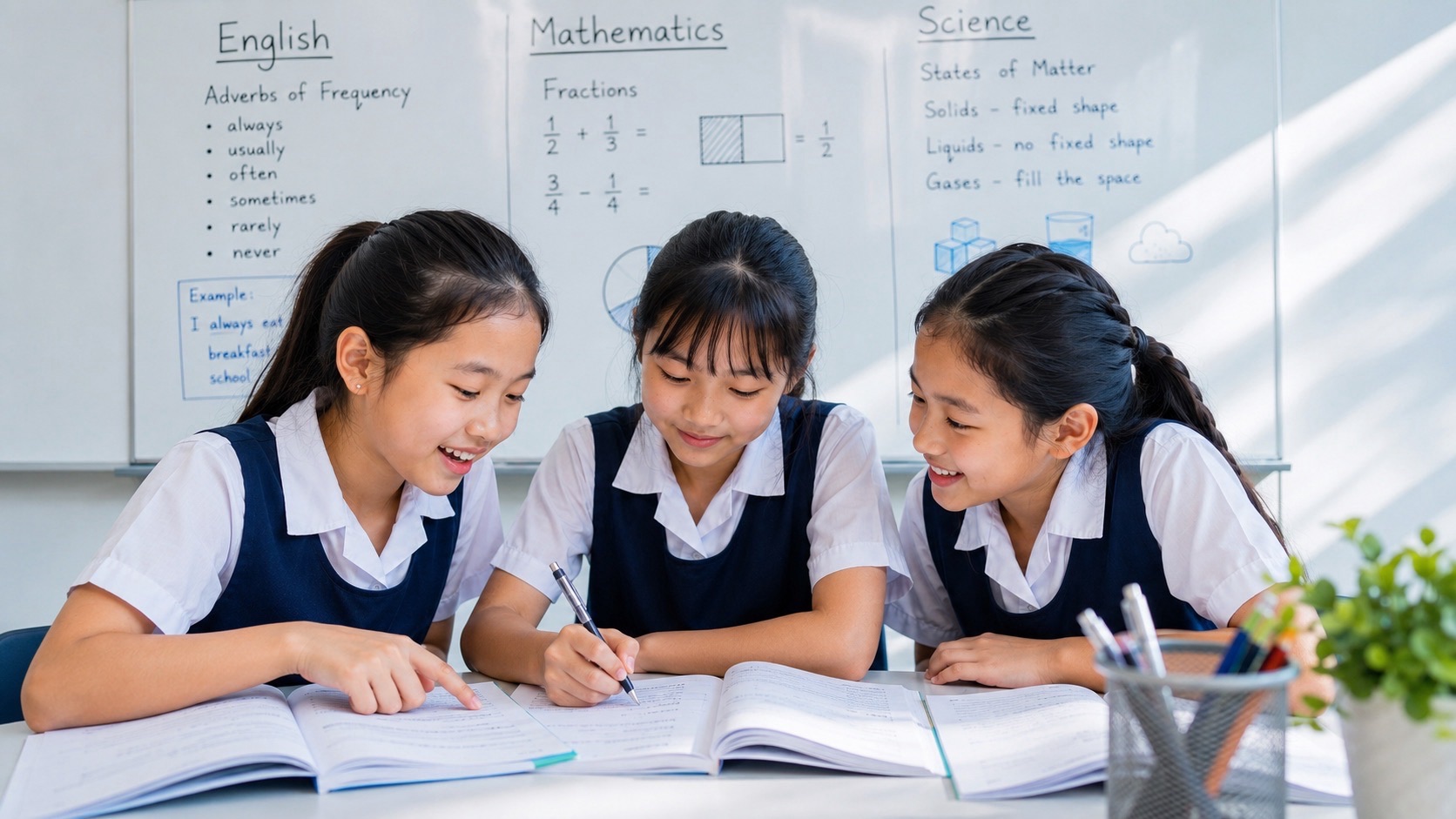
Primary 2 story elements vocabulary, Grade 2 narrative terms, 2nd grade reading vocabulary and story structure words help children understand how narratives are built. Important terms include character, setting, event, plot, beginning, middle, end, problem, solution, goal, obstacle, dialogue, narrator, sequence, prediction, inference, retell and summary. These words give learners a language for talking about stories rather than merely answering disconnected questions.
For parents and teachers searching for Primary 2 reading vocabulary, Grade 2 story elements, 2nd grade narrative structure, character and setting, plot problem and solution, retelling vocabulary, reading comprehension terms or story map words, the central principle is relationship. A story is not a bag of isolated elements. Characters act in settings, goals create action, obstacles create problems, events have causes and consequences, and endings respond to what came before.
This guide is the conceptual owner for Primary 2 story elements, narrative structure and reading terms. It sits beneath the What is Primary 2 Vocabulary apex guide and connects to the Primary 2 Context and Reading Comprehension guide. The aim is to make story vocabulary functional for comprehension, oral retelling and narrative writing.
The 50-Second Router
- Need the basic map? Read What Story Elements Are.
- Need character and setting? Go to Character and Setting.
- Need plot structure? Read Plot, Events and Narrative Structure.
- Need problem and solution? Go to Problem, Attempt and Solution.
- Need retelling support? Read Retelling and Summary Vocabulary.
- Need a programme? Use the 12-Week Story-Vocabulary Programme.
Central proposition: Primary 2 story vocabulary should help children represent relationships inside narratives. Terms become useful when they organise characters, settings, goals, events, problems, solutions and evidence into a coherent mental model.
Story Vocabulary in One Model
| Layer | Question |
|---|---|
| Character | Who acts, thinks, feels or changes? |
| Setting | Where and when does the story happen? |
| Goal | What does the character want or need? |
| Problem | What blocks the goal or disturbs the situation? |
| Events | What happens, and in what order? |
| Solution | How is the problem addressed, and what changes? |
1. What Story Elements Are
Story elements are the parts and relationships readers use to represent a narrative. Common Primary 2 terms include character, setting, event, problem, solution, beginning, middle and end. These labels are useful only when they help the learner understand how the story works.
A character exists in a setting, wants something, encounters an obstacle, acts, experiences consequences and may change. The plot is the organised pattern of these events. Teaching each term separately can provide a starting point, but integration is the real comprehension goal.
Story-element vocabulary also supports memory. A learner who can organise information under character, setting, problem and solution has a structure for retelling rather than trying to remember every sentence equally.
Failure mode: story maps can become boxes filled mechanically after reading. Children may locate a name or place without understanding why it matters.
Teaching move: ask relational questions: How does the setting affect the problem? How does the character’s goal cause the next event? How does the solution respond to the obstacle?
Transfer: story terms become comprehension tools when they organise new narratives rather than one familiar worksheet.
2. Character
A character is a person, animal or other represented being who participates in the story. Characters can act, speak, think, feel, choose and change. Not every named person is equally central.
Primary 2 readers can distinguish the main character from supporting characters by asking whose goal, problem or change organises most of the events. This is more useful than simply choosing the first name in the story.
Character vocabulary connects naturally to traits, emotions, motives and behaviour. The term character identifies the story participant; words such as patient, worried or determined describe aspects of that participant.
Teaching move: track what the character wants, does, says and learns. Use evidence rather than labels alone.
Writing move: give a character a goal and a reason before adding appearance or decorative details.
Transfer: character vocabulary should support fiction, folktales, picture books and simple narrative nonfiction.
3. Setting
The setting is where and when a story happens, including relevant social and environmental conditions. A classroom at lunchtime, a forest during a storm and a home before sunrise are more informative than a place name alone.
Setting can affect what characters can do, what dangers exist, what objects are available and how the mood feels. A locked school after dark creates a different problem from the same school during assembly.
Time vocabulary matters: morning, later, the next day, long ago and suddenly. Place vocabulary also benefits from precision: corridor, playground, shoreline, market or shelter.
Failure mode: children may write only the story happened in a park without connecting the setting to events.
Teaching move: ask what would change if the same event happened in another place or time.
Transfer: setting vocabulary supports inference, atmosphere and narrative planning.
4. Event
An event is something that happens in a story. Important events change the situation, reveal character, create a problem, represent an attempt or move the narrative toward resolution.
Not every detail deserves equal weight. A character tying a shoe may be minor unless it causes a delay that matters. Readers learn to distinguish central events from decorative or routine details.
Event vocabulary includes action, reaction, cause, result, attempt, decision, accident and discovery. These words help children talk about function, not only sequence.
Teaching move: after each event, ask what changed because it happened. If nothing meaningful changed, it may be a minor detail.
Retelling move: choose events that preserve the causal chain rather than recounting every sentence.
Transfer: event selection supports summary and coherent writing.
5. Plot, Events and Narrative Structure
Plot is the organised sequence of story events and their relationships. At Primary 2, children can understand plot as what happens and how one event leads to another around a character’s problem or goal.
A list of events becomes a plot when readers see cause, intention, obstacle and consequence. The dog ran away. Mia searched the park. A neighbour heard barking. They found the dog. The events form a connected search narrative.
Beginning, middle and end provide a simple macrostructure. The beginning establishes character, setting and situation; the middle develops problem and attempts; the end shows outcome and possible change.
Failure mode: learners may identify first, next and last without understanding why the order matters.
Teaching move: scramble events and ask which causal or temporal relationships determine the correct order.
Transfer: plot vocabulary supports comprehension, retelling and narrative composition.
6. Beginning, Middle and End
Beginning, middle and end are broad narrative regions, not three equal boxes. A beginning introduces enough information for readers to enter the story. A middle develops action and complication. An ending responds to the central situation.
Some stories begin with the problem immediately; others establish ordinary life first. Endings can solve the problem fully, partly or unexpectedly. Primary 2 instruction should allow variation while keeping the overall structure understandable.
Useful transition words include at first, soon, later, meanwhile, finally and in the end. These words signal movement but do not create coherence by themselves.
Teaching move: summarise each region in one sentence and explain how it connects to the next.
Writing move: plan the problem and ending before adding many middle events.
Transfer: macrostructure helps children hold longer narratives in memory.
7. Goal
A goal is what a character wants, needs or tries to achieve. Goals create direction and help readers understand why actions matter.
The goal may be external—find a lost item, reach home, win a race—or internal—gain courage, repair a friendship or understand a mistake. Primary 2 stories often use concrete goals, but simple emotional goals can also be accessible.
Goals connect action and motive. Without a goal, a series of events can feel random. With a clear goal, attempts and obstacles become meaningful.
Teaching move: complete the frame The character wants ___ because ___, then remove the frame later.
Reading move: revise the inferred goal if later evidence changes the interpretation.
Transfer: goal vocabulary strengthens motive inference and story planning.
8. Obstacle
An obstacle is something that blocks or complicates a goal. It can be a physical barrier, missing information, another character, a rule, time pressure, fear or an earlier mistake.
Obstacles create reasons for action. If a goal can be achieved immediately with no difficulty or decision, the narrative may lack development.
Different obstacles require different responses. A locked door may require a key; a misunderstanding may require explanation; fear may require courage or support.
Teaching move: match obstacles to possible strategies and discuss which response fits the type of problem.
Writing move: choose one meaningful obstacle rather than adding unrelated disasters.
Transfer: obstacle vocabulary links character, plot and problem-solving.
9. Problem, Attempt and Solution
The problem is the central difficulty requiring response. An attempt is something a character does to address it. A solution is the action or development that resolves or reduces the difficulty.
Children often jump directly from problem to solution and miss failed attempts. Yet attempts reveal character, create suspense and explain why the final solution matters.
A solution should connect logically to the problem. Finding an umbrella solves being caught in rain; receiving a bicycle does not unless the story has established why it matters.
Teaching move: use a problem–attempt–result–new attempt–solution chain.
Comprehension move: ask whether the ending truly solves the original difficulty or only changes it.
Transfer: problem-solution vocabulary supports narrative logic and informational text structures.
10. Cause and Effect in Stories
Cause is why something happens; effect is what happens as a result. Stories depend on these relationships even when the words because and so are not stated.
A storm causes the bridge to close; the closure causes the characters to choose another route; the longer route causes them to arrive late. One cause can create a chain of effects.
Character choices also cause consequences. This connects plot vocabulary to trait, motive and responsibility vocabulary.
Teaching move: draw arrows between events and label why each connection exists.
Writing move: check whether major events have understandable causes and effects.
Transfer: causal vocabulary supports stories, explanations and Science reading.
11. Sequence and Time Order
Sequence is the order in which events happen or are presented. Time words such as before, after, first, next, later and finally help readers track order.
Sequence is not the same as cause. One event can happen before another without causing it. Primary 2 learners can begin to distinguish temporal order from causal relationship.
Some stories include memories, predictions or parallel events that make order less direct. Start with linear narratives before adding these variations.
Teaching move: arrange event cards, then add cause arrows only where evidence supports them.
Retelling move: use sequence words selectively rather than before every sentence.
Transfer: sequence vocabulary supports procedures, history and personal recounts as well as fiction.
12. Retelling and Summary Vocabulary
A retell reconstructs important story events in a coherent order, often with more detail than a summary. A summary compresses the story to its central character, situation, problem, major events and outcome.
Vocabulary such as main event, important detail, sequence, problem, attempt and solution gives children criteria for selection. Without these terms, retelling can become either too short or a sentence-by-sentence reproduction.
Oral retelling is a powerful bridge because it tests comprehension and retrieval without adding spelling load. Written summary can follow once the story model is stable.
Teaching move: close the text, retell using story-element prompts, reopen to verify and improve.
Assessment move: listen for preserved causal relationships, not only correct event order.
Transfer: retelling vocabulary supports listening comprehension, reading and writing.
A 12-Week Primary 2 Story-Vocabulary Programme
| Week | Focus | Evidence |
|---|---|---|
| 1 | Character and setting | Learner identifies who, where and when. |
| 2 | Events | Learner distinguishes major events from details. |
| 3 | Beginning, middle and end | Learner explains each region’s job. |
| 4 | Goal | Learner states what the character wants and why. |
| 5 | Obstacle and problem | Learner explains what blocks the goal. |
| 6 | Attempts | Learner tracks responses and results. |
| 7 | Solution | Learner connects ending to central problem. |
| 8 | Cause and effect | Learner links events logically. |
| 9 | Dialogue and motive | Learner uses speech as evidence. |
| 10 | Retelling | Learner preserves sequence and causal chain. |
| 11 | Summary | Learner selects central information. |
| 12 | Reading-to-writing transfer | Learner plans a coherent original story. |
Keep the programme cumulative. Character, setting and goal should remain visible when problem, attempt and solution are added. Stories work as connected systems.
For stronger learners, add narrator, point of view, theme and character change. For learners who struggle, use pictures, acted scenes and short oral narratives before longer texts.
13. Narrator
The narrator is the voice that tells the story. The narrator may be a character using I, or an outside voice using names and pronouns such as she and they. Primary 2 learners do not need complex narratology, but they benefit from asking who is telling and what that voice knows.
A character narrator may describe personal thoughts directly but know less about other characters. An outside narrator may tell readers more than one character knows. This difference affects evidence and point of view.
Readers should not automatically accept every narrator statement as complete truth, especially when the narrator is a character with limited information. At this level, simple stories can show that two people may describe the same event differently.
Teaching move: change a short scene from I to she and discuss what information remains available.
Writing move: choose one narrator and keep pronouns and access to thoughts consistent.
Transfer: narrator vocabulary supports comprehension of perspective and narrative voice.
14. Point of View at a Primary 2 Level
Point of view describes the position from which events are experienced or told. At Primary 2, this can begin with a simple question: How does this character see the event, and how might another character see it differently?
A lost toy may be a crisis for the owner, an interesting object for a younger child and a responsibility problem for the adult. The physical event is shared, but goals and knowledge differ.
Perspective vocabulary includes thinks, believes, notices, knows, does not know, hopes and misunderstands. These verbs help children represent different minds without requiring abstract theory.
Teaching move: use two thought bubbles for the same scene and ask what evidence each character possesses.
Reading move: distinguish what the reader knows from what a character knows.
Transfer: point-of-view language supports empathy, inference and dialogue writing.
15. Dialogue
Dialogue is spoken language represented inside a story. It can reveal information, character, relationships, goals and conflict. Dialogue is not merely conversation inserted between events; it should perform a narrative job.
Speech verbs such as said, asked, replied, whispered and shouted provide information about communicative action. Adverbs and surrounding behaviour may add tone, but the actual words spoken remain important evidence.
Readers should connect dialogue to subsequent action. A promise may create expectation; a warning may change a decision; a lie may cause later conflict.
Teaching move: remove one line of dialogue and ask what story information is lost. This shows its function.
Writing move: use short dialogue to reveal goal or relationship rather than filling the page with greetings.
Transfer: dialogue vocabulary supports oral reading, inference and narrative craft.
16. Prediction
A prediction states what may happen next based on story evidence, genre patterns and background knowledge. It is not a random guess or a statement of personal preference.
A reader may predict that a character will return for an umbrella because storm clouds are gathering and the character notices them. The prediction is stronger when tied to specific evidence.
Predictions should be updated. New events can confirm, weaken or overturn an earlier idea. Revision demonstrates flexible comprehension.
Teaching move: use the frame I predict ___ because ___, then fade it once reasoning becomes habitual.
Assessment move: score the evidence and reasoning, not whether the prediction happens exactly.
Transfer: prediction language supports stories, Science inquiry and everyday planning.
17. Inference
An inference is a meaning the reader constructs from textual evidence and relevant background knowledge when the author does not state everything directly. Character feelings, motives and relationships are common Primary 2 inference targets.
If a character hides a torn paper, avoids eye contact and changes the subject, a reader may infer worry, guilt or fear of consequences. The best choice depends on the rest of the story.
Inference should remain evidence-bound. Several interpretations may be possible, but they are not equally supported. Vocabulary precision helps readers compare alternatives.
Teaching move: separate what the text says from what the reader thinks it means, then connect them with because.
Verification move: read onward and revise when new evidence appears.
Transfer: inference vocabulary supports comprehension across narratives and informational texts.
18. Text Evidence
Text evidence is information from the words, pictures or events of a text that supports an answer or interpretation. At Primary 2, evidence may be quoted, pointed to or paraphrased.
Evidence is not the same as repeating the whole passage. The learner should identify the detail most relevant to the question: an action, line of dialogue, setting clue or consequence.
Picture books require visual evidence too. Facial expression, position, colour and depicted action can support interpretation, but images should be combined with text when both are available.
Teaching move: ask Which exact part helped you decide? after selected comprehension answers.
Writing move: use evidence words such as because, shows and suggests in oral explanations before written answers.
Transfer: evidence vocabulary strengthens reading, discussion and later academic argument.
19. Message and Theme at a Primary 2 Level
A story message is an idea readers may learn or consider from the events. Theme is a broader term for recurring ideas such as friendship, courage, responsibility, honesty or perseverance.
Primary 2 learners should begin with specific story evidence rather than produce generic morals. Always be kind may sound positive but can be too broad if the story is really about asking for help or admitting a mistake.
The message should grow from the character’s problem, choices, consequences and change. Different readers may phrase it differently while preserving the same core idea.
Teaching move: complete This story shows that ___ because ___, then compare answers against the events.
Writing move: let message emerge from action instead of adding a final moral sentence disconnected from the plot.
Transfer: message vocabulary connects narrative comprehension to ethical reflection.
20. Story Maps Used Well
A story map is a visual organiser for narrative information. Useful fields may include character, setting, goal, problem, attempts, solution and change. The map should match the text rather than force every story into identical boxes.
Maps are strongest when completed partly from memory after reading. Continuous copying from the page may create a neat chart without testing comprehension.
Arrows and connectors can show relationships among boxes. The character’s goal leads to action; the obstacle changes the plan; the solution creates an outcome.
Teaching move: begin with fewer fields, then add goal, motive or change when learners are ready.
Assessment move: ask the learner to explain the connections represented, not merely point to completed boxes.
Transfer: visual story vocabulary should support oral retelling and writing planning.
21. From Reading Vocabulary to Narrative Writing
The language used to analyse stories can also help children write them. Character, setting, goal, obstacle, attempt, consequence and solution provide a planning architecture.
Reading examples show how authors distribute information. A setting can be revealed through action; a goal can emerge through dialogue; a solution can result from an earlier clue. Writing instruction becomes richer when story terms are tied to models.
Transfer should not mean copying plots. Learners can borrow a structural principle—goal plus obstacle—while creating original characters and events.
Teaching move: select one admired story feature and ask how it could work differently in a new narrative.
Revision move: use story-element vocabulary to diagnose missing links: unclear goal, unrelated event, weak solution or setting with no function.
Transfer: literary vocabulary becomes productive when it guides original composition decisions.
22. Assessing Story-Element Vocabulary
Assessment should distinguish term recognition, concept understanding, relationship reasoning, retelling and transfer. A child may define setting but fail to explain how the storm setting affects the plot.
Use varied tasks: identify an element, explain its function, connect two elements, retell from memory, complete a story map and use the same terms while planning a new story.
Delayed checks matter. Immediate chart completion may reflect recent instruction; later explanation shows whether the narrative model has become durable.
Diagnostic move: if labels are known but relationships are weak, ask more how and why questions. If the story is understood but terminology is unavailable, teach retrieval.
Authentic move: observe story vocabulary during real discussion and writing revision.
Mastery: flexible organisation of new narratives is stronger evidence than one completed worksheet.
Primary 2 Story-Term Teaching Library
The entries below provide a compact teaching system for twenty high-utility narrative terms. Each term should be encountered in stories, retrieved after reading and used in oral or written explanation.
1. Character
A character is a represented participant who acts, speaks, thinks or experiences events. Ask whose choices matter and whose goal organises the story.
Distinguish main character from supporting character through narrative function, not page position or illustration size alone.
Retrieval task: describe a story without names and ask the learner to identify the central character from actions and goal.
Transfer: create an original character with a goal, fear and likely behaviour.
2. Setting
Setting includes relevant place, time and conditions. It supplies possibilities, constraints and atmosphere.
Ask what would change if the same action occurred elsewhere or at another time.
Retrieval task: give events and ask learners to propose a setting that makes them plausible.
Transfer: choose a setting that creates a useful obstacle in a new story.
3. Event
An event is something that happens and changes or advances the narrative situation.
Compare major events with minor details by asking what changes because of each one.
Retrieval task: recall three central events after closing the text.
Transfer: write one event that creates a meaningful consequence.
4. Plot
Plot is the organised pattern of events around goals, problems and outcomes.
A plot is more than sequence; cause, motive and consequence connect the events.
Retrieval task: arrange event cards and justify the order through relationships.
Transfer: plan a short plot with one goal, one obstacle and one solution.
5. Beginning
The beginning gives readers enough character, setting and situation information to enter the narrative.
It may establish ordinary life or present the problem immediately. Function matters more than formula.
Retrieval task: summarise the beginning in one sentence without retelling the whole story.
Transfer: draft an opening that introduces a goal or situation efficiently.
6. Middle
The middle develops the problem through actions, attempts, discoveries and complications.
A strong middle changes the situation rather than repeating similar events without consequence.
Retrieval task: name the event that most changes the direction of the middle.
Transfer: plan two linked attempts with different results.
7. End
The end presents outcome, resolution and possible character change.
An effective ending responds to the central problem even if the resolution is partial or surprising.
Retrieval task: explain how the final event connects to the beginning problem.
Transfer: write an ending that grows from earlier clues.
8. Goal
A goal is what a character wants, needs or intends to achieve.
Goals explain action and help readers evaluate obstacles and attempts.
Retrieval task: complete The character wants ___ because ___ without looking at the text.
Transfer: create a goal that naturally generates action.
9. Obstacle
An obstacle blocks, delays or complicates the goal.
It may be physical, social, informational, emotional or created by an earlier choice.
Retrieval task: identify the type of obstacle and propose a suitable response.
Transfer: match an obstacle to a character’s strengths and weaknesses.
10. Problem
The problem is the central difficulty requiring response.
It should be distinguished from every inconvenience or minor mistake in the story.
Retrieval task: state the central problem in one clear sentence.
Transfer: design a problem that matters to the character’s goal.
11. Attempt
An attempt is something a character tries in response to the problem.
Attempts may fail, partly work or create new difficulty. They reveal strategy and character.
Retrieval task: list attempts and the result of each one.
Transfer: plan attempts that build logically rather than repeat.
12. Solution
A solution addresses or reduces the central problem.
The solution should connect to earlier actions, knowledge or help rather than appear randomly.
Retrieval task: explain exactly which part of the problem the solution changes.
Transfer: design a plausible solution that uses an earlier clue.
13. Narrator
The narrator is the voice telling the story.
Ask whether the narrator is a character and what the narrator can know.
Retrieval task: identify narrator clues from pronouns and access to thoughts.
Transfer: retell one event through another narrator.
14. Dialogue
Dialogue is represented speech within a story.
It can reveal goal, emotion, relationship, information or conflict.
Retrieval task: explain what one line of dialogue changes or reveals.
Transfer: write dialogue that performs a clear narrative job.
15. Sequence
Sequence is the temporal or presented order of events.
Order should be distinguished from cause, though the two often interact.
Retrieval task: arrange events and identify the time words that support the order.
Transfer: use sequence vocabulary in story, procedure and recount.
16. Cause
A cause is why an event happens.
Causes may be actions, conditions, motives or earlier events.
Retrieval task: complete a because statement for a major event.
Transfer: create a cause that logically produces a planned effect.
17. Effect
An effect is what happens because of a cause.
One effect can become the next cause in an event chain.
Retrieval task: follow arrows through a three-event causal sequence.
Transfer: revise a story event so its consequence matters later.
18. Prediction
A prediction is an evidence-based idea about what may happen next.
It should be revised as new information appears.
Retrieval task: state a prediction and the exact clue supporting it.
Transfer: predict in stories, Science and daily planning.
19. Inference
An inference is a meaning constructed from evidence and relevant knowledge.
Several interpretations may be possible, but evidence makes some stronger.
Retrieval task: separate what the text says from what the reader infers.
Transfer: infer character, motive, cause and unstated meaning.
20. Summary
A summary presents the most important story information in a compressed form.
It preserves central character, problem, major events and outcome while omitting minor detail.
Retrieval task: summarise after closing the text, then reopen to verify.
Transfer: use summary language across stories and informational texts.
Teaching Labs
1. Story-Element Sort
Sort short statements under character, setting, goal, problem, event and solution. Require learners to explain the function, not only match keywords.
2. Goal–Obstacle–Attempt Chain
Build a causal chain from a familiar story. Replace one obstacle and discuss how the attempts and solution must change.
3. Setting Switch
Move one event to a different setting and identify what becomes possible, impossible or more difficult.
4. Evidence for Inference
Separate text details and inferred meanings into two columns, then connect them with arrows and because statements.
5. Retell From Memory
Close the text and retell using story-element prompts. Reopen afterward to repair missing causal links.
6. Narrator Switch
Retell one short event from another character’s position and discuss which facts and feelings change.
7. Summary Trim
Begin with an over-detailed retell and remove information that does not preserve the central story model.
8. Reading-to-Writing Story Map
Study how one published story connects goal, obstacle and solution, then use the architecture to plan an original narrative.
Frequently Asked Questions
What are story elements?
They are the important parts and relationships readers use to represent narratives, such as character, setting, goal, problem, events and solution.
What is plot?
Plot is the organised sequence and relationship of events around character goals, problems and outcomes.
How are retell and summary different?
A retell usually preserves more event detail; a summary compresses the text to central information.
Why teach goal and obstacle?
They explain why characters act and why events develop, making plot more than a list.
What is inference?
Meaning constructed from textual evidence and relevant background knowledge when the author does not state everything directly.
How should story vocabulary be assessed?
Use identification, relationship explanation, retelling, delayed recall and transfer into original writing.
Should every story fit one map?
No. Maps are tools and should be adapted to the narrative rather than forcing every text into an identical formula.
What is mastery?
The learner uses narrative terms to organise, explain, retell and create new stories with decreasing support.
Evidence and Further Reading
- Singapore MOE English Language Syllabus 2020 Primary.
- Education.com: Story Elements.
- IXL Grade 2 English Language Arts: Story Elements and Reading Skills.
- Research traditions on story grammar, narrative comprehension, retelling, inference and writing development.
Final Principle
Primary 2 story vocabulary should help children build a coherent model of narratives. Character, setting, goal, obstacle, event and solution are useful because they explain relationships, not because they fill boxes.
Teach terms through real stories, retrieve after reading, connect inference to evidence and let the same vocabulary guide original writing.
Return to the Primary 2 vocabulary apex guide, the Context and Reading Comprehension guide or the Vocabulary Learning Hub.
Primary 2 Narrative Scenario Laboratory
The scenarios below turn story-element vocabulary into a reasoning system. Each one asks learners to connect character, setting, goal, obstacle, event, cause, consequence, solution, inference and evidence. They can be used for shared reading, oral retelling, comprehension, story mapping or writing. The repeated structure is deliberate: strong narrative vocabulary becomes durable when the same terms organise many different stories rather than one familiar worksheet.
Scenario 1: The Lost Key
A child arrives home and discovers that the front-door key is missing. The character’s goal is to enter safely. The immediate obstacle is the missing key; the larger problem includes being unable to contact an adult at once. Possible attempts include retracing the route, checking the bag carefully and asking an authorised neighbour for help.
Ask learners to separate problem from attempt. Looking inside the bag is not the problem; it is one response. Finding the key under a book is not merely the final event; it is the solution because it resolves the central difficulty.
Use cause-and-effect vocabulary: the child rushed earlier, so the key slipped into another pocket; because the key seemed missing, the child retraced the route. Then ask which details are essential for a retell and which are minor.
For writing transfer, change the setting from home to a school locker or bicycle lock. The architecture remains goal–obstacle–attempt–solution while the objects, risks and actions change.
Scenario 2: Rain During Sports Day
The setting is an outdoor sports field shortly before a race. Dark clouds gather, strong wind begins and rain falls. The setting is not decorative: it creates the obstacle, changes the available actions and affects safety.
The main character wants to compete, but the event organisers pause the race. Learners can distinguish the character’s goal from the responsible decision made by adults. An ending in which the race simply continues during lightning would not solve the safety problem coherently.
Ask what would change if the setting were an indoor sports hall. The same character and goal would produce a different plot because the weather would no longer block the event. This makes setting function visible.
For summary practice, compress the story to setting change, problem, official decision and outcome. Do not recount every drop of rain or every student’s reaction.
Scenario 3: The Broken Model
Two learners build a model for a class presentation. One part breaks just before the presentation. The goal remains presenting the idea clearly; the obstacle is damaged material and limited time. The character’s trait vocabulary—calm, resourceful, frustrated or responsible—should be inferred from the response.
Possible attempts include hiding the damage, blaming a partner, repairing the part, adapting the explanation or asking for help. Each attempt reveals character and creates a different consequence.
Ask learners to predict which attempt is most likely based on earlier behaviour. Then read the next event and revise the prediction if necessary. The quality of the evidence matters more than whether the prediction happens exactly.
For narrative writing, plant an earlier clue—a spare piece of card or knowledge of the model’s design—so the eventual solution grows from the plot rather than appearing randomly.
Scenario 4: A New Student at Recess
The main character notices a new student standing alone at recess. The external event is simple, but motive and point of view create narrative depth. Does the new student want company, need time to observe or feel unsure how to join?
Use dialogue as evidence. An invitation, question and response can reveal goals and feelings without direct labels. A narrator may describe body language, but learners should avoid treating one gesture as proof of one emotion.
Ask learners to retell the same event from each student’s point of view. The playground setting stays constant, but knowledge, expectation and emotional interpretation differ.
For writing transfer, create a small obstacle such as unfamiliar game rules. The solution can emerge through explanation and participation rather than a vague ending in which everyone instantly becomes friends.
Scenario 5: The Mysterious Footprints
After rain, a child sees unusual footprints near the garden. The goal is to find out what made them. The story can develop through observation, prediction, evidence and revised inference rather than danger or dramatic action.
Early clues may support several possibilities: a bird, cat, toy wheel or shoe. The reader should distinguish what is observed from what is inferred. New evidence such as feather marks or stride size can strengthen one explanation.
The plot is organised by information change. Each discovery alters the character’s belief and next action. This shows that narrative events can be cognitive as well as physical.
For summary, preserve the initial clue, key investigation steps and final discovery. For writing, let the solution depend on accumulated evidence rather than a narrator suddenly revealing the answer.
Scenario 6: The Unsent Invitation
A character prepares an invitation for a friend but forgets to send it. On the event day, the friend feels excluded. The central problem arises from an action and its consequence rather than malicious intent.
Point of view matters. The organiser believes the friend received the invitation; the friend believes no invitation was offered. The reader may know both perspectives and understand how misunderstanding grows.
Dialogue can reveal incomplete knowledge. Ask learners what each character knows at each stage and which line changes the situation. The solution should involve explanation, evidence and repair.
For theme discussion, avoid the generic moral always be kind. A more specific message may concern checking communication, asking before assuming or repairing unintended harm.
Scenario 7: The Plant That Bent Toward the Window
A learner notices that a classroom plant bends toward a window. The narrative can combine inquiry and character goals. The child wants to understand the change, records observations and moves the plant to test an idea.
The obstacle is not an enemy but uncertainty. Attempts include asking questions, measuring, rotating the pot and waiting. Sequence and elapsed time become important story vocabulary.
Ask learners which events are observations, which are decisions and which are results. This supports both Science language and narrative structure.
For writing transfer, keep the story coherent by giving the character a clear goal and using each investigation step to change knowledge. The ending may be a supported conclusion rather than a dramatic resolution.
Scenario 8: The Delayed Bus
A family waits for a bus that does not arrive at the expected time. The setting includes a bus stop, changing weather and a clock. The character’s goal is to reach an appointment; the obstacle is delay and limited information.
Attempts may include checking the route notice, asking authorised staff, calling ahead or choosing another safe route. Each attempt should follow from available information.
Time words—at first, ten minutes later, meanwhile, eventually—help readers track sequence. Cause-and-effect language explains why the delay changes later decisions.
For retelling, require the learner to preserve the goal, delay, information gathering and final decision. Remove minor observations that do not affect the outcome.
Scenario 9: The Wrong Lunch Box
Two identical lunch boxes are exchanged by mistake. The problem is discovered when a character sees unfamiliar food or a name label. The story can develop through observation, inference, responsibility and social interaction.
Ask which detail first reveals the problem and which is only confirmation. The name label may be decisive evidence, while the food provides an earlier clue.
Dialogue can create either conflict or repair. A calm question, honest admission and exchange solve the practical problem. A false accusation creates a new social obstacle.
For writing, plan how the problem is noticed, what incorrect inference may arise and what evidence resolves it. This gives the middle a clear information arc.
Scenario 10: A Promise to Water the Plants
A child promises to water a neighbour’s plants during a holiday. The goal is clear, but distractions and changing weather create decisions. Character, responsibility and consequence vocabulary organise the narrative.
One missed day may not prove irresponsibility, but repeated forgetting and failure to respond to reminders create stronger evidence. The story should distinguish accident, carelessness and repair.
Ask learners to identify cause chains: the child forgets, the soil dries, leaves droop, the child notices and changes the routine. Each event becomes the next cause.
For theme, consider reliability, planning or making amends rather than an abstract moral detached from events.
Scenario 11: The Shorter Route
Characters choose between a familiar longer route and an unfamiliar shortcut. The goal is to arrive before an event begins. The setting contains signs, barriers and changing light.
One character values speed; another notices safety evidence. The obstacle may become a blocked path, and the decision creates consequences. Trait vocabulary should be tied to the choice rather than the excitement of the scene.
Ask learners to predict the outcome, then revise when new evidence appears. A responsible ending may involve turning back rather than forcing the shortcut to succeed.
For writing transfer, plant an early warning clue and use it later. This creates cohesion between beginning and ending.
Scenario 12: The Class Pet Escapes
A cage door is left open and the class pet disappears inside the room. The goal is to locate the animal safely. The obstacle includes limited knowledge of its hiding behaviour and the need to avoid frightening it.
Events can be organised through clues: scattered food, movement behind a box, a faint sound. Each clue leads to an attempt. The final solution should use established information about the animal.
Point of view can shift between students, teacher and imagined pet, but the narrator should remain consistent within a section. Learners can discuss what each participant knows.
For retelling, preserve safety, clue sequence and solution. Avoid adding unrelated chase events that weaken causal logic.
Scenario 13: The Surprise Performance
A group plans a surprise performance for a teacher. The goal requires preparation without revealing the plan. Obstacles include limited rehearsal time, missing props and a classmate almost revealing the secret.
Dialogue performs important narrative work: agreeing on roles, warning someone quietly and adjusting the plan. Ask which lines move the plot and which are unnecessary greetings.
The setting changes from rehearsal space to classroom performance. Each setting supports different actions. Time pressure links the scenes.
For writing, maintain coherence by connecting every event to the goal. A random playground accident should not appear unless it changes preparation or outcome.
Scenario 14: The Torn Map
During a supervised learning activity, a paper map tears into several pieces. The characters need to reconstruct it to complete a route-planning task. The obstacle is missing spatial information rather than physical danger.
Attempts may use matching edges, labels, landmarks and direction arrows. Each attempt produces information and changes the next decision.
Ask learners to explain which clue is strongest and why. This connects narrative problem solving to evidence vocabulary.
For summary, state the goal, damage, key strategy and result. For writing, let the solution grow from careful observation and cooperation.
Scenario 15: The Unfair Team Selection
A captain selects only close friends for a game, leaving out players who followed the agreed rule. The central problem involves fairness, goal conflict and group relationships.
Different characters have different viewpoints: the captain wants a strong team, excluded children want the rule respected and a teacher wants a workable solution. Dialogue and motive matter.
Ask learners to distinguish problem from emotion. Disappointment is a response; unfair selection is the central situation. The solution must address the rule, not merely tell everyone to feel better.
For writing transfer, create an ending involving transparent criteria or rotating turns. Link the solution to earlier evidence about the agreed process.
Scenario 16: The Last Piece of Cake
Several family members notice one remaining piece of cake. The event is small, but goal, motive, dialogue and consequence can produce a meaningful narrative.
One character wants the cake after saving it; another assumes it is available; a third proposes sharing. The same action—taking the cake—has different interpretations depending on knowledge and agreement.
Ask what each character knows and whether the narrator reveals all information at once. A misunderstanding may be resolved through dialogue rather than punishment.
For theme, focus on communication, fairness or assumption. Avoid forcing generosity as the only possible message if the story evidence centres on ownership.
Scenario 17: The Noisy Neighbour
A character hears repeated noise while trying to complete homework. The initial inference is that a neighbour is inconsiderate. Later evidence reveals emergency repairs after a water leak.
The plot depends on revised interpretation. Setting clues, time, dialogue and new information change the character’s belief. This is a strong scenario for inference and point of view.
Ask learners to identify what was observed, what was inferred and what later evidence required revision. The character may move from annoyed to concerned or understanding.
For writing, reveal information gradually and let the character’s language change. The solution may involve communication and practical help.
Scenario 18: The Seed Competition
Two groups try to grow the tallest bean plant. One changes several conditions at once; the other records water and light carefully. The story combines competition, inquiry and fair comparison.
The goal is not enough to explain the plot. Methods, decisions and evidence create consequences. A group may appear to win but be unable to explain why the plant grew.
Ask learners which events are central and which scientific vocabulary supports the narrative. Prediction, record, result and conclusion can function as story terms too.
For writing transfer, choose whether the ending celebrates height, learning or cooperation. The selected outcome changes the likely message.
Scenario 19: The Forgotten Costume
A character reaches school before a performance and discovers the costume is at home. The goal is to participate; the obstacles are time, distance and school procedures.
Attempts may include calling an authorised adult, adapting available materials or changing the role. The solution should remain safe and plausible.
Emotion vocabulary can track panic, frustration, focus and relief. However, the plot should be organised by decisions and consequences rather than feeling words alone.
For summary, preserve discovery, chosen attempt and performance outcome. For writing, foreshadow a possible resource or supportive relationship.
Scenario 20: The Message Sent to the Wrong Person
A learner intends to send a group-work reminder but chooses the wrong contact. Confusion follows when another person receives incomplete information. The story involves communication, perspective and repair.
Ask what each character knows and which assumptions are reasonable. The central problem is not technology itself but mismatched information and audience.
Attempts can include deleting where possible, clarifying, apologising and sending accurate information. Consequences should remain age-appropriate and realistic.
For theme, focus on checking audience, correcting mistakes or communicating clearly. The vocabulary should grow from events rather than a generic moral.
Detailed 12-Week Teaching Sequence
Week 1 — Who and where: establish character and setting through picture books and oral stories. Ask which details matter for later events and which merely decorate the scene.
Week 2 — Event importance: sort central events and minor details. Use the question What changed because this happened? to identify narrative function.
Week 3 — Beginning, middle and end: summarise each region and explain the transition. Avoid treating the regions as equal boxes.
Week 4 — Goal and motive: connect what the character wants with reasons, actions and predictions. Revise inferred goals when new evidence appears.
Week 5 — Obstacle and problem: distinguish the central difficulty from every inconvenience. Match obstacle types to plausible responses.
Week 6 — Attempts and results: track what the character tries, what happens and how the next attempt changes. Failed attempts remain narratively valuable.
Week 7 — Cause and sequence: separate what happened first from what caused what. Use arrows and time words without confusing chronology with causality.
Week 8 — Narrator and point of view: compare what different characters know and how one event can be described differently.
Week 9 — Dialogue and evidence: identify what speech reveals, changes or causes. Remove unnecessary dialogue in writing models.
Week 10 — Inference and prediction: tie both to evidence, distinguish current interpretation from future possibility and revise when new information appears.
Week 11 — Retell and summary: close the text, reconstruct the causal chain, verify and compress. Compare a detailed retell with a concise summary.
Week 12 — Reading-to-writing transfer: use story vocabulary to plan an original narrative, diagnose gaps and revise for coherence.
Diagnostic Matrix
| Observed difficulty | Likely bottleneck | Next teaching move |
|---|---|---|
| Names characters and setting but cannot explain plot | Relationship model | Build goal–obstacle–attempt–solution chains. |
| Retells every detail | Event importance and summary | Ask what changed and remove nonessential details. |
| Lists events without causes | Causal reasoning | Connect events with because and consequence arrows. |
| Cannot identify the problem | Goal–obstacle link | State what the character wants and what blocks it. |
| Predicts randomly | Evidence use | Require one specific clue and revise later. |
| Gives traits without evidence | Character inference | Track actions, dialogue, decisions and change. |
| Story ending feels random | Solution coherence | Link ending to problem, attempts and earlier clues. |
| Knows terms but cannot write | Productive transfer | Use terms during planning and one-layer revision. |
Quality Gates for Story Vocabulary
A high-quality narrative lesson passes six gates. Terms must have clear child-friendly meanings; elements must be connected rather than isolated; evidence must support interpretations; retelling must preserve causal structure; retrieval must occur after the text closes; and transfer must be tested in another story or original writing.
Do not mistake completed organisers for comprehension. A story map can be copied. Ask the learner to explain why each element matters and how a change in one element would affect the others.
Do not force every story into one formula. Folktales, realistic stories, mysteries and simple narrative nonfiction can organise goals, problems and endings differently. Vocabulary should illuminate the text rather than flatten it.
The final test is coherence. Can the learner use story vocabulary to understand why events happen, retell the narrative accurately and make original writing more connected? If so, the terms have become thinking tools.