
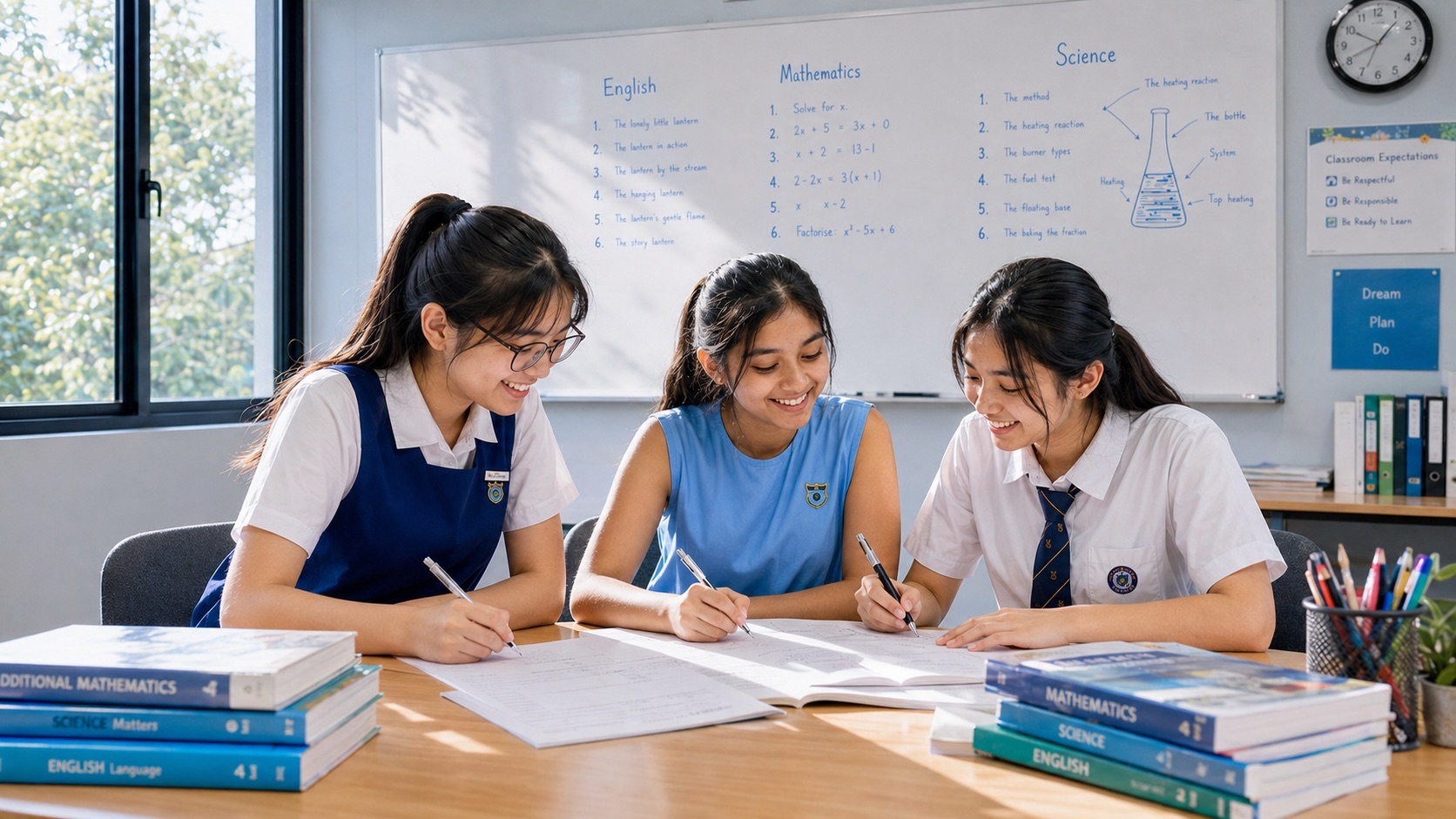
Revision changes learning when revision makes knowledge more accurate, retrievable, connected and usable under the conditions in which students will later need it. Searches for revision techniques, how to revise, best revision methods, exam revision, revision timetable, active recall, past papers and how to study for exams often treat revision as a collection of tricks. The deeper question is which weakness the learner is trying to repair.
Revision is not the same as rereading. Rereading can restore context or clarify a difficult passage, but it provides limited evidence of independent recall. Past papers can reveal examination performance, but repeating papers without diagnosis can become measurement without learning. Flashcards can support retrieval, but they cannot replace extended writing or problem solving when those are the target capabilities.
This guide explains revision through diagnosis, retrieval, spacing, feedback, error correction, past papers, planning and transfer. Its central proposition is simple: revision changes learning when evidence from each attempt changes what the learner revises next.
Your 50-second route
Start with a short closed-source check. Classify the gap. Reteach what is misunderstood. Retrieve what is understood but unavailable. Mix examples when method selection is weak. Use past papers to expose performance under realistic conditions. Correct important errors and revisit them later. Protect sleep. Stop revising everything equally once the evidence shows where the highest-value repairs are.
Expandable contents — diagnosis, techniques, subjects and examinations
1. Revision is not rereading · 2. Revision as diagnosis · 3. Retrieval · 4. Spacing · 5. Feedback · 6. Error repair · 7. Interleaving · 8. Practice testing · 9. Worked examples · 10. Summarising · 11. Flashcards · 12. Notes · 13. Past papers · 14. Planning · 15. Priorities · 16. Knowledge gaps · 17. Misconceptions · 18. Method selection · 19. Time pressure · 20. Vocabulary revision · 21. Reading revision · 22. Writing revision · 23. Mathematics revision · 24. Science revision · 25. Oral revision · 26. Primary learners · 27. Secondary learners · 28. Exam horizons · 29. One month out · 30. One week out · 31. One day out · 32. Parents · 33. Teachers · 34. Revision timetables · 35. Revision overload · 36. Procrastination · 37. Sleep · 38. Stress · 39. Seven-day revision experiment · 40. Thirty-day review · 41. Revision and independence · 42. World-return test
Useful routes: Finish Exam Revision Tasks Faster, Why Spaced Repetition Changes Memory, Why Practice Changes Learning, Why Feedback Changes Learning and the How X Works library.
1. Revision is not rereading
Revision changes learning only when it changes what knowledge is available and what the learner can do with it; rereading alone is one possible activity, not the definition of revision. The visible activity should therefore be interpreted through its purpose. A page of notes, a quiz, a flashcard deck and a past paper can all be useful or wasteful depending on what the learner needs and what happens after the result is known.
Consider a fictional learner who spends an evening rereading a science chapter and feels familiar with every heading. A closed-book explanation the next morning reveals that two causal steps are missing. The problem is now specific. Revision can return to those steps, compare a correct and incomplete explanation, then require another independent account. The closed-source attempt converts familiarity into diagnostic evidence.
Classify the gap before selecting the method. Missing knowledge needs instruction. Weak retrieval needs recall after accurate learning. Confusable ideas need contrast. Wrong method selection needs mixed examples. Execution slips need targeted procedural practice and checking. Time-pressure problems need realistic constraints after the underlying knowledge is stable. One revision technique cannot be best for every mechanism.
Use past papers strategically. First attempt under conditions appropriate to the learner’s stage. Then classify lost marks by cause. Repair the largest recurring mechanisms with smaller tasks before attempting another full paper. Otherwise the learner can spend hours repeatedly demonstrating the same weakness. A paper should generate a revision plan, not merely a score.
Timetables should preserve priorities and recovery. Give more attention to foundational knowledge, recurring errors and high-value capabilities. Leave space for unexpected repair. A timetable filled completely with planned tasks has no room for the evidence those tasks are supposed to produce. Revision is adaptive work, so the plan must be able to change without collapsing.
For vocabulary, retrieve meaning and use words in context. For reading, practise evidence and inference on fresh passages. For writing, revise principles and then produce fresh text. For mathematics, mix method selection with accurate execution. For science, connect terminology to mechanisms and evidence. Subject differences matter because revision should resemble the capability being prepared.
For parents, ask what the revision session is trying to change rather than how many hours it contains. For teachers, provide criteria and diagnostic categories that help students interpret errors. For students, finish a session with one sentence: what became more reliable, and what is the next unresolved bottleneck? This keeps revision cumulative rather than repetitive.
The world-return test is examination-independent capability. Can the learner retrieve the knowledge after a delay, recognise when it applies, explain the reasoning and recover after a difficult item? If yes, revision has strengthened learning rather than merely rehearsed the revision materials. If not, return to diagnosis and choose the activity that matches the remaining failure mechanism.
2. Revision as diagnosis
Diagnosis should determine revision because different weaknesses require reteaching, retrieval, comparison, execution practice or transfer. The visible activity should therefore be interpreted through its purpose. A page of notes, a quiz, a flashcard deck and a past paper can all be useful or wasteful depending on what the learner needs and what happens after the result is known.
Consider a fictional learner who spends an evening rereading a science chapter and feels familiar with every heading. A closed-book explanation the next morning reveals that two causal steps are missing. The problem is now specific. Revision can return to those steps, compare a correct and incomplete explanation, then require another independent account. The closed-source attempt converts familiarity into diagnostic evidence.
Classify the gap before selecting the method. Missing knowledge needs instruction. Weak retrieval needs recall after accurate learning. Confusable ideas need contrast. Wrong method selection needs mixed examples. Execution slips need targeted procedural practice and checking. Time-pressure problems need realistic constraints after the underlying knowledge is stable. One revision technique cannot be best for every mechanism.
Use past papers strategically. First attempt under conditions appropriate to the learner’s stage. Then classify lost marks by cause. Repair the largest recurring mechanisms with smaller tasks before attempting another full paper. Otherwise the learner can spend hours repeatedly demonstrating the same weakness. A paper should generate a revision plan, not merely a score.
Timetables should preserve priorities and recovery. Give more attention to foundational knowledge, recurring errors and high-value capabilities. Leave space for unexpected repair. A timetable filled completely with planned tasks has no room for the evidence those tasks are supposed to produce. Revision is adaptive work, so the plan must be able to change without collapsing.
For vocabulary, retrieve meaning and use words in context. For reading, practise evidence and inference on fresh passages. For writing, revise principles and then produce fresh text. For mathematics, mix method selection with accurate execution. For science, connect terminology to mechanisms and evidence. Subject differences matter because revision should resemble the capability being prepared.
For parents, ask what the revision session is trying to change rather than how many hours it contains. For teachers, provide criteria and diagnostic categories that help students interpret errors. For students, finish a session with one sentence: what became more reliable, and what is the next unresolved bottleneck? This keeps revision cumulative rather than repetitive.
The world-return test is examination-independent capability. Can the learner retrieve the knowledge after a delay, recognise when it applies, explain the reasoning and recover after a difficult item? If yes, revision has strengthened learning rather than merely rehearsed the revision materials. If not, return to diagnosis and choose the activity that matches the remaining failure mechanism.
3. Retrieval
Retrieval gives revision an evidence-producing function by revealing what can be produced without the original source. The visible activity should therefore be interpreted through its purpose. A page of notes, a quiz, a flashcard deck and a past paper can all be useful or wasteful depending on what the learner needs and what happens after the result is known.
Consider a fictional learner who spends an evening rereading a science chapter and feels familiar with every heading. A closed-book explanation the next morning reveals that two causal steps are missing. The problem is now specific. Revision can return to those steps, compare a correct and incomplete explanation, then require another independent account. The closed-source attempt converts familiarity into diagnostic evidence.
Classify the gap before selecting the method. Missing knowledge needs instruction. Weak retrieval needs recall after accurate learning. Confusable ideas need contrast. Wrong method selection needs mixed examples. Execution slips need targeted procedural practice and checking. Time-pressure problems need realistic constraints after the underlying knowledge is stable. One revision technique cannot be best for every mechanism.
Use past papers strategically. First attempt under conditions appropriate to the learner’s stage. Then classify lost marks by cause. Repair the largest recurring mechanisms with smaller tasks before attempting another full paper. Otherwise the learner can spend hours repeatedly demonstrating the same weakness. A paper should generate a revision plan, not merely a score.
Timetables should preserve priorities and recovery. Give more attention to foundational knowledge, recurring errors and high-value capabilities. Leave space for unexpected repair. A timetable filled completely with planned tasks has no room for the evidence those tasks are supposed to produce. Revision is adaptive work, so the plan must be able to change without collapsing.
For vocabulary, retrieve meaning and use words in context. For reading, practise evidence and inference on fresh passages. For writing, revise principles and then produce fresh text. For mathematics, mix method selection with accurate execution. For science, connect terminology to mechanisms and evidence. Subject differences matter because revision should resemble the capability being prepared.
For parents, ask what the revision session is trying to change rather than how many hours it contains. For teachers, provide criteria and diagnostic categories that help students interpret errors. For students, finish a session with one sentence: what became more reliable, and what is the next unresolved bottleneck? This keeps revision cumulative rather than repetitive.
The world-return test is examination-independent capability. Can the learner retrieve the knowledge after a delay, recognise when it applies, explain the reasoning and recover after a difficult item? If yes, revision has strengthened learning rather than merely rehearsed the revision materials. If not, return to diagnosis and choose the activity that matches the remaining failure mechanism.
4. Spacing
Spacing distributes important encounters so revision is not compressed into one period of temporary familiarity. The visible activity should therefore be interpreted through its purpose. A page of notes, a quiz, a flashcard deck and a past paper can all be useful or wasteful depending on what the learner needs and what happens after the result is known.
Consider a fictional learner who spends an evening rereading a science chapter and feels familiar with every heading. A closed-book explanation the next morning reveals that two causal steps are missing. The problem is now specific. Revision can return to those steps, compare a correct and incomplete explanation, then require another independent account. The closed-source attempt converts familiarity into diagnostic evidence.
Classify the gap before selecting the method. Missing knowledge needs instruction. Weak retrieval needs recall after accurate learning. Confusable ideas need contrast. Wrong method selection needs mixed examples. Execution slips need targeted procedural practice and checking. Time-pressure problems need realistic constraints after the underlying knowledge is stable. One revision technique cannot be best for every mechanism.
Use past papers strategically. First attempt under conditions appropriate to the learner’s stage. Then classify lost marks by cause. Repair the largest recurring mechanisms with smaller tasks before attempting another full paper. Otherwise the learner can spend hours repeatedly demonstrating the same weakness. A paper should generate a revision plan, not merely a score.
Timetables should preserve priorities and recovery. Give more attention to foundational knowledge, recurring errors and high-value capabilities. Leave space for unexpected repair. A timetable filled completely with planned tasks has no room for the evidence those tasks are supposed to produce. Revision is adaptive work, so the plan must be able to change without collapsing.
For vocabulary, retrieve meaning and use words in context. For reading, practise evidence and inference on fresh passages. For writing, revise principles and then produce fresh text. For mathematics, mix method selection with accurate execution. For science, connect terminology to mechanisms and evidence. Subject differences matter because revision should resemble the capability being prepared.
For parents, ask what the revision session is trying to change rather than how many hours it contains. For teachers, provide criteria and diagnostic categories that help students interpret errors. For students, finish a session with one sentence: what became more reliable, and what is the next unresolved bottleneck? This keeps revision cumulative rather than repetitive.
The world-return test is examination-independent capability. Can the learner retrieve the knowledge after a delay, recognise when it applies, explain the reasoning and recover after a difficult item? If yes, revision has strengthened learning rather than merely rehearsed the revision materials. If not, return to diagnosis and choose the activity that matches the remaining failure mechanism.
5. Feedback
Past papers become learning tools when lost marks are classified and converted into specific repairs rather than merely scored. The visible activity should therefore be interpreted through its purpose. A page of notes, a quiz, a flashcard deck and a past paper can all be useful or wasteful depending on what the learner needs and what happens after the result is known.
Consider a fictional learner who spends an evening rereading a science chapter and feels familiar with every heading. A closed-book explanation the next morning reveals that two causal steps are missing. The problem is now specific. Revision can return to those steps, compare a correct and incomplete explanation, then require another independent account. The closed-source attempt converts familiarity into diagnostic evidence.
Classify the gap before selecting the method. Missing knowledge needs instruction. Weak retrieval needs recall after accurate learning. Confusable ideas need contrast. Wrong method selection needs mixed examples. Execution slips need targeted procedural practice and checking. Time-pressure problems need realistic constraints after the underlying knowledge is stable. One revision technique cannot be best for every mechanism.
Use past papers strategically. First attempt under conditions appropriate to the learner’s stage. Then classify lost marks by cause. Repair the largest recurring mechanisms with smaller tasks before attempting another full paper. Otherwise the learner can spend hours repeatedly demonstrating the same weakness. A paper should generate a revision plan, not merely a score.
Timetables should preserve priorities and recovery. Give more attention to foundational knowledge, recurring errors and high-value capabilities. Leave space for unexpected repair. A timetable filled completely with planned tasks has no room for the evidence those tasks are supposed to produce. Revision is adaptive work, so the plan must be able to change without collapsing.
For vocabulary, retrieve meaning and use words in context. For reading, practise evidence and inference on fresh passages. For writing, revise principles and then produce fresh text. For mathematics, mix method selection with accurate execution. For science, connect terminology to mechanisms and evidence. Subject differences matter because revision should resemble the capability being prepared.
For parents, ask what the revision session is trying to change rather than how many hours it contains. For teachers, provide criteria and diagnostic categories that help students interpret errors. For students, finish a session with one sentence: what became more reliable, and what is the next unresolved bottleneck? This keeps revision cumulative rather than repetitive.
The world-return test is examination-independent capability. Can the learner retrieve the knowledge after a delay, recognise when it applies, explain the reasoning and recover after a difficult item? If yes, revision has strengthened learning rather than merely rehearsed the revision materials. If not, return to diagnosis and choose the activity that matches the remaining failure mechanism.
6. Error repair
A revision timetable should allocate attention according to importance and evidence rather than giving every topic equal time. The visible activity should therefore be interpreted through its purpose. A page of notes, a quiz, a flashcard deck and a past paper can all be useful or wasteful depending on what the learner needs and what happens after the result is known.
Consider a fictional learner who spends an evening rereading a science chapter and feels familiar with every heading. A closed-book explanation the next morning reveals that two causal steps are missing. The problem is now specific. Revision can return to those steps, compare a correct and incomplete explanation, then require another independent account. The closed-source attempt converts familiarity into diagnostic evidence.
Classify the gap before selecting the method. Missing knowledge needs instruction. Weak retrieval needs recall after accurate learning. Confusable ideas need contrast. Wrong method selection needs mixed examples. Execution slips need targeted procedural practice and checking. Time-pressure problems need realistic constraints after the underlying knowledge is stable. One revision technique cannot be best for every mechanism.
Use past papers strategically. First attempt under conditions appropriate to the learner’s stage. Then classify lost marks by cause. Repair the largest recurring mechanisms with smaller tasks before attempting another full paper. Otherwise the learner can spend hours repeatedly demonstrating the same weakness. A paper should generate a revision plan, not merely a score.
Timetables should preserve priorities and recovery. Give more attention to foundational knowledge, recurring errors and high-value capabilities. Leave space for unexpected repair. A timetable filled completely with planned tasks has no room for the evidence those tasks are supposed to produce. Revision is adaptive work, so the plan must be able to change without collapsing.
For vocabulary, retrieve meaning and use words in context. For reading, practise evidence and inference on fresh passages. For writing, revise principles and then produce fresh text. For mathematics, mix method selection with accurate execution. For science, connect terminology to mechanisms and evidence. Subject differences matter because revision should resemble the capability being prepared.
For parents, ask what the revision session is trying to change rather than how many hours it contains. For teachers, provide criteria and diagnostic categories that help students interpret errors. For students, finish a session with one sentence: what became more reliable, and what is the next unresolved bottleneck? This keeps revision cumulative rather than repetitive.
The world-return test is examination-independent capability. Can the learner retrieve the knowledge after a delay, recognise when it applies, explain the reasoning and recover after a difficult item? If yes, revision has strengthened learning rather than merely rehearsed the revision materials. If not, return to diagnosis and choose the activity that matches the remaining failure mechanism.
7. Interleaving
Revision succeeds when knowledge remains usable under the conditions in which the learner will later need it. The visible activity should therefore be interpreted through its purpose. A page of notes, a quiz, a flashcard deck and a past paper can all be useful or wasteful depending on what the learner needs and what happens after the result is known.
Consider a fictional learner who spends an evening rereading a science chapter and feels familiar with every heading. A closed-book explanation the next morning reveals that two causal steps are missing. The problem is now specific. Revision can return to those steps, compare a correct and incomplete explanation, then require another independent account. The closed-source attempt converts familiarity into diagnostic evidence.
Classify the gap before selecting the method. Missing knowledge needs instruction. Weak retrieval needs recall after accurate learning. Confusable ideas need contrast. Wrong method selection needs mixed examples. Execution slips need targeted procedural practice and checking. Time-pressure problems need realistic constraints after the underlying knowledge is stable. One revision technique cannot be best for every mechanism.
Use past papers strategically. First attempt under conditions appropriate to the learner’s stage. Then classify lost marks by cause. Repair the largest recurring mechanisms with smaller tasks before attempting another full paper. Otherwise the learner can spend hours repeatedly demonstrating the same weakness. A paper should generate a revision plan, not merely a score.
Timetables should preserve priorities and recovery. Give more attention to foundational knowledge, recurring errors and high-value capabilities. Leave space for unexpected repair. A timetable filled completely with planned tasks has no room for the evidence those tasks are supposed to produce. Revision is adaptive work, so the plan must be able to change without collapsing.
For vocabulary, retrieve meaning and use words in context. For reading, practise evidence and inference on fresh passages. For writing, revise principles and then produce fresh text. For mathematics, mix method selection with accurate execution. For science, connect terminology to mechanisms and evidence. Subject differences matter because revision should resemble the capability being prepared.
For parents, ask what the revision session is trying to change rather than how many hours it contains. For teachers, provide criteria and diagnostic categories that help students interpret errors. For students, finish a session with one sentence: what became more reliable, and what is the next unresolved bottleneck? This keeps revision cumulative rather than repetitive.
The world-return test is examination-independent capability. Can the learner retrieve the knowledge after a delay, recognise when it applies, explain the reasoning and recover after a difficult item? If yes, revision has strengthened learning rather than merely rehearsed the revision materials. If not, return to diagnosis and choose the activity that matches the remaining failure mechanism.
8. Practice testing
Revision changes learning only when it changes what knowledge is available and what the learner can do with it; rereading alone is one possible activity, not the definition of revision. The visible activity should therefore be interpreted through its purpose. A page of notes, a quiz, a flashcard deck and a past paper can all be useful or wasteful depending on what the learner needs and what happens after the result is known.
Consider a fictional learner who spends an evening rereading a science chapter and feels familiar with every heading. A closed-book explanation the next morning reveals that two causal steps are missing. The problem is now specific. Revision can return to those steps, compare a correct and incomplete explanation, then require another independent account. The closed-source attempt converts familiarity into diagnostic evidence.
Classify the gap before selecting the method. Missing knowledge needs instruction. Weak retrieval needs recall after accurate learning. Confusable ideas need contrast. Wrong method selection needs mixed examples. Execution slips need targeted procedural practice and checking. Time-pressure problems need realistic constraints after the underlying knowledge is stable. One revision technique cannot be best for every mechanism.
Use past papers strategically. First attempt under conditions appropriate to the learner’s stage. Then classify lost marks by cause. Repair the largest recurring mechanisms with smaller tasks before attempting another full paper. Otherwise the learner can spend hours repeatedly demonstrating the same weakness. A paper should generate a revision plan, not merely a score.
Timetables should preserve priorities and recovery. Give more attention to foundational knowledge, recurring errors and high-value capabilities. Leave space for unexpected repair. A timetable filled completely with planned tasks has no room for the evidence those tasks are supposed to produce. Revision is adaptive work, so the plan must be able to change without collapsing.
For vocabulary, retrieve meaning and use words in context. For reading, practise evidence and inference on fresh passages. For writing, revise principles and then produce fresh text. For mathematics, mix method selection with accurate execution. For science, connect terminology to mechanisms and evidence. Subject differences matter because revision should resemble the capability being prepared.
For parents, ask what the revision session is trying to change rather than how many hours it contains. For teachers, provide criteria and diagnostic categories that help students interpret errors. For students, finish a session with one sentence: what became more reliable, and what is the next unresolved bottleneck? This keeps revision cumulative rather than repetitive.
The world-return test is examination-independent capability. Can the learner retrieve the knowledge after a delay, recognise when it applies, explain the reasoning and recover after a difficult item? If yes, revision has strengthened learning rather than merely rehearsed the revision materials. If not, return to diagnosis and choose the activity that matches the remaining failure mechanism.
9. Worked examples
Diagnosis should determine revision because different weaknesses require reteaching, retrieval, comparison, execution practice or transfer. The visible activity should therefore be interpreted through its purpose. A page of notes, a quiz, a flashcard deck and a past paper can all be useful or wasteful depending on what the learner needs and what happens after the result is known.
Consider a fictional learner who spends an evening rereading a science chapter and feels familiar with every heading. A closed-book explanation the next morning reveals that two causal steps are missing. The problem is now specific. Revision can return to those steps, compare a correct and incomplete explanation, then require another independent account. The closed-source attempt converts familiarity into diagnostic evidence.
Classify the gap before selecting the method. Missing knowledge needs instruction. Weak retrieval needs recall after accurate learning. Confusable ideas need contrast. Wrong method selection needs mixed examples. Execution slips need targeted procedural practice and checking. Time-pressure problems need realistic constraints after the underlying knowledge is stable. One revision technique cannot be best for every mechanism.
Use past papers strategically. First attempt under conditions appropriate to the learner’s stage. Then classify lost marks by cause. Repair the largest recurring mechanisms with smaller tasks before attempting another full paper. Otherwise the learner can spend hours repeatedly demonstrating the same weakness. A paper should generate a revision plan, not merely a score.
Timetables should preserve priorities and recovery. Give more attention to foundational knowledge, recurring errors and high-value capabilities. Leave space for unexpected repair. A timetable filled completely with planned tasks has no room for the evidence those tasks are supposed to produce. Revision is adaptive work, so the plan must be able to change without collapsing.
For vocabulary, retrieve meaning and use words in context. For reading, practise evidence and inference on fresh passages. For writing, revise principles and then produce fresh text. For mathematics, mix method selection with accurate execution. For science, connect terminology to mechanisms and evidence. Subject differences matter because revision should resemble the capability being prepared.
For parents, ask what the revision session is trying to change rather than how many hours it contains. For teachers, provide criteria and diagnostic categories that help students interpret errors. For students, finish a session with one sentence: what became more reliable, and what is the next unresolved bottleneck? This keeps revision cumulative rather than repetitive.
The world-return test is examination-independent capability. Can the learner retrieve the knowledge after a delay, recognise when it applies, explain the reasoning and recover after a difficult item? If yes, revision has strengthened learning rather than merely rehearsed the revision materials. If not, return to diagnosis and choose the activity that matches the remaining failure mechanism.
10. Summarising
Retrieval gives revision an evidence-producing function by revealing what can be produced without the original source. The visible activity should therefore be interpreted through its purpose. A page of notes, a quiz, a flashcard deck and a past paper can all be useful or wasteful depending on what the learner needs and what happens after the result is known.
Consider a fictional learner who spends an evening rereading a science chapter and feels familiar with every heading. A closed-book explanation the next morning reveals that two causal steps are missing. The problem is now specific. Revision can return to those steps, compare a correct and incomplete explanation, then require another independent account. The closed-source attempt converts familiarity into diagnostic evidence.
Classify the gap before selecting the method. Missing knowledge needs instruction. Weak retrieval needs recall after accurate learning. Confusable ideas need contrast. Wrong method selection needs mixed examples. Execution slips need targeted procedural practice and checking. Time-pressure problems need realistic constraints after the underlying knowledge is stable. One revision technique cannot be best for every mechanism.
Use past papers strategically. First attempt under conditions appropriate to the learner’s stage. Then classify lost marks by cause. Repair the largest recurring mechanisms with smaller tasks before attempting another full paper. Otherwise the learner can spend hours repeatedly demonstrating the same weakness. A paper should generate a revision plan, not merely a score.
Timetables should preserve priorities and recovery. Give more attention to foundational knowledge, recurring errors and high-value capabilities. Leave space for unexpected repair. A timetable filled completely with planned tasks has no room for the evidence those tasks are supposed to produce. Revision is adaptive work, so the plan must be able to change without collapsing.
For vocabulary, retrieve meaning and use words in context. For reading, practise evidence and inference on fresh passages. For writing, revise principles and then produce fresh text. For mathematics, mix method selection with accurate execution. For science, connect terminology to mechanisms and evidence. Subject differences matter because revision should resemble the capability being prepared.
For parents, ask what the revision session is trying to change rather than how many hours it contains. For teachers, provide criteria and diagnostic categories that help students interpret errors. For students, finish a session with one sentence: what became more reliable, and what is the next unresolved bottleneck? This keeps revision cumulative rather than repetitive.
The world-return test is examination-independent capability. Can the learner retrieve the knowledge after a delay, recognise when it applies, explain the reasoning and recover after a difficult item? If yes, revision has strengthened learning rather than merely rehearsed the revision materials. If not, return to diagnosis and choose the activity that matches the remaining failure mechanism.
11. Flashcards
Spacing distributes important encounters so revision is not compressed into one period of temporary familiarity. The visible activity should therefore be interpreted through its purpose. A page of notes, a quiz, a flashcard deck and a past paper can all be useful or wasteful depending on what the learner needs and what happens after the result is known.
Consider a fictional learner who spends an evening rereading a science chapter and feels familiar with every heading. A closed-book explanation the next morning reveals that two causal steps are missing. The problem is now specific. Revision can return to those steps, compare a correct and incomplete explanation, then require another independent account. The closed-source attempt converts familiarity into diagnostic evidence.
Classify the gap before selecting the method. Missing knowledge needs instruction. Weak retrieval needs recall after accurate learning. Confusable ideas need contrast. Wrong method selection needs mixed examples. Execution slips need targeted procedural practice and checking. Time-pressure problems need realistic constraints after the underlying knowledge is stable. One revision technique cannot be best for every mechanism.
Use past papers strategically. First attempt under conditions appropriate to the learner’s stage. Then classify lost marks by cause. Repair the largest recurring mechanisms with smaller tasks before attempting another full paper. Otherwise the learner can spend hours repeatedly demonstrating the same weakness. A paper should generate a revision plan, not merely a score.
Timetables should preserve priorities and recovery. Give more attention to foundational knowledge, recurring errors and high-value capabilities. Leave space for unexpected repair. A timetable filled completely with planned tasks has no room for the evidence those tasks are supposed to produce. Revision is adaptive work, so the plan must be able to change without collapsing.
For vocabulary, retrieve meaning and use words in context. For reading, practise evidence and inference on fresh passages. For writing, revise principles and then produce fresh text. For mathematics, mix method selection with accurate execution. For science, connect terminology to mechanisms and evidence. Subject differences matter because revision should resemble the capability being prepared.
For parents, ask what the revision session is trying to change rather than how many hours it contains. For teachers, provide criteria and diagnostic categories that help students interpret errors. For students, finish a session with one sentence: what became more reliable, and what is the next unresolved bottleneck? This keeps revision cumulative rather than repetitive.
The world-return test is examination-independent capability. Can the learner retrieve the knowledge after a delay, recognise when it applies, explain the reasoning and recover after a difficult item? If yes, revision has strengthened learning rather than merely rehearsed the revision materials. If not, return to diagnosis and choose the activity that matches the remaining failure mechanism.
12. Notes
Past papers become learning tools when lost marks are classified and converted into specific repairs rather than merely scored. The visible activity should therefore be interpreted through its purpose. A page of notes, a quiz, a flashcard deck and a past paper can all be useful or wasteful depending on what the learner needs and what happens after the result is known.
Consider a fictional learner who spends an evening rereading a science chapter and feels familiar with every heading. A closed-book explanation the next morning reveals that two causal steps are missing. The problem is now specific. Revision can return to those steps, compare a correct and incomplete explanation, then require another independent account. The closed-source attempt converts familiarity into diagnostic evidence.
Classify the gap before selecting the method. Missing knowledge needs instruction. Weak retrieval needs recall after accurate learning. Confusable ideas need contrast. Wrong method selection needs mixed examples. Execution slips need targeted procedural practice and checking. Time-pressure problems need realistic constraints after the underlying knowledge is stable. One revision technique cannot be best for every mechanism.
Use past papers strategically. First attempt under conditions appropriate to the learner’s stage. Then classify lost marks by cause. Repair the largest recurring mechanisms with smaller tasks before attempting another full paper. Otherwise the learner can spend hours repeatedly demonstrating the same weakness. A paper should generate a revision plan, not merely a score.
Timetables should preserve priorities and recovery. Give more attention to foundational knowledge, recurring errors and high-value capabilities. Leave space for unexpected repair. A timetable filled completely with planned tasks has no room for the evidence those tasks are supposed to produce. Revision is adaptive work, so the plan must be able to change without collapsing.
For vocabulary, retrieve meaning and use words in context. For reading, practise evidence and inference on fresh passages. For writing, revise principles and then produce fresh text. For mathematics, mix method selection with accurate execution. For science, connect terminology to mechanisms and evidence. Subject differences matter because revision should resemble the capability being prepared.
For parents, ask what the revision session is trying to change rather than how many hours it contains. For teachers, provide criteria and diagnostic categories that help students interpret errors. For students, finish a session with one sentence: what became more reliable, and what is the next unresolved bottleneck? This keeps revision cumulative rather than repetitive.
The world-return test is examination-independent capability. Can the learner retrieve the knowledge after a delay, recognise when it applies, explain the reasoning and recover after a difficult item? If yes, revision has strengthened learning rather than merely rehearsed the revision materials. If not, return to diagnosis and choose the activity that matches the remaining failure mechanism.
13. Past papers
A revision timetable should allocate attention according to importance and evidence rather than giving every topic equal time. The visible activity should therefore be interpreted through its purpose. A page of notes, a quiz, a flashcard deck and a past paper can all be useful or wasteful depending on what the learner needs and what happens after the result is known.
Consider a fictional learner who spends an evening rereading a science chapter and feels familiar with every heading. A closed-book explanation the next morning reveals that two causal steps are missing. The problem is now specific. Revision can return to those steps, compare a correct and incomplete explanation, then require another independent account. The closed-source attempt converts familiarity into diagnostic evidence.
Classify the gap before selecting the method. Missing knowledge needs instruction. Weak retrieval needs recall after accurate learning. Confusable ideas need contrast. Wrong method selection needs mixed examples. Execution slips need targeted procedural practice and checking. Time-pressure problems need realistic constraints after the underlying knowledge is stable. One revision technique cannot be best for every mechanism.
Use past papers strategically. First attempt under conditions appropriate to the learner’s stage. Then classify lost marks by cause. Repair the largest recurring mechanisms with smaller tasks before attempting another full paper. Otherwise the learner can spend hours repeatedly demonstrating the same weakness. A paper should generate a revision plan, not merely a score.
Timetables should preserve priorities and recovery. Give more attention to foundational knowledge, recurring errors and high-value capabilities. Leave space for unexpected repair. A timetable filled completely with planned tasks has no room for the evidence those tasks are supposed to produce. Revision is adaptive work, so the plan must be able to change without collapsing.
For vocabulary, retrieve meaning and use words in context. For reading, practise evidence and inference on fresh passages. For writing, revise principles and then produce fresh text. For mathematics, mix method selection with accurate execution. For science, connect terminology to mechanisms and evidence. Subject differences matter because revision should resemble the capability being prepared.
For parents, ask what the revision session is trying to change rather than how many hours it contains. For teachers, provide criteria and diagnostic categories that help students interpret errors. For students, finish a session with one sentence: what became more reliable, and what is the next unresolved bottleneck? This keeps revision cumulative rather than repetitive.
The world-return test is examination-independent capability. Can the learner retrieve the knowledge after a delay, recognise when it applies, explain the reasoning and recover after a difficult item? If yes, revision has strengthened learning rather than merely rehearsed the revision materials. If not, return to diagnosis and choose the activity that matches the remaining failure mechanism.
14. Planning
Revision succeeds when knowledge remains usable under the conditions in which the learner will later need it. The visible activity should therefore be interpreted through its purpose. A page of notes, a quiz, a flashcard deck and a past paper can all be useful or wasteful depending on what the learner needs and what happens after the result is known.
Consider a fictional learner who spends an evening rereading a science chapter and feels familiar with every heading. A closed-book explanation the next morning reveals that two causal steps are missing. The problem is now specific. Revision can return to those steps, compare a correct and incomplete explanation, then require another independent account. The closed-source attempt converts familiarity into diagnostic evidence.
Classify the gap before selecting the method. Missing knowledge needs instruction. Weak retrieval needs recall after accurate learning. Confusable ideas need contrast. Wrong method selection needs mixed examples. Execution slips need targeted procedural practice and checking. Time-pressure problems need realistic constraints after the underlying knowledge is stable. One revision technique cannot be best for every mechanism.
Use past papers strategically. First attempt under conditions appropriate to the learner’s stage. Then classify lost marks by cause. Repair the largest recurring mechanisms with smaller tasks before attempting another full paper. Otherwise the learner can spend hours repeatedly demonstrating the same weakness. A paper should generate a revision plan, not merely a score.
Timetables should preserve priorities and recovery. Give more attention to foundational knowledge, recurring errors and high-value capabilities. Leave space for unexpected repair. A timetable filled completely with planned tasks has no room for the evidence those tasks are supposed to produce. Revision is adaptive work, so the plan must be able to change without collapsing.
For vocabulary, retrieve meaning and use words in context. For reading, practise evidence and inference on fresh passages. For writing, revise principles and then produce fresh text. For mathematics, mix method selection with accurate execution. For science, connect terminology to mechanisms and evidence. Subject differences matter because revision should resemble the capability being prepared.
For parents, ask what the revision session is trying to change rather than how many hours it contains. For teachers, provide criteria and diagnostic categories that help students interpret errors. For students, finish a session with one sentence: what became more reliable, and what is the next unresolved bottleneck? This keeps revision cumulative rather than repetitive.
The world-return test is examination-independent capability. Can the learner retrieve the knowledge after a delay, recognise when it applies, explain the reasoning and recover after a difficult item? If yes, revision has strengthened learning rather than merely rehearsed the revision materials. If not, return to diagnosis and choose the activity that matches the remaining failure mechanism.
15. Priorities
Revision changes learning only when it changes what knowledge is available and what the learner can do with it; rereading alone is one possible activity, not the definition of revision. The visible activity should therefore be interpreted through its purpose. A page of notes, a quiz, a flashcard deck and a past paper can all be useful or wasteful depending on what the learner needs and what happens after the result is known.
Consider a fictional learner who spends an evening rereading a science chapter and feels familiar with every heading. A closed-book explanation the next morning reveals that two causal steps are missing. The problem is now specific. Revision can return to those steps, compare a correct and incomplete explanation, then require another independent account. The closed-source attempt converts familiarity into diagnostic evidence.
Classify the gap before selecting the method. Missing knowledge needs instruction. Weak retrieval needs recall after accurate learning. Confusable ideas need contrast. Wrong method selection needs mixed examples. Execution slips need targeted procedural practice and checking. Time-pressure problems need realistic constraints after the underlying knowledge is stable. One revision technique cannot be best for every mechanism.
Use past papers strategically. First attempt under conditions appropriate to the learner’s stage. Then classify lost marks by cause. Repair the largest recurring mechanisms with smaller tasks before attempting another full paper. Otherwise the learner can spend hours repeatedly demonstrating the same weakness. A paper should generate a revision plan, not merely a score.
Timetables should preserve priorities and recovery. Give more attention to foundational knowledge, recurring errors and high-value capabilities. Leave space for unexpected repair. A timetable filled completely with planned tasks has no room for the evidence those tasks are supposed to produce. Revision is adaptive work, so the plan must be able to change without collapsing.
For vocabulary, retrieve meaning and use words in context. For reading, practise evidence and inference on fresh passages. For writing, revise principles and then produce fresh text. For mathematics, mix method selection with accurate execution. For science, connect terminology to mechanisms and evidence. Subject differences matter because revision should resemble the capability being prepared.
For parents, ask what the revision session is trying to change rather than how many hours it contains. For teachers, provide criteria and diagnostic categories that help students interpret errors. For students, finish a session with one sentence: what became more reliable, and what is the next unresolved bottleneck? This keeps revision cumulative rather than repetitive.
The world-return test is examination-independent capability. Can the learner retrieve the knowledge after a delay, recognise when it applies, explain the reasoning and recover after a difficult item? If yes, revision has strengthened learning rather than merely rehearsed the revision materials. If not, return to diagnosis and choose the activity that matches the remaining failure mechanism.
16. Knowledge gaps
Diagnosis should determine revision because different weaknesses require reteaching, retrieval, comparison, execution practice or transfer. The visible activity should therefore be interpreted through its purpose. A page of notes, a quiz, a flashcard deck and a past paper can all be useful or wasteful depending on what the learner needs and what happens after the result is known.
Consider a fictional learner who spends an evening rereading a science chapter and feels familiar with every heading. A closed-book explanation the next morning reveals that two causal steps are missing. The problem is now specific. Revision can return to those steps, compare a correct and incomplete explanation, then require another independent account. The closed-source attempt converts familiarity into diagnostic evidence.
Classify the gap before selecting the method. Missing knowledge needs instruction. Weak retrieval needs recall after accurate learning. Confusable ideas need contrast. Wrong method selection needs mixed examples. Execution slips need targeted procedural practice and checking. Time-pressure problems need realistic constraints after the underlying knowledge is stable. One revision technique cannot be best for every mechanism.
Use past papers strategically. First attempt under conditions appropriate to the learner’s stage. Then classify lost marks by cause. Repair the largest recurring mechanisms with smaller tasks before attempting another full paper. Otherwise the learner can spend hours repeatedly demonstrating the same weakness. A paper should generate a revision plan, not merely a score.
Timetables should preserve priorities and recovery. Give more attention to foundational knowledge, recurring errors and high-value capabilities. Leave space for unexpected repair. A timetable filled completely with planned tasks has no room for the evidence those tasks are supposed to produce. Revision is adaptive work, so the plan must be able to change without collapsing.
For vocabulary, retrieve meaning and use words in context. For reading, practise evidence and inference on fresh passages. For writing, revise principles and then produce fresh text. For mathematics, mix method selection with accurate execution. For science, connect terminology to mechanisms and evidence. Subject differences matter because revision should resemble the capability being prepared.
For parents, ask what the revision session is trying to change rather than how many hours it contains. For teachers, provide criteria and diagnostic categories that help students interpret errors. For students, finish a session with one sentence: what became more reliable, and what is the next unresolved bottleneck? This keeps revision cumulative rather than repetitive.
The world-return test is examination-independent capability. Can the learner retrieve the knowledge after a delay, recognise when it applies, explain the reasoning and recover after a difficult item? If yes, revision has strengthened learning rather than merely rehearsed the revision materials. If not, return to diagnosis and choose the activity that matches the remaining failure mechanism.
17. Misconceptions
Retrieval gives revision an evidence-producing function by revealing what can be produced without the original source. The visible activity should therefore be interpreted through its purpose. A page of notes, a quiz, a flashcard deck and a past paper can all be useful or wasteful depending on what the learner needs and what happens after the result is known.
Consider a fictional learner who spends an evening rereading a science chapter and feels familiar with every heading. A closed-book explanation the next morning reveals that two causal steps are missing. The problem is now specific. Revision can return to those steps, compare a correct and incomplete explanation, then require another independent account. The closed-source attempt converts familiarity into diagnostic evidence.
Classify the gap before selecting the method. Missing knowledge needs instruction. Weak retrieval needs recall after accurate learning. Confusable ideas need contrast. Wrong method selection needs mixed examples. Execution slips need targeted procedural practice and checking. Time-pressure problems need realistic constraints after the underlying knowledge is stable. One revision technique cannot be best for every mechanism.
Use past papers strategically. First attempt under conditions appropriate to the learner’s stage. Then classify lost marks by cause. Repair the largest recurring mechanisms with smaller tasks before attempting another full paper. Otherwise the learner can spend hours repeatedly demonstrating the same weakness. A paper should generate a revision plan, not merely a score.
Timetables should preserve priorities and recovery. Give more attention to foundational knowledge, recurring errors and high-value capabilities. Leave space for unexpected repair. A timetable filled completely with planned tasks has no room for the evidence those tasks are supposed to produce. Revision is adaptive work, so the plan must be able to change without collapsing.
For vocabulary, retrieve meaning and use words in context. For reading, practise evidence and inference on fresh passages. For writing, revise principles and then produce fresh text. For mathematics, mix method selection with accurate execution. For science, connect terminology to mechanisms and evidence. Subject differences matter because revision should resemble the capability being prepared.
For parents, ask what the revision session is trying to change rather than how many hours it contains. For teachers, provide criteria and diagnostic categories that help students interpret errors. For students, finish a session with one sentence: what became more reliable, and what is the next unresolved bottleneck? This keeps revision cumulative rather than repetitive.
The world-return test is examination-independent capability. Can the learner retrieve the knowledge after a delay, recognise when it applies, explain the reasoning and recover after a difficult item? If yes, revision has strengthened learning rather than merely rehearsed the revision materials. If not, return to diagnosis and choose the activity that matches the remaining failure mechanism.
18. Method selection
Spacing distributes important encounters so revision is not compressed into one period of temporary familiarity. The visible activity should therefore be interpreted through its purpose. A page of notes, a quiz, a flashcard deck and a past paper can all be useful or wasteful depending on what the learner needs and what happens after the result is known.
Consider a fictional learner who spends an evening rereading a science chapter and feels familiar with every heading. A closed-book explanation the next morning reveals that two causal steps are missing. The problem is now specific. Revision can return to those steps, compare a correct and incomplete explanation, then require another independent account. The closed-source attempt converts familiarity into diagnostic evidence.
Classify the gap before selecting the method. Missing knowledge needs instruction. Weak retrieval needs recall after accurate learning. Confusable ideas need contrast. Wrong method selection needs mixed examples. Execution slips need targeted procedural practice and checking. Time-pressure problems need realistic constraints after the underlying knowledge is stable. One revision technique cannot be best for every mechanism.
Use past papers strategically. First attempt under conditions appropriate to the learner’s stage. Then classify lost marks by cause. Repair the largest recurring mechanisms with smaller tasks before attempting another full paper. Otherwise the learner can spend hours repeatedly demonstrating the same weakness. A paper should generate a revision plan, not merely a score.
Timetables should preserve priorities and recovery. Give more attention to foundational knowledge, recurring errors and high-value capabilities. Leave space for unexpected repair. A timetable filled completely with planned tasks has no room for the evidence those tasks are supposed to produce. Revision is adaptive work, so the plan must be able to change without collapsing.
For vocabulary, retrieve meaning and use words in context. For reading, practise evidence and inference on fresh passages. For writing, revise principles and then produce fresh text. For mathematics, mix method selection with accurate execution. For science, connect terminology to mechanisms and evidence. Subject differences matter because revision should resemble the capability being prepared.
For parents, ask what the revision session is trying to change rather than how many hours it contains. For teachers, provide criteria and diagnostic categories that help students interpret errors. For students, finish a session with one sentence: what became more reliable, and what is the next unresolved bottleneck? This keeps revision cumulative rather than repetitive.
The world-return test is examination-independent capability. Can the learner retrieve the knowledge after a delay, recognise when it applies, explain the reasoning and recover after a difficult item? If yes, revision has strengthened learning rather than merely rehearsed the revision materials. If not, return to diagnosis and choose the activity that matches the remaining failure mechanism.
19. Time pressure
Past papers become learning tools when lost marks are classified and converted into specific repairs rather than merely scored. The visible activity should therefore be interpreted through its purpose. A page of notes, a quiz, a flashcard deck and a past paper can all be useful or wasteful depending on what the learner needs and what happens after the result is known.
Consider a fictional learner who spends an evening rereading a science chapter and feels familiar with every heading. A closed-book explanation the next morning reveals that two causal steps are missing. The problem is now specific. Revision can return to those steps, compare a correct and incomplete explanation, then require another independent account. The closed-source attempt converts familiarity into diagnostic evidence.
Classify the gap before selecting the method. Missing knowledge needs instruction. Weak retrieval needs recall after accurate learning. Confusable ideas need contrast. Wrong method selection needs mixed examples. Execution slips need targeted procedural practice and checking. Time-pressure problems need realistic constraints after the underlying knowledge is stable. One revision technique cannot be best for every mechanism.
Use past papers strategically. First attempt under conditions appropriate to the learner’s stage. Then classify lost marks by cause. Repair the largest recurring mechanisms with smaller tasks before attempting another full paper. Otherwise the learner can spend hours repeatedly demonstrating the same weakness. A paper should generate a revision plan, not merely a score.
Timetables should preserve priorities and recovery. Give more attention to foundational knowledge, recurring errors and high-value capabilities. Leave space for unexpected repair. A timetable filled completely with planned tasks has no room for the evidence those tasks are supposed to produce. Revision is adaptive work, so the plan must be able to change without collapsing.
For vocabulary, retrieve meaning and use words in context. For reading, practise evidence and inference on fresh passages. For writing, revise principles and then produce fresh text. For mathematics, mix method selection with accurate execution. For science, connect terminology to mechanisms and evidence. Subject differences matter because revision should resemble the capability being prepared.
For parents, ask what the revision session is trying to change rather than how many hours it contains. For teachers, provide criteria and diagnostic categories that help students interpret errors. For students, finish a session with one sentence: what became more reliable, and what is the next unresolved bottleneck? This keeps revision cumulative rather than repetitive.
The world-return test is examination-independent capability. Can the learner retrieve the knowledge after a delay, recognise when it applies, explain the reasoning and recover after a difficult item? If yes, revision has strengthened learning rather than merely rehearsed the revision materials. If not, return to diagnosis and choose the activity that matches the remaining failure mechanism.
20. Vocabulary revision
A revision timetable should allocate attention according to importance and evidence rather than giving every topic equal time. The visible activity should therefore be interpreted through its purpose. A page of notes, a quiz, a flashcard deck and a past paper can all be useful or wasteful depending on what the learner needs and what happens after the result is known.
Consider a fictional learner who spends an evening rereading a science chapter and feels familiar with every heading. A closed-book explanation the next morning reveals that two causal steps are missing. The problem is now specific. Revision can return to those steps, compare a correct and incomplete explanation, then require another independent account. The closed-source attempt converts familiarity into diagnostic evidence.
Classify the gap before selecting the method. Missing knowledge needs instruction. Weak retrieval needs recall after accurate learning. Confusable ideas need contrast. Wrong method selection needs mixed examples. Execution slips need targeted procedural practice and checking. Time-pressure problems need realistic constraints after the underlying knowledge is stable. One revision technique cannot be best for every mechanism.
Use past papers strategically. First attempt under conditions appropriate to the learner’s stage. Then classify lost marks by cause. Repair the largest recurring mechanisms with smaller tasks before attempting another full paper. Otherwise the learner can spend hours repeatedly demonstrating the same weakness. A paper should generate a revision plan, not merely a score.
Timetables should preserve priorities and recovery. Give more attention to foundational knowledge, recurring errors and high-value capabilities. Leave space for unexpected repair. A timetable filled completely with planned tasks has no room for the evidence those tasks are supposed to produce. Revision is adaptive work, so the plan must be able to change without collapsing.
For vocabulary, retrieve meaning and use words in context. For reading, practise evidence and inference on fresh passages. For writing, revise principles and then produce fresh text. For mathematics, mix method selection with accurate execution. For science, connect terminology to mechanisms and evidence. Subject differences matter because revision should resemble the capability being prepared.
For parents, ask what the revision session is trying to change rather than how many hours it contains. For teachers, provide criteria and diagnostic categories that help students interpret errors. For students, finish a session with one sentence: what became more reliable, and what is the next unresolved bottleneck? This keeps revision cumulative rather than repetitive.
The world-return test is examination-independent capability. Can the learner retrieve the knowledge after a delay, recognise when it applies, explain the reasoning and recover after a difficult item? If yes, revision has strengthened learning rather than merely rehearsed the revision materials. If not, return to diagnosis and choose the activity that matches the remaining failure mechanism.
21. Reading revision
Revision succeeds when knowledge remains usable under the conditions in which the learner will later need it. The visible activity should therefore be interpreted through its purpose. A page of notes, a quiz, a flashcard deck and a past paper can all be useful or wasteful depending on what the learner needs and what happens after the result is known.
Consider a fictional learner who spends an evening rereading a science chapter and feels familiar with every heading. A closed-book explanation the next morning reveals that two causal steps are missing. The problem is now specific. Revision can return to those steps, compare a correct and incomplete explanation, then require another independent account. The closed-source attempt converts familiarity into diagnostic evidence.
Classify the gap before selecting the method. Missing knowledge needs instruction. Weak retrieval needs recall after accurate learning. Confusable ideas need contrast. Wrong method selection needs mixed examples. Execution slips need targeted procedural practice and checking. Time-pressure problems need realistic constraints after the underlying knowledge is stable. One revision technique cannot be best for every mechanism.
Use past papers strategically. First attempt under conditions appropriate to the learner’s stage. Then classify lost marks by cause. Repair the largest recurring mechanisms with smaller tasks before attempting another full paper. Otherwise the learner can spend hours repeatedly demonstrating the same weakness. A paper should generate a revision plan, not merely a score.
Timetables should preserve priorities and recovery. Give more attention to foundational knowledge, recurring errors and high-value capabilities. Leave space for unexpected repair. A timetable filled completely with planned tasks has no room for the evidence those tasks are supposed to produce. Revision is adaptive work, so the plan must be able to change without collapsing.
For vocabulary, retrieve meaning and use words in context. For reading, practise evidence and inference on fresh passages. For writing, revise principles and then produce fresh text. For mathematics, mix method selection with accurate execution. For science, connect terminology to mechanisms and evidence. Subject differences matter because revision should resemble the capability being prepared.
For parents, ask what the revision session is trying to change rather than how many hours it contains. For teachers, provide criteria and diagnostic categories that help students interpret errors. For students, finish a session with one sentence: what became more reliable, and what is the next unresolved bottleneck? This keeps revision cumulative rather than repetitive.
The world-return test is examination-independent capability. Can the learner retrieve the knowledge after a delay, recognise when it applies, explain the reasoning and recover after a difficult item? If yes, revision has strengthened learning rather than merely rehearsed the revision materials. If not, return to diagnosis and choose the activity that matches the remaining failure mechanism.
22. Writing revision
Revision changes learning only when it changes what knowledge is available and what the learner can do with it; rereading alone is one possible activity, not the definition of revision. The visible activity should therefore be interpreted through its purpose. A page of notes, a quiz, a flashcard deck and a past paper can all be useful or wasteful depending on what the learner needs and what happens after the result is known.
Consider a fictional learner who spends an evening rereading a science chapter and feels familiar with every heading. A closed-book explanation the next morning reveals that two causal steps are missing. The problem is now specific. Revision can return to those steps, compare a correct and incomplete explanation, then require another independent account. The closed-source attempt converts familiarity into diagnostic evidence.
Classify the gap before selecting the method. Missing knowledge needs instruction. Weak retrieval needs recall after accurate learning. Confusable ideas need contrast. Wrong method selection needs mixed examples. Execution slips need targeted procedural practice and checking. Time-pressure problems need realistic constraints after the underlying knowledge is stable. One revision technique cannot be best for every mechanism.
Use past papers strategically. First attempt under conditions appropriate to the learner’s stage. Then classify lost marks by cause. Repair the largest recurring mechanisms with smaller tasks before attempting another full paper. Otherwise the learner can spend hours repeatedly demonstrating the same weakness. A paper should generate a revision plan, not merely a score.
Timetables should preserve priorities and recovery. Give more attention to foundational knowledge, recurring errors and high-value capabilities. Leave space for unexpected repair. A timetable filled completely with planned tasks has no room for the evidence those tasks are supposed to produce. Revision is adaptive work, so the plan must be able to change without collapsing.
For vocabulary, retrieve meaning and use words in context. For reading, practise evidence and inference on fresh passages. For writing, revise principles and then produce fresh text. For mathematics, mix method selection with accurate execution. For science, connect terminology to mechanisms and evidence. Subject differences matter because revision should resemble the capability being prepared.
For parents, ask what the revision session is trying to change rather than how many hours it contains. For teachers, provide criteria and diagnostic categories that help students interpret errors. For students, finish a session with one sentence: what became more reliable, and what is the next unresolved bottleneck? This keeps revision cumulative rather than repetitive.
The world-return test is examination-independent capability. Can the learner retrieve the knowledge after a delay, recognise when it applies, explain the reasoning and recover after a difficult item? If yes, revision has strengthened learning rather than merely rehearsed the revision materials. If not, return to diagnosis and choose the activity that matches the remaining failure mechanism.
23. Mathematics revision
Diagnosis should determine revision because different weaknesses require reteaching, retrieval, comparison, execution practice or transfer. The visible activity should therefore be interpreted through its purpose. A page of notes, a quiz, a flashcard deck and a past paper can all be useful or wasteful depending on what the learner needs and what happens after the result is known.
Consider a fictional learner who spends an evening rereading a science chapter and feels familiar with every heading. A closed-book explanation the next morning reveals that two causal steps are missing. The problem is now specific. Revision can return to those steps, compare a correct and incomplete explanation, then require another independent account. The closed-source attempt converts familiarity into diagnostic evidence.
Classify the gap before selecting the method. Missing knowledge needs instruction. Weak retrieval needs recall after accurate learning. Confusable ideas need contrast. Wrong method selection needs mixed examples. Execution slips need targeted procedural practice and checking. Time-pressure problems need realistic constraints after the underlying knowledge is stable. One revision technique cannot be best for every mechanism.
Use past papers strategically. First attempt under conditions appropriate to the learner’s stage. Then classify lost marks by cause. Repair the largest recurring mechanisms with smaller tasks before attempting another full paper. Otherwise the learner can spend hours repeatedly demonstrating the same weakness. A paper should generate a revision plan, not merely a score.
Timetables should preserve priorities and recovery. Give more attention to foundational knowledge, recurring errors and high-value capabilities. Leave space for unexpected repair. A timetable filled completely with planned tasks has no room for the evidence those tasks are supposed to produce. Revision is adaptive work, so the plan must be able to change without collapsing.
For vocabulary, retrieve meaning and use words in context. For reading, practise evidence and inference on fresh passages. For writing, revise principles and then produce fresh text. For mathematics, mix method selection with accurate execution. For science, connect terminology to mechanisms and evidence. Subject differences matter because revision should resemble the capability being prepared.
For parents, ask what the revision session is trying to change rather than how many hours it contains. For teachers, provide criteria and diagnostic categories that help students interpret errors. For students, finish a session with one sentence: what became more reliable, and what is the next unresolved bottleneck? This keeps revision cumulative rather than repetitive.
The world-return test is examination-independent capability. Can the learner retrieve the knowledge after a delay, recognise when it applies, explain the reasoning and recover after a difficult item? If yes, revision has strengthened learning rather than merely rehearsed the revision materials. If not, return to diagnosis and choose the activity that matches the remaining failure mechanism.
24. Science revision
Retrieval gives revision an evidence-producing function by revealing what can be produced without the original source. The visible activity should therefore be interpreted through its purpose. A page of notes, a quiz, a flashcard deck and a past paper can all be useful or wasteful depending on what the learner needs and what happens after the result is known.
Consider a fictional learner who spends an evening rereading a science chapter and feels familiar with every heading. A closed-book explanation the next morning reveals that two causal steps are missing. The problem is now specific. Revision can return to those steps, compare a correct and incomplete explanation, then require another independent account. The closed-source attempt converts familiarity into diagnostic evidence.
Classify the gap before selecting the method. Missing knowledge needs instruction. Weak retrieval needs recall after accurate learning. Confusable ideas need contrast. Wrong method selection needs mixed examples. Execution slips need targeted procedural practice and checking. Time-pressure problems need realistic constraints after the underlying knowledge is stable. One revision technique cannot be best for every mechanism.
Use past papers strategically. First attempt under conditions appropriate to the learner’s stage. Then classify lost marks by cause. Repair the largest recurring mechanisms with smaller tasks before attempting another full paper. Otherwise the learner can spend hours repeatedly demonstrating the same weakness. A paper should generate a revision plan, not merely a score.
Timetables should preserve priorities and recovery. Give more attention to foundational knowledge, recurring errors and high-value capabilities. Leave space for unexpected repair. A timetable filled completely with planned tasks has no room for the evidence those tasks are supposed to produce. Revision is adaptive work, so the plan must be able to change without collapsing.
For vocabulary, retrieve meaning and use words in context. For reading, practise evidence and inference on fresh passages. For writing, revise principles and then produce fresh text. For mathematics, mix method selection with accurate execution. For science, connect terminology to mechanisms and evidence. Subject differences matter because revision should resemble the capability being prepared.
For parents, ask what the revision session is trying to change rather than how many hours it contains. For teachers, provide criteria and diagnostic categories that help students interpret errors. For students, finish a session with one sentence: what became more reliable, and what is the next unresolved bottleneck? This keeps revision cumulative rather than repetitive.
The world-return test is examination-independent capability. Can the learner retrieve the knowledge after a delay, recognise when it applies, explain the reasoning and recover after a difficult item? If yes, revision has strengthened learning rather than merely rehearsed the revision materials. If not, return to diagnosis and choose the activity that matches the remaining failure mechanism.
25. Oral revision
Spacing distributes important encounters so revision is not compressed into one period of temporary familiarity. The visible activity should therefore be interpreted through its purpose. A page of notes, a quiz, a flashcard deck and a past paper can all be useful or wasteful depending on what the learner needs and what happens after the result is known.
Consider a fictional learner who spends an evening rereading a science chapter and feels familiar with every heading. A closed-book explanation the next morning reveals that two causal steps are missing. The problem is now specific. Revision can return to those steps, compare a correct and incomplete explanation, then require another independent account. The closed-source attempt converts familiarity into diagnostic evidence.
Classify the gap before selecting the method. Missing knowledge needs instruction. Weak retrieval needs recall after accurate learning. Confusable ideas need contrast. Wrong method selection needs mixed examples. Execution slips need targeted procedural practice and checking. Time-pressure problems need realistic constraints after the underlying knowledge is stable. One revision technique cannot be best for every mechanism.
Use past papers strategically. First attempt under conditions appropriate to the learner’s stage. Then classify lost marks by cause. Repair the largest recurring mechanisms with smaller tasks before attempting another full paper. Otherwise the learner can spend hours repeatedly demonstrating the same weakness. A paper should generate a revision plan, not merely a score.
Timetables should preserve priorities and recovery. Give more attention to foundational knowledge, recurring errors and high-value capabilities. Leave space for unexpected repair. A timetable filled completely with planned tasks has no room for the evidence those tasks are supposed to produce. Revision is adaptive work, so the plan must be able to change without collapsing.
For vocabulary, retrieve meaning and use words in context. For reading, practise evidence and inference on fresh passages. For writing, revise principles and then produce fresh text. For mathematics, mix method selection with accurate execution. For science, connect terminology to mechanisms and evidence. Subject differences matter because revision should resemble the capability being prepared.
For parents, ask what the revision session is trying to change rather than how many hours it contains. For teachers, provide criteria and diagnostic categories that help students interpret errors. For students, finish a session with one sentence: what became more reliable, and what is the next unresolved bottleneck? This keeps revision cumulative rather than repetitive.
The world-return test is examination-independent capability. Can the learner retrieve the knowledge after a delay, recognise when it applies, explain the reasoning and recover after a difficult item? If yes, revision has strengthened learning rather than merely rehearsed the revision materials. If not, return to diagnosis and choose the activity that matches the remaining failure mechanism.
26. Primary learners
Past papers become learning tools when lost marks are classified and converted into specific repairs rather than merely scored. The visible activity should therefore be interpreted through its purpose. A page of notes, a quiz, a flashcard deck and a past paper can all be useful or wasteful depending on what the learner needs and what happens after the result is known.
Consider a fictional learner who spends an evening rereading a science chapter and feels familiar with every heading. A closed-book explanation the next morning reveals that two causal steps are missing. The problem is now specific. Revision can return to those steps, compare a correct and incomplete explanation, then require another independent account. The closed-source attempt converts familiarity into diagnostic evidence.
Classify the gap before selecting the method. Missing knowledge needs instruction. Weak retrieval needs recall after accurate learning. Confusable ideas need contrast. Wrong method selection needs mixed examples. Execution slips need targeted procedural practice and checking. Time-pressure problems need realistic constraints after the underlying knowledge is stable. One revision technique cannot be best for every mechanism.
Use past papers strategically. First attempt under conditions appropriate to the learner’s stage. Then classify lost marks by cause. Repair the largest recurring mechanisms with smaller tasks before attempting another full paper. Otherwise the learner can spend hours repeatedly demonstrating the same weakness. A paper should generate a revision plan, not merely a score.
Timetables should preserve priorities and recovery. Give more attention to foundational knowledge, recurring errors and high-value capabilities. Leave space for unexpected repair. A timetable filled completely with planned tasks has no room for the evidence those tasks are supposed to produce. Revision is adaptive work, so the plan must be able to change without collapsing.
For vocabulary, retrieve meaning and use words in context. For reading, practise evidence and inference on fresh passages. For writing, revise principles and then produce fresh text. For mathematics, mix method selection with accurate execution. For science, connect terminology to mechanisms and evidence. Subject differences matter because revision should resemble the capability being prepared.
For parents, ask what the revision session is trying to change rather than how many hours it contains. For teachers, provide criteria and diagnostic categories that help students interpret errors. For students, finish a session with one sentence: what became more reliable, and what is the next unresolved bottleneck? This keeps revision cumulative rather than repetitive.
The world-return test is examination-independent capability. Can the learner retrieve the knowledge after a delay, recognise when it applies, explain the reasoning and recover after a difficult item? If yes, revision has strengthened learning rather than merely rehearsed the revision materials. If not, return to diagnosis and choose the activity that matches the remaining failure mechanism.
27. Secondary learners
A revision timetable should allocate attention according to importance and evidence rather than giving every topic equal time. The visible activity should therefore be interpreted through its purpose. A page of notes, a quiz, a flashcard deck and a past paper can all be useful or wasteful depending on what the learner needs and what happens after the result is known.
Consider a fictional learner who spends an evening rereading a science chapter and feels familiar with every heading. A closed-book explanation the next morning reveals that two causal steps are missing. The problem is now specific. Revision can return to those steps, compare a correct and incomplete explanation, then require another independent account. The closed-source attempt converts familiarity into diagnostic evidence.
Classify the gap before selecting the method. Missing knowledge needs instruction. Weak retrieval needs recall after accurate learning. Confusable ideas need contrast. Wrong method selection needs mixed examples. Execution slips need targeted procedural practice and checking. Time-pressure problems need realistic constraints after the underlying knowledge is stable. One revision technique cannot be best for every mechanism.
Use past papers strategically. First attempt under conditions appropriate to the learner’s stage. Then classify lost marks by cause. Repair the largest recurring mechanisms with smaller tasks before attempting another full paper. Otherwise the learner can spend hours repeatedly demonstrating the same weakness. A paper should generate a revision plan, not merely a score.
Timetables should preserve priorities and recovery. Give more attention to foundational knowledge, recurring errors and high-value capabilities. Leave space for unexpected repair. A timetable filled completely with planned tasks has no room for the evidence those tasks are supposed to produce. Revision is adaptive work, so the plan must be able to change without collapsing.
For vocabulary, retrieve meaning and use words in context. For reading, practise evidence and inference on fresh passages. For writing, revise principles and then produce fresh text. For mathematics, mix method selection with accurate execution. For science, connect terminology to mechanisms and evidence. Subject differences matter because revision should resemble the capability being prepared.
For parents, ask what the revision session is trying to change rather than how many hours it contains. For teachers, provide criteria and diagnostic categories that help students interpret errors. For students, finish a session with one sentence: what became more reliable, and what is the next unresolved bottleneck? This keeps revision cumulative rather than repetitive.
The world-return test is examination-independent capability. Can the learner retrieve the knowledge after a delay, recognise when it applies, explain the reasoning and recover after a difficult item? If yes, revision has strengthened learning rather than merely rehearsed the revision materials. If not, return to diagnosis and choose the activity that matches the remaining failure mechanism.
28. Exam horizons
Revision succeeds when knowledge remains usable under the conditions in which the learner will later need it. The visible activity should therefore be interpreted through its purpose. A page of notes, a quiz, a flashcard deck and a past paper can all be useful or wasteful depending on what the learner needs and what happens after the result is known.
Consider a fictional learner who spends an evening rereading a science chapter and feels familiar with every heading. A closed-book explanation the next morning reveals that two causal steps are missing. The problem is now specific. Revision can return to those steps, compare a correct and incomplete explanation, then require another independent account. The closed-source attempt converts familiarity into diagnostic evidence.
Classify the gap before selecting the method. Missing knowledge needs instruction. Weak retrieval needs recall after accurate learning. Confusable ideas need contrast. Wrong method selection needs mixed examples. Execution slips need targeted procedural practice and checking. Time-pressure problems need realistic constraints after the underlying knowledge is stable. One revision technique cannot be best for every mechanism.
Use past papers strategically. First attempt under conditions appropriate to the learner’s stage. Then classify lost marks by cause. Repair the largest recurring mechanisms with smaller tasks before attempting another full paper. Otherwise the learner can spend hours repeatedly demonstrating the same weakness. A paper should generate a revision plan, not merely a score.
Timetables should preserve priorities and recovery. Give more attention to foundational knowledge, recurring errors and high-value capabilities. Leave space for unexpected repair. A timetable filled completely with planned tasks has no room for the evidence those tasks are supposed to produce. Revision is adaptive work, so the plan must be able to change without collapsing.
For vocabulary, retrieve meaning and use words in context. For reading, practise evidence and inference on fresh passages. For writing, revise principles and then produce fresh text. For mathematics, mix method selection with accurate execution. For science, connect terminology to mechanisms and evidence. Subject differences matter because revision should resemble the capability being prepared.
For parents, ask what the revision session is trying to change rather than how many hours it contains. For teachers, provide criteria and diagnostic categories that help students interpret errors. For students, finish a session with one sentence: what became more reliable, and what is the next unresolved bottleneck? This keeps revision cumulative rather than repetitive.
The world-return test is examination-independent capability. Can the learner retrieve the knowledge after a delay, recognise when it applies, explain the reasoning and recover after a difficult item? If yes, revision has strengthened learning rather than merely rehearsed the revision materials. If not, return to diagnosis and choose the activity that matches the remaining failure mechanism.
29. One month out
Revision changes learning only when it changes what knowledge is available and what the learner can do with it; rereading alone is one possible activity, not the definition of revision. The visible activity should therefore be interpreted through its purpose. A page of notes, a quiz, a flashcard deck and a past paper can all be useful or wasteful depending on what the learner needs and what happens after the result is known.
Consider a fictional learner who spends an evening rereading a science chapter and feels familiar with every heading. A closed-book explanation the next morning reveals that two causal steps are missing. The problem is now specific. Revision can return to those steps, compare a correct and incomplete explanation, then require another independent account. The closed-source attempt converts familiarity into diagnostic evidence.
Classify the gap before selecting the method. Missing knowledge needs instruction. Weak retrieval needs recall after accurate learning. Confusable ideas need contrast. Wrong method selection needs mixed examples. Execution slips need targeted procedural practice and checking. Time-pressure problems need realistic constraints after the underlying knowledge is stable. One revision technique cannot be best for every mechanism.
Use past papers strategically. First attempt under conditions appropriate to the learner’s stage. Then classify lost marks by cause. Repair the largest recurring mechanisms with smaller tasks before attempting another full paper. Otherwise the learner can spend hours repeatedly demonstrating the same weakness. A paper should generate a revision plan, not merely a score.
Timetables should preserve priorities and recovery. Give more attention to foundational knowledge, recurring errors and high-value capabilities. Leave space for unexpected repair. A timetable filled completely with planned tasks has no room for the evidence those tasks are supposed to produce. Revision is adaptive work, so the plan must be able to change without collapsing.
For vocabulary, retrieve meaning and use words in context. For reading, practise evidence and inference on fresh passages. For writing, revise principles and then produce fresh text. For mathematics, mix method selection with accurate execution. For science, connect terminology to mechanisms and evidence. Subject differences matter because revision should resemble the capability being prepared.
For parents, ask what the revision session is trying to change rather than how many hours it contains. For teachers, provide criteria and diagnostic categories that help students interpret errors. For students, finish a session with one sentence: what became more reliable, and what is the next unresolved bottleneck? This keeps revision cumulative rather than repetitive.
The world-return test is examination-independent capability. Can the learner retrieve the knowledge after a delay, recognise when it applies, explain the reasoning and recover after a difficult item? If yes, revision has strengthened learning rather than merely rehearsed the revision materials. If not, return to diagnosis and choose the activity that matches the remaining failure mechanism.
30. One week out
Diagnosis should determine revision because different weaknesses require reteaching, retrieval, comparison, execution practice or transfer. The visible activity should therefore be interpreted through its purpose. A page of notes, a quiz, a flashcard deck and a past paper can all be useful or wasteful depending on what the learner needs and what happens after the result is known.
Consider a fictional learner who spends an evening rereading a science chapter and feels familiar with every heading. A closed-book explanation the next morning reveals that two causal steps are missing. The problem is now specific. Revision can return to those steps, compare a correct and incomplete explanation, then require another independent account. The closed-source attempt converts familiarity into diagnostic evidence.
Classify the gap before selecting the method. Missing knowledge needs instruction. Weak retrieval needs recall after accurate learning. Confusable ideas need contrast. Wrong method selection needs mixed examples. Execution slips need targeted procedural practice and checking. Time-pressure problems need realistic constraints after the underlying knowledge is stable. One revision technique cannot be best for every mechanism.
Use past papers strategically. First attempt under conditions appropriate to the learner’s stage. Then classify lost marks by cause. Repair the largest recurring mechanisms with smaller tasks before attempting another full paper. Otherwise the learner can spend hours repeatedly demonstrating the same weakness. A paper should generate a revision plan, not merely a score.
Timetables should preserve priorities and recovery. Give more attention to foundational knowledge, recurring errors and high-value capabilities. Leave space for unexpected repair. A timetable filled completely with planned tasks has no room for the evidence those tasks are supposed to produce. Revision is adaptive work, so the plan must be able to change without collapsing.
For vocabulary, retrieve meaning and use words in context. For reading, practise evidence and inference on fresh passages. For writing, revise principles and then produce fresh text. For mathematics, mix method selection with accurate execution. For science, connect terminology to mechanisms and evidence. Subject differences matter because revision should resemble the capability being prepared.
For parents, ask what the revision session is trying to change rather than how many hours it contains. For teachers, provide criteria and diagnostic categories that help students interpret errors. For students, finish a session with one sentence: what became more reliable, and what is the next unresolved bottleneck? This keeps revision cumulative rather than repetitive.
The world-return test is examination-independent capability. Can the learner retrieve the knowledge after a delay, recognise when it applies, explain the reasoning and recover after a difficult item? If yes, revision has strengthened learning rather than merely rehearsed the revision materials. If not, return to diagnosis and choose the activity that matches the remaining failure mechanism.
31. One day out
Retrieval gives revision an evidence-producing function by revealing what can be produced without the original source. The visible activity should therefore be interpreted through its purpose. A page of notes, a quiz, a flashcard deck and a past paper can all be useful or wasteful depending on what the learner needs and what happens after the result is known.
Consider a fictional learner who spends an evening rereading a science chapter and feels familiar with every heading. A closed-book explanation the next morning reveals that two causal steps are missing. The problem is now specific. Revision can return to those steps, compare a correct and incomplete explanation, then require another independent account. The closed-source attempt converts familiarity into diagnostic evidence.
Classify the gap before selecting the method. Missing knowledge needs instruction. Weak retrieval needs recall after accurate learning. Confusable ideas need contrast. Wrong method selection needs mixed examples. Execution slips need targeted procedural practice and checking. Time-pressure problems need realistic constraints after the underlying knowledge is stable. One revision technique cannot be best for every mechanism.
Use past papers strategically. First attempt under conditions appropriate to the learner’s stage. Then classify lost marks by cause. Repair the largest recurring mechanisms with smaller tasks before attempting another full paper. Otherwise the learner can spend hours repeatedly demonstrating the same weakness. A paper should generate a revision plan, not merely a score.
Timetables should preserve priorities and recovery. Give more attention to foundational knowledge, recurring errors and high-value capabilities. Leave space for unexpected repair. A timetable filled completely with planned tasks has no room for the evidence those tasks are supposed to produce. Revision is adaptive work, so the plan must be able to change without collapsing.
For vocabulary, retrieve meaning and use words in context. For reading, practise evidence and inference on fresh passages. For writing, revise principles and then produce fresh text. For mathematics, mix method selection with accurate execution. For science, connect terminology to mechanisms and evidence. Subject differences matter because revision should resemble the capability being prepared.
For parents, ask what the revision session is trying to change rather than how many hours it contains. For teachers, provide criteria and diagnostic categories that help students interpret errors. For students, finish a session with one sentence: what became more reliable, and what is the next unresolved bottleneck? This keeps revision cumulative rather than repetitive.
The world-return test is examination-independent capability. Can the learner retrieve the knowledge after a delay, recognise when it applies, explain the reasoning and recover after a difficult item? If yes, revision has strengthened learning rather than merely rehearsed the revision materials. If not, return to diagnosis and choose the activity that matches the remaining failure mechanism.
32. Parents
Spacing distributes important encounters so revision is not compressed into one period of temporary familiarity. The visible activity should therefore be interpreted through its purpose. A page of notes, a quiz, a flashcard deck and a past paper can all be useful or wasteful depending on what the learner needs and what happens after the result is known.
Consider a fictional learner who spends an evening rereading a science chapter and feels familiar with every heading. A closed-book explanation the next morning reveals that two causal steps are missing. The problem is now specific. Revision can return to those steps, compare a correct and incomplete explanation, then require another independent account. The closed-source attempt converts familiarity into diagnostic evidence.
Classify the gap before selecting the method. Missing knowledge needs instruction. Weak retrieval needs recall after accurate learning. Confusable ideas need contrast. Wrong method selection needs mixed examples. Execution slips need targeted procedural practice and checking. Time-pressure problems need realistic constraints after the underlying knowledge is stable. One revision technique cannot be best for every mechanism.
Use past papers strategically. First attempt under conditions appropriate to the learner’s stage. Then classify lost marks by cause. Repair the largest recurring mechanisms with smaller tasks before attempting another full paper. Otherwise the learner can spend hours repeatedly demonstrating the same weakness. A paper should generate a revision plan, not merely a score.
Timetables should preserve priorities and recovery. Give more attention to foundational knowledge, recurring errors and high-value capabilities. Leave space for unexpected repair. A timetable filled completely with planned tasks has no room for the evidence those tasks are supposed to produce. Revision is adaptive work, so the plan must be able to change without collapsing.
For vocabulary, retrieve meaning and use words in context. For reading, practise evidence and inference on fresh passages. For writing, revise principles and then produce fresh text. For mathematics, mix method selection with accurate execution. For science, connect terminology to mechanisms and evidence. Subject differences matter because revision should resemble the capability being prepared.
For parents, ask what the revision session is trying to change rather than how many hours it contains. For teachers, provide criteria and diagnostic categories that help students interpret errors. For students, finish a session with one sentence: what became more reliable, and what is the next unresolved bottleneck? This keeps revision cumulative rather than repetitive.
The world-return test is examination-independent capability. Can the learner retrieve the knowledge after a delay, recognise when it applies, explain the reasoning and recover after a difficult item? If yes, revision has strengthened learning rather than merely rehearsed the revision materials. If not, return to diagnosis and choose the activity that matches the remaining failure mechanism.
33. Teachers
Past papers become learning tools when lost marks are classified and converted into specific repairs rather than merely scored. The visible activity should therefore be interpreted through its purpose. A page of notes, a quiz, a flashcard deck and a past paper can all be useful or wasteful depending on what the learner needs and what happens after the result is known.
Consider a fictional learner who spends an evening rereading a science chapter and feels familiar with every heading. A closed-book explanation the next morning reveals that two causal steps are missing. The problem is now specific. Revision can return to those steps, compare a correct and incomplete explanation, then require another independent account. The closed-source attempt converts familiarity into diagnostic evidence.
Classify the gap before selecting the method. Missing knowledge needs instruction. Weak retrieval needs recall after accurate learning. Confusable ideas need contrast. Wrong method selection needs mixed examples. Execution slips need targeted procedural practice and checking. Time-pressure problems need realistic constraints after the underlying knowledge is stable. One revision technique cannot be best for every mechanism.
Use past papers strategically. First attempt under conditions appropriate to the learner’s stage. Then classify lost marks by cause. Repair the largest recurring mechanisms with smaller tasks before attempting another full paper. Otherwise the learner can spend hours repeatedly demonstrating the same weakness. A paper should generate a revision plan, not merely a score.
Timetables should preserve priorities and recovery. Give more attention to foundational knowledge, recurring errors and high-value capabilities. Leave space for unexpected repair. A timetable filled completely with planned tasks has no room for the evidence those tasks are supposed to produce. Revision is adaptive work, so the plan must be able to change without collapsing.
For vocabulary, retrieve meaning and use words in context. For reading, practise evidence and inference on fresh passages. For writing, revise principles and then produce fresh text. For mathematics, mix method selection with accurate execution. For science, connect terminology to mechanisms and evidence. Subject differences matter because revision should resemble the capability being prepared.
For parents, ask what the revision session is trying to change rather than how many hours it contains. For teachers, provide criteria and diagnostic categories that help students interpret errors. For students, finish a session with one sentence: what became more reliable, and what is the next unresolved bottleneck? This keeps revision cumulative rather than repetitive.
The world-return test is examination-independent capability. Can the learner retrieve the knowledge after a delay, recognise when it applies, explain the reasoning and recover after a difficult item? If yes, revision has strengthened learning rather than merely rehearsed the revision materials. If not, return to diagnosis and choose the activity that matches the remaining failure mechanism.
34. Revision timetables
A revision timetable should allocate attention according to importance and evidence rather than giving every topic equal time. The visible activity should therefore be interpreted through its purpose. A page of notes, a quiz, a flashcard deck and a past paper can all be useful or wasteful depending on what the learner needs and what happens after the result is known.
Consider a fictional learner who spends an evening rereading a science chapter and feels familiar with every heading. A closed-book explanation the next morning reveals that two causal steps are missing. The problem is now specific. Revision can return to those steps, compare a correct and incomplete explanation, then require another independent account. The closed-source attempt converts familiarity into diagnostic evidence.
Classify the gap before selecting the method. Missing knowledge needs instruction. Weak retrieval needs recall after accurate learning. Confusable ideas need contrast. Wrong method selection needs mixed examples. Execution slips need targeted procedural practice and checking. Time-pressure problems need realistic constraints after the underlying knowledge is stable. One revision technique cannot be best for every mechanism.
Use past papers strategically. First attempt under conditions appropriate to the learner’s stage. Then classify lost marks by cause. Repair the largest recurring mechanisms with smaller tasks before attempting another full paper. Otherwise the learner can spend hours repeatedly demonstrating the same weakness. A paper should generate a revision plan, not merely a score.
Timetables should preserve priorities and recovery. Give more attention to foundational knowledge, recurring errors and high-value capabilities. Leave space for unexpected repair. A timetable filled completely with planned tasks has no room for the evidence those tasks are supposed to produce. Revision is adaptive work, so the plan must be able to change without collapsing.
For vocabulary, retrieve meaning and use words in context. For reading, practise evidence and inference on fresh passages. For writing, revise principles and then produce fresh text. For mathematics, mix method selection with accurate execution. For science, connect terminology to mechanisms and evidence. Subject differences matter because revision should resemble the capability being prepared.
For parents, ask what the revision session is trying to change rather than how many hours it contains. For teachers, provide criteria and diagnostic categories that help students interpret errors. For students, finish a session with one sentence: what became more reliable, and what is the next unresolved bottleneck? This keeps revision cumulative rather than repetitive.
The world-return test is examination-independent capability. Can the learner retrieve the knowledge after a delay, recognise when it applies, explain the reasoning and recover after a difficult item? If yes, revision has strengthened learning rather than merely rehearsed the revision materials. If not, return to diagnosis and choose the activity that matches the remaining failure mechanism.
35. Revision overload
Revision succeeds when knowledge remains usable under the conditions in which the learner will later need it. The visible activity should therefore be interpreted through its purpose. A page of notes, a quiz, a flashcard deck and a past paper can all be useful or wasteful depending on what the learner needs and what happens after the result is known.
Consider a fictional learner who spends an evening rereading a science chapter and feels familiar with every heading. A closed-book explanation the next morning reveals that two causal steps are missing. The problem is now specific. Revision can return to those steps, compare a correct and incomplete explanation, then require another independent account. The closed-source attempt converts familiarity into diagnostic evidence.
Classify the gap before selecting the method. Missing knowledge needs instruction. Weak retrieval needs recall after accurate learning. Confusable ideas need contrast. Wrong method selection needs mixed examples. Execution slips need targeted procedural practice and checking. Time-pressure problems need realistic constraints after the underlying knowledge is stable. One revision technique cannot be best for every mechanism.
Use past papers strategically. First attempt under conditions appropriate to the learner’s stage. Then classify lost marks by cause. Repair the largest recurring mechanisms with smaller tasks before attempting another full paper. Otherwise the learner can spend hours repeatedly demonstrating the same weakness. A paper should generate a revision plan, not merely a score.
Timetables should preserve priorities and recovery. Give more attention to foundational knowledge, recurring errors and high-value capabilities. Leave space for unexpected repair. A timetable filled completely with planned tasks has no room for the evidence those tasks are supposed to produce. Revision is adaptive work, so the plan must be able to change without collapsing.
For vocabulary, retrieve meaning and use words in context. For reading, practise evidence and inference on fresh passages. For writing, revise principles and then produce fresh text. For mathematics, mix method selection with accurate execution. For science, connect terminology to mechanisms and evidence. Subject differences matter because revision should resemble the capability being prepared.
For parents, ask what the revision session is trying to change rather than how many hours it contains. For teachers, provide criteria and diagnostic categories that help students interpret errors. For students, finish a session with one sentence: what became more reliable, and what is the next unresolved bottleneck? This keeps revision cumulative rather than repetitive.
The world-return test is examination-independent capability. Can the learner retrieve the knowledge after a delay, recognise when it applies, explain the reasoning and recover after a difficult item? If yes, revision has strengthened learning rather than merely rehearsed the revision materials. If not, return to diagnosis and choose the activity that matches the remaining failure mechanism.
36. Procrastination
Revision changes learning only when it changes what knowledge is available and what the learner can do with it; rereading alone is one possible activity, not the definition of revision. The visible activity should therefore be interpreted through its purpose. A page of notes, a quiz, a flashcard deck and a past paper can all be useful or wasteful depending on what the learner needs and what happens after the result is known.
Consider a fictional learner who spends an evening rereading a science chapter and feels familiar with every heading. A closed-book explanation the next morning reveals that two causal steps are missing. The problem is now specific. Revision can return to those steps, compare a correct and incomplete explanation, then require another independent account. The closed-source attempt converts familiarity into diagnostic evidence.
Classify the gap before selecting the method. Missing knowledge needs instruction. Weak retrieval needs recall after accurate learning. Confusable ideas need contrast. Wrong method selection needs mixed examples. Execution slips need targeted procedural practice and checking. Time-pressure problems need realistic constraints after the underlying knowledge is stable. One revision technique cannot be best for every mechanism.
Use past papers strategically. First attempt under conditions appropriate to the learner’s stage. Then classify lost marks by cause. Repair the largest recurring mechanisms with smaller tasks before attempting another full paper. Otherwise the learner can spend hours repeatedly demonstrating the same weakness. A paper should generate a revision plan, not merely a score.
Timetables should preserve priorities and recovery. Give more attention to foundational knowledge, recurring errors and high-value capabilities. Leave space for unexpected repair. A timetable filled completely with planned tasks has no room for the evidence those tasks are supposed to produce. Revision is adaptive work, so the plan must be able to change without collapsing.
For vocabulary, retrieve meaning and use words in context. For reading, practise evidence and inference on fresh passages. For writing, revise principles and then produce fresh text. For mathematics, mix method selection with accurate execution. For science, connect terminology to mechanisms and evidence. Subject differences matter because revision should resemble the capability being prepared.
For parents, ask what the revision session is trying to change rather than how many hours it contains. For teachers, provide criteria and diagnostic categories that help students interpret errors. For students, finish a session with one sentence: what became more reliable, and what is the next unresolved bottleneck? This keeps revision cumulative rather than repetitive.
The world-return test is examination-independent capability. Can the learner retrieve the knowledge after a delay, recognise when it applies, explain the reasoning and recover after a difficult item? If yes, revision has strengthened learning rather than merely rehearsed the revision materials. If not, return to diagnosis and choose the activity that matches the remaining failure mechanism.
37. Sleep
Diagnosis should determine revision because different weaknesses require reteaching, retrieval, comparison, execution practice or transfer. The visible activity should therefore be interpreted through its purpose. A page of notes, a quiz, a flashcard deck and a past paper can all be useful or wasteful depending on what the learner needs and what happens after the result is known.
Consider a fictional learner who spends an evening rereading a science chapter and feels familiar with every heading. A closed-book explanation the next morning reveals that two causal steps are missing. The problem is now specific. Revision can return to those steps, compare a correct and incomplete explanation, then require another independent account. The closed-source attempt converts familiarity into diagnostic evidence.
Classify the gap before selecting the method. Missing knowledge needs instruction. Weak retrieval needs recall after accurate learning. Confusable ideas need contrast. Wrong method selection needs mixed examples. Execution slips need targeted procedural practice and checking. Time-pressure problems need realistic constraints after the underlying knowledge is stable. One revision technique cannot be best for every mechanism.
Use past papers strategically. First attempt under conditions appropriate to the learner’s stage. Then classify lost marks by cause. Repair the largest recurring mechanisms with smaller tasks before attempting another full paper. Otherwise the learner can spend hours repeatedly demonstrating the same weakness. A paper should generate a revision plan, not merely a score.
Timetables should preserve priorities and recovery. Give more attention to foundational knowledge, recurring errors and high-value capabilities. Leave space for unexpected repair. A timetable filled completely with planned tasks has no room for the evidence those tasks are supposed to produce. Revision is adaptive work, so the plan must be able to change without collapsing.
For vocabulary, retrieve meaning and use words in context. For reading, practise evidence and inference on fresh passages. For writing, revise principles and then produce fresh text. For mathematics, mix method selection with accurate execution. For science, connect terminology to mechanisms and evidence. Subject differences matter because revision should resemble the capability being prepared.
For parents, ask what the revision session is trying to change rather than how many hours it contains. For teachers, provide criteria and diagnostic categories that help students interpret errors. For students, finish a session with one sentence: what became more reliable, and what is the next unresolved bottleneck? This keeps revision cumulative rather than repetitive.
The world-return test is examination-independent capability. Can the learner retrieve the knowledge after a delay, recognise when it applies, explain the reasoning and recover after a difficult item? If yes, revision has strengthened learning rather than merely rehearsed the revision materials. If not, return to diagnosis and choose the activity that matches the remaining failure mechanism.
38. Stress
Retrieval gives revision an evidence-producing function by revealing what can be produced without the original source. The visible activity should therefore be interpreted through its purpose. A page of notes, a quiz, a flashcard deck and a past paper can all be useful or wasteful depending on what the learner needs and what happens after the result is known.
Consider a fictional learner who spends an evening rereading a science chapter and feels familiar with every heading. A closed-book explanation the next morning reveals that two causal steps are missing. The problem is now specific. Revision can return to those steps, compare a correct and incomplete explanation, then require another independent account. The closed-source attempt converts familiarity into diagnostic evidence.
Classify the gap before selecting the method. Missing knowledge needs instruction. Weak retrieval needs recall after accurate learning. Confusable ideas need contrast. Wrong method selection needs mixed examples. Execution slips need targeted procedural practice and checking. Time-pressure problems need realistic constraints after the underlying knowledge is stable. One revision technique cannot be best for every mechanism.
Use past papers strategically. First attempt under conditions appropriate to the learner’s stage. Then classify lost marks by cause. Repair the largest recurring mechanisms with smaller tasks before attempting another full paper. Otherwise the learner can spend hours repeatedly demonstrating the same weakness. A paper should generate a revision plan, not merely a score.
Timetables should preserve priorities and recovery. Give more attention to foundational knowledge, recurring errors and high-value capabilities. Leave space for unexpected repair. A timetable filled completely with planned tasks has no room for the evidence those tasks are supposed to produce. Revision is adaptive work, so the plan must be able to change without collapsing.
For vocabulary, retrieve meaning and use words in context. For reading, practise evidence and inference on fresh passages. For writing, revise principles and then produce fresh text. For mathematics, mix method selection with accurate execution. For science, connect terminology to mechanisms and evidence. Subject differences matter because revision should resemble the capability being prepared.
For parents, ask what the revision session is trying to change rather than how many hours it contains. For teachers, provide criteria and diagnostic categories that help students interpret errors. For students, finish a session with one sentence: what became more reliable, and what is the next unresolved bottleneck? This keeps revision cumulative rather than repetitive.
The world-return test is examination-independent capability. Can the learner retrieve the knowledge after a delay, recognise when it applies, explain the reasoning and recover after a difficult item? If yes, revision has strengthened learning rather than merely rehearsed the revision materials. If not, return to diagnosis and choose the activity that matches the remaining failure mechanism.
39. Seven-day revision experiment
Spacing distributes important encounters so revision is not compressed into one period of temporary familiarity. The visible activity should therefore be interpreted through its purpose. A page of notes, a quiz, a flashcard deck and a past paper can all be useful or wasteful depending on what the learner needs and what happens after the result is known.
Consider a fictional learner who spends an evening rereading a science chapter and feels familiar with every heading. A closed-book explanation the next morning reveals that two causal steps are missing. The problem is now specific. Revision can return to those steps, compare a correct and incomplete explanation, then require another independent account. The closed-source attempt converts familiarity into diagnostic evidence.
Classify the gap before selecting the method. Missing knowledge needs instruction. Weak retrieval needs recall after accurate learning. Confusable ideas need contrast. Wrong method selection needs mixed examples. Execution slips need targeted procedural practice and checking. Time-pressure problems need realistic constraints after the underlying knowledge is stable. One revision technique cannot be best for every mechanism.
Use past papers strategically. First attempt under conditions appropriate to the learner’s stage. Then classify lost marks by cause. Repair the largest recurring mechanisms with smaller tasks before attempting another full paper. Otherwise the learner can spend hours repeatedly demonstrating the same weakness. A paper should generate a revision plan, not merely a score.
Timetables should preserve priorities and recovery. Give more attention to foundational knowledge, recurring errors and high-value capabilities. Leave space for unexpected repair. A timetable filled completely with planned tasks has no room for the evidence those tasks are supposed to produce. Revision is adaptive work, so the plan must be able to change without collapsing.
For vocabulary, retrieve meaning and use words in context. For reading, practise evidence and inference on fresh passages. For writing, revise principles and then produce fresh text. For mathematics, mix method selection with accurate execution. For science, connect terminology to mechanisms and evidence. Subject differences matter because revision should resemble the capability being prepared.
For parents, ask what the revision session is trying to change rather than how many hours it contains. For teachers, provide criteria and diagnostic categories that help students interpret errors. For students, finish a session with one sentence: what became more reliable, and what is the next unresolved bottleneck? This keeps revision cumulative rather than repetitive.
The world-return test is examination-independent capability. Can the learner retrieve the knowledge after a delay, recognise when it applies, explain the reasoning and recover after a difficult item? If yes, revision has strengthened learning rather than merely rehearsed the revision materials. If not, return to diagnosis and choose the activity that matches the remaining failure mechanism.
40. Thirty-day review
Past papers become learning tools when lost marks are classified and converted into specific repairs rather than merely scored. The visible activity should therefore be interpreted through its purpose. A page of notes, a quiz, a flashcard deck and a past paper can all be useful or wasteful depending on what the learner needs and what happens after the result is known.
Consider a fictional learner who spends an evening rereading a science chapter and feels familiar with every heading. A closed-book explanation the next morning reveals that two causal steps are missing. The problem is now specific. Revision can return to those steps, compare a correct and incomplete explanation, then require another independent account. The closed-source attempt converts familiarity into diagnostic evidence.
Classify the gap before selecting the method. Missing knowledge needs instruction. Weak retrieval needs recall after accurate learning. Confusable ideas need contrast. Wrong method selection needs mixed examples. Execution slips need targeted procedural practice and checking. Time-pressure problems need realistic constraints after the underlying knowledge is stable. One revision technique cannot be best for every mechanism.
Use past papers strategically. First attempt under conditions appropriate to the learner’s stage. Then classify lost marks by cause. Repair the largest recurring mechanisms with smaller tasks before attempting another full paper. Otherwise the learner can spend hours repeatedly demonstrating the same weakness. A paper should generate a revision plan, not merely a score.
Timetables should preserve priorities and recovery. Give more attention to foundational knowledge, recurring errors and high-value capabilities. Leave space for unexpected repair. A timetable filled completely with planned tasks has no room for the evidence those tasks are supposed to produce. Revision is adaptive work, so the plan must be able to change without collapsing.
For vocabulary, retrieve meaning and use words in context. For reading, practise evidence and inference on fresh passages. For writing, revise principles and then produce fresh text. For mathematics, mix method selection with accurate execution. For science, connect terminology to mechanisms and evidence. Subject differences matter because revision should resemble the capability being prepared.
For parents, ask what the revision session is trying to change rather than how many hours it contains. For teachers, provide criteria and diagnostic categories that help students interpret errors. For students, finish a session with one sentence: what became more reliable, and what is the next unresolved bottleneck? This keeps revision cumulative rather than repetitive.
The world-return test is examination-independent capability. Can the learner retrieve the knowledge after a delay, recognise when it applies, explain the reasoning and recover after a difficult item? If yes, revision has strengthened learning rather than merely rehearsed the revision materials. If not, return to diagnosis and choose the activity that matches the remaining failure mechanism.
41. Revision and independence
A revision timetable should allocate attention according to importance and evidence rather than giving every topic equal time. The visible activity should therefore be interpreted through its purpose. A page of notes, a quiz, a flashcard deck and a past paper can all be useful or wasteful depending on what the learner needs and what happens after the result is known.
Consider a fictional learner who spends an evening rereading a science chapter and feels familiar with every heading. A closed-book explanation the next morning reveals that two causal steps are missing. The problem is now specific. Revision can return to those steps, compare a correct and incomplete explanation, then require another independent account. The closed-source attempt converts familiarity into diagnostic evidence.
Classify the gap before selecting the method. Missing knowledge needs instruction. Weak retrieval needs recall after accurate learning. Confusable ideas need contrast. Wrong method selection needs mixed examples. Execution slips need targeted procedural practice and checking. Time-pressure problems need realistic constraints after the underlying knowledge is stable. One revision technique cannot be best for every mechanism.
Use past papers strategically. First attempt under conditions appropriate to the learner’s stage. Then classify lost marks by cause. Repair the largest recurring mechanisms with smaller tasks before attempting another full paper. Otherwise the learner can spend hours repeatedly demonstrating the same weakness. A paper should generate a revision plan, not merely a score.
Timetables should preserve priorities and recovery. Give more attention to foundational knowledge, recurring errors and high-value capabilities. Leave space for unexpected repair. A timetable filled completely with planned tasks has no room for the evidence those tasks are supposed to produce. Revision is adaptive work, so the plan must be able to change without collapsing.
For vocabulary, retrieve meaning and use words in context. For reading, practise evidence and inference on fresh passages. For writing, revise principles and then produce fresh text. For mathematics, mix method selection with accurate execution. For science, connect terminology to mechanisms and evidence. Subject differences matter because revision should resemble the capability being prepared.
For parents, ask what the revision session is trying to change rather than how many hours it contains. For teachers, provide criteria and diagnostic categories that help students interpret errors. For students, finish a session with one sentence: what became more reliable, and what is the next unresolved bottleneck? This keeps revision cumulative rather than repetitive.
The world-return test is examination-independent capability. Can the learner retrieve the knowledge after a delay, recognise when it applies, explain the reasoning and recover after a difficult item? If yes, revision has strengthened learning rather than merely rehearsed the revision materials. If not, return to diagnosis and choose the activity that matches the remaining failure mechanism.
42. World-return test
Revision succeeds when knowledge remains usable under the conditions in which the learner will later need it. The visible activity should therefore be interpreted through its purpose. A page of notes, a quiz, a flashcard deck and a past paper can all be useful or wasteful depending on what the learner needs and what happens after the result is known.
Consider a fictional learner who spends an evening rereading a science chapter and feels familiar with every heading. A closed-book explanation the next morning reveals that two causal steps are missing. The problem is now specific. Revision can return to those steps, compare a correct and incomplete explanation, then require another independent account. The closed-source attempt converts familiarity into diagnostic evidence.
Classify the gap before selecting the method. Missing knowledge needs instruction. Weak retrieval needs recall after accurate learning. Confusable ideas need contrast. Wrong method selection needs mixed examples. Execution slips need targeted procedural practice and checking. Time-pressure problems need realistic constraints after the underlying knowledge is stable. One revision technique cannot be best for every mechanism.
Use past papers strategically. First attempt under conditions appropriate to the learner’s stage. Then classify lost marks by cause. Repair the largest recurring mechanisms with smaller tasks before attempting another full paper. Otherwise the learner can spend hours repeatedly demonstrating the same weakness. A paper should generate a revision plan, not merely a score.
Timetables should preserve priorities and recovery. Give more attention to foundational knowledge, recurring errors and high-value capabilities. Leave space for unexpected repair. A timetable filled completely with planned tasks has no room for the evidence those tasks are supposed to produce. Revision is adaptive work, so the plan must be able to change without collapsing.
For vocabulary, retrieve meaning and use words in context. For reading, practise evidence and inference on fresh passages. For writing, revise principles and then produce fresh text. For mathematics, mix method selection with accurate execution. For science, connect terminology to mechanisms and evidence. Subject differences matter because revision should resemble the capability being prepared.
For parents, ask what the revision session is trying to change rather than how many hours it contains. For teachers, provide criteria and diagnostic categories that help students interpret errors. For students, finish a session with one sentence: what became more reliable, and what is the next unresolved bottleneck? This keeps revision cumulative rather than repetitive.
The world-return test is examination-independent capability. Can the learner retrieve the knowledge after a delay, recognise when it applies, explain the reasoning and recover after a difficult item? If yes, revision has strengthened learning rather than merely rehearsed the revision materials. If not, return to diagnosis and choose the activity that matches the remaining failure mechanism.
Research floor and further routes
Research starting points include APA principles for learning and teaching and Institute of Education Sciences evidence resources. Evidence on retrieval practice, spacing and feedback should be applied with attention to task, prior knowledge and assessment conditions. Continue through spacing, mistakes, sleep and stress.
Teaching Guide: turn a revision session into a closed learning loop
A complete revision loop can be short: choose one target, attempt it without unnecessary support, check the result, classify the gap, repair the mechanism and finish with a changed example. The loop matters more than the visible size of the session. Twenty pages of passive review can leave the learner uncertain about what is actually available, while a few well-chosen questions can reveal exactly where teaching or practice is needed.
Begin each week with a diagnostic sample rather than a promise to revise every topic equally. Use the syllabus or teacher guidance to ensure coverage, then let evidence influence allocation. Secure material still needs maintenance, but persistent misconceptions and foundational gaps deserve different attention from knowledge that can already be retrieved and applied independently.
Protect the distinction between learning and simulation. A full timed paper is valuable when the learner needs to integrate knowledge under realistic conditions. It is inefficient when every question reveals the same missing prerequisite. Move between whole papers and targeted repair. The whole task exposes system performance; the smaller task rebuilds a component; the next whole task checks whether the repair survived reintegration.
Revision should also have a stopping rule. When accuracy and attention deteriorate, continuing may produce poor-quality repetitions. Record the next unresolved item, prepare the first task for the next session and recover. Sustainable revision preserves sleep, school attendance and the ability to think on the following day. The aim is not to win a contest for visible study time.
Near an examination, reduce novelty. Prioritise knowledge and methods already within reach, recurring high-value errors and realistic execution. Do not interpret this as a universal ban on learning anything new; circumstances differ. It is a planning principle about opportunity cost. The closer the deadline, the more carefully each new task should justify the time it takes from retrieval, checking, rest and existing priorities.
After the examination, keep what remains foundational. Revision should not vanish entirely when the paper ends if the knowledge supports the next stage. Archive low-value temporary details, repair misconceptions that will recur and preserve a light maintenance route for important concepts. This converts examination revision into part of long-term learning rather than a cycle of repeated forgetting and emergency relearning.