
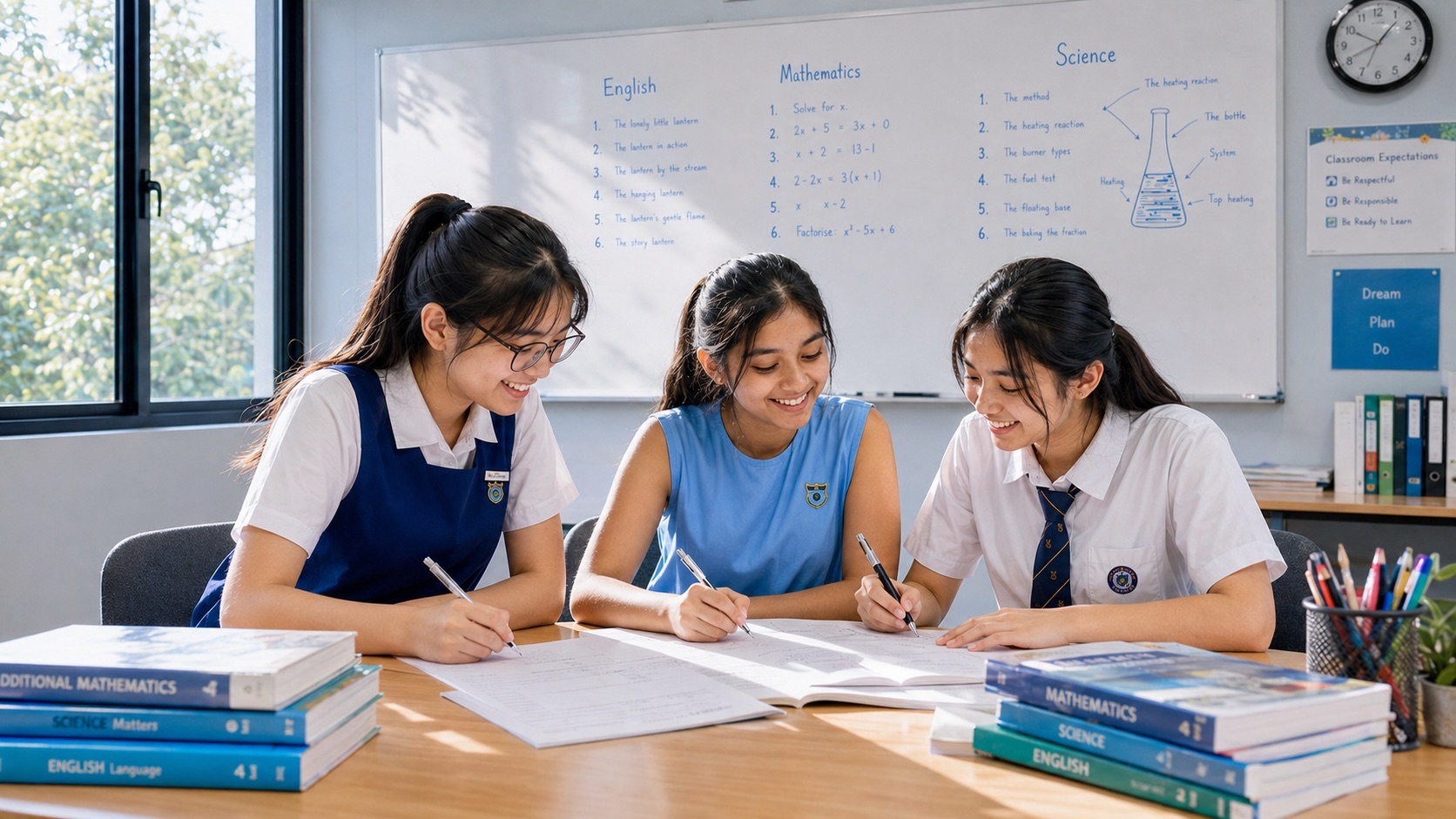
How to Learn Anything Quickly is part of eduKateSG’s complete system for learning faster with active recall, retrieval practice, spaced repetition, deliberate practice, feedback, mental models and transfer. Fast learning means reducing wasted effort while preserving the understanding and memory required for independent performance.
People searching for how to learn faster, learning how to learn, learn by teaching, chunking, mental models, first principles, practice tests, testing effect, active recall, spaced repetition and study techniques are asking how to make study produce knowledge that can still be used when notes, examples and prompts disappear.
The eduKateSG learning loop begins with a target, makes an early attempt, retrieves without support, diagnoses errors, repairs the weakest component, retries, varies the task, spaces another retrieval and tests transfer. The same architecture can serve vocabulary, comprehension, writing, Mathematics, Science, languages, technical skills and examination preparation.
50-Second Router
- Need to understand: build a model and explain it without notes.
- Need to remember: retrieve, correct and return after a delay.
- Need to perform: practise the real task and vary the conditions.
- Need to fix errors: classify the cause before doing more repetitions.
- Need exam readiness: use cumulative retrieval under progressively realistic conditions.
1. What a chunk is
What a chunk is should produce evidence, not merely activity. Begin with an observable performance. A learner needs a finish line that can be demonstrated without the original support. This may be an explanation, solution, written response, prediction, conversation, procedure or working product. Resources are inputs; the learning target is a change in independent capability.
What a chunk is should produce evidence, not merely activity. Make an early attempt because attempts generate information. They reveal missing prerequisites, uncertain vocabulary, misconceptions, weak distinctions, poor method selection and execution errors. Record the smallest point of failure rather than labelling the whole topic difficult. A precise bottleneck makes the next practice decision easier.
What a chunk is should produce evidence, not merely activity. Retrieve before looking back. Recognition creates familiarity, but retrieval requires the learner to reconstruct knowledge. Close the source, produce the answer or process, and then compare with a reliable model. Correct the missing element and retrieve again. This turns memory into an active part of learning rather than a final test.
What a chunk is should produce evidence, not merely activity. Diagnose why an answer failed. Knowledge, interpretation, representation, selection, execution, checking and communication are distinct failure modes. Repeating more questions without identifying the cause can strengthen the wrong habit. The repair should match the mechanism that produced the error.
What a chunk is should produce evidence, not merely activity. Use feedback as control information. Good feedback changes the next attempt. It identifies a specific discrepancy, points toward a correction and leaves the learner responsible for producing the improved performance. After correction, remove the model and retry so the learner must generate the solution independently.
What a chunk is should produce evidence, not merely activity. Space retrieval across time. Immediate repetition can establish fluency, but delayed retrieval reveals durability. Return after some forgetting, attempt first, check quickly and schedule another encounter. The purpose of spacing is not to make study inconvenient; it is to reduce the amount of future relearning needed to keep knowledge accessible.
What a chunk is should produce evidence, not merely activity. Vary practice to build discrimination and transfer. When every question looks alike, the format can reveal the method. Mixed and changed examples force the learner to notice structure, choose a method and adapt. Those decisions are central to examinations and real-world use because authentic problems rarely announce which chapter they belong to.
What a chunk is should produce evidence, not merely activity. Explain ideas through several representations. Use ordinary language, technical language, examples, non-examples, diagrams, mechanisms and predictions. If the representations disagree, investigate the mismatch. Multiple representations make misconceptions easier to see and give memory several meaningful routes back to the same underlying structure.
What a chunk is should produce evidence, not merely activity. Connect the method across eduKateSG. Vocabulary requires meaning, context, retrieval and use. Reading requires evidence and inference. Writing requires ideas, organisation, language and revision. Mathematics requires representation, method selection and verification. Science requires models, mechanisms, evidence and prediction.
What a chunk is should produce evidence, not merely activity. Measure delayed independent performance rather than minutes spent. Track retrieval accuracy, explanation quality, error patterns, method selection, transfer and eventually speed. Evidence determines the next action: advance, repair, change representation, seek feedback or schedule another retrieval.
2. Working memory limits
Working memory limits should produce evidence, not merely activity. Begin with an observable performance. A learner needs a finish line that can be demonstrated without the original support. This may be an explanation, solution, written response, prediction, conversation, procedure or working product. Resources are inputs; the learning target is a change in independent capability.
Working memory limits should produce evidence, not merely activity. Make an early attempt because attempts generate information. They reveal missing prerequisites, uncertain vocabulary, misconceptions, weak distinctions, poor method selection and execution errors. Record the smallest point of failure rather than labelling the whole topic difficult. A precise bottleneck makes the next practice decision easier.
Working memory limits should produce evidence, not merely activity. Retrieve before looking back. Recognition creates familiarity, but retrieval requires the learner to reconstruct knowledge. Close the source, produce the answer or process, and then compare with a reliable model. Correct the missing element and retrieve again. This turns memory into an active part of learning rather than a final test.
Working memory limits should produce evidence, not merely activity. Diagnose why an answer failed. Knowledge, interpretation, representation, selection, execution, checking and communication are distinct failure modes. Repeating more questions without identifying the cause can strengthen the wrong habit. The repair should match the mechanism that produced the error.
Working memory limits should produce evidence, not merely activity. Use feedback as control information. Good feedback changes the next attempt. It identifies a specific discrepancy, points toward a correction and leaves the learner responsible for producing the improved performance. After correction, remove the model and retry so the learner must generate the solution independently.
Working memory limits should produce evidence, not merely activity. Space retrieval across time. Immediate repetition can establish fluency, but delayed retrieval reveals durability. Return after some forgetting, attempt first, check quickly and schedule another encounter. The purpose of spacing is not to make study inconvenient; it is to reduce the amount of future relearning needed to keep knowledge accessible.
Working memory limits should produce evidence, not merely activity. Vary practice to build discrimination and transfer. When every question looks alike, the format can reveal the method. Mixed and changed examples force the learner to notice structure, choose a method and adapt. Those decisions are central to examinations and real-world use because authentic problems rarely announce which chapter they belong to.
Working memory limits should produce evidence, not merely activity. Explain ideas through several representations. Use ordinary language, technical language, examples, non-examples, diagrams, mechanisms and predictions. If the representations disagree, investigate the mismatch. Multiple representations make misconceptions easier to see and give memory several meaningful routes back to the same underlying structure.
Working memory limits should produce evidence, not merely activity. Connect the method across eduKateSG. Vocabulary requires meaning, context, retrieval and use. Reading requires evidence and inference. Writing requires ideas, organisation, language and revision. Mathematics requires representation, method selection and verification. Science requires models, mechanisms, evidence and prediction.
Working memory limits should produce evidence, not merely activity. Measure delayed independent performance rather than minutes spent. Track retrieval accuracy, explanation quality, error patterns, method selection, transfer and eventually speed. Evidence determines the next action: advance, repair, change representation, seek feedback or schedule another retrieval.
3. Prior knowledge
Prior knowledge should produce evidence, not merely activity. Begin with an observable performance. A learner needs a finish line that can be demonstrated without the original support. This may be an explanation, solution, written response, prediction, conversation, procedure or working product. Resources are inputs; the learning target is a change in independent capability.
Prior knowledge should produce evidence, not merely activity. Make an early attempt because attempts generate information. They reveal missing prerequisites, uncertain vocabulary, misconceptions, weak distinctions, poor method selection and execution errors. Record the smallest point of failure rather than labelling the whole topic difficult. A precise bottleneck makes the next practice decision easier.
Prior knowledge should produce evidence, not merely activity. Retrieve before looking back. Recognition creates familiarity, but retrieval requires the learner to reconstruct knowledge. Close the source, produce the answer or process, and then compare with a reliable model. Correct the missing element and retrieve again. This turns memory into an active part of learning rather than a final test.
Prior knowledge should produce evidence, not merely activity. Diagnose why an answer failed. Knowledge, interpretation, representation, selection, execution, checking and communication are distinct failure modes. Repeating more questions without identifying the cause can strengthen the wrong habit. The repair should match the mechanism that produced the error.
Prior knowledge should produce evidence, not merely activity. Use feedback as control information. Good feedback changes the next attempt. It identifies a specific discrepancy, points toward a correction and leaves the learner responsible for producing the improved performance. After correction, remove the model and retry so the learner must generate the solution independently.
Prior knowledge should produce evidence, not merely activity. Space retrieval across time. Immediate repetition can establish fluency, but delayed retrieval reveals durability. Return after some forgetting, attempt first, check quickly and schedule another encounter. The purpose of spacing is not to make study inconvenient; it is to reduce the amount of future relearning needed to keep knowledge accessible.
Prior knowledge should produce evidence, not merely activity. Vary practice to build discrimination and transfer. When every question looks alike, the format can reveal the method. Mixed and changed examples force the learner to notice structure, choose a method and adapt. Those decisions are central to examinations and real-world use because authentic problems rarely announce which chapter they belong to.
Prior knowledge should produce evidence, not merely activity. Explain ideas through several representations. Use ordinary language, technical language, examples, non-examples, diagrams, mechanisms and predictions. If the representations disagree, investigate the mismatch. Multiple representations make misconceptions easier to see and give memory several meaningful routes back to the same underlying structure.
Prior knowledge should produce evidence, not merely activity. Connect the method across eduKateSG. Vocabulary requires meaning, context, retrieval and use. Reading requires evidence and inference. Writing requires ideas, organisation, language and revision. Mathematics requires representation, method selection and verification. Science requires models, mechanisms, evidence and prediction.
Prior knowledge should produce evidence, not merely activity. Measure delayed independent performance rather than minutes spent. Track retrieval accuracy, explanation quality, error patterns, method selection, transfer and eventually speed. Evidence determines the next action: advance, repair, change representation, seek feedback or schedule another retrieval.
4. Build chunks from meaning
Build chunks from meaning should produce evidence, not merely activity. Begin with an observable performance. A learner needs a finish line that can be demonstrated without the original support. This may be an explanation, solution, written response, prediction, conversation, procedure or working product. Resources are inputs; the learning target is a change in independent capability.
Build chunks from meaning should produce evidence, not merely activity. Make an early attempt because attempts generate information. They reveal missing prerequisites, uncertain vocabulary, misconceptions, weak distinctions, poor method selection and execution errors. Record the smallest point of failure rather than labelling the whole topic difficult. A precise bottleneck makes the next practice decision easier.
Build chunks from meaning should produce evidence, not merely activity. Retrieve before looking back. Recognition creates familiarity, but retrieval requires the learner to reconstruct knowledge. Close the source, produce the answer or process, and then compare with a reliable model. Correct the missing element and retrieve again. This turns memory into an active part of learning rather than a final test.
Build chunks from meaning should produce evidence, not merely activity. Diagnose why an answer failed. Knowledge, interpretation, representation, selection, execution, checking and communication are distinct failure modes. Repeating more questions without identifying the cause can strengthen the wrong habit. The repair should match the mechanism that produced the error.
Build chunks from meaning should produce evidence, not merely activity. Use feedback as control information. Good feedback changes the next attempt. It identifies a specific discrepancy, points toward a correction and leaves the learner responsible for producing the improved performance. After correction, remove the model and retry so the learner must generate the solution independently.
Build chunks from meaning should produce evidence, not merely activity. Space retrieval across time. Immediate repetition can establish fluency, but delayed retrieval reveals durability. Return after some forgetting, attempt first, check quickly and schedule another encounter. The purpose of spacing is not to make study inconvenient; it is to reduce the amount of future relearning needed to keep knowledge accessible.
Build chunks from meaning should produce evidence, not merely activity. Vary practice to build discrimination and transfer. When every question looks alike, the format can reveal the method. Mixed and changed examples force the learner to notice structure, choose a method and adapt. Those decisions are central to examinations and real-world use because authentic problems rarely announce which chapter they belong to.
Build chunks from meaning should produce evidence, not merely activity. Explain ideas through several representations. Use ordinary language, technical language, examples, non-examples, diagrams, mechanisms and predictions. If the representations disagree, investigate the mismatch. Multiple representations make misconceptions easier to see and give memory several meaningful routes back to the same underlying structure.
Build chunks from meaning should produce evidence, not merely activity. Connect the method across eduKateSG. Vocabulary requires meaning, context, retrieval and use. Reading requires evidence and inference. Writing requires ideas, organisation, language and revision. Mathematics requires representation, method selection and verification. Science requires models, mechanisms, evidence and prediction.
Build chunks from meaning should produce evidence, not merely activity. Measure delayed independent performance rather than minutes spent. Track retrieval accuracy, explanation quality, error patterns, method selection, transfer and eventually speed. Evidence determines the next action: advance, repair, change representation, seek feedback or schedule another retrieval.
5. Do not chunk too early
Do not chunk too early should produce evidence, not merely activity. Begin with an observable performance. A learner needs a finish line that can be demonstrated without the original support. This may be an explanation, solution, written response, prediction, conversation, procedure or working product. Resources are inputs; the learning target is a change in independent capability.
Do not chunk too early should produce evidence, not merely activity. Make an early attempt because attempts generate information. They reveal missing prerequisites, uncertain vocabulary, misconceptions, weak distinctions, poor method selection and execution errors. Record the smallest point of failure rather than labelling the whole topic difficult. A precise bottleneck makes the next practice decision easier.
Do not chunk too early should produce evidence, not merely activity. Retrieve before looking back. Recognition creates familiarity, but retrieval requires the learner to reconstruct knowledge. Close the source, produce the answer or process, and then compare with a reliable model. Correct the missing element and retrieve again. This turns memory into an active part of learning rather than a final test.
Do not chunk too early should produce evidence, not merely activity. Diagnose why an answer failed. Knowledge, interpretation, representation, selection, execution, checking and communication are distinct failure modes. Repeating more questions without identifying the cause can strengthen the wrong habit. The repair should match the mechanism that produced the error.
Do not chunk too early should produce evidence, not merely activity. Use feedback as control information. Good feedback changes the next attempt. It identifies a specific discrepancy, points toward a correction and leaves the learner responsible for producing the improved performance. After correction, remove the model and retry so the learner must generate the solution independently.
Do not chunk too early should produce evidence, not merely activity. Space retrieval across time. Immediate repetition can establish fluency, but delayed retrieval reveals durability. Return after some forgetting, attempt first, check quickly and schedule another encounter. The purpose of spacing is not to make study inconvenient; it is to reduce the amount of future relearning needed to keep knowledge accessible.
Do not chunk too early should produce evidence, not merely activity. Vary practice to build discrimination and transfer. When every question looks alike, the format can reveal the method. Mixed and changed examples force the learner to notice structure, choose a method and adapt. Those decisions are central to examinations and real-world use because authentic problems rarely announce which chapter they belong to.
Do not chunk too early should produce evidence, not merely activity. Explain ideas through several representations. Use ordinary language, technical language, examples, non-examples, diagrams, mechanisms and predictions. If the representations disagree, investigate the mismatch. Multiple representations make misconceptions easier to see and give memory several meaningful routes back to the same underlying structure.
Do not chunk too early should produce evidence, not merely activity. Connect the method across eduKateSG. Vocabulary requires meaning, context, retrieval and use. Reading requires evidence and inference. Writing requires ideas, organisation, language and revision. Mathematics requires representation, method selection and verification. Science requires models, mechanisms, evidence and prediction.
Do not chunk too early should produce evidence, not merely activity. Measure delayed independent performance rather than minutes spent. Track retrieval accuracy, explanation quality, error patterns, method selection, transfer and eventually speed. Evidence determines the next action: advance, repair, change representation, seek feedback or schedule another retrieval.
6. Components first
Components first should produce evidence, not merely activity. Begin with an observable performance. A learner needs a finish line that can be demonstrated without the original support. This may be an explanation, solution, written response, prediction, conversation, procedure or working product. Resources are inputs; the learning target is a change in independent capability.
Components first should produce evidence, not merely activity. Make an early attempt because attempts generate information. They reveal missing prerequisites, uncertain vocabulary, misconceptions, weak distinctions, poor method selection and execution errors. Record the smallest point of failure rather than labelling the whole topic difficult. A precise bottleneck makes the next practice decision easier.
Components first should produce evidence, not merely activity. Retrieve before looking back. Recognition creates familiarity, but retrieval requires the learner to reconstruct knowledge. Close the source, produce the answer or process, and then compare with a reliable model. Correct the missing element and retrieve again. This turns memory into an active part of learning rather than a final test.
Components first should produce evidence, not merely activity. Diagnose why an answer failed. Knowledge, interpretation, representation, selection, execution, checking and communication are distinct failure modes. Repeating more questions without identifying the cause can strengthen the wrong habit. The repair should match the mechanism that produced the error.
Components first should produce evidence, not merely activity. Use feedback as control information. Good feedback changes the next attempt. It identifies a specific discrepancy, points toward a correction and leaves the learner responsible for producing the improved performance. After correction, remove the model and retry so the learner must generate the solution independently.
Components first should produce evidence, not merely activity. Space retrieval across time. Immediate repetition can establish fluency, but delayed retrieval reveals durability. Return after some forgetting, attempt first, check quickly and schedule another encounter. The purpose of spacing is not to make study inconvenient; it is to reduce the amount of future relearning needed to keep knowledge accessible.
Components first should produce evidence, not merely activity. Vary practice to build discrimination and transfer. When every question looks alike, the format can reveal the method. Mixed and changed examples force the learner to notice structure, choose a method and adapt. Those decisions are central to examinations and real-world use because authentic problems rarely announce which chapter they belong to.
Components first should produce evidence, not merely activity. Explain ideas through several representations. Use ordinary language, technical language, examples, non-examples, diagrams, mechanisms and predictions. If the representations disagree, investigate the mismatch. Multiple representations make misconceptions easier to see and give memory several meaningful routes back to the same underlying structure.
Components first should produce evidence, not merely activity. Connect the method across eduKateSG. Vocabulary requires meaning, context, retrieval and use. Reading requires evidence and inference. Writing requires ideas, organisation, language and revision. Mathematics requires representation, method selection and verification. Science requires models, mechanisms, evidence and prediction.
Components first should produce evidence, not merely activity. Measure delayed independent performance rather than minutes spent. Track retrieval accuracy, explanation quality, error patterns, method selection, transfer and eventually speed. Evidence determines the next action: advance, repair, change representation, seek feedback or schedule another retrieval.
7. Patterns and structure
Patterns and structure should produce evidence, not merely activity. Begin with an observable performance. A learner needs a finish line that can be demonstrated without the original support. This may be an explanation, solution, written response, prediction, conversation, procedure or working product. Resources are inputs; the learning target is a change in independent capability.
Patterns and structure should produce evidence, not merely activity. Make an early attempt because attempts generate information. They reveal missing prerequisites, uncertain vocabulary, misconceptions, weak distinctions, poor method selection and execution errors. Record the smallest point of failure rather than labelling the whole topic difficult. A precise bottleneck makes the next practice decision easier.
Patterns and structure should produce evidence, not merely activity. Retrieve before looking back. Recognition creates familiarity, but retrieval requires the learner to reconstruct knowledge. Close the source, produce the answer or process, and then compare with a reliable model. Correct the missing element and retrieve again. This turns memory into an active part of learning rather than a final test.
Patterns and structure should produce evidence, not merely activity. Diagnose why an answer failed. Knowledge, interpretation, representation, selection, execution, checking and communication are distinct failure modes. Repeating more questions without identifying the cause can strengthen the wrong habit. The repair should match the mechanism that produced the error.
Patterns and structure should produce evidence, not merely activity. Use feedback as control information. Good feedback changes the next attempt. It identifies a specific discrepancy, points toward a correction and leaves the learner responsible for producing the improved performance. After correction, remove the model and retry so the learner must generate the solution independently.
Patterns and structure should produce evidence, not merely activity. Space retrieval across time. Immediate repetition can establish fluency, but delayed retrieval reveals durability. Return after some forgetting, attempt first, check quickly and schedule another encounter. The purpose of spacing is not to make study inconvenient; it is to reduce the amount of future relearning needed to keep knowledge accessible.
Patterns and structure should produce evidence, not merely activity. Vary practice to build discrimination and transfer. When every question looks alike, the format can reveal the method. Mixed and changed examples force the learner to notice structure, choose a method and adapt. Those decisions are central to examinations and real-world use because authentic problems rarely announce which chapter they belong to.
Patterns and structure should produce evidence, not merely activity. Explain ideas through several representations. Use ordinary language, technical language, examples, non-examples, diagrams, mechanisms and predictions. If the representations disagree, investigate the mismatch. Multiple representations make misconceptions easier to see and give memory several meaningful routes back to the same underlying structure.
Patterns and structure should produce evidence, not merely activity. Connect the method across eduKateSG. Vocabulary requires meaning, context, retrieval and use. Reading requires evidence and inference. Writing requires ideas, organisation, language and revision. Mathematics requires representation, method selection and verification. Science requires models, mechanisms, evidence and prediction.
Patterns and structure should produce evidence, not merely activity. Measure delayed independent performance rather than minutes spent. Track retrieval accuracy, explanation quality, error patterns, method selection, transfer and eventually speed. Evidence determines the next action: advance, repair, change representation, seek feedback or schedule another retrieval.
8. Vocabulary chunks
Vocabulary chunks should produce evidence, not merely activity. Begin with an observable performance. A learner needs a finish line that can be demonstrated without the original support. This may be an explanation, solution, written response, prediction, conversation, procedure or working product. Resources are inputs; the learning target is a change in independent capability.
Vocabulary chunks should produce evidence, not merely activity. Make an early attempt because attempts generate information. They reveal missing prerequisites, uncertain vocabulary, misconceptions, weak distinctions, poor method selection and execution errors. Record the smallest point of failure rather than labelling the whole topic difficult. A precise bottleneck makes the next practice decision easier.
Vocabulary chunks should produce evidence, not merely activity. Retrieve before looking back. Recognition creates familiarity, but retrieval requires the learner to reconstruct knowledge. Close the source, produce the answer or process, and then compare with a reliable model. Correct the missing element and retrieve again. This turns memory into an active part of learning rather than a final test.
Vocabulary chunks should produce evidence, not merely activity. Diagnose why an answer failed. Knowledge, interpretation, representation, selection, execution, checking and communication are distinct failure modes. Repeating more questions without identifying the cause can strengthen the wrong habit. The repair should match the mechanism that produced the error.
Vocabulary chunks should produce evidence, not merely activity. Use feedback as control information. Good feedback changes the next attempt. It identifies a specific discrepancy, points toward a correction and leaves the learner responsible for producing the improved performance. After correction, remove the model and retry so the learner must generate the solution independently.
Vocabulary chunks should produce evidence, not merely activity. Space retrieval across time. Immediate repetition can establish fluency, but delayed retrieval reveals durability. Return after some forgetting, attempt first, check quickly and schedule another encounter. The purpose of spacing is not to make study inconvenient; it is to reduce the amount of future relearning needed to keep knowledge accessible.
Vocabulary chunks should produce evidence, not merely activity. Vary practice to build discrimination and transfer. When every question looks alike, the format can reveal the method. Mixed and changed examples force the learner to notice structure, choose a method and adapt. Those decisions are central to examinations and real-world use because authentic problems rarely announce which chapter they belong to.
Vocabulary chunks should produce evidence, not merely activity. Explain ideas through several representations. Use ordinary language, technical language, examples, non-examples, diagrams, mechanisms and predictions. If the representations disagree, investigate the mismatch. Multiple representations make misconceptions easier to see and give memory several meaningful routes back to the same underlying structure.
Vocabulary chunks should produce evidence, not merely activity. Connect the method across eduKateSG. Vocabulary requires meaning, context, retrieval and use. Reading requires evidence and inference. Writing requires ideas, organisation, language and revision. Mathematics requires representation, method selection and verification. Science requires models, mechanisms, evidence and prediction.
Vocabulary chunks should produce evidence, not merely activity. Measure delayed independent performance rather than minutes spent. Track retrieval accuracy, explanation quality, error patterns, method selection, transfer and eventually speed. Evidence determines the next action: advance, repair, change representation, seek feedback or schedule another retrieval.
9. Collocations
Collocations should produce evidence, not merely activity. Begin with an observable performance. A learner needs a finish line that can be demonstrated without the original support. This may be an explanation, solution, written response, prediction, conversation, procedure or working product. Resources are inputs; the learning target is a change in independent capability.
Collocations should produce evidence, not merely activity. Make an early attempt because attempts generate information. They reveal missing prerequisites, uncertain vocabulary, misconceptions, weak distinctions, poor method selection and execution errors. Record the smallest point of failure rather than labelling the whole topic difficult. A precise bottleneck makes the next practice decision easier.
Collocations should produce evidence, not merely activity. Retrieve before looking back. Recognition creates familiarity, but retrieval requires the learner to reconstruct knowledge. Close the source, produce the answer or process, and then compare with a reliable model. Correct the missing element and retrieve again. This turns memory into an active part of learning rather than a final test.
Collocations should produce evidence, not merely activity. Diagnose why an answer failed. Knowledge, interpretation, representation, selection, execution, checking and communication are distinct failure modes. Repeating more questions without identifying the cause can strengthen the wrong habit. The repair should match the mechanism that produced the error.
Collocations should produce evidence, not merely activity. Use feedback as control information. Good feedback changes the next attempt. It identifies a specific discrepancy, points toward a correction and leaves the learner responsible for producing the improved performance. After correction, remove the model and retry so the learner must generate the solution independently.
Collocations should produce evidence, not merely activity. Space retrieval across time. Immediate repetition can establish fluency, but delayed retrieval reveals durability. Return after some forgetting, attempt first, check quickly and schedule another encounter. The purpose of spacing is not to make study inconvenient; it is to reduce the amount of future relearning needed to keep knowledge accessible.
Collocations should produce evidence, not merely activity. Vary practice to build discrimination and transfer. When every question looks alike, the format can reveal the method. Mixed and changed examples force the learner to notice structure, choose a method and adapt. Those decisions are central to examinations and real-world use because authentic problems rarely announce which chapter they belong to.
Collocations should produce evidence, not merely activity. Explain ideas through several representations. Use ordinary language, technical language, examples, non-examples, diagrams, mechanisms and predictions. If the representations disagree, investigate the mismatch. Multiple representations make misconceptions easier to see and give memory several meaningful routes back to the same underlying structure.
Collocations should produce evidence, not merely activity. Connect the method across eduKateSG. Vocabulary requires meaning, context, retrieval and use. Reading requires evidence and inference. Writing requires ideas, organisation, language and revision. Mathematics requires representation, method selection and verification. Science requires models, mechanisms, evidence and prediction.
Collocations should produce evidence, not merely activity. Measure delayed independent performance rather than minutes spent. Track retrieval accuracy, explanation quality, error patterns, method selection, transfer and eventually speed. Evidence determines the next action: advance, repair, change representation, seek feedback or schedule another retrieval.
10. Reading structures
Reading structures should produce evidence, not merely activity. Begin with an observable performance. A learner needs a finish line that can be demonstrated without the original support. This may be an explanation, solution, written response, prediction, conversation, procedure or working product. Resources are inputs; the learning target is a change in independent capability.
Reading structures should produce evidence, not merely activity. Make an early attempt because attempts generate information. They reveal missing prerequisites, uncertain vocabulary, misconceptions, weak distinctions, poor method selection and execution errors. Record the smallest point of failure rather than labelling the whole topic difficult. A precise bottleneck makes the next practice decision easier.
Reading structures should produce evidence, not merely activity. Retrieve before looking back. Recognition creates familiarity, but retrieval requires the learner to reconstruct knowledge. Close the source, produce the answer or process, and then compare with a reliable model. Correct the missing element and retrieve again. This turns memory into an active part of learning rather than a final test.
Reading structures should produce evidence, not merely activity. Diagnose why an answer failed. Knowledge, interpretation, representation, selection, execution, checking and communication are distinct failure modes. Repeating more questions without identifying the cause can strengthen the wrong habit. The repair should match the mechanism that produced the error.
Reading structures should produce evidence, not merely activity. Use feedback as control information. Good feedback changes the next attempt. It identifies a specific discrepancy, points toward a correction and leaves the learner responsible for producing the improved performance. After correction, remove the model and retry so the learner must generate the solution independently.
Reading structures should produce evidence, not merely activity. Space retrieval across time. Immediate repetition can establish fluency, but delayed retrieval reveals durability. Return after some forgetting, attempt first, check quickly and schedule another encounter. The purpose of spacing is not to make study inconvenient; it is to reduce the amount of future relearning needed to keep knowledge accessible.
Reading structures should produce evidence, not merely activity. Vary practice to build discrimination and transfer. When every question looks alike, the format can reveal the method. Mixed and changed examples force the learner to notice structure, choose a method and adapt. Those decisions are central to examinations and real-world use because authentic problems rarely announce which chapter they belong to.
Reading structures should produce evidence, not merely activity. Explain ideas through several representations. Use ordinary language, technical language, examples, non-examples, diagrams, mechanisms and predictions. If the representations disagree, investigate the mismatch. Multiple representations make misconceptions easier to see and give memory several meaningful routes back to the same underlying structure.
Reading structures should produce evidence, not merely activity. Connect the method across eduKateSG. Vocabulary requires meaning, context, retrieval and use. Reading requires evidence and inference. Writing requires ideas, organisation, language and revision. Mathematics requires representation, method selection and verification. Science requires models, mechanisms, evidence and prediction.
Reading structures should produce evidence, not merely activity. Measure delayed independent performance rather than minutes spent. Track retrieval accuracy, explanation quality, error patterns, method selection, transfer and eventually speed. Evidence determines the next action: advance, repair, change representation, seek feedback or schedule another retrieval.
11. Writing structures
Writing structures should produce evidence, not merely activity. Begin with an observable performance. A learner needs a finish line that can be demonstrated without the original support. This may be an explanation, solution, written response, prediction, conversation, procedure or working product. Resources are inputs; the learning target is a change in independent capability.
Writing structures should produce evidence, not merely activity. Make an early attempt because attempts generate information. They reveal missing prerequisites, uncertain vocabulary, misconceptions, weak distinctions, poor method selection and execution errors. Record the smallest point of failure rather than labelling the whole topic difficult. A precise bottleneck makes the next practice decision easier.
Writing structures should produce evidence, not merely activity. Retrieve before looking back. Recognition creates familiarity, but retrieval requires the learner to reconstruct knowledge. Close the source, produce the answer or process, and then compare with a reliable model. Correct the missing element and retrieve again. This turns memory into an active part of learning rather than a final test.
Writing structures should produce evidence, not merely activity. Diagnose why an answer failed. Knowledge, interpretation, representation, selection, execution, checking and communication are distinct failure modes. Repeating more questions without identifying the cause can strengthen the wrong habit. The repair should match the mechanism that produced the error.
Writing structures should produce evidence, not merely activity. Use feedback as control information. Good feedback changes the next attempt. It identifies a specific discrepancy, points toward a correction and leaves the learner responsible for producing the improved performance. After correction, remove the model and retry so the learner must generate the solution independently.
Writing structures should produce evidence, not merely activity. Space retrieval across time. Immediate repetition can establish fluency, but delayed retrieval reveals durability. Return after some forgetting, attempt first, check quickly and schedule another encounter. The purpose of spacing is not to make study inconvenient; it is to reduce the amount of future relearning needed to keep knowledge accessible.
Writing structures should produce evidence, not merely activity. Vary practice to build discrimination and transfer. When every question looks alike, the format can reveal the method. Mixed and changed examples force the learner to notice structure, choose a method and adapt. Those decisions are central to examinations and real-world use because authentic problems rarely announce which chapter they belong to.
Writing structures should produce evidence, not merely activity. Explain ideas through several representations. Use ordinary language, technical language, examples, non-examples, diagrams, mechanisms and predictions. If the representations disagree, investigate the mismatch. Multiple representations make misconceptions easier to see and give memory several meaningful routes back to the same underlying structure.
Writing structures should produce evidence, not merely activity. Connect the method across eduKateSG. Vocabulary requires meaning, context, retrieval and use. Reading requires evidence and inference. Writing requires ideas, organisation, language and revision. Mathematics requires representation, method selection and verification. Science requires models, mechanisms, evidence and prediction.
Writing structures should produce evidence, not merely activity. Measure delayed independent performance rather than minutes spent. Track retrieval accuracy, explanation quality, error patterns, method selection, transfer and eventually speed. Evidence determines the next action: advance, repair, change representation, seek feedback or schedule another retrieval.
12. Mathematical patterns
Mathematical patterns should produce evidence, not merely activity. Begin with an observable performance. A learner needs a finish line that can be demonstrated without the original support. This may be an explanation, solution, written response, prediction, conversation, procedure or working product. Resources are inputs; the learning target is a change in independent capability.
Mathematical patterns should produce evidence, not merely activity. Make an early attempt because attempts generate information. They reveal missing prerequisites, uncertain vocabulary, misconceptions, weak distinctions, poor method selection and execution errors. Record the smallest point of failure rather than labelling the whole topic difficult. A precise bottleneck makes the next practice decision easier.
Mathematical patterns should produce evidence, not merely activity. Retrieve before looking back. Recognition creates familiarity, but retrieval requires the learner to reconstruct knowledge. Close the source, produce the answer or process, and then compare with a reliable model. Correct the missing element and retrieve again. This turns memory into an active part of learning rather than a final test.
Mathematical patterns should produce evidence, not merely activity. Diagnose why an answer failed. Knowledge, interpretation, representation, selection, execution, checking and communication are distinct failure modes. Repeating more questions without identifying the cause can strengthen the wrong habit. The repair should match the mechanism that produced the error.
Mathematical patterns should produce evidence, not merely activity. Use feedback as control information. Good feedback changes the next attempt. It identifies a specific discrepancy, points toward a correction and leaves the learner responsible for producing the improved performance. After correction, remove the model and retry so the learner must generate the solution independently.
Mathematical patterns should produce evidence, not merely activity. Space retrieval across time. Immediate repetition can establish fluency, but delayed retrieval reveals durability. Return after some forgetting, attempt first, check quickly and schedule another encounter. The purpose of spacing is not to make study inconvenient; it is to reduce the amount of future relearning needed to keep knowledge accessible.
Mathematical patterns should produce evidence, not merely activity. Vary practice to build discrimination and transfer. When every question looks alike, the format can reveal the method. Mixed and changed examples force the learner to notice structure, choose a method and adapt. Those decisions are central to examinations and real-world use because authentic problems rarely announce which chapter they belong to.
Mathematical patterns should produce evidence, not merely activity. Explain ideas through several representations. Use ordinary language, technical language, examples, non-examples, diagrams, mechanisms and predictions. If the representations disagree, investigate the mismatch. Multiple representations make misconceptions easier to see and give memory several meaningful routes back to the same underlying structure.
Mathematical patterns should produce evidence, not merely activity. Connect the method across eduKateSG. Vocabulary requires meaning, context, retrieval and use. Reading requires evidence and inference. Writing requires ideas, organisation, language and revision. Mathematics requires representation, method selection and verification. Science requires models, mechanisms, evidence and prediction.
Mathematical patterns should produce evidence, not merely activity. Measure delayed independent performance rather than minutes spent. Track retrieval accuracy, explanation quality, error patterns, method selection, transfer and eventually speed. Evidence determines the next action: advance, repair, change representation, seek feedback or schedule another retrieval.
13. Scientific models
Scientific models should produce evidence, not merely activity. Begin with an observable performance. A learner needs a finish line that can be demonstrated without the original support. This may be an explanation, solution, written response, prediction, conversation, procedure or working product. Resources are inputs; the learning target is a change in independent capability.
Scientific models should produce evidence, not merely activity. Make an early attempt because attempts generate information. They reveal missing prerequisites, uncertain vocabulary, misconceptions, weak distinctions, poor method selection and execution errors. Record the smallest point of failure rather than labelling the whole topic difficult. A precise bottleneck makes the next practice decision easier.
Scientific models should produce evidence, not merely activity. Retrieve before looking back. Recognition creates familiarity, but retrieval requires the learner to reconstruct knowledge. Close the source, produce the answer or process, and then compare with a reliable model. Correct the missing element and retrieve again. This turns memory into an active part of learning rather than a final test.
Scientific models should produce evidence, not merely activity. Diagnose why an answer failed. Knowledge, interpretation, representation, selection, execution, checking and communication are distinct failure modes. Repeating more questions without identifying the cause can strengthen the wrong habit. The repair should match the mechanism that produced the error.
Scientific models should produce evidence, not merely activity. Use feedback as control information. Good feedback changes the next attempt. It identifies a specific discrepancy, points toward a correction and leaves the learner responsible for producing the improved performance. After correction, remove the model and retry so the learner must generate the solution independently.
Scientific models should produce evidence, not merely activity. Space retrieval across time. Immediate repetition can establish fluency, but delayed retrieval reveals durability. Return after some forgetting, attempt first, check quickly and schedule another encounter. The purpose of spacing is not to make study inconvenient; it is to reduce the amount of future relearning needed to keep knowledge accessible.
Scientific models should produce evidence, not merely activity. Vary practice to build discrimination and transfer. When every question looks alike, the format can reveal the method. Mixed and changed examples force the learner to notice structure, choose a method and adapt. Those decisions are central to examinations and real-world use because authentic problems rarely announce which chapter they belong to.
Scientific models should produce evidence, not merely activity. Explain ideas through several representations. Use ordinary language, technical language, examples, non-examples, diagrams, mechanisms and predictions. If the representations disagree, investigate the mismatch. Multiple representations make misconceptions easier to see and give memory several meaningful routes back to the same underlying structure.
Scientific models should produce evidence, not merely activity. Connect the method across eduKateSG. Vocabulary requires meaning, context, retrieval and use. Reading requires evidence and inference. Writing requires ideas, organisation, language and revision. Mathematics requires representation, method selection and verification. Science requires models, mechanisms, evidence and prediction.
Scientific models should produce evidence, not merely activity. Measure delayed independent performance rather than minutes spent. Track retrieval accuracy, explanation quality, error patterns, method selection, transfer and eventually speed. Evidence determines the next action: advance, repair, change representation, seek feedback or schedule another retrieval.
14. Language phrases
Language phrases should produce evidence, not merely activity. Begin with an observable performance. A learner needs a finish line that can be demonstrated without the original support. This may be an explanation, solution, written response, prediction, conversation, procedure or working product. Resources are inputs; the learning target is a change in independent capability.
Language phrases should produce evidence, not merely activity. Make an early attempt because attempts generate information. They reveal missing prerequisites, uncertain vocabulary, misconceptions, weak distinctions, poor method selection and execution errors. Record the smallest point of failure rather than labelling the whole topic difficult. A precise bottleneck makes the next practice decision easier.
Language phrases should produce evidence, not merely activity. Retrieve before looking back. Recognition creates familiarity, but retrieval requires the learner to reconstruct knowledge. Close the source, produce the answer or process, and then compare with a reliable model. Correct the missing element and retrieve again. This turns memory into an active part of learning rather than a final test.
Language phrases should produce evidence, not merely activity. Diagnose why an answer failed. Knowledge, interpretation, representation, selection, execution, checking and communication are distinct failure modes. Repeating more questions without identifying the cause can strengthen the wrong habit. The repair should match the mechanism that produced the error.
Language phrases should produce evidence, not merely activity. Use feedback as control information. Good feedback changes the next attempt. It identifies a specific discrepancy, points toward a correction and leaves the learner responsible for producing the improved performance. After correction, remove the model and retry so the learner must generate the solution independently.
Language phrases should produce evidence, not merely activity. Space retrieval across time. Immediate repetition can establish fluency, but delayed retrieval reveals durability. Return after some forgetting, attempt first, check quickly and schedule another encounter. The purpose of spacing is not to make study inconvenient; it is to reduce the amount of future relearning needed to keep knowledge accessible.
Language phrases should produce evidence, not merely activity. Vary practice to build discrimination and transfer. When every question looks alike, the format can reveal the method. Mixed and changed examples force the learner to notice structure, choose a method and adapt. Those decisions are central to examinations and real-world use because authentic problems rarely announce which chapter they belong to.
Language phrases should produce evidence, not merely activity. Explain ideas through several representations. Use ordinary language, technical language, examples, non-examples, diagrams, mechanisms and predictions. If the representations disagree, investigate the mismatch. Multiple representations make misconceptions easier to see and give memory several meaningful routes back to the same underlying structure.
Language phrases should produce evidence, not merely activity. Connect the method across eduKateSG. Vocabulary requires meaning, context, retrieval and use. Reading requires evidence and inference. Writing requires ideas, organisation, language and revision. Mathematics requires representation, method selection and verification. Science requires models, mechanisms, evidence and prediction.
Language phrases should produce evidence, not merely activity. Measure delayed independent performance rather than minutes spent. Track retrieval accuracy, explanation quality, error patterns, method selection, transfer and eventually speed. Evidence determines the next action: advance, repair, change representation, seek feedback or schedule another retrieval.
15. Technical procedures
Technical procedures should produce evidence, not merely activity. Begin with an observable performance. A learner needs a finish line that can be demonstrated without the original support. This may be an explanation, solution, written response, prediction, conversation, procedure or working product. Resources are inputs; the learning target is a change in independent capability.
Technical procedures should produce evidence, not merely activity. Make an early attempt because attempts generate information. They reveal missing prerequisites, uncertain vocabulary, misconceptions, weak distinctions, poor method selection and execution errors. Record the smallest point of failure rather than labelling the whole topic difficult. A precise bottleneck makes the next practice decision easier.
Technical procedures should produce evidence, not merely activity. Retrieve before looking back. Recognition creates familiarity, but retrieval requires the learner to reconstruct knowledge. Close the source, produce the answer or process, and then compare with a reliable model. Correct the missing element and retrieve again. This turns memory into an active part of learning rather than a final test.
Technical procedures should produce evidence, not merely activity. Diagnose why an answer failed. Knowledge, interpretation, representation, selection, execution, checking and communication are distinct failure modes. Repeating more questions without identifying the cause can strengthen the wrong habit. The repair should match the mechanism that produced the error.
Technical procedures should produce evidence, not merely activity. Use feedback as control information. Good feedback changes the next attempt. It identifies a specific discrepancy, points toward a correction and leaves the learner responsible for producing the improved performance. After correction, remove the model and retry so the learner must generate the solution independently.
Technical procedures should produce evidence, not merely activity. Space retrieval across time. Immediate repetition can establish fluency, but delayed retrieval reveals durability. Return after some forgetting, attempt first, check quickly and schedule another encounter. The purpose of spacing is not to make study inconvenient; it is to reduce the amount of future relearning needed to keep knowledge accessible.
Technical procedures should produce evidence, not merely activity. Vary practice to build discrimination and transfer. When every question looks alike, the format can reveal the method. Mixed and changed examples force the learner to notice structure, choose a method and adapt. Those decisions are central to examinations and real-world use because authentic problems rarely announce which chapter they belong to.
Technical procedures should produce evidence, not merely activity. Explain ideas through several representations. Use ordinary language, technical language, examples, non-examples, diagrams, mechanisms and predictions. If the representations disagree, investigate the mismatch. Multiple representations make misconceptions easier to see and give memory several meaningful routes back to the same underlying structure.
Technical procedures should produce evidence, not merely activity. Connect the method across eduKateSG. Vocabulary requires meaning, context, retrieval and use. Reading requires evidence and inference. Writing requires ideas, organisation, language and revision. Mathematics requires representation, method selection and verification. Science requires models, mechanisms, evidence and prediction.
Technical procedures should produce evidence, not merely activity. Measure delayed independent performance rather than minutes spent. Track retrieval accuracy, explanation quality, error patterns, method selection, transfer and eventually speed. Evidence determines the next action: advance, repair, change representation, seek feedback or schedule another retrieval.
16. Worked examples
Worked examples should produce evidence, not merely activity. Begin with an observable performance. A learner needs a finish line that can be demonstrated without the original support. This may be an explanation, solution, written response, prediction, conversation, procedure or working product. Resources are inputs; the learning target is a change in independent capability.
Worked examples should produce evidence, not merely activity. Make an early attempt because attempts generate information. They reveal missing prerequisites, uncertain vocabulary, misconceptions, weak distinctions, poor method selection and execution errors. Record the smallest point of failure rather than labelling the whole topic difficult. A precise bottleneck makes the next practice decision easier.
Worked examples should produce evidence, not merely activity. Retrieve before looking back. Recognition creates familiarity, but retrieval requires the learner to reconstruct knowledge. Close the source, produce the answer or process, and then compare with a reliable model. Correct the missing element and retrieve again. This turns memory into an active part of learning rather than a final test.
Worked examples should produce evidence, not merely activity. Diagnose why an answer failed. Knowledge, interpretation, representation, selection, execution, checking and communication are distinct failure modes. Repeating more questions without identifying the cause can strengthen the wrong habit. The repair should match the mechanism that produced the error.
Worked examples should produce evidence, not merely activity. Use feedback as control information. Good feedback changes the next attempt. It identifies a specific discrepancy, points toward a correction and leaves the learner responsible for producing the improved performance. After correction, remove the model and retry so the learner must generate the solution independently.
Worked examples should produce evidence, not merely activity. Space retrieval across time. Immediate repetition can establish fluency, but delayed retrieval reveals durability. Return after some forgetting, attempt first, check quickly and schedule another encounter. The purpose of spacing is not to make study inconvenient; it is to reduce the amount of future relearning needed to keep knowledge accessible.
Worked examples should produce evidence, not merely activity. Vary practice to build discrimination and transfer. When every question looks alike, the format can reveal the method. Mixed and changed examples force the learner to notice structure, choose a method and adapt. Those decisions are central to examinations and real-world use because authentic problems rarely announce which chapter they belong to.
Worked examples should produce evidence, not merely activity. Explain ideas through several representations. Use ordinary language, technical language, examples, non-examples, diagrams, mechanisms and predictions. If the representations disagree, investigate the mismatch. Multiple representations make misconceptions easier to see and give memory several meaningful routes back to the same underlying structure.
Worked examples should produce evidence, not merely activity. Connect the method across eduKateSG. Vocabulary requires meaning, context, retrieval and use. Reading requires evidence and inference. Writing requires ideas, organisation, language and revision. Mathematics requires representation, method selection and verification. Science requires models, mechanisms, evidence and prediction.
Worked examples should produce evidence, not merely activity. Measure delayed independent performance rather than minutes spent. Track retrieval accuracy, explanation quality, error patterns, method selection, transfer and eventually speed. Evidence determines the next action: advance, repair, change representation, seek feedback or schedule another retrieval.
17. Practice retrieval
Practice retrieval should produce evidence, not merely activity. Begin with an observable performance. A learner needs a finish line that can be demonstrated without the original support. This may be an explanation, solution, written response, prediction, conversation, procedure or working product. Resources are inputs; the learning target is a change in independent capability.
Practice retrieval should produce evidence, not merely activity. Make an early attempt because attempts generate information. They reveal missing prerequisites, uncertain vocabulary, misconceptions, weak distinctions, poor method selection and execution errors. Record the smallest point of failure rather than labelling the whole topic difficult. A precise bottleneck makes the next practice decision easier.
Practice retrieval should produce evidence, not merely activity. Retrieve before looking back. Recognition creates familiarity, but retrieval requires the learner to reconstruct knowledge. Close the source, produce the answer or process, and then compare with a reliable model. Correct the missing element and retrieve again. This turns memory into an active part of learning rather than a final test.
Practice retrieval should produce evidence, not merely activity. Diagnose why an answer failed. Knowledge, interpretation, representation, selection, execution, checking and communication are distinct failure modes. Repeating more questions without identifying the cause can strengthen the wrong habit. The repair should match the mechanism that produced the error.
Practice retrieval should produce evidence, not merely activity. Use feedback as control information. Good feedback changes the next attempt. It identifies a specific discrepancy, points toward a correction and leaves the learner responsible for producing the improved performance. After correction, remove the model and retry so the learner must generate the solution independently.
Practice retrieval should produce evidence, not merely activity. Space retrieval across time. Immediate repetition can establish fluency, but delayed retrieval reveals durability. Return after some forgetting, attempt first, check quickly and schedule another encounter. The purpose of spacing is not to make study inconvenient; it is to reduce the amount of future relearning needed to keep knowledge accessible.
Practice retrieval should produce evidence, not merely activity. Vary practice to build discrimination and transfer. When every question looks alike, the format can reveal the method. Mixed and changed examples force the learner to notice structure, choose a method and adapt. Those decisions are central to examinations and real-world use because authentic problems rarely announce which chapter they belong to.
Practice retrieval should produce evidence, not merely activity. Explain ideas through several representations. Use ordinary language, technical language, examples, non-examples, diagrams, mechanisms and predictions. If the representations disagree, investigate the mismatch. Multiple representations make misconceptions easier to see and give memory several meaningful routes back to the same underlying structure.
Practice retrieval should produce evidence, not merely activity. Connect the method across eduKateSG. Vocabulary requires meaning, context, retrieval and use. Reading requires evidence and inference. Writing requires ideas, organisation, language and revision. Mathematics requires representation, method selection and verification. Science requires models, mechanisms, evidence and prediction.
Practice retrieval should produce evidence, not merely activity. Measure delayed independent performance rather than minutes spent. Track retrieval accuracy, explanation quality, error patterns, method selection, transfer and eventually speed. Evidence determines the next action: advance, repair, change representation, seek feedback or schedule another retrieval.
18. Automaticity
Automaticity should produce evidence, not merely activity. Begin with an observable performance. A learner needs a finish line that can be demonstrated without the original support. This may be an explanation, solution, written response, prediction, conversation, procedure or working product. Resources are inputs; the learning target is a change in independent capability.
Automaticity should produce evidence, not merely activity. Make an early attempt because attempts generate information. They reveal missing prerequisites, uncertain vocabulary, misconceptions, weak distinctions, poor method selection and execution errors. Record the smallest point of failure rather than labelling the whole topic difficult. A precise bottleneck makes the next practice decision easier.
Automaticity should produce evidence, not merely activity. Retrieve before looking back. Recognition creates familiarity, but retrieval requires the learner to reconstruct knowledge. Close the source, produce the answer or process, and then compare with a reliable model. Correct the missing element and retrieve again. This turns memory into an active part of learning rather than a final test.
Automaticity should produce evidence, not merely activity. Diagnose why an answer failed. Knowledge, interpretation, representation, selection, execution, checking and communication are distinct failure modes. Repeating more questions without identifying the cause can strengthen the wrong habit. The repair should match the mechanism that produced the error.
Automaticity should produce evidence, not merely activity. Use feedback as control information. Good feedback changes the next attempt. It identifies a specific discrepancy, points toward a correction and leaves the learner responsible for producing the improved performance. After correction, remove the model and retry so the learner must generate the solution independently.
Automaticity should produce evidence, not merely activity. Space retrieval across time. Immediate repetition can establish fluency, but delayed retrieval reveals durability. Return after some forgetting, attempt first, check quickly and schedule another encounter. The purpose of spacing is not to make study inconvenient; it is to reduce the amount of future relearning needed to keep knowledge accessible.
Automaticity should produce evidence, not merely activity. Vary practice to build discrimination and transfer. When every question looks alike, the format can reveal the method. Mixed and changed examples force the learner to notice structure, choose a method and adapt. Those decisions are central to examinations and real-world use because authentic problems rarely announce which chapter they belong to.
Automaticity should produce evidence, not merely activity. Explain ideas through several representations. Use ordinary language, technical language, examples, non-examples, diagrams, mechanisms and predictions. If the representations disagree, investigate the mismatch. Multiple representations make misconceptions easier to see and give memory several meaningful routes back to the same underlying structure.
Automaticity should produce evidence, not merely activity. Connect the method across eduKateSG. Vocabulary requires meaning, context, retrieval and use. Reading requires evidence and inference. Writing requires ideas, organisation, language and revision. Mathematics requires representation, method selection and verification. Science requires models, mechanisms, evidence and prediction.
Automaticity should produce evidence, not merely activity. Measure delayed independent performance rather than minutes spent. Track retrieval accuracy, explanation quality, error patterns, method selection, transfer and eventually speed. Evidence determines the next action: advance, repair, change representation, seek feedback or schedule another retrieval.
19. Speed and accuracy
Speed and accuracy should produce evidence, not merely activity. Begin with an observable performance. A learner needs a finish line that can be demonstrated without the original support. This may be an explanation, solution, written response, prediction, conversation, procedure or working product. Resources are inputs; the learning target is a change in independent capability.
Speed and accuracy should produce evidence, not merely activity. Make an early attempt because attempts generate information. They reveal missing prerequisites, uncertain vocabulary, misconceptions, weak distinctions, poor method selection and execution errors. Record the smallest point of failure rather than labelling the whole topic difficult. A precise bottleneck makes the next practice decision easier.
Speed and accuracy should produce evidence, not merely activity. Retrieve before looking back. Recognition creates familiarity, but retrieval requires the learner to reconstruct knowledge. Close the source, produce the answer or process, and then compare with a reliable model. Correct the missing element and retrieve again. This turns memory into an active part of learning rather than a final test.
Speed and accuracy should produce evidence, not merely activity. Diagnose why an answer failed. Knowledge, interpretation, representation, selection, execution, checking and communication are distinct failure modes. Repeating more questions without identifying the cause can strengthen the wrong habit. The repair should match the mechanism that produced the error.
Speed and accuracy should produce evidence, not merely activity. Use feedback as control information. Good feedback changes the next attempt. It identifies a specific discrepancy, points toward a correction and leaves the learner responsible for producing the improved performance. After correction, remove the model and retry so the learner must generate the solution independently.
Speed and accuracy should produce evidence, not merely activity. Space retrieval across time. Immediate repetition can establish fluency, but delayed retrieval reveals durability. Return after some forgetting, attempt first, check quickly and schedule another encounter. The purpose of spacing is not to make study inconvenient; it is to reduce the amount of future relearning needed to keep knowledge accessible.
Speed and accuracy should produce evidence, not merely activity. Vary practice to build discrimination and transfer. When every question looks alike, the format can reveal the method. Mixed and changed examples force the learner to notice structure, choose a method and adapt. Those decisions are central to examinations and real-world use because authentic problems rarely announce which chapter they belong to.
Speed and accuracy should produce evidence, not merely activity. Explain ideas through several representations. Use ordinary language, technical language, examples, non-examples, diagrams, mechanisms and predictions. If the representations disagree, investigate the mismatch. Multiple representations make misconceptions easier to see and give memory several meaningful routes back to the same underlying structure.
Speed and accuracy should produce evidence, not merely activity. Connect the method across eduKateSG. Vocabulary requires meaning, context, retrieval and use. Reading requires evidence and inference. Writing requires ideas, organisation, language and revision. Mathematics requires representation, method selection and verification. Science requires models, mechanisms, evidence and prediction.
Speed and accuracy should produce evidence, not merely activity. Measure delayed independent performance rather than minutes spent. Track retrieval accuracy, explanation quality, error patterns, method selection, transfer and eventually speed. Evidence determines the next action: advance, repair, change representation, seek feedback or schedule another retrieval.
20. Hierarchies
Hierarchies should produce evidence, not merely activity. Begin with an observable performance. A learner needs a finish line that can be demonstrated without the original support. This may be an explanation, solution, written response, prediction, conversation, procedure or working product. Resources are inputs; the learning target is a change in independent capability.
Hierarchies should produce evidence, not merely activity. Make an early attempt because attempts generate information. They reveal missing prerequisites, uncertain vocabulary, misconceptions, weak distinctions, poor method selection and execution errors. Record the smallest point of failure rather than labelling the whole topic difficult. A precise bottleneck makes the next practice decision easier.
Hierarchies should produce evidence, not merely activity. Retrieve before looking back. Recognition creates familiarity, but retrieval requires the learner to reconstruct knowledge. Close the source, produce the answer or process, and then compare with a reliable model. Correct the missing element and retrieve again. This turns memory into an active part of learning rather than a final test.
Hierarchies should produce evidence, not merely activity. Diagnose why an answer failed. Knowledge, interpretation, representation, selection, execution, checking and communication are distinct failure modes. Repeating more questions without identifying the cause can strengthen the wrong habit. The repair should match the mechanism that produced the error.
Hierarchies should produce evidence, not merely activity. Use feedback as control information. Good feedback changes the next attempt. It identifies a specific discrepancy, points toward a correction and leaves the learner responsible for producing the improved performance. After correction, remove the model and retry so the learner must generate the solution independently.
Hierarchies should produce evidence, not merely activity. Space retrieval across time. Immediate repetition can establish fluency, but delayed retrieval reveals durability. Return after some forgetting, attempt first, check quickly and schedule another encounter. The purpose of spacing is not to make study inconvenient; it is to reduce the amount of future relearning needed to keep knowledge accessible.
Hierarchies should produce evidence, not merely activity. Vary practice to build discrimination and transfer. When every question looks alike, the format can reveal the method. Mixed and changed examples force the learner to notice structure, choose a method and adapt. Those decisions are central to examinations and real-world use because authentic problems rarely announce which chapter they belong to.
Hierarchies should produce evidence, not merely activity. Explain ideas through several representations. Use ordinary language, technical language, examples, non-examples, diagrams, mechanisms and predictions. If the representations disagree, investigate the mismatch. Multiple representations make misconceptions easier to see and give memory several meaningful routes back to the same underlying structure.
Hierarchies should produce evidence, not merely activity. Connect the method across eduKateSG. Vocabulary requires meaning, context, retrieval and use. Reading requires evidence and inference. Writing requires ideas, organisation, language and revision. Mathematics requires representation, method selection and verification. Science requires models, mechanisms, evidence and prediction.
Hierarchies should produce evidence, not merely activity. Measure delayed independent performance rather than minutes spent. Track retrieval accuracy, explanation quality, error patterns, method selection, transfer and eventually speed. Evidence determines the next action: advance, repair, change representation, seek feedback or schedule another retrieval.
21. Schemas
Schemas should produce evidence, not merely activity. Begin with an observable performance. A learner needs a finish line that can be demonstrated without the original support. This may be an explanation, solution, written response, prediction, conversation, procedure or working product. Resources are inputs; the learning target is a change in independent capability.
Schemas should produce evidence, not merely activity. Make an early attempt because attempts generate information. They reveal missing prerequisites, uncertain vocabulary, misconceptions, weak distinctions, poor method selection and execution errors. Record the smallest point of failure rather than labelling the whole topic difficult. A precise bottleneck makes the next practice decision easier.
Schemas should produce evidence, not merely activity. Retrieve before looking back. Recognition creates familiarity, but retrieval requires the learner to reconstruct knowledge. Close the source, produce the answer or process, and then compare with a reliable model. Correct the missing element and retrieve again. This turns memory into an active part of learning rather than a final test.
Schemas should produce evidence, not merely activity. Diagnose why an answer failed. Knowledge, interpretation, representation, selection, execution, checking and communication are distinct failure modes. Repeating more questions without identifying the cause can strengthen the wrong habit. The repair should match the mechanism that produced the error.
Schemas should produce evidence, not merely activity. Use feedback as control information. Good feedback changes the next attempt. It identifies a specific discrepancy, points toward a correction and leaves the learner responsible for producing the improved performance. After correction, remove the model and retry so the learner must generate the solution independently.
Schemas should produce evidence, not merely activity. Space retrieval across time. Immediate repetition can establish fluency, but delayed retrieval reveals durability. Return after some forgetting, attempt first, check quickly and schedule another encounter. The purpose of spacing is not to make study inconvenient; it is to reduce the amount of future relearning needed to keep knowledge accessible.
Schemas should produce evidence, not merely activity. Vary practice to build discrimination and transfer. When every question looks alike, the format can reveal the method. Mixed and changed examples force the learner to notice structure, choose a method and adapt. Those decisions are central to examinations and real-world use because authentic problems rarely announce which chapter they belong to.
Schemas should produce evidence, not merely activity. Explain ideas through several representations. Use ordinary language, technical language, examples, non-examples, diagrams, mechanisms and predictions. If the representations disagree, investigate the mismatch. Multiple representations make misconceptions easier to see and give memory several meaningful routes back to the same underlying structure.
Schemas should produce evidence, not merely activity. Connect the method across eduKateSG. Vocabulary requires meaning, context, retrieval and use. Reading requires evidence and inference. Writing requires ideas, organisation, language and revision. Mathematics requires representation, method selection and verification. Science requires models, mechanisms, evidence and prediction.
Schemas should produce evidence, not merely activity. Measure delayed independent performance rather than minutes spent. Track retrieval accuracy, explanation quality, error patterns, method selection, transfer and eventually speed. Evidence determines the next action: advance, repair, change representation, seek feedback or schedule another retrieval.
22. Diagrams
Diagrams should produce evidence, not merely activity. Begin with an observable performance. A learner needs a finish line that can be demonstrated without the original support. This may be an explanation, solution, written response, prediction, conversation, procedure or working product. Resources are inputs; the learning target is a change in independent capability.
Diagrams should produce evidence, not merely activity. Make an early attempt because attempts generate information. They reveal missing prerequisites, uncertain vocabulary, misconceptions, weak distinctions, poor method selection and execution errors. Record the smallest point of failure rather than labelling the whole topic difficult. A precise bottleneck makes the next practice decision easier.
Diagrams should produce evidence, not merely activity. Retrieve before looking back. Recognition creates familiarity, but retrieval requires the learner to reconstruct knowledge. Close the source, produce the answer or process, and then compare with a reliable model. Correct the missing element and retrieve again. This turns memory into an active part of learning rather than a final test.
Diagrams should produce evidence, not merely activity. Diagnose why an answer failed. Knowledge, interpretation, representation, selection, execution, checking and communication are distinct failure modes. Repeating more questions without identifying the cause can strengthen the wrong habit. The repair should match the mechanism that produced the error.
Diagrams should produce evidence, not merely activity. Use feedback as control information. Good feedback changes the next attempt. It identifies a specific discrepancy, points toward a correction and leaves the learner responsible for producing the improved performance. After correction, remove the model and retry so the learner must generate the solution independently.
Diagrams should produce evidence, not merely activity. Space retrieval across time. Immediate repetition can establish fluency, but delayed retrieval reveals durability. Return after some forgetting, attempt first, check quickly and schedule another encounter. The purpose of spacing is not to make study inconvenient; it is to reduce the amount of future relearning needed to keep knowledge accessible.
Diagrams should produce evidence, not merely activity. Vary practice to build discrimination and transfer. When every question looks alike, the format can reveal the method. Mixed and changed examples force the learner to notice structure, choose a method and adapt. Those decisions are central to examinations and real-world use because authentic problems rarely announce which chapter they belong to.
Diagrams should produce evidence, not merely activity. Explain ideas through several representations. Use ordinary language, technical language, examples, non-examples, diagrams, mechanisms and predictions. If the representations disagree, investigate the mismatch. Multiple representations make misconceptions easier to see and give memory several meaningful routes back to the same underlying structure.
Diagrams should produce evidence, not merely activity. Connect the method across eduKateSG. Vocabulary requires meaning, context, retrieval and use. Reading requires evidence and inference. Writing requires ideas, organisation, language and revision. Mathematics requires representation, method selection and verification. Science requires models, mechanisms, evidence and prediction.
Diagrams should produce evidence, not merely activity. Measure delayed independent performance rather than minutes spent. Track retrieval accuracy, explanation quality, error patterns, method selection, transfer and eventually speed. Evidence determines the next action: advance, repair, change representation, seek feedback or schedule another retrieval.
23. Compression
Compression should produce evidence, not merely activity. Begin with an observable performance. A learner needs a finish line that can be demonstrated without the original support. This may be an explanation, solution, written response, prediction, conversation, procedure or working product. Resources are inputs; the learning target is a change in independent capability.
Compression should produce evidence, not merely activity. Make an early attempt because attempts generate information. They reveal missing prerequisites, uncertain vocabulary, misconceptions, weak distinctions, poor method selection and execution errors. Record the smallest point of failure rather than labelling the whole topic difficult. A precise bottleneck makes the next practice decision easier.
Compression should produce evidence, not merely activity. Retrieve before looking back. Recognition creates familiarity, but retrieval requires the learner to reconstruct knowledge. Close the source, produce the answer or process, and then compare with a reliable model. Correct the missing element and retrieve again. This turns memory into an active part of learning rather than a final test.
Compression should produce evidence, not merely activity. Diagnose why an answer failed. Knowledge, interpretation, representation, selection, execution, checking and communication are distinct failure modes. Repeating more questions without identifying the cause can strengthen the wrong habit. The repair should match the mechanism that produced the error.
Compression should produce evidence, not merely activity. Use feedback as control information. Good feedback changes the next attempt. It identifies a specific discrepancy, points toward a correction and leaves the learner responsible for producing the improved performance. After correction, remove the model and retry so the learner must generate the solution independently.
Compression should produce evidence, not merely activity. Space retrieval across time. Immediate repetition can establish fluency, but delayed retrieval reveals durability. Return after some forgetting, attempt first, check quickly and schedule another encounter. The purpose of spacing is not to make study inconvenient; it is to reduce the amount of future relearning needed to keep knowledge accessible.
Compression should produce evidence, not merely activity. Vary practice to build discrimination and transfer. When every question looks alike, the format can reveal the method. Mixed and changed examples force the learner to notice structure, choose a method and adapt. Those decisions are central to examinations and real-world use because authentic problems rarely announce which chapter they belong to.
Compression should produce evidence, not merely activity. Explain ideas through several representations. Use ordinary language, technical language, examples, non-examples, diagrams, mechanisms and predictions. If the representations disagree, investigate the mismatch. Multiple representations make misconceptions easier to see and give memory several meaningful routes back to the same underlying structure.
Compression should produce evidence, not merely activity. Connect the method across eduKateSG. Vocabulary requires meaning, context, retrieval and use. Reading requires evidence and inference. Writing requires ideas, organisation, language and revision. Mathematics requires representation, method selection and verification. Science requires models, mechanisms, evidence and prediction.
Compression should produce evidence, not merely activity. Measure delayed independent performance rather than minutes spent. Track retrieval accuracy, explanation quality, error patterns, method selection, transfer and eventually speed. Evidence determines the next action: advance, repair, change representation, seek feedback or schedule another retrieval.
24. Unpacking chunks
Unpacking chunks should produce evidence, not merely activity. Begin with an observable performance. A learner needs a finish line that can be demonstrated without the original support. This may be an explanation, solution, written response, prediction, conversation, procedure or working product. Resources are inputs; the learning target is a change in independent capability.
Unpacking chunks should produce evidence, not merely activity. Make an early attempt because attempts generate information. They reveal missing prerequisites, uncertain vocabulary, misconceptions, weak distinctions, poor method selection and execution errors. Record the smallest point of failure rather than labelling the whole topic difficult. A precise bottleneck makes the next practice decision easier.
Unpacking chunks should produce evidence, not merely activity. Retrieve before looking back. Recognition creates familiarity, but retrieval requires the learner to reconstruct knowledge. Close the source, produce the answer or process, and then compare with a reliable model. Correct the missing element and retrieve again. This turns memory into an active part of learning rather than a final test.
Unpacking chunks should produce evidence, not merely activity. Diagnose why an answer failed. Knowledge, interpretation, representation, selection, execution, checking and communication are distinct failure modes. Repeating more questions without identifying the cause can strengthen the wrong habit. The repair should match the mechanism that produced the error.
Unpacking chunks should produce evidence, not merely activity. Use feedback as control information. Good feedback changes the next attempt. It identifies a specific discrepancy, points toward a correction and leaves the learner responsible for producing the improved performance. After correction, remove the model and retry so the learner must generate the solution independently.
Unpacking chunks should produce evidence, not merely activity. Space retrieval across time. Immediate repetition can establish fluency, but delayed retrieval reveals durability. Return after some forgetting, attempt first, check quickly and schedule another encounter. The purpose of spacing is not to make study inconvenient; it is to reduce the amount of future relearning needed to keep knowledge accessible.
Unpacking chunks should produce evidence, not merely activity. Vary practice to build discrimination and transfer. When every question looks alike, the format can reveal the method. Mixed and changed examples force the learner to notice structure, choose a method and adapt. Those decisions are central to examinations and real-world use because authentic problems rarely announce which chapter they belong to.
Unpacking chunks should produce evidence, not merely activity. Explain ideas through several representations. Use ordinary language, technical language, examples, non-examples, diagrams, mechanisms and predictions. If the representations disagree, investigate the mismatch. Multiple representations make misconceptions easier to see and give memory several meaningful routes back to the same underlying structure.
Unpacking chunks should produce evidence, not merely activity. Connect the method across eduKateSG. Vocabulary requires meaning, context, retrieval and use. Reading requires evidence and inference. Writing requires ideas, organisation, language and revision. Mathematics requires representation, method selection and verification. Science requires models, mechanisms, evidence and prediction.
Unpacking chunks should produce evidence, not merely activity. Measure delayed independent performance rather than minutes spent. Track retrieval accuracy, explanation quality, error patterns, method selection, transfer and eventually speed. Evidence determines the next action: advance, repair, change representation, seek feedback or schedule another retrieval.
25. Transfer
Transfer should produce evidence, not merely activity. Begin with an observable performance. A learner needs a finish line that can be demonstrated without the original support. This may be an explanation, solution, written response, prediction, conversation, procedure or working product. Resources are inputs; the learning target is a change in independent capability.
Transfer should produce evidence, not merely activity. Make an early attempt because attempts generate information. They reveal missing prerequisites, uncertain vocabulary, misconceptions, weak distinctions, poor method selection and execution errors. Record the smallest point of failure rather than labelling the whole topic difficult. A precise bottleneck makes the next practice decision easier.
Transfer should produce evidence, not merely activity. Retrieve before looking back. Recognition creates familiarity, but retrieval requires the learner to reconstruct knowledge. Close the source, produce the answer or process, and then compare with a reliable model. Correct the missing element and retrieve again. This turns memory into an active part of learning rather than a final test.
Transfer should produce evidence, not merely activity. Diagnose why an answer failed. Knowledge, interpretation, representation, selection, execution, checking and communication are distinct failure modes. Repeating more questions without identifying the cause can strengthen the wrong habit. The repair should match the mechanism that produced the error.
Transfer should produce evidence, not merely activity. Use feedback as control information. Good feedback changes the next attempt. It identifies a specific discrepancy, points toward a correction and leaves the learner responsible for producing the improved performance. After correction, remove the model and retry so the learner must generate the solution independently.
Transfer should produce evidence, not merely activity. Space retrieval across time. Immediate repetition can establish fluency, but delayed retrieval reveals durability. Return after some forgetting, attempt first, check quickly and schedule another encounter. The purpose of spacing is not to make study inconvenient; it is to reduce the amount of future relearning needed to keep knowledge accessible.
Transfer should produce evidence, not merely activity. Vary practice to build discrimination and transfer. When every question looks alike, the format can reveal the method. Mixed and changed examples force the learner to notice structure, choose a method and adapt. Those decisions are central to examinations and real-world use because authentic problems rarely announce which chapter they belong to.
Transfer should produce evidence, not merely activity. Explain ideas through several representations. Use ordinary language, technical language, examples, non-examples, diagrams, mechanisms and predictions. If the representations disagree, investigate the mismatch. Multiple representations make misconceptions easier to see and give memory several meaningful routes back to the same underlying structure.
Transfer should produce evidence, not merely activity. Connect the method across eduKateSG. Vocabulary requires meaning, context, retrieval and use. Reading requires evidence and inference. Writing requires ideas, organisation, language and revision. Mathematics requires representation, method selection and verification. Science requires models, mechanisms, evidence and prediction.
Transfer should produce evidence, not merely activity. Measure delayed independent performance rather than minutes spent. Track retrieval accuracy, explanation quality, error patterns, method selection, transfer and eventually speed. Evidence determines the next action: advance, repair, change representation, seek feedback or schedule another retrieval.
26. Variation
Variation should produce evidence, not merely activity. Begin with an observable performance. A learner needs a finish line that can be demonstrated without the original support. This may be an explanation, solution, written response, prediction, conversation, procedure or working product. Resources are inputs; the learning target is a change in independent capability.
Variation should produce evidence, not merely activity. Make an early attempt because attempts generate information. They reveal missing prerequisites, uncertain vocabulary, misconceptions, weak distinctions, poor method selection and execution errors. Record the smallest point of failure rather than labelling the whole topic difficult. A precise bottleneck makes the next practice decision easier.
Variation should produce evidence, not merely activity. Retrieve before looking back. Recognition creates familiarity, but retrieval requires the learner to reconstruct knowledge. Close the source, produce the answer or process, and then compare with a reliable model. Correct the missing element and retrieve again. This turns memory into an active part of learning rather than a final test.
Variation should produce evidence, not merely activity. Diagnose why an answer failed. Knowledge, interpretation, representation, selection, execution, checking and communication are distinct failure modes. Repeating more questions without identifying the cause can strengthen the wrong habit. The repair should match the mechanism that produced the error.
Variation should produce evidence, not merely activity. Use feedback as control information. Good feedback changes the next attempt. It identifies a specific discrepancy, points toward a correction and leaves the learner responsible for producing the improved performance. After correction, remove the model and retry so the learner must generate the solution independently.
Variation should produce evidence, not merely activity. Space retrieval across time. Immediate repetition can establish fluency, but delayed retrieval reveals durability. Return after some forgetting, attempt first, check quickly and schedule another encounter. The purpose of spacing is not to make study inconvenient; it is to reduce the amount of future relearning needed to keep knowledge accessible.
Variation should produce evidence, not merely activity. Vary practice to build discrimination and transfer. When every question looks alike, the format can reveal the method. Mixed and changed examples force the learner to notice structure, choose a method and adapt. Those decisions are central to examinations and real-world use because authentic problems rarely announce which chapter they belong to.
Variation should produce evidence, not merely activity. Explain ideas through several representations. Use ordinary language, technical language, examples, non-examples, diagrams, mechanisms and predictions. If the representations disagree, investigate the mismatch. Multiple representations make misconceptions easier to see and give memory several meaningful routes back to the same underlying structure.
Variation should produce evidence, not merely activity. Connect the method across eduKateSG. Vocabulary requires meaning, context, retrieval and use. Reading requires evidence and inference. Writing requires ideas, organisation, language and revision. Mathematics requires representation, method selection and verification. Science requires models, mechanisms, evidence and prediction.
Variation should produce evidence, not merely activity. Measure delayed independent performance rather than minutes spent. Track retrieval accuracy, explanation quality, error patterns, method selection, transfer and eventually speed. Evidence determines the next action: advance, repair, change representation, seek feedback or schedule another retrieval.
27. Interleaving
Interleaving should produce evidence, not merely activity. Begin with an observable performance. A learner needs a finish line that can be demonstrated without the original support. This may be an explanation, solution, written response, prediction, conversation, procedure or working product. Resources are inputs; the learning target is a change in independent capability.
Interleaving should produce evidence, not merely activity. Make an early attempt because attempts generate information. They reveal missing prerequisites, uncertain vocabulary, misconceptions, weak distinctions, poor method selection and execution errors. Record the smallest point of failure rather than labelling the whole topic difficult. A precise bottleneck makes the next practice decision easier.
Interleaving should produce evidence, not merely activity. Retrieve before looking back. Recognition creates familiarity, but retrieval requires the learner to reconstruct knowledge. Close the source, produce the answer or process, and then compare with a reliable model. Correct the missing element and retrieve again. This turns memory into an active part of learning rather than a final test.
Interleaving should produce evidence, not merely activity. Diagnose why an answer failed. Knowledge, interpretation, representation, selection, execution, checking and communication are distinct failure modes. Repeating more questions without identifying the cause can strengthen the wrong habit. The repair should match the mechanism that produced the error.
Interleaving should produce evidence, not merely activity. Use feedback as control information. Good feedback changes the next attempt. It identifies a specific discrepancy, points toward a correction and leaves the learner responsible for producing the improved performance. After correction, remove the model and retry so the learner must generate the solution independently.
Interleaving should produce evidence, not merely activity. Space retrieval across time. Immediate repetition can establish fluency, but delayed retrieval reveals durability. Return after some forgetting, attempt first, check quickly and schedule another encounter. The purpose of spacing is not to make study inconvenient; it is to reduce the amount of future relearning needed to keep knowledge accessible.
Interleaving should produce evidence, not merely activity. Vary practice to build discrimination and transfer. When every question looks alike, the format can reveal the method. Mixed and changed examples force the learner to notice structure, choose a method and adapt. Those decisions are central to examinations and real-world use because authentic problems rarely announce which chapter they belong to.
Interleaving should produce evidence, not merely activity. Explain ideas through several representations. Use ordinary language, technical language, examples, non-examples, diagrams, mechanisms and predictions. If the representations disagree, investigate the mismatch. Multiple representations make misconceptions easier to see and give memory several meaningful routes back to the same underlying structure.
Interleaving should produce evidence, not merely activity. Connect the method across eduKateSG. Vocabulary requires meaning, context, retrieval and use. Reading requires evidence and inference. Writing requires ideas, organisation, language and revision. Mathematics requires representation, method selection and verification. Science requires models, mechanisms, evidence and prediction.
Interleaving should produce evidence, not merely activity. Measure delayed independent performance rather than minutes spent. Track retrieval accuracy, explanation quality, error patterns, method selection, transfer and eventually speed. Evidence determines the next action: advance, repair, change representation, seek feedback or schedule another retrieval.
28. Seven-day protocol
Seven-day protocol should produce evidence, not merely activity. Begin with an observable performance. A learner needs a finish line that can be demonstrated without the original support. This may be an explanation, solution, written response, prediction, conversation, procedure or working product. Resources are inputs; the learning target is a change in independent capability.
Seven-day protocol should produce evidence, not merely activity. Make an early attempt because attempts generate information. They reveal missing prerequisites, uncertain vocabulary, misconceptions, weak distinctions, poor method selection and execution errors. Record the smallest point of failure rather than labelling the whole topic difficult. A precise bottleneck makes the next practice decision easier.
Seven-day protocol should produce evidence, not merely activity. Retrieve before looking back. Recognition creates familiarity, but retrieval requires the learner to reconstruct knowledge. Close the source, produce the answer or process, and then compare with a reliable model. Correct the missing element and retrieve again. This turns memory into an active part of learning rather than a final test.
Seven-day protocol should produce evidence, not merely activity. Diagnose why an answer failed. Knowledge, interpretation, representation, selection, execution, checking and communication are distinct failure modes. Repeating more questions without identifying the cause can strengthen the wrong habit. The repair should match the mechanism that produced the error.
Seven-day protocol should produce evidence, not merely activity. Use feedback as control information. Good feedback changes the next attempt. It identifies a specific discrepancy, points toward a correction and leaves the learner responsible for producing the improved performance. After correction, remove the model and retry so the learner must generate the solution independently.
Seven-day protocol should produce evidence, not merely activity. Space retrieval across time. Immediate repetition can establish fluency, but delayed retrieval reveals durability. Return after some forgetting, attempt first, check quickly and schedule another encounter. The purpose of spacing is not to make study inconvenient; it is to reduce the amount of future relearning needed to keep knowledge accessible.
Seven-day protocol should produce evidence, not merely activity. Vary practice to build discrimination and transfer. When every question looks alike, the format can reveal the method. Mixed and changed examples force the learner to notice structure, choose a method and adapt. Those decisions are central to examinations and real-world use because authentic problems rarely announce which chapter they belong to.
Seven-day protocol should produce evidence, not merely activity. Explain ideas through several representations. Use ordinary language, technical language, examples, non-examples, diagrams, mechanisms and predictions. If the representations disagree, investigate the mismatch. Multiple representations make misconceptions easier to see and give memory several meaningful routes back to the same underlying structure.
Seven-day protocol should produce evidence, not merely activity. Connect the method across eduKateSG. Vocabulary requires meaning, context, retrieval and use. Reading requires evidence and inference. Writing requires ideas, organisation, language and revision. Mathematics requires representation, method selection and verification. Science requires models, mechanisms, evidence and prediction.
Seven-day protocol should produce evidence, not merely activity. Measure delayed independent performance rather than minutes spent. Track retrieval accuracy, explanation quality, error patterns, method selection, transfer and eventually speed. Evidence determines the next action: advance, repair, change representation, seek feedback or schedule another retrieval.
29. Thirty-day protocol
Thirty-day protocol should produce evidence, not merely activity. Begin with an observable performance. A learner needs a finish line that can be demonstrated without the original support. This may be an explanation, solution, written response, prediction, conversation, procedure or working product. Resources are inputs; the learning target is a change in independent capability.
Thirty-day protocol should produce evidence, not merely activity. Make an early attempt because attempts generate information. They reveal missing prerequisites, uncertain vocabulary, misconceptions, weak distinctions, poor method selection and execution errors. Record the smallest point of failure rather than labelling the whole topic difficult. A precise bottleneck makes the next practice decision easier.
Thirty-day protocol should produce evidence, not merely activity. Retrieve before looking back. Recognition creates familiarity, but retrieval requires the learner to reconstruct knowledge. Close the source, produce the answer or process, and then compare with a reliable model. Correct the missing element and retrieve again. This turns memory into an active part of learning rather than a final test.
Thirty-day protocol should produce evidence, not merely activity. Diagnose why an answer failed. Knowledge, interpretation, representation, selection, execution, checking and communication are distinct failure modes. Repeating more questions without identifying the cause can strengthen the wrong habit. The repair should match the mechanism that produced the error.
Thirty-day protocol should produce evidence, not merely activity. Use feedback as control information. Good feedback changes the next attempt. It identifies a specific discrepancy, points toward a correction and leaves the learner responsible for producing the improved performance. After correction, remove the model and retry so the learner must generate the solution independently.
Thirty-day protocol should produce evidence, not merely activity. Space retrieval across time. Immediate repetition can establish fluency, but delayed retrieval reveals durability. Return after some forgetting, attempt first, check quickly and schedule another encounter. The purpose of spacing is not to make study inconvenient; it is to reduce the amount of future relearning needed to keep knowledge accessible.
Thirty-day protocol should produce evidence, not merely activity. Vary practice to build discrimination and transfer. When every question looks alike, the format can reveal the method. Mixed and changed examples force the learner to notice structure, choose a method and adapt. Those decisions are central to examinations and real-world use because authentic problems rarely announce which chapter they belong to.
Thirty-day protocol should produce evidence, not merely activity. Explain ideas through several representations. Use ordinary language, technical language, examples, non-examples, diagrams, mechanisms and predictions. If the representations disagree, investigate the mismatch. Multiple representations make misconceptions easier to see and give memory several meaningful routes back to the same underlying structure.
Thirty-day protocol should produce evidence, not merely activity. Connect the method across eduKateSG. Vocabulary requires meaning, context, retrieval and use. Reading requires evidence and inference. Writing requires ideas, organisation, language and revision. Mathematics requires representation, method selection and verification. Science requires models, mechanisms, evidence and prediction.
Thirty-day protocol should produce evidence, not merely activity. Measure delayed independent performance rather than minutes spent. Track retrieval accuracy, explanation quality, error patterns, method selection, transfer and eventually speed. Evidence determines the next action: advance, repair, change representation, seek feedback or schedule another retrieval.
30. Common failures
Common failures should produce evidence, not merely activity. Begin with an observable performance. A learner needs a finish line that can be demonstrated without the original support. This may be an explanation, solution, written response, prediction, conversation, procedure or working product. Resources are inputs; the learning target is a change in independent capability.
Common failures should produce evidence, not merely activity. Make an early attempt because attempts generate information. They reveal missing prerequisites, uncertain vocabulary, misconceptions, weak distinctions, poor method selection and execution errors. Record the smallest point of failure rather than labelling the whole topic difficult. A precise bottleneck makes the next practice decision easier.
Common failures should produce evidence, not merely activity. Retrieve before looking back. Recognition creates familiarity, but retrieval requires the learner to reconstruct knowledge. Close the source, produce the answer or process, and then compare with a reliable model. Correct the missing element and retrieve again. This turns memory into an active part of learning rather than a final test.
Common failures should produce evidence, not merely activity. Diagnose why an answer failed. Knowledge, interpretation, representation, selection, execution, checking and communication are distinct failure modes. Repeating more questions without identifying the cause can strengthen the wrong habit. The repair should match the mechanism that produced the error.
Common failures should produce evidence, not merely activity. Use feedback as control information. Good feedback changes the next attempt. It identifies a specific discrepancy, points toward a correction and leaves the learner responsible for producing the improved performance. After correction, remove the model and retry so the learner must generate the solution independently.
Common failures should produce evidence, not merely activity. Space retrieval across time. Immediate repetition can establish fluency, but delayed retrieval reveals durability. Return after some forgetting, attempt first, check quickly and schedule another encounter. The purpose of spacing is not to make study inconvenient; it is to reduce the amount of future relearning needed to keep knowledge accessible.
Common failures should produce evidence, not merely activity. Vary practice to build discrimination and transfer. When every question looks alike, the format can reveal the method. Mixed and changed examples force the learner to notice structure, choose a method and adapt. Those decisions are central to examinations and real-world use because authentic problems rarely announce which chapter they belong to.
Common failures should produce evidence, not merely activity. Explain ideas through several representations. Use ordinary language, technical language, examples, non-examples, diagrams, mechanisms and predictions. If the representations disagree, investigate the mismatch. Multiple representations make misconceptions easier to see and give memory several meaningful routes back to the same underlying structure.
Common failures should produce evidence, not merely activity. Connect the method across eduKateSG. Vocabulary requires meaning, context, retrieval and use. Reading requires evidence and inference. Writing requires ideas, organisation, language and revision. Mathematics requires representation, method selection and verification. Science requires models, mechanisms, evidence and prediction.
Common failures should produce evidence, not merely activity. Measure delayed independent performance rather than minutes spent. Track retrieval accuracy, explanation quality, error patterns, method selection, transfer and eventually speed. Evidence determines the next action: advance, repair, change representation, seek feedback or schedule another retrieval.
31. Teacher implementation
Teacher implementation should produce evidence, not merely activity. Begin with an observable performance. A learner needs a finish line that can be demonstrated without the original support. This may be an explanation, solution, written response, prediction, conversation, procedure or working product. Resources are inputs; the learning target is a change in independent capability.
Teacher implementation should produce evidence, not merely activity. Make an early attempt because attempts generate information. They reveal missing prerequisites, uncertain vocabulary, misconceptions, weak distinctions, poor method selection and execution errors. Record the smallest point of failure rather than labelling the whole topic difficult. A precise bottleneck makes the next practice decision easier.
Teacher implementation should produce evidence, not merely activity. Retrieve before looking back. Recognition creates familiarity, but retrieval requires the learner to reconstruct knowledge. Close the source, produce the answer or process, and then compare with a reliable model. Correct the missing element and retrieve again. This turns memory into an active part of learning rather than a final test.
Teacher implementation should produce evidence, not merely activity. Diagnose why an answer failed. Knowledge, interpretation, representation, selection, execution, checking and communication are distinct failure modes. Repeating more questions without identifying the cause can strengthen the wrong habit. The repair should match the mechanism that produced the error.
Teacher implementation should produce evidence, not merely activity. Use feedback as control information. Good feedback changes the next attempt. It identifies a specific discrepancy, points toward a correction and leaves the learner responsible for producing the improved performance. After correction, remove the model and retry so the learner must generate the solution independently.
Teacher implementation should produce evidence, not merely activity. Space retrieval across time. Immediate repetition can establish fluency, but delayed retrieval reveals durability. Return after some forgetting, attempt first, check quickly and schedule another encounter. The purpose of spacing is not to make study inconvenient; it is to reduce the amount of future relearning needed to keep knowledge accessible.
Teacher implementation should produce evidence, not merely activity. Vary practice to build discrimination and transfer. When every question looks alike, the format can reveal the method. Mixed and changed examples force the learner to notice structure, choose a method and adapt. Those decisions are central to examinations and real-world use because authentic problems rarely announce which chapter they belong to.
Teacher implementation should produce evidence, not merely activity. Explain ideas through several representations. Use ordinary language, technical language, examples, non-examples, diagrams, mechanisms and predictions. If the representations disagree, investigate the mismatch. Multiple representations make misconceptions easier to see and give memory several meaningful routes back to the same underlying structure.
Teacher implementation should produce evidence, not merely activity. Connect the method across eduKateSG. Vocabulary requires meaning, context, retrieval and use. Reading requires evidence and inference. Writing requires ideas, organisation, language and revision. Mathematics requires representation, method selection and verification. Science requires models, mechanisms, evidence and prediction.
Teacher implementation should produce evidence, not merely activity. Measure delayed independent performance rather than minutes spent. Track retrieval accuracy, explanation quality, error patterns, method selection, transfer and eventually speed. Evidence determines the next action: advance, repair, change representation, seek feedback or schedule another retrieval.
32. Measure usable patterns
Measure usable patterns should produce evidence, not merely activity. Begin with an observable performance. A learner needs a finish line that can be demonstrated without the original support. This may be an explanation, solution, written response, prediction, conversation, procedure or working product. Resources are inputs; the learning target is a change in independent capability.
Measure usable patterns should produce evidence, not merely activity. Make an early attempt because attempts generate information. They reveal missing prerequisites, uncertain vocabulary, misconceptions, weak distinctions, poor method selection and execution errors. Record the smallest point of failure rather than labelling the whole topic difficult. A precise bottleneck makes the next practice decision easier.
Measure usable patterns should produce evidence, not merely activity. Retrieve before looking back. Recognition creates familiarity, but retrieval requires the learner to reconstruct knowledge. Close the source, produce the answer or process, and then compare with a reliable model. Correct the missing element and retrieve again. This turns memory into an active part of learning rather than a final test.
Measure usable patterns should produce evidence, not merely activity. Diagnose why an answer failed. Knowledge, interpretation, representation, selection, execution, checking and communication are distinct failure modes. Repeating more questions without identifying the cause can strengthen the wrong habit. The repair should match the mechanism that produced the error.
Measure usable patterns should produce evidence, not merely activity. Use feedback as control information. Good feedback changes the next attempt. It identifies a specific discrepancy, points toward a correction and leaves the learner responsible for producing the improved performance. After correction, remove the model and retry so the learner must generate the solution independently.
Measure usable patterns should produce evidence, not merely activity. Space retrieval across time. Immediate repetition can establish fluency, but delayed retrieval reveals durability. Return after some forgetting, attempt first, check quickly and schedule another encounter. The purpose of spacing is not to make study inconvenient; it is to reduce the amount of future relearning needed to keep knowledge accessible.
Measure usable patterns should produce evidence, not merely activity. Vary practice to build discrimination and transfer. When every question looks alike, the format can reveal the method. Mixed and changed examples force the learner to notice structure, choose a method and adapt. Those decisions are central to examinations and real-world use because authentic problems rarely announce which chapter they belong to.
Measure usable patterns should produce evidence, not merely activity. Explain ideas through several representations. Use ordinary language, technical language, examples, non-examples, diagrams, mechanisms and predictions. If the representations disagree, investigate the mismatch. Multiple representations make misconceptions easier to see and give memory several meaningful routes back to the same underlying structure.
Measure usable patterns should produce evidence, not merely activity. Connect the method across eduKateSG. Vocabulary requires meaning, context, retrieval and use. Reading requires evidence and inference. Writing requires ideas, organisation, language and revision. Mathematics requires representation, method selection and verification. Science requires models, mechanisms, evidence and prediction.
Measure usable patterns should produce evidence, not merely activity. Measure delayed independent performance rather than minutes spent. Track retrieval accuracy, explanation quality, error patterns, method selection, transfer and eventually speed. Evidence determines the next action: advance, repair, change representation, seek feedback or schedule another retrieval.
Seven-Day Implementation
Day 1 defines the performance and records a baseline. Day 2 retrieves before review. Day 3 repairs the dominant bottleneck. Day 4 varies related examples. Day 5 tests transfer. Day 6 returns to fragile knowledge after a delay. Day 7 performs a cumulative independent test and uses the results to design the next cycle.
eduKateSG Ecosystem
- How to Learn Anything Quickly — Master Guide
- Active Recall
- Spaced Repetition
- Deliberate Practice
- Transfer Learning
- How X Works Hub
Evidence Base
- Nature Reviews Psychology — effective learning
- The Learning Scientists
- American Psychological Association — learning and memory
Teaching Guide
Define independent performance, observe an attempt, diagnose the bottleneck, teach enough to unlock another attempt, require retrieval and explanation, give specific feedback, space another encounter and increase variation. The endpoint is reliable independent transfer.