
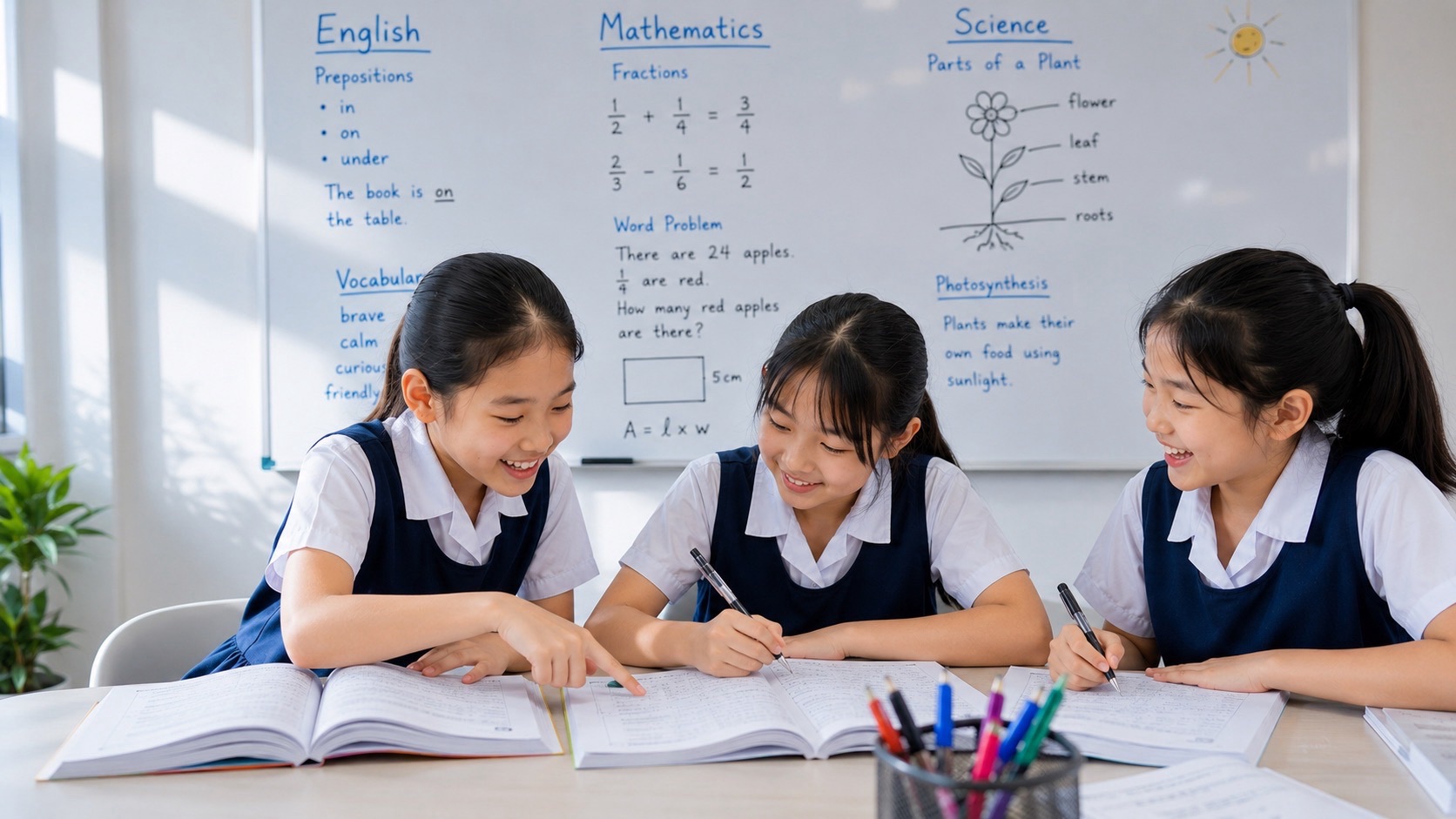
Grade 4 Prepositions and Prepositional Phrases is a world-facing Primary 4 guide to 4th grade prepositions, Grade 4 prepositional phrases, prepositions of place, prepositions of time, prepositions of direction, object of the preposition, preposition worksheets, sentence expansion, dependent prepositions and common preposition errors. The goal is not to memorize a long list of small words. It is to help learners see the relationship each preposition creates between people, places, objects, times, actions and ideas.
Current fourth-grade grammar resources repeatedly emphasize identifying prepositions and whole prepositional phrases, distinguishing place and time relationships, recognizing the object of the preposition, adding prepositional phrases to sentences, and correcting common usage errors such as on Friday, at six o’clock and in March. This article expands that search family into a full vocabulary-and-usage system while keeping sentence meaning at the centre.
This page owns the new Primary 4 / Grade 4 Prepositions and Prepositional Phrases intent inside the eduKateSG world lane. It does not replace the broader Grade 4 Grammar Vocabulary page, the PSLE prepositions owner, or the narrower Primary 3–4 direction-language page. Alicia, Tricia and Kai Kai model the full control loop: find the relationship → locate the phrase boundary → identify the object → test the preposition choice → check sentence meaning → repair the error → transfer the pattern to new writing.
The 50-Second Preposition Rule
- Find the relationship: place, time, direction, cause, topic, means or another connection.
- Locate the preposition or compound preposition.
- Find the object that follows it.
- Mark the whole prepositional phrase.
- Check whether the phrase modifies a noun or gives information about an action.
- Test the meaning, not only what sounds familiar.
- Watch common time patterns: at a clock time, on a day, in a month or year.
- Distinguish between and among by the relationship being expressed, not by a memorized slogan alone.
- Check dependent combinations such as interested in, responsible for and solution to.
- Read the full sentence after editing; preposition choice can change meaning.
A preposition is a relationship word. Strong grammar starts by asking what relationship the sentence needs.
Why Grade 4 Prepositions Matter
Prepositions are short, but they control large parts of sentence meaning. Compare the book on the table, the book under the table and the book beside the table. One small word changes the spatial relationship completely. Time works the same way: at six, on Monday and in March are conventional English patterns that learners need to retrieve accurately.
Prepositional phrases also affect grammar beyond vocabulary. In The stack of books is heavy, the subject is stack, not books. A learner who sees the phrase of books as a unit is less likely to choose the wrong verb. This is why Grade 4 preposition work connects sentence meaning, noun phrases, subject–verb agreement, sentence expansion and writing fluency.
Prepositions of Place
These ten entries belong to the prepositions of place family. Learn each through complete sentences and relationship tests rather than isolated memorization.
1. in
Meaning: inside an area, space or container.
Example: Alicia placed the notebook in the bag.
Tricia’s relationship check: Identify the relationship expressed by in. If it begins a prepositional phrase, identify the object and mark where the phrase ends. Then replace the preposition with a plausible alternative and explain how the meaning changes.
Transfer: Write a fresh sentence using in naturally. Create one near-miss sentence with the wrong preposition and repair it.
2. on
Meaning: touching or supported by a surface.
Example: The ruler is on the table.
Kai Kai’s relationship check: Identify the relationship expressed by on. If it begins a prepositional phrase, identify the object and mark where the phrase ends. Then replace the preposition with a plausible alternative and explain how the meaning changes.
Transfer: Write a fresh sentence using on naturally. Create one near-miss sentence with the wrong preposition and repair it.
3. at
Meaning: at a particular point or location.
Example: Tricia waited at the gate.
Alicia’s relationship check: Identify the relationship expressed by at. If it begins a prepositional phrase, identify the object and mark where the phrase ends. Then replace the preposition with a plausible alternative and explain how the meaning changes.
Transfer: Write a fresh sentence using at naturally. Create one near-miss sentence with the wrong preposition and repair it.
4. under
Meaning: lower than something and often directly beneath it.
Example: Kai Kai found the key under the chair.
Tricia’s relationship check: Identify the relationship expressed by under. If it begins a prepositional phrase, identify the object and mark where the phrase ends. Then replace the preposition with a plausible alternative and explain how the meaning changes.
Transfer: Write a fresh sentence using under naturally. Create one near-miss sentence with the wrong preposition and repair it.
5. over
Meaning: higher than and sometimes directly above or crossing something.
Example: The lamp hangs over the desk.
Kai Kai’s relationship check: Identify the relationship expressed by over. If it begins a prepositional phrase, identify the object and mark where the phrase ends. Then replace the preposition with a plausible alternative and explain how the meaning changes.
Transfer: Write a fresh sentence using over naturally. Create one near-miss sentence with the wrong preposition and repair it.
6. above
Meaning: at a higher position than something.
Example: The clock is above the whiteboard.
Alicia’s relationship check: Identify the relationship expressed by above. If it begins a prepositional phrase, identify the object and mark where the phrase ends. Then replace the preposition with a plausible alternative and explain how the meaning changes.
Transfer: Write a fresh sentence using above naturally. Create one near-miss sentence with the wrong preposition and repair it.
7. below
Meaning: at a lower position than something.
Example: The shelf is below the window.
Tricia’s relationship check: Identify the relationship expressed by below. If it begins a prepositional phrase, identify the object and mark where the phrase ends. Then replace the preposition with a plausible alternative and explain how the meaning changes.
Transfer: Write a fresh sentence using below naturally. Create one near-miss sentence with the wrong preposition and repair it.
8. between
Meaning: in the space separating two people, places or things.
Example: Alicia sat between Tricia and Kai Kai.
Kai Kai’s relationship check: Identify the relationship expressed by between. If it begins a prepositional phrase, identify the object and mark where the phrase ends. Then replace the preposition with a plausible alternative and explain how the meaning changes.
Transfer: Write a fresh sentence using between naturally. Create one near-miss sentence with the wrong preposition and repair it.
9. among
Meaning: surrounded by or included in a group of more than two.
Example: The note was hidden among the books.
Alicia’s relationship check: Identify the relationship expressed by among. If it begins a prepositional phrase, identify the object and mark where the phrase ends. Then replace the preposition with a plausible alternative and explain how the meaning changes.
Transfer: Write a fresh sentence using among naturally. Create one near-miss sentence with the wrong preposition and repair it.
10. beside
Meaning: next to or at the side of something.
Example: The umbrella stood beside the door.
Tricia’s relationship check: Identify the relationship expressed by beside. If it begins a prepositional phrase, identify the object and mark where the phrase ends. Then replace the preposition with a plausible alternative and explain how the meaning changes.
Transfer: Write a fresh sentence using beside naturally. Create one near-miss sentence with the wrong preposition and repair it.
Prepositions of Place mini-practice
- Use in in a fresh Grade 4 sentence. Underline the preposition, box its object when applicable, and explain the relationship in plain language.
- Use on in a fresh Grade 4 sentence. Underline the preposition, box its object when applicable, and explain the relationship in plain language.
- Use at in a fresh Grade 4 sentence. Underline the preposition, box its object when applicable, and explain the relationship in plain language.
- Use under in a fresh Grade 4 sentence. Underline the preposition, box its object when applicable, and explain the relationship in plain language.
- Use over in a fresh Grade 4 sentence. Underline the preposition, box its object when applicable, and explain the relationship in plain language.
- Use above in a fresh Grade 4 sentence. Underline the preposition, box its object when applicable, and explain the relationship in plain language.
- Use below in a fresh Grade 4 sentence. Underline the preposition, box its object when applicable, and explain the relationship in plain language.
- Use between in a fresh Grade 4 sentence. Underline the preposition, box its object when applicable, and explain the relationship in plain language.
- Use among in a fresh Grade 4 sentence. Underline the preposition, box its object when applicable, and explain the relationship in plain language.
- Use beside in a fresh Grade 4 sentence. Underline the preposition, box its object when applicable, and explain the relationship in plain language.
Prepositions of Time
These ten entries belong to the prepositions of time family. Learn each through complete sentences and relationship tests rather than isolated memorization.
11. before
Meaning: earlier than a time or event.
Example: Finish the checklist before lunch.
Kai Kai’s relationship check: Identify the relationship expressed by before. If it begins a prepositional phrase, identify the object and mark where the phrase ends. Then replace the preposition with a plausible alternative and explain how the meaning changes.
Transfer: Write a fresh sentence using before naturally. Create one near-miss sentence with the wrong preposition and repair it.
12. after
Meaning: later than a time or event.
Example: The class met after recess.
Alicia’s relationship check: Identify the relationship expressed by after. If it begins a prepositional phrase, identify the object and mark where the phrase ends. Then replace the preposition with a plausible alternative and explain how the meaning changes.
Transfer: Write a fresh sentence using after naturally. Create one near-miss sentence with the wrong preposition and repair it.
13. during
Meaning: throughout part or all of an event or period.
Example: Tricia took notes during the presentation.
Tricia’s relationship check: Identify the relationship expressed by during. If it begins a prepositional phrase, identify the object and mark where the phrase ends. Then replace the preposition with a plausible alternative and explain how the meaning changes.
Transfer: Write a fresh sentence using during naturally. Create one near-miss sentence with the wrong preposition and repair it.
14. since
Meaning: from a past starting point until now or another reference time.
Example: Kai Kai has used the notebook since Monday.
Kai Kai’s relationship check: Identify the relationship expressed by since. If it begins a prepositional phrase, identify the object and mark where the phrase ends. Then replace the preposition with a plausible alternative and explain how the meaning changes.
Transfer: Write a fresh sentence using since naturally. Create one near-miss sentence with the wrong preposition and repair it.
15. for
Meaning: through a stated length of time.
Example: Alicia read for twenty minutes.
Alicia’s relationship check: Identify the relationship expressed by for. If it begins a prepositional phrase, identify the object and mark where the phrase ends. Then replace the preposition with a plausible alternative and explain how the meaning changes.
Transfer: Write a fresh sentence using for naturally. Create one near-miss sentence with the wrong preposition and repair it.
16. until
Meaning: up to a stated time or event.
Example: The library stays open until six.
Tricia’s relationship check: Identify the relationship expressed by until. If it begins a prepositional phrase, identify the object and mark where the phrase ends. Then replace the preposition with a plausible alternative and explain how the meaning changes.
Transfer: Write a fresh sentence using until naturally. Create one near-miss sentence with the wrong preposition and repair it.
17. by
Meaning: not later than a stated time.
Example: Submit the form by Friday.
Kai Kai’s relationship check: Identify the relationship expressed by by. If it begins a prepositional phrase, identify the object and mark where the phrase ends. Then replace the preposition with a plausible alternative and explain how the meaning changes.
Transfer: Write a fresh sentence using by naturally. Create one near-miss sentence with the wrong preposition and repair it.
18. from
Meaning: starting at a stated time.
Example: The lesson runs from two o’clock.
Alicia’s relationship check: Identify the relationship expressed by from. If it begins a prepositional phrase, identify the object and mark where the phrase ends. Then replace the preposition with a plausible alternative and explain how the meaning changes.
Transfer: Write a fresh sentence using from naturally. Create one near-miss sentence with the wrong preposition and repair it.
19. within
Meaning: before the end of a stated period.
Example: Return the book within two weeks.
Tricia’s relationship check: Identify the relationship expressed by within. If it begins a prepositional phrase, identify the object and mark where the phrase ends. Then replace the preposition with a plausible alternative and explain how the meaning changes.
Transfer: Write a fresh sentence using within naturally. Create one near-miss sentence with the wrong preposition and repair it.
20. throughout
Meaning: during the whole of a period.
Example: The lights remained on throughout the afternoon.
Kai Kai’s relationship check: Identify the relationship expressed by throughout. If it begins a prepositional phrase, identify the object and mark where the phrase ends. Then replace the preposition with a plausible alternative and explain how the meaning changes.
Transfer: Write a fresh sentence using throughout naturally. Create one near-miss sentence with the wrong preposition and repair it.
Prepositions of Time mini-practice
- Use before in a fresh Grade 4 sentence. Underline the preposition, box its object when applicable, and explain the relationship in plain language.
- Use after in a fresh Grade 4 sentence. Underline the preposition, box its object when applicable, and explain the relationship in plain language.
- Use during in a fresh Grade 4 sentence. Underline the preposition, box its object when applicable, and explain the relationship in plain language.
- Use since in a fresh Grade 4 sentence. Underline the preposition, box its object when applicable, and explain the relationship in plain language.
- Use for in a fresh Grade 4 sentence. Underline the preposition, box its object when applicable, and explain the relationship in plain language.
- Use until in a fresh Grade 4 sentence. Underline the preposition, box its object when applicable, and explain the relationship in plain language.
- Use by in a fresh Grade 4 sentence. Underline the preposition, box its object when applicable, and explain the relationship in plain language.
- Use from in a fresh Grade 4 sentence. Underline the preposition, box its object when applicable, and explain the relationship in plain language.
- Use within in a fresh Grade 4 sentence. Underline the preposition, box its object when applicable, and explain the relationship in plain language.
- Use throughout in a fresh Grade 4 sentence. Underline the preposition, box its object when applicable, and explain the relationship in plain language.
Prepositions of Direction and Movement
These ten entries belong to the prepositions of direction and movement family. Learn each through complete sentences and relationship tests rather than isolated memorization.
21. to
Meaning: toward a destination or endpoint.
Example: Tricia walked to the library.
Alicia’s relationship check: Identify the relationship expressed by to. If it begins a prepositional phrase, identify the object and mark where the phrase ends. Then replace the preposition with a plausible alternative and explain how the meaning changes.
Transfer: Write a fresh sentence using to naturally. Create one near-miss sentence with the wrong preposition and repair it.
22. toward
Meaning: in the direction of something.
Example: Kai Kai moved toward the exit.
Tricia’s relationship check: Identify the relationship expressed by toward. If it begins a prepositional phrase, identify the object and mark where the phrase ends. Then replace the preposition with a plausible alternative and explain how the meaning changes.
Transfer: Write a fresh sentence using toward naturally. Create one near-miss sentence with the wrong preposition and repair it.
23. into
Meaning: from outside to inside.
Example: Alicia poured the water into the cup.
Kai Kai’s relationship check: Identify the relationship expressed by into. If it begins a prepositional phrase, identify the object and mark where the phrase ends. Then replace the preposition with a plausible alternative and explain how the meaning changes.
Transfer: Write a fresh sentence using into naturally. Create one near-miss sentence with the wrong preposition and repair it.
24. onto
Meaning: to a position on a surface.
Example: The cat jumped onto the wall.
Alicia’s relationship check: Identify the relationship expressed by onto. If it begins a prepositional phrase, identify the object and mark where the phrase ends. Then replace the preposition with a plausible alternative and explain how the meaning changes.
Transfer: Write a fresh sentence using onto naturally. Create one near-miss sentence with the wrong preposition and repair it.
25. through
Meaning: from one side or end to another inside something.
Example: The class walked through the tunnel.
Tricia’s relationship check: Identify the relationship expressed by through. If it begins a prepositional phrase, identify the object and mark where the phrase ends. Then replace the preposition with a plausible alternative and explain how the meaning changes.
Transfer: Write a fresh sentence using through naturally. Create one near-miss sentence with the wrong preposition and repair it.
26. across
Meaning: from one side to the other over a surface or area.
Example: Tricia crossed across the field in the example sentence, then revised it to walked across the field.
Kai Kai’s relationship check: Identify the relationship expressed by across. If it begins a prepositional phrase, identify the object and mark where the phrase ends. Then replace the preposition with a plausible alternative and explain how the meaning changes.
Transfer: Write a fresh sentence using across naturally. Create one near-miss sentence with the wrong preposition and repair it.
27. along
Meaning: following the length or course of something.
Example: Kai Kai cycled along the path.
Alicia’s relationship check: Identify the relationship expressed by along. If it begins a prepositional phrase, identify the object and mark where the phrase ends. Then replace the preposition with a plausible alternative and explain how the meaning changes.
Transfer: Write a fresh sentence using along naturally. Create one near-miss sentence with the wrong preposition and repair it.
28. around
Meaning: following a curved route or moving to several points in an area.
Example: Alicia walked around the pond.
Tricia’s relationship check: Identify the relationship expressed by around. If it begins a prepositional phrase, identify the object and mark where the phrase ends. Then replace the preposition with a plausible alternative and explain how the meaning changes.
Transfer: Write a fresh sentence using around naturally. Create one near-miss sentence with the wrong preposition and repair it.
29. past
Meaning: beyond a person or place while moving.
Example: Tricia ran past the bus stop.
Kai Kai’s relationship check: Identify the relationship expressed by past. If it begins a prepositional phrase, identify the object and mark where the phrase ends. Then replace the preposition with a plausible alternative and explain how the meaning changes.
Transfer: Write a fresh sentence using past naturally. Create one near-miss sentence with the wrong preposition and repair it.
30. out of
Meaning: from inside to outside.
Example: Kai Kai stepped out of the room.
Alicia’s relationship check: Identify the relationship expressed by out of. If it begins a prepositional phrase, identify the object and mark where the phrase ends. Then replace the preposition with a plausible alternative and explain how the meaning changes.
Transfer: Write a fresh sentence using out of naturally. Create one near-miss sentence with the wrong preposition and repair it.
Prepositions of Direction and Movement mini-practice
- Use to in a fresh Grade 4 sentence. Underline the preposition, box its object when applicable, and explain the relationship in plain language.
- Use toward in a fresh Grade 4 sentence. Underline the preposition, box its object when applicable, and explain the relationship in plain language.
- Use into in a fresh Grade 4 sentence. Underline the preposition, box its object when applicable, and explain the relationship in plain language.
- Use onto in a fresh Grade 4 sentence. Underline the preposition, box its object when applicable, and explain the relationship in plain language.
- Use through in a fresh Grade 4 sentence. Underline the preposition, box its object when applicable, and explain the relationship in plain language.
- Use across in a fresh Grade 4 sentence. Underline the preposition, box its object when applicable, and explain the relationship in plain language.
- Use along in a fresh Grade 4 sentence. Underline the preposition, box its object when applicable, and explain the relationship in plain language.
- Use around in a fresh Grade 4 sentence. Underline the preposition, box its object when applicable, and explain the relationship in plain language.
- Use past in a fresh Grade 4 sentence. Underline the preposition, box its object when applicable, and explain the relationship in plain language.
- Use out of in a fresh Grade 4 sentence. Underline the preposition, box its object when applicable, and explain the relationship in plain language.
Position and Spatial Relationships
These ten entries belong to the position and spatial relationships family. Learn each through complete sentences and relationship tests rather than isolated memorization.
31. near
Meaning: close to.
Example: The class gathered near the stage.
Tricia’s relationship check: Identify the relationship expressed by near. If it begins a prepositional phrase, identify the object and mark where the phrase ends. Then replace the preposition with a plausible alternative and explain how the meaning changes.
Transfer: Write a fresh sentence using near naturally. Create one near-miss sentence with the wrong preposition and repair it.
32. behind
Meaning: at the back of something.
Example: Alicia stood behind the curtain.
Kai Kai’s relationship check: Identify the relationship expressed by behind. If it begins a prepositional phrase, identify the object and mark where the phrase ends. Then replace the preposition with a plausible alternative and explain how the meaning changes.
Transfer: Write a fresh sentence using behind naturally. Create one near-miss sentence with the wrong preposition and repair it.
33. in front of
Meaning: before or ahead of something in position.
Example: Tricia waited in front of the office.
Alicia’s relationship check: Identify the relationship expressed by in front of. If it begins a prepositional phrase, identify the object and mark where the phrase ends. Then replace the preposition with a plausible alternative and explain how the meaning changes.
Transfer: Write a fresh sentence using in front of naturally. Create one near-miss sentence with the wrong preposition and repair it.
34. next to
Meaning: immediately beside.
Example: Kai Kai placed the cup next to the beaker.
Tricia’s relationship check: Identify the relationship expressed by next to. If it begins a prepositional phrase, identify the object and mark where the phrase ends. Then replace the preposition with a plausible alternative and explain how the meaning changes.
Transfer: Write a fresh sentence using next to naturally. Create one near-miss sentence with the wrong preposition and repair it.
35. opposite
Meaning: facing or across from something.
Example: The library is opposite the hall.
Kai Kai’s relationship check: Identify the relationship expressed by opposite. If it begins a prepositional phrase, identify the object and mark where the phrase ends. Then replace the preposition with a plausible alternative and explain how the meaning changes.
Transfer: Write a fresh sentence using opposite naturally. Create one near-miss sentence with the wrong preposition and repair it.
36. inside
Meaning: within the inner part of something.
Example: The students waited inside the shelter.
Alicia’s relationship check: Identify the relationship expressed by inside. If it begins a prepositional phrase, identify the object and mark where the phrase ends. Then replace the preposition with a plausible alternative and explain how the meaning changes.
Transfer: Write a fresh sentence using inside naturally. Create one near-miss sentence with the wrong preposition and repair it.
37. outside
Meaning: beyond the outer part of something.
Example: The bicycles were parked outside the gate.
Tricia’s relationship check: Identify the relationship expressed by outside. If it begins a prepositional phrase, identify the object and mark where the phrase ends. Then replace the preposition with a plausible alternative and explain how the meaning changes.
Transfer: Write a fresh sentence using outside naturally. Create one near-miss sentence with the wrong preposition and repair it.
38. beneath
Meaning: directly under something, often in more formal or literary language.
Example: The box was stored beneath the table.
Kai Kai’s relationship check: Identify the relationship expressed by beneath. If it begins a prepositional phrase, identify the object and mark where the phrase ends. Then replace the preposition with a plausible alternative and explain how the meaning changes.
Transfer: Write a fresh sentence using beneath naturally. Create one near-miss sentence with the wrong preposition and repair it.
39. underneath
Meaning: directly below and often covered by something.
Example: The coin was underneath the paper.
Alicia’s relationship check: Identify the relationship expressed by underneath. If it begins a prepositional phrase, identify the object and mark where the phrase ends. Then replace the preposition with a plausible alternative and explain how the meaning changes.
Transfer: Write a fresh sentence using underneath naturally. Create one near-miss sentence with the wrong preposition and repair it.
40. beyond
Meaning: farther than or outside a stated limit.
Example: The trail continues beyond the bridge.
Tricia’s relationship check: Identify the relationship expressed by beyond. If it begins a prepositional phrase, identify the object and mark where the phrase ends. Then replace the preposition with a plausible alternative and explain how the meaning changes.
Transfer: Write a fresh sentence using beyond naturally. Create one near-miss sentence with the wrong preposition and repair it.
Position and Spatial Relationships mini-practice
- Use near in a fresh Grade 4 sentence. Underline the preposition, box its object when applicable, and explain the relationship in plain language.
- Use behind in a fresh Grade 4 sentence. Underline the preposition, box its object when applicable, and explain the relationship in plain language.
- Use in front of in a fresh Grade 4 sentence. Underline the preposition, box its object when applicable, and explain the relationship in plain language.
- Use next to in a fresh Grade 4 sentence. Underline the preposition, box its object when applicable, and explain the relationship in plain language.
- Use opposite in a fresh Grade 4 sentence. Underline the preposition, box its object when applicable, and explain the relationship in plain language.
- Use inside in a fresh Grade 4 sentence. Underline the preposition, box its object when applicable, and explain the relationship in plain language.
- Use outside in a fresh Grade 4 sentence. Underline the preposition, box its object when applicable, and explain the relationship in plain language.
- Use beneath in a fresh Grade 4 sentence. Underline the preposition, box its object when applicable, and explain the relationship in plain language.
- Use underneath in a fresh Grade 4 sentence. Underline the preposition, box its object when applicable, and explain the relationship in plain language.
- Use beyond in a fresh Grade 4 sentence. Underline the preposition, box its object when applicable, and explain the relationship in plain language.
Relationship, Topic and Association
These ten entries belong to the relationship, topic and association family. Learn each through complete sentences and relationship tests rather than isolated memorization.
41. with
Meaning: together with, using, or having.
Example: Alicia wrote with a blue pen.
Kai Kai’s relationship check: Identify the relationship expressed by with. If it begins a prepositional phrase, identify the object and mark where the phrase ends. Then replace the preposition with a plausible alternative and explain how the meaning changes.
Transfer: Write a fresh sentence using with naturally. Create one near-miss sentence with the wrong preposition and repair it.
42. without
Meaning: not having or not accompanied by.
Example: Tricia completed the task without help.
Alicia’s relationship check: Identify the relationship expressed by without. If it begins a prepositional phrase, identify the object and mark where the phrase ends. Then replace the preposition with a plausible alternative and explain how the meaning changes.
Transfer: Write a fresh sentence using without naturally. Create one near-miss sentence with the wrong preposition and repair it.
43. about
Meaning: concerning a topic.
Example: Kai Kai read an article about volcanoes.
Tricia’s relationship check: Identify the relationship expressed by about. If it begins a prepositional phrase, identify the object and mark where the phrase ends. Then replace the preposition with a plausible alternative and explain how the meaning changes.
Transfer: Write a fresh sentence using about naturally. Create one near-miss sentence with the wrong preposition and repair it.
44. of
Meaning: showing belonging, composition or relationship.
Example: The cover of the book was torn.
Kai Kai’s relationship check: Identify the relationship expressed by of. If it begins a prepositional phrase, identify the object and mark where the phrase ends. Then replace the preposition with a plausible alternative and explain how the meaning changes.
Transfer: Write a fresh sentence using of naturally. Create one near-miss sentence with the wrong preposition and repair it.
15. for
Meaning: intended for, benefiting, or connected with a purpose.
Example: The guide is for new students.
Alicia’s relationship check: Identify the relationship expressed by for. If it begins a prepositional phrase, identify the object and mark where the phrase ends. Then replace the preposition with a plausible alternative and explain how the meaning changes.
Transfer: Write a fresh sentence using for naturally. Create one near-miss sentence with the wrong preposition and repair it.
18. from
Meaning: showing origin, source or separation.
Example: Alicia received a message from her teacher.
Alicia’s relationship check: Identify the relationship expressed by from. If it begins a prepositional phrase, identify the object and mark where the phrase ends. Then replace the preposition with a plausible alternative and explain how the meaning changes.
Transfer: Write a fresh sentence using from naturally. Create one near-miss sentence with the wrong preposition and repair it.
47. against
Meaning: in contact with, opposed to, or compared with.
Example: The ladder rested against the wall.
Kai Kai’s relationship check: Identify the relationship expressed by against. If it begins a prepositional phrase, identify the object and mark where the phrase ends. Then replace the preposition with a plausible alternative and explain how the meaning changes.
Transfer: Write a fresh sentence using against naturally. Create one near-miss sentence with the wrong preposition and repair it.
48. except
Meaning: not including.
Example: Everyone attended except one student.
Alicia’s relationship check: Identify the relationship expressed by except. If it begins a prepositional phrase, identify the object and mark where the phrase ends. Then replace the preposition with a plausible alternative and explain how the meaning changes.
Transfer: Write a fresh sentence using except naturally. Create one near-miss sentence with the wrong preposition and repair it.
49. like
Meaning: similar to.
Example: The cloud looked like a ship.
Tricia’s relationship check: Identify the relationship expressed by like. If it begins a prepositional phrase, identify the object and mark where the phrase ends. Then replace the preposition with a plausible alternative and explain how the meaning changes.
Transfer: Write a fresh sentence using like naturally. Create one near-miss sentence with the wrong preposition and repair it.
50. unlike
Meaning: different from.
Example: Unlike the first route, the second route has a shelter.
Kai Kai’s relationship check: Identify the relationship expressed by unlike. If it begins a prepositional phrase, identify the object and mark where the phrase ends. Then replace the preposition with a plausible alternative and explain how the meaning changes.
Transfer: Write a fresh sentence using unlike naturally. Create one near-miss sentence with the wrong preposition and repair it.
Relationship, Topic and Association mini-practice
- Use with in a fresh Grade 4 sentence. Underline the preposition, box its object when applicable, and explain the relationship in plain language.
- Use without in a fresh Grade 4 sentence. Underline the preposition, box its object when applicable, and explain the relationship in plain language.
- Use about in a fresh Grade 4 sentence. Underline the preposition, box its object when applicable, and explain the relationship in plain language.
- Use of in a fresh Grade 4 sentence. Underline the preposition, box its object when applicable, and explain the relationship in plain language.
- Use for in a fresh Grade 4 sentence. Underline the preposition, box its object when applicable, and explain the relationship in plain language.
- Use from in a fresh Grade 4 sentence. Underline the preposition, box its object when applicable, and explain the relationship in plain language.
- Use against in a fresh Grade 4 sentence. Underline the preposition, box its object when applicable, and explain the relationship in plain language.
- Use except in a fresh Grade 4 sentence. Underline the preposition, box its object when applicable, and explain the relationship in plain language.
- Use like in a fresh Grade 4 sentence. Underline the preposition, box its object when applicable, and explain the relationship in plain language.
- Use unlike in a fresh Grade 4 sentence. Underline the preposition, box its object when applicable, and explain the relationship in plain language.
Cause, Reason, Contrast and Purpose Phrases
These ten entries belong to the cause, reason, contrast and purpose phrases family. Learn each through complete sentences and relationship tests rather than isolated memorization.
51. because of
Meaning: for the reason of.
Example: The trip was delayed because of heavy rain.
Alicia’s relationship check: Identify the relationship expressed by because of. If it begins a prepositional phrase, identify the object and mark where the phrase ends. Then replace the preposition with a plausible alternative and explain how the meaning changes.
Transfer: Write a fresh sentence using because of naturally. Create one near-miss sentence with the wrong preposition and repair it.
52. due to
Meaning: because of, especially in formal contexts.
Example: The match was postponed due to lightning.
Tricia’s relationship check: Identify the relationship expressed by due to. If it begins a prepositional phrase, identify the object and mark where the phrase ends. Then replace the preposition with a plausible alternative and explain how the meaning changes.
Transfer: Write a fresh sentence using due to naturally. Create one near-miss sentence with the wrong preposition and repair it.
53. thanks to
Meaning: because of something helpful or beneficial.
Example: The project finished early thanks to careful planning.
Kai Kai’s relationship check: Identify the relationship expressed by thanks to. If it begins a prepositional phrase, identify the object and mark where the phrase ends. Then replace the preposition with a plausible alternative and explain how the meaning changes.
Transfer: Write a fresh sentence using thanks to naturally. Create one near-miss sentence with the wrong preposition and repair it.
54. according to
Meaning: as stated or reported by a source.
Example: According to the timetable, the bus leaves at eight.
Alicia’s relationship check: Identify the relationship expressed by according to. If it begins a prepositional phrase, identify the object and mark where the phrase ends. Then replace the preposition with a plausible alternative and explain how the meaning changes.
Transfer: Write a fresh sentence using according to naturally. Create one near-miss sentence with the wrong preposition and repair it.
55. instead of
Meaning: in place of.
Example: Tricia used a diagram instead of a long description.
Tricia’s relationship check: Identify the relationship expressed by instead of. If it begins a prepositional phrase, identify the object and mark where the phrase ends. Then replace the preposition with a plausible alternative and explain how the meaning changes.
Transfer: Write a fresh sentence using instead of naturally. Create one near-miss sentence with the wrong preposition and repair it.
56. in spite of
Meaning: despite a difficulty or contrast.
Example: In spite of the rain, the class continued indoors.
Kai Kai’s relationship check: Identify the relationship expressed by in spite of. If it begins a prepositional phrase, identify the object and mark where the phrase ends. Then replace the preposition with a plausible alternative and explain how the meaning changes.
Transfer: Write a fresh sentence using in spite of naturally. Create one near-miss sentence with the wrong preposition and repair it.
57. despite
Meaning: without being prevented by.
Example: Despite the delay, Kai Kai remained calm.
Alicia’s relationship check: Identify the relationship expressed by despite. If it begins a prepositional phrase, identify the object and mark where the phrase ends. Then replace the preposition with a plausible alternative and explain how the meaning changes.
Transfer: Write a fresh sentence using despite naturally. Create one near-miss sentence with the wrong preposition and repair it.
58. apart from
Meaning: except for or in addition to, depending on context.
Example: Apart from one spelling error, the paragraph was clear.
Tricia’s relationship check: Identify the relationship expressed by apart from. If it begins a prepositional phrase, identify the object and mark where the phrase ends. Then replace the preposition with a plausible alternative and explain how the meaning changes.
Transfer: Write a fresh sentence using apart from naturally. Create one near-miss sentence with the wrong preposition and repair it.
59. except for
Meaning: not including one person, thing or detail.
Example: The room was empty except for one chair.
Kai Kai’s relationship check: Identify the relationship expressed by except for. If it begins a prepositional phrase, identify the object and mark where the phrase ends. Then replace the preposition with a plausible alternative and explain how the meaning changes.
Transfer: Write a fresh sentence using except for naturally. Create one near-miss sentence with the wrong preposition and repair it.
60. as a result of
Meaning: because of a preceding cause.
Example: The path closed as a result of flooding.
Alicia’s relationship check: Identify the relationship expressed by as a result of. If it begins a prepositional phrase, identify the object and mark where the phrase ends. Then replace the preposition with a plausible alternative and explain how the meaning changes.
Transfer: Write a fresh sentence using as a result of naturally. Create one near-miss sentence with the wrong preposition and repair it.
Cause, Reason, Contrast and Purpose Phrases mini-practice
- Use because of in a fresh Grade 4 sentence. Underline the preposition, box its object when applicable, and explain the relationship in plain language.
- Use due to in a fresh Grade 4 sentence. Underline the preposition, box its object when applicable, and explain the relationship in plain language.
- Use thanks to in a fresh Grade 4 sentence. Underline the preposition, box its object when applicable, and explain the relationship in plain language.
- Use according to in a fresh Grade 4 sentence. Underline the preposition, box its object when applicable, and explain the relationship in plain language.
- Use instead of in a fresh Grade 4 sentence. Underline the preposition, box its object when applicable, and explain the relationship in plain language.
- Use in spite of in a fresh Grade 4 sentence. Underline the preposition, box its object when applicable, and explain the relationship in plain language.
- Use despite in a fresh Grade 4 sentence. Underline the preposition, box its object when applicable, and explain the relationship in plain language.
- Use apart from in a fresh Grade 4 sentence. Underline the preposition, box its object when applicable, and explain the relationship in plain language.
- Use except for in a fresh Grade 4 sentence. Underline the preposition, box its object when applicable, and explain the relationship in plain language.
- Use as a result of in a fresh Grade 4 sentence. Underline the preposition, box its object when applicable, and explain the relationship in plain language.
Verb + Preposition Partnerships
These ten entries belong to the verb + preposition partnerships family. Learn each through complete sentences and relationship tests rather than isolated memorization.
61. depend on
Meaning: rely on.
Example: The result depends on accurate measurement.
Tricia’s relationship check: Identify the relationship expressed by depend on. If it begins a prepositional phrase, identify the object and mark where the phrase ends. Then replace the preposition with a plausible alternative and explain how the meaning changes.
Transfer: Write a fresh sentence using depend on naturally. Create one near-miss sentence with the wrong preposition and repair it.
62. belong to
Meaning: be owned by or be part of.
Example: This notebook belongs to Alicia.
Kai Kai’s relationship check: Identify the relationship expressed by belong to. If it begins a prepositional phrase, identify the object and mark where the phrase ends. Then replace the preposition with a plausible alternative and explain how the meaning changes.
Transfer: Write a fresh sentence using belong to naturally. Create one near-miss sentence with the wrong preposition and repair it.
63. listen to
Meaning: pay attention to sound or speech.
Example: Tricia listened to the instructions.
Alicia’s relationship check: Identify the relationship expressed by listen to. If it begins a prepositional phrase, identify the object and mark where the phrase ends. Then replace the preposition with a plausible alternative and explain how the meaning changes.
Transfer: Write a fresh sentence using listen to naturally. Create one near-miss sentence with the wrong preposition and repair it.
64. agree with
Meaning: share the same opinion as a person or idea.
Example: Kai Kai agrees with the recommendation.
Tricia’s relationship check: Identify the relationship expressed by agree with. If it begins a prepositional phrase, identify the object and mark where the phrase ends. Then replace the preposition with a plausible alternative and explain how the meaning changes.
Transfer: Write a fresh sentence using agree with naturally. Create one near-miss sentence with the wrong preposition and repair it.
65. ask for
Meaning: request.
Example: Alicia asked for clarification.
Kai Kai’s relationship check: Identify the relationship expressed by ask for. If it begins a prepositional phrase, identify the object and mark where the phrase ends. Then replace the preposition with a plausible alternative and explain how the meaning changes.
Transfer: Write a fresh sentence using ask for naturally. Create one near-miss sentence with the wrong preposition and repair it.
66. wait for
Meaning: remain until someone or something arrives or happens.
Example: Tricia waited for the bus.
Alicia’s relationship check: Identify the relationship expressed by wait for. If it begins a prepositional phrase, identify the object and mark where the phrase ends. Then replace the preposition with a plausible alternative and explain how the meaning changes.
Transfer: Write a fresh sentence using wait for naturally. Create one near-miss sentence with the wrong preposition and repair it.
67. look at
Meaning: direct the eyes toward.
Example: Kai Kai looked at the graph.
Tricia’s relationship check: Identify the relationship expressed by look at. If it begins a prepositional phrase, identify the object and mark where the phrase ends. Then replace the preposition with a plausible alternative and explain how the meaning changes.
Transfer: Write a fresh sentence using look at naturally. Create one near-miss sentence with the wrong preposition and repair it.
68. think about
Meaning: consider.
Example: Alicia thought about the problem before answering.
Kai Kai’s relationship check: Identify the relationship expressed by think about. If it begins a prepositional phrase, identify the object and mark where the phrase ends. Then replace the preposition with a plausible alternative and explain how the meaning changes.
Transfer: Write a fresh sentence using think about naturally. Create one near-miss sentence with the wrong preposition and repair it.
69. learn about
Meaning: gain knowledge concerning a topic.
Example: The class learned about habitats.
Alicia’s relationship check: Identify the relationship expressed by learn about. If it begins a prepositional phrase, identify the object and mark where the phrase ends. Then replace the preposition with a plausible alternative and explain how the meaning changes.
Transfer: Write a fresh sentence using learn about naturally. Create one near-miss sentence with the wrong preposition and repair it.
70. write about
Meaning: create writing concerning a topic.
Example: Tricia wrote about a local tradition.
Tricia’s relationship check: Identify the relationship expressed by write about. If it begins a prepositional phrase, identify the object and mark where the phrase ends. Then replace the preposition with a plausible alternative and explain how the meaning changes.
Transfer: Write a fresh sentence using write about naturally. Create one near-miss sentence with the wrong preposition and repair it.
Verb + Preposition Partnerships mini-practice
- Use depend on in a fresh Grade 4 sentence. Underline the preposition, box its object when applicable, and explain the relationship in plain language.
- Use belong to in a fresh Grade 4 sentence. Underline the preposition, box its object when applicable, and explain the relationship in plain language.
- Use listen to in a fresh Grade 4 sentence. Underline the preposition, box its object when applicable, and explain the relationship in plain language.
- Use agree with in a fresh Grade 4 sentence. Underline the preposition, box its object when applicable, and explain the relationship in plain language.
- Use ask for in a fresh Grade 4 sentence. Underline the preposition, box its object when applicable, and explain the relationship in plain language.
- Use wait for in a fresh Grade 4 sentence. Underline the preposition, box its object when applicable, and explain the relationship in plain language.
- Use look at in a fresh Grade 4 sentence. Underline the preposition, box its object when applicable, and explain the relationship in plain language.
- Use think about in a fresh Grade 4 sentence. Underline the preposition, box its object when applicable, and explain the relationship in plain language.
- Use learn about in a fresh Grade 4 sentence. Underline the preposition, box its object when applicable, and explain the relationship in plain language.
- Use write about in a fresh Grade 4 sentence. Underline the preposition, box its object when applicable, and explain the relationship in plain language.
Adjective + Preposition Partnerships
These ten entries belong to the adjective + preposition partnerships family. Learn each through complete sentences and relationship tests rather than isolated memorization.
71. interested in
Meaning: wanting to know or learn more about.
Example: Kai Kai is interested in astronomy.
Kai Kai’s relationship check: Identify the relationship expressed by interested in. If it begins a prepositional phrase, identify the object and mark where the phrase ends. Then replace the preposition with a plausible alternative and explain how the meaning changes.
Transfer: Write a fresh sentence using interested in naturally. Create one near-miss sentence with the wrong preposition and repair it.
72. proud of
Meaning: pleased about someone’s achievement or quality.
Example: Alicia is proud of her improvement.
Alicia’s relationship check: Identify the relationship expressed by proud of. If it begins a prepositional phrase, identify the object and mark where the phrase ends. Then replace the preposition with a plausible alternative and explain how the meaning changes.
Transfer: Write a fresh sentence using proud of naturally. Create one near-miss sentence with the wrong preposition and repair it.
73. responsible for
Meaning: having a duty for something.
Example: Tricia is responsible for checking the equipment.
Tricia’s relationship check: Identify the relationship expressed by responsible for. If it begins a prepositional phrase, identify the object and mark where the phrase ends. Then replace the preposition with a plausible alternative and explain how the meaning changes.
Transfer: Write a fresh sentence using responsible for naturally. Create one near-miss sentence with the wrong preposition and repair it.
74. afraid of
Meaning: feeling fear toward something.
Example: Kai Kai was afraid of the dark tunnel.
Kai Kai’s relationship check: Identify the relationship expressed by afraid of. If it begins a prepositional phrase, identify the object and mark where the phrase ends. Then replace the preposition with a plausible alternative and explain how the meaning changes.
Transfer: Write a fresh sentence using afraid of naturally. Create one near-miss sentence with the wrong preposition and repair it.
75. good at
Meaning: skilled in an activity.
Example: Alicia is good at organizing notes.
Alicia’s relationship check: Identify the relationship expressed by good at. If it begins a prepositional phrase, identify the object and mark where the phrase ends. Then replace the preposition with a plausible alternative and explain how the meaning changes.
Transfer: Write a fresh sentence using good at naturally. Create one near-miss sentence with the wrong preposition and repair it.
76. different from
Meaning: not the same as.
Example: This method is different from the first one.
Tricia’s relationship check: Identify the relationship expressed by different from. If it begins a prepositional phrase, identify the object and mark where the phrase ends. Then replace the preposition with a plausible alternative and explain how the meaning changes.
Transfer: Write a fresh sentence using different from naturally. Create one near-miss sentence with the wrong preposition and repair it.
77. similar to
Meaning: sharing important features.
Example: The second graph is similar to the first.
Kai Kai’s relationship check: Identify the relationship expressed by similar to. If it begins a prepositional phrase, identify the object and mark where the phrase ends. Then replace the preposition with a plausible alternative and explain how the meaning changes.
Transfer: Write a fresh sentence using similar to naturally. Create one near-miss sentence with the wrong preposition and repair it.
78. ready for
Meaning: prepared for something.
Example: Tricia is ready for the presentation.
Alicia’s relationship check: Identify the relationship expressed by ready for. If it begins a prepositional phrase, identify the object and mark where the phrase ends. Then replace the preposition with a plausible alternative and explain how the meaning changes.
Transfer: Write a fresh sentence using ready for naturally. Create one near-miss sentence with the wrong preposition and repair it.
79. worried about
Meaning: feeling concern about something.
Example: Kai Kai is worried about the weather.
Tricia’s relationship check: Identify the relationship expressed by worried about. If it begins a prepositional phrase, identify the object and mark where the phrase ends. Then replace the preposition with a plausible alternative and explain how the meaning changes.
Transfer: Write a fresh sentence using worried about naturally. Create one near-miss sentence with the wrong preposition and repair it.
80. familiar with
Meaning: knowing something from previous experience.
Example: Alicia is familiar with the procedure.
Kai Kai’s relationship check: Identify the relationship expressed by familiar with. If it begins a prepositional phrase, identify the object and mark where the phrase ends. Then replace the preposition with a plausible alternative and explain how the meaning changes.
Transfer: Write a fresh sentence using familiar with naturally. Create one near-miss sentence with the wrong preposition and repair it.
Adjective + Preposition Partnerships mini-practice
- Use interested in in a fresh Grade 4 sentence. Underline the preposition, box its object when applicable, and explain the relationship in plain language.
- Use proud of in a fresh Grade 4 sentence. Underline the preposition, box its object when applicable, and explain the relationship in plain language.
- Use responsible for in a fresh Grade 4 sentence. Underline the preposition, box its object when applicable, and explain the relationship in plain language.
- Use afraid of in a fresh Grade 4 sentence. Underline the preposition, box its object when applicable, and explain the relationship in plain language.
- Use good at in a fresh Grade 4 sentence. Underline the preposition, box its object when applicable, and explain the relationship in plain language.
- Use different from in a fresh Grade 4 sentence. Underline the preposition, box its object when applicable, and explain the relationship in plain language.
- Use similar to in a fresh Grade 4 sentence. Underline the preposition, box its object when applicable, and explain the relationship in plain language.
- Use ready for in a fresh Grade 4 sentence. Underline the preposition, box its object when applicable, and explain the relationship in plain language.
- Use worried about in a fresh Grade 4 sentence. Underline the preposition, box its object when applicable, and explain the relationship in plain language.
- Use familiar with in a fresh Grade 4 sentence. Underline the preposition, box its object when applicable, and explain the relationship in plain language.
Noun + Preposition Partnerships
These ten entries belong to the noun + preposition partnerships family. Learn each through complete sentences and relationship tests rather than isolated memorization.
81. reason for
Meaning: the cause or explanation connected with something.
Example: The reason for the delay was heavy rain.
Alicia’s relationship check: Identify the relationship expressed by reason for. If it begins a prepositional phrase, identify the object and mark where the phrase ends. Then replace the preposition with a plausible alternative and explain how the meaning changes.
Transfer: Write a fresh sentence using reason for naturally. Create one near-miss sentence with the wrong preposition and repair it.
82. solution to
Meaning: an answer or method that solves a problem.
Example: The group found a solution to the leak.
Tricia’s relationship check: Identify the relationship expressed by solution to. If it begins a prepositional phrase, identify the object and mark where the phrase ends. Then replace the preposition with a plausible alternative and explain how the meaning changes.
Transfer: Write a fresh sentence using solution to naturally. Create one near-miss sentence with the wrong preposition and repair it.
83. effect on
Meaning: a result or influence affecting something.
Example: Shade has an effect on temperature.
Kai Kai’s relationship check: Identify the relationship expressed by effect on. If it begins a prepositional phrase, identify the object and mark where the phrase ends. Then replace the preposition with a plausible alternative and explain how the meaning changes.
Transfer: Write a fresh sentence using effect on naturally. Create one near-miss sentence with the wrong preposition and repair it.
84. increase in
Meaning: a rise in quantity or amount.
Example: The graph shows an increase in rainfall.
Alicia’s relationship check: Identify the relationship expressed by increase in. If it begins a prepositional phrase, identify the object and mark where the phrase ends. Then replace the preposition with a plausible alternative and explain how the meaning changes.
Transfer: Write a fresh sentence using increase in naturally. Create one near-miss sentence with the wrong preposition and repair it.
85. difference between
Meaning: a point that distinguishes two things.
Example: Tricia explained the difference between weather and climate.
Tricia’s relationship check: Identify the relationship expressed by difference between. If it begins a prepositional phrase, identify the object and mark where the phrase ends. Then replace the preposition with a plausible alternative and explain how the meaning changes.
Transfer: Write a fresh sentence using difference between naturally. Create one near-miss sentence with the wrong preposition and repair it.
86. example of
Meaning: a specific case showing a larger idea.
Example: A mangrove is an example of coastal vegetation.
Kai Kai’s relationship check: Identify the relationship expressed by example of. If it begins a prepositional phrase, identify the object and mark where the phrase ends. Then replace the preposition with a plausible alternative and explain how the meaning changes.
Transfer: Write a fresh sentence using example of naturally. Create one near-miss sentence with the wrong preposition and repair it.
87. information about
Meaning: facts or knowledge concerning a topic.
Example: Kai Kai found information about migration.
Alicia’s relationship check: Identify the relationship expressed by information about. If it begins a prepositional phrase, identify the object and mark where the phrase ends. Then replace the preposition with a plausible alternative and explain how the meaning changes.
Transfer: Write a fresh sentence using information about naturally. Create one near-miss sentence with the wrong preposition and repair it.
88. answer to
Meaning: a response or solution connected with a question.
Example: Alicia found the answer to the puzzle.
Tricia’s relationship check: Identify the relationship expressed by answer to. If it begins a prepositional phrase, identify the object and mark where the phrase ends. Then replace the preposition with a plausible alternative and explain how the meaning changes.
Transfer: Write a fresh sentence using answer to naturally. Create one near-miss sentence with the wrong preposition and repair it.
89. relationship between
Meaning: the connection linking two things.
Example: The article explains the relationship between sleep and attention.
Kai Kai’s relationship check: Identify the relationship expressed by relationship between. If it begins a prepositional phrase, identify the object and mark where the phrase ends. Then replace the preposition with a plausible alternative and explain how the meaning changes.
Transfer: Write a fresh sentence using relationship between naturally. Create one near-miss sentence with the wrong preposition and repair it.
90. need for
Meaning: a reason that something is required.
Example: The report explains the need for more shade.
Alicia’s relationship check: Identify the relationship expressed by need for. If it begins a prepositional phrase, identify the object and mark where the phrase ends. Then replace the preposition with a plausible alternative and explain how the meaning changes.
Transfer: Write a fresh sentence using need for naturally. Create one near-miss sentence with the wrong preposition and repair it.
Noun + Preposition Partnerships mini-practice
- Use reason for in a fresh Grade 4 sentence. Underline the preposition, box its object when applicable, and explain the relationship in plain language.
- Use solution to in a fresh Grade 4 sentence. Underline the preposition, box its object when applicable, and explain the relationship in plain language.
- Use effect on in a fresh Grade 4 sentence. Underline the preposition, box its object when applicable, and explain the relationship in plain language.
- Use increase in in a fresh Grade 4 sentence. Underline the preposition, box its object when applicable, and explain the relationship in plain language.
- Use difference between in a fresh Grade 4 sentence. Underline the preposition, box its object when applicable, and explain the relationship in plain language.
- Use example of in a fresh Grade 4 sentence. Underline the preposition, box its object when applicable, and explain the relationship in plain language.
- Use information about in a fresh Grade 4 sentence. Underline the preposition, box its object when applicable, and explain the relationship in plain language.
- Use answer to in a fresh Grade 4 sentence. Underline the preposition, box its object when applicable, and explain the relationship in plain language.
- Use relationship between in a fresh Grade 4 sentence. Underline the preposition, box its object when applicable, and explain the relationship in plain language.
- Use need for in a fresh Grade 4 sentence. Underline the preposition, box its object when applicable, and explain the relationship in plain language.
Prepositional Phrase Grammar
These ten entries belong to the prepositional phrase grammar family. Learn each through complete sentences and relationship tests rather than isolated memorization.
91. preposition
Meaning: a word or phrase showing a relationship such as place, time, direction or connection.
Example: In under the table, under is the preposition.
Tricia’s relationship check: Identify the relationship expressed by preposition. If it begins a prepositional phrase, identify the object and mark where the phrase ends. Then replace the preposition with a plausible alternative and explain how the meaning changes.
Transfer: Write a fresh sentence using preposition naturally. Create one near-miss sentence with the wrong preposition and repair it.
92. prepositional phrase
Meaning: a phrase beginning with a preposition and including its object and modifiers.
Example: Under the old wooden table is a prepositional phrase.
Kai Kai’s relationship check: Identify the relationship expressed by prepositional phrase. If it begins a prepositional phrase, identify the object and mark where the phrase ends. Then replace the preposition with a plausible alternative and explain how the meaning changes.
Transfer: Write a fresh sentence using prepositional phrase naturally. Create one near-miss sentence with the wrong preposition and repair it.
93. object of the preposition
Meaning: the noun, pronoun or noun phrase that follows a preposition.
Example: In under the table, table is the object of the preposition.
Alicia’s relationship check: Identify the relationship expressed by object of the preposition. If it begins a prepositional phrase, identify the object and mark where the phrase ends. Then replace the preposition with a plausible alternative and explain how the meaning changes.
Transfer: Write a fresh sentence using object of the preposition naturally. Create one near-miss sentence with the wrong preposition and repair it.
94. compound preposition
Meaning: a multiword preposition such as in front of or because of.
Example: Because of is a compound preposition.
Tricia’s relationship check: Identify the relationship expressed by compound preposition. If it begins a prepositional phrase, identify the object and mark where the phrase ends. Then replace the preposition with a plausible alternative and explain how the meaning changes.
Transfer: Write a fresh sentence using compound preposition naturally. Create one near-miss sentence with the wrong preposition and repair it.
95. prepositional opener
Meaning: a prepositional phrase placed at the beginning of a sentence.
Example: After lunch, the class returned.
Kai Kai’s relationship check: Identify the relationship expressed by prepositional opener. If it begins a prepositional phrase, identify the object and mark where the phrase ends. Then replace the preposition with a plausible alternative and explain how the meaning changes.
Transfer: Write a fresh sentence using prepositional opener naturally. Create one near-miss sentence with the wrong preposition and repair it.
96. adverbial prepositional phrase
Meaning: a prepositional phrase modifying a verb, adjective or adverb by giving information such as where, when or how.
Example: The phrase after lunch tells when the class returned.
Alicia’s relationship check: Identify the relationship expressed by adverbial prepositional phrase. If it begins a prepositional phrase, identify the object and mark where the phrase ends. Then replace the preposition with a plausible alternative and explain how the meaning changes.
Transfer: Write a fresh sentence using adverbial prepositional phrase naturally. Create one near-miss sentence with the wrong preposition and repair it.
97. adjectival prepositional phrase
Meaning: a prepositional phrase modifying a noun or pronoun.
Example: In the book on the desk, on the desk describes book.
Tricia’s relationship check: Identify the relationship expressed by adjectival prepositional phrase. If it begins a prepositional phrase, identify the object and mark where the phrase ends. Then replace the preposition with a plausible alternative and explain how the meaning changes.
Transfer: Write a fresh sentence using adjectival prepositional phrase naturally. Create one near-miss sentence with the wrong preposition and repair it.
98. phrase boundary
Meaning: the point where a prepositional phrase begins and ends.
Example: Kai Kai marks under the old bridge as one phrase boundary.
Kai Kai’s relationship check: Identify the relationship expressed by phrase boundary. If it begins a prepositional phrase, identify the object and mark where the phrase ends. Then replace the preposition with a plausible alternative and explain how the meaning changes.
Transfer: Write a fresh sentence using phrase boundary naturally. Create one near-miss sentence with the wrong preposition and repair it.
99. preposition choice
Meaning: the selection of the relationship word that fits meaning and usage.
Example: Tricia checks whether the meeting is on Monday or in Monday.
Alicia’s relationship check: Identify the relationship expressed by preposition choice. If it begins a prepositional phrase, identify the object and mark where the phrase ends. Then replace the preposition with a plausible alternative and explain how the meaning changes.
Transfer: Write a fresh sentence using preposition choice naturally. Create one near-miss sentence with the wrong preposition and repair it.
100. preposition error
Meaning: an incorrect, missing or unnecessary preposition.
Example: Alicia repairs arrived to the airport to arrived at the airport.
Tricia’s relationship check: Identify the relationship expressed by preposition error. If it begins a prepositional phrase, identify the object and mark where the phrase ends. Then replace the preposition with a plausible alternative and explain how the meaning changes.
Transfer: Write a fresh sentence using preposition error naturally. Create one near-miss sentence with the wrong preposition and repair it.
Prepositional Phrase Grammar mini-practice
- Use preposition in a fresh Grade 4 sentence. Underline the preposition, box its object when applicable, and explain the relationship in plain language.
- Use prepositional phrase in a fresh Grade 4 sentence. Underline the preposition, box its object when applicable, and explain the relationship in plain language.
- Use object of the preposition in a fresh Grade 4 sentence. Underline the preposition, box its object when applicable, and explain the relationship in plain language.
- Use compound preposition in a fresh Grade 4 sentence. Underline the preposition, box its object when applicable, and explain the relationship in plain language.
- Use prepositional opener in a fresh Grade 4 sentence. Underline the preposition, box its object when applicable, and explain the relationship in plain language.
- Use adverbial prepositional phrase in a fresh Grade 4 sentence. Underline the preposition, box its object when applicable, and explain the relationship in plain language.
- Use adjectival prepositional phrase in a fresh Grade 4 sentence. Underline the preposition, box its object when applicable, and explain the relationship in plain language.
- Use phrase boundary in a fresh Grade 4 sentence. Underline the preposition, box its object when applicable, and explain the relationship in plain language.
- Use preposition choice in a fresh Grade 4 sentence. Underline the preposition, box its object when applicable, and explain the relationship in plain language.
- Use preposition error in a fresh Grade 4 sentence. Underline the preposition, box its object when applicable, and explain the relationship in plain language.
Worksheet 1 — Place: In, On or At?
- The books are ___ the shelf.
- The class meets ___ the library entrance.
- The pencils are ___ the box.
- Alicia waited ___ the bus stop.
- The notice is ___ the wall.
- Write three new sentences showing how in, on and at divide space differently.
Possible answers depend on context: on the shelf, at the entrance, in the box, at the bus stop, on the wall. The important question is the spatial relationship, not merely the noun that follows.
Worksheet 2 — Time: At, On or In?
- ___ six o’clock
- ___ Monday
- ___ September
- ___ 2026
- ___ the afternoon
- ___ noon
- ___ Friday morning
- ___ winter
Use the conventional patterns to complete the phrases, then write a complete sentence for each. Notice that real English contains idiomatic patterns and exceptions, so reading widely strengthens what grammar rules begin.
Worksheet 3 — Find the Whole Prepositional Phrase
- Mark every complete prepositional phrase in: The notebook on the desk belongs to Alicia.. Identify the preposition and object in each phrase.
- Mark every complete prepositional phrase in: After lunch, the class returned to the laboratory.. Identify the preposition and object in each phrase.
- Mark every complete prepositional phrase in: The dog with the red collar waited beside the gate.. Identify the preposition and object in each phrase.
- Mark every complete prepositional phrase in: Kai Kai walked through the tunnel with his classmates.. Identify the preposition and object in each phrase.
- Mark every complete prepositional phrase in: The chart above the shelf shows rainfall throughout the year.. Identify the preposition and object in each phrase.
Worksheet 4 — Subject–Verb Agreement: Cross Out the Phrase
- The stack of books is / are heavy.
- The boxes under the table belongs / belong to the class.
- The leader of the teams speaks / speak first.
- The students in the library reads / read quietly.
- The colour of the walls changes / change in bright light.
Temporarily bracket or cross out the prepositional phrase to expose the true subject. This is a grammar strategy, not a claim that the phrase is unimportant to meaning.
Worksheet 5 — Direction and Movement
- Walk ___ the bridge from one side to the other.
- Move ___ the room from outside.
- Place the book ___ the shelf from your hand.
- Cycle ___ the path, following its length.
- Run ___ the gate without stopping there.
- Compare through and across using a tunnel and a field.
- Compare into and in by explaining movement versus position.
Worksheet 6 — Between and Among
Write one sentence using between for a relationship involving two clear endpoints, one using among for membership within a group, and one sentence where between can naturally relate more than two individually identified parties. The goal is to learn real relationship patterns rather than an oversimplified “two versus more than two” rule.
Worksheet 7 — Dependent Prepositions
- Complete naturally: interested ___ Science. Then write a full sentence and identify whether the first word is a verb, adjective or noun.
- Complete naturally: responsible ___ checking. Then write a full sentence and identify whether the first word is a verb, adjective or noun.
- Complete naturally: good ___ Mathematics. Then write a full sentence and identify whether the first word is a verb, adjective or noun.
- Complete naturally: different ___ the first version. Then write a full sentence and identify whether the first word is a verb, adjective or noun.
- Complete naturally: similar ___ the original. Then write a full sentence and identify whether the first word is a verb, adjective or noun.
- Complete naturally: worried ___ the weather. Then write a full sentence and identify whether the first word is a verb, adjective or noun.
- Complete naturally: depend ___ the result. Then write a full sentence and identify whether the first word is a verb, adjective or noun.
- Complete naturally: listen ___ the instructions. Then write a full sentence and identify whether the first word is a verb, adjective or noun.
- Complete naturally: ask ___ help. Then write a full sentence and identify whether the first word is a verb, adjective or noun.
- Complete naturally: solution ___ the problem. Then write a full sentence and identify whether the first word is a verb, adjective or noun.
Worksheet 8 — Error Repair
- Repair the sentence if needed: The meeting is in Monday. Explain whether the issue is an incorrect, missing or unnecessary preposition, and note where more than one variety or construction may be acceptable.
- Repair the sentence if needed: We arrived to the airport early. Explain whether the issue is an incorrect, missing or unnecessary preposition, and note where more than one variety or construction may be acceptable.
- Repair the sentence if needed: Alicia is interested on Science. Explain whether the issue is an incorrect, missing or unnecessary preposition, and note where more than one variety or construction may be acceptable.
- Repair the sentence if needed: This solution is different than the first one in formal school English. Explain whether the issue is an incorrect, missing or unnecessary preposition, and note where more than one variety or construction may be acceptable.
- Repair the sentence if needed: Kai Kai listened the instructions. Explain whether the issue is an incorrect, missing or unnecessary preposition, and note where more than one variety or construction may be acceptable.
- Repair the sentence if needed: Tricia explained about the reason. Explain whether the issue is an incorrect, missing or unnecessary preposition, and note where more than one variety or construction may be acceptable.
- Repair the sentence if needed: The book belongs with Alicia. Explain whether the issue is an incorrect, missing or unnecessary preposition, and note where more than one variety or construction may be acceptable.
- Repair the sentence if needed: The answer of the question is 24. Explain whether the issue is an incorrect, missing or unnecessary preposition, and note where more than one variety or construction may be acceptable.
- Repair the sentence if needed: We discussed about the problem. Explain whether the issue is an incorrect, missing or unnecessary preposition, and note where more than one variety or construction may be acceptable.
- Repair the sentence if needed: The class entered into the room when simple entered the room would be more natural. Explain whether the issue is an incorrect, missing or unnecessary preposition, and note where more than one variety or construction may be acceptable.
Worksheet 9 — Sentence Expansion
Start with The child waited. Add one prepositional phrase for place, one for time and one for accompaniment. Then revise the sentence so it remains natural. Prepositional phrases can expand sentences, but piling too many together makes relationships harder to follow.
Worksheet 10 — Adjectival or Adverbial Phrase?
- The book on the desk is mine.
- Alicia waited after lunch.
- The student with the red folder spoke first.
- The class walked through the tunnel.
- The chart above the shelf shows rainfall.
Decide whether the bold prepositional phrase mainly describes a noun/pronoun or adds information to the action or clause. Explain the evidence rather than memorizing the label.
100 Retrieval Prompts
- Retrieve the preposition, phrase or grammar term meaning “inside an area, space or container”: in. Then create one fresh sentence showing the relationship clearly.
- Retrieve the preposition, phrase or grammar term meaning “touching or supported by a surface”: on. Then create one fresh sentence showing the relationship clearly.
- Retrieve the preposition, phrase or grammar term meaning “at a particular point or location”: at. Then create one fresh sentence showing the relationship clearly.
- Retrieve the preposition, phrase or grammar term meaning “lower than something and often directly beneath it”: under. Then create one fresh sentence showing the relationship clearly.
- Retrieve the preposition, phrase or grammar term meaning “higher than and sometimes directly above or crossing something”: over. Then create one fresh sentence showing the relationship clearly.
- Retrieve the preposition, phrase or grammar term meaning “at a higher position than something”: above. Then create one fresh sentence showing the relationship clearly.
- Retrieve the preposition, phrase or grammar term meaning “at a lower position than something”: below. Then create one fresh sentence showing the relationship clearly.
- Retrieve the preposition, phrase or grammar term meaning “in the space separating two people, places or things”: between. Then create one fresh sentence showing the relationship clearly.
- Retrieve the preposition, phrase or grammar term meaning “surrounded by or included in a group of more than two”: among. Then create one fresh sentence showing the relationship clearly.
- Retrieve the preposition, phrase or grammar term meaning “next to or at the side of something”: beside. Then create one fresh sentence showing the relationship clearly.
- Retrieve the preposition, phrase or grammar term meaning “earlier than a time or event”: before. Then create one fresh sentence showing the relationship clearly.
- Retrieve the preposition, phrase or grammar term meaning “later than a time or event”: after. Then create one fresh sentence showing the relationship clearly.
- Retrieve the preposition, phrase or grammar term meaning “throughout part or all of an event or period”: during. Then create one fresh sentence showing the relationship clearly.
- Retrieve the preposition, phrase or grammar term meaning “from a past starting point until now or another reference time”: since. Then create one fresh sentence showing the relationship clearly.
- Retrieve the preposition, phrase or grammar term meaning “through a stated length of time”: for. Then create one fresh sentence showing the relationship clearly.
- Retrieve the preposition, phrase or grammar term meaning “up to a stated time or event”: until. Then create one fresh sentence showing the relationship clearly.
- Retrieve the preposition, phrase or grammar term meaning “not later than a stated time”: by. Then create one fresh sentence showing the relationship clearly.
- Retrieve the preposition, phrase or grammar term meaning “starting at a stated time”: from. Then create one fresh sentence showing the relationship clearly.
- Retrieve the preposition, phrase or grammar term meaning “before the end of a stated period”: within. Then create one fresh sentence showing the relationship clearly.
- Retrieve the preposition, phrase or grammar term meaning “during the whole of a period”: throughout. Then create one fresh sentence showing the relationship clearly.
- Retrieve the preposition, phrase or grammar term meaning “toward a destination or endpoint”: to. Then create one fresh sentence showing the relationship clearly.
- Retrieve the preposition, phrase or grammar term meaning “in the direction of something”: toward. Then create one fresh sentence showing the relationship clearly.
- Retrieve the preposition, phrase or grammar term meaning “from outside to inside”: into. Then create one fresh sentence showing the relationship clearly.
- Retrieve the preposition, phrase or grammar term meaning “to a position on a surface”: onto. Then create one fresh sentence showing the relationship clearly.
- Retrieve the preposition, phrase or grammar term meaning “from one side or end to another inside something”: through. Then create one fresh sentence showing the relationship clearly.
- Retrieve the preposition, phrase or grammar term meaning “from one side to the other over a surface or area”: across. Then create one fresh sentence showing the relationship clearly.
- Retrieve the preposition, phrase or grammar term meaning “following the length or course of something”: along. Then create one fresh sentence showing the relationship clearly.
- Retrieve the preposition, phrase or grammar term meaning “following a curved route or moving to several points in an area”: around. Then create one fresh sentence showing the relationship clearly.
- Retrieve the preposition, phrase or grammar term meaning “beyond a person or place while moving”: past. Then create one fresh sentence showing the relationship clearly.
- Retrieve the preposition, phrase or grammar term meaning “from inside to outside”: out of. Then create one fresh sentence showing the relationship clearly.
- Retrieve the preposition, phrase or grammar term meaning “close to”: near. Then create one fresh sentence showing the relationship clearly.
- Retrieve the preposition, phrase or grammar term meaning “at the back of something”: behind. Then create one fresh sentence showing the relationship clearly.
- Retrieve the preposition, phrase or grammar term meaning “before or ahead of something in position”: in front of. Then create one fresh sentence showing the relationship clearly.
- Retrieve the preposition, phrase or grammar term meaning “immediately beside”: next to. Then create one fresh sentence showing the relationship clearly.
- Retrieve the preposition, phrase or grammar term meaning “facing or across from something”: opposite. Then create one fresh sentence showing the relationship clearly.
- Retrieve the preposition, phrase or grammar term meaning “within the inner part of something”: inside. Then create one fresh sentence showing the relationship clearly.
- Retrieve the preposition, phrase or grammar term meaning “beyond the outer part of something”: outside. Then create one fresh sentence showing the relationship clearly.
- Retrieve the preposition, phrase or grammar term meaning “directly under something, often in more formal or literary language”: beneath. Then create one fresh sentence showing the relationship clearly.
- Retrieve the preposition, phrase or grammar term meaning “directly below and often covered by something”: underneath. Then create one fresh sentence showing the relationship clearly.
- Retrieve the preposition, phrase or grammar term meaning “farther than or outside a stated limit”: beyond. Then create one fresh sentence showing the relationship clearly.
- Retrieve the preposition, phrase or grammar term meaning “together with, using, or having”: with. Then create one fresh sentence showing the relationship clearly.
- Retrieve the preposition, phrase or grammar term meaning “not having or not accompanied by”: without. Then create one fresh sentence showing the relationship clearly.
- Retrieve the preposition, phrase or grammar term meaning “concerning a topic”: about. Then create one fresh sentence showing the relationship clearly.
- Retrieve the preposition, phrase or grammar term meaning “showing belonging, composition or relationship”: of. Then create one fresh sentence showing the relationship clearly.
- Retrieve the preposition, phrase or grammar term meaning “intended for, benefiting, or connected with a purpose”: for. Then create one fresh sentence showing the relationship clearly.
- Retrieve the preposition, phrase or grammar term meaning “showing origin, source or separation”: from. Then create one fresh sentence showing the relationship clearly.
- Retrieve the preposition, phrase or grammar term meaning “in contact with, opposed to, or compared with”: against. Then create one fresh sentence showing the relationship clearly.
- Retrieve the preposition, phrase or grammar term meaning “not including”: except. Then create one fresh sentence showing the relationship clearly.
- Retrieve the preposition, phrase or grammar term meaning “similar to”: like. Then create one fresh sentence showing the relationship clearly.
- Retrieve the preposition, phrase or grammar term meaning “different from”: unlike. Then create one fresh sentence showing the relationship clearly.
- Retrieve the preposition, phrase or grammar term meaning “for the reason of”: because of. Then create one fresh sentence showing the relationship clearly.
- Retrieve the preposition, phrase or grammar term meaning “because of, especially in formal contexts”: due to. Then create one fresh sentence showing the relationship clearly.
- Retrieve the preposition, phrase or grammar term meaning “because of something helpful or beneficial”: thanks to. Then create one fresh sentence showing the relationship clearly.
- Retrieve the preposition, phrase or grammar term meaning “as stated or reported by a source”: according to. Then create one fresh sentence showing the relationship clearly.
- Retrieve the preposition, phrase or grammar term meaning “in place of”: instead of. Then create one fresh sentence showing the relationship clearly.
- Retrieve the preposition, phrase or grammar term meaning “despite a difficulty or contrast”: in spite of. Then create one fresh sentence showing the relationship clearly.
- Retrieve the preposition, phrase or grammar term meaning “without being prevented by”: despite. Then create one fresh sentence showing the relationship clearly.
- Retrieve the preposition, phrase or grammar term meaning “except for or in addition to, depending on context”: apart from. Then create one fresh sentence showing the relationship clearly.
- Retrieve the preposition, phrase or grammar term meaning “not including one person, thing or detail”: except for. Then create one fresh sentence showing the relationship clearly.
- Retrieve the preposition, phrase or grammar term meaning “because of a preceding cause”: as a result of. Then create one fresh sentence showing the relationship clearly.
- Retrieve the preposition, phrase or grammar term meaning “rely on”: depend on. Then create one fresh sentence showing the relationship clearly.
- Retrieve the preposition, phrase or grammar term meaning “be owned by or be part of”: belong to. Then create one fresh sentence showing the relationship clearly.
- Retrieve the preposition, phrase or grammar term meaning “pay attention to sound or speech”: listen to. Then create one fresh sentence showing the relationship clearly.
- Retrieve the preposition, phrase or grammar term meaning “share the same opinion as a person or idea”: agree with. Then create one fresh sentence showing the relationship clearly.
- Retrieve the preposition, phrase or grammar term meaning “request”: ask for. Then create one fresh sentence showing the relationship clearly.
- Retrieve the preposition, phrase or grammar term meaning “remain until someone or something arrives or happens”: wait for. Then create one fresh sentence showing the relationship clearly.
- Retrieve the preposition, phrase or grammar term meaning “direct the eyes toward”: look at. Then create one fresh sentence showing the relationship clearly.
- Retrieve the preposition, phrase or grammar term meaning “consider”: think about. Then create one fresh sentence showing the relationship clearly.
- Retrieve the preposition, phrase or grammar term meaning “gain knowledge concerning a topic”: learn about. Then create one fresh sentence showing the relationship clearly.
- Retrieve the preposition, phrase or grammar term meaning “create writing concerning a topic”: write about. Then create one fresh sentence showing the relationship clearly.
- Retrieve the preposition, phrase or grammar term meaning “wanting to know or learn more about”: interested in. Then create one fresh sentence showing the relationship clearly.
- Retrieve the preposition, phrase or grammar term meaning “pleased about someone’s achievement or quality”: proud of. Then create one fresh sentence showing the relationship clearly.
- Retrieve the preposition, phrase or grammar term meaning “having a duty for something”: responsible for. Then create one fresh sentence showing the relationship clearly.
- Retrieve the preposition, phrase or grammar term meaning “feeling fear toward something”: afraid of. Then create one fresh sentence showing the relationship clearly.
- Retrieve the preposition, phrase or grammar term meaning “skilled in an activity”: good at. Then create one fresh sentence showing the relationship clearly.
- Retrieve the preposition, phrase or grammar term meaning “not the same as”: different from. Then create one fresh sentence showing the relationship clearly.
- Retrieve the preposition, phrase or grammar term meaning “sharing important features”: similar to. Then create one fresh sentence showing the relationship clearly.
- Retrieve the preposition, phrase or grammar term meaning “prepared for something”: ready for. Then create one fresh sentence showing the relationship clearly.
- Retrieve the preposition, phrase or grammar term meaning “feeling concern about something”: worried about. Then create one fresh sentence showing the relationship clearly.
- Retrieve the preposition, phrase or grammar term meaning “knowing something from previous experience”: familiar with. Then create one fresh sentence showing the relationship clearly.
- Retrieve the preposition, phrase or grammar term meaning “the cause or explanation connected with something”: reason for. Then create one fresh sentence showing the relationship clearly.
- Retrieve the preposition, phrase or grammar term meaning “an answer or method that solves a problem”: solution to. Then create one fresh sentence showing the relationship clearly.
- Retrieve the preposition, phrase or grammar term meaning “a result or influence affecting something”: effect on. Then create one fresh sentence showing the relationship clearly.
- Retrieve the preposition, phrase or grammar term meaning “a rise in quantity or amount”: increase in. Then create one fresh sentence showing the relationship clearly.
- Retrieve the preposition, phrase or grammar term meaning “a point that distinguishes two things”: difference between. Then create one fresh sentence showing the relationship clearly.
- Retrieve the preposition, phrase or grammar term meaning “a specific case showing a larger idea”: example of. Then create one fresh sentence showing the relationship clearly.
- Retrieve the preposition, phrase or grammar term meaning “facts or knowledge concerning a topic”: information about. Then create one fresh sentence showing the relationship clearly.
- Retrieve the preposition, phrase or grammar term meaning “a response or solution connected with a question”: answer to. Then create one fresh sentence showing the relationship clearly.
- Retrieve the preposition, phrase or grammar term meaning “the connection linking two things”: relationship between. Then create one fresh sentence showing the relationship clearly.
- Retrieve the preposition, phrase or grammar term meaning “a reason that something is required”: need for. Then create one fresh sentence showing the relationship clearly.
- Retrieve the preposition, phrase or grammar term meaning “a word or phrase showing a relationship such as place, time, direction or connection”: preposition. Then create one fresh sentence showing the relationship clearly.
- Retrieve the preposition, phrase or grammar term meaning “a phrase beginning with a preposition and including its object and modifiers”: prepositional phrase. Then create one fresh sentence showing the relationship clearly.
- Retrieve the preposition, phrase or grammar term meaning “the noun, pronoun or noun phrase that follows a preposition”: object of the preposition. Then create one fresh sentence showing the relationship clearly.
- Retrieve the preposition, phrase or grammar term meaning “a multiword preposition such as in front of or because of”: compound preposition. Then create one fresh sentence showing the relationship clearly.
- Retrieve the preposition, phrase or grammar term meaning “a prepositional phrase placed at the beginning of a sentence”: prepositional opener. Then create one fresh sentence showing the relationship clearly.
- Retrieve the preposition, phrase or grammar term meaning “a prepositional phrase modifying a verb, adjective or adverb by giving information such as where, when or how”: adverbial prepositional phrase. Then create one fresh sentence showing the relationship clearly.
- Retrieve the preposition, phrase or grammar term meaning “a prepositional phrase modifying a noun or pronoun”: adjectival prepositional phrase. Then create one fresh sentence showing the relationship clearly.
- Retrieve the preposition, phrase or grammar term meaning “the point where a prepositional phrase begins and ends”: phrase boundary. Then create one fresh sentence showing the relationship clearly.
- Retrieve the preposition, phrase or grammar term meaning “the selection of the relationship word that fits meaning and usage”: preposition choice. Then create one fresh sentence showing the relationship clearly.
- Retrieve the preposition, phrase or grammar term meaning “an incorrect, missing or unnecessary preposition”: preposition error. Then create one fresh sentence showing the relationship clearly.
100 Relationship Challenges
- For in, name the relationship it commonly expresses: place, time, direction, topic, association, cause, purpose, dependency or phrase structure. Give one example and one near-miss.
- For on, name the relationship it commonly expresses: place, time, direction, topic, association, cause, purpose, dependency or phrase structure. Give one example and one near-miss.
- For at, name the relationship it commonly expresses: place, time, direction, topic, association, cause, purpose, dependency or phrase structure. Give one example and one near-miss.
- For under, name the relationship it commonly expresses: place, time, direction, topic, association, cause, purpose, dependency or phrase structure. Give one example and one near-miss.
- For over, name the relationship it commonly expresses: place, time, direction, topic, association, cause, purpose, dependency or phrase structure. Give one example and one near-miss.
- For above, name the relationship it commonly expresses: place, time, direction, topic, association, cause, purpose, dependency or phrase structure. Give one example and one near-miss.
- For below, name the relationship it commonly expresses: place, time, direction, topic, association, cause, purpose, dependency or phrase structure. Give one example and one near-miss.
- For between, name the relationship it commonly expresses: place, time, direction, topic, association, cause, purpose, dependency or phrase structure. Give one example and one near-miss.
- For among, name the relationship it commonly expresses: place, time, direction, topic, association, cause, purpose, dependency or phrase structure. Give one example and one near-miss.
- For beside, name the relationship it commonly expresses: place, time, direction, topic, association, cause, purpose, dependency or phrase structure. Give one example and one near-miss.
- For before, name the relationship it commonly expresses: place, time, direction, topic, association, cause, purpose, dependency or phrase structure. Give one example and one near-miss.
- For after, name the relationship it commonly expresses: place, time, direction, topic, association, cause, purpose, dependency or phrase structure. Give one example and one near-miss.
- For during, name the relationship it commonly expresses: place, time, direction, topic, association, cause, purpose, dependency or phrase structure. Give one example and one near-miss.
- For since, name the relationship it commonly expresses: place, time, direction, topic, association, cause, purpose, dependency or phrase structure. Give one example and one near-miss.
- For for, name the relationship it commonly expresses: place, time, direction, topic, association, cause, purpose, dependency or phrase structure. Give one example and one near-miss.
- For until, name the relationship it commonly expresses: place, time, direction, topic, association, cause, purpose, dependency or phrase structure. Give one example and one near-miss.
- For by, name the relationship it commonly expresses: place, time, direction, topic, association, cause, purpose, dependency or phrase structure. Give one example and one near-miss.
- For from, name the relationship it commonly expresses: place, time, direction, topic, association, cause, purpose, dependency or phrase structure. Give one example and one near-miss.
- For within, name the relationship it commonly expresses: place, time, direction, topic, association, cause, purpose, dependency or phrase structure. Give one example and one near-miss.
- For throughout, name the relationship it commonly expresses: place, time, direction, topic, association, cause, purpose, dependency or phrase structure. Give one example and one near-miss.
- For to, name the relationship it commonly expresses: place, time, direction, topic, association, cause, purpose, dependency or phrase structure. Give one example and one near-miss.
- For toward, name the relationship it commonly expresses: place, time, direction, topic, association, cause, purpose, dependency or phrase structure. Give one example and one near-miss.
- For into, name the relationship it commonly expresses: place, time, direction, topic, association, cause, purpose, dependency or phrase structure. Give one example and one near-miss.
- For onto, name the relationship it commonly expresses: place, time, direction, topic, association, cause, purpose, dependency or phrase structure. Give one example and one near-miss.
- For through, name the relationship it commonly expresses: place, time, direction, topic, association, cause, purpose, dependency or phrase structure. Give one example and one near-miss.
- For across, name the relationship it commonly expresses: place, time, direction, topic, association, cause, purpose, dependency or phrase structure. Give one example and one near-miss.
- For along, name the relationship it commonly expresses: place, time, direction, topic, association, cause, purpose, dependency or phrase structure. Give one example and one near-miss.
- For around, name the relationship it commonly expresses: place, time, direction, topic, association, cause, purpose, dependency or phrase structure. Give one example and one near-miss.
- For past, name the relationship it commonly expresses: place, time, direction, topic, association, cause, purpose, dependency or phrase structure. Give one example and one near-miss.
- For out of, name the relationship it commonly expresses: place, time, direction, topic, association, cause, purpose, dependency or phrase structure. Give one example and one near-miss.
- For near, name the relationship it commonly expresses: place, time, direction, topic, association, cause, purpose, dependency or phrase structure. Give one example and one near-miss.
- For behind, name the relationship it commonly expresses: place, time, direction, topic, association, cause, purpose, dependency or phrase structure. Give one example and one near-miss.
- For in front of, name the relationship it commonly expresses: place, time, direction, topic, association, cause, purpose, dependency or phrase structure. Give one example and one near-miss.
- For next to, name the relationship it commonly expresses: place, time, direction, topic, association, cause, purpose, dependency or phrase structure. Give one example and one near-miss.
- For opposite, name the relationship it commonly expresses: place, time, direction, topic, association, cause, purpose, dependency or phrase structure. Give one example and one near-miss.
- For inside, name the relationship it commonly expresses: place, time, direction, topic, association, cause, purpose, dependency or phrase structure. Give one example and one near-miss.
- For outside, name the relationship it commonly expresses: place, time, direction, topic, association, cause, purpose, dependency or phrase structure. Give one example and one near-miss.
- For beneath, name the relationship it commonly expresses: place, time, direction, topic, association, cause, purpose, dependency or phrase structure. Give one example and one near-miss.
- For underneath, name the relationship it commonly expresses: place, time, direction, topic, association, cause, purpose, dependency or phrase structure. Give one example and one near-miss.
- For beyond, name the relationship it commonly expresses: place, time, direction, topic, association, cause, purpose, dependency or phrase structure. Give one example and one near-miss.
- For with, name the relationship it commonly expresses: place, time, direction, topic, association, cause, purpose, dependency or phrase structure. Give one example and one near-miss.
- For without, name the relationship it commonly expresses: place, time, direction, topic, association, cause, purpose, dependency or phrase structure. Give one example and one near-miss.
- For about, name the relationship it commonly expresses: place, time, direction, topic, association, cause, purpose, dependency or phrase structure. Give one example and one near-miss.
- For of, name the relationship it commonly expresses: place, time, direction, topic, association, cause, purpose, dependency or phrase structure. Give one example and one near-miss.
- For for, name the relationship it commonly expresses: place, time, direction, topic, association, cause, purpose, dependency or phrase structure. Give one example and one near-miss.
- For from, name the relationship it commonly expresses: place, time, direction, topic, association, cause, purpose, dependency or phrase structure. Give one example and one near-miss.
- For against, name the relationship it commonly expresses: place, time, direction, topic, association, cause, purpose, dependency or phrase structure. Give one example and one near-miss.
- For except, name the relationship it commonly expresses: place, time, direction, topic, association, cause, purpose, dependency or phrase structure. Give one example and one near-miss.
- For like, name the relationship it commonly expresses: place, time, direction, topic, association, cause, purpose, dependency or phrase structure. Give one example and one near-miss.
- For unlike, name the relationship it commonly expresses: place, time, direction, topic, association, cause, purpose, dependency or phrase structure. Give one example and one near-miss.
- For because of, name the relationship it commonly expresses: place, time, direction, topic, association, cause, purpose, dependency or phrase structure. Give one example and one near-miss.
- For due to, name the relationship it commonly expresses: place, time, direction, topic, association, cause, purpose, dependency or phrase structure. Give one example and one near-miss.
- For thanks to, name the relationship it commonly expresses: place, time, direction, topic, association, cause, purpose, dependency or phrase structure. Give one example and one near-miss.
- For according to, name the relationship it commonly expresses: place, time, direction, topic, association, cause, purpose, dependency or phrase structure. Give one example and one near-miss.
- For instead of, name the relationship it commonly expresses: place, time, direction, topic, association, cause, purpose, dependency or phrase structure. Give one example and one near-miss.
- For in spite of, name the relationship it commonly expresses: place, time, direction, topic, association, cause, purpose, dependency or phrase structure. Give one example and one near-miss.
- For despite, name the relationship it commonly expresses: place, time, direction, topic, association, cause, purpose, dependency or phrase structure. Give one example and one near-miss.
- For apart from, name the relationship it commonly expresses: place, time, direction, topic, association, cause, purpose, dependency or phrase structure. Give one example and one near-miss.
- For except for, name the relationship it commonly expresses: place, time, direction, topic, association, cause, purpose, dependency or phrase structure. Give one example and one near-miss.
- For as a result of, name the relationship it commonly expresses: place, time, direction, topic, association, cause, purpose, dependency or phrase structure. Give one example and one near-miss.
- For depend on, name the relationship it commonly expresses: place, time, direction, topic, association, cause, purpose, dependency or phrase structure. Give one example and one near-miss.
- For belong to, name the relationship it commonly expresses: place, time, direction, topic, association, cause, purpose, dependency or phrase structure. Give one example and one near-miss.
- For listen to, name the relationship it commonly expresses: place, time, direction, topic, association, cause, purpose, dependency or phrase structure. Give one example and one near-miss.
- For agree with, name the relationship it commonly expresses: place, time, direction, topic, association, cause, purpose, dependency or phrase structure. Give one example and one near-miss.
- For ask for, name the relationship it commonly expresses: place, time, direction, topic, association, cause, purpose, dependency or phrase structure. Give one example and one near-miss.
- For wait for, name the relationship it commonly expresses: place, time, direction, topic, association, cause, purpose, dependency or phrase structure. Give one example and one near-miss.
- For look at, name the relationship it commonly expresses: place, time, direction, topic, association, cause, purpose, dependency or phrase structure. Give one example and one near-miss.
- For think about, name the relationship it commonly expresses: place, time, direction, topic, association, cause, purpose, dependency or phrase structure. Give one example and one near-miss.
- For learn about, name the relationship it commonly expresses: place, time, direction, topic, association, cause, purpose, dependency or phrase structure. Give one example and one near-miss.
- For write about, name the relationship it commonly expresses: place, time, direction, topic, association, cause, purpose, dependency or phrase structure. Give one example and one near-miss.
- For interested in, name the relationship it commonly expresses: place, time, direction, topic, association, cause, purpose, dependency or phrase structure. Give one example and one near-miss.
- For proud of, name the relationship it commonly expresses: place, time, direction, topic, association, cause, purpose, dependency or phrase structure. Give one example and one near-miss.
- For responsible for, name the relationship it commonly expresses: place, time, direction, topic, association, cause, purpose, dependency or phrase structure. Give one example and one near-miss.
- For afraid of, name the relationship it commonly expresses: place, time, direction, topic, association, cause, purpose, dependency or phrase structure. Give one example and one near-miss.
- For good at, name the relationship it commonly expresses: place, time, direction, topic, association, cause, purpose, dependency or phrase structure. Give one example and one near-miss.
- For different from, name the relationship it commonly expresses: place, time, direction, topic, association, cause, purpose, dependency or phrase structure. Give one example and one near-miss.
- For similar to, name the relationship it commonly expresses: place, time, direction, topic, association, cause, purpose, dependency or phrase structure. Give one example and one near-miss.
- For ready for, name the relationship it commonly expresses: place, time, direction, topic, association, cause, purpose, dependency or phrase structure. Give one example and one near-miss.
- For worried about, name the relationship it commonly expresses: place, time, direction, topic, association, cause, purpose, dependency or phrase structure. Give one example and one near-miss.
- For familiar with, name the relationship it commonly expresses: place, time, direction, topic, association, cause, purpose, dependency or phrase structure. Give one example and one near-miss.
- For reason for, name the relationship it commonly expresses: place, time, direction, topic, association, cause, purpose, dependency or phrase structure. Give one example and one near-miss.
- For solution to, name the relationship it commonly expresses: place, time, direction, topic, association, cause, purpose, dependency or phrase structure. Give one example and one near-miss.
- For effect on, name the relationship it commonly expresses: place, time, direction, topic, association, cause, purpose, dependency or phrase structure. Give one example and one near-miss.
- For increase in, name the relationship it commonly expresses: place, time, direction, topic, association, cause, purpose, dependency or phrase structure. Give one example and one near-miss.
- For difference between, name the relationship it commonly expresses: place, time, direction, topic, association, cause, purpose, dependency or phrase structure. Give one example and one near-miss.
- For example of, name the relationship it commonly expresses: place, time, direction, topic, association, cause, purpose, dependency or phrase structure. Give one example and one near-miss.
- For information about, name the relationship it commonly expresses: place, time, direction, topic, association, cause, purpose, dependency or phrase structure. Give one example and one near-miss.
- For answer to, name the relationship it commonly expresses: place, time, direction, topic, association, cause, purpose, dependency or phrase structure. Give one example and one near-miss.
- For relationship between, name the relationship it commonly expresses: place, time, direction, topic, association, cause, purpose, dependency or phrase structure. Give one example and one near-miss.
- For need for, name the relationship it commonly expresses: place, time, direction, topic, association, cause, purpose, dependency or phrase structure. Give one example and one near-miss.
- For preposition, name the relationship it commonly expresses: place, time, direction, topic, association, cause, purpose, dependency or phrase structure. Give one example and one near-miss.
- For prepositional phrase, name the relationship it commonly expresses: place, time, direction, topic, association, cause, purpose, dependency or phrase structure. Give one example and one near-miss.
- For object of the preposition, name the relationship it commonly expresses: place, time, direction, topic, association, cause, purpose, dependency or phrase structure. Give one example and one near-miss.
- For compound preposition, name the relationship it commonly expresses: place, time, direction, topic, association, cause, purpose, dependency or phrase structure. Give one example and one near-miss.
- For prepositional opener, name the relationship it commonly expresses: place, time, direction, topic, association, cause, purpose, dependency or phrase structure. Give one example and one near-miss.
- For adverbial prepositional phrase, name the relationship it commonly expresses: place, time, direction, topic, association, cause, purpose, dependency or phrase structure. Give one example and one near-miss.
- For adjectival prepositional phrase, name the relationship it commonly expresses: place, time, direction, topic, association, cause, purpose, dependency or phrase structure. Give one example and one near-miss.
- For phrase boundary, name the relationship it commonly expresses: place, time, direction, topic, association, cause, purpose, dependency or phrase structure. Give one example and one near-miss.
- For preposition choice, name the relationship it commonly expresses: place, time, direction, topic, association, cause, purpose, dependency or phrase structure. Give one example and one near-miss.
- For preposition error, name the relationship it commonly expresses: place, time, direction, topic, association, cause, purpose, dependency or phrase structure. Give one example and one near-miss.
100 Object-and-Phrase Challenges
- Use in in a sentence where possible. Mark the complete prepositional phrase and identify its object. If the entry is a grammar term rather than a preposition, create a sentence that demonstrates the term and label its parts.
- Use on in a sentence where possible. Mark the complete prepositional phrase and identify its object. If the entry is a grammar term rather than a preposition, create a sentence that demonstrates the term and label its parts.
- Use at in a sentence where possible. Mark the complete prepositional phrase and identify its object. If the entry is a grammar term rather than a preposition, create a sentence that demonstrates the term and label its parts.
- Use under in a sentence where possible. Mark the complete prepositional phrase and identify its object. If the entry is a grammar term rather than a preposition, create a sentence that demonstrates the term and label its parts.
- Use over in a sentence where possible. Mark the complete prepositional phrase and identify its object. If the entry is a grammar term rather than a preposition, create a sentence that demonstrates the term and label its parts.
- Use above in a sentence where possible. Mark the complete prepositional phrase and identify its object. If the entry is a grammar term rather than a preposition, create a sentence that demonstrates the term and label its parts.
- Use below in a sentence where possible. Mark the complete prepositional phrase and identify its object. If the entry is a grammar term rather than a preposition, create a sentence that demonstrates the term and label its parts.
- Use between in a sentence where possible. Mark the complete prepositional phrase and identify its object. If the entry is a grammar term rather than a preposition, create a sentence that demonstrates the term and label its parts.
- Use among in a sentence where possible. Mark the complete prepositional phrase and identify its object. If the entry is a grammar term rather than a preposition, create a sentence that demonstrates the term and label its parts.
- Use beside in a sentence where possible. Mark the complete prepositional phrase and identify its object. If the entry is a grammar term rather than a preposition, create a sentence that demonstrates the term and label its parts.
- Use before in a sentence where possible. Mark the complete prepositional phrase and identify its object. If the entry is a grammar term rather than a preposition, create a sentence that demonstrates the term and label its parts.
- Use after in a sentence where possible. Mark the complete prepositional phrase and identify its object. If the entry is a grammar term rather than a preposition, create a sentence that demonstrates the term and label its parts.
- Use during in a sentence where possible. Mark the complete prepositional phrase and identify its object. If the entry is a grammar term rather than a preposition, create a sentence that demonstrates the term and label its parts.
- Use since in a sentence where possible. Mark the complete prepositional phrase and identify its object. If the entry is a grammar term rather than a preposition, create a sentence that demonstrates the term and label its parts.
- Use for in a sentence where possible. Mark the complete prepositional phrase and identify its object. If the entry is a grammar term rather than a preposition, create a sentence that demonstrates the term and label its parts.
- Use until in a sentence where possible. Mark the complete prepositional phrase and identify its object. If the entry is a grammar term rather than a preposition, create a sentence that demonstrates the term and label its parts.
- Use by in a sentence where possible. Mark the complete prepositional phrase and identify its object. If the entry is a grammar term rather than a preposition, create a sentence that demonstrates the term and label its parts.
- Use from in a sentence where possible. Mark the complete prepositional phrase and identify its object. If the entry is a grammar term rather than a preposition, create a sentence that demonstrates the term and label its parts.
- Use within in a sentence where possible. Mark the complete prepositional phrase and identify its object. If the entry is a grammar term rather than a preposition, create a sentence that demonstrates the term and label its parts.
- Use throughout in a sentence where possible. Mark the complete prepositional phrase and identify its object. If the entry is a grammar term rather than a preposition, create a sentence that demonstrates the term and label its parts.
- Use to in a sentence where possible. Mark the complete prepositional phrase and identify its object. If the entry is a grammar term rather than a preposition, create a sentence that demonstrates the term and label its parts.
- Use toward in a sentence where possible. Mark the complete prepositional phrase and identify its object. If the entry is a grammar term rather than a preposition, create a sentence that demonstrates the term and label its parts.
- Use into in a sentence where possible. Mark the complete prepositional phrase and identify its object. If the entry is a grammar term rather than a preposition, create a sentence that demonstrates the term and label its parts.
- Use onto in a sentence where possible. Mark the complete prepositional phrase and identify its object. If the entry is a grammar term rather than a preposition, create a sentence that demonstrates the term and label its parts.
- Use through in a sentence where possible. Mark the complete prepositional phrase and identify its object. If the entry is a grammar term rather than a preposition, create a sentence that demonstrates the term and label its parts.
- Use across in a sentence where possible. Mark the complete prepositional phrase and identify its object. If the entry is a grammar term rather than a preposition, create a sentence that demonstrates the term and label its parts.
- Use along in a sentence where possible. Mark the complete prepositional phrase and identify its object. If the entry is a grammar term rather than a preposition, create a sentence that demonstrates the term and label its parts.
- Use around in a sentence where possible. Mark the complete prepositional phrase and identify its object. If the entry is a grammar term rather than a preposition, create a sentence that demonstrates the term and label its parts.
- Use past in a sentence where possible. Mark the complete prepositional phrase and identify its object. If the entry is a grammar term rather than a preposition, create a sentence that demonstrates the term and label its parts.
- Use out of in a sentence where possible. Mark the complete prepositional phrase and identify its object. If the entry is a grammar term rather than a preposition, create a sentence that demonstrates the term and label its parts.
- Use near in a sentence where possible. Mark the complete prepositional phrase and identify its object. If the entry is a grammar term rather than a preposition, create a sentence that demonstrates the term and label its parts.
- Use behind in a sentence where possible. Mark the complete prepositional phrase and identify its object. If the entry is a grammar term rather than a preposition, create a sentence that demonstrates the term and label its parts.
- Use in front of in a sentence where possible. Mark the complete prepositional phrase and identify its object. If the entry is a grammar term rather than a preposition, create a sentence that demonstrates the term and label its parts.
- Use next to in a sentence where possible. Mark the complete prepositional phrase and identify its object. If the entry is a grammar term rather than a preposition, create a sentence that demonstrates the term and label its parts.
- Use opposite in a sentence where possible. Mark the complete prepositional phrase and identify its object. If the entry is a grammar term rather than a preposition, create a sentence that demonstrates the term and label its parts.
- Use inside in a sentence where possible. Mark the complete prepositional phrase and identify its object. If the entry is a grammar term rather than a preposition, create a sentence that demonstrates the term and label its parts.
- Use outside in a sentence where possible. Mark the complete prepositional phrase and identify its object. If the entry is a grammar term rather than a preposition, create a sentence that demonstrates the term and label its parts.
- Use beneath in a sentence where possible. Mark the complete prepositional phrase and identify its object. If the entry is a grammar term rather than a preposition, create a sentence that demonstrates the term and label its parts.
- Use underneath in a sentence where possible. Mark the complete prepositional phrase and identify its object. If the entry is a grammar term rather than a preposition, create a sentence that demonstrates the term and label its parts.
- Use beyond in a sentence where possible. Mark the complete prepositional phrase and identify its object. If the entry is a grammar term rather than a preposition, create a sentence that demonstrates the term and label its parts.
- Use with in a sentence where possible. Mark the complete prepositional phrase and identify its object. If the entry is a grammar term rather than a preposition, create a sentence that demonstrates the term and label its parts.
- Use without in a sentence where possible. Mark the complete prepositional phrase and identify its object. If the entry is a grammar term rather than a preposition, create a sentence that demonstrates the term and label its parts.
- Use about in a sentence where possible. Mark the complete prepositional phrase and identify its object. If the entry is a grammar term rather than a preposition, create a sentence that demonstrates the term and label its parts.
- Use of in a sentence where possible. Mark the complete prepositional phrase and identify its object. If the entry is a grammar term rather than a preposition, create a sentence that demonstrates the term and label its parts.
- Use for in a sentence where possible. Mark the complete prepositional phrase and identify its object. If the entry is a grammar term rather than a preposition, create a sentence that demonstrates the term and label its parts.
- Use from in a sentence where possible. Mark the complete prepositional phrase and identify its object. If the entry is a grammar term rather than a preposition, create a sentence that demonstrates the term and label its parts.
- Use against in a sentence where possible. Mark the complete prepositional phrase and identify its object. If the entry is a grammar term rather than a preposition, create a sentence that demonstrates the term and label its parts.
- Use except in a sentence where possible. Mark the complete prepositional phrase and identify its object. If the entry is a grammar term rather than a preposition, create a sentence that demonstrates the term and label its parts.
- Use like in a sentence where possible. Mark the complete prepositional phrase and identify its object. If the entry is a grammar term rather than a preposition, create a sentence that demonstrates the term and label its parts.
- Use unlike in a sentence where possible. Mark the complete prepositional phrase and identify its object. If the entry is a grammar term rather than a preposition, create a sentence that demonstrates the term and label its parts.
- Use because of in a sentence where possible. Mark the complete prepositional phrase and identify its object. If the entry is a grammar term rather than a preposition, create a sentence that demonstrates the term and label its parts.
- Use due to in a sentence where possible. Mark the complete prepositional phrase and identify its object. If the entry is a grammar term rather than a preposition, create a sentence that demonstrates the term and label its parts.
- Use thanks to in a sentence where possible. Mark the complete prepositional phrase and identify its object. If the entry is a grammar term rather than a preposition, create a sentence that demonstrates the term and label its parts.
- Use according to in a sentence where possible. Mark the complete prepositional phrase and identify its object. If the entry is a grammar term rather than a preposition, create a sentence that demonstrates the term and label its parts.
- Use instead of in a sentence where possible. Mark the complete prepositional phrase and identify its object. If the entry is a grammar term rather than a preposition, create a sentence that demonstrates the term and label its parts.
- Use in spite of in a sentence where possible. Mark the complete prepositional phrase and identify its object. If the entry is a grammar term rather than a preposition, create a sentence that demonstrates the term and label its parts.
- Use despite in a sentence where possible. Mark the complete prepositional phrase and identify its object. If the entry is a grammar term rather than a preposition, create a sentence that demonstrates the term and label its parts.
- Use apart from in a sentence where possible. Mark the complete prepositional phrase and identify its object. If the entry is a grammar term rather than a preposition, create a sentence that demonstrates the term and label its parts.
- Use except for in a sentence where possible. Mark the complete prepositional phrase and identify its object. If the entry is a grammar term rather than a preposition, create a sentence that demonstrates the term and label its parts.
- Use as a result of in a sentence where possible. Mark the complete prepositional phrase and identify its object. If the entry is a grammar term rather than a preposition, create a sentence that demonstrates the term and label its parts.
- Use depend on in a sentence where possible. Mark the complete prepositional phrase and identify its object. If the entry is a grammar term rather than a preposition, create a sentence that demonstrates the term and label its parts.
- Use belong to in a sentence where possible. Mark the complete prepositional phrase and identify its object. If the entry is a grammar term rather than a preposition, create a sentence that demonstrates the term and label its parts.
- Use listen to in a sentence where possible. Mark the complete prepositional phrase and identify its object. If the entry is a grammar term rather than a preposition, create a sentence that demonstrates the term and label its parts.
- Use agree with in a sentence where possible. Mark the complete prepositional phrase and identify its object. If the entry is a grammar term rather than a preposition, create a sentence that demonstrates the term and label its parts.
- Use ask for in a sentence where possible. Mark the complete prepositional phrase and identify its object. If the entry is a grammar term rather than a preposition, create a sentence that demonstrates the term and label its parts.
- Use wait for in a sentence where possible. Mark the complete prepositional phrase and identify its object. If the entry is a grammar term rather than a preposition, create a sentence that demonstrates the term and label its parts.
- Use look at in a sentence where possible. Mark the complete prepositional phrase and identify its object. If the entry is a grammar term rather than a preposition, create a sentence that demonstrates the term and label its parts.
- Use think about in a sentence where possible. Mark the complete prepositional phrase and identify its object. If the entry is a grammar term rather than a preposition, create a sentence that demonstrates the term and label its parts.
- Use learn about in a sentence where possible. Mark the complete prepositional phrase and identify its object. If the entry is a grammar term rather than a preposition, create a sentence that demonstrates the term and label its parts.
- Use write about in a sentence where possible. Mark the complete prepositional phrase and identify its object. If the entry is a grammar term rather than a preposition, create a sentence that demonstrates the term and label its parts.
- Use interested in in a sentence where possible. Mark the complete prepositional phrase and identify its object. If the entry is a grammar term rather than a preposition, create a sentence that demonstrates the term and label its parts.
- Use proud of in a sentence where possible. Mark the complete prepositional phrase and identify its object. If the entry is a grammar term rather than a preposition, create a sentence that demonstrates the term and label its parts.
- Use responsible for in a sentence where possible. Mark the complete prepositional phrase and identify its object. If the entry is a grammar term rather than a preposition, create a sentence that demonstrates the term and label its parts.
- Use afraid of in a sentence where possible. Mark the complete prepositional phrase and identify its object. If the entry is a grammar term rather than a preposition, create a sentence that demonstrates the term and label its parts.
- Use good at in a sentence where possible. Mark the complete prepositional phrase and identify its object. If the entry is a grammar term rather than a preposition, create a sentence that demonstrates the term and label its parts.
- Use different from in a sentence where possible. Mark the complete prepositional phrase and identify its object. If the entry is a grammar term rather than a preposition, create a sentence that demonstrates the term and label its parts.
- Use similar to in a sentence where possible. Mark the complete prepositional phrase and identify its object. If the entry is a grammar term rather than a preposition, create a sentence that demonstrates the term and label its parts.
- Use ready for in a sentence where possible. Mark the complete prepositional phrase and identify its object. If the entry is a grammar term rather than a preposition, create a sentence that demonstrates the term and label its parts.
- Use worried about in a sentence where possible. Mark the complete prepositional phrase and identify its object. If the entry is a grammar term rather than a preposition, create a sentence that demonstrates the term and label its parts.
- Use familiar with in a sentence where possible. Mark the complete prepositional phrase and identify its object. If the entry is a grammar term rather than a preposition, create a sentence that demonstrates the term and label its parts.
- Use reason for in a sentence where possible. Mark the complete prepositional phrase and identify its object. If the entry is a grammar term rather than a preposition, create a sentence that demonstrates the term and label its parts.
- Use solution to in a sentence where possible. Mark the complete prepositional phrase and identify its object. If the entry is a grammar term rather than a preposition, create a sentence that demonstrates the term and label its parts.
- Use effect on in a sentence where possible. Mark the complete prepositional phrase and identify its object. If the entry is a grammar term rather than a preposition, create a sentence that demonstrates the term and label its parts.
- Use increase in in a sentence where possible. Mark the complete prepositional phrase and identify its object. If the entry is a grammar term rather than a preposition, create a sentence that demonstrates the term and label its parts.
- Use difference between in a sentence where possible. Mark the complete prepositional phrase and identify its object. If the entry is a grammar term rather than a preposition, create a sentence that demonstrates the term and label its parts.
- Use example of in a sentence where possible. Mark the complete prepositional phrase and identify its object. If the entry is a grammar term rather than a preposition, create a sentence that demonstrates the term and label its parts.
- Use information about in a sentence where possible. Mark the complete prepositional phrase and identify its object. If the entry is a grammar term rather than a preposition, create a sentence that demonstrates the term and label its parts.
- Use answer to in a sentence where possible. Mark the complete prepositional phrase and identify its object. If the entry is a grammar term rather than a preposition, create a sentence that demonstrates the term and label its parts.
- Use relationship between in a sentence where possible. Mark the complete prepositional phrase and identify its object. If the entry is a grammar term rather than a preposition, create a sentence that demonstrates the term and label its parts.
- Use need for in a sentence where possible. Mark the complete prepositional phrase and identify its object. If the entry is a grammar term rather than a preposition, create a sentence that demonstrates the term and label its parts.
- Use preposition in a sentence where possible. Mark the complete prepositional phrase and identify its object. If the entry is a grammar term rather than a preposition, create a sentence that demonstrates the term and label its parts.
- Use prepositional phrase in a sentence where possible. Mark the complete prepositional phrase and identify its object. If the entry is a grammar term rather than a preposition, create a sentence that demonstrates the term and label its parts.
- Use object of the preposition in a sentence where possible. Mark the complete prepositional phrase and identify its object. If the entry is a grammar term rather than a preposition, create a sentence that demonstrates the term and label its parts.
- Use compound preposition in a sentence where possible. Mark the complete prepositional phrase and identify its object. If the entry is a grammar term rather than a preposition, create a sentence that demonstrates the term and label its parts.
- Use prepositional opener in a sentence where possible. Mark the complete prepositional phrase and identify its object. If the entry is a grammar term rather than a preposition, create a sentence that demonstrates the term and label its parts.
- Use adverbial prepositional phrase in a sentence where possible. Mark the complete prepositional phrase and identify its object. If the entry is a grammar term rather than a preposition, create a sentence that demonstrates the term and label its parts.
- Use adjectival prepositional phrase in a sentence where possible. Mark the complete prepositional phrase and identify its object. If the entry is a grammar term rather than a preposition, create a sentence that demonstrates the term and label its parts.
- Use phrase boundary in a sentence where possible. Mark the complete prepositional phrase and identify its object. If the entry is a grammar term rather than a preposition, create a sentence that demonstrates the term and label its parts.
- Use preposition choice in a sentence where possible. Mark the complete prepositional phrase and identify its object. If the entry is a grammar term rather than a preposition, create a sentence that demonstrates the term and label its parts.
- Use preposition error in a sentence where possible. Mark the complete prepositional phrase and identify its object. If the entry is a grammar term rather than a preposition, create a sentence that demonstrates the term and label its parts.
100 Transfer Challenges
- Use in naturally in a classroom. Explain what relationship the preposition or phrase adds and how changing it would change meaning.
- Use on naturally in a journey. Explain what relationship the preposition or phrase adds and how changing it would change meaning.
- Use at naturally in a Science experiment. Explain what relationship the preposition or phrase adds and how changing it would change meaning.
- Use under naturally in a school timetable. Explain what relationship the preposition or phrase adds and how changing it would change meaning.
- Use over naturally in a library. Explain what relationship the preposition or phrase adds and how changing it would change meaning.
- Use above naturally in a sports activity. Explain what relationship the preposition or phrase adds and how changing it would change meaning.
- Use below naturally in a map description. Explain what relationship the preposition or phrase adds and how changing it would change meaning.
- Use between naturally in a narrative. Explain what relationship the preposition or phrase adds and how changing it would change meaning.
- Use among naturally in an informational paragraph. Explain what relationship the preposition or phrase adds and how changing it would change meaning.
- Use beside naturally in a set of instructions. Explain what relationship the preposition or phrase adds and how changing it would change meaning.
- Use before naturally in a classroom. Explain what relationship the preposition or phrase adds and how changing it would change meaning.
- Use after naturally in a journey. Explain what relationship the preposition or phrase adds and how changing it would change meaning.
- Use during naturally in a Science experiment. Explain what relationship the preposition or phrase adds and how changing it would change meaning.
- Use since naturally in a school timetable. Explain what relationship the preposition or phrase adds and how changing it would change meaning.
- Use for naturally in a library. Explain what relationship the preposition or phrase adds and how changing it would change meaning.
- Use until naturally in a sports activity. Explain what relationship the preposition or phrase adds and how changing it would change meaning.
- Use by naturally in a map description. Explain what relationship the preposition or phrase adds and how changing it would change meaning.
- Use from naturally in a narrative. Explain what relationship the preposition or phrase adds and how changing it would change meaning.
- Use within naturally in an informational paragraph. Explain what relationship the preposition or phrase adds and how changing it would change meaning.
- Use throughout naturally in a set of instructions. Explain what relationship the preposition or phrase adds and how changing it would change meaning.
- Use to naturally in a classroom. Explain what relationship the preposition or phrase adds and how changing it would change meaning.
- Use toward naturally in a journey. Explain what relationship the preposition or phrase adds and how changing it would change meaning.
- Use into naturally in a Science experiment. Explain what relationship the preposition or phrase adds and how changing it would change meaning.
- Use onto naturally in a school timetable. Explain what relationship the preposition or phrase adds and how changing it would change meaning.
- Use through naturally in a library. Explain what relationship the preposition or phrase adds and how changing it would change meaning.
- Use across naturally in a sports activity. Explain what relationship the preposition or phrase adds and how changing it would change meaning.
- Use along naturally in a map description. Explain what relationship the preposition or phrase adds and how changing it would change meaning.
- Use around naturally in a narrative. Explain what relationship the preposition or phrase adds and how changing it would change meaning.
- Use past naturally in an informational paragraph. Explain what relationship the preposition or phrase adds and how changing it would change meaning.
- Use out of naturally in a set of instructions. Explain what relationship the preposition or phrase adds and how changing it would change meaning.
- Use near naturally in a classroom. Explain what relationship the preposition or phrase adds and how changing it would change meaning.
- Use behind naturally in a journey. Explain what relationship the preposition or phrase adds and how changing it would change meaning.
- Use in front of naturally in a Science experiment. Explain what relationship the preposition or phrase adds and how changing it would change meaning.
- Use next to naturally in a school timetable. Explain what relationship the preposition or phrase adds and how changing it would change meaning.
- Use opposite naturally in a library. Explain what relationship the preposition or phrase adds and how changing it would change meaning.
- Use inside naturally in a sports activity. Explain what relationship the preposition or phrase adds and how changing it would change meaning.
- Use outside naturally in a map description. Explain what relationship the preposition or phrase adds and how changing it would change meaning.
- Use beneath naturally in a narrative. Explain what relationship the preposition or phrase adds and how changing it would change meaning.
- Use underneath naturally in an informational paragraph. Explain what relationship the preposition or phrase adds and how changing it would change meaning.
- Use beyond naturally in a set of instructions. Explain what relationship the preposition or phrase adds and how changing it would change meaning.
- Use with naturally in a classroom. Explain what relationship the preposition or phrase adds and how changing it would change meaning.
- Use without naturally in a journey. Explain what relationship the preposition or phrase adds and how changing it would change meaning.
- Use about naturally in a Science experiment. Explain what relationship the preposition or phrase adds and how changing it would change meaning.
- Use of naturally in a school timetable. Explain what relationship the preposition or phrase adds and how changing it would change meaning.
- Use for naturally in a library. Explain what relationship the preposition or phrase adds and how changing it would change meaning.
- Use from naturally in a sports activity. Explain what relationship the preposition or phrase adds and how changing it would change meaning.
- Use against naturally in a map description. Explain what relationship the preposition or phrase adds and how changing it would change meaning.
- Use except naturally in a narrative. Explain what relationship the preposition or phrase adds and how changing it would change meaning.
- Use like naturally in an informational paragraph. Explain what relationship the preposition or phrase adds and how changing it would change meaning.
- Use unlike naturally in a set of instructions. Explain what relationship the preposition or phrase adds and how changing it would change meaning.
- Use because of naturally in a classroom. Explain what relationship the preposition or phrase adds and how changing it would change meaning.
- Use due to naturally in a journey. Explain what relationship the preposition or phrase adds and how changing it would change meaning.
- Use thanks to naturally in a Science experiment. Explain what relationship the preposition or phrase adds and how changing it would change meaning.
- Use according to naturally in a school timetable. Explain what relationship the preposition or phrase adds and how changing it would change meaning.
- Use instead of naturally in a library. Explain what relationship the preposition or phrase adds and how changing it would change meaning.
- Use in spite of naturally in a sports activity. Explain what relationship the preposition or phrase adds and how changing it would change meaning.
- Use despite naturally in a map description. Explain what relationship the preposition or phrase adds and how changing it would change meaning.
- Use apart from naturally in a narrative. Explain what relationship the preposition or phrase adds and how changing it would change meaning.
- Use except for naturally in an informational paragraph. Explain what relationship the preposition or phrase adds and how changing it would change meaning.
- Use as a result of naturally in a set of instructions. Explain what relationship the preposition or phrase adds and how changing it would change meaning.
- Use depend on naturally in a classroom. Explain what relationship the preposition or phrase adds and how changing it would change meaning.
- Use belong to naturally in a journey. Explain what relationship the preposition or phrase adds and how changing it would change meaning.
- Use listen to naturally in a Science experiment. Explain what relationship the preposition or phrase adds and how changing it would change meaning.
- Use agree with naturally in a school timetable. Explain what relationship the preposition or phrase adds and how changing it would change meaning.
- Use ask for naturally in a library. Explain what relationship the preposition or phrase adds and how changing it would change meaning.
- Use wait for naturally in a sports activity. Explain what relationship the preposition or phrase adds and how changing it would change meaning.
- Use look at naturally in a map description. Explain what relationship the preposition or phrase adds and how changing it would change meaning.
- Use think about naturally in a narrative. Explain what relationship the preposition or phrase adds and how changing it would change meaning.
- Use learn about naturally in an informational paragraph. Explain what relationship the preposition or phrase adds and how changing it would change meaning.
- Use write about naturally in a set of instructions. Explain what relationship the preposition or phrase adds and how changing it would change meaning.
- Use interested in naturally in a classroom. Explain what relationship the preposition or phrase adds and how changing it would change meaning.
- Use proud of naturally in a journey. Explain what relationship the preposition or phrase adds and how changing it would change meaning.
- Use responsible for naturally in a Science experiment. Explain what relationship the preposition or phrase adds and how changing it would change meaning.
- Use afraid of naturally in a school timetable. Explain what relationship the preposition or phrase adds and how changing it would change meaning.
- Use good at naturally in a library. Explain what relationship the preposition or phrase adds and how changing it would change meaning.
- Use different from naturally in a sports activity. Explain what relationship the preposition or phrase adds and how changing it would change meaning.
- Use similar to naturally in a map description. Explain what relationship the preposition or phrase adds and how changing it would change meaning.
- Use ready for naturally in a narrative. Explain what relationship the preposition or phrase adds and how changing it would change meaning.
- Use worried about naturally in an informational paragraph. Explain what relationship the preposition or phrase adds and how changing it would change meaning.
- Use familiar with naturally in a set of instructions. Explain what relationship the preposition or phrase adds and how changing it would change meaning.
- Use reason for naturally in a classroom. Explain what relationship the preposition or phrase adds and how changing it would change meaning.
- Use solution to naturally in a journey. Explain what relationship the preposition or phrase adds and how changing it would change meaning.
- Use effect on naturally in a Science experiment. Explain what relationship the preposition or phrase adds and how changing it would change meaning.
- Use increase in naturally in a school timetable. Explain what relationship the preposition or phrase adds and how changing it would change meaning.
- Use difference between naturally in a library. Explain what relationship the preposition or phrase adds and how changing it would change meaning.
- Use example of naturally in a sports activity. Explain what relationship the preposition or phrase adds and how changing it would change meaning.
- Use information about naturally in a map description. Explain what relationship the preposition or phrase adds and how changing it would change meaning.
- Use answer to naturally in a narrative. Explain what relationship the preposition or phrase adds and how changing it would change meaning.
- Use relationship between naturally in an informational paragraph. Explain what relationship the preposition or phrase adds and how changing it would change meaning.
- Use need for naturally in a set of instructions. Explain what relationship the preposition or phrase adds and how changing it would change meaning.
- Use preposition naturally in a classroom. Explain what relationship the preposition or phrase adds and how changing it would change meaning.
- Use prepositional phrase naturally in a journey. Explain what relationship the preposition or phrase adds and how changing it would change meaning.
- Use object of the preposition naturally in a Science experiment. Explain what relationship the preposition or phrase adds and how changing it would change meaning.
- Use compound preposition naturally in a school timetable. Explain what relationship the preposition or phrase adds and how changing it would change meaning.
- Use prepositional opener naturally in a library. Explain what relationship the preposition or phrase adds and how changing it would change meaning.
- Use adverbial prepositional phrase naturally in a sports activity. Explain what relationship the preposition or phrase adds and how changing it would change meaning.
- Use adjectival prepositional phrase naturally in a map description. Explain what relationship the preposition or phrase adds and how changing it would change meaning.
- Use phrase boundary naturally in a narrative. Explain what relationship the preposition or phrase adds and how changing it would change meaning.
- Use preposition choice naturally in an informational paragraph. Explain what relationship the preposition or phrase adds and how changing it would change meaning.
- Use preposition error naturally in a set of instructions. Explain what relationship the preposition or phrase adds and how changing it would change meaning.
A 20-Day Grade 4 Prepositions Plan
Day 1 — in, on, at, under, over
Learn five entries. Explain the relationship, write one fresh sentence, mark the prepositional phrase where applicable, identify the object, and repair one near-miss. Retrieve yesterday’s five before adding today’s set.
Day 2 — above, below, between, among, beside
Learn five entries. Explain the relationship, write one fresh sentence, mark the prepositional phrase where applicable, identify the object, and repair one near-miss. Retrieve yesterday’s five before adding today’s set.
Day 3 — before, after, during, since, for
Learn five entries. Explain the relationship, write one fresh sentence, mark the prepositional phrase where applicable, identify the object, and repair one near-miss. Retrieve yesterday’s five before adding today’s set.
Day 4 — until, by, from, within, throughout
Learn five entries. Explain the relationship, write one fresh sentence, mark the prepositional phrase where applicable, identify the object, and repair one near-miss. Retrieve yesterday’s five before adding today’s set.
Day 5 — to, toward, into, onto, through
Learn five entries. Explain the relationship, write one fresh sentence, mark the prepositional phrase where applicable, identify the object, and repair one near-miss. Retrieve yesterday’s five before adding today’s set.
Day 6 — across, along, around, past, out of
Learn five entries. Explain the relationship, write one fresh sentence, mark the prepositional phrase where applicable, identify the object, and repair one near-miss. Retrieve yesterday’s five before adding today’s set.
Day 7 — near, behind, in front of, next to, opposite
Learn five entries. Explain the relationship, write one fresh sentence, mark the prepositional phrase where applicable, identify the object, and repair one near-miss. Retrieve yesterday’s five before adding today’s set.
Day 8 — inside, outside, beneath, underneath, beyond
Learn five entries. Explain the relationship, write one fresh sentence, mark the prepositional phrase where applicable, identify the object, and repair one near-miss. Retrieve yesterday’s five before adding today’s set.
Day 9 — with, without, about, of, for
Learn five entries. Explain the relationship, write one fresh sentence, mark the prepositional phrase where applicable, identify the object, and repair one near-miss. Retrieve yesterday’s five before adding today’s set.
Day 10 — from, against, except, like, unlike
Learn five entries. Explain the relationship, write one fresh sentence, mark the prepositional phrase where applicable, identify the object, and repair one near-miss. Retrieve yesterday’s five before adding today’s set.
Day 11 — because of, due to, thanks to, according to, instead of
Learn five entries. Explain the relationship, write one fresh sentence, mark the prepositional phrase where applicable, identify the object, and repair one near-miss. Retrieve yesterday’s five before adding today’s set.
Day 12 — in spite of, despite, apart from, except for, as a result of
Learn five entries. Explain the relationship, write one fresh sentence, mark the prepositional phrase where applicable, identify the object, and repair one near-miss. Retrieve yesterday’s five before adding today’s set.
Day 13 — depend on, belong to, listen to, agree with, ask for
Learn five entries. Explain the relationship, write one fresh sentence, mark the prepositional phrase where applicable, identify the object, and repair one near-miss. Retrieve yesterday’s five before adding today’s set.
Day 14 — wait for, look at, think about, learn about, write about
Learn five entries. Explain the relationship, write one fresh sentence, mark the prepositional phrase where applicable, identify the object, and repair one near-miss. Retrieve yesterday’s five before adding today’s set.
Day 15 — interested in, proud of, responsible for, afraid of, good at
Learn five entries. Explain the relationship, write one fresh sentence, mark the prepositional phrase where applicable, identify the object, and repair one near-miss. Retrieve yesterday’s five before adding today’s set.
Day 16 — different from, similar to, ready for, worried about, familiar with
Learn five entries. Explain the relationship, write one fresh sentence, mark the prepositional phrase where applicable, identify the object, and repair one near-miss. Retrieve yesterday’s five before adding today’s set.
Day 17 — reason for, solution to, effect on, increase in, difference between
Learn five entries. Explain the relationship, write one fresh sentence, mark the prepositional phrase where applicable, identify the object, and repair one near-miss. Retrieve yesterday’s five before adding today’s set.
Day 18 — example of, information about, answer to, relationship between, need for
Learn five entries. Explain the relationship, write one fresh sentence, mark the prepositional phrase where applicable, identify the object, and repair one near-miss. Retrieve yesterday’s five before adding today’s set.
Day 19 — preposition, prepositional phrase, object of the preposition, compound preposition, prepositional opener
Learn five entries. Explain the relationship, write one fresh sentence, mark the prepositional phrase where applicable, identify the object, and repair one near-miss. Retrieve yesterday’s five before adding today’s set.
Day 20 — adverbial prepositional phrase, adjectival prepositional phrase, phrase boundary, preposition choice, preposition error
Learn five entries. Explain the relationship, write one fresh sentence, mark the prepositional phrase where applicable, identify the object, and repair one near-miss. Retrieve yesterday’s five before adding today’s set.
Parent Guide — Ask “What Relationship Does That Word Create?”
If a child chooses in, ask what relationship the sentence means: inside, during a period, within a larger group or something else? If the child writes on Monday, compare it with at six and in September. Short contrast pairs help conventional English patterns become memorable.
When subject–verb agreement becomes difficult, temporarily bracket prepositional phrases such as of books or with the red collar. Then find the main subject. This makes the grammar structure visible without pretending the phrase does not matter.
Teacher Guide — Preposition Errors Are Not All the Same
Some errors are semantic: the learner chooses a spatial relationship that does not match the scene. Some are conventional: in Monday instead of on Monday. Some come from dependent combinations such as interested in or solution to. Others come from sentence structure when a learner mistakes the object of a preposition for the subject. Diagnose the error type before assigning more practice.
Where This Page Sits in the Primary 4 Vocabulary World Lane
- Grade 4 Grammar Vocabulary — wider grammar terminology.
- Primary 3–4 Direction and Route Language — narrower movement-language specialist.
- Grade 4 Sentence Starters — sentence scaffolding.
- Vocabulary apex.
This is a new standalone Grade 4 Prepositions and Prepositional Phrases owner. No existing published article is replaced or rewritten.
Final Mastery Test
- Can the learner identify the relationship expressed by a preposition?
- Can the learner mark a complete prepositional phrase?
- Can the learner identify the object of the preposition?
- Can the learner distinguish place, time and direction uses?
- Can the learner use at, on and in naturally for common time expressions?
- Can the learner control dependent prepositions such as interested in and solution to?
- Can the learner distinguish adjectival and adverbial phrase functions at a basic level?
- Can the learner use phrase bracketing to protect subject–verb agreement?
- Can the learner spot unnecessary as well as missing prepositions?
- Can the learner transfer the patterns into independent writing?
Prepositions become easier when learners stop seeing them as tiny mystery words and start seeing the relationships they build.