
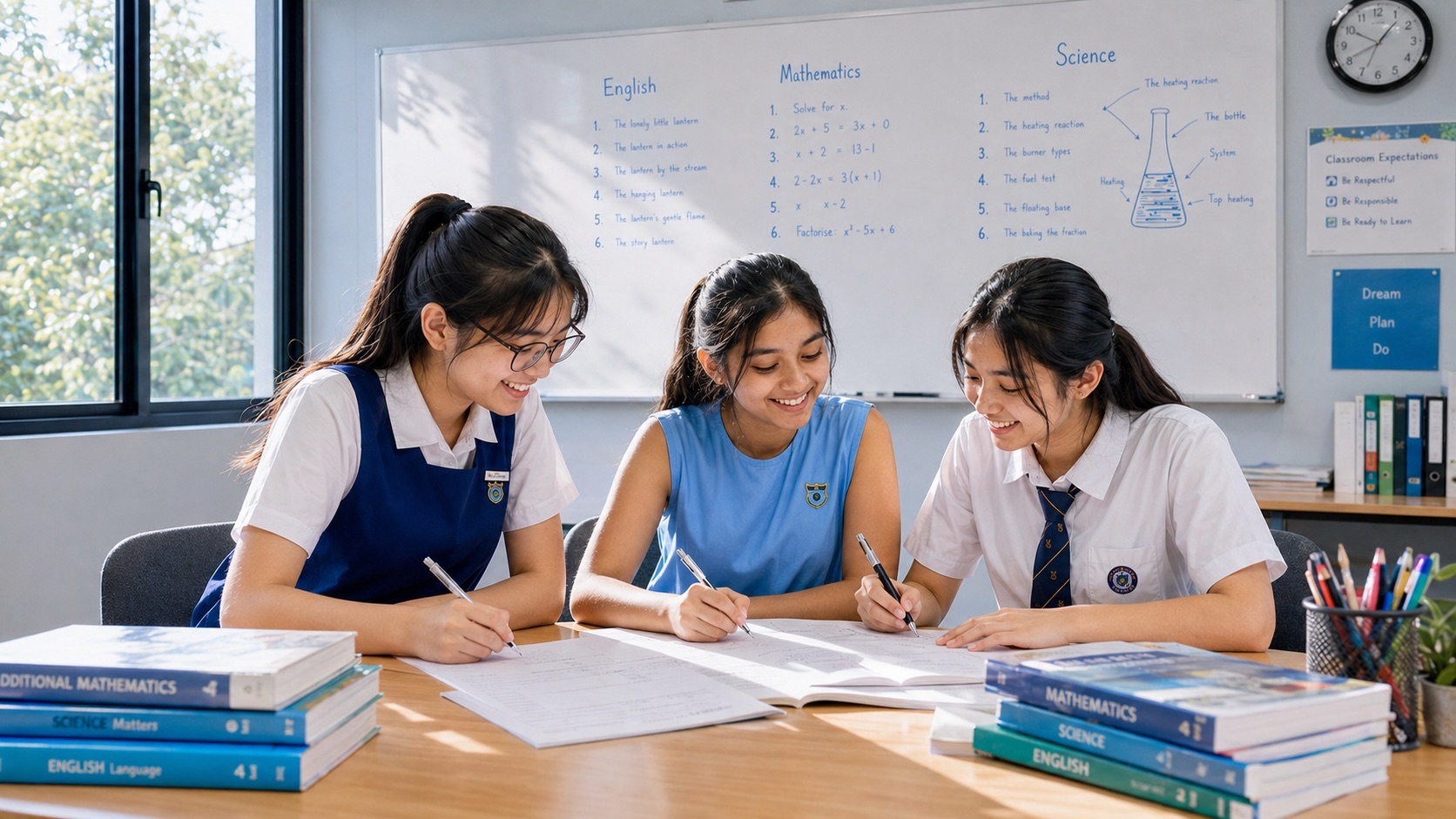
Creative writing improves through practice when the practice isolates a controllable decision, gives the writer evidence about the result and then transfers the skill into new material. Writing more can help, but volume alone does not guarantee learning. A useful practice system alternates complete creative work with focused laboratories for character, scene, dialogue, description, structure, sentences, revision and reader response.
This guide explains how to practise creative writing, which writing exercises build transferable skill, how to use deliberate practice without making writing mechanical and how to design a sustainable writing routine. It includes original exercises, diagnostics, model attempts, feedback loops, transfer tests and a four-week training cycle using eduKateSG’s fictional resident cast.
The practical answer to “how do I get better at creative writing?” is to stop treating every weakness as a request to “write more.” First locate the bottleneck. If scenes have no change, practise scene turns. If dialogue explains too much, practise intention and subtext. If endings feel unearned, practise setup and return. Then use the skill in a fresh complete piece so the exercise does not become an isolated trick.
Quick Read: Diagnose → Isolate → Practise → Feedback → Transfer → Integrate
WHOLE ATTEMPT → BOTTLENECK → SMALL EXERCISE → IMMEDIATE EVIDENCE → VARIATION → NEW MATERIAL → WHOLE ATTEMPT. The cycle begins and ends with actual writing. Exercises are temporary laboratories, not replacements for stories, poems, scripts or essays.
The central laboratory follows Ethan, whose stories repeatedly begin well and then flatten because scenes end in the same state they began. Instead of assigning him ten more generic stories, the practice system narrows the problem to scene change. He trains one decision, receives evidence, varies the task and then returns to a new complete story where no prompt tells him when to use the skill.
For the full process, use From First Idea to Finished Draft. For reading-to-writing transfer, use Reading Like a Writer. This article owns deliberate creative-writing practice as a training architecture.
1. Practise the Decision, Not the Label
“Practise dialogue” is broad. “Write eight lines in which each reply changes what the other person can plausibly say next” is controllable. “Practise description” is broad. “Describe one room from three different purposes and change the selected details” is controllable.
A useful exercise has a visible operation. The writer can attempt it, compare versions and explain what changed. This does not reduce art to a checklist; it makes one part of craft available for focused attention.
After the exercise, remove the instruction and test the skill in a new piece. If it disappears without the prompt, more transfer practice is needed.
2. Start with a Whole Attempt So the Bottleneck Is Real
Exercises become more useful when they answer a problem observed in actual writing. Ethan’s scenes contain competent sentences and clear settings, but conversations end without changed knowledge, intention or options. That is evidence for a scene-turn exercise.
Do not diagnose from one sentence alone. Look for repeated patterns across several attempts. A single weak ending may be local; six similar endings suggest a practice target.
Keep samples over time. Progress becomes easier to see when the learner can compare independent work rather than relying on memory.
3. Narrow the Exercise Enough to Produce Fast Evidence
A 300-word scene can reveal whether the exit state differs from the entry state. A 90,000-word novel is a poor unit for testing one small craft change quickly.
Small exercises reduce the cost of failure. Writers can try an extreme version, reverse it and compare. This supports experimentation without requiring every attempt to become publishable.
The exercise should be difficult enough to require attention but small enough to repeat with variation.
4. Feedback Should Match the Exercise
If the target is scene change, feedback should identify entry state, exit state and the action that caused the difference. Correcting every adjective during the same exercise can bury the learning signal.
One focused question often produces better practice feedback than a page of general comments. “What became possible at the end that was not possible at the start?” directly tests the skill.
For the specialist feedback route, use Feedback, Editing and Rewriting.
5. Variation Prevents Memorised Performance
Repeat the same skill with different characters, settings, stakes and forms. Ethan can practise scene change through a borrowed key, a missed bus, a shared recipe and a disagreement over a photograph.
If the learner succeeds only when the prompt says “now create a turning point,” the skill is not yet independent. Variation helps recognition: when does this move become useful without being named?
Transfer is the test that separates a completed exercise from a developing capability.
Part Two: The Core Creative Writing Practice Laboratories
6. Scene Change Laboratory
Write a scene whose entry state can be stated in one sentence: “Mira does not have permission to use the room.” By the end, change knowledge, permission, intention, relationship or resources.
After drafting, write the exit state. If it is identical, decide whether deliberate accumulation justifies the scene or whether a choice needs to alter conditions.
Keep the attempt short enough to repeat. Record one observation, one revision and one transfer target. The notebook should show decisions, not just word counts.
7. Character Choice Laboratory
Give a character two plausible options with different costs. Do not label one correct. Write only the decision and immediate consequence.
The exercise trains character through trade-off rather than trait description. Repeat with another character facing the same options and compare.
Keep the attempt short enough to repeat. Record one observation, one revision and one transfer target. The notebook should show decisions, not just word counts.
8. Dialogue Response Laboratory
Write ten lines. Every reply must respond to the previous move by answering, evading, challenging, narrowing or redirecting it.
Delete lines that merely wait for the speaker’s turn. Then transfer the mechanism into a complete scene with action and setting.
Keep the attempt short enough to repeat. Record one observation, one revision and one transfer target. The notebook should show decisions, not just word counts.
9. Description through Purpose Laboratory
Describe the same room for someone cleaning it, hiding in it and deciding whether to rent it. Keep the room physically stable.
Compare which details enter because purpose changes. The skill is selective attention, not adjective accumulation.
Keep the attempt short enough to repeat. Record one observation, one revision and one transfer target. The notebook should show decisions, not just word counts.
10. Point-of-View Access Laboratory
Write one event from two viewpoints. List what each can know directly, infer and not know.
The exercise succeeds when reader questions change because access changes, not merely because pronouns change.
Keep the attempt short enough to repeat. Record one observation, one revision and one transfer target. The notebook should show decisions, not just word counts.
11. Sentence Emphasis Laboratory
Take one factual sentence and rearrange it three ways. Foreground person, place and consequence separately.
Read each in paragraph context. Choose based on attention rather than unusualness.
Keep the attempt short enough to repeat. Record one observation, one revision and one transfer target. The notebook should show decisions, not just word counts.
12. Opening Promise Laboratory
Write three openings to one premise: contradiction, action and voice. For each, state what the reader is invited to expect.
Then draft only the version whose promise matches the story you actually want to develop.
Keep the attempt short enough to repeat. Record one observation, one revision and one transfer target. The notebook should show decisions, not just word counts.
13. Ending Return Laboratory
Choose an object or question from the opening. Write three endings that return to it with changed meaning, function or relationship.
Avoid repeating merely for symmetry. The intervening story must alter the return.
Keep the attempt short enough to repeat. Record one observation, one revision and one transfer target. The notebook should show decisions, not just word counts.
14. Imagery Relationship Laboratory
Write one literal description. Add one comparison and state what relation it creates. Remove it and compare.
Keep imagery that clarifies viewpoint, tone or meaning. Discard imagery whose main function is to sound literary.
Keep the attempt short enough to repeat. Record one observation, one revision and one transfer target. The notebook should show decisions, not just word counts.
15. Research Constraint Laboratory
Identify one real-world dependency in a draft and verify it. List three ways the fact changes available actions.
Use research to generate choices, not to display knowledge.
Keep the attempt short enough to repeat. Record one observation, one revision and one transfer target. The notebook should show decisions, not just word counts.
16. Revision Diagnosis Laboratory
Reverse-outline a complete draft. One line per scene or paragraph: what happens and what changes.
Find repeated functions and missing foundations before touching sentence polish.
Keep the attempt short enough to repeat. Record one observation, one revision and one transfer target. The notebook should show decisions, not just word counts.
17. Transfer Laboratory
Choose one skill from the week and write new material without looking at the exercise model. Afterwards, explain where the skill appeared.
Independent recognition is the goal. If the skill appears only after prompting, vary and repeat.
Keep the attempt short enough to repeat. Record one observation, one revision and one transfer target. The notebook should show decisions, not just word counts.
Part Three: Complete Practice Case Study—The Door Never Opens
Ethan’s story began with a locked music room.
It ended six hundred words later with the room still locked and the protagonist still wondering who had the key.
“Atmospheric,” Ethan said.
Aisha looked at the draft.
“Yes.”
“But?”
“Nothing changes.”
“The weather changes.”
“It starts raining harder.”
“Change.”
Aisha drew two boxes on a sheet of paper.
ENTRY STATE: Lena cannot enter the music room.
EXIT STATE: ?
Ethan read the second box.
“Lena still cannot enter.”
“What does she know at the end that she didn’t know at the start?”
He looked through the story.
“That it is raining harder.”
Aisha waited.
“You’re very committed to not respecting weather.”
“I respect weather. I’m asking what the scene changes.”
Ethan took the paper.
His story contained a corridor, an old noticeboard, a locked door, a message from Lena’s friend and several paragraphs of good rain.
The friend’s message said: RUNNING LATE.
Nothing in the message altered the problem.
“So what am I supposed to add? A dramatic key?”
“No. We’re not fixing this story yet.”
Aisha gave him an exercise.
Write 250 words. A character begins without permission to enter a room. By the end, permission changes but the door stays closed.
“That is annoyingly specific.”
“Good.”
Ethan wrote.
In the exercise, Jo wanted access to a workshop after hours. He called the supervisor, explained why he needed a forgotten portfolio and received permission to return the next morning before opening. The door stayed closed. The available future changed.
Aisha read it.
“Entry?”
“Cannot enter.”
“Exit?”
“Still cannot enter now, but can enter tomorrow at eight.”
“What caused the change?”
“He asked.”
“Good.”
“That feels extremely small.”
“Small enough to see.”
The second exercise changed knowledge instead of permission.
Mira waited outside a locked cupboard believing her notebook was inside. By the end, she learned Ben had moved it to the front desk. The cupboard stayed locked; the problem disappeared.
The third changed intention.
Adrian arrived at a locked rehearsal room determined to retrieve a recording. After hearing the recording had already been backed up, he chose not to enter.
Ethan put the three exercises beside his original story.
“They all solve the problem.”
“Not exactly. They change the state.”
“Isn’t that solving it?”
“Sometimes the new state is worse.”
The fourth exercise proved this.
Clara began with permission to use a studio. Halfway through, she ignored a safety instruction. By the end, permission was withdrawn.
“That one changes,” Ethan said.
“Yes.”
“I dislike it.”
“Also yes.”
They returned to the music-room story.
Aisha did not tell him what to add.
“What could change without opening the door?” she asked.
Ethan read the friend’s message again.
RUNNING LATE.
He changed it.
DON’T WAIT. I LEFT THE KEY WITH RYAN.
Now Lena had information.
Too easy.
She could simply find Ryan.
Ethan deleted it.
New message: DON’T WAIT. I GAVE THE KEY BACK TO THE OFFICE.
The office was closed.
Still static.
He stared at the noticeboard he had described for half a page.
Among the notices was a schedule for tomorrow’s rehearsal.
Ethan had added it for atmosphere.
Now he read it as information.
Lena had believed she needed the room tonight because her group performed first thing tomorrow. The schedule showed the rehearsal had moved to afternoon.
“That’s convenient,” he said.
Aisha said, “Was the schedule already there?”
“Yes.”
“Was the rehearsal time already established?”
“No.”
“Then establish it earlier if it matters.”
Ethan revised the opening. Lena came because she believed the group rehearsed at eight the next morning. Her friend was late with the key. Rain increased. While waiting, Lena read the updated noticeboard and discovered the session had been moved to two.
The door never opened.
The scene now ended with Lena leaving.
“That’s almost embarrassingly simple,” Ethan said.
“Can you use it in another story?”
“A noticeboard?”
“No.”
He looked at the four exercises.
“Change the available next move.”
“Good.”
A week later, Ethan wrote a story about a bicycle with a broken chain.
Nobody mentioned scenes.
Nobody mentioned entry or exit states.
Halfway through, the protagonist learned that the friend she was racing to meet had already walked back towards her.
The bicycle remained broken.
The direction of the story changed.
Aisha read the draft without commenting on the technique.
At the end she asked one question.
“What became possible?”
Ethan answered without looking at his notes.
“They can meet halfway.”
The exercise was no longer visible.
The skill was.
18. Why the Training Works
Ethan’s original problem is not “bad writing.” His prose can already create atmosphere. The bottleneck is narrower: scenes repeatedly end without changed options, knowledge, intention or relationship. Naming the bottleneck protects strengths that do not need repair.
The first exercises make the target visible by holding one condition stable: the door remains closed. This prevents Ethan from solving every scene through a physical event. He learns that narrative change can occur through permission, knowledge or intention.
Variation prevents memorisation. The fourth exercise reverses the direction by withdrawing permission. Ethan therefore learns the category “changed state” rather than the template “locked door becomes accessible.”
The bicycle story is the transfer test. No instruction tells Ethan to create a scene turn. He recognises the need independently and changes the available next move through new information. The exercise has become skill when the scaffolding can disappear.
Part Four: Practice Failure Laboratories
19. Writing More without Diagnosing
Locate the bottleneck in independent work. Do not prescribe a drill merely because it is popular. The exercise should answer an observed pattern.
Reduce the task until the target decision can be seen and repeated. Keep unrelated corrections out of the main feedback channel unless they prevent understanding.
Vary the material and gradually remove prompts. If performance collapses when the instruction disappears, the learner still needs recognition practice.
Return to a complete piece. Craft exists to serve integrated writing. A laboratory that never reconnects to whole work can produce excellent exercises and weak stories.
20. Collecting Exercises without Completing Stories
Locate the bottleneck in independent work. Do not prescribe a drill merely because it is popular. The exercise should answer an observed pattern.
Reduce the task until the target decision can be seen and repeated. Keep unrelated corrections out of the main feedback channel unless they prevent understanding.
Vary the material and gradually remove prompts. If performance collapses when the instruction disappears, the learner still needs recognition practice.
Return to a complete piece. Craft exists to serve integrated writing. A laboratory that never reconnects to whole work can produce excellent exercises and weak stories.
21. Practising Only Strengths
Locate the bottleneck in independent work. Do not prescribe a drill merely because it is popular. The exercise should answer an observed pattern.
Reduce the task until the target decision can be seen and repeated. Keep unrelated corrections out of the main feedback channel unless they prevent understanding.
Vary the material and gradually remove prompts. If performance collapses when the instruction disappears, the learner still needs recognition practice.
Return to a complete piece. Craft exists to serve integrated writing. A laboratory that never reconnects to whole work can produce excellent exercises and weak stories.
22. Correcting Everything at Once
Locate the bottleneck in independent work. Do not prescribe a drill merely because it is popular. The exercise should answer an observed pattern.
Reduce the task until the target decision can be seen and repeated. Keep unrelated corrections out of the main feedback channel unless they prevent understanding.
Vary the material and gradually remove prompts. If performance collapses when the instruction disappears, the learner still needs recognition practice.
Return to a complete piece. Craft exists to serve integrated writing. A laboratory that never reconnects to whole work can produce excellent exercises and weak stories.
23. Repeating One Prompt until the Answer Is Memorised
Locate the bottleneck in independent work. Do not prescribe a drill merely because it is popular. The exercise should answer an observed pattern.
Reduce the task until the target decision can be seen and repeated. Keep unrelated corrections out of the main feedback channel unless they prevent understanding.
Vary the material and gradually remove prompts. If performance collapses when the instruction disappears, the learner still needs recognition practice.
Return to a complete piece. Craft exists to serve integrated writing. A laboratory that never reconnects to whole work can produce excellent exercises and weak stories.
24. Measuring Progress Only by Word Count
Locate the bottleneck in independent work. Do not prescribe a drill merely because it is popular. The exercise should answer an observed pattern.
Reduce the task until the target decision can be seen and repeated. Keep unrelated corrections out of the main feedback channel unless they prevent understanding.
Vary the material and gradually remove prompts. If performance collapses when the instruction disappears, the learner still needs recognition practice.
Return to a complete piece. Craft exists to serve integrated writing. A laboratory that never reconnects to whole work can produce excellent exercises and weak stories.
25. Using Model Answers as Scripts
Locate the bottleneck in independent work. Do not prescribe a drill merely because it is popular. The exercise should answer an observed pattern.
Reduce the task until the target decision can be seen and repeated. Keep unrelated corrections out of the main feedback channel unless they prevent understanding.
Vary the material and gradually remove prompts. If performance collapses when the instruction disappears, the learner still needs recognition practice.
Return to a complete piece. Craft exists to serve integrated writing. A laboratory that never reconnects to whole work can produce excellent exercises and weak stories.
26. Getting Feedback Too Broad to Act On
Locate the bottleneck in independent work. Do not prescribe a drill merely because it is popular. The exercise should answer an observed pattern.
Reduce the task until the target decision can be seen and repeated. Keep unrelated corrections out of the main feedback channel unless they prevent understanding.
Vary the material and gradually remove prompts. If performance collapses when the instruction disappears, the learner still needs recognition practice.
Return to a complete piece. Craft exists to serve integrated writing. A laboratory that never reconnects to whole work can produce excellent exercises and weak stories.
27. Increasing Difficulty before Control Exists
Locate the bottleneck in independent work. Do not prescribe a drill merely because it is popular. The exercise should answer an observed pattern.
Reduce the task until the target decision can be seen and repeated. Keep unrelated corrections out of the main feedback channel unless they prevent understanding.
Vary the material and gradually remove prompts. If performance collapses when the instruction disappears, the learner still needs recognition practice.
Return to a complete piece. Craft exists to serve integrated writing. A laboratory that never reconnects to whole work can produce excellent exercises and weak stories.
28. Keeping Exercises Too Easy
Locate the bottleneck in independent work. Do not prescribe a drill merely because it is popular. The exercise should answer an observed pattern.
Reduce the task until the target decision can be seen and repeated. Keep unrelated corrections out of the main feedback channel unless they prevent understanding.
Vary the material and gradually remove prompts. If performance collapses when the instruction disappears, the learner still needs recognition practice.
Return to a complete piece. Craft exists to serve integrated writing. A laboratory that never reconnects to whole work can produce excellent exercises and weak stories.
29. Mistaking Supported Performance for Independent Skill
Locate the bottleneck in independent work. Do not prescribe a drill merely because it is popular. The exercise should answer an observed pattern.
Reduce the task until the target decision can be seen and repeated. Keep unrelated corrections out of the main feedback channel unless they prevent understanding.
Vary the material and gradually remove prompts. If performance collapses when the instruction disappears, the learner still needs recognition practice.
Return to a complete piece. Craft exists to serve integrated writing. A laboratory that never reconnects to whole work can produce excellent exercises and weak stories.
30. Never Returning to Whole Creative Work
Locate the bottleneck in independent work. Do not prescribe a drill merely because it is popular. The exercise should answer an observed pattern.
Reduce the task until the target decision can be seen and repeated. Keep unrelated corrections out of the main feedback channel unless they prevent understanding.
Vary the material and gradually remove prompts. If performance collapses when the instruction disappears, the learner still needs recognition practice.
Return to a complete piece. Craft exists to serve integrated writing. A laboratory that never reconnects to whole work can produce excellent exercises and weak stories.
Part Five: Four-Week Creative Writing Training Cycle
31. Week One: Diagnose from Real Work
Complete two short pieces. Reverse-outline them and identify one repeated bottleneck. Choose only one primary skill for the week.
Run three small exercises targeting that decision. End with one new piece where the prompt is removed.
32. Week Two: Vary the Skill
Repeat the same underlying skill through different characters, settings and forms. Make one exercise easier and one harder.
Seek focused feedback that tests only the target relationship. Record what transfers and what still requires prompting.
33. Week Three: Integrate a Second Skill
Keep the first skill active while adding one adjacent target. Scene change might combine with dialogue response; viewpoint might combine with description selection.
Do not demand equal attention to ten dimensions. One skill can remain primary while the second becomes a controlled complication.
34. Week Four: Independent Performance
Write a complete piece from a fresh prompt or self-generated idea without consulting the exercise notes.
Afterwards, diagnose where trained skills appeared spontaneously. Compare with the month’s opening samples and choose the next bottleneck.
35. Transfer Challenge 1
Select a skill from an earlier laboratory. Change the genre or form, remove the original props and create a new constraint. Draft without reopening the model.
After writing, identify where the skill appeared and whether the new form required a different solution. Record one limit: when would this technique be inappropriate or unnecessary?
Use the answer to update your craft ledger. A mature skill includes knowing when not to use it.
36. Transfer Challenge 2
Select a skill from an earlier laboratory. Change the genre or form, remove the original props and create a new constraint. Draft without reopening the model.
After writing, identify where the skill appeared and whether the new form required a different solution. Record one limit: when would this technique be inappropriate or unnecessary?
Use the answer to update your craft ledger. A mature skill includes knowing when not to use it.
37. Transfer Challenge 3
Select a skill from an earlier laboratory. Change the genre or form, remove the original props and create a new constraint. Draft without reopening the model.
After writing, identify where the skill appeared and whether the new form required a different solution. Record one limit: when would this technique be inappropriate or unnecessary?
Use the answer to update your craft ledger. A mature skill includes knowing when not to use it.
38. Transfer Challenge 4
Select a skill from an earlier laboratory. Change the genre or form, remove the original props and create a new constraint. Draft without reopening the model.
After writing, identify where the skill appeared and whether the new form required a different solution. Record one limit: when would this technique be inappropriate or unnecessary?
Use the answer to update your craft ledger. A mature skill includes knowing when not to use it.
39. Transfer Challenge 5
Select a skill from an earlier laboratory. Change the genre or form, remove the original props and create a new constraint. Draft without reopening the model.
After writing, identify where the skill appeared and whether the new form required a different solution. Record one limit: when would this technique be inappropriate or unnecessary?
Use the answer to update your craft ledger. A mature skill includes knowing when not to use it.
40. Transfer Challenge 6
Select a skill from an earlier laboratory. Change the genre or form, remove the original props and create a new constraint. Draft without reopening the model.
After writing, identify where the skill appeared and whether the new form required a different solution. Record one limit: when would this technique be inappropriate or unnecessary?
Use the answer to update your craft ledger. A mature skill includes knowing when not to use it.
41. Transfer Challenge 7
Select a skill from an earlier laboratory. Change the genre or form, remove the original props and create a new constraint. Draft without reopening the model.
After writing, identify where the skill appeared and whether the new form required a different solution. Record one limit: when would this technique be inappropriate or unnecessary?
Use the answer to update your craft ledger. A mature skill includes knowing when not to use it.
42. Transfer Challenge 8
Select a skill from an earlier laboratory. Change the genre or form, remove the original props and create a new constraint. Draft without reopening the model.
After writing, identify where the skill appeared and whether the new form required a different solution. Record one limit: when would this technique be inappropriate or unnecessary?
Use the answer to update your craft ledger. A mature skill includes knowing when not to use it.
Creative Writing Practice FAQ
How do I practise creative writing? Alternate complete writing with focused exercises based on problems observed in your own drafts. Practise one controllable decision, vary it and transfer it into new material.
Does writing every day make you better? Regular writing can increase fluency and continuity, but improvement depends on what you practise, what feedback you receive and whether you revise recurring weaknesses.
What are the best creative writing exercises? The best exercise is the one matched to the current bottleneck. Dialogue, viewpoint, scene, description and sentence drills solve different problems.
How long should a writing exercise be? Long enough to expose the target decision and short enough to repeat. Many focused exercises can work in a few hundred words or less.
Should beginners write full stories? Yes, alongside focused practice. Complete pieces teach endings, integration and revision in ways isolated drills cannot.
How do I know what to practise? Review several independent samples and look for repeated bottlenecks. Ask what decision repeatedly fails or requires heavy support.
How do I measure creative writing progress? Compare independent samples over time, track the level of support required and record whether trained skills transfer to new material. Word count alone is insufficient.
Should I use model answers? Models can make decisions visible, but they should become objects of analysis rather than scripts. Transfer the mechanism into different material.
How much feedback do I need? Enough to test the target skill. Focused feedback can be more useful than comprehensive correction during deliberate practice.
What if an exercise feels mechanical? That can be acceptable temporarily. A drill isolates one relationship so it becomes controllable. Return to whole creative work where multiple decisions interact naturally.
How do I build a writing habit? Reduce re-entry cost, choose a sustainable schedule, leave clear next actions and alternate demanding creative sessions with smaller practice tasks.
When have I learned a skill? When you can recognise when it is useful and apply it independently in new material without the original prompt or model.
Further Routes and Scope
This article presents a practical educational training framework, not a claim that artistic development can be reduced to one universal schedule. Writers differ in goals, experience, genre, available time and preferred process. The useful principle is adaptive practice: diagnose from evidence and change the exercise when the bottleneck changes.
Within eduKate, continue through From First Idea to Finished Draft, Reading Like a Writer, Feedback, Editing and Rewriting, Creative Writing Lessons and From Writing Exercise to Real Skill. These specialist owners remain distinct from this integrated practice system.
Practice Becomes Skill When the Exercise Can Disappear
Ethan does not improve because somebody gives him more pages to fill. He improves because a repeated weakness becomes a precise decision he can practise: make the scene change the available next move. The locked-door exercises expose the relationship; variation broadens it; the bicycle story proves transfer.
Write whole work. Diagnose. Isolate. Repeat with variation. Get focused evidence. Remove the prompt. Transfer. Integrate. Then diagnose again. Creative writing practice is most powerful when it produces not dependence on exercises, but the ability to make better decisions after the exercise is gone.