
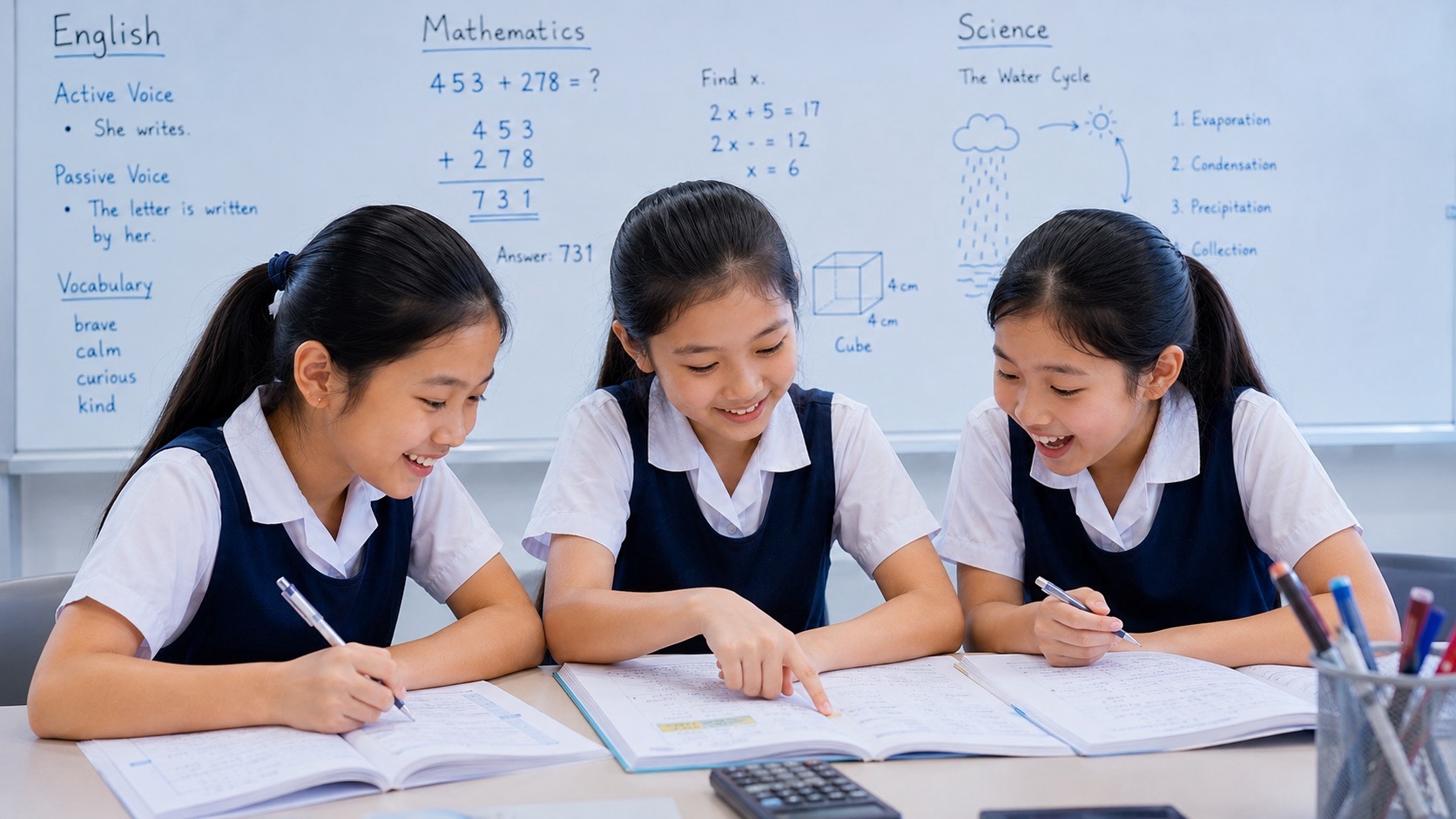
Primary 2 Mathematics Tuition | Outram Park is for families looking for P2 Math tuition around Outram Park and wanting a programme that strengthens the actual mathematical system beneath schoolwork. Primary 2 Mathematics expands number sense, place value, addition and subtraction, multiplication and division, fractions, money, measurement, time, geometry, data and word problems. A useful P2 tuition programme should therefore be MOE-aligned, concept-first and diagnostic: it should identify the first weak link, rebuild it clearly, then develop arithmetic fluency, model drawing, problem-solving, accuracy and independent checking.
Parents comparing Primary 2 Maths tuition in Outram Park often search for small classes, experienced tutors, MOE syllabus alignment, problem sums, model method, multiplication tables, mental Mathematics, worksheets and school-assessment preparation. Those phrases matter only when they describe a coherent learning process. The important questions are whether a student understands hundreds, tens and ones; can move between concrete, pictorial and symbolic representations; can choose the right operation in a word problem; can retrieve basic facts without overloading working memory; and can explain why an answer is reasonable.
eduKateSG treats Primary 2 Mathematics tuition for Outram Park families as a year of consolidation and expansion. P2 is where an apparently small P1 weakness can become visible because the number range widens, operations become more demanding and questions expect more independent interpretation. This guide therefore connects to the broader Mathematics Learning Hub and the main Primary 2 Mathematics Tuition owner while remaining a location-specific route for Outram Park families.
Primary 2 is the year when foundations must begin to carry more weight
Primary 1 introduces the basic architecture of school Mathematics. Primary 2 asks that architecture to carry a larger load. Numbers become larger. Addition and subtraction demand more secure place-value reasoning. Multiplication and division move from early equal-group ideas toward more dependable facts and strategies. Fractions introduce a new way to describe quantity. Money, time, length and mass require the student to connect numbers to units and real situations.
This is why a child can look comfortable in P1 and suddenly appear inconsistent in P2. The problem is not necessarily that P2 is “hard”. The problem may be that a P1 strategy no longer scales. Counting every object works for small quantities but becomes inefficient. Guessing an operation from one keyword fails when questions vary. Remembering a procedure without understanding place value becomes unreliable when regrouping or larger numbers appear.
Good tuition recognises this transition. It does not respond to every error with more of the same worksheet. It asks what earlier idea the current question depends on and whether that idea is genuinely secure.
The first job is diagnosis, not acceleration
At P2, parents can be tempted by advanced material because it looks like progress. But acceleration is useful only when the current system is stable. If a child is weak in place value, moving into harder arithmetic multiplies the problem. If a learner cannot represent a simple word problem, giving more complicated problem sums increases guessing rather than reasoning.
A diagnostic lesson checks number representation, place value, fact fluency, calculation method, mathematical language, problem interpretation, visual modelling, checking habits and retention. The tutor also observes how the child behaves when uncertain. Does the student count from one? Copy a peer? Choose the first familiar operation? Stop immediately? Draw an unlabelled picture? Re-read the question? These behaviours reveal how the learner currently manages difficulty.
The diagnosis should result in a repair plan. “Needs more practice” is not specific enough. “Confuses the value of the tens digit when decomposing three-digit numbers” is teachable. “Understands multiplication as equal groups but cannot retrieve 2, 5 and 10 facts reliably” is teachable. “Can calculate but selects the wrong operation in comparison problems” is teachable.
Number sense must expand with the number range
As numbers grow, number sense becomes more important, not less. A P2 learner should gradually develop a feel for magnitude and benchmarks. The child should know that 498 is close to 500, that 302 is slightly more than 300, and that 750 sits between 700 and 800. These ideas support estimation, comparison and checking.
Number sense also includes flexible decomposition. A learner can see 286 as 200 + 80 + 6, but should eventually also see 286 as 280 + 6, 300 − 14 or 250 + 36 when a calculation makes one representation more useful than another. This flexibility is not an advanced trick. It is how efficient mental Mathematics grows.
Tuition can develop this through number lines, place-value charts, quick estimation, comparison tasks and “how else could we make this number?” questions. A child who can move between representations is less dependent on one rigid procedure.
Hundreds, tens and ones: place value becomes the organising principle
Place value is central to P2 because larger numbers cannot be managed reliably as strings of digits. The learner needs to understand that a digit’s value depends on position. In 427, the 4 represents four hundreds, the 2 represents two tens and the 7 represents seven ones. But strong understanding goes further: the number can be partitioned and recombined in several equivalent ways.
A child who understands place value can reason about addition and subtraction before applying a formal method. For 398 + 25, the learner may notice that adding 2 reaches 400 and then add the remaining 23. For 602 − 198, the learner may estimate that the result should be a little above 400. These judgments create a checking system around the algorithm.
Weak place value often appears as regrouping errors, reversed digits, inability to compare numbers or confusion when zeros appear inside a numeral. A tutor should repair the concept with grouped materials, diagrams and expanded notation before demanding faster written calculation.
Addition and subtraction should become both accurate and explainable
By P2, addition and subtraction are not new operations, but the demands increase. Larger numbers require stronger place-value control and clearer written organisation. A student should know not only how to carry out a method but also what each step represents.
When regrouping is taught purely as “carry the one” or “borrow”, children can perform the moves without understanding the exchange. Better teaching makes the exchange explicit: ten ones can be regrouped as one ten; one ten can be decomposed into ten ones. The notation then records a place-value transformation rather than a mysterious instruction.
Accuracy routines matter. Align place values. Copy the numbers correctly. Mark the operation. Estimate the likely size of the answer. Calculate. Then use inverse reasoning or a rough estimate to check. These habits are small enough for a seven- or eight-year-old, but powerful enough to remain useful much later.
Arithmetic fluency: facts should become available for thinking
Fluency is not the same as rushing. A fluent learner can retrieve or reconstruct useful facts without spending excessive attention. That matters because working memory is limited. If a child must repeatedly count to solve 7 + 8, there is less mental space left for a multi-step problem or a new concept.
Effective fact practice is organised around relationships. Doubles support near doubles. Ten facts support complements. Known addition facts support subtraction. Multiplication facts can be connected to skip counting, arrays and repeated addition. Division facts can be connected to the inverse of multiplication.
The tutor should also distinguish a retrieval problem from a conceptual one. A child may understand multiplication perfectly but still need spaced practice to make basic facts faster. Another may recite a table yet fail to recognise an equal-groups situation. The same score can conceal different needs.
Multiplication must mean equal groups before tables become automatic
Multiplication tables are valuable, but memorisation should sit on top of meaning. A P2 learner needs to understand that 4 × 3 can represent four groups of three or three groups of four, depending on the convention being used in the question and classroom. Arrays, equal groups and repeated addition make this relationship visible.
When the structure is clear, fact learning becomes easier because the student sees patterns. Twos are doubles. Fives connect to counting in fives and the structure of our number system. Tens shift place value predictably. Related facts can be derived instead of memorised independently.
Tuition should move gradually from concrete groups to diagrams, then to number sentences and mental retrieval. The goal is not permanent dependence on objects. It is to ensure that the symbol retains meaning after the object disappears.
Division should be taught as sharing and grouping
Division is often harder because two related situations can produce the same calculation. A quantity can be shared into a known number of equal groups, or divided into groups of a known size. Children benefit from seeing both interpretations with objects and drawings.
For example, twelve counters shared equally among three children answers “how many in each group?” Twelve counters arranged in groups of three answers “how many groups?” The calculation is related, but the unknown is different. This distinction becomes important in word problems.
A strong tutor connects division to multiplication facts. If 3 × 4 = 12, then 12 ÷ 3 = 4 and 12 ÷ 4 = 3. This family of relationships reduces isolated memorisation and strengthens checking.
Fractions introduce a different way of thinking about quantity
Fractions can become difficult when children treat the numerator and denominator as two unrelated whole numbers. At P2, the foundation should be strongly visual. A fraction describes equal parts of a whole or set. The equal-part condition matters.
A child should experience halves, thirds and quarters through folding, partitioning, shading and sharing. The tutor can ask whether two differently shaped parts are still equal, whether a shaded region represents one half, and how many equal parts make the whole. Language such as numerator and denominator may be introduced appropriately, but meaning should lead terminology.
The strongest early fraction understanding includes comparison with familiar benchmarks. One half should feel like a meaningful quantity, not merely the symbols 1/2. That intuition later supports equivalent fractions, addition and subtraction of fractions, ratio and percentage.
Model drawing should become a reasoning tool
In P2, model drawing can begin to do more work. A simple bar model can represent a total and its parts, a comparison between two quantities, or a change over time. The model is useful because it shows the relationship between quantities before calculation begins.
Children sometimes learn to draw bars mechanically. That defeats the purpose. The tutor should ask: What does this bar stand for? Why is this part shorter? Which number is the total? What is unknown? If the student cannot answer, the drawing has become decoration rather than representation.
Alicia may solve familiar part-whole questions quickly but become confused when the unknown is the starting amount rather than the final total. A model helps her preserve the relationship while the surface wording changes. The important learning is not one diagram. It is the habit of externalising structure.
Word problems should not be reduced to keywords
Keyword rules are attractive because they seem efficient: “altogether” means add, “left” means subtract, “each” means multiply. Unfortunately, real questions do not obey such a simple code. The same word can appear in different structures, and some questions contain no helpful keyword at all.
A better process asks the child to identify quantities, units and relationships. What is known? What changed? What is being compared? What is the unknown? Can the situation be drawn? Only after the relationship is clear should the operation be selected.
Tricia may calculate accurately but choose the wrong operation because she starts working before reading the whole question. Her repair routine is to pause after reading, state the question in her own words, label the known quantities and draw a simple model. At first this slows her down. Later it saves time because fewer questions need to be restarted.
Two-step thinking begins with keeping track of state
As questions become more complex, children need to understand that one calculation can produce information required for the next. The intermediate answer is not the final answer. This sounds obvious to adults but creates a new control demand for younger learners.
A tutor can teach the child to label each intermediate result. If the first step finds the number of books remaining, write “books remaining” beside the answer before continuing. This protects meaning and reduces the chance that a number is reused incorrectly.
Students should also learn to look ahead before calculating. What will this step tell me? Will that information answer the question, or will I need it for another step? Planning even one step ahead is an early form of mathematical executive control.
Money: arithmetic becomes attached to value and units
Money questions look familiar because children encounter prices outside school. But mathematical money work requires careful unit handling, comparison and sometimes conversion between dollars and cents. A student can understand addition and still make a money error by dropping a unit or misreading notation.
Tuition can use realistic examples—combining prices, finding change, comparing costs—while keeping the mathematical structure explicit. The child should estimate first. If two items cost a little more than ten dollars together, an answer of one hundred dollars should immediately look suspicious.
Estimation is therefore part of accuracy. It gives the learner a rough expected range before exact calculation. This habit becomes increasingly important as calculations become longer.
Measurement teaches that a number without a unit can be incomplete
Length, mass and other measurement topics teach children that numbers describe quantities through units. The same numeral can mean very different things depending on whether it refers to centimetres, metres, grams or kilograms. Unit sense is therefore conceptual, not merely notational.
A child should learn to judge whether a unit is sensible. A pencil is more naturally measured in centimetres than kilometres. A schoolbag is more naturally described in kilograms than milligrams. These judgments connect Mathematics to physical experience and support estimation.
When measurement questions go wrong, the tutor should check whether the error comes from arithmetic, unit knowledge, reading a scale or understanding what is being measured. Each requires a different repair.
Time requires both number and structure
Time is unusual because the clock is not a simple base-ten representation. Children need to connect analogue positions, digital notation, hours, minutes and everyday sequences. A child who is generally strong in arithmetic may still find time difficult because the representation is different.
Tuition should use clocks, timelines and verbal descriptions. Ask the child to show a time, read a time, move forward by a small interval and explain what changed. A timeline is especially useful because it turns elapsed-time thinking into a visible sequence.
As with other topics, fluency should come after meaning. Fast clock reading is useful, but it should not be trained as isolated pattern recognition without an understanding of the hour and minute structure.
Geometry develops visual reasoning
Shape work is sometimes treated as vocabulary memorisation. Stronger teaching asks students to notice properties. What makes a square a square even when it is rotated? How is a rectangle alike or different? Which features matter and which are incidental?
The child should learn that orientation does not change identity. A square standing on a corner is still a square. This apparently simple idea builds a more general habit: mathematical objects are defined by properties, not by one familiar picture.
Geometry also develops spatial reasoning. Building, folding, rotating and decomposing shapes can improve the student’s ability to imagine transformations and parts. These skills later matter in area, volume, coordinate geometry and many problem-solving tasks.
Data and picture graphs require translation between representations
A picture graph is not just a colourful counting activity. It teaches that information can be encoded visually. The learner must understand what the symbols represent, read categories, compare values and sometimes use a scale.
Errors often come from overlooking the key, counting symbols rather than represented values, or reading the wrong category. The tutor can ask the child to describe the graph in a full sentence before calculating. Language strengthens interpretation.
Data work is an early form of evidence reading. The student learns to distinguish what the representation actually shows from what one merely assumes. That habit scales far beyond P2 Mathematics.
Conceptual understanding and procedural fluency should reinforce each other
Parents sometimes hear a false choice between “understanding” and “practice”. P2 needs both. Understanding tells the learner what a method means, when it applies and why it works. Practice reduces the attention required to execute it. Without understanding, procedures become brittle. Without fluency, even good reasoning can be overwhelmed by slow or inaccurate calculation.
The teaching cycle should move between explanation, guided examples, independent practice, retrieval and mixed application. A new method may be taught with a representation. It is then practised until stable. Later it returns without a prompt, mixed among other topics. Finally the student applies it in a problem where the method is not announced.
That final stage is important. School assessments rarely say, “Use this exact strategy now.” Students must recognise the structure and select a method independently.
A P2 diagnostic gap-repair cycle
A useful repair cycle has six steps: observe, locate, rebuild, practise, delay and transfer. Observe the actual error. Locate the earliest concept or process that failed. Rebuild it using the clearest representation. Practise a small set of matched questions. Delay before retesting. Then transfer the idea into a mixed or differently worded question.
If Alicia writes 304 as “34”, the tutor does not simply correct the numeral. The zero may reveal a place-value gap. Use hundreds, tens and ones, expanded notation and comparison with 340. Ask Alicia to build 304, 340 and 403 and explain how the position of each digit changes its value.
If Tricia knows multiplication facts but adds when a problem asks for equal groups, the weak link is not memory. It is representation. Return to arrays and groups, then compare an additive situation with a multiplicative one using similar numbers.
If Kai Kai solves correctly in lesson but cannot do the same task a week later, the issue may be retrieval and retention. Use spaced low-stakes review and require him to explain the method after a delay. A repair is not complete until it survives time.
School assessments are diagnostic evidence
A school worksheet, topical test or weighted assessment can reveal useful patterns if errors are classified. One wrong answer may come from a concept gap. Another from arithmetic fluency. Another from misreading. Another from a copied number. Another from a missing unit. Another from anxiety that caused the child to abandon checking.
The tutor should not treat every incorrect answer as equal. A concept error deserves reteaching. A retrieval error deserves spaced practice. An execution error deserves a routine. A representation error deserves modelling. A language error deserves explicit clarification.
This is more useful than simply redoing the entire paper. Repetition without diagnosis can leave the real failure untouched.
Examination confidence is built from recoverable routines
At P2, formal examination pressure should not dominate learning. But the child can begin building habits that later support examination confidence. Read the question for meaning. Mark the task. Draw or represent when necessary. Calculate clearly. Check the answer against the situation.
Confidence becomes stronger when the child knows what to do after a moment of uncertainty. Instead of freezing, the learner can use a recovery sequence: reread, identify known and unknown quantities, choose a representation, estimate, then solve. The routine gives uncertainty a pathway.
Repeated successful recovery matters more than motivational slogans. The student develops evidence that unfamiliar questions can be entered, analysed and solved.
Accuracy should be engineered, not demanded vaguely
“Be careful” is not an instructional method. If Kai Kai repeatedly copies numbers incorrectly, teach tracking. If he forgets units, add a final-unit check. If he loses place alignment, use squared paper or clear columns until the layout becomes stable. If he misses operation signs, create a deliberate sign-check before calculation.
Accuracy can be measured by error type. Over several weeks, the tutor can see whether transcription errors are falling, whether operation-selection errors are improving and whether checking catches more mistakes before submission.
This turns “carelessness” from a label into a set of trainable behaviours.
Mixed practice is where real independence begins
Topical practice is useful while a method is being learned. Mixed practice becomes essential once the method is stable. A page containing only subtraction tells the child exactly what to do. A page containing addition, subtraction, multiplication, division, time and a word problem forces the learner to recognise the structure.
This recognition is a core mathematical skill. The child must decide which knowledge applies. That is closer to school assessments and, much later, examination conditions.
Mixed practice also reveals false mastery. A student may perform perfectly when a chapter heading announces the method but become uncertain when the method is hidden among alternatives. The tutor needs to see that uncertainty because it is the next thing to teach.
Delayed retrieval protects learning from disappearing
Immediate success can be misleading. Right after a lesson, the method is active in working memory. The stronger question is whether the student can retrieve it days later. A well-designed tuition programme therefore revisits prior topics in small amounts.
Spaced retrieval can be short: two old facts, one place-value question, one word problem and one explanation. The purpose is not to overload the child. It is to keep important knowledge accessible enough that new learning can connect to it.
Over time, the learner’s Mathematics becomes a network rather than a sequence of forgotten chapters.
Alicia: fluent facts, weak place value
Alicia can add basic facts quickly and therefore appears strong. But when numbers move into the hundreds, she becomes inconsistent. She can read 572 yet struggles to explain the value of the 7. Her written methods begin to break when regrouping is required.
The tutor temporarily reduces calculation speed and rebuilds the representation. Alicia makes numbers with place-value materials, writes expanded form, compares similar numerals and explains exchanges between hundreds, tens and ones. She then returns to calculation and can explain why each regrouping step works.
Her improvement does not come from doing more sums. It comes from repairing the structure that the sums depend on.
Tricia: correct arithmetic, inconsistent word problems
Tricia’s arithmetic is accurate, but her problem sums fluctuate. She tends to scan for keywords and calculate before deciding what the quantities mean. When the wording changes, her answer changes even if the underlying structure is familiar.
The tutor introduces a fixed representation routine. Tricia states the question in her own words, labels known and unknown quantities, draws a bar or simple diagram and predicts the operation before calculating. Then she compares two questions that use similar vocabulary but require different operations.
Gradually she stops treating word problems as language puzzles with secret keywords. She starts seeing mathematical relationships beneath the sentences.
Kai Kai: understanding is present, execution is unstable
Kai Kai can explain multiplication and division clearly. Yet his schoolwork contains missing signs, omitted units and occasional copied digits. Calling him careless does not help. The tutor maps the exact error pattern and builds a short checking routine.
Before calculation, Kai Kai marks the operation. During calculation, he keeps place values aligned. At the end, he checks whether the answer has the correct unit and whether the magnitude is sensible. The routine adds only a few seconds but sharply reduces preventable loss.
He learns that accuracy is not a personality trait. It is a process he can execute.
What a three-student tutorial makes possible
In a three-student class, the tutor can observe each learner closely while preserving useful peer explanation. Alicia may demonstrate a flexible mental strategy. Tricia may show a clear model. Kai Kai may explain why an inverse check works. The teacher can compare methods and expose what is common beneath them.
Small-group teaching also allows different repair tasks within the same topic. All three students can work on multiplication, but one may need equal-group representations, another retrieval practice and another word-problem transfer. The shared topic remains coherent while the intervention becomes precise.
The aim is not to make every learner move identically. It is to keep each student working on the next useful layer without losing the benefits of discussion and comparison.
How parents can support P2 Mathematics at home
Home support is most effective when it protects routine and explanation rather than reproducing a tuition lesson. Ask the child to explain one strategy. Use everyday opportunities for estimation, money, time and measurement. Keep fact retrieval short and regular. Praise a corrected misconception, not just a fast answer.
When the child is stuck, avoid saying the operation immediately. Ask: What do you know? What are you trying to find? Can you draw the quantities? Which number is the whole? What would a sensible answer look like? These prompts keep responsibility with the learner.
If homework becomes a long struggle, identify whether the problem is fatigue, concept, reading or volume. More time is not always more learning.
A practical weekly P2 rhythm
A strong week can include five components. Begin with retrieval of older facts. Teach one new idea through representation and explanation. Practise it while feedback is immediate. Mix it with earlier content so method selection becomes necessary. Finish with a brief review of one error and how it was repaired.
Homework can then remain focused: a small set of fact practice, a few application questions and one explanation. The purpose is to keep learning alive between lessons, not to exhaust the child.
Consistency matters more than occasional bursts. Mathematics grows through repeated contact with ideas that are just difficult enough to require thought but not so difficult that the child can only guess.
How to know whether tuition is producing durable improvement
Marks are one indicator, but not the only one. Look for faster retrieval without increased error. Look for clearer explanation. Look for reduced dependence on prompts. Look for better operation selection in mixed problems. Look for improved checking. Look for a repaired concept still being available after a week.
A strong sign is that the child begins to notice mistakes independently. “That answer cannot be right because it should be close to 500” is a powerful sentence. It shows number sense, estimation and self-monitoring operating together.
Another strong sign is transfer. The learner can use a known idea in a new-looking question without waiting for an adult to name the method.
Common P2 tuition failure modes
One failure mode is worksheet volume without diagnosis. A second is memorising multiplication tables without connecting them to equal groups. A third is teaching bar models as drawing templates rather than reasoning tools. A fourth is equating speed with strength. A fifth is pushing into P3 content while P2 place value remains fragile.
Another failure mode is rescuing the child too quickly. If an adult gives the operation at the first sign of hesitation, the learner never practises problem entry. Tuition should provide enough support for productive thinking, then remove the support deliberately.
Finally, some programmes reteach every mistake as though it were a concept gap. That wastes time. A transcription mistake, retrieval failure and misconception should not receive identical treatment.
Problem-solving heuristics should have a purpose
Young learners can benefit from simple heuristics such as drawing a model, making a table, acting out a situation, looking for a pattern or working backwards in an accessible problem. But the heuristic should be tied to a reason. A model is useful because it shows part-whole or comparison structure. A table is useful because it organises repeated cases.
The tutor should ask what the chosen strategy made visible. This helps the child learn when to use it again. Memorising the name of a heuristic without understanding its job adds vocabulary but not problem-solving power.
Mathematical explanation is part of learning
When a child explains a method, the tutor can hear whether the reasoning is coherent. A correct answer may have come from guessing, copying or an accidental procedure. Explanation exposes the structure behind the result.
Students do not need adult technical language. “I made ten first because ten is easier to add” is already useful reasoning. “I drew two bars because I am comparing two amounts” shows that the child understands the representation. These short explanations build metacognition.
Over time, the child becomes better able to choose strategies because the learner understands not only how they work but when they are useful.
The transition from concrete to pictorial to symbolic should be deliberate
Manipulatives are valuable when they make an invisible relationship visible. But they are not the final goal. The tutor should know when to move from physical objects to drawings and from drawings to symbols. The transition should happen when the child can preserve the idea without the earlier support.
Moving too quickly creates memorised notation without meaning. Moving too slowly can create dependency. Good tuition watches the learner’s explanation and gradually fades the representation while checking that understanding remains.
P2 Mathematics should prepare for P3 by strengthening transferable structures
Primary 3 increases the demand for multiplication and division, fractions, larger-number operations, area and perimeter, graphs and multi-step problem solving. The best preparation is not to rush through the entire P3 syllabus early. It is to make P2 structures strong enough that P3 has a stable base.
That means flexible place value, reliable arithmetic facts, meaningful multiplication and division, secure fraction language, sensible model drawing and the ability to enter a word problem without waiting for a keyword. It also means clear written work and basic checking habits.
Families can continue to the Primary 3 Mathematics Tuition | Outram Park guide to see how these foundations are extended.
What Outram Park families should look for when choosing P2 support
Convenience matters, but proximity alone cannot diagnose a misconception. Whether a family chooses a nearby centre, travels to an eduKate teaching location or studies online, the important issue is instructional fit. Ask how the tutor identifies gaps, how small-group feedback works, how model drawing is taught and how the programme measures retention rather than immediate worksheet completion.
Ask what happens when a child is fast but conceptually weak. Ask what happens when a child understands but is slow. Ask how the tutor distinguishes a reading problem from an arithmetic problem. Ask how school assessments are turned into a repair plan.
A strong programme should be able to answer these questions concretely. The point of tuition is not simply to occupy another afternoon. It is to make learning more precise.
A closer look at addition and subtraction transfer
A child may master a written addition method and still fail to transfer it into a word problem. This happens because calculation and representation are separate demands. The learner must first identify that addition is appropriate before the algorithm becomes useful.
Tuition should therefore compare problems with the same numbers but different structures. “Alicia has 235 stickers and receives 48 more” is different from “Alicia has 235 stickers, which is 48 more than Tricia.” The vocabulary overlaps, but the relationship differs. A model or labelled diagram makes the difference visible.
These contrastive examples are powerful because they train discrimination. Students learn not merely what a method looks like, but what situation calls for it.
A closer look at multiplication-table learning
Table fluency grows more securely when facts are organised. A tutor can begin with facts the child already knows, connect new facts to them, then practise retrieval in short sessions. For example, a difficult fact can sometimes be derived from a known double or from a nearby fact.
Retrieval practice should include both directions. Ask 5 × 4 and also “how many groups of 5 make 20?” Mix multiplication and division so that fact families remain connected. Occasionally ask the child to draw an array or explain the groups so meaning does not disappear behind speed.
When fluency improves, word problems become easier because calculation consumes less attention. But the tutor should continue checking that the child selects multiplication for structural reasons rather than because the numbers “look like a times-table question”.
A closer look at checking
Checking should not mean repeating the same incorrect method in the same way. Strong checking uses a different source of evidence. Estimate the magnitude. Use the inverse operation. Compare with a benchmark. Re-read the question and confirm the unit. Ask whether the answer is possible.
If 298 + 105 produces 313, an estimate near 400 immediately signals trouble. If a subtraction answer is larger than the starting quantity in a simple take-away situation, the child should question it. These checks turn number sense into a practical error-control system.
Teaching children to check in different ways is an early form of mathematical verification. It reduces dependence on adult marking.
A closer look at confidence after a poor school result
A disappointing score can make a young child believe that Mathematics ability is fixed. Tuition should convert the result into a map. Which questions were misunderstood? Which facts were unavailable? Which methods were correct but poorly executed? Which errors repeated?
The tutor can then repair one category at a time and let the learner see the change. When Alicia retakes a small set of place-value questions and succeeds for the right reasons, the improvement becomes concrete evidence. When Tricia solves a previously confusing word-problem type using a model, she experiences a recoverable problem rather than a verdict on ability.
This is how confidence should be built: through competence that the child can explain and repeat.
The value of cumulative review
School chapters can create the illusion that a topic is finished when the class moves on. Mathematics does not work that way. Addition remains inside money. Place value remains inside subtraction. Multiplication later supports fractions, area and ratio. Earlier ideas are reused continuously.
A good tuition programme therefore keeps a small cumulative review alive. It does not wait until year-end to discover that an earlier skill has faded. The review can be brief, but it should be deliberate and spaced.
This cumulative structure also makes later examination preparation less frantic because foundational knowledge has been repeatedly retrieved rather than abandoned after each chapter test.
Why local tuition pages should not pretend every neighbourhood is the same classroom
An Outram Park guide should help a family make a learning decision without implying that a physical eduKate branch exists on every street named in a search query. Location pages are useful when they organise local intent around an honest instructional route: what a child at this level needs, how to diagnose fit, what questions to ask and where the canonical curriculum resources live.
That is why this page links back to eduKateSG’s core Mathematics owners rather than creating a competing syllabus universe. The local page answers the location decision. The level owner remains the wider curriculum reference.
Related Outram Park Mathematics routes
Start earlier with Primary 1 Mathematics Tuition | Outram Park, continue here through P2, move forward to Primary 3 Mathematics Tuition | Outram Park, or see the later examination transition in SEC Examination Mathematics Tuition | Outram Park. The wider curriculum route remains the Mathematics Learning Hub, with national assessment routes in the Examinations & Assessment Hub.
Final principle
Primary 2 Mathematics tuition works when it strengthens the system beneath the answers. The child should leave P2 with more flexible number sense, stronger place value, more available arithmetic facts, meaningful multiplication and division, an emerging understanding of fractions, better model drawing, clearer word-problem representation, more reliable checking and greater independence. For Outram Park families, that is the standard worth using when comparing tuition. The goal is not to finish more pages. It is to build mathematics that continues to work when the numbers grow, the wording changes and the student has to think alone.