
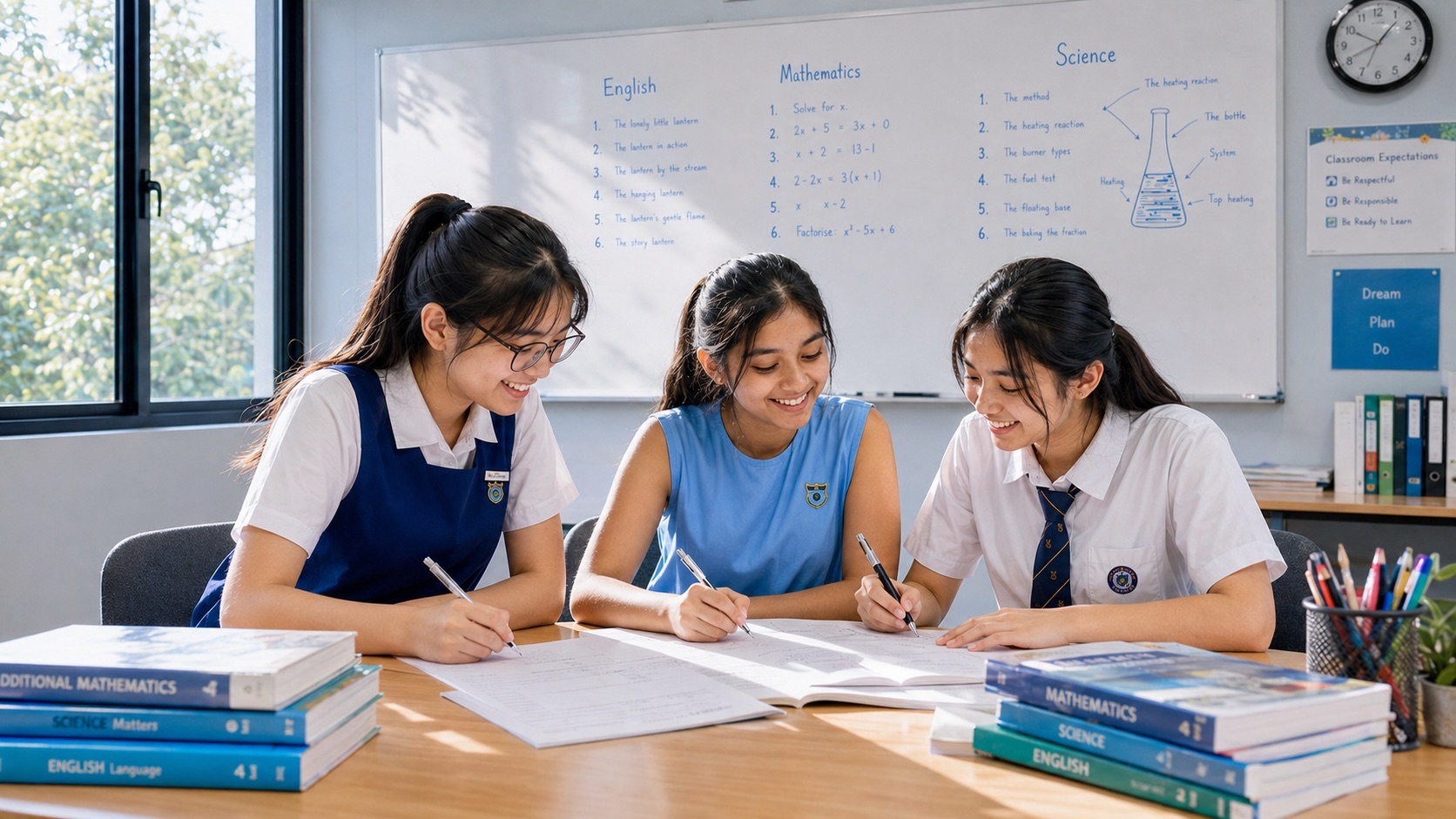
Creative writing worksheets work best when each worksheet isolates one decision and then returns that decision to real writing. A useful worksheet does not simply ask students to fill blank lines with adjectives, similes or “better words.” It helps a writer generate alternatives, compare effects, make a choice, draft, inspect the result and explain what changed.
If you are searching for creative writing worksheets, creative writing exercises with answers, writing worksheets for students, story writing worksheets, fiction writing practice or printable creative writing activities, this guide provides a complete set of original practice sheets with worked answers and teaching notes. The worksheets cover ideas, character, conflict, point of view, setting, description, dialogue, plot, pacing, vocabulary, sentence craft, openings, endings, revision and feedback.
This world-facing eduKate workbook complements the 12-week Creative Writing Course, the Creative Writing Skills map and 100 Creative Writing Prompts. Its distinct job is practice: each worksheet gives a bounded task, an original worked response and a transfer challenge so the learner must build new material rather than copy the model.
Quick read: how to use these worksheets
Attempt the task before reading the worked answer. Compare decisions, not wording. Mark one thing your version does differently and decide whether that difference is purposeful. Then complete the transfer task with new characters, objects or settings. The answer is an example of a working solution, not the one correct creative answer.
Routes: worksheets 1–5, worksheets 6–10, worksheets 11–15, worksheets 16–20, answer key principles, and teaching guide. All named characters and worked scenes are fictional teaching material.
1. Why creative writing worksheets need transfer
A learner can complete ten exercises on “strong verbs” and still write generic verbs in an original story. The missing step is transfer. After every isolated task, the learner needs a new context in which the technique is not announced. That is why each worksheet ends with a transfer challenge.
The sequence follows a simple contract: locate the skill, practise under constraint, compare with a model, apply in new material, observe the result. The worksheet is temporary scaffolding. The goal is writing without the worksheet.
2. Worksheet 1 — Turn a topic into a story premise
Task: Topic: an umbrella. Write a character, goal, obstacle and consequence. Then combine them into one premise sentence.
Worked answer: Character: Aisha. Goal: return an umbrella she borrowed before its owner leaves the building. Obstacle: three identical umbrellas are in the stand and none is labelled. Consequence: choosing incorrectly means returning somebody else’s property and losing the chance to return the original.
Premise: Aisha has ten minutes to return a borrowed umbrella, but three identical umbrellas remain in the stand, so she must identify the correct one without creating a second ownership problem.
Why it works: the object is no longer a topic. It participates in a decision. Transfer: repeat with a notebook, ticket or key. Change the relationship rather than merely replacing the noun.
3. Worksheet 2 — Generate five motives
Task: A character refuses to throw away a cracked bowl. Give five different motives. At least three must avoid sentimental bereavement as the explanation.
Worked answers: 1. The bowl belongs to someone who has not collected it. 2. The crack marks an experiment the character wants to study. 3. The bowl is the only object that fits a particular shelf. 4. The character promised to repair it. 5. Nobody knows whose it is, and the character fears discarding another person’s property.
Extension: choose motive five. Add a deadline: the room must be cleared today. Add a second character who believes unclaimed objects should be discarded. Now write the first decision.
Teaching note: this worksheet trains divergence. Do not praise only the strangest motive. Ask which motive creates the most usable consequences.
4. Worksheet 3 — Character through “usually / except when”
Task: Complete three sentences: “Mira usually ___, except when ___.” Then choose one and write 150 words at the exception.
Worked answer: “Mira usually corrects mistakes immediately, except when the correction would expose somebody who trusted her.”
Worked scene: The slide showed 3,000. Mira knew the source sheet said 300. Adrian had given her the sheet privately because the figures were unfinished. The presenter moved to the next bullet. Mira raised her hand, lowered it, then opened the shared chat and typed: Can we pause on the previous number?
The contradiction creates a choice between accuracy and confidentiality. Transfer: create a character who is usually patient except under one condition. Avoid making the exception random.
5. Worksheet 4 — Build conflict without a villain
Task: Two characters need the same table. Give each a reasonable reason. Neither may insult, threaten or lie.
Worked answer: Clara needs the table because a model must remain flat while glue dries. Ethan needs it because six people are arriving for a meeting in five minutes. Moving the model may damage it; moving the meeting creates disruption.
Worked opening: “How long?” Ethan asked. Clara looked at the glue bottle. “Forty minutes.” He looked at the six chairs. “They arrive in five.” Neither of them moved.
Transfer: create a conflict between speed and accuracy, or privacy and safety. The pressure should come from conditions, not personality labels.
6. Worksheet 5 — Stakes without catastrophe
Task: Event: a character loses a handwritten note. Write three different reasons the loss matters without adding physical danger, illness or a large amount of money.
Worked answers: The note contains directions written by a person whose phone is off. The note is the only record of an agreed wording before a public announcement. The character promised to return it because it belongs to someone else.
Transfer: take an ordinary object and make its loss consequential through relationship, timing or responsibility. Stakes are importance to the character, not spectacle.
7. Worksheet 6 — Point-of-view knowledge audit
Task: Read: “Clara watched Ben close the drawer. He hoped she had not seen the letter inside.” The scene is close third person around Clara. Identify the problem and repair it without changing viewpoint.
Worked answer: Clara cannot directly know Ben’s hope. Revision: “Clara watched Ben close the drawer. He put his hand on the handle for a second after it shut, then looked at her.” The behaviour gives Clara evidence without granting access to Ben’s mind.
Transfer: write three sentences in close third where the viewpoint character must infer another person’s motive from observable action. For deeper work, use Point of View.
8. Worksheet 7 — Selective description
Task: Room facts: clock above door, six chairs, wet umbrella, whiteboard, open window, stack of forms, broken pencil, two cups. Describe the room in 80 words from the viewpoint of someone who is late and needs one signed form.
Worked answer: Ryan saw the clock first: 3:07. The forms were stacked beneath the whiteboard, but the chair beside them was empty. One cup still steamed. He crossed the room, nearly caught his shoe on the wet umbrella and lifted the top form. No signature.
The answer ignores several available details because the viewpoint has a task. Transfer: rewrite from the cleaner’s viewpoint without changing the room.
9. Worksheet 8 — Sensory detail with a job
Task: Write one sound, one texture and one smell for a bakery scene. Then choose only the detail that changes what the character does.
Worked answer: Sound: the timer rings behind the counter. Texture: flour dusts the chair. Smell: bread cooling near the door. If the character is waiting to collect a cake before a bus leaves, the timer can trigger action. The other details may remain atmospheric but are not automatically necessary.
Transfer: use one sensory detail to reveal a change before the character sees it. Avoid adding all five senses merely to complete a list.
10. Worksheet 9 — Dialogue objectives
Task: Aisha wants Ben to stay for a meeting. Ben wants to leave without admitting he is upset. They may discuss only the weather and transport for the first six lines.
Worked answer:
“Rain’s getting heavier,” Aisha said.
“That’s why I should go.”
“The next bus is in twelve minutes.”
“I can wait downstairs.”
“It’s dry here.”
Ben picked up his bag. “That isn’t really the problem, is it?”
The surface topic remains meaningful while the objectives create subtext. Transfer: write another exchange where one speaker wants an apology and the other wants practical repair. Use Dialogue and Subtext for more.
11. Worksheet 10 — Scene state change
Task: Beginning state: Ethan believes the room is available. Ending state: Ethan knows it has been reserved, but the reservation may be wrong. Write three events that create the change.
Worked answer: Ethan enters and begins arranging chairs. Clara arrives with a printed reservation. Ethan checks the online calendar and finds no booking. Clara points to an email sent after the calendar was printed. Now neither source settles the issue.
Transfer: create a scene where knowledge becomes less certain rather than more certain. State change does not always mean solution.
12. Worksheet 11 — Build a causal chain
Task: Starting event: Jo returns for her umbrella and misses the lift. Ending event: she discovers an error on a notice. Connect the events with therefore or but rather than unrelated “and then” steps.
Worked answer: Jo returns for the umbrella, therefore she misses the lift. She takes the stairs, but the stairwell exit on level three is blocked. She uses the corridor instead, therefore she passes the noticeboard she normally never sees. The date on a new notice is wrong.
Transfer: create a four-event chain beginning with a forgotten object and ending with a changed decision. Remove one event and test whether the chain still works.
13. Worksheet 12 — Pacing through compression and expansion
Task A: compress this idea to one sentence: a character wakes, eats, travels, queues and arrives at an interview. Worked answer: “By the time Mira reached the interview room, two buses and a forty-minute queue had used up every answer she had rehearsed.”
Task B: expand the five seconds after the interviewer asks an unexpected question. Include perception, thought and one physical action without adding backstory unrelated to the decision.
Worked answer: “Mira looked at the glass of water beside her hand. A bubble clung to the inside, perfectly still. The answer she had prepared belonged to a different question. She moved the glass away from her notes. ‘Could I think about that for a moment?’”
Transfer: compress routine and expand consequence in your own draft. Pace is allocation, not merely sentence speed.
14. Worksheet 13 — Vocabulary decision points
Task: Choose among looked, glanced, inspected and checked for each situation: a person verifies a door is locked; a person briefly sees a clock; a technician examines damage; a character turns towards a sound without a special purpose.
Worked answers: checked the door; glanced at the clock; inspected the damage; looked towards the sound. Context may support alternatives, but each verb carries a different purpose or duration.
Transfer: find five generic verbs in your draft. Replace only where the new verb captures an intended distinction. Use The Word-Choice Decision System.
15. Worksheet 14 — Sentence rhythm
Task: Information: Ben opens a folder, finds the wrong document, hears footsteps and hides the folder. Write one long-sentence version and one short-sentence version.
Worked long version: “Ben opened the folder expecting the timetable, found instead the signed complaint he had been told was missing, and was still reading the first line when footsteps sounded beyond the door.”
Worked short version: “Ben opened the folder. Wrong document. He read the first line. Footsteps. He closed it.”
The versions distribute attention differently. Transfer: write a third version that combines continuity and stop. Choose based on desired reader experience rather than a rule demanding variety.
16. Worksheet 15 — Opening laboratory
Task: Premise: Clara receives a package addressed correctly to a person who has never lived at her address. Write three openings: disturbance, voice and action.
Worked disturbance: “The package had Clara’s address and somebody else’s history.” Worked voice: “I am usually very good at returning other people’s problems unopened.” Worked action: “Clara carried the package downstairs, reached the post box and stopped.”
Transfer: choose the opening that creates the most useful expectation for your planned story. A hook is a reason to continue, not a mandatory shock.
17. Worksheet 16 — Ending laboratory
Task: Story: Ryan has spent the afternoon trying to return a notebook to its owner. Write three endings: external resolution, changed action and transformed image.
External resolution: “The owner arrived at six, took the notebook and checked the elastic band before saying thank you.” Changed action: “The next time Ryan found an unlabelled notebook, he opened only the front cover and looked for a name before carrying it anywhere.” Transformed image: “The empty shelf where the notebook had waited all afternoon looked larger than it had when the book was there.”
Transfer: write three endings for your own story. Decide which promise the story most needs to answer.
18. Worksheet 17 — Show, tell or combine?
Task: Information: Aisha has avoided calling someone for two weeks. Decide what to tell and what to show.
Worked answer: Tell the elapsed time: “For two weeks, Aisha moved the reminder to tomorrow.” Show the consequential attempt: “On the fifteenth day she pressed call, heard one ring and ended it before the second.” The combination allocates page time according to importance.
Transfer: choose one repeated behaviour in your story. Summarise the repetition, then dramatise the moment the pattern changes. Use Show, Don’t Tell Worksheets for extended practice.
19. Worksheet 18 — Foreshadowing through enabling conditions
Task: Ending event: a character uses a spare key to enter a room. Plant an earlier detail that makes the event fair without announcing it.
Worked answer: Early scene: “When Clara returned the equipment, Adrian counted the cables but waved away the two keys. ‘Keep the spare until Friday,’ he said.” Later use of the spare key now grows from an established condition.
Transfer: choose one late event and identify the minimum earlier condition required. Plant it where it has an immediate function too. Avoid mysterious emphasis merely to signal a clue.
20. Worksheet 19 — Structural revision
Task: Draft structure: Scene 1 explains the character’s childhood. Scene 2 introduces the lost key. Scene 3 repeats why the key matters. Scene 4 the character searches. Scene 5 the key is found by coincidence. Identify two high-leverage revisions.
Worked answer: Begin near scene 2 and move only necessary childhood context into later moments. Replace the coincidental discovery with a consequence of the character’s search or earlier setup. Scene 3 may be cut or changed so it adds new pressure rather than repeating meaning.
Transfer: reverse-outline your own draft in one sentence per scene. Mark repeated jobs and unexplained solutions. Revise structure before polishing sentences.
21. Worksheet 20 — Feedback to revision
Task: Reader comment: “I wanted more description in the argument.” Generate three possible underlying problems before deciding what to add.
Worked possibilities: The reader cannot picture where the characters are; physical actions are absent, making dialogue float; the emotional turn feels unsupported because there are no observable reactions. Each problem suggests a different repair.
Worked revision choice: if dialogue is floating, add spatial action: “Ben pushed the unsigned form back across the table.” Do not automatically add wall colour or weather. Transfer: take one piece of feedback and separate reported reader experience from suggested solution.
22. Why the worked answers are not “the answers”
Creative tasks can have many successful solutions. The worked responses demonstrate a mechanism under the stated constraints. A learner who produces a different but coherent solution should not be marked wrong for failing to resemble the model. Assessment should ask whether the response controls the targeted relationship.
For Worksheet 4, the target is conflict between reasonable goals. A student who writes about two people needing the same charger for different urgent tasks may satisfy the exercise even though no table appears. The surface material can change; the mechanism remains.
23. A four-level answer check
Level 1 — Task completion: did the learner attempt the required decision? Level 2 — Coherence: do the choices fit one another? Level 3 — Control: can the learner explain why the choice creates the intended effect? Level 4 — Transfer: can the capability appear in new writing without the worksheet announcing it?
Transfer is the strongest evidence that the worksheet has done its job. A student may score perfectly on isolated synonym choices but still fail to choose precise words in a story. Return skills to authentic writing.
24. How to mark open creative responses
Mark against the exercise objective, not personal taste. For a viewpoint worksheet, check information access. For causality, check event relationships. For dialogue objectives, check whether speech performs actions. For description, check selection and relevance. Avoid comments such as “make it more exciting” without identifying the missing relationship.
25. When a strange answer is a strong answer
A learner may solve the task unexpectedly. If the solution remains coherent, do not punish novelty for departing from the model. Ask the learner to explain. An unusual answer that survives explanation may show stronger control than a conventional answer copied from a familiar pattern.
26. When a polished answer is a weak answer
Elegant sentences can conceal failure to meet the task. A beautifully described room may fail Worksheet 7 if the details ignore the viewpoint character’s goal. Separate surface fluency from the capability being tested.
27. Teaching guide: use one worksheet as a cycle, not a page
A strong lesson can spend substantial time on one worksheet. First locate the skill in a model. Let learners attempt the task. Compare several valid responses. Ask what changed. Then transfer the capability into a short original scene. The worksheet becomes a launchpad rather than the lesson’s endpoint.
28. Do not hand out the answer before the attempt
Worked answers are useful after generation because they create comparison. Shown first, they can narrow the learner’s search and encourage imitation. Where learners need more support, reveal a partial scaffold rather than the full response.
29. Differentiate by changing constraint, not just word count
For an easier version, reduce variables: one viewpoint, one location, one immediate goal. For a harder version, add a competing obligation, tighter deadline or information restriction. Complexity should come from decisions, not merely requiring more words.
30. Use worksheet pairs
Pair related skills: viewpoint plus description, character plus conflict, causality plus pacing, vocabulary plus sentence rhythm, opening plus ending. Complete each separately, then combine them in one scene. This interleaving tests coordination.
31. A four-week worksheet programme
Week 1: Worksheets 1–5 for ideas, character and stakes. Week 2: Worksheets 6–10 for viewpoint, description, dialogue and scene change. Week 3: Worksheets 11–15 for causality, pacing, vocabulary, rhythm and openings. Week 4: Worksheets 16–20 for endings, show/tell, foreshadowing, revision and feedback.
At the end of each week, write one original piece without the worksheet visible. Mark where the week’s capabilities appear. If they disappear, return to transfer rather than adding more worksheets.
32. Adapting worksheets for younger learners
Use shorter outputs and concrete situations. Replace “write 150 words” with “write the moment the choice happens.” Allow oral planning. Keep the intellectual relationship intact: want, obstacle, choice, consequence. Do not reduce creative writing to decorative vocabulary.
33. Adapting worksheets for secondary learners
Add time limits, competing obligations, viewpoint restrictions and revision commentary. Connect creative tasks with comprehension: what evidence supports an inference about a character? Connect vocabulary with actual drafts rather than isolated word lists.
34. Adapting worksheets for adults
Increase form choice and reduce unnecessary scaffolding. Adults can use professional or family mechanisms as inspiration while fictionalising material where privacy matters. A workplace scheduling conflict can become a fictional scene without reproducing confidential events.
35. Frequently asked question: are creative writing worksheets useful?
They are useful when they isolate a capability, provide feedback and lead back to independent writing. Worksheets become weak when completion itself is treated as mastery or when students merely fill blanks without making decisions.
36. Should creative writing worksheets have answers?
Worked examples can help learners compare reasoning, but creative tasks rarely have one correct answer. Label models as examples and explain the mechanism they demonstrate. Where a task tests factual grammar or vocabulary meaning, more definite answers may exist.
37. How many worksheets should a student do?
Enough to improve the diagnosed capability, then transfer it. More pages are not automatically better. If the student can already maintain viewpoint but struggles with causality, stop assigning viewpoint sheets and target causality.
38. Can these worksheets be used for self-study?
Yes. Attempt before reading the model, keep versions, complete the transfer challenge and return later without prompts. A self-learner should write a one-sentence reflection after each exercise: what decision did I practise, and where will I use it next?
39. Can worksheets improve exam composition writing?
They can strengthen component capabilities such as planning, causality, description, dialogue, vocabulary and revision. Exam performance also depends on the specific assessment’s task, timing and marking requirements. Practise transfer under the relevant exam conditions rather than assuming general craft exercises reproduce an official marking scheme.
40. Can I print or adapt the tasks for teaching?
The exercises are presented here as eduKate teaching material for learning and classroom-style practice. When reproducing or distributing material beyond ordinary personal or classroom use, follow the site’s applicable terms and attribution requirements. Teachers can also use the mechanisms to create their own fresh examples for a particular group.
41. The final worksheet is the blank page
The purpose of scaffolding is to disappear. After worksheet twenty, choose a fresh prompt and write a complete piece without the answer key, labels or step-by-step boxes. Then diagnose the draft. Which capabilities appeared automatically? Which vanished without support? That difference tells you what to practise next.
A completed worksheet is evidence that you can solve a bounded problem. Independent writing is evidence that you can recognise the problem yourself. Keep moving from the first kind of evidence to the second.
Reference and scope notes
For broader creative-writing teaching and practice context, see Purdue OWL’s Creative Writing resources and the Open University’s Creative Writing and Critical Reading materials. The twenty worksheets, worked responses, transfer tasks, teaching notes and programme in this article are original eduKate teaching material.
Worked answers demonstrate possible solutions, not universal artistic judgments. Adapt difficulty and output length to the learner, and follow any school, examination, course or publication requirements that apply to the actual task.