
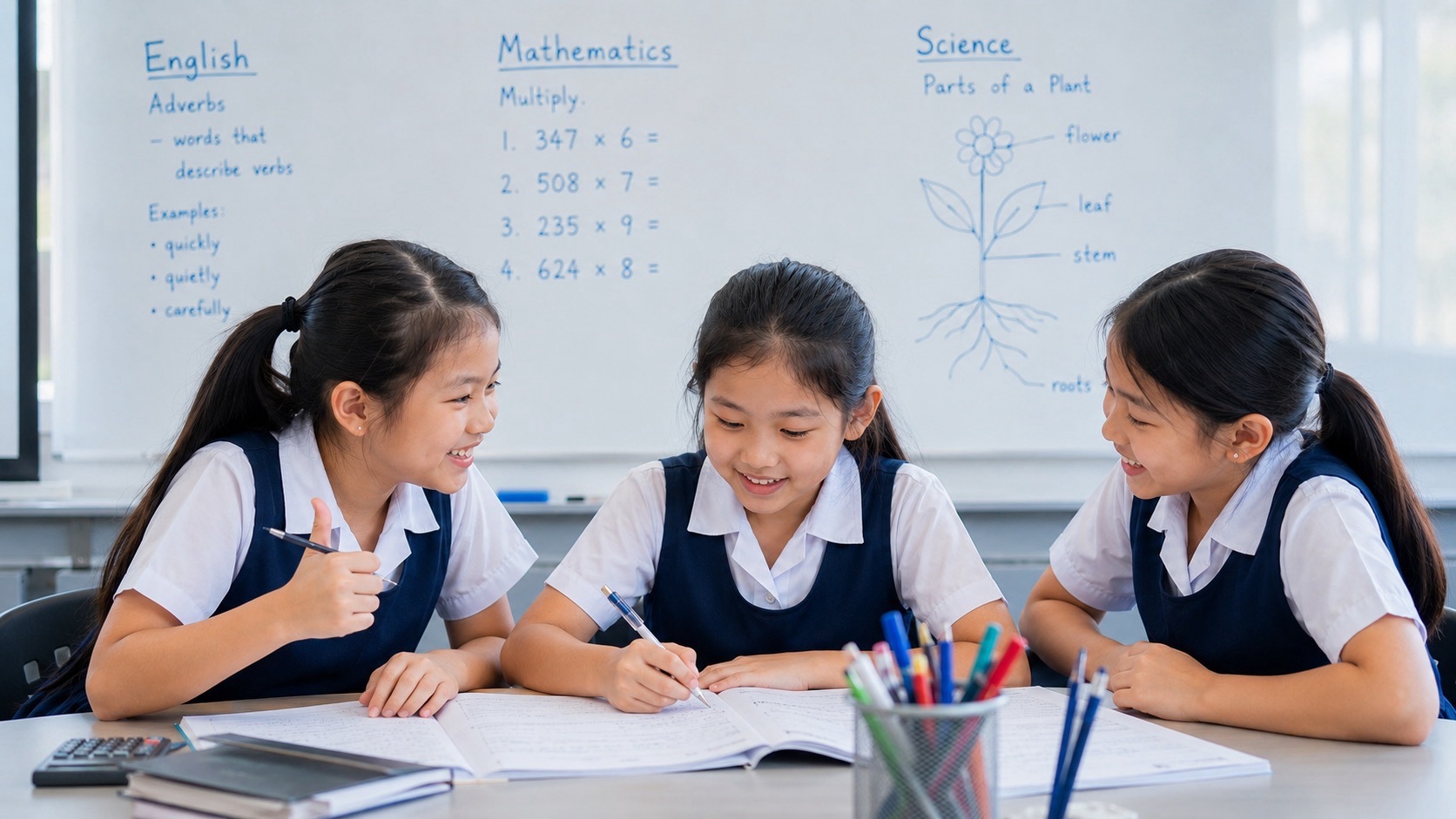
Primary 6 Science Tuition | Boon Keng is written for families searching for Primary 6 Science tuition in Boon Keng, P6 Science tuition Singapore, a Primary Science tutor serving Boon Keng, Bendemeer and Kallang, or a 3-pax small-group programme that can coordinate the final primary-school year without reducing Science to paper drilling. Primary 6 has two simultaneous jobs. Students must learn new content while keeping Primary 3, Primary 4 and Primary 5 knowledge accessible for a cumulative PSLE Science paper. Strong tuition therefore has to diagnose old gaps, teach new models, connect topics across years, sharpen scientific inquiry, strengthen structured explanations and gradually make performance reliable under time.
Parents commonly search for Primary Science tuition Singapore, P6 Science tuition Boon Keng, PSLE Science tuition, Science tutor, Science tuition centre, MOE Primary Science syllabus, SEAB PSLE Science, MCQ practice, structured questions, open-ended questions, keywords, answering techniques, experiments, fair tests, diagrams, tables, graphs, data interpretation, application and PSLE readiness. Those search terms point to a genuine final-year problem: the learner has to coordinate knowledge and execution. Knowing a chapter is not enough when one question combines a graph with a plant system, embeds force inside an experiment or asks the student to explain an environmental change through a food web.
This year-specific Boon Keng guide sits inside eduKateSG’s established Science architecture. It routes through the Science Learning Hub, the Primary Science Tuition Singapore branch and the wider Primary Science Tuition collection. It follows Primary 4 Science Tuition | Boon Keng and Primary 5 Science Tuition | Boon Keng. It is a local discovery and teaching crosswalk, not a claim that eduKateSG operates a physical Boon Keng branch.
Boon Keng Primary 6 Science: Turn Four Years of Learning Into Reliable Performance
Families searching for Primary 6 Science tuition Boon Keng are usually dealing with a compressed problem: the child must consolidate Primary 3 to Primary 6 Science while school assessments and PSLE preparation are already moving. Current Singapore programmes commonly emphasise content mastery, systematic question analysis, structured answering, experiments, data interpretation and mock-paper practice. Those elements are useful when they are arranged in the right order. A student needs a stable scientific model before timed practice can reveal anything meaningful about examination execution.
Primary 6 therefore begins with diagnosis. Clara may understand the concept but overwrite and introduce contradictions. Ethan may freeze when the context looks unfamiliar even though the underlying relationship is known. Adrian may remember the chapter but fail to recognise which idea applies when two topics are combined. A good tutor separates concept errors from recognition, evidence, inference, language and execution errors so that revision time is spent on the first weak link rather than spread evenly across everything.
Mixed practice becomes more important at this stage because the examination does not label every question with the chapter name. The learner has to identify whether the problem concerns a system, cycle, interaction, energy relationship, experiment variable, data pattern or another scientific idea. Retrieval after delay is equally important. If a concept can only be used immediately after revision, it is not yet examination-ready. The student must retrieve it days or weeks later and apply it in a changed situation.
The Boon Keng route stays cumulative: Primary 4 Science Tuition | Boon Keng and Primary 5 Science Tuition | Boon Keng provide the earlier foundation, this Primary 6 guide focuses on consolidation and transfer, and the PSLE Boon Keng guide provides the final examination lens. The broader Science Learning Hub remains the subject-wide owner.
Primary 6 Science Is a Course, Not Four New Chapters
The current MOE Primary Science syllabus places new Primary 6 learning around photosynthesis, energy conversion, forces and interactions within the environment. Those topics matter, but Primary 6 students are not starting a new subject. The final course rests on earlier learning about diversity, life cycles, magnets, plant parts, digestion, matter, light, heat, reproduction, water, plant transport, respiratory and circulatory systems and electricity.
The power of Primary 6 comes from connecting those layers. A photosynthesis question can depend on plant parts, plant transport, water, gases, light and energy. An environmental question may depend on life cycles, food relationships, adaptation, data interpretation and cause and effect. A force question may sit inside an experiment and require variable control. The learner therefore needs a network, not a stack of chapter notes.
The Revised 2026 PSLE Science Format Sets the Performance Target
For examinations from 2026, SEAB uses one Standard Science written paper lasting 1 hour 45 minutes. Booklet A contains 30 multiple-choice questions worth 2 marks each, for 60 marks. Booklet B contains 10 to 11 structured questions worth 2 to 5 marks each, for 40 marks. Candidates answer all questions. The official assessment objectives include knowledge with understanding and the application of knowledge and scientific inquiry, including prediction, hypothesis formation, interpretation, analysis, evaluation and communication of explanations and reasoning.
That structure changes the training question. A student cannot rely on “open-ended question tricks” while leaving concept understanding unstable. Nor can a strong concept student ignore time, MCQ discrimination or written precision. The final-year programme has to preserve both Science and examination control.
Primary 6 Diagnosis: Sort the Marks Before Trying to Recover Them
A school paper gives a total score, but tuition needs a causal diagnosis. Which marks came from old content gaps? Which came from new Primary 6 concepts? Which came from reading the question incorrectly? Which came from failing to use a graph or diagram? Which came from incomplete causal chains? Which came from time pressure? Which came from changing a correct answer during checking?
- Foundation debt: a P3–P5 idea is no longer retrievable or was never stable.
- New-concept debt: a P6 model such as energy conversion or force is inaccurate.
- Recognition failure: the student knows the concept but cannot identify when it applies.
- Inquiry failure: variables, predictions, hypotheses, evidence or evaluation are weak.
- Representation failure: diagrams, tables or graphs are misread.
- Language failure: the scientific relationship is not expressed completely.
- Execution failure: time allocation, checking or attention causes avoidable loss.
The best repair plan targets the first unstable cause rather than the final wrong sentence. A student who misread a graph needs different practice from one who misunderstood photosynthesis. Precision in diagnosis protects the limited final-year timetable.
Adrian: Stop Searching for the Familiar Worksheet
Adrian has accumulated years of Science notes and can often recognise a familiar question. His problem appears when PSLE-style variation changes the organism, apparatus, graph or sequence. He starts searching memory for an identical worksheet instead of reconstructing the Science. His tutor changes the routine: identify the system, isolate the changed condition, inspect the evidence, choose the concept and reason forward.
Adrian compares pairs of questions with very different stories but the same underlying relationship. He has to name the structural similarity. Transfer becomes explicit. By the end of Primary 6, the goal is for him to trust the model more than the surface familiarity of the question.
Photosynthesis: Build the System, Not a Slogan
Students often memorise a photosynthesis sentence and believe the topic is complete. A stronger model asks what the plant needs, where those inputs come from, which plant structures support the process, what is produced, how light relates to the process and how the products matter to the plant and wider food relationships at the appropriate Primary Science level. The learner should be able to reconstruct the process from a diagram rather than recite only a formula-like sentence.
Photosynthesis is especially useful because it integrates earlier years. Water recalls roots and plant transport. Light recalls earlier energy learning. Gases connect with living systems. Food production connects to energy and environmental interactions. A well-taught photosynthesis unit becomes a rehearsal for cumulative Science.
Photosynthesis Experiments: Evidence Before Conclusion
Experiment questions around photosynthesis can tempt students to jump to a memorised conclusion. Tuition should slow the evidence path. What was changed? What was kept the same? What result was observed? What does that result support? Is the conclusion stronger than the evidence? The learner should explain why a comparison is fair and what alternative explanation would appear if another condition also changed.
This is a powerful place to teach experimental logic because the content is already conceptually rich. The child learns that inquiry is not separate from the topic; inquiry is how the topic is tested.
Jo: Keywords Must Serve the Photosynthesis Explanation
Jo knows the expected vocabulary but still loses marks when her answer lists terms without connecting them. Her tutor asks her to build the relationship first. Which condition changed? What process is affected? What product or outcome changes? How does that create the observed result? Only then does she write the final sentence.
This changes “keywords” into scientific compression. The word is useful because it carries a precise concept inside a causal chain. A strong answer is not a keyword collection; it is a model expressed economically.
Energy Conversion: Follow the Pathway
Energy conversion is easier when students stop treating arrows as decoration. Ask where energy enters the system, what form is relevant, what device or event changes it and what output is observed. The Primary course uses familiar energy forms such as kinetic, potential, light, electrical, sound and heat energy at the required level. Students should avoid importing unsupported secondary-school distinctions.
A tutor can use familiar objects first, then unfamiliar systems. The student traces the shortest complete conversion chain supported by evidence. If the child adds an energy form, they should be able to point to evidence for it. This creates disciplined representation rather than arrow memorisation.
Energy Questions Often Test More Than Energy
An energy-conversion question may include electricity, motion, heat, light or sound. It may require the student to read an apparatus, recognise which component is operating and explain a change. That makes it a transfer topic. Students should practise moving between earlier electrical-system knowledge and the new energy lens.
Ask the learner to describe the device without energy words first. What is moving? What lights up? What becomes warmer? What makes sound? Then map those observations onto energy forms. Evidence should lead the language.
Forces: Begin With Interaction and Observable Effect
Primary 6 introduces frictional force, gravitational force and elastic spring force at the appropriate level, while earlier learning about magnets remains part of the wider course. Students should not begin with memorised definitions alone. Start with interactions and effects. What objects are interacting? What force is present? What changes in motion, shape or position can be observed? What evidence supports the claim?
This keeps force reasoning grounded. It also prevents a common error in which a student names a force merely because a familiar object appears in the picture. The force has to fit the interaction shown.
Friction: Useful and Opposing at the Same Time
Friction questions can become oversimplified into “friction is bad because it slows things down.” A better model recognises that friction opposes relative motion or a tendency of motion between surfaces, and that this can be useful or unwanted depending on the situation. Students should compare surfaces, forces and outcomes rather than memorise a moral category.
Experiments involving different surfaces are excellent for variable control. If the purpose is to compare friction, what must remain the same? What should be measured? How would repeated trials improve confidence? What conclusion is justified by the result? Content and inquiry should reinforce each other.
Gravitational Force: Explain Weight Without Over-Extending the Syllabus
Students need a clear Primary-level model: gravitational force acts on objects and gives them weight. They should identify situations in which gravitational force affects motion or keeps objects directed toward Earth. Tuition should resist importing advanced formulas or terminology that are unnecessary for the PSLE course.
The discipline here is curricular precision. Strong teaching is not measured by how far beyond the syllabus it can go. It is measured by whether the learner has the right model at the right resolution and can apply it reliably.
Elastic Spring Force: Relate Deformation to the System
Elastic spring force questions often use springs or elastic objects in measured setups. Students need to understand the relationship between deformation and the restoring effect at the required level, interpret diagrams carefully and distinguish the force being investigated from other forces in the situation.
Data tables and graphs can make this a strong inquiry topic. The child identifies what is changed, what is measured and what pattern appears. The tutor then asks whether the evidence supports the proposed relationship and where the evidence stops. Again, inquiry grows from content.
Ben: MCQ Strength Can Hide Weak Generated Reasoning
Ben performs well in Booklet A practice because the correct option often activates recognition. In structured questions, he sometimes cannot produce the same reasoning independently. His tutor turns MCQs into generated-response practice. After Ben chooses, the options are hidden and he explains the answer. Then one condition changes and he predicts the new outcome.
This makes MCQ practice more diagnostic and prepares him for Booklet B. It also improves Booklet A because he learns why distractors fail rather than merely developing a feeling for the right option.
Interactions Within the Environment: Think in Networks
Environmental interactions are difficult because one change can propagate through a system. Students need to understand organisms, roles, food relationships, habitats, adaptations and human impact at the required Primary Science level. A food chain is a start, but a food web better reveals why changing one population can affect several others.
Tuition should train students to trace consequences step by step. If one population decreases, which organisms lose a food source? Which may face less predation? Which changes are directly supported and which are speculative? The strongest answer remains close to the stated web and evidence.
Environmental Questions Reward Causal Discipline
Students often write “the ecosystem will be affected” without explaining how. A stronger response identifies the changed factor, the organism or condition directly affected, the next relationship in the system and the observable consequence. If the question includes a graph or table, the answer should incorporate that evidence.
The tutor can use arrows to map population relationships before converting them into prose. This reduces the chance of reversing predator–prey effects or making unsupported leaps across a food web.
Adaptation: Structure or Behaviour Must Connect to Survival
Students can memorise lists of adaptations and still struggle with unfamiliar organisms. The transferable skill is to connect a feature or behaviour to a function and then to a survival or reproductive advantage in the stated environment. A new animal or plant should not be impossible if the learner can inspect the feature and reason from its likely function.
Avoid invented stories. The answer must stay within the evidence supplied and the Primary Science concepts taught. Strong environmental reasoning is specific without becoming speculative.
Data Interpretation: Evidence Before Story
Primary 6 graphs and tables can combine several variables, multiple series and unfamiliar contexts. Students should begin mechanically: headings, axes, units, scale, relevant points, comparison, trend. Only then should they explain. This protects against jumping to a favourite concept before reading the evidence.
Ask the student to separate two sentences: “What does the data show?” and “Why might Science explain that pattern?” This distinction is simple and powerful. It prevents inference from being mistaken for observation.
Diagrams: Use Annotation to Reduce Working-Memory Load
Complex Primary 6 questions often compress information into diagrams. Teach students to annotate only what serves the task: trace a path, mark the changed condition, circle the measured outcome, identify the relevant organism or component, and add arrows for a process or force where appropriate. The purpose is reasoning, not decoration.
Students should also practise redrawing a simplified version. If the original diagram is visually busy, a clean sketch can reveal the system more clearly. Representation is a tool for thinking.
Inquiry: Variables, Hypotheses and Evaluation
The official PSLE Science assessment objectives explicitly include scientific inquiry: making predictions, formulating hypotheses, interpreting and analysing information, evaluating observations, information and methods, and communicating explanations and reasoning. Tuition should therefore make these moves explicit across topics.
A hypothesis should express a testable relationship. A fair test should control alternative explanations. An evaluation should identify whether a method or conclusion is supported. These are not isolated “process skill” lessons; they should be practised through forces, photosynthesis, environment, electricity, water and other content.
Observation Is Not Inference, and Inference Is Not Explanation
Primary 6 students should distinguish the jobs of scientific statements. Observation stays close to what is seen or measured. Inference interprets evidence. Prediction uses the model to state a likely future or changed-condition outcome. Explanation connects evidence to scientific mechanisms. Evaluation judges whether evidence or method is adequate.
The tutor can take one experiment and ask for all five response types. This teaches the student to read the question verb before writing and reduces answers that are scientifically true but task-inappropriate.
Aisha: Cumulative Retrieval Is Now Essential
Aisha cannot revise Primary 6 by rereading one chapter at a time because the course is cumulative. Her weekly system includes retrieval from P3, P4, P5 and P6. She may draw a plant system, explain evaporation, trace circulation, solve an electricity MCQ and analyse a force experiment in one mixed session.
This is harder than chapter-blocked revision, but it trains the selection problem the examination creates. The student must decide which concept applies without a chapter heading telling her. Retrieval plus interleaving turns the course into an active network.
Spaced Practice: Protect Knowledge From Revision Debt
Revision debt occurs when old topics decay until the final months. The student then has to relearn before practising. A better system revisits knowledge throughout the year. Short retrieval bursts keep earlier concepts alive while the class progresses through P6 content.
Spacing also reveals durability. If a concept disappears after two weeks, it was not yet secure. That is useful information early in the year and expensive information a week before PSLE.
Interleaving: The Student Must Choose the Model
Chapter-blocked worksheets are useful while a concept is being learned. They are insufficient for final-year readiness because they remove the decision about which concept applies. Mixed practice brings that decision back. The student sees a diagram and must determine whether the relevant model is heat, electricity, plant transport, force, photosynthesis or something else.
Interleaving should be calibrated. Too much mixing before basic understanding creates noise. Once topics are stable, increasing mixture is essential for transfer.
Ryan: The Error Log Becomes a PSLE Control Panel
Ryan’s error log classifies mistakes by mechanism and topic. One column records whether the error was knowledge, recognition, evidence, inference, language or execution. Another records the repair action. Another records when the question should be retrieved again. This prevents the log from becoming a museum of corrected answers.
Before a school examination or prelim, Ryan reviews patterns rather than hundreds of pages. If graph errors are falling but causal-chain errors remain, revision priorities are clear. The log turns mistakes into data.
Booklet A: Sixty Marks Require Disciplined MCQ Reasoning
The revised PSLE Science Booklet A carries 60 marks across 30 multiple-choice questions. This makes MCQ a major part of the paper, not a warm-up. Students should read the stem carefully, identify the tested relationship, use diagrams or data, predict where possible and eliminate options for scientific reasons. When two options remain, the child should articulate the distinction.
Timed practice becomes useful after the reasoning is visible. Speed built on guessing is unstable. Speed built on automatic distinctions is more reliable.
Distractors Reveal Misconceptions
A good distractor is not random. It often represents a common misconception, partial rule or misread condition. Tuition should use wrong options diagnostically. Ask why a distractor feels tempting and what exact evidence rules it out. This turns MCQ correction into misconception repair.
Over time, students become better at noticing fine distinctions. That skill transfers to structured questions because the learner’s concept boundaries are sharper.
Booklet B: Structured Questions Need Connected Reasoning
The revised Booklet B contains 10 to 11 structured questions for 40 marks. These may contain linked parts, diagrams, tables, graphs or experimental setups. Students should track what each sub-part is doing. One may ask for observation, another inference, another explanation, another prediction or evaluation. The child should not use the same response pattern for every verb.
Question mapping can help. Before writing, identify the task, evidence, concept and required endpoint. Then write the minimum complete explanation. This is more reliable than memorising generic sentence starters without understanding.
The Search Term “OEQ” Still Exists, but the Official Format Says Structured
Many parents and tuition pages still refer to “open-ended questions” or OEQ, so those terms remain useful for search intent. The official revised 2026 SEAB format describes Booklet B as structured questions. eduKateSG uses the current format language while recognising what families may search. The educational focus is the same: students must generate scientifically accurate reasoning rather than select from options.
That distinction matters because preparation should follow the actual paper. Families should verify the current format on SEAB’s official website for their child’s cohort.
Answering Techniques: Build Cause and Effect Until the Question Is Answered
Many Primary 6 students lose marks because their explanation stops one link too early. They write a correct concept but fail to connect it to the observed result. The tutor can use a simple check: point to the exact phenomenon the question asks about. Does the last sentence explain that phenomenon? If not, another causal link is needed.
During teaching, use arrow chains: condition → process → intermediate effect → observed result. Later, remove the arrows and ask the student to plan mentally. The technique serves the Science rather than replacing it.
Scientific Vocabulary: Precision Without Ritual
Primary 6 students need precise vocabulary, but “keywords” should not become superstition. The correct word matters because it carries a precise relationship. Teach collocations and sentence patterns that reflect real scientific meaning, then vary the context. The student should be able to use the term appropriately rather than paste it into every answer.
Contrast sets are useful: observation versus inference, evaporation versus boiling, conductor versus insulator, producer versus consumer, friction versus gravity, input versus output energy, changed versus measured variable. Fine distinctions reduce both MCQ and structured-response errors.
Mira: Timing Must Protect Accuracy and Completion
Mira understands the Science but loses later questions because she over-invests time in early structured responses. The tutor measures time by task type. How long does she spend reading, planning and writing? Does she over-answer low-mark questions? Does she return repeatedly to uncertain MCQs? Timing becomes a diagnostic rather than a stopwatch punishment.
Practice can progress from timed clusters to half papers to full papers. Review should record both marks and time. The goal is a pace that allows reasoning to remain accurate across the full 1 hour 45 minutes.
Clara: Checking Is a Risk-Control System
Clara used to reread the entire paper and call that checking. Her new routine targets known risks: flagged MCQs, changed answers, graph scales, units, comparison words, multi-link explanations and questions with diagrams. She checks whether every sub-part is answered and whether the final sentence reaches the required outcome.
Checking becomes personal. A student who often reverses increase and decrease needs a different final scan from one who often omits evidence. Risk-based checking uses limited exam time more intelligently.
Ethan: Unfamiliar Questions Need a Stable Opening Sequence
Ethan’s anxiety rises when a question looks new. The tutor does not promise that every question will look familiar. Instead Ethan practises a stable opening: what is given, what changed, what is measured, what is being asked, what evidence matters and which known system could explain it. The routine creates a first foothold.
As Ethan succeeds repeatedly on unfamiliar-looking questions, confidence becomes grounded in control. He learns that a new story can still contain old Science.
Three-Student Tutorials: Feedback Density Matters
In a three-student tutorial, every learner can be asked to reason aloud, draw a model, predict and write. One student may have a concept error while another has a language error on the same question. The tutor can see both and respond differently. Students can also compare explanations and evaluate which one is scientifically complete.
Small groups are useful when they make thinking visible. They should not simply shrink a lecture. Each learner should receive enough turns, written feedback and independent attempt time to expose the real state of understanding.
A 90-Minute Primary 6 Science Lesson
A strong lesson can begin with cumulative retrieval from P3–P5 and recent P6 work. The next phase addresses a new concept or repairs an error pattern. Guided examples make reasoning explicit. Independent transfer then tests whether the student can use the model without prompts. The final phase may include a timed MCQ cluster, a structured response, error classification and a scheduled retrieval task.
As PSLE approaches, the proportion changes. More mixed and timed practice enters the lesson, but concept repair remains available. A student should never be forced to practise exam execution on top of a known misconception simply because the calendar says “revision.”
School Papers: Turn Marks Into a Repair Queue
Every school weighted assessment, test and preliminary paper can be converted into a repair queue. Sort questions by topic and error mechanism. Identify marks recoverable with one habit change. Identify deep concept gaps that need reteaching. Identify time losses. Identify strong topics that only need maintenance.
The queue should be prioritised by leverage and recurrence. A mistake that appears across five topics because the student ignores comparison words may deserve more attention than one rare factual gap. The aim is not to redo an entire paper blindly; it is to extract the next training priorities.
Prelims: A Diagnostic Event, Not the Final Identity of the Student
Preliminary examinations arrive when time is limited, which makes prioritisation essential. Families should resist reacting only to the headline grade. Ask which marks were lost, why they were lost and how many are realistically recoverable before PSLE. Some errors need concept repair. Some need retrieval. Some need timing. Some need better checking.
The weeks after prelims should not become a panic-driven attempt to do every paper. A smaller number of deeply reviewed papers and targeted repair sets often produce more learning than uncontrolled volume.
Full Papers: Simulation Plus Analysis
Full-paper practice is useful in Primary 6 because it simulates retrieval across the course, time management and switching between MCQ and structured tasks. But the paper is only half the training. Review matters just as much. Students should explain why marks were lost, classify the error and identify what will change on the next attempt.
Repeated papers without analysis can create a false sense of productivity. The aim is not paper accumulation. It is adaptation.
Mock Exams: Rehearse the Process You Want on the Real Day
A mock should include more than timing. Rehearse the opening routine, pacing, flagging uncertain questions, moving on when stuck and checking strategy. The student should know how to respond when one question feels unusually difficult so a local problem does not consume the whole paper.
After the mock, review process as well as marks. Did the student follow the plan? Did panic change the plan? Which timing assumptions were wrong? Simulation is valuable when it produces information for the next rehearsal.
Revision Priority: Unstable Essentials, Transfer, Then Speed
When time becomes scarce, prioritise. First repair high-frequency, foundational misunderstandings that contaminate many questions. Next practise transfer so the student can recognise concepts in varied contexts. Then increase speed and paper-level execution. Trying to accelerate before the model is accurate simply produces faster wrong answers.
Reliable strengths should still be maintained through spaced retrieval, but they do not need equal time. Revision is resource allocation under a deadline.
How Parents Can Support the Primary 6 Year
Parents can help by asking diagnostic questions instead of only asking for the mark. “Which errors repeated?” “Which old topic returned?” “Was this a concept error or an answer error?” “What will you do differently next time?” These conversations encourage metacognition without turning home into another classroom.
Parents can also protect sleep, sustainable workload and recovery. Science performance depends on attention and memory. Endless late-night practice may create more errors while feeling industrious. A final-year plan should be demanding but sustainable.
What Not to Do in Primary 6 Science Tuition
- Do not assume every weak score is caused by insufficient practice volume.
- Do not close P3–P5 topics while teaching new P6 content.
- Do not teach answer templates that override scientific meaning.
- Do not treat keywords as marks independent of relationships.
- Do not run full papers without analysing the error mechanisms.
- Do not over-teach secondary Science concepts outside the Primary course.
- Do not use time pressure before the student has a workable reasoning process.
- Do not let one difficult question destroy the pacing of the whole paper.
A Weekly Primary 6 Science System
A balanced week can contain cumulative retrieval, current P6 concept work, mixed MCQs, structured explanations, one inquiry or data task and error review. Closer to examinations, add timed clusters and full-paper simulation while keeping short retrieval alive. Every important mistake should reappear after correction so the student proves that the repair survived.
The system should adapt to the school calendar. Before a topic test, current content receives more weight. Before prelims, mixed retrieval and exam execution increase. After prelims, the plan becomes highly selective. The constant is diagnosis.
Boon Keng Search Intent and Local Science Tuition
Families may search for Primary 6 Science tuition Boon Keng, P6 Science tutor Bendemeer, PSLE Science tuition Kallang, Science tuition Lavender or Science tuition near Whampoa. Current search results around the area include Primary Science and PSLE Science tuition centres and tutor-matching services that foreground MOE alignment, process skills, experiments, answering strategies, PSLE preparation and local access. Those are reasonable comparison points, but the decisive issue is whether the programme can diagnose and repair the individual student’s error mechanisms while preparing for the current paper.
This Primary 6 article narrows the intent to the final school year and routes through eduKateSG’s existing Science architecture. It does not state that eduKateSG operates a physical branch in Boon Keng; current teaching locations, formats and availability should be confirmed directly.
Questions to Ask Before Choosing Primary 6 Science Tuition
- How are P3–P5 gaps identified and repaired?
- How are new P6 topics integrated with earlier learning?
- How does the tutor teach the revised 2026 PSLE Science format?
- How are Booklet A MCQs used diagnostically?
- How are Booklet B structured questions taught without keyword dumping?
- How are experiments, variables, hypotheses and evaluation practised?
- How are diagrams, tables and graphs interpreted?
- How does full-paper practice lead to a repair plan?
- How is timing increased while protecting accuracy?
- How does a small group make each learner’s reasoning visible?
Frequently Asked Questions About Primary 6 Science Tuition in Boon Keng
What new topics are taught in Primary 6 Science?
The current MOE syllabus places new P6 learning around photosynthesis, energy conversion, forces and interactions within the environment. PSLE readiness also requires cumulative retrieval and application of earlier Primary Science learning.
What is the PSLE Science format from 2026?
The revised SEAB Standard Science format uses one 1-hour-45-minute paper. Booklet A has 30 multiple-choice questions for 60 marks. Booklet B has 10 to 11 structured questions for 40 marks. Candidates answer all questions.
Should Primary 6 students still revise Primary 4 and Primary 5 Science?
Yes. PSLE Science assesses attainment across the Primary Science course, so earlier concepts remain available for integration. Revision should be selective and diagnostic rather than an equal-time march through every old worksheet.
How many full Science papers should a child do?
There is no useful universal number. Full papers are valuable when they train timing and integration and are reviewed deeply. The quality of the learning cycle after each paper matters more than paper count alone.
Are Science keywords important for PSLE?
Precise scientific vocabulary matters, but keywords must sit inside correct reasoning. Students need to connect conditions, processes, evidence and outcomes rather than insert isolated terms.
Does this page mean eduKateSG has a tuition centre in Boon Keng?
No. This is a location-discovery guide for families searching from Boon Keng and nearby areas. Current physical teaching arrangements should be confirmed directly with eduKateSG.
The Primary 6 Science Tuition | Boon Keng Route
Primary 6 is where the whole Primary Science system must become usable. Diagnose old gaps. Build the new P6 models. Connect topics across years. Retrieve cumulatively. Mix contexts. Practise inquiry. Sharpen scientific language. Add timed MCQ and structured work. Use school and mock papers as diagnostic instruments. Reduce prompts until the learner can control the process independently.
Use the Science Learning Hub for the full subject architecture, Primary Science Tuition Singapore for the central tuition route, and the year sequence through Primary 4 Science Tuition | Boon Keng and Primary 5 Science Tuition | Boon Keng. For current official information, consult the MOE Primary Science syllabus and the SEAB PSLE Science format.