
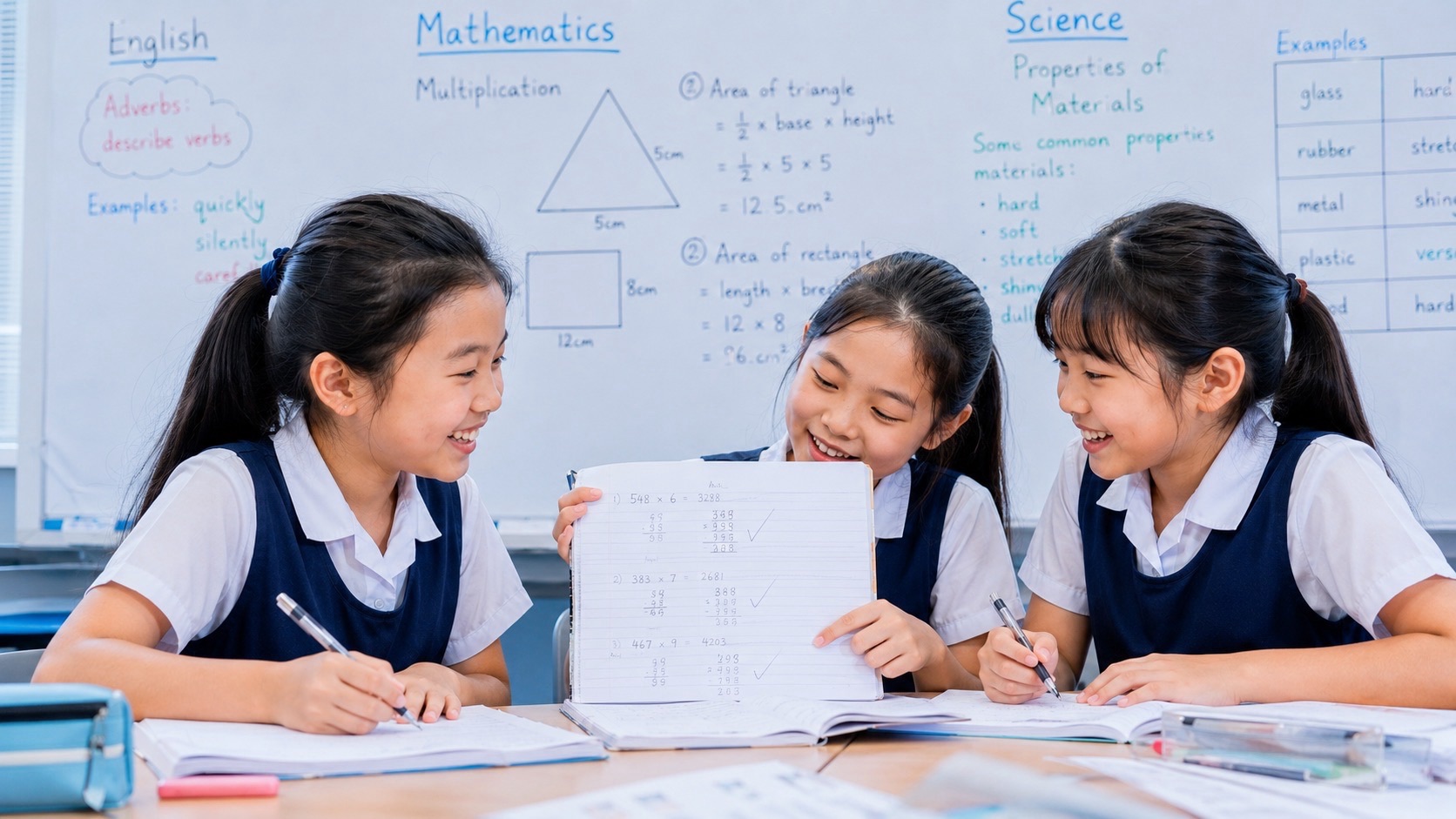
Primary 5 Science Tuition | Bedok South is for families comparing Primary Science tuition Singapore options at the point where Science becomes decisively cumulative. Strong P5 Science tuition should keep earlier P3 and P4 knowledge retrievable while developing systems, cycles, scientific inquiry, experiments, fair tests, diagrams, tables, graphs, data interpretation, scientific vocabulary and increasingly demanding application. Parents searching for a Primary 5 Science tutor, Science tuition centre or 3-pax small-group tuition around Bedok South should look for a programme that diagnoses why marks are lost, strengthens transfer and keeps older concepts active rather than simply increasing worksheet volume.
The current MOE Primary Science Teaching and Learning Syllabus organises learning around broad concepts and scientific practices across the primary years. The 2026 SEAB PSLE Science syllabus shows the final destination: knowledge with understanding plus application through scientific inquiry, including predictions, interpretation, evaluation and communicated reasoning. That destination matters in P5 because MCQ discrimination, structured questions, experiments, data, diagrams and scientific vocabulary become harder when students must coordinate several years of knowledge at once.
Bedok South sits within an east-side tuition market where families may compare options across Bedok, Tanah Merah, Upper East Coast, Marine Parade and nearby neighbourhoods. Current local search results include general tuition centres and private-tutor options, while broader Primary Science tuition Singapore pages emphasise concepts, MOE alignment, answering techniques, experiments and examination preparation. This page is a year-specific discovery layer inside eduKateSG’s existing Science Learning Hub and Primary Science Tuition Singapore branch. It does not imply a physical eduKate centre in Bedok South.
Make cumulative retrieval the centre of P5 Science
The P5 Science objective here is to keep P3 and P4 knowledge accessible while new P5 topics are added. A common breakdown occurs when a learner studies only the latest chapter and rediscovers old concepts before every test. Because P5 is cumulative, that weakness can reappear across several chapters and make later mixed questions feel harder than they actually are. The important step is to identify whether the problem lies in retrieval, concept selection, evidence reading, scientific reasoning or execution rather than treating every low mark as a content problem.
A useful repair is to rotate older topics through short retrieval sets and repair only what fails to return. The tutor should then remove the original cues, change the representation or context and ask the learner to reproduce the decision independently. Delayed retesting matters because immediate success can simply reflect working memory. A repair becomes more trustworthy when the same reasoning survives a different surface and a later session.
Treat cycles as states, transitions and conditions
The P5 Science objective here is to understand why one stage leads to another rather than memorising a circular diagram. A common breakdown occurs when a learner can recite a cycle from the top but cannot begin from an unfamiliar stage. Because P5 is cumulative, that weakness can reappear across several chapters and make later mixed questions feel harder than they actually are. The important step is to identify whether the problem lies in retrieval, concept selection, evidence reading, scientific reasoning or execution rather than treating every low mark as a content problem.
A useful repair is to remove one stage or reverse the layout and ask the learner to reconstruct the process scientifically. The tutor should then remove the original cues, change the representation or context and ask the learner to reproduce the decision independently. Delayed retesting matters because immediate success can simply reflect working memory. A repair becomes more trustworthy when the same reasoning survives a different surface and a later session.
Teach plant reproduction as function plus sequence
The P5 Science objective here is to connect structures to what they do and what happens if one part changes. A common breakdown occurs when a learner knows flower-part names but cannot predict consequences in a changed diagram. Because P5 is cumulative, that weakness can reappear across several chapters and make later mixed questions feel harder than they actually are. The important step is to identify whether the problem lies in retrieval, concept selection, evidence reading, scientific reasoning or execution rather than treating every low mark as a content problem.
A useful repair is to compare two flower setups and connect each structural difference to a predicted outcome. The tutor should then remove the original cues, change the representation or context and ask the learner to reproduce the decision independently. Delayed retesting matters because immediate success can simply reflect working memory. A repair becomes more trustworthy when the same reasoning survives a different surface and a later session.
Compare animal life cycles without overgeneralising
The P5 Science objective here is to recognise common biological patterns while preserving meaningful differences. A common breakdown occurs when a learner forces every organism into the same remembered template. Because P5 is cumulative, that weakness can reappear across several chapters and make later mixed questions feel harder than they actually are. The important step is to identify whether the problem lies in retrieval, concept selection, evidence reading, scientific reasoning or execution rather than treating every low mark as a content problem.
A useful repair is to sort similarities and differences, then state which features are essential to the comparison. The tutor should then remove the original cues, change the representation or context and ask the learner to reproduce the decision independently. Delayed retesting matters because immediate success can simply reflect working memory. A repair becomes more trustworthy when the same reasoning survives a different surface and a later session.
Use the water cycle to train transfer
The P5 Science objective here is to apply evaporation and condensation beyond familiar textbook diagrams. A common breakdown occurs when a learner recognises the words but struggles when the processes appear in a real-world or experiment context. Because P5 is cumulative, that weakness can reappear across several chapters and make later mixed questions feel harder than they actually are. The important step is to identify whether the problem lies in retrieval, concept selection, evidence reading, scientific reasoning or execution rather than treating every low mark as a content problem.
A useful repair is to trace where water came from, what condition changed and what evidence supports the process. The tutor should then remove the original cues, change the representation or context and ask the learner to reproduce the decision independently. Delayed retesting matters because immediate success can simply reflect working memory. A repair becomes more trustworthy when the same reasoning survives a different surface and a later session.
Keep changes of state evidence-based
The P5 Science objective here is to link heating and cooling to observable changes at the expected primary level. A common breakdown occurs when a learner adds advanced explanations that are not required or justified. Because P5 is cumulative, that weakness can reappear across several chapters and make later mixed questions feel harder than they actually are. The important step is to identify whether the problem lies in retrieval, concept selection, evidence reading, scientific reasoning or execution rather than treating every low mark as a content problem.
A useful repair is to describe the state change, the condition and the observed result before introducing terminology. The tutor should then remove the original cues, change the representation or context and ask the learner to reproduce the decision independently. Delayed retesting matters because immediate success can simply reflect working memory. A repair becomes more trustworthy when the same reasoning survives a different surface and a later session.
Teach the respiratory system as coordinated function
The P5 Science objective here is to connect structures, movement and purpose. A common breakdown occurs when a learner memorises labels but cannot use a before-and-after diagram. Because P5 is cumulative, that weakness can reappear across several chapters and make later mixed questions feel harder than they actually are. The important step is to identify whether the problem lies in retrieval, concept selection, evidence reading, scientific reasoning or execution rather than treating every low mark as a content problem.
A useful repair is to translate the diagram into a sequence of functional statements and compare changed conditions. The tutor should then remove the original cues, change the representation or context and ask the learner to reproduce the decision independently. Delayed retesting matters because immediate success can simply reflect working memory. A repair becomes more trustworthy when the same reasoning survives a different surface and a later session.
Teach circulation as a transport network
The P5 Science objective here is to track route, transported material and system purpose. A common breakdown occurs when a learner remembers the route but cannot explain why the movement matters. Because P5 is cumulative, that weakness can reappear across several chapters and make later mixed questions feel harder than they actually are. The important step is to identify whether the problem lies in retrieval, concept selection, evidence reading, scientific reasoning or execution rather than treating every low mark as a content problem.
A useful repair is to trace the pathway, name what is transported and connect it to the receiving parts of the body. The tutor should then remove the original cues, change the representation or context and ask the learner to reproduce the decision independently. Delayed retesting matters because immediate success can simply reflect working memory. A repair becomes more trustworthy when the same reasoning survives a different surface and a later session.
Teach electrical systems through pathways
The P5 Science objective here is to reason about complete and incomplete circuits rather than memorising common pictures. A common breakdown occurs when a learner recognises a circuit drawing but cannot predict a changed connection. Because P5 is cumulative, that weakness can reappear across several chapters and make later mixed questions feel harder than they actually are. The important step is to identify whether the problem lies in retrieval, concept selection, evidence reading, scientific reasoning or execution rather than treating every low mark as a content problem.
A useful repair is to trace the path through every component and identify what makes the pathway complete. The tutor should then remove the original cues, change the representation or context and ask the learner to reproduce the decision independently. Delayed retesting matters because immediate success can simply reflect working memory. A repair becomes more trustworthy when the same reasoning survives a different surface and a later session.
Build systems thinking across topics
The P5 Science objective here is to use parts, functions, pathways, inputs, outputs and consequences as recurring reasoning tools. A common breakdown occurs when a learner treats every topic as an unrelated list. Because P5 is cumulative, that weakness can reappear across several chapters and make later mixed questions feel harder than they actually are. The important step is to identify whether the problem lies in retrieval, concept selection, evidence reading, scientific reasoning or execution rather than treating every low mark as a content problem.
A useful repair is to compare how system reasoning appears in plants, humans and circuits without confusing the scientific content. The tutor should then remove the original cues, change the representation or context and ask the learner to reproduce the decision independently. Delayed retesting matters because immediate success can simply reflect working memory. A repair becomes more trustworthy when the same reasoning survives a different surface and a later session.
Use concept maps to show relationships
The P5 Science objective here is to label how ideas connect instead of drawing decorative keyword bubbles. A common breakdown occurs when a learner creates visually dense notes that reveal little about understanding. Because P5 is cumulative, that weakness can reappear across several chapters and make later mixed questions feel harder than they actually are. The important step is to identify whether the problem lies in retrieval, concept selection, evidence reading, scientific reasoning or execution rather than treating every low mark as a content problem.
A useful repair is to write relationship labels on the links and rebuild the map from closed-book retrieval. The tutor should then remove the original cues, change the representation or context and ask the learner to reproduce the decision independently. Delayed retesting matters because immediate success can simply reflect working memory. A repair becomes more trustworthy when the same reasoning survives a different surface and a later session.
Make P5 vocabulary conditional
The P5 Science objective here is to use scientific terms only where the conditions make them correct. A common breakdown occurs when a learner remembers definitions but misuses words in unfamiliar contexts. Because P5 is cumulative, that weakness can reappear across several chapters and make later mixed questions feel harder than they actually are. The important step is to identify whether the problem lies in retrieval, concept selection, evidence reading, scientific reasoning or execution rather than treating every low mark as a content problem.
A useful repair is to attach each term to one correct condition, one contrast and one changed-context example. The tutor should then remove the original cues, change the representation or context and ask the learner to reproduce the decision independently. Delayed retesting matters because immediate success can simply reflect working memory. A repair becomes more trustworthy when the same reasoning survives a different surface and a later session.
Read experiments from the tested relationship
The P5 Science objective here is to identify the purpose before variables or apparatus details. A common breakdown occurs when a learner names equipment without understanding what question the method addresses. Because P5 is cumulative, that weakness can reappear across several chapters and make later mixed questions feel harder than they actually are. The important step is to identify whether the problem lies in retrieval, concept selection, evidence reading, scientific reasoning or execution rather than treating every low mark as a content problem.
A useful repair is to summarise the investigation in one sentence before answering subparts. The tutor should then remove the original cues, change the representation or context and ask the learner to reproduce the decision independently. Delayed retesting matters because immediate success can simply reflect working memory. A repair becomes more trustworthy when the same reasoning survives a different surface and a later session.
Understand controls as protection against alternative explanations
The P5 Science objective here is to reason about why one factor must stay stable. A common breakdown occurs when a learner recites controlled-variable language mechanically. Because P5 is cumulative, that weakness can reappear across several chapters and make later mixed questions feel harder than they actually are. The important step is to identify whether the problem lies in retrieval, concept selection, evidence reading, scientific reasoning or execution rather than treating every low mark as a content problem.
A useful repair is to name the rival cause that would appear if the condition changed. The tutor should then remove the original cues, change the representation or context and ask the learner to reproduce the decision independently. Delayed retesting matters because immediate success can simply reflect working memory. A repair becomes more trustworthy when the same reasoning survives a different surface and a later session.
Use repeated measurements appropriately
The P5 Science objective here is to understand that repetition can strengthen evidence but cannot repair a flawed comparison. A common breakdown occurs when a learner believes repeating any experiment automatically makes it fair. Because P5 is cumulative, that weakness can reappear across several chapters and make later mixed questions feel harder than they actually are. The important step is to identify whether the problem lies in retrieval, concept selection, evidence reading, scientific reasoning or execution rather than treating every low mark as a content problem.
A useful repair is to separate variation problems from design problems and choose the improvement that addresses the actual weakness. The tutor should then remove the original cues, change the representation or context and ask the learner to reproduce the decision independently. Delayed retesting matters because immediate success can simply reflect working memory. A repair becomes more trustworthy when the same reasoning survives a different surface and a later session.
Describe tables before explaining them
The P5 Science objective here is to keep data interpretation grounded in the values. A common breakdown occurs when a learner writes a remembered cause before stating the pattern. Because P5 is cumulative, that weakness can reappear across several chapters and make later mixed questions feel harder than they actually are. The important step is to identify whether the problem lies in retrieval, concept selection, evidence reading, scientific reasoning or execution rather than treating every low mark as a content problem.
A useful repair is to produce a neutral relationship sentence and only then connect the pattern to a concept. The tutor should then remove the original cues, change the representation or context and ask the learner to reproduce the decision independently. Delayed retesting matters because immediate success can simply reflect working memory. A repair becomes more trustworthy when the same reasoning survives a different surface and a later session.
Read graphs for pattern, scale and exceptions
The P5 Science objective here is to treat graph literacy as a distinct skill. A common breakdown occurs when a learner loses marks despite knowing the Science because axes or scale are misread. Because P5 is cumulative, that weakness can reappear across several chapters and make later mixed questions feel harder than they actually are. The important step is to identify whether the problem lies in retrieval, concept selection, evidence reading, scientific reasoning or execution rather than treating every low mark as a content problem.
A useful repair is to use a fixed scan and practise graph reading separately when needed. The tutor should then remove the original cues, change the representation or context and ask the learner to reproduce the decision independently. Delayed retesting matters because immediate success can simply reflect working memory. A repair becomes more trustworthy when the same reasoning survives a different surface and a later session.
Translate diagrams into propositions
The P5 Science objective here is to convert arrows, labels and positions into short scientific statements. A common breakdown occurs when a learner answers from topic recognition instead of image evidence. Because P5 is cumulative, that weakness can reappear across several chapters and make later mixed questions feel harder than they actually are. The important step is to identify whether the problem lies in retrieval, concept selection, evidence reading, scientific reasoning or execution rather than treating every low mark as a content problem.
A useful repair is to state what the diagram shows, what it implies and what it does not establish. The tutor should then remove the original cues, change the representation or context and ask the learner to reproduce the decision independently. Delayed retesting matters because immediate success can simply reflect working memory. A repair becomes more trustworthy when the same reasoning survives a different surface and a later session.
Review MCQ distractors deliberately
The P5 Science objective here is to learn concept boundaries from plausible wrong options. A common breakdown occurs when a learner records only the correct letter and misses the misconception behind the question. Because P5 is cumulative, that weakness can reappear across several chapters and make later mixed questions feel harder than they actually are. The important step is to identify whether the problem lies in retrieval, concept selection, evidence reading, scientific reasoning or execution rather than treating every low mark as a content problem.
A useful repair is to explain why the second-best option fails and store the decision rule. The tutor should then remove the original cues, change the representation or context and ask the learner to reproduce the decision independently. Delayed retesting matters because immediate success can simply reflect working memory. A repair becomes more trustworthy when the same reasoning survives a different surface and a later session.
Plan structured answers before polishing language
The P5 Science objective here is to identify target, evidence, concept and mechanism. A common breakdown occurs when a learner writes long answers full of true but irrelevant facts. Because P5 is cumulative, that weakness can reappear across several chapters and make later mixed questions feel harder than they actually are. The important step is to identify whether the problem lies in retrieval, concept selection, evidence reading, scientific reasoning or execution rather than treating every low mark as a content problem.
A useful repair is to build the scientific skeleton first and convert it into concise sentences. The tutor should then remove the original cues, change the representation or context and ask the learner to reproduce the decision independently. Delayed retesting matters because immediate success can simply reflect working memory. A repair becomes more trustworthy when the same reasoning survives a different surface and a later session.
Treat application as transfer, not a new syllabus
The P5 Science objective here is to recognise known relationships inside unfamiliar surfaces. A common breakdown occurs when a learner freezes when apparatus or story changes. Because P5 is cumulative, that weakness can reappear across several chapters and make later mixed questions feel harder than they actually are. The important step is to identify whether the problem lies in retrieval, concept selection, evidence reading, scientific reasoning or execution rather than treating every low mark as a content problem.
A useful repair is to strip away decorative context and identify the invariant scientific relationship. The tutor should then remove the original cues, change the representation or context and ask the learner to reproduce the decision independently. Delayed retesting matters because immediate success can simply reflect working memory. A repair becomes more trustworthy when the same reasoning survives a different surface and a later session.
Use spacing for repaired errors
The P5 Science objective here is to make corrections survive beyond the lesson. A common breakdown occurs when a learner performs perfectly immediately after feedback but relapses later. Because P5 is cumulative, that weakness can reappear across several chapters and make later mixed questions feel harder than they actually are. The important step is to identify whether the problem lies in retrieval, concept selection, evidence reading, scientific reasoning or execution rather than treating every low mark as a content problem.
A useful repair is to retest the same decision in a changed item after several days. The tutor should then remove the original cues, change the representation or context and ask the learner to reproduce the decision independently. Delayed retesting matters because immediate success can simply reflect working memory. A repair becomes more trustworthy when the same reasoning survives a different surface and a later session.
Use interleaving to train concept selection
The P5 Science objective here is to remove chapter cues in controlled mixed practice. A common breakdown occurs when a learner can solve only when the topic is announced. Because P5 is cumulative, that weakness can reappear across several chapters and make later mixed questions feel harder than they actually are. The important step is to identify whether the problem lies in retrieval, concept selection, evidence reading, scientific reasoning or execution rather than treating every low mark as a content problem.
A useful repair is to mix secure topics and require classification before solving. The tutor should then remove the original cues, change the representation or context and ask the learner to reproduce the decision independently. Delayed retesting matters because immediate success can simply reflect working memory. A repair becomes more trustworthy when the same reasoning survives a different surface and a later session.
Replace careless with a diagnostic label
The P5 Science objective here is to describe the actual mechanism of the error. A common breakdown occurs when a learner uses careless as a catch-all explanation. Because P5 is cumulative, that weakness can reappear across several chapters and make later mixed questions feel harder than they actually are. The important step is to identify whether the problem lies in retrieval, concept selection, evidence reading, scientific reasoning or execution rather than treating every low mark as a content problem.
A useful repair is to code errors as retrieval, concept-selection, evidence, mechanism, vocabulary, scope or execution failures. The tutor should then remove the original cues, change the representation or context and ask the learner to reproduce the decision independently. Delayed retesting matters because immediate success can simply reflect working memory. A repair becomes more trustworthy when the same reasoning survives a different surface and a later session.
Make 3-pax lessons explanation-rich
The P5 Science objective here is to use small-group visibility to expose reasoning. A common breakdown occurs when a learner lets one confident learner carry the discussion. Because P5 is cumulative, that weakness can reappear across several chapters and make later mixed questions feel harder than they actually are. The important step is to identify whether the problem lies in retrieval, concept selection, evidence reading, scientific reasoning or execution rather than treating every low mark as a content problem.
A useful repair is to rotate explaining, challenging and improving roles, followed by individual transfer. The tutor should then remove the original cues, change the representation or context and ask the learner to reproduce the decision independently. Delayed retesting matters because immediate success can simply reflect working memory. A repair becomes more trustworthy when the same reasoning survives a different surface and a later session.
Use homework as a sample of the system
The P5 Science objective here is to test several skills without excessive volume. A common breakdown occurs when a learner completes repetitive pages that reveal little about selection or transfer. Because P5 is cumulative, that weakness can reappear across several chapters and make later mixed questions feel harder than they actually are. The important step is to identify whether the problem lies in retrieval, concept selection, evidence reading, scientific reasoning or execution rather than treating every low mark as a content problem.
A useful repair is to combine retrieval, MCQ, experiment, data and structured response in a compact set. The tutor should then remove the original cues, change the representation or context and ask the learner to reproduce the decision independently. Delayed retesting matters because immediate success can simply reflect working memory. A repair becomes more trustworthy when the same reasoning survives a different surface and a later session.
Mine school assessments for recurring processes
The P5 Science objective here is to look across papers for patterns that survive topic changes. A common breakdown occurs when a learner focuses only on the final percentage. Because P5 is cumulative, that weakness can reappear across several chapters and make later mixed questions feel harder than they actually are. The important step is to identify whether the problem lies in retrieval, concept selection, evidence reading, scientific reasoning or execution rather than treating every low mark as a content problem.
A useful repair is to track which mechanisms repeatedly lose marks across different content areas. The tutor should then remove the original cues, change the representation or context and ask the learner to reproduce the decision independently. Delayed retesting matters because immediate success can simply reflect working memory. A repair becomes more trustworthy when the same reasoning survives a different surface and a later session.
Keep P5 exam preparation method-first
The P5 Science objective here is to add timing to reliable methods rather than substitute timing for understanding. A common breakdown occurs when a learner responds to weak scores by doing more full papers immediately. Because P5 is cumulative, that weakness can reappear across several chapters and make later mixed questions feel harder than they actually are. The important step is to identify whether the problem lies in retrieval, concept selection, evidence reading, scientific reasoning or execution rather than treating every low mark as a content problem.
A useful repair is to repair accuracy and concept selection first, then layer short timed sections and full papers selectively. The tutor should then remove the original cues, change the representation or context and ask the learner to reproduce the decision independently. Delayed retesting matters because immediate success can simply reflect working memory. A repair becomes more trustworthy when the same reasoning survives a different surface and a later session.
Balance revision across knowledge, inquiry and communication
The P5 Science objective here is to recognise that factual recall is only one assessment demand. A common breakdown occurs when a learner schedules revision entirely by chapter. Because P5 is cumulative, that weakness can reappear across several chapters and make later mixed questions feel harder than they actually are. The important step is to identify whether the problem lies in retrieval, concept selection, evidence reading, scientific reasoning or execution rather than treating every low mark as a content problem.
A useful repair is to alternate retrieval, experiment/data analysis and structured-answer construction. The tutor should then remove the original cues, change the representation or context and ask the learner to reproduce the decision independently. Delayed retesting matters because immediate success can simply reflect working memory. A repair becomes more trustworthy when the same reasoning survives a different surface and a later session.
Monitor independence before marks rise
The P5 Science objective here is to notice whether the learner can retrieve, classify and self-correct without prompting. A common breakdown occurs when a learner judges improvement only from one school score. Because P5 is cumulative, that weakness can reappear across several chapters and make later mixed questions feel harder than they actually are. The important step is to identify whether the problem lies in retrieval, concept selection, evidence reading, scientific reasoning or execution rather than treating every low mark as a content problem.
A useful repair is to track whether notes are opened less quickly and whether previous error types stop repeating. The tutor should then remove the original cues, change the representation or context and ask the learner to reproduce the decision independently. Delayed retesting matters because immediate success can simply reflect working memory. A repair becomes more trustworthy when the same reasoning survives a different surface and a later session.
Decompose unfamiliar questions
The P5 Science objective here is to reduce novelty to system, change, evidence and concept. A common breakdown occurs when a learner treats unfamiliar context as unfamiliar Science. Because P5 is cumulative, that weakness can reappear across several chapters and make later mixed questions feel harder than they actually are. The important step is to identify whether the problem lies in retrieval, concept selection, evidence reading, scientific reasoning or execution rather than treating every low mark as a content problem.
A useful repair is to underline only the scientific conditions and rewrite the problem in simpler relational language. The tutor should then remove the original cues, change the representation or context and ask the learner to reproduce the decision independently. Delayed retesting matters because immediate success can simply reflect working memory. A repair becomes more trustworthy when the same reasoning survives a different surface and a later session.
Control answer scope
The P5 Science objective here is to write enough to establish the required relationship and no more. A common breakdown occurs when a learner assumes longer answers are safer. Because P5 is cumulative, that weakness can reappear across several chapters and make later mixed questions feel harder than they actually are. The important step is to identify whether the problem lies in retrieval, concept selection, evidence reading, scientific reasoning or execution rather than treating every low mark as a content problem.
A useful repair is to identify the command and target, then remove true statements that do not advance the answer. The tutor should then remove the original cues, change the representation or context and ask the learner to reproduce the decision independently. Delayed retesting matters because immediate success can simply reflect working memory. A repair becomes more trustworthy when the same reasoning survives a different surface and a later session.
Externalise difficult reasoning
The P5 Science objective here is to use quick sketches and annotations to reduce working-memory load. A common breakdown occurs when a learner tries to hold every pathway or variable mentally. Because P5 is cumulative, that weakness can reappear across several chapters and make later mixed questions feel harder than they actually are. The important step is to identify whether the problem lies in retrieval, concept selection, evidence reading, scientific reasoning or execution rather than treating every low mark as a content problem.
A useful repair is to draw arrows, mark changed factors or sketch before-and-after states before writing. The tutor should then remove the original cues, change the representation or context and ask the learner to reproduce the decision independently. Delayed retesting matters because immediate success can simply reflect working memory. A repair becomes more trustworthy when the same reasoning survives a different surface and a later session.
Contrast misconceptions explicitly
The P5 Science objective here is to replace persistent wrong rules through evidence and comparison. A common breakdown occurs when a learner copies corrections but keeps the old mental model. Because P5 is cumulative, that weakness can reappear across several chapters and make later mixed questions feel harder than they actually are. The important step is to identify whether the problem lies in retrieval, concept selection, evidence reading, scientific reasoning or execution rather than treating every low mark as a content problem.
A useful repair is to record the old rule, corrected rule and one discriminating example. The tutor should then remove the original cues, change the representation or context and ask the learner to reproduce the decision independently. Delayed retesting matters because immediate success can simply reflect working memory. A repair becomes more trustworthy when the same reasoning survives a different surface and a later session.
Use notes after an attempt
The P5 Science objective here is to make reference materials serve repair rather than passive rereading. A common breakdown occurs when a learner looks at notes before testing memory. Because P5 is cumulative, that weakness can reappear across several chapters and make later mixed questions feel harder than they actually are. The important step is to identify whether the problem lies in retrieval, concept selection, evidence reading, scientific reasoning or execution rather than treating every low mark as a content problem.
A useful repair is to attempt, diagnose, consult, reconstruct and retest. The tutor should then remove the original cues, change the representation or context and ask the learner to reproduce the decision independently. Delayed retesting matters because immediate success can simply reflect working memory. A repair becomes more trustworthy when the same reasoning survives a different surface and a later session.
Use oral explanation to reveal hidden gaps
The P5 Science objective here is to test whether written success reflects understanding. A common breakdown occurs when a learner produces polished sentences from memory but cannot defend them. Because P5 is cumulative, that weakness can reappear across several chapters and make later mixed questions feel harder than they actually are. The important step is to identify whether the problem lies in retrieval, concept selection, evidence reading, scientific reasoning or execution rather than treating every low mark as a content problem.
A useful repair is to ask why, what evidence, and what would change the conclusion. The tutor should then remove the original cues, change the representation or context and ask the learner to reproduce the decision independently. Delayed retesting matters because immediate success can simply reflect working memory. A repair becomes more trustworthy when the same reasoning survives a different surface and a later session.
Calibrate practice difficulty
The P5 Science objective here is to create useful friction without overwhelming the learner. A common breakdown occurs when a learner sees only easy blocked work or extremely difficult transfer. Because P5 is cumulative, that weakness can reappear across several chapters and make later mixed questions feel harder than they actually are. The important step is to identify whether the problem lies in retrieval, concept selection, evidence reading, scientific reasoning or execution rather than treating every low mark as a content problem.
A useful repair is to move from secure retrieval to moderate application and then selected unfamiliar items. The tutor should then remove the original cues, change the representation or context and ask the learner to reproduce the decision independently. Delayed retesting matters because immediate success can simply reflect working memory. A repair becomes more trustworthy when the same reasoning survives a different surface and a later session.
Tie confidence to performance evidence
The P5 Science objective here is to build confidence from retrieval and transfer. A common breakdown occurs when a learner feels secure because the page looks familiar. Because P5 is cumulative, that weakness can reappear across several chapters and make later mixed questions feel harder than they actually are. The important step is to identify whether the problem lies in retrieval, concept selection, evidence reading, scientific reasoning or execution rather than treating every low mark as a content problem.
A useful repair is to track delayed retests, mixed-set success and shrinking error categories. The tutor should then remove the original cues, change the representation or context and ask the learner to reproduce the decision independently. Delayed retesting matters because immediate success can simply reflect working memory. A repair becomes more trustworthy when the same reasoning survives a different surface and a later session.
Connect school, tuition and home practice
The P5 Science objective here is to give each setting a distinct function. A common breakdown occurs when a learner duplicates the same worksheet load in all three places. Because P5 is cumulative, that weakness can reappear across several chapters and make later mixed questions feel harder than they actually are. The important step is to identify whether the problem lies in retrieval, concept selection, evidence reading, scientific reasoning or execution rather than treating every low mark as a content problem.
A useful repair is to use school work for evidence, tuition for diagnosis and home for light spaced retrieval. The tutor should then remove the original cues, change the representation or context and ask the learner to reproduce the decision independently. Delayed retesting matters because immediate success can simply reflect working memory. A repair becomes more trustworthy when the same reasoning survives a different surface and a later session.
Prepare the transition into P6
The P5 Science objective here is to enter the final primary year with known strengths and risks. A common breakdown occurs when a learner starts P6 with only a grade and no learning profile. Because P5 is cumulative, that weakness can reappear across several chapters and make later mixed questions feel harder than they actually are. The important step is to identify whether the problem lies in retrieval, concept selection, evidence reading, scientific reasoning or execution rather than treating every low mark as a content problem.
A useful repair is to map secure concepts, slow retrieval, fragile inquiry skills and recurring execution errors. The tutor should then remove the original cues, change the representation or context and ask the learner to reproduce the decision independently. Delayed retesting matters because immediate success can simply reflect working memory. A repair becomes more trustworthy when the same reasoning survives a different surface and a later session.
Teach prediction as model use
The P5 Science objective here is to justify expected outcomes from relationships and data. A common breakdown occurs when a learner guesses what happens next without identifying why. Because P5 is cumulative, that weakness can reappear across several chapters and make later mixed questions feel harder than they actually are. The important step is to identify whether the problem lies in retrieval, concept selection, evidence reading, scientific reasoning or execution rather than treating every low mark as a content problem.
A useful repair is to state the governing relationship before the prediction. The tutor should then remove the original cues, change the representation or context and ask the learner to reproduce the decision independently. Delayed retesting matters because immediate success can simply reflect working memory. A repair becomes more trustworthy when the same reasoning survives a different surface and a later session.
Teach conclusion scope
The P5 Science objective here is to keep claims proportional to the experiment. A common breakdown occurs when a learner turns one result into a universal statement. Because P5 is cumulative, that weakness can reappear across several chapters and make later mixed questions feel harder than they actually are. The important step is to identify whether the problem lies in retrieval, concept selection, evidence reading, scientific reasoning or execution rather than treating every low mark as a content problem.
A useful repair is to write exactly what the tested conditions support and identify what remains untested. The tutor should then remove the original cues, change the representation or context and ask the learner to reproduce the decision independently. Delayed retesting matters because immediate success can simply reflect working memory. A repair becomes more trustworthy when the same reasoning survives a different surface and a later session.
Teach method improvement as weakness-change-benefit
The P5 Science objective here is to link suggestions to the actual experimental problem. A common breakdown occurs when a learner uses generic improvements such as repeat more for every item. Because P5 is cumulative, that weakness can reappear across several chapters and make later mixed questions feel harder than they actually are. The important step is to identify whether the problem lies in retrieval, concept selection, evidence reading, scientific reasoning or execution rather than treating every low mark as a content problem.
A useful repair is to name the weakness, propose a change and explain how the evidence becomes stronger. The tutor should then remove the original cues, change the representation or context and ask the learner to reproduce the decision independently. Delayed retesting matters because immediate success can simply reflect working memory. A repair becomes more trustworthy when the same reasoning survives a different surface and a later session.
Review correct answers selectively
The P5 Science objective here is to test whether success came from a stable method. A common breakdown occurs when a learner guesses correctly or spends too long on a correct item. Because P5 is cumulative, that weakness can reappear across several chapters and make later mixed questions feel harder than they actually are. The important step is to identify whether the problem lies in retrieval, concept selection, evidence reading, scientific reasoning or execution rather than treating every low mark as a content problem.
A useful repair is to ask for the decisive evidence and a changed condition that would alter the answer. The tutor should then remove the original cues, change the representation or context and ask the learner to reproduce the decision independently. Delayed retesting matters because immediate success can simply reflect working memory. A repair becomes more trustworthy when the same reasoning survives a different surface and a later session.
Build a P5 error portfolio that remains small
The P5 Science objective here is to store only high-value recurring patterns. A common breakdown occurs when a learner keeps a huge correction file that is never revisited. Because P5 is cumulative, that weakness can reappear across several chapters and make later mixed questions feel harder than they actually are. The important step is to identify whether the problem lies in retrieval, concept selection, evidence reading, scientific reasoning or execution rather than treating every low mark as a content problem.
A useful repair is to retain a short set of recurring mechanisms with retest dates and closure criteria. The tutor should then remove the original cues, change the representation or context and ask the learner to reproduce the decision independently. Delayed retesting matters because immediate success can simply reflect working memory. A repair becomes more trustworthy when the same reasoning survives a different surface and a later session.
Use local Bedok South context without diluting the Science
The P5 Science objective here is to connect discovery intent to practical family decisions. A common breakdown occurs when a learner turns a location page into repetitive advertising. Because P5 is cumulative, that weakness can reappear across several chapters and make later mixed questions feel harder than they actually are. The important step is to identify whether the problem lies in retrieval, concept selection, evidence reading, scientific reasoning or execution rather than treating every low mark as a content problem.
A useful repair is to keep the educational system central and use Bedok South only where it helps families navigate options. The tutor should then remove the original cues, change the representation or context and ask the learner to reproduce the decision independently. Delayed retesting matters because immediate success can simply reflect working memory. A repair becomes more trustworthy when the same reasoning survives a different surface and a later session.
Resident cases: eight different P5 bottlenecks
Adrian: fluent in chapters, slower in mixed application
Adrian can solve blocked practice quickly but spends too long deciding which concept applies when topics are mixed. His tutor separates classification from solving and gives short stems where he identifies only the system and governing relationship. Faster selection emerges without rushed reading.
Jo: strong vocabulary, weak answer scope
Jo knows many scientific terms and writes detailed responses. She improves when she identifies the target before writing and includes only the evidence, concept and mechanism needed to answer it. Precision replaces information dumping.
Ben: MCQ confidence without elimination discipline
Ben often chooses the correct answer but cannot explain the nearest distractor. He now records the decisive clue and the boundary that eliminates the second-best option. His performance becomes more transferable because each choice rests on a defensible rule.
Aisha: background knowledge can overpower the data
Aisha recognises familiar Science stories and sometimes predicts what should happen before reading the table carefully. She writes one neutral evidence sentence first. The data now constrain the explanation instead of being fitted to an expected story.
Ryan: variable labels without design logic
Ryan can name variables but struggles to explain why a control matters. He must state the competing explanation that appears if the condition changes. This turns the vocabulary of experiments into scientific reasoning.
Mira: representation switching
Mira is confident with prose but slower with graphs or diagrams. She practises converting the same relationship from words to arrows, tables and graphs. The concept becomes less dependent on the presentation format.
Clara: earlier topics are fading
Clara understands the current P5 chapter but retrieves P4 ideas slowly. A rotating spaced schedule brings selected older concepts back every week. She repairs only the knowledge that actually fails to return rather than rereading entire years.
Ethan: immediate corrections do not always last
Ethan understands feedback in the lesson but some errors return. Each important correction receives a changed item immediately and a delayed retest. His error log closes only after the new decision survives time.
How to compare Primary 5 Science tuition around Bedok South
- Look for cumulative retrieval across P3, P4 and P5 rather than current-chapter teaching alone.
- Ask how systems, cycles and experiments are connected to evidence and mechanisms.
- Ask how MCQ distractors and structured answers are diagnosed.
- Ask how fair tests, variables and conclusions are taught as reasoning rather than labels.
- Ask how diagrams, tables and graphs are read before explanation begins.
- Ask how scientific vocabulary is attached to correct conditions and relationships.
- Ask what a 3-pax class changes about explanation turns and individual error tracking.
- Ask how school assessments are analysed for recurring failure mechanisms.
- Ask how P5 builds a controlled transition into P6 and the current PSLE Science format.
How the Bedok South Science route connects
The Primary 4 Science Tuition | Bedok South page builds concept connections, evidence discipline and inquiry foundations. This P5 page deepens cumulative retrieval, systems thinking and transfer. The later P6 and PSLE pages take the same learning system into full-curriculum integration and current examination execution.
All four year-level owners route through the existing Science Learning Hub and Primary Science Tuition Singapore owner rather than creating a competing broad Science hub.
Official and eduKateSG routes
- MOE Primary Science Teaching and Learning Syllabus
- 2026 SEAB PSLE Science syllabus
- eduKateSG Science Learning Hub
- Primary Science Tuition Singapore
- How Primary Science Tuition Works
Final perspective
Strong Primary 5 Science tuition in Bedok South should make the curriculum increasingly connected, retrievable and transferable. The learner should not depend on chapter headings to choose a concept, and systems, cycles, experiments, diagrams and data should become working scientific representations rather than separate worksheet formats.
The purpose of P5 is cumulative control. When earlier knowledge remains accessible, inquiry skills are explicit, scientific vocabulary carries mechanisms and errors are repaired through changed questions and delayed retesting, Primary 6 can focus on integration and examination performance instead of rebuilding foundations.