
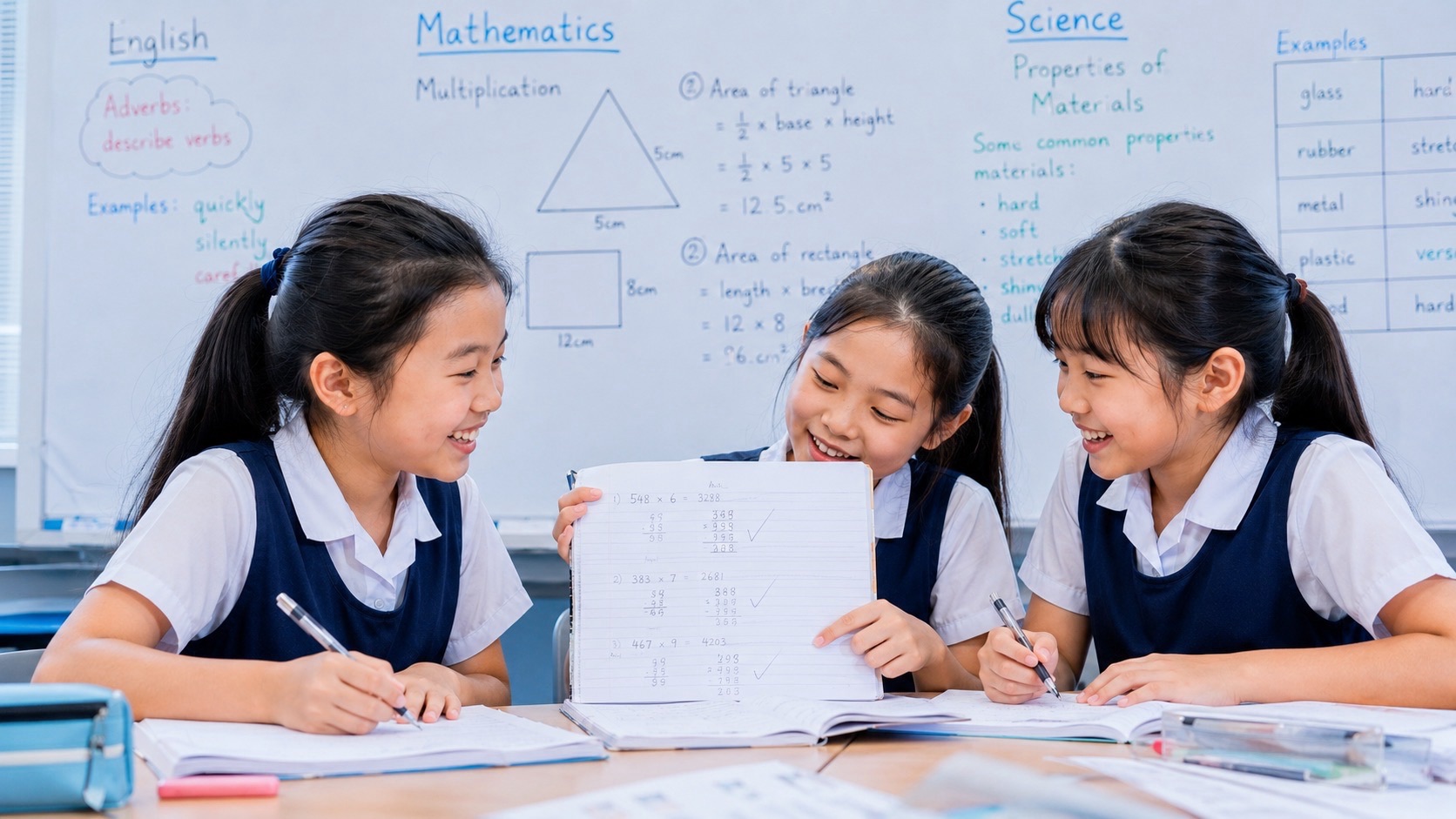
Primary 6 Science Tuition | Chai Chee is a final-year guide for families comparing Primary Science tuition Singapore options when a learner needs to integrate P3-P6 knowledge, strengthen scientific reasoning, improve experiment and data questions, and execute accurately under PSLE conditions. Parents searching for a Primary 6 Science tutor, P6 Science tuition, PSLE Science preparation or three-student Science tuition around Chai Chee should compare diagnosis, transfer, answering precision and current exam alignment rather than relying on worksheet volume alone.
The current MOE Primary Science Teaching and Learning Syllabus organises learning around core ideas and scientific practices across Diversity, Cycles, Systems, Energy and Interactions. The SEAB PSLE formats examined in 2026 identify Science as revised. For Standard Science, the 2026 format uses one 1-hour-45-minute written paper: Booklet A has 30 multiple-choice questions for 60 marks, while Booklet B has 10–11 structured questions for 40 marks. Final-year tuition should therefore build both discrimination and explanation while preserving the deeper goal of scientific understanding.
Chai Chee sits in the wider Bedok and east-side education corridor, alongside search behaviour connected to Bedok Central, Bedok South, Kembangan, Eunos, Siglap, Upper East Coast and Tanah Merah. Current Singapore Science tuition pages commonly foreground concept mastery, answering techniques, experiments, higher-order application, small classes and PSLE readiness. These claims matter only when visible teaching routines support them. This eduKateSG page is a local discovery layer inside the Science Learning Hub and Primary Science Tuition Singapore branch; it does not imply a physical eduKateSG branch in Chai Chee.
The P6 job: integration before acceleration
Primary 6 should not become a race to complete the largest number of papers. The more useful sequence is diagnose, repair, transfer, integrate and then accelerate. A student who knows many facts but repeatedly misreads evidence needs a different intervention from one who understands the question but cannot retrieve the mechanism. Final-year efficiency comes from making those distinctions early.
Integrate concepts across themes
Primary 6 compresses several years of Science into a final year where retrieval, transfer and execution have to work together. The immediate objective is to combine relevant ideas instead of waiting for a chapter label. A recurring breakdown appears when the learner knows individual topics but cannot select the right combination in a novel question. In final-year Science, a small weakness can spread across several item types because the paper may combine content, data, experiment logic and response control in the same task. The tutor therefore needs to identify the first unstable decision before choosing the repair.
A practical repair is to classify the demand, retrieve the smallest relevant set of concepts and state how they interact. The learner should explain the route, solve a changed version and return to the idea after a delay. Evidence of stronger mastery appears when a mixed question can be solved without being told which chapter it belongs to. This gives stronger evidence than an immediate model-answer correction.
Make retrieval fast enough for final-year work
For a P6 learner, a correct answer is useful evidence only when the reasoning can survive a changed question and time pressure. The immediate objective is to bring core knowledge to mind without repeated rereading. A recurring breakdown appears when revision time is spent recognising notes rather than recalling ideas. In final-year Science, a small weakness can spread across several item types because the paper may combine content, data, experiment logic and response control in the same task. The tutor therefore needs to identify the first unstable decision before choosing the repair.
A practical repair is to begin each session with closed-book retrieval from several older themes. The learner should explain the route, solve a changed version and return to the idea after a delay. Evidence of stronger mastery appears when key knowledge is available quickly enough to support reasoning under time. The repair is not closed until it survives delay and transfer.
Use evidence before explanation
A strong Primary 6 programme separates the scientific problem from the examination problem so each can be repaired directly. The immediate objective is to anchor every answer to what the question actually shows. A recurring breakdown appears when background knowledge overwhelms the data, diagram or observation. In final-year Science, a small weakness can spread across several item types because the paper may combine content, data, experiment logic and response control in the same task. The tutor therefore needs to identify the first unstable decision before choosing the repair.
A practical repair is to write a neutral evidence statement before adding mechanism. The learner should explain the route, solve a changed version and return to the idea after a delay. Evidence of stronger mastery appears when the final explanation accounts for the actual evidence rather than the expected story. The intended endpoint is independent execution.
Read experimental purpose before apparatus
In a three-student class, this skill becomes visible because every learner can be asked to expose a decision rather than hide behind the group’s answer. The immediate objective is to identify the relationship being tested. A recurring breakdown appears when the student can name equipment but misses the scientific question. In final-year Science, a small weakness can spread across several item types because the paper may combine content, data, experiment logic and response control in the same task. The tutor therefore needs to identify the first unstable decision before choosing the repair.
A practical repair is to summarise purpose in one sentence before identifying variables and controls. The learner should explain the route, solve a changed version and return to the idea after a delay. Evidence of stronger mastery appears when a redesigned setup remains interpretable. That keeps revision focused on the actual source of marks lost.
Treat fair tests as causal protection
Primary 6 compresses several years of Science into a final year where retrieval, transfer and execution have to work together. The immediate objective is to understand why controls matter. A recurring breakdown appears when controls are memorised without recognising rival explanations. In final-year Science, a small weakness can spread across several item types because the paper may combine content, data, experiment logic and response control in the same task. The tutor therefore needs to identify the first unstable decision before choosing the repair.
A practical repair is to name the alternative cause that appears if a control changes. The learner should explain the route, solve a changed version and return to the idea after a delay. Evidence of stronger mastery appears when control choices can be justified. This gives stronger evidence than an immediate model-answer correction.
Separate changed, measured and controlled factors
For a P6 learner, a correct answer is useful evidence only when the reasoning can survive a changed question and time pressure. The immediate objective is to map treatment, outcome and fair comparison. A recurring breakdown appears when variable labels blur together in complex setups. In final-year Science, a small weakness can spread across several item types because the paper may combine content, data, experiment logic and response control in the same task. The tutor therefore needs to identify the first unstable decision before choosing the repair.
A practical repair is to write changed factor → measured outcome, then identify conditions needed for comparison. The learner should explain the route, solve a changed version and return to the idea after a delay. Evidence of stronger mastery appears when roles stay clear when multiple variables appear. The repair is not closed until it survives delay and transfer.
Evaluate method improvements
A strong Primary 6 programme separates the scientific problem from the examination problem so each can be repaired directly. The immediate objective is to connect weakness, change and benefit. A recurring breakdown appears when generic suggestions are used for every experiment. In final-year Science, a small weakness can spread across several item types because the paper may combine content, data, experiment logic and response control in the same task. The tutor therefore needs to identify the first unstable decision before choosing the repair.
A practical repair is to identify the specific weakness, make a targeted change and state how evidence improves. The learner should explain the route, solve a changed version and return to the idea after a delay. Evidence of stronger mastery appears when different flaws generate different improvements. The intended endpoint is independent execution.
Interpret repeated trials
In a three-student class, this skill becomes visible because every learner can be asked to expose a decision rather than hide behind the group’s answer. The immediate objective is to distinguish random variation from systematic design problems. A recurring breakdown appears when repetition is assumed to fix every weakness. In final-year Science, a small weakness can spread across several item types because the paper may combine content, data, experiment logic and response control in the same task. The tutor therefore needs to identify the first unstable decision before choosing the repair.
A practical repair is to ask what source of uncertainty repetition addresses and what it cannot repair. The learner should explain the route, solve a changed version and return to the idea after a delay. Evidence of stronger mastery appears when the learner knows when more trials matter. That keeps revision focused on the actual source of marks lost.
Read tables for pattern and exception
Primary 6 compresses several years of Science into a final year where retrieval, transfer and execution have to work together. The immediate objective is to describe before explaining. A recurring breakdown appears when one convenient value drives the whole answer. In final-year Science, a small weakness can spread across several item types because the paper may combine content, data, experiment logic and response control in the same task. The tutor therefore needs to identify the first unstable decision before choosing the repair.
A practical repair is to state overall trend, comparison and any anomaly before interpreting. The learner should explain the route, solve a changed version and return to the idea after a delay. Evidence of stronger mastery appears when the mechanism fits the full dataset. This gives stronger evidence than an immediate model-answer correction.
Read graphs with a fixed scan
For a P6 learner, a correct answer is useful evidence only when the reasoning can survive a changed question and time pressure. The immediate objective is to protect marks on title, axes, units, scale and trend. A recurring breakdown appears when known Science is undermined by representation errors. In final-year Science, a small weakness can spread across several item types because the paper may combine content, data, experiment logic and response control in the same task. The tutor therefore needs to identify the first unstable decision before choosing the repair.
A practical repair is to use the same graph-reading sequence under timed conditions. The learner should explain the route, solve a changed version and return to the idea after a delay. Evidence of stronger mastery appears when accuracy stays high as graph type changes. The repair is not closed until it survives delay and transfer.
Translate diagrams into propositions
A strong Primary 6 programme separates the scientific problem from the examination problem so each can be repaired directly. The immediate objective is to use labels and arrows as evidence. A recurring breakdown appears when familiarity with the topic replaces careful reading. In final-year Science, a small weakness can spread across several item types because the paper may combine content, data, experiment logic and response control in the same task. The tutor therefore needs to identify the first unstable decision before choosing the repair.
A practical repair is to say what each relevant feature means before recalling facts. The learner should explain the route, solve a changed version and return to the idea after a delay. Evidence of stronger mastery appears when changed diagrams produce appropriately changed answers. The intended endpoint is independent execution.
Switch representations deliberately
In a three-student class, this skill becomes visible because every learner can be asked to expose a decision rather than hide behind the group’s answer. The immediate objective is to move among prose, graphs, tables and diagrams without losing the relationship. A recurring breakdown appears when understanding is tied to one presentation. In final-year Science, a small weakness can spread across several item types because the paper may combine content, data, experiment logic and response control in the same task. The tutor therefore needs to identify the first unstable decision before choosing the repair.
A practical repair is to re-express the same mechanism in two different formats. The learner should explain the route, solve a changed version and return to the idea after a delay. Evidence of stronger mastery appears when the concept remains portable. That keeps revision focused on the actual source of marks lost.
Build structured answers as causal chains
Primary 6 compresses several years of Science into a final year where retrieval, transfer and execution have to work together. The immediate objective is to connect evidence, mechanism and outcome. A recurring breakdown appears when an answer contains correct keywords but skips the scientific middle. In final-year Science, a small weakness can spread across several item types because the paper may combine content, data, experiment logic and response control in the same task. The tutor therefore needs to identify the first unstable decision before choosing the repair.
A practical repair is to draft the chain in steps then compress it to the required scope. The learner should explain the route, solve a changed version and return to the idea after a delay. Evidence of stronger mastery appears when responses are complete without being padded. This gives stronger evidence than an immediate model-answer correction.
Use command words as constraints
For a P6 learner, a correct answer is useful evidence only when the reasoning can survive a changed question and time pressure. The immediate objective is to match response form to state, describe, explain, compare, predict and suggest. A recurring breakdown appears when good knowledge is delivered in the wrong shape. In final-year Science, a small weakness can spread across several item types because the paper may combine content, data, experiment logic and response control in the same task. The tutor therefore needs to identify the first unstable decision before choosing the repair.
A practical repair is to identify the command before writing and check every sentence against it. The learner should explain the route, solve a changed version and return to the idea after a delay. Evidence of stronger mastery appears when answers become more relevant. The repair is not closed until it survives delay and transfer.
Treat MCQ distractors diagnostically
A strong Primary 6 programme separates the scientific problem from the examination problem so each can be repaired directly. The immediate objective is to use wrong options to reveal misconceptions. A recurring breakdown appears when the correct option is selected by recognition or luck. In final-year Science, a small weakness can spread across several item types because the paper may combine content, data, experiment logic and response control in the same task. The tutor therefore needs to identify the first unstable decision before choosing the repair.
A practical repair is to explain the decisive clue and why the strongest rival fails. The learner should explain the route, solve a changed version and return to the idea after a delay. Evidence of stronger mastery appears when correct answers become evidence of discrimination. The intended endpoint is independent execution.
Review selected correct answers
In a three-student class, this skill becomes visible because every learner can be asked to expose a decision rather than hide behind the group’s answer. The immediate objective is to detect fragile reasoning hidden by high scores. A recurring breakdown appears when guesses disappear inside the total mark. In final-year Science, a small weakness can spread across several item types because the paper may combine content, data, experiment logic and response control in the same task. The tutor therefore needs to identify the first unstable decision before choosing the repair.
A practical repair is to sample correct responses and require the reasoning route. The learner should explain the route, solve a changed version and return to the idea after a delay. Evidence of stronger mastery appears when score becomes a better indicator of mastery. That keeps revision focused on the actual source of marks lost.
Use spaced retrieval across P3-P6 knowledge
Primary 6 compresses several years of Science into a final year where retrieval, transfer and execution have to work together. The immediate objective is to keep the whole curriculum active. A recurring breakdown appears when older chapters fade while current revision dominates. In final-year Science, a small weakness can spread across several item types because the paper may combine content, data, experiment logic and response control in the same task. The tutor therefore needs to identify the first unstable decision before choosing the repair.
A practical repair is to cycle older themes into every week with delayed retests. The learner should explain the route, solve a changed version and return to the idea after a delay. Evidence of stronger mastery appears when cumulative access improves. This gives stronger evidence than an immediate model-answer correction.
Interleave once concepts are secure
For a P6 learner, a correct answer is useful evidence only when the reasoning can survive a changed question and time pressure. The immediate objective is to force concept selection without topic cues. A recurring breakdown appears when performance drops on mixed papers. In final-year Science, a small weakness can spread across several item types because the paper may combine content, data, experiment logic and response control in the same task. The tutor therefore needs to identify the first unstable decision before choosing the repair.
A practical repair is to classify each question before solving. The learner should explain the route, solve a changed version and return to the idea after a delay. Evidence of stronger mastery appears when selection becomes more automatic. The repair is not closed until it survives delay and transfer.
Use transfer as the mastery test
A strong Primary 6 programme separates the scientific problem from the examination problem so each can be repaired directly. The immediate objective is to prove that learning survives changed surfaces. A recurring breakdown appears when repeated near-identical questions create false confidence. In final-year Science, a small weakness can spread across several item types because the paper may combine content, data, experiment logic and response control in the same task. The tutor therefore needs to identify the first unstable decision before choosing the repair.
A practical repair is to change objects, wording, representations and irrelevant detail. The learner should explain the route, solve a changed version and return to the idea after a delay. Evidence of stronger mastery appears when success persists without the original cue. The intended endpoint is independent execution.
Contrast misconceptions
In a three-student class, this skill becomes visible because every learner can be asked to expose a decision rather than hide behind the group’s answer. The immediate objective is to replace wrong rules explicitly. A recurring breakdown appears when the same error returns after model-answer correction. In final-year Science, a small weakness can spread across several item types because the paper may combine content, data, experiment logic and response control in the same task. The tutor therefore needs to identify the first unstable decision before choosing the repair.
A practical repair is to write old rule, corrected rule and a discriminating example. The learner should explain the route, solve a changed version and return to the idea after a delay. Evidence of stronger mastery appears when the learner can explain why the old rule fails. That keeps revision focused on the actual source of marks lost.
Diagnose the first broken layer
Primary 6 compresses several years of Science into a final year where retrieval, transfer and execution have to work together. The immediate objective is to separate retrieval, reading, evidence, mechanism, vocabulary, scope and execution. A recurring breakdown appears when all errors are called careless. In final-year Science, a small weakness can spread across several item types because the paper may combine content, data, experiment logic and response control in the same task. The tutor therefore needs to identify the first unstable decision before choosing the repair.
A practical repair is to identify the earliest unstable decision. The learner should explain the route, solve a changed version and return to the idea after a delay. Evidence of stronger mastery appears when repair work becomes precise. This gives stronger evidence than an immediate model-answer correction.
Separate concept weakness from exam execution
For a P6 learner, a correct answer is useful evidence only when the reasoning can survive a changed question and time pressure. The immediate objective is to avoid reteaching secure Science. A recurring breakdown appears when lost marks from timing or reading trigger unnecessary content revision. In final-year Science, a small weakness can spread across several item types because the paper may combine content, data, experiment logic and response control in the same task. The tutor therefore needs to identify the first unstable decision before choosing the repair.
A practical repair is to code errors by cause and assign different interventions. The learner should explain the route, solve a changed version and return to the idea after a delay. Evidence of stronger mastery appears when study time matches the bottleneck. The repair is not closed until it survives delay and transfer.
Use an error log as an active queue
A strong Primary 6 programme separates the scientific problem from the examination problem so each can be repaired directly. The immediate objective is to keep only unresolved high-value errors. A recurring breakdown appears when corrections accumulate without retesting. In final-year Science, a small weakness can spread across several item types because the paper may combine content, data, experiment logic and response control in the same task. The tutor therefore needs to identify the first unstable decision before choosing the repair.
A practical repair is to attach each error to a changed retest and closure condition. The learner should explain the route, solve a changed version and return to the idea after a delay. Evidence of stronger mastery appears when the log shrinks as learning stabilises. The intended endpoint is independent execution.
Build answer precision
In a three-student class, this skill becomes visible because every learner can be asked to expose a decision rather than hide behind the group’s answer. The immediate objective is to replace vague language with exact scientific relationships. A recurring breakdown appears when long answers still contain ambiguous pronouns or missing causal links. In final-year Science, a small weakness can spread across several item types because the paper may combine content, data, experiment logic and response control in the same task. The tutor therefore needs to identify the first unstable decision before choosing the repair.
A practical repair is to name the factor, state the direction of change and connect the mechanism. The learner should explain the route, solve a changed version and return to the idea after a delay. Evidence of stronger mastery appears when clarity rises without unnecessary length. That keeps revision focused on the actual source of marks lost.
Use oral defence
Primary 6 compresses several years of Science into a final year where retrieval, transfer and execution have to work together. The immediate objective is to make reasoning explicit. A recurring breakdown appears when memorised model answers hide uncertainty. In final-year Science, a small weakness can spread across several item types because the paper may combine content, data, experiment logic and response control in the same task. The tutor therefore needs to identify the first unstable decision before choosing the repair.
A practical repair is to ask why, what evidence, what changes next and what would alter the conclusion. The learner should explain the route, solve a changed version and return to the idea after a delay. Evidence of stronger mastery appears when the student can defend an answer independently. This gives stronger evidence than an immediate model-answer correction.
Train prediction from models
For a P6 learner, a correct answer is useful evidence only when the reasoning can survive a changed question and time pressure. The immediate objective is to use known relationships to forecast outcomes. A recurring breakdown appears when predictions are intuition dressed as Science. In final-year Science, a small weakness can spread across several item types because the paper may combine content, data, experiment logic and response control in the same task. The tutor therefore needs to identify the first unstable decision before choosing the repair.
A practical repair is to state condition, apply relationship and give expected result. The learner should explain the route, solve a changed version and return to the idea after a delay. Evidence of stronger mastery appears when the learner can explain how a changed condition alters the prediction. The repair is not closed until it survives delay and transfer.
Write conclusions within tested boundaries
A strong Primary 6 programme separates the scientific problem from the examination problem so each can be repaired directly. The immediate objective is to keep claims proportional to evidence. A recurring breakdown appears when specific results become universal statements. In final-year Science, a small weakness can spread across several item types because the paper may combine content, data, experiment logic and response control in the same task. The tutor therefore needs to identify the first unstable decision before choosing the repair.
A practical repair is to include the tested variables and range in the conclusion. The learner should explain the route, solve a changed version and return to the idea after a delay. Evidence of stronger mastery appears when claims remain defensible. The intended endpoint is independent execution.
Handle anomalies carefully
In a three-student class, this skill becomes visible because every learner can be asked to expose a decision rather than hide behind the group’s answer. The immediate objective is to recognise unusual data without abandoning the main pattern. A recurring breakdown appears when one odd value is ignored or overinterpreted. In final-year Science, a small weakness can spread across several item types because the paper may combine content, data, experiment logic and response control in the same task. The tutor therefore needs to identify the first unstable decision before choosing the repair.
A practical repair is to state the main trend, flag the anomaly and decide whether more evidence is needed. The learner should explain the route, solve a changed version and return to the idea after a delay. Evidence of stronger mastery appears when data reasoning becomes balanced. That keeps revision focused on the actual source of marks lost.
Use comparison frames
Primary 6 compresses several years of Science into a final year where retrieval, transfer and execution have to work together. The immediate objective is to compare along one scientific dimension at a time. A recurring breakdown appears when two items are described separately. In final-year Science, a small weakness can spread across several item types because the paper may combine content, data, experiment logic and response control in the same task. The tutor therefore needs to identify the first unstable decision before choosing the repair.
A practical repair is to name the property and compare both objects under it. The learner should explain the route, solve a changed version and return to the idea after a delay. Evidence of stronger mastery appears when comparison answers become concise. This gives stronger evidence than an immediate model-answer correction.
Turn definitions into boundary tests
For a P6 learner, a correct answer is useful evidence only when the reasoning can survive a changed question and time pressure. The immediate objective is to distinguish close concepts. A recurring breakdown appears when definitions are memorised but near-neighbours are confused. In final-year Science, a small weakness can spread across several item types because the paper may combine content, data, experiment logic and response control in the same task. The tutor therefore needs to identify the first unstable decision before choosing the repair.
A practical repair is to pair each term with a non-example and explain the boundary. The learner should explain the route, solve a changed version and return to the idea after a delay. Evidence of stronger mastery appears when distractors become easier to reject. The repair is not closed until it survives delay and transfer.
Use local context as an entry point
A strong Primary 6 programme separates the scientific problem from the examination problem so each can be repaired directly. The immediate objective is to connect Chai Chee observations to precise inquiry. A recurring breakdown appears when familiarity produces casual explanations. In final-year Science, a small weakness can spread across several item types because the paper may combine content, data, experiment logic and response control in the same task. The tutor therefore needs to identify the first unstable decision before choosing the repair.
A practical repair is to start with heat, shade, rain, plants, materials or movement and ask what must be measured or controlled. The learner should explain the route, solve a changed version and return to the idea after a delay. Evidence of stronger mastery appears when the relationship later transfers to unfamiliar exam contexts. The intended endpoint is independent execution.
Use timed sets to diagnose rather than punish
In a three-student class, this skill becomes visible because every learner can be asked to expose a decision rather than hide behind the group’s answer. The immediate objective is to discover where time is lost. A recurring breakdown appears when timing pressure creates new mistakes without revealing cause. In final-year Science, a small weakness can spread across several item types because the paper may combine content, data, experiment logic and response control in the same task. The tutor therefore needs to identify the first unstable decision before choosing the repair.
A practical repair is to record delay by item type and reasoning stage. The learner should explain the route, solve a changed version and return to the idea after a delay. Evidence of stronger mastery appears when speed work targets the actual bottleneck. That keeps revision focused on the actual source of marks lost.
Build pace after stable routines
Primary 6 compresses several years of Science into a final year where retrieval, transfer and execution have to work together. The immediate objective is to increase speed without sacrificing interpretation. A recurring breakdown appears when the learner rushes before a reliable method exists. In final-year Science, a small weakness can spread across several item types because the paper may combine content, data, experiment logic and response control in the same task. The tutor therefore needs to identify the first unstable decision before choosing the repair.
A practical repair is to stabilise the sequence first, then shorten time progressively. The learner should explain the route, solve a changed version and return to the idea after a delay. Evidence of stronger mastery appears when accuracy remains steady as pace improves. This gives stronger evidence than an immediate model-answer correction.
Use two-pass paper management
For a P6 learner, a correct answer is useful evidence only when the reasoning can survive a changed question and time pressure. The immediate objective is to separate straightforward marks from high-friction items. A recurring breakdown appears when one difficult question consumes too much early time. In final-year Science, a small weakness can spread across several item types because the paper may combine content, data, experiment logic and response control in the same task. The tutor therefore needs to identify the first unstable decision before choosing the repair.
A practical repair is to complete secure items first, flag high-friction items and return with a clear budget. The learner should explain the route, solve a changed version and return to the idea after a delay. Evidence of stronger mastery appears when time is distributed more rationally. The repair is not closed until it survives delay and transfer.
Create a checking routine
A strong Primary 6 programme separates the scientific problem from the examination problem so each can be repaired directly. The immediate objective is to verify evidence, units, scope and mechanism. A recurring breakdown appears when checking becomes aimless rereading. In final-year Science, a small weakness can spread across several item types because the paper may combine content, data, experiment logic and response control in the same task. The tutor therefore needs to identify the first unstable decision before choosing the repair.
A practical repair is to use a fixed checklist tied to common error types. The learner should explain the route, solve a changed version and return to the idea after a delay. Evidence of stronger mastery appears when final review catches substantive mistakes. The intended endpoint is independent execution.
Practise under realistic constraints
In a three-student class, this skill becomes visible because every learner can be asked to expose a decision rather than hide behind the group’s answer. The immediate objective is to make exam execution familiar. A recurring breakdown appears when practice is always untimed and heavily prompted. In final-year Science, a small weakness can spread across several item types because the paper may combine content, data, experiment logic and response control in the same task. The tutor therefore needs to identify the first unstable decision before choosing the repair.
A practical repair is to periodically remove aids and use realistic time windows. The learner should explain the route, solve a changed version and return to the idea after a delay. Evidence of stronger mastery appears when independence increases. That keeps revision focused on the actual source of marks lost.
Avoid full-paper overuse
Primary 6 compresses several years of Science into a final year where retrieval, transfer and execution have to work together. The immediate objective is to use papers as integration tests rather than daily teaching substitutes. A recurring breakdown appears when large papers repeat the same unresolved weakness. In final-year Science, a small weakness can spread across several item types because the paper may combine content, data, experiment logic and response control in the same task. The tutor therefore needs to identify the first unstable decision before choosing the repair.
A practical repair is to repair locally between broader assessments. The learner should explain the route, solve a changed version and return to the idea after a delay. Evidence of stronger mastery appears when paper practice becomes informative. This gives stronger evidence than an immediate model-answer correction.
Use school prelim and weighted-assessment errors intelligently
For a P6 learner, a correct answer is useful evidence only when the reasoning can survive a changed question and time pressure. The immediate objective is to treat school results as diagnostic samples. A recurring breakdown appears when marks are discussed without analysing the reasoning decisions behind them. In final-year Science, a small weakness can spread across several item types because the paper may combine content, data, experiment logic and response control in the same task. The tutor therefore needs to identify the first unstable decision before choosing the repair.
A practical repair is to classify errors across content, representation, experiment, scope and execution. The learner should explain the route, solve a changed version and return to the idea after a delay. Evidence of stronger mastery appears when revision priorities become evidence-based. The repair is not closed until it survives delay and transfer.
Build a final-year revision map
A strong Primary 6 programme separates the scientific problem from the examination problem so each can be repaired directly. The immediate objective is to know what is secure, fragile and unknown. A recurring breakdown appears when revision follows chapter order even when needs are uneven. In final-year Science, a small weakness can spread across several item types because the paper may combine content, data, experiment logic and response control in the same task. The tutor therefore needs to identify the first unstable decision before choosing the repair.
A practical repair is to rank themes and process skills by risk and retest evidence. The learner should explain the route, solve a changed version and return to the idea after a delay. Evidence of stronger mastery appears when study time goes where it matters. The intended endpoint is independent execution.
Use confidence calibration
In a three-student class, this skill becomes visible because every learner can be asked to expose a decision rather than hide behind the group’s answer. The immediate objective is to compare certainty with actual performance. A recurring breakdown appears when familiar wording creates overconfidence. In final-year Science, a small weakness can spread across several item types because the paper may combine content, data, experiment logic and response control in the same task. The tutor therefore needs to identify the first unstable decision before choosing the repair.
A practical repair is to record confidence and the evidence behind it. The learner should explain the route, solve a changed version and return to the idea after a delay. Evidence of stronger mastery appears when guessing and uncertainty become visible. That keeps revision focused on the actual source of marks lost.
Protect sleep and sustainable study
Primary 6 compresses several years of Science into a final year where retrieval, transfer and execution have to work together. The immediate objective is to preserve cognitive performance during intensive preparation. A recurring breakdown appears when late-night volume replaces focused retrieval. In final-year Science, a small weakness can spread across several item types because the paper may combine content, data, experiment logic and response control in the same task. The tutor therefore needs to identify the first unstable decision before choosing the repair.
A practical repair is to use shorter deliberate sessions with spacing and recovery. The learner should explain the route, solve a changed version and return to the idea after a delay. Evidence of stronger mastery appears when practice quality remains high. This gives stronger evidence than an immediate model-answer correction.
Keep curiosity alive
For a P6 learner, a correct answer is useful evidence only when the reasoning can survive a changed question and time pressure. The immediate objective is to retain genuine scientific thinking alongside exam preparation. A recurring breakdown appears when the year becomes only marks and scripts. In final-year Science, a small weakness can spread across several item types because the paper may combine content, data, experiment logic and response control in the same task. The tutor therefore needs to identify the first unstable decision before choosing the repair.
A practical repair is to allow questions, predictions and explanation before formal answer compression. The learner should explain the route, solve a changed version and return to the idea after a delay. Evidence of stronger mastery appears when understanding supports exam performance. The repair is not closed until it survives delay and transfer.
Use three-student discussion as a diagnostic tool
A strong Primary 6 programme separates the scientific problem from the examination problem so each can be repaired directly. The immediate objective is to see multiple reasoning routes quickly. A recurring breakdown appears when small-group tuition becomes a lecture. In final-year Science, a small weakness can spread across several item types because the paper may combine content, data, experiment logic and response control in the same task. The tutor therefore needs to identify the first unstable decision before choosing the repair.
A practical repair is to require individual commitment before comparing answers. The learner should explain the route, solve a changed version and return to the idea after a delay. Evidence of stronger mastery appears when the tutor can diagnose each learner. The intended endpoint is independent execution.
Make feedback immediate and specific
In a three-student class, this skill becomes visible because every learner can be asked to expose a decision rather than hide behind the group’s answer. The immediate objective is to connect correction to the decision that caused it. A recurring breakdown appears when feedback arrives as only right/wrong. In final-year Science, a small weakness can spread across several item types because the paper may combine content, data, experiment logic and response control in the same task. The tutor therefore needs to identify the first unstable decision before choosing the repair.
A practical repair is to name the broken layer and the next test. The learner should explain the route, solve a changed version and return to the idea after a delay. Evidence of stronger mastery appears when the learner knows what to change. That keeps revision focused on the actual source of marks lost.
Use parent reporting as evidence
Primary 6 compresses several years of Science into a final year where retrieval, transfer and execution have to work together. The immediate objective is to communicate durable progress rather than workload. A recurring breakdown appears when updates focus on pages completed. In final-year Science, a small weakness can spread across several item types because the paper may combine content, data, experiment logic and response control in the same task. The tutor therefore needs to identify the first unstable decision before choosing the repair.
A practical repair is to report recurring error, intervention, delayed retest and next risk. The learner should explain the route, solve a changed version and return to the idea after a delay. Evidence of stronger mastery appears when families can see what learning changed. This gives stronger evidence than an immediate model-answer correction.
Prepare for the revised 2026 PSLE Science format
For a P6 learner, a correct answer is useful evidence only when the reasoning can survive a changed question and time pressure. The immediate objective is to align final-year work with the current assessment destination. A recurring breakdown appears when practice relies on outdated assumptions about the paper. In final-year Science, a small weakness can spread across several item types because the paper may combine content, data, experiment logic and response control in the same task. The tutor therefore needs to identify the first unstable decision before choosing the repair.
A practical repair is to use current SEAB information and train both MCQ discrimination and structured reasoning. The learner should explain the route, solve a changed version and return to the idea after a delay. Evidence of stronger mastery appears when preparation matches the paper examined in 2026. The repair is not closed until it survives delay and transfer.
Keep the local page connected to central Science owners
A strong Primary 6 programme separates the scientific problem from the examination problem so each can be repaired directly. The immediate objective is to expand discovery without fragmenting curriculum authority. A recurring breakdown appears when location pages become isolated duplicate hubs. In final-year Science, a small weakness can spread across several item types because the paper may combine content, data, experiment logic and response control in the same task. The tutor therefore needs to identify the first unstable decision before choosing the repair.
A practical repair is to route upward to Science Learning Hub and Primary Science Tuition and sideways to local siblings. The learner should explain the route, solve a changed version and return to the idea after a delay. Evidence of stronger mastery appears when the site remains coherent. The intended endpoint is independent execution.
Resident cases: eight final-year bottlenecks
Adrian: secure chapters, weak mixing
Adrian performs strongly on topic worksheets but hesitates when a paper mixes several themes. He classifies the question demand before retrieving content and then explains why one concept is relevant while another familiar concept is not. His mixed-set accuracy rises because selection becomes explicit.
Jo: excellent terminology, missing causal middle
Jo knows scientific language but can still skip a mechanism. She drafts evidence → mechanism → outcome before compressing the answer. Keywords remain important, but they now sit inside a causal structure that the examiner can follow.
Ben: high MCQ accuracy with occasional risky shortcuts
Ben is fast and often correct. His tutor samples his correct answers and asks for the decisive clue and strongest rejected option. This catches lucky pattern-matching before it becomes dangerous under a changed question.
Aisha: knowledge that outruns question scope
Aisha likes rich explanations and sometimes adds true but unasked material. She marks the command word and evidence first, then limits the answer to what the question can support. Her responses become shorter and more precise.
Ryan: experiments by label rather than logic
Ryan can recite variable vocabulary. He now begins with the investigation’s purpose and rival explanations. Controls become meaningful because he can say what unfair alternative cause they prevent.
Mira: accuracy with excessive checking
Mira needs a stopping rule. Her fixed data and graph checks allow her to verify what matters once and move on. Timed practice records where she actually slows down, so speed work remains targeted.
Clara: understanding that depends on presentation
Clara can explain prose questions confidently but slows down with dense diagrams. She converts diagrams to statements, tables to patterns and graphs to comparisons. Representation switching reduces the shock of unfamiliar presentation.
Ethan: strong corrections, weak delayed retention
Ethan’s correction book looks excellent, but some errors recur. Every high-value error now has a delayed changed retest. If the misconception returns, it remains open and receives another discriminating example.
A Chai Chee final-year Science laboratory
Familiar east-side surroundings can still be useful for scientific thinking. Heat, shade, rainwater, plants, materials, movement and changes over time can generate questions about evidence, variables and mechanisms. But P6 practice must quickly leave the familiar surface. The same relationship should appear next in an unfamiliar experiment, a graph, a table or a structured item so that the learner proves transfer rather than local recognition.
This matters because the PSLE does not reward familiarity with a neighbourhood story. It rewards the ability to interpret what is given, retrieve the relevant Science and construct an answer that fits the evidence and command. Local context is therefore an entry point, never the endpoint.
How to compare Primary 6 Science tuition around Chai Chee
- Ask how the programme integrates P3-P6 content rather than revising only chapter by chapter.
- Ask how the 2026 revised PSLE Science format is reflected in practice.
- Ask how MCQ distractors are analysed rather than only marked.
- Ask how structured answers are built from evidence to mechanism.
- Ask how experiments, controls and method improvements are taught.
- Ask how diagrams, tables and graphs are handled under time.
- Ask how errors are classified and retested after delay.
- Ask how full papers are used between targeted repair sessions.
- Ask what three-student tuition changes about questioning and individual feedback.
Frequently asked questions
What changed in the 2026 Standard PSLE Science format?
SEAB’s 2026 syllabus specifies one 1-hour-45-minute written paper. Booklet A contains 30 multiple-choice questions worth 60 marks. Booklet B contains 10–11 structured questions worth 40 marks. Candidates answer all questions in both booklets.
Should P6 students do many full papers?
Full papers are useful integration tests, but they should not replace targeted repair. If repeated losses come from one misconception, graph-reading routine or experiment error, a shorter focused set may produce more improvement before the next full paper.
How important are model answers?
They are useful references, not substitutes for reasoning. The student should understand why the answer fits the evidence and command word, then be able to reproduce the mechanism in different wording and context.
What should happen after a wrong MCQ?
Identify the decisive clue, explain why the chosen option failed, analyse the strongest distractor and solve a changed version later. A wrong MCQ can reveal a concept error, reading error or discrimination problem.
How should open-ended answers be improved?
Start with the evidence, build the causal chain, use precise scientific terms and stop when the command has been fully answered. More words are not automatically more marks.
What is the value of a small group?
In a genuine three-student class, every learner can be asked to commit to a prediction, defend evidence and explain a correction. The tutor can track individual misconceptions without losing the comparison benefits of group discussion.
Does this page mean eduKateSG has a physical Chai Chee branch?
No. It is a location-discovery and routing page. Families should confirm actual lesson venue, mode, tutor and timetable directly.
Official and eduKateSG routes
- MOE Primary Science Teaching and Learning Syllabus
- SEAB 2026 PSLE Science syllabus and examination format
- SEAB PSLE Formats Examined in 2026
- eduKateSG Science Learning Hub
- Primary Science Tuition Singapore
- How Primary Science Tuition Works
- Primary 4 Science Tuition | Chai Chee
- Primary 5 Science Tuition | Chai Chee
- PSLE Science Tuition | Chai Chee
Final perspective
Strong Primary 6 Science tuition in Chai Chee should integrate knowledge, evidence and execution. The learner should retrieve across themes, read experiments and representations carefully, discriminate among close alternatives, construct bounded causal explanations and manage time without sacrificing scientific precision.
The final-year target is not dependence on a tutor’s model answer. It is an independent operating system: retrieve, interpret, select, explain, check and move on. When that system is stable, PSLE practice becomes a way to test integration rather than a substitute for learning.