
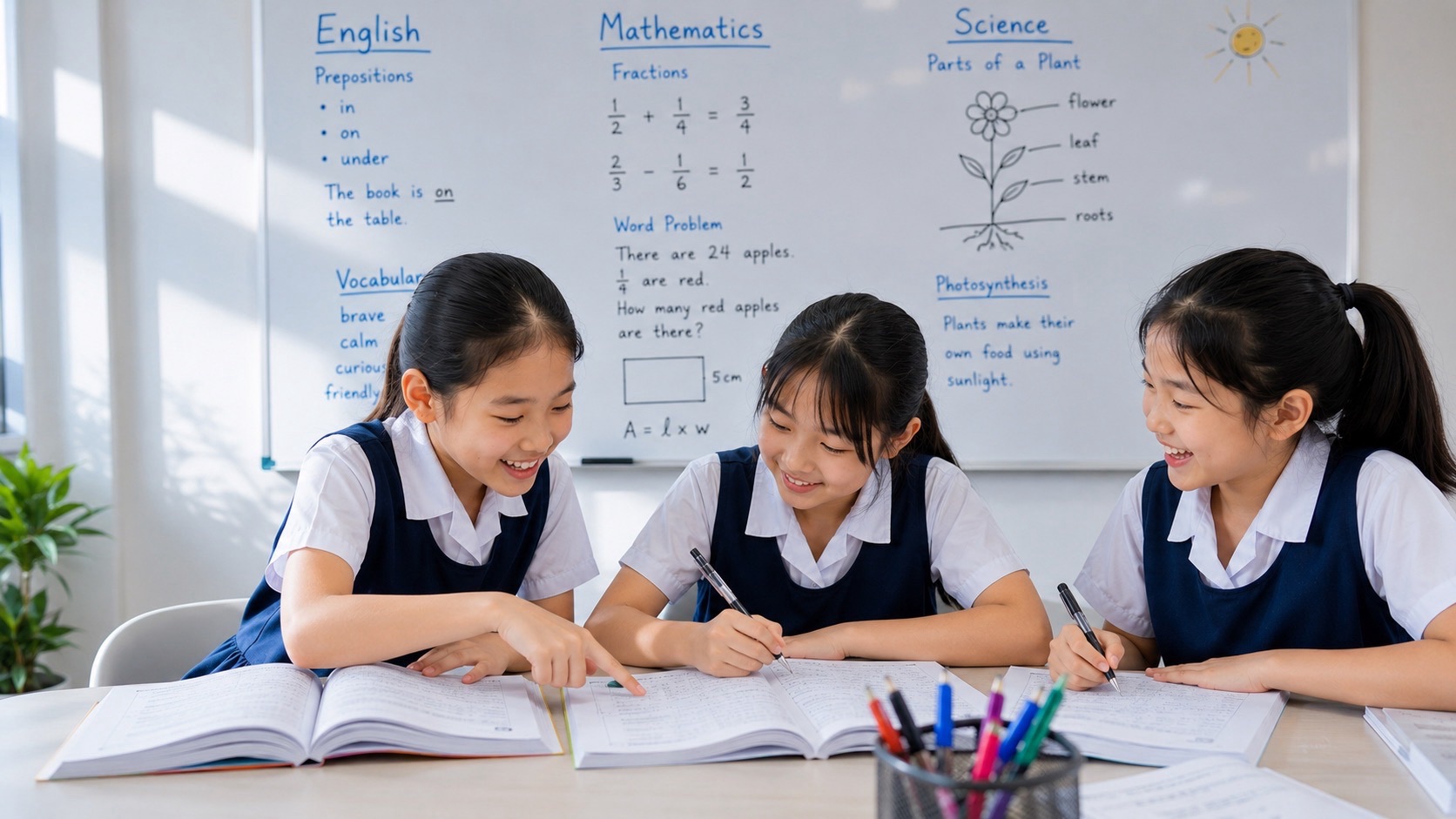
Primary 6 Science Tuition | Marine Terrace is for families comparing Primary Science tuition Singapore options during the year when P3–P6 concepts, scientific inquiry and examination execution must operate as one system. Strong P6 Science tuition should integrate MOE Primary Science syllabus knowledge with process skills, experiments, fair tests, scientific vocabulary, MCQ discrimination, structured questions, diagrams, tables, graphs, data interpretation, application, answering techniques and PSLE readiness. Parents searching for a Primary 6 Science tutor, Science tuition centre or 3-pax small-group tuition around Marine Terrace should look for precise diagnosis and transfer rather than paper volume alone.
The current MOE Primary Science Teaching and Learning Syllabus provides the conceptual and inquiry foundation, while the 2026 SEAB PSLE Science syllabus defines the assessment destination. Students must demonstrate knowledge with understanding and application through scientific inquiry, including prediction, interpretation, analysis, evaluation of observations and methods, and communicated reasoning. P6 Science tuition therefore needs to make concepts retrievable, transferable and executable under increasingly examination-like conditions.
Marine Terrace lies in an east-side search corridor linked to Kembangan, Opera Estate, Frankel, Joo Chiat, Eunos, Siglap and Bedok. Current local results show Science and Mathematics tuition options around Kembangan and Marine Terrace, while broader P6 Science tuition and PSLE Science tuition Singapore competitors emphasise concept mastery, answering techniques, MOE alignment, scientific inquiry and small classes. This page translates those labels into observable teaching and routes through eduKateSG’s existing Science Learning Hub and Primary Science Tuition Singapore branch. It does not imply a physical eduKate centre in Marine Terrace.
Full-system control
The P6 objective here is to integrate P3–P6 knowledge so concepts can be selected without chapter cues. A recurring performance problem appears when a learner performs well only when practice is grouped by topic. Because Primary 6 mixes several years of content and increasingly exam-like conditions, that weakness can cost marks across multiple topics. Diagnosis should separate missing knowledge from weak retrieval, wrong concept selection, evidence-reading errors, incomplete reasoning, language problems and execution under time.
The repair is to use mixed classification drills before solving so the learner identifies the governing system and concept first. The tutor should then change the surface, remove the original cue and test whether the learner can initiate the method independently. The same surface error can come from different causes, so the tutor should locate the earliest broken decision. That keeps intervention surgical and prevents unnecessary reteaching of content the student already knows.
Cumulative retrieval
The P6 objective here is to keep P3–P5 knowledge accessible every week. A recurring performance problem appears when a learner relearns old topics before major assessments. Because Primary 6 mixes several years of content and increasingly exam-like conditions, that weakness can cost marks across multiple topics. Diagnosis should separate missing knowledge from weak retrieval, wrong concept selection, evidence-reading errors, incomplete reasoning, language problems and execution under time.
The repair is to rotate earlier concepts through short retrieval and repair only what fails to return. The tutor should then change the surface, remove the original cue and test whether the learner can initiate the method independently. Transfer needs a changed context. The learner should solve a second item that preserves the scientific structure while changing objects, wording or representation. Stable performance shows the method is becoming independent.
Syllabus mapping
The P6 objective here is to track secure, fragile and missing concepts alongside process skills. A recurring performance problem appears when a learner treats syllabus completion as proof of mastery. Because Primary 6 mixes several years of content and increasingly exam-like conditions, that weakness can cost marks across multiple topics. Diagnosis should separate missing knowledge from weak retrieval, wrong concept selection, evidence-reading errors, incomplete reasoning, language problems and execution under time.
The repair is to mark retrieval strength, transfer strength and recurring process errors separately. The tutor should then change the surface, remove the original cue and test whether the learner can initiate the method independently. Delayed success matters. Immediate corrections are useful, but a changed item several days later gives stronger evidence that the repair has survived beyond working memory.
Photosynthesis
The P6 objective here is to connect conditions, structures, evidence and outcomes. A recurring performance problem appears when a learner remembers a model sentence but cannot interpret changed setups. Because Primary 6 mixes several years of content and increasingly exam-like conditions, that weakness can cost marks across multiple topics. Diagnosis should separate missing knowledge from weak retrieval, wrong concept selection, evidence-reading errors, incomplete reasoning, language problems and execution under time.
The repair is to compare altered conditions and predict consequences using the same relationship. The tutor should then change the surface, remove the original cue and test whether the learner can initiate the method independently. Progress becomes visible when error categories shrink across papers, not merely when one paper is easier. The learner should increasingly recover without tutor prompts and explain why a decision is justified.
Forces
The P6 objective here is to connect frictional, gravitational and elastic effects to the system shown. A recurring performance problem appears when a learner names a force without explaining its effect. Because Primary 6 mixes several years of content and increasingly exam-like conditions, that weakness can cost marks across multiple topics. Diagnosis should separate missing knowledge from weak retrieval, wrong concept selection, evidence-reading errors, incomplete reasoning, language problems and execution under time.
The repair is to identify the interaction and connect it to the observed outcome. The tutor should then change the surface, remove the original cue and test whether the learner can initiate the method independently. The same surface error can come from different causes, so the tutor should locate the earliest broken decision. That keeps intervention surgical and prevents unnecessary reteaching of content the student already knows.
Energy
The P6 objective here is to track initial state, change and observable result. A recurring performance problem appears when a learner attaches energy labels mechanically. Because Primary 6 mixes several years of content and increasingly exam-like conditions, that weakness can cost marks across multiple topics. Diagnosis should separate missing knowledge from weak retrieval, wrong concept selection, evidence-reading errors, incomplete reasoning, language problems and execution under time.
The repair is to write a before-change-after chain and explain which link matters. The tutor should then change the surface, remove the original cue and test whether the learner can initiate the method independently. Transfer needs a changed context. The learner should solve a second item that preserves the scientific structure while changing objects, wording or representation. Stable performance shows the method is becoming independent.
Environmental interactions
The P6 objective here is to trace direct and indirect consequences in a system. A recurring performance problem appears when a learner knows isolated ecology facts but cannot follow a change through the network. Because Primary 6 mixes several years of content and increasingly exam-like conditions, that weakness can cost marks across multiple topics. Diagnosis should separate missing knowledge from weak retrieval, wrong concept selection, evidence-reading errors, incomplete reasoning, language problems and execution under time.
The repair is to draw a causal chain and separate data-supported links from background knowledge. The tutor should then change the surface, remove the original cue and test whether the learner can initiate the method independently. Delayed success matters. Immediate corrections are useful, but a changed item several days later gives stronger evidence that the repair has survived beyond working memory.
Unfamiliar contexts
The P6 objective here is to reduce novel stories to system, change, evidence and concept. A recurring performance problem appears when a learner treats unusual apparatus as unfamiliar Science. Because Primary 6 mixes several years of content and increasingly exam-like conditions, that weakness can cost marks across multiple topics. Diagnosis should separate missing knowledge from weak retrieval, wrong concept selection, evidence-reading errors, incomplete reasoning, language problems and execution under time.
The repair is to rewrite the item in simpler relational language before solving. The tutor should then change the surface, remove the original cue and test whether the learner can initiate the method independently. Progress becomes visible when error categories shrink across papers, not merely when one paper is easier. The learner should increasingly recover without tutor prompts and explain why a decision is justified.
Concept selection
The P6 objective here is to train the decision that precedes every answer. A recurring performance problem appears when a learner starts calculating or writing before knowing what the question tests. Because Primary 6 mixes several years of content and increasingly exam-like conditions, that weakness can cost marks across multiple topics. Diagnosis should separate missing knowledge from weak retrieval, wrong concept selection, evidence-reading errors, incomplete reasoning, language problems and execution under time.
The repair is to use short stems where the task is only to classify the likely concept and evidence. The tutor should then change the surface, remove the original cue and test whether the learner can initiate the method independently. The same surface error can come from different causes, so the tutor should locate the earliest broken decision. That keeps intervention surgical and prevents unnecessary reteaching of content the student already knows.
Cross-topic transfer
The P6 objective here is to reuse scientific practices across distinct content areas. A recurring performance problem appears when a learner recognises a reasoning skill in one chapter but not another. Because Primary 6 mixes several years of content and increasingly exam-like conditions, that weakness can cost marks across multiple topics. Diagnosis should separate missing knowledge from weak retrieval, wrong concept selection, evidence-reading errors, incomplete reasoning, language problems and execution under time.
The repair is to compare fair-test, evidence and system reasoning across several topics. The tutor should then change the surface, remove the original cue and test whether the learner can initiate the method independently. Transfer needs a changed context. The learner should solve a second item that preserves the scientific structure while changing objects, wording or representation. Stable performance shows the method is becoming independent.
MCQ boundaries
The P6 objective here is to use decisive evidence rather than familiarity. A recurring performance problem appears when a learner chooses plausible distractors because they contain a true fact. Because Primary 6 mixes several years of content and increasingly exam-like conditions, that weakness can cost marks across multiple topics. Diagnosis should separate missing knowledge from weak retrieval, wrong concept selection, evidence-reading errors, incomplete reasoning, language problems and execution under time.
The repair is to identify the condition that makes the correct option work and the distractor fail. The tutor should then change the surface, remove the original cue and test whether the learner can initiate the method independently. Delayed success matters. Immediate corrections are useful, but a changed item several days later gives stronger evidence that the repair has survived beyond working memory.
MCQ change control
The P6 objective here is to change answers only with new evidence. A recurring performance problem appears when a learner replaces correct first choices because another option sounds technical. Because Primary 6 mixes several years of content and increasingly exam-like conditions, that weakness can cost marks across multiple topics. Diagnosis should separate missing knowledge from weak retrieval, wrong concept selection, evidence-reading errors, incomplete reasoning, language problems and execution under time.
The repair is to require a specific overlooked fact, label or concept error before changing. The tutor should then change the surface, remove the original cue and test whether the learner can initiate the method independently. Progress becomes visible when error categories shrink across papers, not merely when one paper is easier. The learner should increasingly recover without tutor prompts and explain why a decision is justified.
Structured-answer skeleton
The P6 objective here is to plan target, evidence, concept and mechanism. A recurring performance problem appears when a learner writes long responses that wander outside the task. Because Primary 6 mixes several years of content and increasingly exam-like conditions, that weakness can cost marks across multiple topics. Diagnosis should separate missing knowledge from weak retrieval, wrong concept selection, evidence-reading errors, incomplete reasoning, language problems and execution under time.
The repair is to construct the minimal causal chain first and then polish. The tutor should then change the surface, remove the original cue and test whether the learner can initiate the method independently. The same surface error can come from different causes, so the tutor should locate the earliest broken decision. That keeps intervention surgical and prevents unnecessary reteaching of content the student already knows.
Scientific vocabulary
The P6 objective here is to use precise terms after the reasoning is correct. A recurring performance problem appears when a learner inserts keywords into a wrong or incomplete relationship. Because Primary 6 mixes several years of content and increasingly exam-like conditions, that weakness can cost marks across multiple topics. Diagnosis should separate missing knowledge from weak retrieval, wrong concept selection, evidence-reading errors, incomplete reasoning, language problems and execution under time.
The repair is to explain the mechanism plainly and then replace vague language. The tutor should then change the surface, remove the original cue and test whether the learner can initiate the method independently. Transfer needs a changed context. The learner should solve a second item that preserves the scientific structure while changing objects, wording or representation. Stable performance shows the method is becoming independent.
Command words
The P6 objective here is to switch response behaviour according to describe, explain, compare, predict or suggest. A recurring performance problem appears when a learner knows the content but performs the wrong task. Because Primary 6 mixes several years of content and increasingly exam-like conditions, that weakness can cost marks across multiple topics. Diagnosis should separate missing knowledge from weak retrieval, wrong concept selection, evidence-reading errors, incomplete reasoning, language problems and execution under time.
The repair is to identify the verb before writing. The tutor should then change the surface, remove the original cue and test whether the learner can initiate the method independently. Delayed success matters. Immediate corrections are useful, but a changed item several days later gives stronger evidence that the repair has survived beyond working memory.
Experiment purpose
The P6 objective here is to read apparatus through the relationship being tested. A recurring performance problem appears when a learner gets lost in setup details. Because Primary 6 mixes several years of content and increasingly exam-like conditions, that weakness can cost marks across multiple topics. Diagnosis should separate missing knowledge from weak retrieval, wrong concept selection, evidence-reading errors, incomplete reasoning, language problems and execution under time.
The repair is to state the experimental question before identifying variables and conclusions. The tutor should then change the surface, remove the original cue and test whether the learner can initiate the method independently. Progress becomes visible when error categories shrink across papers, not merely when one paper is easier. The learner should increasingly recover without tutor prompts and explain why a decision is justified.
Fair-test logic
The P6 objective here is to understand controls through competing causes. A recurring performance problem appears when a learner repeats controlled-variable language mechanically. Because Primary 6 mixes several years of content and increasingly exam-like conditions, that weakness can cost marks across multiple topics. Diagnosis should separate missing knowledge from weak retrieval, wrong concept selection, evidence-reading errors, incomplete reasoning, language problems and execution under time.
The repair is to name the rival explanation that appears if another relevant factor changes. The tutor should then change the surface, remove the original cue and test whether the learner can initiate the method independently. The same surface error can come from different causes, so the tutor should locate the earliest broken decision. That keeps intervention surgical and prevents unnecessary reteaching of content the student already knows.
Repeated trials
The P6 objective here is to separate reliability problems from design problems. A recurring performance problem appears when a learner thinks repetition fixes every experiment. Because Primary 6 mixes several years of content and increasingly exam-like conditions, that weakness can cost marks across multiple topics. Diagnosis should separate missing knowledge from weak retrieval, wrong concept selection, evidence-reading errors, incomplete reasoning, language problems and execution under time.
The repair is to decide whether the weakness is variation or confounding. The tutor should then change the surface, remove the original cue and test whether the learner can initiate the method independently. Transfer needs a changed context. The learner should solve a second item that preserves the scientific structure while changing objects, wording or representation. Stable performance shows the method is becoming independent.
Tables
The P6 objective here is to let values constrain the explanation. A recurring performance problem appears when a learner sees the topic and writes the expected story. Because Primary 6 mixes several years of content and increasingly exam-like conditions, that weakness can cost marks across multiple topics. Diagnosis should separate missing knowledge from weak retrieval, wrong concept selection, evidence-reading errors, incomplete reasoning, language problems and execution under time.
The repair is to write a neutral relationship sentence before causal interpretation. The tutor should then change the surface, remove the original cue and test whether the learner can initiate the method independently. Delayed success matters. Immediate corrections are useful, but a changed item several days later gives stronger evidence that the repair has survived beyond working memory.
Graphs
The P6 objective here is to protect accuracy under time. A recurring performance problem appears when a learner misreads units, scale or axes when rushed. Because Primary 6 mixes several years of content and increasingly exam-like conditions, that weakness can cost marks across multiple topics. Diagnosis should separate missing knowledge from weak retrieval, wrong concept selection, evidence-reading errors, incomplete reasoning, language problems and execution under time.
The repair is to use a fixed scan for title, axes, units, scale, pattern and exception. The tutor should then change the surface, remove the original cue and test whether the learner can initiate the method independently. Progress becomes visible when error categories shrink across papers, not merely when one paper is easier. The learner should increasingly recover without tutor prompts and explain why a decision is justified.
Diagrams
The P6 objective here is to translate visual information into propositions. A recurring performance problem appears when a learner answers from memory without inspecting labels or arrows. Because Primary 6 mixes several years of content and increasingly exam-like conditions, that weakness can cost marks across multiple topics. Diagnosis should separate missing knowledge from weak retrieval, wrong concept selection, evidence-reading errors, incomplete reasoning, language problems and execution under time.
The repair is to state what moved, changed or remained connected. The tutor should then change the surface, remove the original cue and test whether the learner can initiate the method independently. The same surface error can come from different causes, so the tutor should locate the earliest broken decision. That keeps intervention surgical and prevents unnecessary reteaching of content the student already knows.
Pattern versus cause
The P6 objective here is to avoid claiming more than the data justify. A recurring performance problem appears when a learner treats a data relationship as proof of a mechanism. Because Primary 6 mixes several years of content and increasingly exam-like conditions, that weakness can cost marks across multiple topics. Diagnosis should separate missing knowledge from weak retrieval, wrong concept selection, evidence-reading errors, incomplete reasoning, language problems and execution under time.
The repair is to describe the pattern then use design plus concept to judge causation. The tutor should then change the surface, remove the original cue and test whether the learner can initiate the method independently. Transfer needs a changed context. The learner should solve a second item that preserves the scientific structure while changing objects, wording or representation. Stable performance shows the method is becoming independent.
Model-answer analysis
The P6 objective here is to learn why a response succeeds. A recurring performance problem appears when a learner copies polished sentences without changing future behaviour. Because Primary 6 mixes several years of content and increasingly exam-like conditions, that weakness can cost marks across multiple topics. Diagnosis should separate missing knowledge from weak retrieval, wrong concept selection, evidence-reading errors, incomplete reasoning, language problems and execution under time.
The repair is to identify missing evidence, mechanism or scope and solve a transformed item. The tutor should then change the surface, remove the original cue and test whether the learner can initiate the method independently. Delayed success matters. Immediate corrections are useful, but a changed item several days later gives stronger evidence that the repair has survived beyond working memory.
Error logs
The P6 objective here is to record mechanisms rather than topic names. A recurring performance problem appears when a learner writes plants wrong or electricity wrong. Because Primary 6 mixes several years of content and increasingly exam-like conditions, that weakness can cost marks across multiple topics. Diagnosis should separate missing knowledge from weak retrieval, wrong concept selection, evidence-reading errors, incomplete reasoning, language problems and execution under time.
The repair is to log ignored condition, wrong concept, incomplete mechanism, scale error, scope error or checking error. The tutor should then change the surface, remove the original cue and test whether the learner can initiate the method independently. Progress becomes visible when error categories shrink across papers, not merely when one paper is easier. The learner should increasingly recover without tutor prompts and explain why a decision is justified.
Delayed retesting
The P6 objective here is to separate immediate understanding from durable repair. A recurring performance problem appears when a learner looks perfect after feedback but relapses later. Because Primary 6 mixes several years of content and increasingly exam-like conditions, that weakness can cost marks across multiple topics. Diagnosis should separate missing knowledge from weak retrieval, wrong concept selection, evidence-reading errors, incomplete reasoning, language problems and execution under time.
The repair is to require successful changed-context performance after delay. The tutor should then change the surface, remove the original cue and test whether the learner can initiate the method independently. The same surface error can come from different causes, so the tutor should locate the earliest broken decision. That keeps intervention surgical and prevents unnecessary reteaching of content the student already knows.
Timing layers
The P6 objective here is to use clusters, sections and full papers for different purposes. A recurring performance problem appears when a learner uses full papers as the only timing practice. Because Primary 6 mixes several years of content and increasingly exam-like conditions, that weakness can cost marks across multiple topics. Diagnosis should separate missing knowledge from weak retrieval, wrong concept selection, evidence-reading errors, incomplete reasoning, language problems and execution under time.
The repair is to match timing scale to the bottleneck being measured. The tutor should then change the surface, remove the original cue and test whether the learner can initiate the method independently. Transfer needs a changed context. The learner should solve a second item that preserves the scientific structure while changing objects, wording or representation. Stable performance shows the method is becoming independent.
Recovery rule
The P6 objective here is to protect accessible marks when one item is difficult. A recurring performance problem appears when a learner lets one question consume the paper. Because Primary 6 mixes several years of content and increasingly exam-like conditions, that weakness can cost marks across multiple topics. Diagnosis should separate missing knowledge from weak retrieval, wrong concept selection, evidence-reading errors, incomplete reasoning, language problems and execution under time.
The repair is to make a serious attempt, mark the item, continue and return later. The tutor should then change the surface, remove the original cue and test whether the learner can initiate the method independently. Delayed success matters. Immediate corrections are useful, but a changed item several days later gives stronger evidence that the repair has survived beyond working memory.
Selective checking
The P6 objective here is to target known risks rather than reopen every decision. A recurring performance problem appears when a learner rereads the whole paper and creates fresh doubt. Because Primary 6 mixes several years of content and increasingly exam-like conditions, that weakness can cost marks across multiple topics. Diagnosis should separate missing knowledge from weak retrieval, wrong concept selection, evidence-reading errors, incomplete reasoning, language problems and execution under time.
The repair is to check unanswered subparts, units, scales, changed MCQs and personal error categories. The tutor should then change the surface, remove the original cue and test whether the learner can initiate the method independently. Progress becomes visible when error categories shrink across papers, not merely when one paper is easier. The learner should increasingly recover without tutor prompts and explain why a decision is justified.
School assessment diagnosis
The P6 objective here is to separate conceptual, retrieval and execution failures. A recurring performance problem appears when a learner responds to any weak test with more papers. Because Primary 6 mixes several years of content and increasingly exam-like conditions, that weakness can cost marks across multiple topics. Diagnosis should separate missing knowledge from weak retrieval, wrong concept selection, evidence-reading errors, incomplete reasoning, language problems and execution under time.
The repair is to classify lost marks before choosing the next practice. The tutor should then change the surface, remove the original cue and test whether the learner can initiate the method independently. The same surface error can come from different causes, so the tutor should locate the earliest broken decision. That keeps intervention surgical and prevents unnecessary reteaching of content the student already knows.
Full-paper review
The P6 objective here is to reconstruct decisions rather than only mark answers. A recurring performance problem appears when a learner records the score and moves on. Because Primary 6 mixes several years of content and increasingly exam-like conditions, that weakness can cost marks across multiple topics. Diagnosis should separate missing knowledge from weak retrieval, wrong concept selection, evidence-reading errors, incomplete reasoning, language problems and execution under time.
The repair is to analyse distractors, missed evidence, incomplete mechanisms, time loss and checking errors. The tutor should then change the surface, remove the original cue and test whether the learner can initiate the method independently. Transfer needs a changed context. The learner should solve a second item that preserves the scientific structure while changing objects, wording or representation. Stable performance shows the method is becoming independent.
Revision cycle
The P6 objective here is to alternate retrieval, repair, transfer and simulation. A recurring performance problem appears when a learner collapses revision into rereading or endless papers. Because Primary 6 mixes several years of content and increasingly exam-like conditions, that weakness can cost marks across multiple topics. Diagnosis should separate missing knowledge from weak retrieval, wrong concept selection, evidence-reading errors, incomplete reasoning, language problems and execution under time.
The repair is to cycle through memory testing, targeted teaching, changed-context application and realistic simulation. The tutor should then change the surface, remove the original cue and test whether the learner can initiate the method independently. Delayed success matters. Immediate corrections are useful, but a changed item several days later gives stronger evidence that the repair has survived beyond working memory.
Three-student visibility
The P6 objective here is to make every learner explain, challenge and revise. A recurring performance problem appears when a learner turns a small group into a miniature lecture. Because Primary 6 mixes several years of content and increasingly exam-like conditions, that weakness can cost marks across multiple topics. Diagnosis should separate missing knowledge from weak retrieval, wrong concept selection, evidence-reading errors, incomplete reasoning, language problems and execution under time.
The repair is to rotate experiment analysis, evidence challenge and answer refinement roles. The tutor should then change the surface, remove the original cue and test whether the learner can initiate the method independently. Progress becomes visible when error categories shrink across papers, not merely when one paper is easier. The learner should increasingly recover without tutor prompts and explain why a decision is justified.
Diagnostic homework
The P6 objective here is to assign work because it reveals whether a repair held. A recurring performance problem appears when a learner uses volume as the main measure of seriousness. Because Primary 6 mixes several years of content and increasingly exam-like conditions, that weakness can cost marks across multiple topics. Diagnosis should separate missing knowledge from weak retrieval, wrong concept selection, evidence-reading errors, incomplete reasoning, language problems and execution under time.
The repair is to choose a compact mixed set tied to the current error profile. The tutor should then change the surface, remove the original cue and test whether the learner can initiate the method independently. The same surface error can come from different causes, so the tutor should locate the earliest broken decision. That keeps intervention surgical and prevents unnecessary reteaching of content the student already knows.
Independence
The P6 objective here is to test whether routines start without prompts. A recurring performance problem appears when a learner looks strong only with tutor scaffolding. Because Primary 6 mixes several years of content and increasingly exam-like conditions, that weakness can cost marks across multiple topics. Diagnosis should separate missing knowledge from weak retrieval, wrong concept selection, evidence-reading errors, incomplete reasoning, language problems and execution under time.
The repair is to remove cues progressively and check self-initiation. The tutor should then change the surface, remove the original cue and test whether the learner can initiate the method independently. Transfer needs a changed context. The learner should solve a second item that preserves the scientific structure while changing objects, wording or representation. Stable performance shows the method is becoming independent.
Answer density
The P6 objective here is to make structured responses concise without losing mechanism. A recurring performance problem appears when a learner adds sentences whenever uncertain. Because Primary 6 mixes several years of content and increasingly exam-like conditions, that weakness can cost marks across multiple topics. Diagnosis should separate missing knowledge from weak retrieval, wrong concept selection, evidence-reading errors, incomplete reasoning, language problems and execution under time.
The repair is to replace vague wording, preserve causal steps and remove irrelevant facts. The tutor should then change the surface, remove the original cue and test whether the learner can initiate the method independently. Delayed success matters. Immediate corrections are useful, but a changed item several days later gives stronger evidence that the repair has survived beyond working memory.
Prediction
The P6 objective here is to derive expected outcomes from relationships or data. A recurring performance problem appears when a learner guesses from familiarity. Because Primary 6 mixes several years of content and increasingly exam-like conditions, that weakness can cost marks across multiple topics. Diagnosis should separate missing knowledge from weak retrieval, wrong concept selection, evidence-reading errors, incomplete reasoning, language problems and execution under time.
The repair is to state the governing relationship then derive the prediction. The tutor should then change the surface, remove the original cue and test whether the learner can initiate the method independently. Progress becomes visible when error categories shrink across papers, not merely when one paper is easier. The learner should increasingly recover without tutor prompts and explain why a decision is justified.
Conclusion scope
The P6 objective here is to match claims to what was tested. A recurring performance problem appears when a learner writes universal conclusions from narrow data. Because Primary 6 mixes several years of content and increasingly exam-like conditions, that weakness can cost marks across multiple topics. Diagnosis should separate missing knowledge from weak retrieval, wrong concept selection, evidence-reading errors, incomplete reasoning, language problems and execution under time.
The repair is to state exactly what the conditions support. The tutor should then change the surface, remove the original cue and test whether the learner can initiate the method independently. The same surface error can come from different causes, so the tutor should locate the earliest broken decision. That keeps intervention surgical and prevents unnecessary reteaching of content the student already knows.
Method improvement
The P6 objective here is to connect changes to the actual experimental flaw. A recurring performance problem appears when a learner gives generic improvements. Because Primary 6 mixes several years of content and increasingly exam-like conditions, that weakness can cost marks across multiple topics. Diagnosis should separate missing knowledge from weak retrieval, wrong concept selection, evidence-reading errors, incomplete reasoning, language problems and execution under time.
The repair is to name the weakness, propose a change and explain the evidence benefit. The tutor should then change the surface, remove the original cue and test whether the learner can initiate the method independently. Transfer needs a changed context. The learner should solve a second item that preserves the scientific structure while changing objects, wording or representation. Stable performance shows the method is becoming independent.
Representation switching
The P6 objective here is to move between prose, diagrams, tables and graphs without losing the concept. A recurring performance problem appears when a learner knows the idea only in one format. Because Primary 6 mixes several years of content and increasingly exam-like conditions, that weakness can cost marks across multiple topics. Diagnosis should separate missing knowledge from weak retrieval, wrong concept selection, evidence-reading errors, incomplete reasoning, language problems and execution under time.
The repair is to convert the relationship into another representation before explaining. The tutor should then change the surface, remove the original cue and test whether the learner can initiate the method independently. Delayed success matters. Immediate corrections are useful, but a changed item several days later gives stronger evidence that the repair has survived beyond working memory.
Correct-answer review
The P6 objective here is to check whether success came from stable reasoning. A recurring performance problem appears when a learner guesses correctly or spends excessive time. Because Primary 6 mixes several years of content and increasingly exam-like conditions, that weakness can cost marks across multiple topics. Diagnosis should separate missing knowledge from weak retrieval, wrong concept selection, evidence-reading errors, incomplete reasoning, language problems and execution under time.
The repair is to ask for decisive evidence and a changed condition that would alter the answer. The tutor should then change the surface, remove the original cue and test whether the learner can initiate the method independently. Progress becomes visible when error categories shrink across papers, not merely when one paper is easier. The learner should increasingly recover without tutor prompts and explain why a decision is justified.
Score decomposition
The P6 objective here is to separate knowledge, retrieval, reading, reasoning, timing and checking. A recurring performance problem appears when a learner treats total percentage as the only diagnosis. Because Primary 6 mixes several years of content and increasingly exam-like conditions, that weakness can cost marks across multiple topics. Diagnosis should separate missing knowledge from weak retrieval, wrong concept selection, evidence-reading errors, incomplete reasoning, language problems and execution under time.
The repair is to track mark loss by mechanism across several papers. The tutor should then change the surface, remove the original cue and test whether the learner can initiate the method independently. The same surface error can come from different causes, so the tutor should locate the earliest broken decision. That keeps intervention surgical and prevents unnecessary reteaching of content the student already knows.
Late-stage narrowing
The P6 objective here is to target persistent risks instead of everything equally. A recurring performance problem appears when a learner tries to relearn the whole syllabus late in the year. Because Primary 6 mixes several years of content and increasingly exam-like conditions, that weakness can cost marks across multiple topics. Diagnosis should separate missing knowledge from weak retrieval, wrong concept selection, evidence-reading errors, incomplete reasoning, language problems and execution under time.
The repair is to weight mixed retrieval toward fragile concepts and recurring errors. The tutor should then change the surface, remove the original cue and test whether the learner can initiate the method independently. Transfer needs a changed context. The learner should solve a second item that preserves the scientific structure while changing objects, wording or representation. Stable performance shows the method is becoming independent.
Sleep and attention
The P6 objective here is to treat cognition as part of examination performance. A recurring performance problem appears when a learner adds late-night volume even when accuracy falls. Because Primary 6 mixes several years of content and increasingly exam-like conditions, that weakness can cost marks across multiple topics. Diagnosis should separate missing knowledge from weak retrieval, wrong concept selection, evidence-reading errors, incomplete reasoning, language problems and execution under time.
The repair is to maintain sustainable routines so reading, retrieval and checking remain reliable. The tutor should then change the surface, remove the original cue and test whether the learner can initiate the method independently. Delayed success matters. Immediate corrections are useful, but a changed item several days later gives stronger evidence that the repair has survived beyond working memory.
PSLE runway
The P6 objective here is to enter intensive preparation with known concepts, routines and risks. A recurring performance problem appears when a learner uses the final months to discover basic weaknesses. Because Primary 6 mixes several years of content and increasingly exam-like conditions, that weakness can cost marks across multiple topics. Diagnosis should separate missing knowledge from weak retrieval, wrong concept selection, evidence-reading errors, incomplete reasoning, language problems and execution under time.
The repair is to finish P6 integration with a clear profile of fragile concepts and execution errors. The tutor should then change the surface, remove the original cue and test whether the learner can initiate the method independently. Progress becomes visible when error categories shrink across papers, not merely when one paper is easier. The learner should increasingly recover without tutor prompts and explain why a decision is justified.
Local discovery accuracy
The P6 objective here is to use Marine Terrace as a practical search route without inventing a branch. A recurring performance problem appears when a learner assumes the title proves a physical eduKate centre exists. Because Primary 6 mixes several years of content and increasingly exam-like conditions, that weakness can cost marks across multiple topics. Diagnosis should separate missing knowledge from weak retrieval, wrong concept selection, evidence-reading errors, incomplete reasoning, language problems and execution under time.
The repair is to state that venue, mode, tutor and timetable must be verified. The tutor should then change the surface, remove the original cue and test whether the learner can initiate the method independently. The same surface error can come from different causes, so the tutor should locate the earliest broken decision. That keeps intervention surgical and prevents unnecessary reteaching of content the student already knows.
Hub architecture
The P6 objective here is to route local intent through established broad owners. A recurring performance problem appears when a learner creates a competing Science hub. Because Primary 6 mixes several years of content and increasingly exam-like conditions, that weakness can cost marks across multiple topics. Diagnosis should separate missing knowledge from weak retrieval, wrong concept selection, evidence-reading errors, incomplete reasoning, language problems and execution under time.
The repair is to link upward to the Science Learning Hub and Primary Science Tuition branch. The tutor should then change the surface, remove the original cue and test whether the learner can initiate the method independently. Transfer needs a changed context. The learner should solve a second item that preserves the scientific structure while changing objects, wording or representation. Stable performance shows the method is becoming independent.
Resident cases: eight P6 bottlenecks
Adrian: slow concept selection in mixed papers
Adrian knows the chapters but spends too long deciding what an unfamiliar item is testing. He practises classification separately from solving: system, change, evidence and likely concept. Speed improves because the route becomes clear earlier, not because he reads more carelessly.
Jo: complete knowledge, overlong structured answers
Jo can explain almost everything she knows, which creates scope problems. She identifies the target first and writes only the evidence, concept and mechanism required. Her answers become shorter while remaining scientifically complete.
Ben: strong first-pass MCQ, weak change control
Ben often has the right first answer but changes it during checking when a distractor sounds more technical. He may change only when he can identify specific new evidence or a genuine concept error.
Aisha: expectation can override data
Aisha recognises common Science stories and predicts what the result should be. She now writes one neutral data statement before interpretation so the evidence constrains the explanation.
Ryan: experimental labels without causal logic
Ryan knows the vocabulary of variables but needs stronger design reasoning. He must name the rival explanation that appears when a control changes.
Mira: graph accuracy under time
Mira is accurate when untimed but rereads graphs repeatedly during timed work. A fixed scan gives her an entry routine and stopping rule.
Clara: older topics fade between revision cycles
Clara can relearn old content quickly but loses it again because retrieval is too infrequent. A rotating schedule keeps a small number of earlier concepts active every week.
Ethan: immediate correction without durable retention
Ethan understands model answers in the lesson but can repeat the same mistake later. Every significant error receives an immediate transformed item and a delayed retest.
How to compare Primary 6 Science tuition around Marine Terrace
- Ask how P3–P5 knowledge is kept retrievable while P6 content is taught.
- Ask how unfamiliar questions are decomposed into system, evidence and concept.
- Ask how MCQ distractors and answer changes are reviewed.
- Ask how structured responses are built from evidence, concept and mechanism.
- Ask how experiments, fair tests, diagrams, tables and graphs are diagnosed.
- Ask how timing is layered onto accurate methods rather than used to force speed.
- Ask what a 3-pax class changes about questioning and individual error tracking.
- Ask how school assessments and full papers are reviewed for recurring mechanisms.
- Ask how the programme transitions from P6 curriculum integration into the current PSLE Science format.
How the Marine Terrace Science route connects
The Primary 4 Science Tuition | Marine Terrace page builds concept connections and inquiry foundations. The Primary 5 Science Tuition | Marine Terrace page strengthens cumulative retrieval and transfer. This P6 page integrates the full Primary Science system and prepares the learner to move into the specific examination-performance work of the Marine Terrace PSLE Science route.
All year-level owners remain underneath the established Science Learning Hub and Primary Science Tuition Singapore branch. No competing broad hub is created.
Official and eduKateSG routes
- MOE Primary Science Teaching and Learning Syllabus
- 2026 SEAB PSLE Science syllabus
- eduKateSG Science Learning Hub
- Primary Science Tuition Singapore
- How Primary Science Tuition Works
Final perspective
Strong Primary 6 Science tuition in Marine Terrace should convert four years of content into a controllable performance system. Concepts need to remain retrievable without chapter cues, unfamiliar contexts need to be reduced to scientific structure, experiments and data need to be interpreted from evidence, and MCQ and structured responses need precise execution.
The aim is not simply to finish more papers. It is to reduce uncertainty about what the learner knows, how the learner decides and which errors are likely to recur. When retrieval, reasoning, communication, timing, checking and recovery are deliberately trained, PSLE preparation becomes refinement rather than emergency reconstruction.