
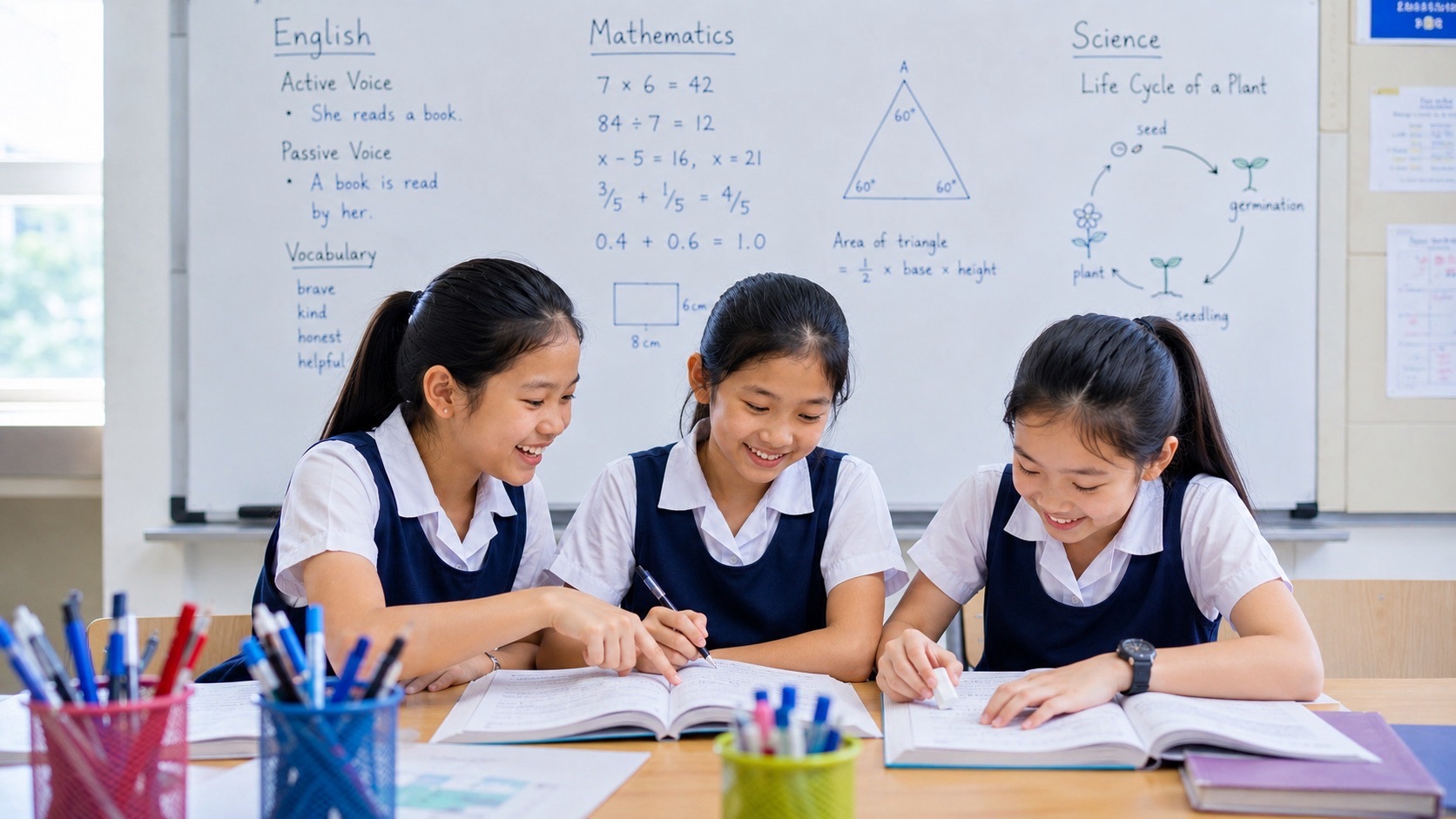
Primary 1 Mathematics tutor for Geylang Bahru students. Premium 3-pax tutorials near Sixth Avenue MRT, with number-sense foundations, clear teaching and focused support.
A confident Primary 1 Mathematics journey begins with a careful transition into formal mathematical thinking.
At eduKateSG, we provide premium 3-pax Primary 1 Mathematics tutorials for students travelling from Geylang Bahru to our centre near Sixth Avenue MRT. Each lesson combines clear explanations, carefully sequenced practice and close tutor attention.
The purpose is not simply to give young students more questions.
It is to help them understand how numbers, quantities, symbols and simple problem solving work.
Our Primary 1 Mathematics tutorials are suitable for students who need to:
- build secure number sense and place value;
- strengthen addition and subtraction foundations;
- understand simple mathematical language and word problems;
- improve accuracy and written organisation;
- keep pace with school;
- learn slightly ahead when ready; or
- build a stronger foundation for Primary 2 Mathematics.
Class size is limited to three students.
Lessons are 1.5 hours weekly, with materials, guided corrections, focused home practice and support around school assessment periods.
Arrange a parent–student consultation with eduKate Singapore
Chat with eduKateSG on WhatsApp
A More Important Beginning Than It First Appears
Primary 1 Mathematics is often described as basic counting and simple sums.
That is only partly correct.
The child is entering a formal mathematical environment in which quantities must be represented with symbols, instructions must be interpreted precisely and methods must gradually become independent.
A student may recognise numerals and still be uncertain about quantity. Another may know a number bond by memory but fail to recognise the same relationship inside a short story problem. A good Primary 1 Mathematics tutor makes those hidden differences visible.
The Hidden Mathematics Problem: Quantity Must Become Structure
Consider a simple relationship:
7 = 5 + 2
A child may view this only as one fact to remember.
But the same relationship can also mean that 7 can be split into 5 and 2, that 2 more than 5 is 7, that 5 less than 7 leaves 2, and that the parts remain connected to the same whole.
This is a small example of a much larger shift.
Students are not only learning answers. They are learning how quantities relate.
At eduKateSG, we return to the underlying principle.
We show students why a method is valid before expecting them to perform it quickly.
Clarity comes first.
Speed is built afterwards.
Why Geylang Bahru Parents Choose 3-Pax Mathematics Tutorials
A class of three creates a particular kind of learning environment.
There is enough interaction for students to hear another approach, compare methods and learn through carefully managed discussion. At the same time, the group remains small enough for the tutor to observe each student closely.
This matters in Mathematics because the wrong answer is only the visible end of the problem.
The tutor must identify the incorrect mental move that produced it.
For example, a Primary 1 student may:
- count one object twice or skip an object;
- confuse the numeral with the quantity it represents;
- treat tens and ones as unrelated digits;
- know a number bond but fail to recognise it inside a word problem;
- choose an operation from a keyword instead of the relationship;
- reverse digits or copy a number incorrectly;
- understand the idea but organise the working poorly; or
- wait for an adult before attempting the first step.
In a large class, these small errors may pass unnoticed.
In a 3-pax tutorial, the tutor can pause, inspect the student’s working and correct the exact point where the reasoning changed direction.
The advantages of three students
- Immediate feedback during practice
- Pacing matched more closely to the students
- Frequent opportunities to answer and explain
- Less room to remain silent when confused
- More detailed checking of workings
- Targeted questions for each learner
- Calm peer momentum without large-class noise
- Easier adjustment before school tests
The class is small by design.
It allows teaching to remain personal without removing the useful energy of learning with peers.
What We Teach in Primary 1 Mathematics Tutorials
Schools may introduce topics in different sequences. Our tutorials coordinate with the student’s school programme while protecting the core mathematical foundation.
Numbers and numerical structure
- counting with one-to-one correspondence;
- reading and writing numerals;
- comparing and ordering numbers;
- tens and ones;
- number bonds;
- part–whole relationships;
- simple number patterns; and
- early estimation.
These ideas may look elementary, but weakness here frequently reappears inside later arithmetic.
Addition and subtraction
- joining and separating quantities;
- fact families;
- mental strategies;
- simple written methods;
- inverse checking;
- part–whole reasoning; and
- simple word problems.
We teach addition and subtraction as relationships rather than isolated procedures.
Early multiplication and division ideas
- equal groups;
- repeated addition;
- sharing;
- grouping;
- simple arrays; and
- connections between multiplication and division.
The purpose is to establish meaning before later fact fluency becomes important.
Measurement, time, money, shapes and data
- comparing measurable quantities;
- reading simple time representations;
- working with Singapore money;
- recognising common 2D and 3D shapes;
- sorting and classifying information; and
- reading simple pictorial data.
These topics help the student connect mathematical thinking to familiar situations.
Our First-Principles Teaching Method
A strong Mathematics programme should do more than demonstrate a procedure and assign twenty similar questions.
Students need a structure that helps knowledge remain usable after the lesson.
1. Diagnose the exact weakness
We avoid broad descriptions such as “weak in Mathematics” whenever possible.
A Primary 1 student may actually be struggling with counting, numeral recognition, place value, number bonds, language, working memory, copying or confidence.
The correction depends on the cause.
2. Rebuild from the first unstable point
When an earlier skill is missing, we return to it.
This is not moving backwards.
It is restoring the floor beneath the current topic.
3. Use the Fencing Method
We teach within a clear boundary before increasing complexity.
A student may first work with clean numbers, one operation and one visual representation.
Once that structure is secure, we add larger values, less familiar wording and mixed applications.
4. Move from visible ideas to abstract notation
Where useful, we apply a Concrete–Representational–Abstract progression.
A concept may begin with physical or familiar quantities, move through a diagram or model and then be expressed with formal symbols.
5. Ask students to think aloud
- what the question is asking;
- what information is available;
- which relationship matters;
- why a method is suitable;
- what each line of working does; and
- whether the final answer is reasonable.
Explanation reveals understanding.
6. Retrieve and interleave
Topics are revisited after the original lesson.
Older and newer concepts are mixed so students must recognise the correct method rather than simply repeat the method demonstrated immediately before.
7. Build assessment discipline early
- neat working;
- clear number formation;
- correct use of symbols;
- appropriate units;
- accurate copying;
- simple estimation checks;
- sensible time control; and
- final-answer verification.
What Happens During a 90-Minute Lesson
Warm-up retrieval
Students begin with a short set drawn from earlier learning. This allows the tutor to check retention and reactivate concepts needed for the day’s work.
Concept instruction
The tutor introduces or revisits the central idea. Explanations focus on meaning, structure and common misconceptions.
Guided practice
Students attempt questions with the tutor nearby. Prompts are gradually reduced as control improves.
Independent application
Students complete selected questions without step-by-step help. This shows whether the idea can be used independently.
Mixed practice
Earlier topics may be combined with the current topic so students must decide what to do without a chapter heading.
Error review
Mistakes are classified and corrected. The student learns whether an error came from misunderstanding, incorrect reading, weak recall, arithmetic, notation, poor organisation or rushing.
Focused continuation work
Home practice is kept purposeful. The intention is to reinforce the lesson, not to create an indiscriminate pile of worksheets.
Three Primary 1 Student Pathways
The repair pathway
This student may already be struggling with counting, place value, number bonds, simple arithmetic, word problems or school homework. The immediate priority is to stop further drift.
We locate the earliest unstable skill, rebuild it and reconnect it to the school topic.
The stabilisation pathway
This student is generally coping, but performance is inconsistent. The priority is to make understanding, recall and working habits more dependable.
The extension pathway
This student is coping well and needs greater depth.
- less routine applications;
- multiple representations;
- stronger explanation;
- unfamiliar problem structures;
- deeper number patterns; and
- careful preparation for Primary 2 Mathematics.
The priority is not simply to rush through chapters.
It is to deepen control.
Why Number Sense Receives Special Attention
Number sense is not only one Primary 1 topic.
It gradually becomes the operating foundation of later Mathematics.
A child who can decompose, compare and reconstruct quantities has more ways to recover when a memorised fact is forgotten. That flexibility is more valuable than speed alone.
How We Reduce Careless Mistakes
“Careless” is often too broad a diagnosis.
Reading errors
The student may miss a comparison word or instruction. Correction requires deliberate reading and clearer mathematical vocabulary.
Counting errors
The child may skip or double-count. Correction requires more structured one-to-one counting and representation.
Place-value errors
The child may treat digits as labels rather than quantities. Correction returns to tens, ones and decomposition.
Arithmetic errors
The idea may be correct but the calculation wrong. Correction uses number relationships, checking and retrieval practice.
Copying errors
A number or symbol may change between the question and working. Correction requires cleaner layout and a deliberate scan.
We maintain an error pattern rather than treating every wrong answer as isolated.
Teaching Ahead Without Rushing
Where appropriate, we introduce topics slightly before they appear in school.
The purpose is not to race through the syllabus.
It is to give the student a first encounter in a quiet, supported environment.
Teaching ahead only works when earlier foundations are secure.
What Progress Should Look Like
- begins homework with less resistance;
- uses number bonds more flexibly;
- reads mathematical instructions more carefully;
- writes clearer steps;
- checks simple answers;
- identifies mistakes independently;
- explains methods with greater confidence; and
- handles unfamiliar questions more calmly.
Marks usually improve when understanding, recall, accuracy and execution begin working together.
When Should a Geylang Bahru Student Begin Primary 1 Mathematics Tuition?
- counting remains unreliable;
- tens and ones are unclear;
- number bonds remain fragile;
- basic addition or subtraction depends on guessing;
- simple word problems create confusion;
- the child depends heavily on adult help;
- working is disorganised; or
- the family wants a stronger foundation before Primary 2.
Parents do not need to wait for a serious failure.
Early support is often quieter and more efficient because fewer layers need to be dismantled.
Convenient Access from Geylang Bahru to Sixth Avenue
eduKateSG’s Bukit Timah location is at 8 Fourth Avenue, near Sixth Avenue MRT on the Downtown Line.
Students travelling by MRT can take the Downtown Line directly from Geylang Bahru to Sixth Avenue without changing lines.
Location: eduKateSG, 8 Fourth Avenue, Singapore 268674
Nearest MRT: Sixth Avenue MRT, Downtown Line
Attendance: By appointment
Class Details
Format: Premium 3-pax small-group tutorials
Level: Primary 1 Mathematics
Duration: 1.5 hours weekly
Teaching approach:
- first-principles explanation;
- guided and independent practice;
- retrieval and interleaving;
- error analysis;
- school-test alignment; and
- carefully paced pre-teaching.
Materials:
- curated lesson notes;
- topic practice;
- mixed revision;
- assessment-style questions;
- micro-tests; and
- focused continuation work.
What Parents Can Bring to the Consultation
- recent school worksheets;
- marked assignments;
- the school’s current topic schedule;
- the student’s Mathematics textbook;
- teacher comments; and
- examples of questions the student finds difficult.
We are not only looking at the final score.
We are looking for repeated patterns.
Frequently Asked Questions
Is Primary 1 Mathematics tuition necessary for every child?
No. A child who is learning confidently, completing work independently and adapting well may not need additional tuition. Support becomes useful when a gap appears, school pace is difficult or the family wants more structured extension.
Do you follow the school’s topic order?
We consider the school sequence and upcoming assessments. At the same time, we may need to repair an earlier skill before the current topic can become stable.
Do you teach ahead of school?
Yes, when the student’s foundation is ready. Pre-teaching gives the student a calm first encounter with the topic.
How do you help students who make careless mistakes?
We separate mistakes into categories such as reading, concept, arithmetic, copying, presentation and attention. The correction is matched to the actual error pattern.
How quickly should improvement appear?
Some students show better confidence and working habits within several lesson cycles. Larger conceptual gaps require more time.
Can students join during the school term?
Yes, subject to a suitable 3-pax placement.
Helpful Reading for Geylang Bahru Parents
Primary 1 Mathematics Tutor for Geylang Bahru Families
Primary 1 is where the student begins learning the deeper grammar of Mathematics.
Numbers become relationships.
Pictures become reasoning tools.
Working becomes part of the answer.
At eduKateSG, our 3-pax Primary 1 Mathematics tutorials provide the space, attention and structure needed to make that change properly.
For students who are behind, we rebuild.
For students who are coping, we stabilise.
For students who are ready, we extend.
The objective is a student who can enter Primary 2 with stronger foundations, clearer mathematical language and the confidence to face more demanding work without losing control.
Arrange a Parent–Student Consultation
Speak with us about your child’s school level, current results, learning gaps and upcoming assessments.
eduKateSG
8 Fourth Avenue
Singapore 268674
Near Sixth Avenue MRT
Premium 3-pax small-group tuition
By appointment
Properly taught kids shine a bright light into the future.