
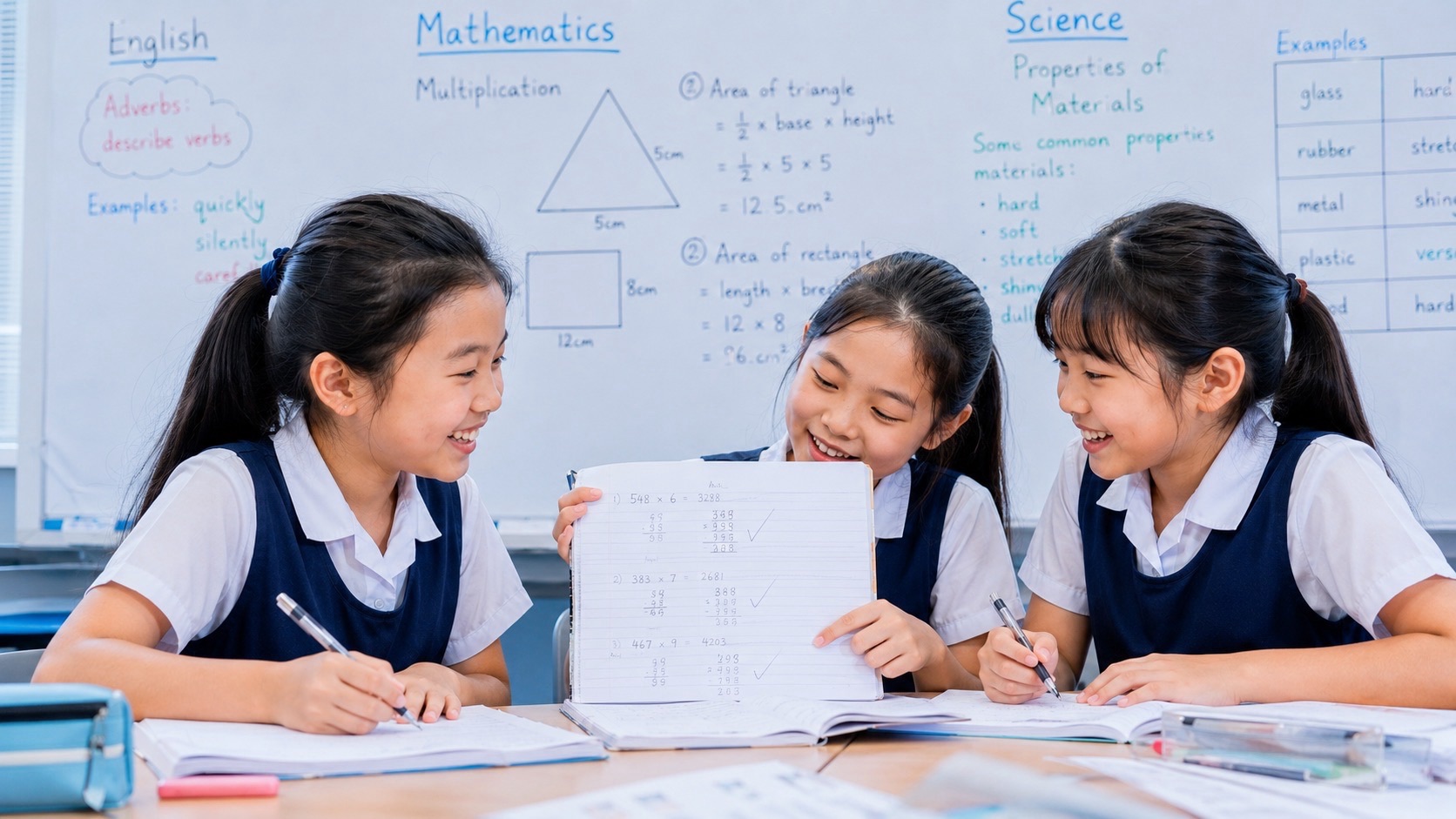
Primary 1 Mathematics tuition for Siglap families. Premium 3-pax tutorials near Sixth Avenue MRT, with patient number-sense teaching, clear mathematical language and close tutor attention.
A strong Primary 1 Mathematics journey begins quietly. The first task is not to race ahead. It is to help the child become comfortable with numbers, symbols, instructions and the habit of showing how an answer was found.
At eduKateSG, our Primary 1 Mathematics tutorials are built for students travelling from Siglap to our centre at 8 Fourth Avenue, near Sixth Avenue MRT. Lessons combine first-principles explanation, carefully sequenced practice, retrieval, visual models and immediate correction in a maximum group of three students.
The objective is larger than finishing worksheets. We want the child to understand what numbers mean, recognise simple structures, explain a method in age-appropriate language and begin working independently without turning every unfamiliar question into a guessing exercise.
Primary 1 support may be useful for children who need to strengthen counting and place value, stabilise addition and subtraction, understand simple word problems, improve attention to mathematical language, become more independent with schoolwork, or build a calm foundation before Primary 2.
Class size is limited to three students. Lessons are 1.5 hours weekly, with materials, guided corrections, focused continuation practice and support around the child’s school learning sequence.
Read the Primary 1 Mathematics Tuition hub · Explore How Mathematics Works
A Strong Start Matters More Than Speed
Primary 1 is the first formal Mathematics year, but children do not arrive with identical number experience. One child may count confidently but not understand that the digit 5 represents a quantity. Another may recognise numerals but lose track when objects are rearranged. A third may calculate simple sums but become stuck when the same relationship is written as a short story.
These differences matter because early Mathematics is cumulative. If the child sees numbers only as marks on a page, later work becomes mechanical. If the child understands quantities, relationships and the language of change, the same foundation can support place value, operations, measurement, fractions and eventually algebra.
Our teaching therefore starts from meaning. We ask what the child sees, what the number represents, what changed, what stayed the same and how the answer can be checked. Speed is added only after the structure is stable.
The Hidden Mathematics Problem: Quantity Must Become Number Language
Consider the statement “there are 8 counters and 3 are taken away.” A child may be able to say 5 from memory. But strong understanding includes several connected ideas: 8 is the starting quantity, 3 describes a change, subtraction represents removal in this context, 5 is what remains, and the relationship can be checked because 5 + 3 returns to 8.
That small network is the beginning of mathematical structure. It allows the child to move between objects, pictures, words and symbols instead of depending on one memorised format.
This is why we use a Concrete–Representational–Abstract progression where useful. The child may first handle or imagine real quantities, then use drawings or number bonds, and finally express the same idea with numerals and operation signs. The representation changes, but the relationship remains.
Why Siglap Parents Choose 3-Pax Mathematics Tutorials
A three-student class allows the tutor to see the child’s reasoning, not merely the final answer. At Primary 1, this is particularly important because a wrong answer may come from very different causes.
- the child counted inaccurately even though the operation was understood;
- the child read the number correctly but misunderstood the instruction;
- place value is unstable, so tens and ones are being treated as separate labels rather than one number;
- the child knows a number bond but cannot recognise it in a word problem;
- the child is relying on fingers because the underlying relationship is not yet fluent;
- the child understands the concept but rushes, skips a symbol or copies a numeral incorrectly; or
- the child is hesitant and stops before attempting a question independently.
In a large class these causes can look identical. In a 3-pax tutorial, the tutor can pause, ask the child to explain, inspect the written work and correct the exact point where the reasoning changed direction.
The advantages of three students
- Immediate correction while the idea is still fresh
- Frequent opportunities to answer aloud
- Pacing that can respond to each child
- Enough peer interaction to make learning lively
- Less opportunity to remain silent when confused
- More detailed checking of writing and number formation
- Targeted practice instead of undifferentiated worksheet volume
- A calmer environment for children still adjusting to formal school routines
What We Teach in Primary 1 Mathematics Tutorials
The school sequence can vary. We align with the child’s current classroom work while protecting the core foundation described in Singapore’s Primary Mathematics curriculum.
Number sense and place value
- counting forward and backward with understanding rather than chanting alone;
- reading and writing numerals accurately;
- comparing and ordering numbers;
- understanding tens and ones;
- number bonds and part–whole relationships;
- recognising patterns and missing numbers;
- estimating small quantities sensibly; and
- moving flexibly between objects, pictures, words and symbols.
The aim is for the child to see a number as a structure. For example, 47 is not merely a two-digit label. It can be understood as 4 tens and 7 ones, 40 + 7, one more than 46, one less than 48, or a quantity that can be decomposed in several useful ways.
Addition and subtraction
- joining and separating quantities;
- part–whole relationships;
- fact families;
- mental strategies based on number bonds;
- checking subtraction with addition;
- interpreting simple mathematical statements; and
- solving short word problems without keyword guessing.
We avoid teaching children to hunt for one word such as “altogether” and immediately choose an operation. Instead, the child learns to ask: what is happening to the quantity? Is it increasing, decreasing, being compared or being divided into parts?
Early multiplication and division ideas
Where these ideas appear in the child’s school programme, we build them through equal groups, repeated addition, sharing and grouping. The objective is not premature memorisation. It is to prepare a sensible foundation for the multiplication and division work that becomes heavier later.
Measurement, time, money, shapes and data
- comparing and describing length or mass using appropriate early concepts;
- reading simple time representations;
- recognising and working with Singapore money in age-appropriate contexts;
- identifying and describing common 2D and 3D shapes;
- sorting and classifying information; and
- reading simple pictorial data.
These topics are valuable because they connect Mathematics to the child’s everyday world. They also expose whether the child can transfer a concept into a new setting instead of succeeding only on familiar worksheet layouts.
Our First-Principles Teaching Method
1. Diagnose the exact weakness
We avoid broad labels such as “weak in Maths.” A Primary 1 child may be struggling with counting, numeral recognition, place value, mathematical vocabulary, attention, working memory, word-problem interpretation, confidence or independence. The repair depends on the cause.
2. Rebuild from the first unstable point
If the child is confused by two-digit addition because tens and ones are not secure, adding more two-digit worksheets will not solve the problem. We first rebuild place value, then reconnect it to the current topic.
3. Use the Fencing Method
We teach one clean structure inside a clear boundary before increasing difficulty. A child may first work with small positive whole numbers, one operation and one simple visual model. Once the relationship is secure, we vary the numbers, wording, representation and order of information.
4. Move from visible ideas to symbols
Young learners often understand more when they can see the relationship. We use number lines, diagrams, grouped objects, simple bar representations and part–whole models before requiring the child to operate confidently with symbols alone.
5. Ask the child to explain
A short explanation such as “I had 10, I used 4, so 6 are left” reveals more than a correct answer by itself. The tutor listens for whether the child understands the relationship or is repeating a memorised procedure.
6. Retrieve and revisit
Earlier ideas return after the original lesson. Number bonds, place value, comparison and arithmetic are mixed with newer topics so that knowledge remains available instead of disappearing once a worksheet chapter is completed.
7. Build independent working habits
The child learns to read the instruction, mark useful information, try a sensible first step, show enough working, check the answer and ask a precise question when genuinely stuck. These habits matter as much as the arithmetic.
What Happens During a 90-Minute Lesson
Warm-up retrieval
A short opening set reactivates number bonds, place value, comparison or another earlier skill. This lets the tutor see what has been retained.
Concept instruction
The main idea is introduced or repaired with age-appropriate language and representations. The tutor checks meaning before increasing speed.
Guided practice
The child solves questions with prompts available. Support is reduced gradually rather than removed suddenly.
Independent application
The student attempts selected questions without step-by-step assistance. This is where the tutor can distinguish recognition from real control.
Mixed practice
Older and newer ideas are combined in small amounts. The child must decide what the question requires instead of being told which method to use.
Error review
Mistakes are classified as counting, reading, concept, arithmetic, copying, attention, language or presentation errors. The correction is matched to the actual pattern.
Focused continuation work
Home practice is purposeful and limited to what needs to be strengthened. The aim is stable learning, not an indiscriminate pile of worksheets.
Three Primary 1 Student Pathways
The repair pathway
This child may already be uncertain with counting, number bonds, basic addition or subtraction, or may be anxious whenever a worksheet looks unfamiliar. We locate the first unstable idea and rebuild it calmly.
The stabilisation pathway
This child generally understands lessons but is inconsistent. Errors may come from rushing, weak recall, unclear place value, skipping instructions or dependence on adult prompting. The priority is dependable independent work.
The extension pathway
This child is coping comfortably. Extension means deeper reasoning rather than rushing into older students’ chapters. We may use richer number patterns, multiple ways to decompose a quantity, non-routine word problems, explanation and comparison of methods.
How We Reduce “Careless” Mistakes
“Careless” is too broad to be useful. We separate the error before trying to fix it.
Reading errors
The child may miss words such as more, fewer, left, before, after, difference, same, altogether or each. Correction requires better instruction reading and mathematical vocabulary.
Counting errors
The child may skip or double-count an object. Correction may involve more structured representations and a one-to-one counting routine.
Place-value errors
Digits may be read individually instead of as tens and ones. Correction returns to grouping and decomposition.
Arithmetic errors
The concept may be correct but the calculation unstable. Correction uses number relationships, checking strategies and retrieval practice.
Copying and writing errors
A numeral or operation sign may change between question and working. Correction requires a simple scan routine and clearer layout.
Independence errors
The child may know what to do only when an adult is beside them. Correction requires staged release: prompt, partial prompt, wait, then independent attempt.
Mathematical Language Matters Early
Primary Mathematics is not language-free. Children meet words such as greater, smaller, more than, less than, equal, difference, total, remaining, before, after, first, last and between. A child can understand the arithmetic and still lose the question because the relationship is hidden inside language.
We therefore teach the vocabulary together with the mathematics. The child learns to connect a phrase to a relationship and a relationship to an operation. This becomes increasingly important as word problems become longer in later Primary years.
Teaching Ahead Without Rushing
Where the child is ready, we may introduce a concept slightly before it appears in school. The purpose is familiarity, not acceleration for its own sake.
A calm first encounter means that when the topic later appears in class, the language, visual structure and basic operation already feel known. School practice then becomes consolidation instead of the child’s first exposure under time pressure.
We do not place new content on top of an unstable foundation merely to claim faster coverage.
What Progress Should Look Like
Parents may first notice progress outside formal scores. The child may begin homework with less resistance, read instructions more carefully, use number bonds without heavy prompting, explain simple methods, correct an answer independently, organise work more neatly and persist for longer when a question is unfamiliar.
Marks usually become more stable when understanding, recall, attention, language and independent execution begin working together. The pace of improvement depends on the size of the gap, attendance, practice, school demands and how long an error pattern has been repeated.
When Should a Siglap Child Begin Primary 1 Mathematics Tuition?
- counting is still unreliable after repeated practice;
- the child cannot explain tens and ones;
- number bonds remain fragile;
- addition or subtraction depends on guessing or constant finger counting;
- simple word problems create confusion even when the arithmetic is easy;
- the child waits for an adult to begin every question;
- schoolwork takes a very long time despite age-appropriate difficulty;
- the child is becoming avoidant or anxious around Mathematics; or
- the child is coping well and the family wants a more deliberate foundation.
Parents do not need to wait for a serious failure. Early support can be efficient because fewer layers have been built on top of the original confusion.
Convenient Access from Siglap to Sixth Avenue
Siglap MRT is on the Thomson–East Coast Line. Students travelling by rail can take the Thomson–East Coast Line to Stevens, transfer to the Downtown Line and continue to Sixth Avenue. The exact door-to-door journey depends on the family’s starting point within Siglap, so parents should check current travel information before the first lesson.
Location: eduKateSG, 8 Fourth Avenue, Singapore 268674
Nearest MRT: Sixth Avenue MRT, Downtown Line
Attendance: By appointment
Class Details
Format: Premium 3-pax small-group tutorials
Level: Primary 1 Mathematics
Duration: 1.5 hours weekly
Teaching approach: first-principles explanation, Concrete–Representational–Abstract progression where useful, retrieval, interleaving, guided-to-independent practice, error analysis and carefully paced pre-teaching.
Materials: curated lesson notes, visual models, topic practice, mixed revision, short retrieval sets and focused continuation work.
Support may include preparation around school assessments and classroom topic changes, subject to the child’s readiness and the class arrangement.
What Parents Can Bring to the Consultation
- recent school worksheets;
- marked classwork;
- examples of questions the child avoids;
- teacher comments where available;
- the current school topic sequence;
- a short description of home-practice difficulties; and
- any recurring concern such as slow work, guessing, weak recall or anxiety.
We are not looking only for the number of correct answers. We are looking for the repeated pattern that explains why the child is succeeding or struggling.
Frequently Asked Questions
Is Primary 1 Mathematics tuition supposed to be difficult?
No. Effective support should make the child’s thinking clearer, not create unnecessary pressure. Difficulty should increase only after the foundation is secure.
My child can already calculate quickly. Does that mean the foundation is strong?
Not necessarily. We also check place value, number relationships, word-problem interpretation, explanation, checking and independent working.
Do you use manipulatives and visual models?
Yes, when they help the child see the mathematical relationship. The support is gradually reduced so the student can later work confidently with diagrams and symbols.
Do you follow the school’s topic order?
We consider the school sequence and current classwork. If an earlier idea is blocking the present topic, we repair the earlier idea first.
Do you teach ahead?
Yes, when the child is ready. Pre-teaching is used to create familiarity, not to race through the syllabus.
How quickly should improvement appear?
Some children show better independence or clearer working within several lesson cycles. Larger foundation gaps take longer. The useful question is whether the child’s learning behaviour and reasoning are becoming more stable.
Can a child join during the school term?
Yes, subject to a suitable 3-pax placement. We first assess whether the child’s pace and support needs fit the available group.
Helpful Reading for Siglap Parents
- Primary 1 Mathematics Tuition
- Primary 2 Mathematics Tuition
- How Mathematics Works
- MOE Primary Mathematics Syllabus
- LTA Thomson–East Coast Line
- LTA Downtown Line
Primary 1 Mathematics Tuition for Siglap Families
Primary 1 is where a child begins to discover that Mathematics is not a collection of isolated sums. Numbers have structure. Operations describe relationships. Diagrams can make thinking visible. Language tells the child what relationship a question is asking about.
At eduKateSG, our 3-pax Primary 1 Mathematics tutorials create the space to build those habits carefully. For children who are behind, we repair. For children who are inconsistent, we stabilise. For children who are ready, we deepen.
The objective is a child who can enter Primary 2 with stronger number sense, clearer mathematical language, better independent habits and a calmer confidence when a question looks unfamiliar.
Arrange a Parent–Student Consultation
Speak with us about your child’s current schoolwork, number foundation, word-problem difficulties, independence and next learning goals.
Contact eduKate Singapore · Chat on WhatsApp
eduKateSG
8 Fourth Avenue
Singapore 268674
Near Sixth Avenue MRT
Premium 3-pax small-group tuition
By appointment
Properly taught kids shine a bright light into the future.