
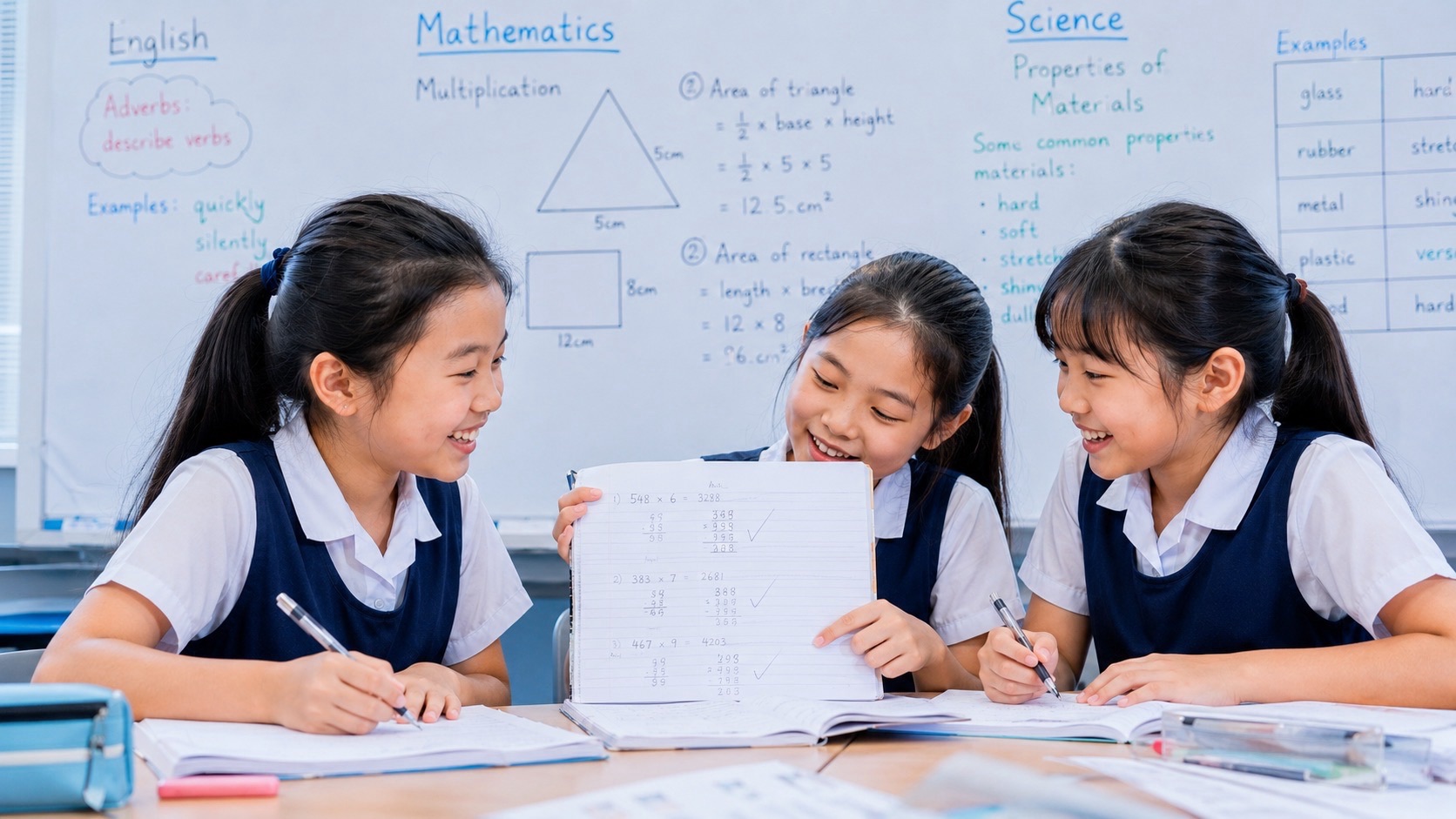
Primary 2 English Tuition | Queenstown is designed for the year when early literacy must become dependable language. At eduKateSG, our 3-pax small-group English tutorials help children move beyond “I can read this” toward “I can understand it, explain it, write about it and notice when something is wrong.”
Primary 2 often looks comfortable because reading becomes smoother and school routines feel familiar. Yet this is where a hidden gap can widen: fluent-looking reading may begin to outrun comprehension, and correct-looking grammar may still depend heavily on worksheet cues.
For Queenstown families, the central Primary 2 question is whether fluency is becoming usable comprehension and whether the child can carry language decisions with less adult prompting.
Read the main eduKateSG Primary 2 English Tuition guide.
Primary 2 Is Where Fluency Must Become Meaning
A Primary 1 reader may work word by word. By Primary 2, many children begin to read more smoothly. That is important progress, but smooth pronunciation can create an illusion of understanding.
A child may sound confident and still lose track of who did what, why an event happened, what a pronoun refers to or which detail answers the question. Reading fluency and reading comprehension grow together, but they are not identical.
Our task is to protect both: reduce the effort of reading while increasing attention to meaning.
The Hidden Primary 2 Problem: Automatic Reading Can Hide Weak Monitoring
A strong reader does not only move forward. A strong reader checks. When a sentence feels strange, a pronoun has no clear referent, an answer contradicts the passage or a word does not fit the context, the reader notices.
In Primary 2, we make this monitoring deliberate. Students may be asked who the sentence is about, what happened first, what changed, which noun a pronoun refers to and which words support the answer.
The child learns that rereading has a purpose.
Why a 3-Pax Primary 2 English Class Helps
Primary 2 students often make errors that are small enough to pass unnoticed in a larger class: skipping function words, changing tense, giving incomplete answers, using unclear pronouns, losing spelling inside writing or copying a nearby sentence simply because it shares a keyword.
Three students allow the tutor to hear individual reading, inspect short answers, compare spoken and written language and ask follow-up questions.
- whether the child reads for meaning or only for sound
- whether vocabulary can be retrieved without prompts
- whether grammar transfers into writing
- whether comprehension answers are text-supported
- whether spelling survives when attention shifts to ideas
- whether the child can explain a choice
- whether corrections are remembered later
- whether support can be reduced
The small class increases the amount of useful information available to the tutor.
What We Teach in Primary 2 English Tuition
Reading fluency with comprehension
- accurate rereading
- phrasing and punctuation awareness
- tracking characters and events
- recognising when meaning breaks
- using context as evidence
- literal comprehension
- sequence
- simple cause and effect
Fluency should free attention for meaning rather than replace it.
Vocabulary that travels
- high-utility verbs
- precise adjectives
- time and sequence words
- position and direction words
- emotion vocabulary
- word families
- prefix and suffix awareness
- synonyms and antonyms
Vocabulary is taught for recognition, retrieval and use in new sentences.
Grammar as sentence meaning
- subject–verb agreement
- simple present and past
- present continuous
- pronoun reference
- possessive forms
- articles
- prepositions
- conjunctions
- question forms
- sentence expansion
We compare sentences so the child can see how grammar changes meaning.
Comprehension response control
- identify the question type
- locate the relevant sentence
- find the smallest sufficient evidence
- write a complete answer where needed
- avoid copying irrelevant text
- check pronoun reference
- reread to verify
Primary 2 is a good year to establish disciplined answer habits before passages become longer.
Writing from sentence to paragraph
- complete sentences
- sentence combining
- sequence control
- relevant detail
- basic paragraph unity
- simple dialogue conventions
- punctuation
- editing
The child begins to understand that several sentences should work together around one idea or event.
How We Teach Primary 2 English
1. Find the first failure, not the loudest symptom
A weak comprehension answer may come from vocabulary, question misunderstanding, pronoun confusion or incomplete expression. We identify the first point where control was lost.
2. Stabilise a pattern before adding variation
The learner first sees clean examples. Then vocabulary, sentence order or context changes so the child must understand the relationship rather than memorise the worksheet shape.
3. Require explanation
Students are asked why an answer works. Even a short explanation reveals whether the learner understands or guessed.
4. Retrieve after time has passed
Grammar, vocabulary and spelling return after a delay so memory becomes durable.
5. Transfer into another English task
A tense form learnt in grammar should survive in writing. Vocabulary learnt in reading should become available in composition or oral language.
6. Reduce scaffolds
Cue words, model sentences and tutor prompts are gradually removed.
A Typical 90-Minute Primary 2 Lesson
Retrieval opening
Short questions reactivate older vocabulary, grammar or spelling.
Reading with monitoring
Students read a short text while the tutor checks accuracy, phrasing, reference tracking and meaning.
Explicit teaching
One language relationship is made clear through examples and contrast.
Guided response
Students practise while feedback is immediate.
Independent application
A changed task tests whether the method can be selected without the same cues.
Writing transfer
The concept is used in a sentence or short paragraph.
Error review
The tutor classifies errors so future practice remains targeted.
Three Primary 2 Student Pathways
Repair
For children still guessing words, losing sentence meaning or struggling with basic sentence control, we rebuild the earlier foundation that Primary 2 now assumes.
Stabilise
For children who are coping but inconsistent, we strengthen transfer from worksheets into reading and writing.
Extend
For fluent learners, we use richer texts, more precise vocabulary, less predictable comprehension and stronger paragraph writing.
The Primary 2 Skill We Protect Most: The Reread Decision
One of the strongest habits a young reader can develop is knowing when to reread. Some children reread only when an adult tells them. Others begin to notice independently that the sentence did not make sense, the answer does not fit or a word was probably misread.
We teach rereading as an active tool for checking reference, sequence, meaning and evidence.
How We Build Vocabulary Without Word-List Dependence
A child who remembers a word only in list order does not yet own it. We use a cycle: meet the word → understand it → connect it → retrieve it → use it → meet it again in a changed context.
The objective is flexible word knowledge rather than decorative vocabulary.
How Grammar Moves Into Writing
A common Primary 2 problem is compartmentalisation. The learner may answer subject–verb agreement questions correctly and still write an agreement error inside a story. The rule is known but transfer has failed.
We therefore require grammar to appear inside production: sentence creation, editing and short writing tasks.
What Progress Should Look Like
- reading becomes smoother without losing comprehension
- the child notices when meaning breaks
- answers become more complete and text-based
- pronoun reference becomes clearer
- grammar errors recur less often
- spelling survives inside writing
- vocabulary can be retrieved later
- paragraphs stay more focused
- the child can explain why an answer fits
- adult prompting gradually reduces
We track both the outcome and the process that produced it.
When Should a Queenstown Student Begin Primary 2 English Tuition?
- reading sounds fluent but comprehension is weak
- the child cannot explain a passage after reading
- answers are incomplete or copied indiscriminately
- spelling disappears during writing
- grammar is correct in drills but weak in paragraphs
- the child avoids writing more than one or two sentences
- vocabulary is recognised but not used
- errors return immediately after correction
- school pace is becoming difficult
- the learner needs structured extension
Not every Primary 2 child needs tuition. Support should answer a real learning need.
Queenstown Families and Travel Practicality
eduKateSG teaches at 8 Fourth Avenue, Singapore 268674, near Sixth Avenue MRT. Queenstown families should consider total travel time, school activities, meals and whether the child can arrive with enough attention for useful learning.
A lesson slot that protects concentration is more valuable than one that merely fits a crowded timetable.
Primary 2 English Tuition | Queenstown — Class Details
- premium 3-pax small-group tutorial
- Primary 2 English
- approximately 1.5 hours weekly
- 8 Fourth Avenue, Singapore 268674
- near Sixth Avenue MRT
- reading, vocabulary, grammar, comprehension, spelling and writing
- retrieval, interleaving, guided practice and independent transfer
- targeted materials and continuation work
- placement by appointment
What Parents Can Bring
- recent English worksheets and test papers
- school readers
- spelling work
- writing samples
- teacher comments
- examples of recurring grammar errors
- questions the child repeatedly finds difficult
Repeated patterns reveal more than a single score.
Frequently Asked Questions
My child reads quickly. Why is comprehension weak?
Speed reduces decoding effort, but comprehension still requires vocabulary, syntax, reference tracking and attention.
Should Primary 2 children write long compositions?
Control matters more than length. We first stabilise sentences and short paragraphs.
Do you follow school topics exactly?
We consider current school work, but an earlier foundation may need repair before the current topic becomes secure.
How do you reduce careless errors?
We classify the error—question reading, evidence, grammar, spelling or checking—so the correction is specific.
Will you teach ahead?
Yes when the foundation is stable. Pre-teaching should reduce future load rather than hide current gaps.
How much homework is given?
Continuation work is targeted. The objective is consolidation and retrieval rather than volume.
Can a student join mid-year?
Yes, subject to a suitable 3-pax placement.
How does Primary 2 prepare for later English?
It strengthens the monitoring, vocabulary, sentence and comprehension habits needed for longer passages and more independent writing.
Continue the Queenstown Primary English Pathway
- Primary 1 English Tuition | Queenstown
- Primary 3 English Tuition | Queenstown
- Primary 4 English Tuition | Queenstown
- Primary 2 English Tuition at eduKateSG
- How English Works
- eduKateSG Vocabulary Hub
Primary 2 English Tuition for Queenstown Families
Primary 2 is the year when early English should begin holding itself together. Reading becomes smoother, but the child must learn to monitor meaning, construct answers and use grammar and vocabulary outside familiar drills.
For learners who are behind, we repair. For learners who are inconsistent, we stabilise. For learners who are ready, we extend. The common aim is independence.
Arrange a Parent–Student Consultation
eduKateSG
8 Fourth Avenue
Singapore 268674
Near Sixth Avenue MRT
Premium 3-pax small-group tuition
By appointment
Properly taught kids shine a bright light into the future.