
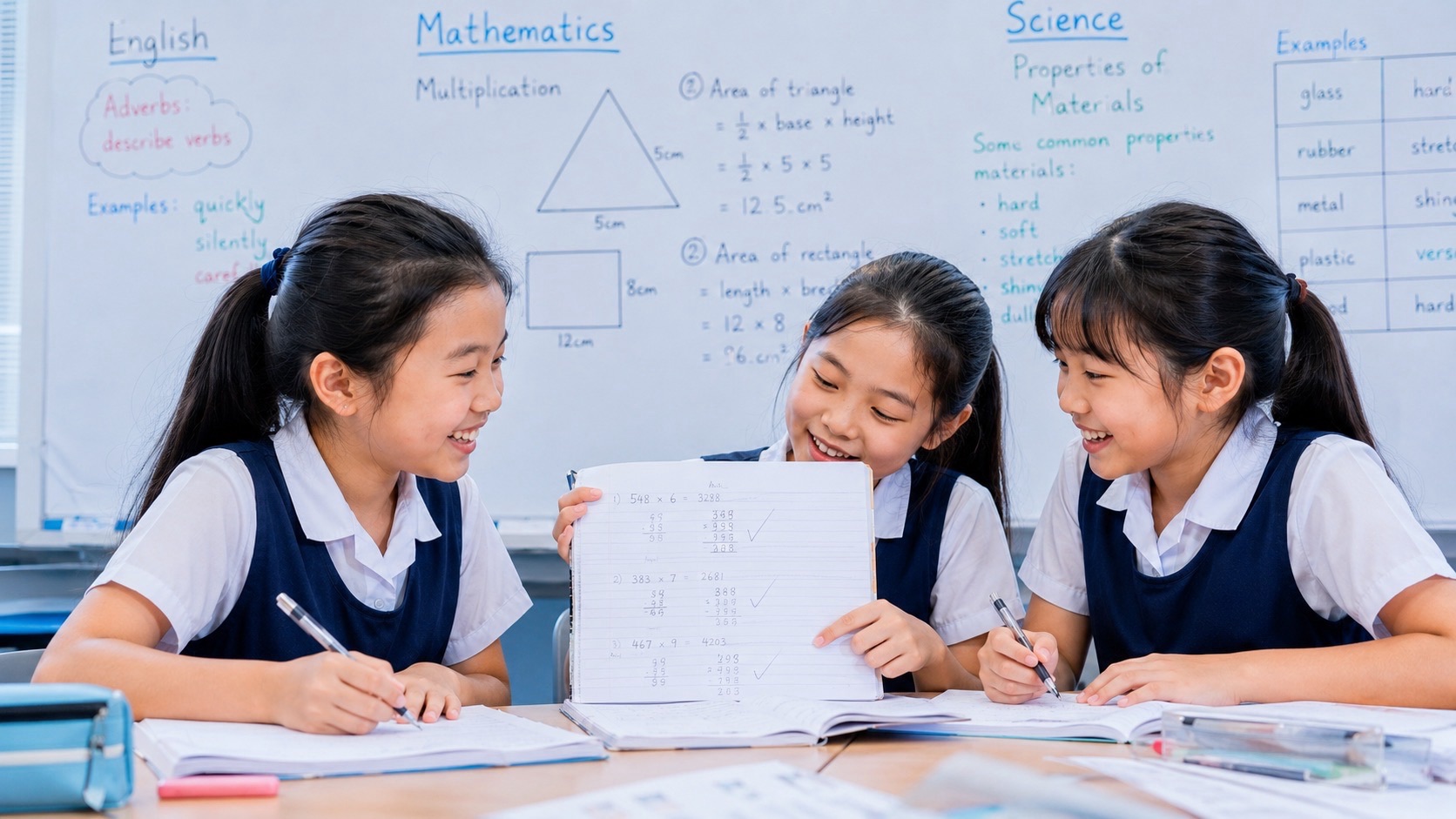
Primary 2 Mathematics Tuition | Tanjong Rhu for families looking for a premium 3-pax small-group Mathematics programme near Sixth Avenue MRT.
Primary 2 Mathematics is where lower-primary foundations must become reliable enough to carry more load. At eduKateSG, our Primary 2 Mathematics lessons are designed around place value, written arithmetic, multiplication and division foundations, fractions and word-problem control.
Students travelling from Tanjong Rhu attend lessons at 8 Fourth Avenue, Singapore 268674, near Sixth Avenue MRT. The small-group format allows the tutor to inspect working closely, identify the first unstable step and adjust the lesson before a small misunderstanding becomes a repeated habit.
The objective is not simply to complete more worksheets. It is to help the student understand the mathematical structure, retrieve the right knowledge at the right time, work accurately and become more independent.
Mathematics Learning Hub · How Mathematics Works
Why Primary 2 Mathematics Needs More Than Repetition
Repetition is useful only when the student is repeating the correct idea.
If the underlying concept is wrong, more practice can make the wrong model more automatic. That is why we first ask what the student thinks the question means, what relationship is present and why a particular operation or method should be used.
A correct answer can hide weak reasoning. A wrong answer can hide a nearly correct method. In both cases, the tutor needs to see the working, not only the score.
Why Tanjong Rhu Parents Choose 3-Pax Mathematics Tutorials
A group of three is small enough for detailed diagnosis and large enough for useful peer comparison.
- Immediate correction while the reasoning is still fresh
- Frequent opportunities to explain a method aloud
- Pacing that can respond to each learner
- Detailed inspection of working and notation
- Targeted questions instead of undifferentiated worksheet volume
- Gradual removal of prompts as independence improves
- Enough peer momentum without large-class noise
The class is deliberately small because mathematical mistakes often begin several lines before the final answer.
What We Teach in Primary 2 Mathematics Tutorials
Numbers and place value
- hundreds, tens and ones;
- reading and writing larger numbers;
- comparing and ordering;
- flexible decomposition;
- number patterns;
- mental strategies;
- estimation;
We teach numbers and place value as part of a connected system. Students are expected to understand what the quantities represent, why the method works and how the answer can be checked.
Addition and subtraction
- mental calculation;
- written methods;
- regrouping;
- fact families;
- inverse relationships;
- estimation checks;
- word-problem applications;
We teach addition and subtraction as part of a connected system. Students are expected to understand what the quantities represent, why the method works and how the answer can be checked.
Multiplication and division foundations
- equal groups;
- arrays;
- repeated addition;
- sharing and grouping;
- related multiplication and division facts;
- age-appropriate fact fluency;
- simple word problems;
We teach multiplication and division foundations as part of a connected system. Students are expected to understand what the quantities represent, why the method works and how the answer can be checked.
Fractions, measurement, time, money and data
- equal parts of a whole;
- simple fraction notation;
- measurement in familiar contexts;
- time;
- Singapore money;
- shape properties;
- simple data interpretation;
We teach fractions, measurement, time, money and data as part of a connected system. Students are expected to understand what the quantities represent, why the method works and how the answer can be checked.
Our First-Principles Teaching Method
1. Diagnose the exact weakness
We avoid vague labels such as “weak in Maths.” A student may actually be struggling with one specific dependency: place value, fact recall, language, operation choice, working memory, units, notation or checking.
2. Repair the first unstable point
If the present topic depends on an earlier skill that is not secure, we repair that dependency first and then reconnect it to current schoolwork.
3. Fence one difficulty at a time
We keep the learning boundary clear when a new idea is introduced. Clean numbers, direct wording and one representation are used first. Complexity increases only after the structure is stable.
4. Move between representations
Where useful, students move from concrete or familiar quantities to diagrams, bar models, tables, number lines and finally formal symbolic working.
5. Ask the student to explain
- What is the question asking?
- What information is known?
- What is unknown?
- How do the quantities relate?
- Why does this operation fit?
- How can the answer be checked?
6. Retrieve and interleave
Older topics return after the original lesson. Mixed practice forces the student to recognise the correct method instead of depending on a worksheet chapter heading.
7. Build assessment discipline
- clear working
- accurate copying
- one logical step per line
- appropriate units
- labelled diagrams
- reasonableness checks
- careful final answers
- time awareness
What Happens During a 90-Minute Lesson
Warm-up retrieval
A short set from earlier learning reactivates knowledge needed for the current lesson and gives the tutor a quick retention check.
Concept instruction
The central idea is introduced or repaired with clear explanations and age-appropriate representations.
Guided practice
Students solve selected questions with prompts available. Support is reduced as control improves.
Independent application
Students attempt questions without step-by-step help. This tests whether the method can survive without the tutor carrying the process.
Mixed problem solving
Earlier and current topics are combined so students must decide what to do independently.
Error review
Mistakes are classified by cause rather than simply marked wrong.
Focused continuation work
Home practice is chosen from the evidence of the lesson. The aim is reinforcement, not indiscriminate worksheet volume.
Three Primary 2 Student Pathways
Repair
The student has an earlier weakness that is now affecting current Mathematics. We locate the first unstable dependency, rebuild it and reconnect it to the school topic.
Stabilise
The student generally understands but performance fluctuates. We strengthen retrieval, working organisation, checking and independence.
Extend
The student is secure and ready for deeper reasoning through unfamiliar structures, multiple methods, explanation and stronger topic connections.
Why Place Value Matters So Much in Primary 2
Place value supports written arithmetic, estimation and later decimal work.
A child who treats a three-digit number as unrelated digits can appear comfortable on easy questions but will struggle when regrouping becomes more demanding. We keep hundreds, tens and ones visible as a working structure.
How We Reduce Repeated “Careless” Mistakes
The word “careless” is too broad to guide repair. We identify the actual error pattern.
- place-value alignment;
- regrouping;
- weak fact recall;
- operation choice;
- copying;
- unit omission;
- incomplete checking;
Once the pattern is known, the correction becomes specific. A unit error needs a unit-check routine. A place-value error needs structural repair. A copying error needs a deliberate scan. A reasoning error needs a different representation or explanation.
Working With the School Programme
Schools may move through topics in different orders and at different speeds.
We coordinate with the student’s current school sequence while protecting the mathematical foundation underneath it.
If the student is ready, we may introduce an upcoming idea early so the school lesson becomes a second exposure. If an earlier gap is blocking the current chapter, we repair that gap first.
What Progress Should Look Like
Progress should become visible in the student’s behaviour before it is reduced to one test score.
- starting questions with less prompting
- choosing methods more deliberately
- showing clearer working
- retrieving earlier skills more reliably
- checking units and reasonableness
- explaining what an intermediate answer represents
- recovering more calmly after a mistake
When understanding, retrieval, accuracy and checking begin working together, results usually become more stable.
When Should a Tanjong Rhu Student Begin Primary 2 Mathematics Tuition?
- Primary 1 foundations remain shaky;
- place value is confusing;
- regrouping causes repeated mistakes;
- multiplication and division feel unrelated;
- simple fractions are memorised without meaning;
- word problems trigger random operation choice;
- homework requires constant supervision;
Parents do not need to wait for a major failure. Earlier repair is often simpler because fewer later topics have been built on top of the original gap.
Travelling from Tanjong Rhu to Sixth Avenue
Tanjong Rhu MRT is on the Thomson–East Coast Line. Students travelling by rail can take the Thomson–East Coast Line to Stevens, transfer to the Downtown Line and continue to Sixth Avenue.
Families should check current LTA or MyTransport journey information before the first lesson.
Location: eduKateSG, 8 Fourth Avenue, Singapore 268674
Nearest MRT: Sixth Avenue MRT, Downtown Line
Attendance: By appointment
Class Details
Format: Premium 3-pax small-group tutorials
Level: Primary 2 Mathematics
Duration: 1.5 hours weekly
Teaching approach: first-principles explanation, careful diagnosis, guided-to-independent practice, retrieval, interleaving, visual representation, error analysis and school-aligned preparation.
Materials: curated notes, topic practice, mixed revision, word-problem work, short retrieval sets and focused continuation practice.
What Parents Can Bring to the Consultation
- recent school worksheets
- marked classwork or test papers
- examples of questions the child avoids
- teacher comments where available
- the current school topic sequence
- a description of homework difficulties
- examples of recurring errors
We are not looking only at the score. We are looking for the repeated pattern that explains why the score happened.
Frequently Asked Questions
Do you follow the school’s topic order?
We coordinate with the school sequence. If an earlier dependency is blocking the current topic, we repair it first.
Do you teach ahead?
Yes, when the student is ready. Pre-teaching is used to reduce novelty and improve classroom readiness, not to race through the syllabus.
Do you use bar models and visual representations?
Yes, when they clarify the mathematical relationship. Students also learn when a direct symbolic method is more efficient.
How quickly should improvement appear?
Some students show better independence or clearer working within several lesson cycles. Larger foundation gaps require longer repair. The useful question is whether the student’s reasoning and execution are becoming more stable.
Can students join during the school term?
Yes, subject to a suitable 3-pax placement and a reasonable match between the student’s needs and the current group pace.
Helpful Reading for Tanjong Rhu Parents
- Mathematics Learning Hub
- How Mathematics Works
- MOE Primary Mathematics Syllabus
- LTA Thomson–East Coast Line
- LTA Downtown Line
Primary 2 Mathematics Tuition for Tanjong Rhu Families
Primary 2 Mathematics becomes easier to manage when the student can see the structure beneath the procedure.
At eduKateSG, our 3-pax tutorials create the space to diagnose precisely, explain clearly, practise deliberately and build enough independent control for school Mathematics to become more manageable.
For students who are behind, we repair. For students who are inconsistent, we stabilise. For students who are ready, we deepen.
Arrange a Parent–Student Consultation
Contact eduKate Singapore · Chat on WhatsApp
eduKateSG
8 Fourth Avenue
Singapore 268674
Near Sixth Avenue MRT
Premium 3-pax small-group tuition
By appointment
Properly taught kids shine a bright light into the future.