
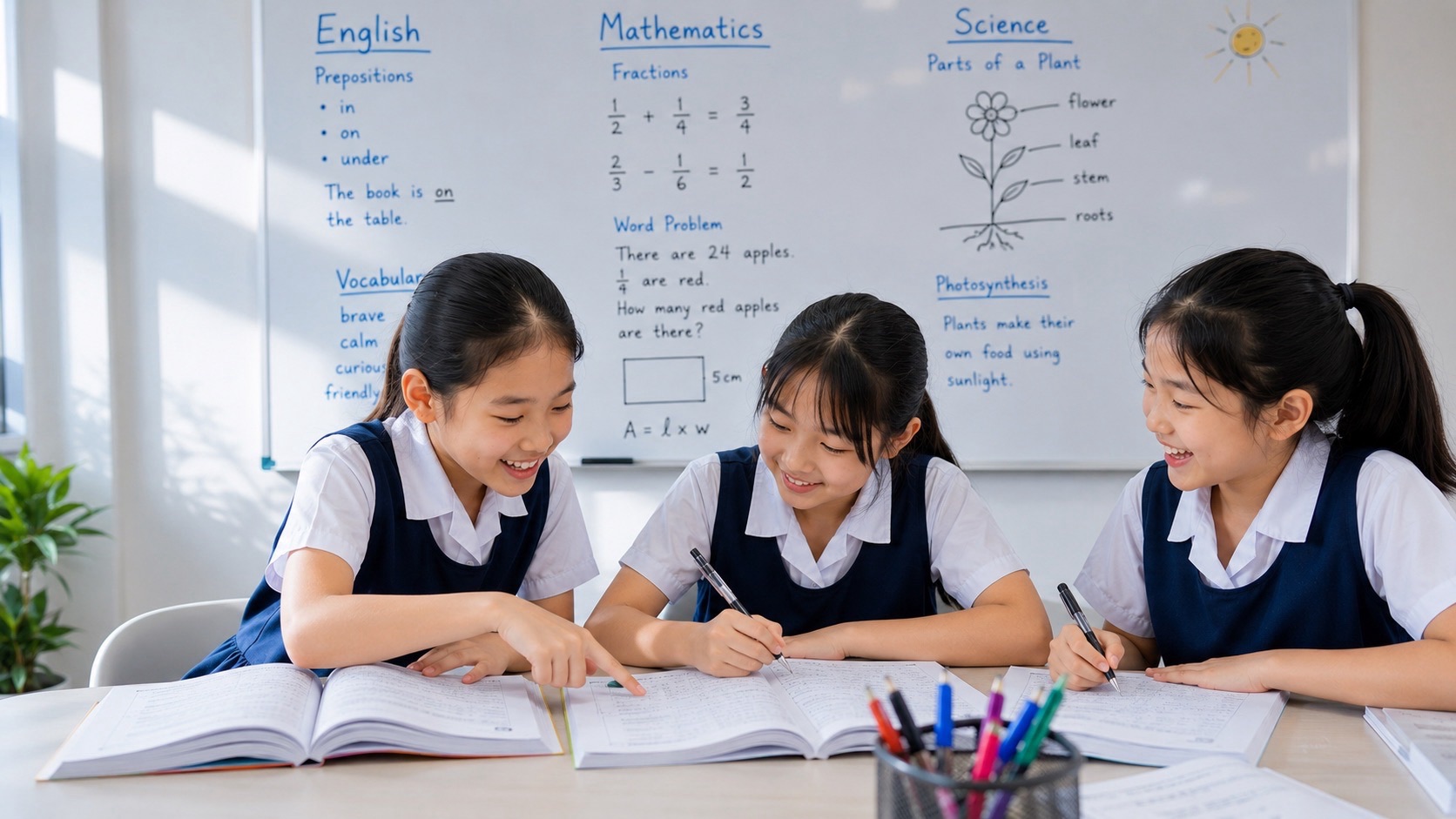
Primary 6 Science tuition for Ranggung students. Three-student tutorials that bring earlier concepts, current school learning and independent scientific reasoning together.
The final primary year needs a clear plan, not simply more papers.
At eduKateSG, we help students identify the gaps that still affect their Science, repair those gaps and apply their knowledge across unfamiliar questions. Our Primary Science programme uses human-led, three-student lessons lasting 1.5 hours, with close attention to explanation, evidence and independent work.
Some children need to rebuild an earlier concept. Others need more dependable retrieval or better control of written answers. A strong student may need deeper questions and more precise judgment about what the evidence supports. These are different starting points, and the teaching should recognise the difference.
For families around Ranggung, the first step is a parent–student consultation to discuss the learner and suitable class arrangements. Venue, timetable and availability are confirmed directly; this page does not announce a classroom at Ranggung.
Ask about Primary 6 Science tuition
Primary 6 Is the Year to Bring the Learning Together
A Primary 6 student does not begin the year with an empty notebook. Several years of Science have already been taught. The challenge is to make that learning usable as a connected body of knowledge while the remaining school topics are introduced.
A question can require a concept learned earlier, a process taught recently and a representation the child has never seen before. The student must select the relevant relationship without being told which chapter to use. Then the child has to express the reasoning accurately enough for another person to follow.
This explains why a thick revision file is not necessarily a secure foundation. The file may contain correct definitions and completed worksheets, while the learner still depends on familiar wording or a tutor’s first prompt. The knowledge is present on paper but not reliably available when the task changes.
Our Primary 6 lessons therefore connect learning and performance. We continue teaching what needs to be understood, but we also create opportunities for the child to use that understanding without support. When an independent attempt fails, we inspect the cause rather than immediately assign another complete paper.
The distinction matters throughout the year. A student who lacks an essential concept needs time to repair it. A student whose concepts are secure may need mixed practice, answer editing or better handling of unfamiliar investigations. Treating both students as if they need the same revision packet wastes the information their work is providing.
A useful plan keeps three questions visible: what does the child understand, what can the child do independently and what should be taught or practised next?
The Hidden Problem: Choosing the Right Topic but Using the Wrong Explanation
Some Primary 6 errors are surprisingly difficult to notice during ordinary revision. The child identifies the correct chapter and includes several relevant words, so the answer appears close to being right. However, the explanation describes a different condition from the one in the question.
For example, a learner may write that an insulating layer prevents heat from escaping when the task is about keeping a cold drink cool in warmer surroundings. The material idea is relevant, but the direction of heat transfer has not been checked. The child has retrieved a familiar sentence rather than reconstructed the explanation.
A similar error occurs when a student writes that a plant in darkness cannot respire because it cannot photosynthesise. The two processes have been confused. The learner needs to understand their different roles and conditions, not simply add the word “energy” to the answer.
In an investigation, a student may remember that a fair test changes one factor but still accept a conclusion from two setups with several relevant differences. The rule has been learned, yet it is not being used to evaluate the actual evidence.
We address these errors through close contrasts. Two questions may look similar but require different decisions. The child identifies the condition that changes the explanation and states why it matters. This makes the boundary of the concept clearer.
Primary 6 tuition should therefore inspect the reasoning inside correct-looking answers. The question is not only whether a familiar keyword appears. It is whether the relationship expressed by the answer is true for this setup, this comparison and this command.
Why Three Students Help Us See the Individual Difficulty
A three-student lesson gives the tutor room to distinguish different causes of the same result. One child may lose a mark because the concept is unclear. Another may understand it but overlook the measured variable. A third may select the right evidence and then omit the final causal link in writing.
We ask students to commit to an individual attempt before discussing the answer together. This is especially important in the final primary year, when learners can become skilled at following someone else’s reasoning. Listening carefully is useful, but it does not prove that the child can begin and complete the task independently.
After the first attempt, discussion becomes a way to examine decisions. Students can compare two explanations, identify the information that matters or explain why a tempting option does not fit. The tutor keeps the conversation focused on evidence rather than on which student sounds most confident.
Every learner then returns to individual work. A changed question tests whether the discussion has produced usable understanding. The tutor notes not only correctness but also the amount of help needed, the quality of the explanation and whether the same error returns.
The group is small enough for specific feedback, but suitable placement still matters. A child who needs substantial foundational repair may not benefit from joining students already working comfortably through demanding mixed sets. We consider pace, current topics and learning needs before recommending a class.
The value of the format is not a guarantee of a score. It is the opportunity to make each student’s thinking visible and to respond while the misunderstanding is still a teachable decision rather than a repeated habit.
Current School Learning and the Examination Destination
The SEAB Science document for examinations from 2026 links assessment to the 2023 Primary Science syllabus and includes both understanding and the application of knowledge through inquiry. This means that revision must include using information, evaluating methods and communicating reasoning, not merely recalling facts.
The child’s own school programme remains the starting point for lesson planning. We ask for current topic information and marked work. The areas discussed below are examples of Primary 6 teaching and cumulative revision, not a claim that every school introduces them in an identical order.
Standard Science and Foundation Science require appropriate matching of content and assessment preparation. SEAB publishes separate examination documents. A Foundation learner should not be given an indiscriminate Standard Science workload and expected to adapt without suitable teaching.
This guide focuses on the year-long work of learning, integration and increasing independence. Our PSLE Science Tuition | Ranggung guide considers examination execution in greater detail. The two purposes support each other, but a paper strategy cannot replace an unlearned concept.
For a child preparing in a later examination year, use the official requirements for that cohort. An old paper can still provide useful practice, but its format and content should not automatically be treated as the current specification.
What We Teach and Revisit in Primary 6 Science
Photosynthesis, respiration and plant needs
Students need to distinguish food production from the release of energy from food. At the appropriate primary-school level, photosynthesis connects light, water and carbon dioxide with food production in green plants. Respiration is a different process. A child should not treat the two words as interchangeable explanations for anything involving a plant.
We pay particular attention to changed conditions. A plant without light cannot carry out photosynthesis in the usual school model, but that does not mean that every life process stops immediately. Stored food and the timescale of the question matter. Statements such as “the plant dies straight away” often go beyond the information given.
Earlier learning about plant parts is connected to these processes. Roots and stems are not merely labels to revisit before an examination; their functions help the student understand how resources reach the parts where they are needed. We teach the required relationship clearly before asking for a more complicated application.
Forces and changes in motion
Force questions require the child to identify an interaction and explain its effect. A student should name what acts on what and whether the question concerns starting, stopping, changing speed, changing direction or changing shape. Writing “there is force” does not yet explain the observation.
For friction questions, we inspect the conditions supplied. If the problem states that one test surface produces greater friction and the objects begin the test under the same relevant conditions, the learner can use that information to explain a difference in motion. We do not replace careful reading with an unqualified rule about every rough or smooth material.
Where elastic spring force is part of the student’s programme, students distinguish the spring’s total length from its extension. They read patterns in data and make appropriately qualified predictions. The work is matched to the child’s actual subject requirements rather than assuming that every learner needs the same scope.
Energy and the changes that can be observed
Energy questions become clearer when students identify the starting form, the device or process and the observable outcome. A battery-powered torch can be discussed through chemical energy stored in the battery, electrical transfer and the light and heat produced. The learner should not claim that energy has simply vanished when it is no longer in the most useful form.
We keep the explanation tied to the question. A long list of energy forms is not helpful when the task asks about one change in a particular device. Similarly, an answer about motion should identify the object whose motion is being considered rather than use “kinetic energy” as an unattached keyword.
Illustrative devices and diagrams are selected to reveal the relationship. Students do not need to dismantle electrical appliances or conduct risky home experiments. Paper-based comparisons can provide demanding reasoning without adding unnecessary practical hazards.
Living together, feeding relationships and adaptations
Students learn to read the direction and meaning of arrows in a food chain or food web. They distinguish a direct feeding relationship from an indirect effect through another organism. The diagram is evidence, not decoration, and the answer must match the relationship it shows.
Predictions are made within the simplified conditions of the question. A change in one population can affect another, but real populations also depend on many conditions. We teach the child to use the stated model and assumptions rather than turn a school diagram into an absolute claim about every ecosystem.
Adaptation questions require a connection between a feature, its function and the environmental challenge. Naming a body part is not enough. The student should explain how the feature helps under the specified conditions, while avoiding the suggestion that an individual animal deliberately chooses to grow a useful feature.
Water, heat, materials and electricity in cumulative revision
Earlier physical Science remains active. We revisit changes of state, heat transfer, material properties, light and electrical systems where they affect current understanding. The purpose is not to repeat every page from earlier years; it is to ensure that essential relationships remain available in mixed work.
A question about an unfamiliar container may depend on a familiar material property. An investigation about a plant can require a familiar comparison skill. A circuit drawn in a new shape still needs to be read from its connections. These are opportunities to use earlier knowledge, not necessarily evidence that the child needs another new topic.
We give particular attention to pairs of ideas that students commonly confuse. Comparing them directly is often more useful than studying them in separate revision sessions and hoping that the distinction becomes clear later.
Worked Example: A Cold Drink and an Incorrect Heat Explanation
The following is an original teaching example. Two identical sealed bottles contain equal amounts of the same cold drink at the same initial temperature. One is placed inside a suitable insulating sleeve; the other is not. Both are left for the same period in the same warmer room. The sleeved bottle’s drink has a smaller temperature rise.
A student writes, “The sleeve prevents heat from escaping, so the drink remains cold.” The answer uses a relevant material idea but describes the wrong direction of transfer. The surroundings are warmer than the drink. The explanation should concern reducing the rate at which heat is transferred from the warmer surroundings to the colder drink.
We first ask the learner to identify the two temperatures and draw a simple directional arrow. Only then do we ask for the sentence. This separates a concept error from an answer-construction error. If the arrow is wrong, the relationship needs teaching; if the arrow is right but the sentence is wrong, the child needs help preserving the meaning in words.
The next version concerns a warm drink in a cooler room. Now the direction is reversed. The student should explain why the same insulating property can be useful in both situations without reusing one fixed sentence mechanically.
We also inspect the investigation. Equal starting temperature, equal amount of drink and comparable surroundings help make the comparison meaningful. A child who lists these conditions should be able to explain what competing influence each condition controls.
The final independent task uses a different object and provides the results in a table. The learner must identify the temperature change, name the relevant transfer and explain the outcome without the original bottle example serving as a cue.
Worked Example: Spring Length Is Not Spring Extension
In this illustrative question, an unloaded spring is 10 centimetres long. With a load of 100 grams, its length is 12 centimetres; with 200 grams, it is 14 centimetres; with 300 grams, it is 16 centimetres. The question asks the student to use the pattern to predict the extension for a 250-gram load.
The first step is to distinguish length from extension. The extensions in the three supplied cases are 2, 4 and 6 centimetres. A learner who uses 12, 14 and 16 as the extensions is misreading the quantity before any deeper reasoning begins.
Within the pattern supplied, 250 grams lies between 200 and 300 grams. A pattern-based prediction is an extension of 5 centimetres, assuming the same relationship continues between those values. The corresponding total length would be 15 centimetres. The answer must use the quantity the question requested.
We do not turn this limited table into an unlimited rule about every spring under every load. A prediction based on a pattern is not permission to extrapolate far beyond the evidence without checking whether the same relationship remains valid.
This example shows why some Science difficulties are also representation difficulties. The child may know that a spring stretches when a load is added and still answer incorrectly because the baseline length was ignored. The useful repair is to identify the starting quantity and the change, then practise that distinction in a new context.
Any practical demonstration is supervised with appropriate equipment. Children do not need to hang heavy objects or improvise potentially unsafe spring setups at home to learn how to interpret the table.
Worked Example: A Food Web and the Limits of a Prediction
Consider a simplified teaching model in which a plant is eaten by an insect, and the insect is eaten by a bird. The question states that the bird population decreases while other relevant conditions are initially unchanged. A student predicts that the insect population may increase because fewer insects are eaten by birds.
The reasoning connects the stated change to a direct feeding relationship. A stronger answer names the organisms and the mechanism rather than say only that there are “more survivors”. It also respects the simplified conditions supplied by the question.
Now add another predator that also eats the insect. The student must inspect the complete web before predicting the effect. A remembered three-organism chain may no longer capture all the relationships shown. The child should not ignore a relevant arrow simply because the first explanation is familiar.
We also distinguish an immediate prediction from a long-term guarantee. If insect numbers rise, food availability and other factors may later matter. The exact answer should match the question’s scope, assumptions and timescale. Primary Science does not require an elaborate ecological essay, but it does require avoiding claims that exceed the model.
For an adaptation question, we use the same discipline. A feature must be connected to a function and a particular challenge. “It is adapted” repeats the label; explaining how the feature helps the organism obtain food, avoid a threat or cope with a condition supplies the reasoning.
The point of the exercise is not to memorise one food web. It is to read relationships accurately and make a conclusion that the supplied information can support.
Experiments and Data: Read Before Explaining
By Primary 6, students should have a dependable routine for interpreting an investigation. We begin with the purpose, identify what changes, identify what is measured and then inspect the conditions that make the comparison meaningful. Only after reading the results do we construct an explanation.
The order matters. A familiar apparatus can tempt a learner to write the expected story before noticing what the data actually show. We ask for a neutral description first: which value increased, which decreased, what stayed similar and over what period? The scientific explanation must then fit that description.
Graphs require the same care. Students identify the axes, units, scale and range before interpreting a trend. They distinguish a value at a particular time from a change over an interval. They also notice whether the question asks for a description, a prediction or a reason for the pattern.
When evaluating an experiment, students should name the problem precisely. “Not accurate” is too vague if the real issue is that the starting amounts differ. “Not reliable” should not be used as a generic substitute for explaining why a comparison cannot isolate the intended factor.
Repeated trials, suitable measurements and controlled conditions play different roles. Repetition may help reveal whether results are consistent, but repeated use of an unfair design does not remove the original competing explanation. We teach these distinctions through examples rather than as disconnected definitions.
The final conclusion should answer the investigation’s question at the level supported by the results. A limited range does not justify an unlimited claim. A table showing height does not automatically establish overall health. A difference between setups does not prove the intended cause when another relevant condition also changed.
Our First-Principles Teaching Method
Build a useful starting picture
We review a recent school paper and a small selection of independent questions. The aim is not to assign a permanent label to the student. It is to identify the concepts, representations and answer decisions that most need attention now.
We record how the answer was produced. A correct response after several prompts is different from one completed alone. A blank answer may reflect missing knowledge, uncertainty about the command or difficulty getting started. The next lesson should respond to that cause.
Repair the smallest meaningful gap
A child described as weak in energy may actually be uncertain about which object is moving, what the initial energy store is or how to interpret the diagram. We locate the first unstable relationship and teach it with a simpler example before returning to the original question.
This is not avoiding the syllabus. It is making the current topic learnable. Repeating harder questions without repairing the prerequisite can turn practice into repeated evidence of the same difficulty.
Increase complexity deliberately
Through our Fencing Method, the learner first controls a clear relationship. We then introduce a changed condition, an unfamiliar representation or a question that combines two ideas. The added difficulty is chosen, not accidental.
If understanding breaks down, we can identify the new demand that caused the problem. This gives the tutor a more precise response than concluding that the whole topic needs to be taught again.
Require independent use
After explanation and guided practice, the child completes a fresh question without leading prompts. The tutor checks the first decision, the evidence selected and the completeness of the answer. Correctness is important, but so is the reasoning that produced it.
We revisit the idea later in mixed work. A correction becomes more convincing when it survives a different context and a delay. The child should increasingly recognise and apply the relationship without being told which lesson it belongs to.
What Happens During a 90-Minute Lesson
Primary 6 lessons balance teaching with independent application. The exact allocation changes with the learners, but the following example shows how a 90-minute tutorial can remain purposeful.
Ten minutes: retrieve and reconnect. Students attempt a short set involving earlier learning and one current prerequisite. The tutor checks what remains accessible without notes and identifies any gap that would obstruct the day’s work.
Fifteen minutes: teach or repair the main concept. We clarify the relationship through a diagram, a contrasting pair of examples or a carefully bounded explanation. Students are asked to state what changed and why the change matters.
Fifteen minutes: guided application. The learner attempts selected questions with support available. Prompts are reduced as the reasoning becomes clearer. We avoid allowing the tutor’s questions to become the student’s entire method.
Twenty minutes: independent mixed work. Students complete a fresh set that requires concept selection and explanation. Timing may be introduced where appropriate, but pressure is not used to conceal an unlearned skill. The task should show what the learner can currently do alone.
Fifteen minutes: review important decisions. We inspect the errors with the greatest teaching value, compare alternative explanations and identify what needs to change. The child should be able to explain why a correction is better, not merely recognise the tutor’s wording.
Ten minutes: retest a repaired point. A short changed question checks the correction. It may be simpler than the mixed set if the purpose is to isolate the exact decision that was previously unstable.
Five minutes: agree continuation work. The student leaves with a bounded task, a clear purpose and an understanding of what to record if difficulty returns. The next lesson can then begin from useful evidence.
Three Primary 6 Student Pathways
Repair: rebuilding what still blocks learning
A learner on this pathway may have important earlier misconceptions or be unable to use the current school content without substantial help. We identify the essential relationship that needs repair and teach it directly. The aim is not to restart every chapter, but to remove the obstacle that is affecting current performance.
Practice begins with manageable questions and progresses to changed applications. The student needs to experience genuine independent success at the repaired step. That success is a foundation for harder work, not a reason to remain indefinitely with easy questions.
Stabilise: making knowledge dependable
This learner can often explain the concepts but produces inconsistent answers. The problem may appear when topics are mixed, diagrams change or the child has to work under time. We use spaced retrieval, contrasting questions and a specific checking routine to make the decisions more reliable.
We also inspect unnecessary answer changes and incomplete explanations. The priority is not always learning something new. It may be using existing knowledge accurately and consistently across different conditions.
Extend: developing stronger scientific judgment
A secure learner can work on subtler applications, better investigation design and the limits of evidence. We may ask the student to improve a flawed method, distinguish two plausible explanations or state what additional information would be needed for a conclusion.
Extension does not remove the need for precision. Strong students can lose marks by overgeneralising, writing beyond the command or adding a fact that contradicts an otherwise correct answer. More advanced work should sharpen judgment, not encourage longer responses for their own sake.
A Practical Sequence Across the Primary 6 Year
Establish the foundation before accelerating
At the beginning of support, we identify the current school content and the earlier concepts that are already secure, partly secure or uncertain. The map is built from actual attempts rather than the student’s confidence rating alone. A familiar chapter can still contain an important misconception.
The first priorities should be clear enough for the family to understand. For example, repair heat-transfer direction, improve comparison statements and practise identifying what an investigation measures. The plan can then be reviewed against fresh work rather than a vague promise to improve everything.
Learn remaining content while keeping earlier ideas active
New topics are taught in coordination with school, while older ideas return in short, purposeful retrieval tasks. This avoids the pattern in which a chapter is studied intensely and then disappears until a large revision exercise months later.
The balance changes with the student’s needs. A child struggling with a new concept may need more direct teaching. A child who understands current lessons but forgets older content may need more cumulative practice. Coverage and retention must both be considered.
Increase independent integration
As the foundation becomes more secure, questions are mixed and familiar cues are removed. Students identify the system, evidence and command independently. The tutor checks whether the child can maintain the quality of reasoning across a longer set rather than one isolated example.
Where a repeated error returns, we temporarily isolate it, repair it and then reintroduce it into mixed work. Integration does not mean abandoning focused teaching. It means using focused teaching where the independent evidence shows it is still needed.
Rehearse assessment without abandoning learning
Near assessments, complete or partial papers can help students practise pacing, switching between question types and maintaining accurate explanations. However, the review remains essential. A paper that is marked and filed without a useful correction may reveal a problem without changing it.
The number of papers is not the main measure of readiness. More useful evidence is that important misconceptions are reducing, explanations remain accurate when the setting changes and the student needs fewer prompts to begin, check and recover.
How We Improve Open-Ended Answers
We begin with the command. A question asking the child to describe a pattern needs a different response from one asking why the pattern occurs. A comparison requires both sides. An evaluation needs a reason that addresses the method or conclusion. Topic knowledge must be shaped to the task.
Next, the learner identifies the essential evidence. The answer should use the measurement, observation or condition that actually supports it. Copying an entire table into prose is not necessary, but neither is ignoring the data and writing a generic explanation from memory.
The mechanism then connects the evidence to the outcome. We ask which step is missing when an answer stops too early. A sentence such as “The temperature decreases because of heat” names a topic but does not identify the direction of transfer or the objects involved.
Finally, students edit for precision. They replace ambiguous pronouns, specify quantities and remove irrelevant facts. The aim is a complete answer with no unnecessary contradiction. A shorter, accurate explanation is better than a long response that contains both the correct and incorrect processes.
We use sentence frames only as temporary support. The student should understand what each part contributes and eventually produce an appropriate answer without forcing every question into a memorised structure.
How We Reduce Careless and Repeated Errors
We avoid using careless as a complete diagnosis. A repeated mistake deserves a more precise description. Was the wrong value copied? Was the command missed? Was a definition used outside its conditions? Did the learner confuse an observation with an inference?
For reading errors, we establish a deliberate first pass through the question. The student identifies the required output, the changed condition and the relevant representation. The aim is not to underline the entire page, but to notice the information that changes the answer.
For graph and table errors, we practise reading units, intervals, baselines and changes. A child may understand the Science and still lose the comparison by using final values when the question asks for increases. The repair must address that exact decision.
For conceptual errors, we use contrasting examples and require the learner to explain the boundary. Heating and cooling, photosynthesis and respiration, spring length and extension, and a result and a conclusion should not be allowed to blur into one another.
For time-pressure errors, we separate a knowledge problem from an execution problem. A child who cannot answer slowly needs teaching, not simply a faster timer. A child who answers accurately without time pressure may benefit from gradually longer or more realistic independent sets.
Checking is tied to the student’s known risks. It should be a purposeful inspection, not a ritual of rereading every word and becoming less certain. An answer is changed when there is a specific reason grounded in the question or the Science.
Home Practice Without Turning Every Evening into an Examination
Primary 6 families need a sustainable routine. Science is one part of the child’s school week, and the value of practice depends on attention and independence, not only duration. We agree on tasks that the student can attempt honestly and that provide useful information for the next lesson.
A short practice cycle might begin with closed-book retrieval, continue with a changed question and end with a review of one correction. These tasks can be distributed across the week. The arrangement is adjusted around school demands rather than imposed as a universal schedule.
Parents can ask the child to explain the most important decision in a question. Why was that concept selected? Which result supports the conclusion? What would change if the condition were different? The conversation can remain brief and focused.
Record help rather than hide it. If the child needed a reminder about the heat-transfer direction or the meaning of an axis, note that beside the attempt. A supported correct answer is still useful, but it should not be mistaken for independent readiness.
After an unsuccessful attempt, identify one next action. That may be consulting a relevant note, recording a question for the tutor or trying a simpler comparison. Repeating a difficult task without a new explanation can produce frustration rather than understanding.
Keep a sensible stopping point and preserve the wider routine. A child should not feel that every conversation, journey or meal has become another Science assessment. Curiosity and ordinary family life should remain possible during the final primary year.
What Progress Should Look Like
We look for evidence that the child is becoming more independent and more accurate at the same time. The learner identifies the relevant process sooner, reads the data before explaining and produces an answer that stays within the command.
Important improvements may include fewer repeated misconceptions, clearer comparisons, more accurate use of units and a better ability to explain why an option is wrong. These changes should appear on unfamiliar work, not only on questions recently corrected with the tutor.
We also look at how the student responds to difficulty. Can the child identify what is unknown, make a reasonable first step and continue after an error? A learner who can recover with less prompting is developing a useful form of confidence grounded in action.
School assessments provide another source of information. We examine the pattern of marks lost and compare it with lesson evidence. One result should not be treated as a complete verdict, especially when content and difficulty change between assessments.
No tuition programme can guarantee AL1 or a fixed grade gain. We can make the teaching purposeful, the feedback specific and the evidence of learning more visible. The child’s starting point, practice, school context and performance on the day still matter.
When Should a Ranggung Family Seek Primary 6 Science Support?
Support may be useful when earlier concepts remain uncertain, school homework needs constant prompting, the child performs well only by chapter or open-ended answers repeatedly miss the required mechanism. It may also help when a capable student needs closer feedback on complex investigations and precise explanations.
Starting earlier gives more room for diagnosis and consolidation, but the right response at any point is to examine the actual work and choose a manageable priority. A late enquiry should not trigger a promise of instant transformation or an indiscriminate pile of papers.
Tuition is not automatically necessary when the child is learning confidently and using school feedback independently. The decision should be based on the help required and the suitability of the available class. More lessons are not always the missing ingredient.
Practical Access from Ranggung
Ranggung LRT station is on the Sengkang East Loop near the Sengkang East Avenue and Compassvale Lane area. Families should plan from the child’s actual home or school rather than assume that a station-based estimate represents the complete journey.
The LTA guide to the Sengkang–Punggol LRT describes the connection to the North East Line at Sengkang. For a confirmed Punggol appointment, families may connect there and continue towards Punggol, checking current services and their preferred route before departure.
Our Punggol contact page lists 83 Punggol Central, Singapore 828761. Visits are by appointment. Confirm the actual Science class venue, meeting instructions and available placement before making the trip.
A good arrangement should also fit school dismissal, meals and the return journey. We do not promise a fixed travel time or imply that every class advertised on a general contact page has a suitable Primary 6 opening.
Class Details and the First Consultation
Format: three-student, human-led small-group tuition. Lesson length: 1.5 hours. Focus: current Primary 6 learning, cumulative concepts, inquiry, representation reading, accurate explanations and increasing independent application.
Materials may include concept comparisons, worked examples, school-aligned topic practice, mixed sets and focused error reviews. Current fees, timetable, venue and any additional assessment arrangements are confirmed directly.
Bring recent marked papers, the current textbook or topic list and examples of difficult questions. Tell us which work was completed independently and where help was given. A realistic starting picture is more useful than a carefully polished set of answers.
We also discuss the child’s school commitments and the time that can reasonably be used for practice. The plan should be specific enough to review and manageable enough to follow. It should not depend on a family maintaining an unrealistic routine.
The consultation helps determine whether the available class is suitable and whether the first priority is repair, stabilisation or extension. It is a practical discussion about the learner, not a guarantee of a particular examination outcome.
Frequently Asked Questions
Is Primary 6 Science tuition the same as a PSLE revision class?
There is overlap, but the emphasis can differ. Primary 6 support includes learning remaining school content, repairing earlier gaps and integrating concepts across the year. Examination-focused work also considers timing, paper management and independent performance under assessment conditions. A student still learning a concept needs teaching before repeated timed rehearsal. The programme should match that starting point.
My child remembers definitions but cannot answer unfamiliar questions. What is missing?
The learner may need help selecting the relevant concept and connecting it to the evidence. We compare familiar and unfamiliar versions of the same relationship, remove chapter cues and ask for the reason behind the answer. More definitions are not always the solution. The useful change is the ability to recognise when and how an existing idea applies.
Will you restart Primary 3 and Primary 4 content?
Only where an earlier idea is affecting present work. A student confused about heat transfer may need a focused repair before understanding a cooling question. Another may need help reading measurements rather than a complete return to an earlier chapter. We locate the relevant prerequisite and reconnect it to the current task instead of repeating everything indiscriminately.
How do you help with open-ended answers?
We check the command, the evidence selected and the mechanism expressed. Some students need conceptual teaching; others need a clearer comparison, a named object or the final link in an explanation. We use the child’s original response to identify the missing part and then test the correction in a new question. The aim is accurate independent writing, not dependence on model wording.
Do you teach Standard and Foundation Science in the same way?
The learner’s actual subject requirements and starting point must guide the content, language support and assessment practice. SEAB publishes separate formats, and a general Standard Science packet is not automatically appropriate for a Foundation learner. Discuss the child’s school arrangement during consultation so that the proposed support and class compatibility can be considered properly.
How many papers should a Primary 6 student complete?
There is no universally useful number. Papers can reveal integration, timing and independent performance, but their value depends on how the errors are reviewed and repaired. Repeatedly completing papers with the same unresolved misconception may produce little improvement. We choose a balance of focused teaching, mixed sets and fuller rehearsal according to what the student’s work shows.
Can a strong student still benefit from tuition?
Possibly, when the learner needs deeper investigation questions, better judgment about evidence or more precise explanations. Extension should increase control, not simply add workload. A capable child may need to reduce overgeneralisation or unnecessary writing rather than learn more facts. A student already receiving appropriate challenge and feedback may not need an additional class.
What happens when a student panics at an unfamiliar question?
We practise a clear first step: identify the command, locate the relevant information and state which relationship might apply. The question is then approached in manageable parts. We distinguish lack of knowledge from uncertainty caused by the presentation. Confidence is built through repeated independent decisions, not by promising that every examination question will look familiar.
Can parents help without becoming the tutor?
Yes. Support a manageable routine, encourage an honest attempt and ask the child to explain one important decision. Record where a prompt was needed and leave the original work visible. Parents do not need to rewrite every answer. Useful information about the child’s independence helps the tutor decide what to teach next.
How quickly should improvement appear?
The pace depends on the starting gap and the opportunities to practise. Some changes in reading and answer construction may become visible before a major assessment, while substantial conceptual gaps require more time. We review specific evidence rather than promise a fixed result after a set number of lessons. Improvement should show in what the learner can increasingly do alone.
Is there a Science classroom at Ranggung?
This guide serves Ranggung families and does not announce a classroom in the neighbourhood. Please confirm the teaching venue and available Primary 6 placement directly. The published Punggol contact address is 83 Punggol Central, with visits by appointment. The academic fit and practical travel arrangement should both be checked before enrolment.
What should we bring to the first meeting?
Bring recent marked Science work, the current topic list or textbook and a few questions that show the difficulty. Tell us how much help the child usually needs. The most useful material is authentic work with its uncertainties still visible. We can then discuss a specific starting priority rather than judge the learner from a score alone.
Helpful Reading for Ranggung Parents
For earlier learning, read Primary 4 Science Tuition | Ranggung and Primary 5 Science Tuition | Ranggung. For paper preparation and examination decisions, continue to PSLE Science Tuition | Ranggung.
The Science Learning Hub provides further subject reading. Our Primary Science Tuition guide explains the learning approach, while SEAB’s published formats provide the official assessment reference for 2026.
Primary 6 Science Tuition for Ranggung Families
The purpose of the final primary year is not to replace curiosity with anxiety. It is to bring the learning together so that the child can understand, explain and act on it with greater independence.
We repair what is missing, stabilise what is inconsistent and extend what is ready. We teach the relationship before asking for speed, and we use independent work to check whether the teaching has become usable knowledge.
A stronger learner can meet an unfamiliar question with a clear first step, connect evidence to a concept and produce an explanation that belongs to the actual task.
Arrange a Parent–Student Consultation
Tell us where your child is now and which part of Science needs attention. A recent piece of work gives us a concrete place to begin.
Contact eduKate Singapore · Chat on WhatsApp
eduKate Singapore · Three-student small-group tuition · Visits by appointment.