
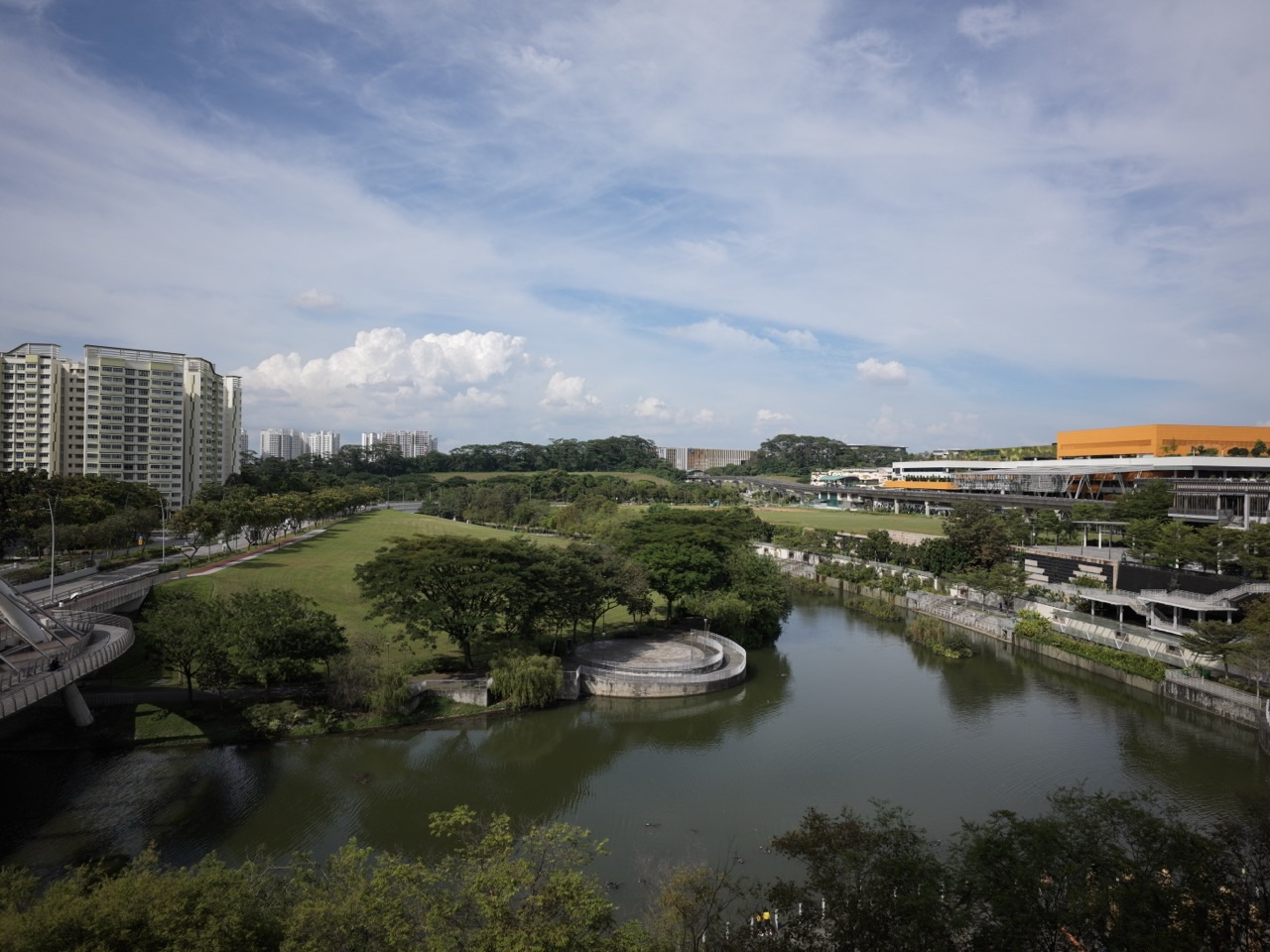
Things to do for kids in Punggol can become much more than a search for somewhere to spend the afternoon. Punggol gives families an unusual combination of water, parkland, cycling routes, biodiversity, local history and one of Singapore’s newest major public libraries.
That combination makes the town ideal for a learning day.
Touring Singapore reading: Open the Touring Singapore master hub for all 17 published vocabulary days, Top 10 visitor articles and Singapore family-learning places. Compare Punggol’s waterfront landscape and community life with Toa Payoh in the heartland vocabulary guide. Choose a topic, not an exhausting multi-destination itinerary.
Related Punggol vocabulary reading: Day 6: Heartland Towns, HDB Living and Everyday Singapore connects Punggol’s waterfront and eco-town planning with wider HDB vocabulary. Its hundred terms cover residential services, transport access, neighbourhood design and respectful urban observation.
A child can begin outdoors by watching water move through Punggol Waterway Park, continue by observing habitats at Coney Island Park, and finish indoors at Punggol Regional Library with a book, exhibition or making activity that gives the day a second layer.
The key is not to turn the outing into school.
The key is to help the child notice more than they normally would.
A good learning day in Punggol can quietly build observation, scientific reasoning, vocabulary, map reading, estimation, history and independence.
- observe how water, paths, housing and greenery work together;
- look for biodiversity without disturbing habitats;
- compare engineered landscapes with more rustic environments;
- use maps and travel time as practical Mathematics;
- learn how Punggol changed across generations;
- read or research one question at Punggol Regional Library;
- finish by explaining one idea in the child’s own words.
Visit the official Punggol Waterway Park page
Read about Punggol Regional Library
Begin at Punggol Waterway Park: Read the Town Through Water
Punggol Waterway Park runs along the waterway through the town and includes several themed areas. This makes it useful for families because the landscape changes as the child moves.
Do not begin by telling the child what every feature means.
Ask them to identify patterns.
Where is the water closest to housing?
Where are the banks planted more densely?
Where do bridges change the way people move?
Where are there open spaces for play and gathering?
A child may first see a park.
With better questions, the same child begins to see a system.
The waterway is connected to movement, recreation, drainage, greenery and the design of the town.
A simple observation challenge
- Find one place designed for movement.
- Find one place designed for rest.
- Find one place where plants affect how the space feels.
- Find one bridge and explain why it is placed there.
- Find one sign of wildlife.
- Find one feature that appears to manage water.
The child does not need to know every technical term.
The first objective is to distinguish function.
What is this part for?
Use the Preserved Old Punggol Road Elements to Introduce History
Punggol Waterway Park preserves reminders of older Punggol, including a stretch of Old Punggol Road and an old bus stop.
This is a useful teaching moment because young children often assume that a modern town has always looked modern.
Ask the child to imagine the area before the present housing landscape.
What would transport have been like?
Where would people have worked?
What might the roads have looked like?
How would a waterfront settlement feel different from a dense residential town?
The purpose is not to memorise dates.
It is to understand change.
When children realise that places have earlier versions, history becomes local.
Turn Bridges into Mathematics
Punggol’s bridges are natural prompts for estimation and geometry.
Ask the child to choose one bridge.
Estimate its length before walking across.
Count walking steps.
Estimate average stride length.
Compare the estimate with a map distance if available.
For younger children, simply count repeated elements or look for symmetry.
For older children, ask what makes the estimate imperfect.
- step length changes;
- people do not walk in a perfectly straight line;
- map distances may follow different paths;
- the start and end points may be chosen differently.
This teaches something important about Mathematics.
Numbers come from methods.
A result is only as reliable as the way it was measured.
Use the Waterway to Build Science Language
Children often understand more than they can express.
A learning walk can help language catch up with observation.
Water can flow, ripple, collect, drain, reflect, surge, recede or meander.
A cyclist can coast, accelerate, turn, brake or balance.
Birds can perch, glide, forage, swoop or circle.
Ask the child to collect five verbs from the outing.
The goal is not to use difficult words.
The goal is to choose words that describe what actually happened.
Precise vocabulary improves thinking because it forces the learner to notice differences.
Continue to Coney Island Park: Let the Landscape Become More Rustic
Coney Island Park offers a useful contrast with the landscaped waterway.
The park is more rustic, with natural habitats, boardwalks and cycling paths. That contrast gives children a reason to compare environments rather than seeing every green space as the same.
Ask:
- Which place feels more designed?
- Which place feels more wild?
- What signs show that people still manage the space?
- Where might animals find shelter?
- What kinds of plants seem adapted to the conditions here?
- Why are opening hours and access rules important in a nature area?
NParks lists Coney Island Park as open from 7am to 7pm. Families should plan the visit with those hours in mind.
Check current Coney Island Park information
Teach Biodiversity Without Turning Nature into a Collection
Children often want to pick, catch or touch what they discover.
A better habit is careful observation.
Choose one small area and look for differences.
- two leaf shapes;
- two kinds of bark;
- two insects behaving differently;
- evidence of feeding;
- evidence of decomposition;
- a plant growing in a shaded position;
- a plant exposed to stronger sunlight.
Ask the child to sketch or photograph rather than collect.
This teaches a fundamental scientific attitude: learn from the system without unnecessarily disturbing it.
Punggol Regional Library: Move from Experience to Research
Punggol Regional Library provides an unusually strong second half for the learning day.
The library opened fully in 2023 and spans five storeys, with spaces and resources for children, teens, adults and persons with disabilities.
For families, the most useful learning move is to carry one question from outdoors into the library.
A child might ask:
- How did Punggol look before the present town?
- Why do wetlands support so many organisms?
- How do rivers and drains move stormwater?
- Why do cities build cycling networks?
- What birds are common in north-eastern Singapore?
- How are public spaces designed for different ages?
The child does not need to write a report.
Finding one useful source is enough.
Then ask what the source adds that direct observation could not.
This is the relationship between field experience and research.
One gives evidence.
The other gives context.
Use the Punggol Stories Exhibition to Teach Local History
Punggol Regional Library includes the permanent Punggol Stories trail, drawing from National Library Board collections to show how the area changed from kampongs and plantations to later seafood, recreation and farming histories before the modern town.
This is valuable because children can compare the Punggol outside the library with earlier versions of the same place.
Ask the child to identify one thing that has changed and one thing that still connects the old and new town.
Water may be one connection.
Movement may be another.
Community life may be another.
Use Making to Turn Knowledge into Production
Punggol Regional Library also includes making and innovation spaces.
For older children and teens, the educational value is not simply access to equipment.
It is the change from consuming information to producing something.
A learner who reads about structures can design one.
A learner who studies an object can prototype an improved version.
A learner who notices a local problem can think about a practical response.
That transition matters.
Strong learning eventually produces output.
A Simple Half-Day Punggol Learning Route
Stage 1: Waterway observation
Walk a short section of Punggol Waterway Park. Ask the child to identify water, movement, vegetation and one piece of infrastructure.
Stage 2: Estimate something
Estimate a bridge length, walking time or cycling distance.
Stage 3: History stop
Look for the preserved Old Punggol Road element and discuss how the town has changed.
Stage 4: Nature contrast
If time and energy allow, continue towards Coney Island Park and compare the more rustic landscape with the designed waterway.
Stage 5: Library
Bring one question into Punggol Regional Library.
Stage 6: Teach-back
On the way home, ask the child to explain one thing in under two minutes.
If the explanation becomes unclear, that is useful information.
It shows where understanding still needs work.
How to Adjust the Punggol Day by Age
Ages 5 to 7
- find three kinds of movement;
- count repeating shapes on a bridge;
- draw one bird, plant or water feature;
- choose one library book linked to the day.
Ages 8 to 10
- make one prediction about water or wildlife;
- estimate one distance;
- use five precise verbs;
- compare Punggol Waterway Park with Coney Island Park.
Ages 11 to 12
- identify one human-designed system;
- explain one interaction between living and non-living parts of the environment;
- research one local-history question;
- write a paragraph supported by two observations.
Secondary students
- discuss trade-offs between development and habitat;
- evaluate a measurement method;
- compare planned and rustic landscapes;
- connect the town to geography, ecology, design or urban planning.
Build English from a Real Punggol Scene
A real place gives children better material for writing than a generic prompt.
Choose one moment rather than the whole outing.
- A cyclist crossing a bridge at sunset
- A child noticing an otter or bird near the water
- An old bus stop beside a modern town
- The first few minutes inside Coney Island
- A quiet corner inside Punggol Regional Library
Ask the child to include one precise movement, one sound, one visual detail and one change in thought.
Good writing becomes stronger when the writer selects.
What Parents Should Avoid
- Do not attempt to cover every attraction in one day.
- Do not disturb wildlife for photographs.
- Do not quiz continuously.
- Do not force a long worksheet after a physically active outing.
- Do not make every fact into a memory test.
- Do not answer every question immediately if the child can investigate it.
The parent’s role is to keep curiosity alive.
Frequently Asked Questions
Is Punggol suitable for a learning day with young children?
Yes. The waterway, bridges, park spaces and library provide concrete experiences that can be kept simple and playful.
Is Coney Island suitable for every child?
It is a rustic nature park with specific opening hours. Families should consider weather, walking ability and the child’s comfort with a less urban environment before including it.
How can Punggol support Primary Science?
Use water, habitats, biodiversity, plant-animal interactions and observation. The outing supports understanding but does not replace syllabus teaching.
How can Punggol support Mathematics?
Use distance, time, mapping, step counts, bridge geometry, estimation and measurement error.
How can the library help?
Carry one question from the outdoor experience into the library and find one reliable source that deepens it.
Do we need to spend the whole day?
No. A short route with one park section and the library is enough for a strong learning experience.
Helpful Links for a Punggol Learning Day
Things to do for Kids | Learning Punggol
Punggol works as a learning landscape because it contains visible connections.
Water connects to town planning.
Nature connects to development.
Old Punggol connects to new Punggol.
Observation connects to research.
Research can connect to making.
The best outcome is not a child who remembers every fact.
It is a child who begins to notice that a neighbourhood is full of questions.
Properly taught kids shine a bright light into the future.