
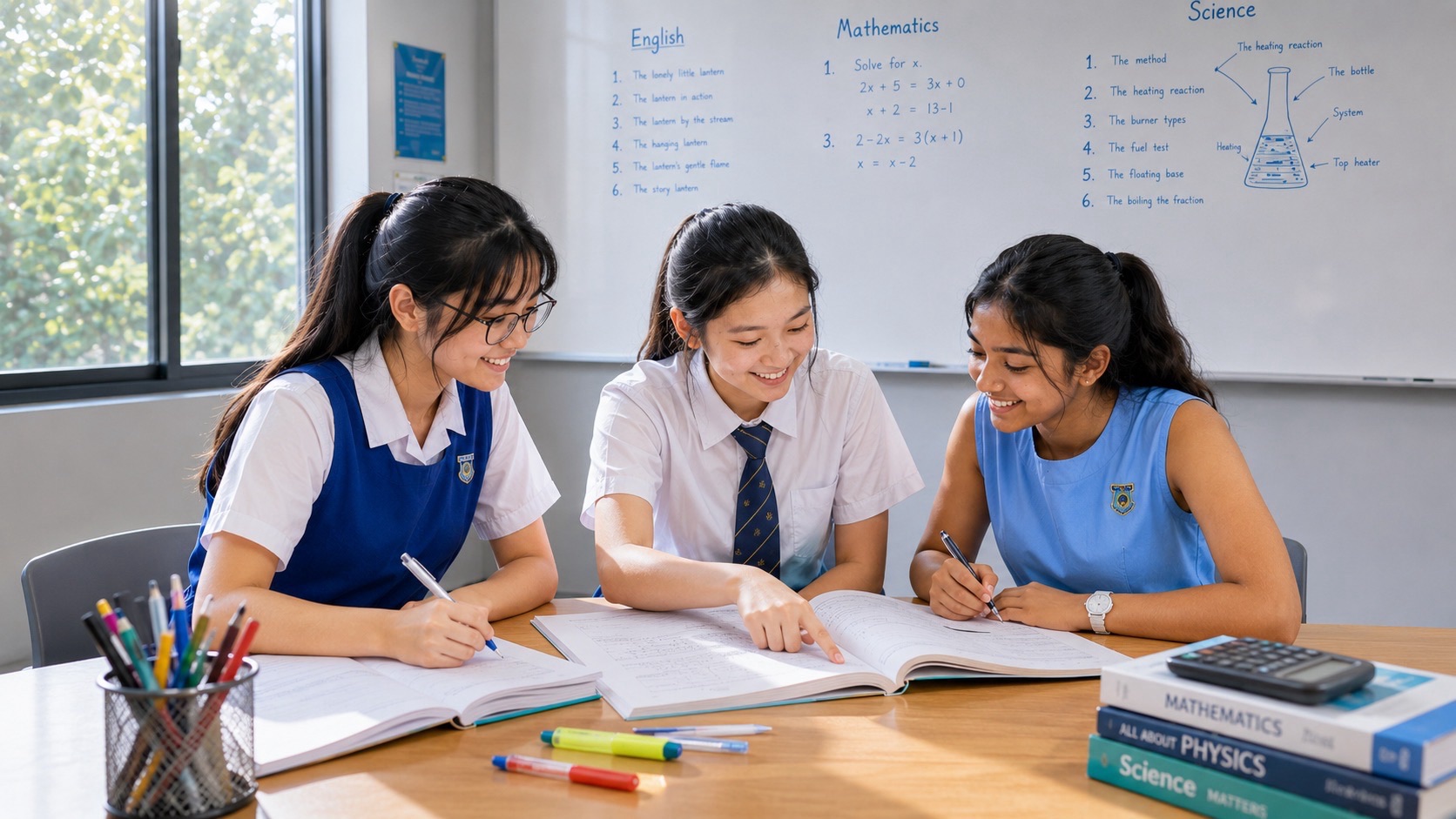
Education and tuition for Toh Guan families. Primary and Secondary learning, careful progression and premium 3-pax tutorials at eduKateSG near Sixth Avenue MRT.
Feedback becomes valuable only when it changes the next attempt.
Toh Guan sits beside the Jurong East education and transport corridor. For families here, a useful tuition system is one that turns school feedback, tuition correction and home practice into a closed loop rather than three separate piles of comments.
At eduKateSG, tutorials are limited to three students. The established weekly lesson duration is 1.5 hours, with teaching materials, guided corrections and focused continuation work.
Families from Toh Guan attend our Bukit Timah location near Sixth Avenue MRT. This guide addresses Toh Guan families; it does not describe an eduKateSG branch in the neighbourhood.
Arrange a parent–student consultation with eduKate Singapore.
Feedback Must Return to the Next Attempt
Students often understand a correction immediately and still repeat the error later. The missing step is not always explanation; it is converting the correction into a future decision.
A strong repair ends with a replacement habit and a later check: identify the unknown before choosing the operation, underline the evidence before writing the inference, or check the sign before moving to the next line.
The purpose of tuition is not to create permanent dependence on another explanation. It is to identify the obstacle, teach through it and leave the learner with a method that can be used later without the same support.
The Hidden Learning Problem: More Work Does Not Always Mean More Capability
A student can complete a large amount of work while the same misunderstanding remains untouched.
One learner may do many Mathematics questions but repeatedly choose the wrong operation. Another may write several English paragraphs but continue to use evidence vaguely. A Science student may memorise model answers without learning how the condition leads to the result.
- Concept gap: the student does not understand the idea.
- Retrieval gap: the idea was understood but is no longer easily recalled.
- Selection gap: the learner knows several methods but chooses the wrong one.
- Transfer gap: the method works only when the question looks familiar.
- Execution gap: the method is correct but accuracy, timing or presentation breaks down.
- Repair gap: the same error returns because the correction never became a new habit.
A good tutorial makes the category visible and chooses the next task accordingly.
Why Toh Guan Families May Consider a 3-Pax Tutorial
A class of three gives the tutor enough visibility to inspect the student’s route through the work rather than only the answer.
- Each student can attempt before seeing a model.
- The tutor can inspect intermediate working and explanations.
- Different causes of similar errors can receive different repairs.
- Prompts can be reduced gradually as control improves.
- Peers can compare methods after independent thinking.
- Continuation work can be selected for the actual error pattern.
The class size is a teaching condition, not a promise of a specific result. The student still needs suitable placement, meaningful practice and enough time for learning to consolidate.
Primary English: Build a Clear Link Between Reading and Writing
Primary English becomes stronger when students see reading and writing as connected.
A child who can explain an event orally but writes an unclear sentence needs a different repair from a child who has not understood the event.
We therefore work from meaning outward: identify the idea, make the sentence complete, then improve vocabulary and style where they add precision.
In comprehension, students learn to distinguish stated information from supported inference. In writing, they learn to give the reader enough information to follow the action and reason.
Primary Mathematics: Understand the Quantities Before Choosing the Operation
Mathematics becomes more reliable when the student knows what each quantity represents.
Consider an invented example: 72 counters are shared equally among eight groups. Each group receives nine. If the problem instead gives 72 counters and nine per group, the unknown becomes the number of groups.
The numbers are familiar, but the direction of reasoning has changed.
The student should therefore identify the whole, the known quantities and the unknown before selecting the operation.
This habit supports fractions, ratio, percentage and later algebra.
Primary Science: Connect Condition, Process and Effect
Science answers often become incomplete when the learner knows the keyword but not the explanatory chain.
A useful answer identifies what changed, states the relevant process and explains the resulting effect.
When evidence is supplied in a table or diagram, the student should connect that evidence to the explanation.
If several factors change together in a hypothetical comparison, the learner should recognise that a confident single-cause conclusion may not be justified.
Primary 5, Primary 6 and PSLE: Repair, Retrieve and Execute
Repair
If the learner does not understand the concept, return to the prerequisite and rebuild it.
Retrieve
If the concept was understood before but is now unavailable, bring it back after spacing without immediately reopening the notes.
Execute
When understanding and recall are stable, practise mixed questions, timing, paper navigation and checking.
A full practice paper is useful because it tests the whole system. It should not be the only place where the system is taught.
Secondary 1: A New Academic Operating Environment
Secondary school changes the language and organisation of learning.
Mathematics becomes more symbolic. English becomes more interpretive. Science becomes more formal. Students also manage more subjects, teachers and deadlines.
A student who performed adequately in Primary 6 can still feel unsettled.
Good tuition makes the new expectations explicit while protecting the foundations that still matter.
Full Subject-Based Banding and the Singapore-Cambridge SEC
Under Full Subject-Based Banding, secondary students may offer subjects at G1, G2 or G3 levels. SEAB states that the Singapore-Cambridge Secondary Education Certificate begins in 2027, with the certificate reflecting the subjects and levels taken.
Tuition should therefore align with the student’s actual school programme and subject level.
Students in Integrated Programme or another curriculum should identify that programme clearly during consultation.
Secondary English Tuition for Toh Guan Students
Secondary English tuition should connect reading, interpretation and expression.
- Vocabulary in context
- Grammar and sentence construction
- Comprehension inference
- Evidence selection
- Summary control
- Situational writing
- Continuous writing
- Oral explanation
- Editing and rewriting
The student should not depend permanently on model phrases. The long-term objective is independent language control.
Secondary Mathematics Tuition for Toh Guan Students
Secondary Mathematics is cumulative. A visible problem in the current chapter may begin in an earlier prerequisite.
Algebra may fail because fractions or negative numbers are unstable. Trigonometry may fail because diagrams are interpreted poorly. Statistics may fail because the question is read inaccurately.
We trace the error backward, repair the first important unstable point and reconnect the learner to the current syllabus.
Families can also read Singapore Tuition | Secondary Math Tutor’s Latest Classes.
Science Tuition for Toh Guan Students
Science becomes more dependable when students build complete causal chains.
The learner should know what changed, what process follows, what evidence matters and what final effect must be stated.
This reasoning transfers from Primary Science into Biology, Chemistry and Physics.
Additional Mathematics: Build the Runway Before Increasing Speed
Additional Mathematics depends on stable algebra, careful notation and the ability to sustain several logical steps.
Indices, logarithms, functions, trigonometry and calculus become harder when ordinary algebra still consumes too much attention.
Strong preparation therefore means dependable fractions, equations, graphs, functions and symbolic manipulation.
Subject availability and suitable placement should be confirmed directly during consultation.
Our First-Principles Teaching Method
1. Preserve the first attempt
The student’s own work reveals what the learner currently understands.
2. Identify the first unstable point
We find the earliest important misconception, missing prerequisite or interpretation error.
3. Use the Fencing Method
A clean case is taught first. One new condition is introduced at a time so the learner can see what changed.
4. Connect representations
Words, diagrams, tables and equations should describe the same underlying relationship.
5. Alternate examples and attempts
The What Works Clearinghouse study guide recommends worked examples, retrieval and explanatory questioning. We model clearly, then require the learner to make the key decisions on a fresh task.
6. Retrieve after spacing
The idea returns after time has passed so the student has to reconstruct it.
7. Interleave
Different topics are mixed so the learner must identify which method applies.
8. Transfer
A changed question checks whether the concept survives beyond the original example.
What Happens During a 90-Minute Tutorial
A typical lesson begins with short retrieval from earlier work and review of a current school question or assessment error.
The tutor selects one high-value concept or error pattern. Direct teaching is followed by guided practice.
Prompts are then reduced and the student completes a fresh attempt independently.
A changed question tests whether the method transfers.
The lesson closes with error review and focused continuation work.
Three Student Pathways
Repair
The learner has a clear concept or prerequisite gap. We rebuild the earliest important point and reconnect it to current work.
Stabilisation
The learner understands but performs inconsistently. We strengthen retrieval, accuracy, timing and checking.
Extension
The learner is secure and ready for deeper reasoning, alternate methods and unfamiliar applications.
These pathways describe current learning needs rather than permanent labels.
Toh Guan Learning: Close the Feedback Loop
Keep the original error, the corrected reasoning and the later check connected.
The student should be able to explain what went wrong and what action will prevent the same mistake next time.
When the later attempt is successful without the original prompt, the correction has become more useful than a red mark on a completed page.
A Practical Weekly System for Toh Guan Families
- One short retrieval task from earlier learning
- One current school task completed independently
- One correction based on a repeated error
- One changed question later in the week
- Enough time for ordinary schoolwork, meals, sleep and recovery
The purpose is continuity rather than volume.
What Progress Should Look Like
Progress becomes visible when the student begins work with less prompting and asks more precise questions.
Written working becomes easier to follow. Repeated mistakes occur less often. The learner can explain why an earlier answer was wrong and what should be done differently next time.
Unfamiliar questions create less panic because the student has a method for finding the structure.
School results remain important, but no responsible tuition programme can promise a fixed grade gain after a fixed number of lessons.
When Should a Toh Guan Family Consider Tuition?
Support may be useful when a recurring problem survives normal school correction, when the learner cannot begin work independently, when a major transition is approaching with unstable foundations or when results remain inconsistent despite effort.
A strong student may also benefit from deeper transfer and explanation.
A learner who understands school lessons, uses feedback and progresses independently may not need another weekly class.
Access From Toh Guan to Sixth Avenue
Families from Toh Guan can connect through Jurong East and the wider western rail network, then continue toward the Downtown Line and Sixth Avenue MRT.
Plan the full journey from the student’s actual starting point after school, including walking, interchange and the return home.
eduKateSG’s Bukit Timah location is at 8 Fourth Avenue, Singapore 268674, near Sixth Avenue MRT. Attendance is by appointment.
Class Details
- Premium 3-pax small-group tutorials
- Established weekly duration: 1.5 hours
- Primary English, Mathematics and Science support according to suitable placement
- Secondary English and Mathematics support according to the student’s programme
- Additional Mathematics support for suitable upper-secondary students
- Teaching materials, guided corrections and focused continuation work
What Parents Can Bring to the Consultation
- A recent marked assessment
- One ordinary homework sample
- The student’s own first attempt on a difficult question
- The current school topic sequence where available
- Teacher feedback where available
- A realistic outline of weekly commitments
Bring the original question with the answer. The tutor needs to see what the learner was asked to do, not only the final mark.
Frequently Asked Questions
Is there an eduKateSG centre in Toh Guan?
No. This guide addresses families living near or travelling through the area. The tuition location described is at 8 Fourth Avenue near Sixth Avenue MRT.
Should tuition follow the school exactly?
It should respect the school sequence and assessment calendar, but an earlier prerequisite may need repair first.
Can a shy student benefit from a 3-pax class?
Often, yes. The class is small enough for frequent participation while allowing the tutor to build explanation gradually.
Do you teach ahead?
Pre-teaching can be useful when the foundation is ready. The purpose is familiarity and confidence, not acceleration for its own sake.
Can a strong student benefit from tuition?
Yes, when the purpose is deeper transfer, stronger explanation or more demanding application.
How quickly should progress appear?
Some improvements in organisation and error awareness can appear within several lesson cycles. Deeper conceptual repair takes longer and depends on the learner’s starting point and practice.
Helpful Reading for Toh Guan Families
Education and Tuition | Jurong East
Education and Tuition | Pandan Gardens
Secondary 1 Mathematics Tutor Clementi | Small Groups Tutorials
SEAB | Singapore-Cambridge Secondary Education Certificate
Education and Tuition for Toh Guan Families
A strong education plan begins with an accurate picture of what the learner can do independently and what still requires support.
Repair genuine gaps. Stabilise inconsistent performance. Extend students who are ready. Keep the weekly load workable and make progress visible.
When tuition does these things well, it supports education without replacing the student’s own responsibility.
Arrange a Parent–Student Consultation
Contact eduKate Singapore with the student’s school level, subject, recent work and current difficulty.
eduKateSG
8 Fourth Avenue
Singapore 268674
Near Sixth Avenue MRT
Premium 3-pax small-group tuition
By appointment
Properly taught kids shine a bright light into the future.