
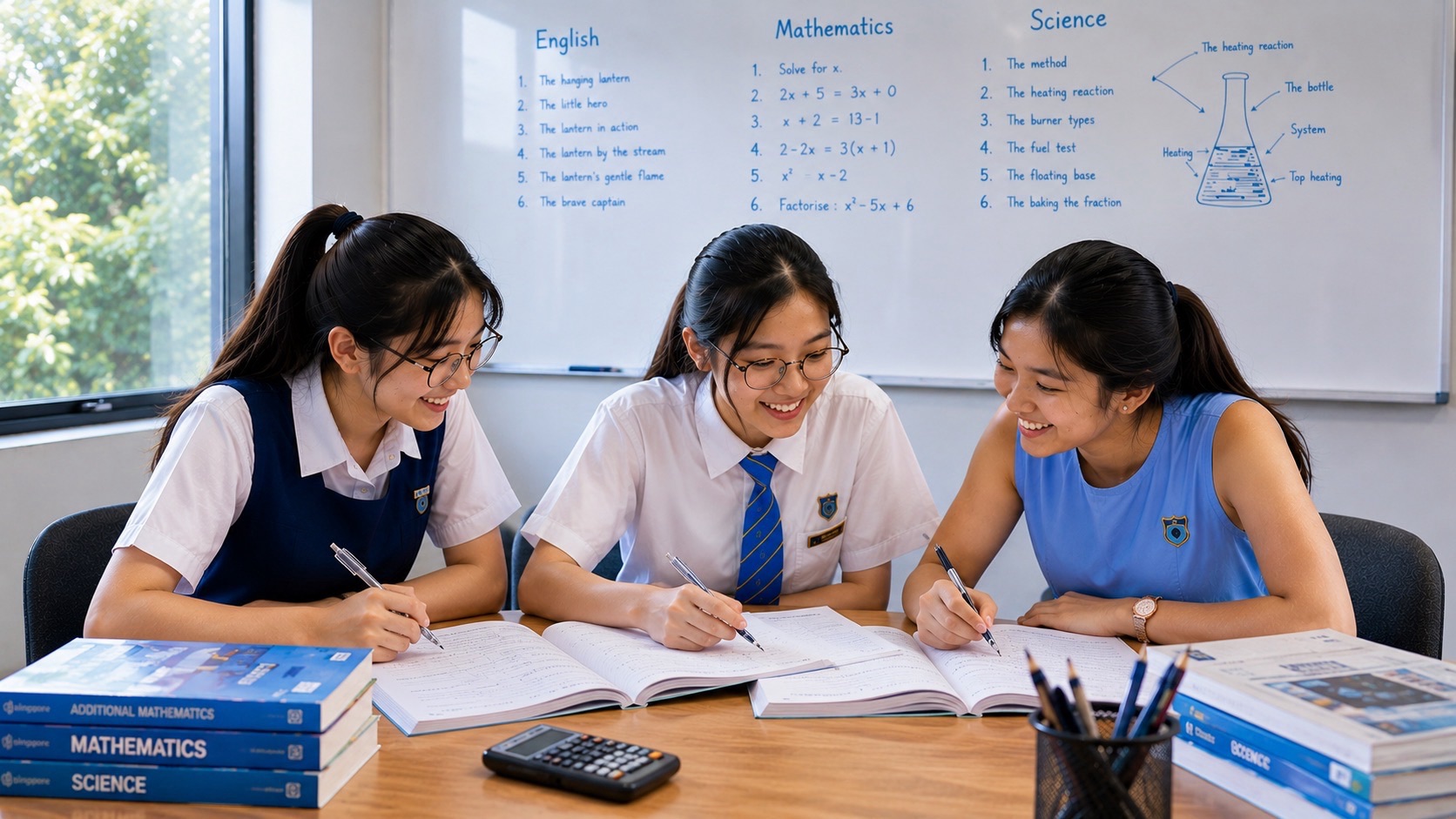
How to improve with tuition for Bugis students: reduce academic noise so the student can identify the signal in each question and act on it.
Bugis is busy, connected and full of competing signals. Students can experience learning the same way: several methods, notes, examples and instructions arrive at once. Tuition should make the important part easier to see.
At eduKateSG, we teach in premium 3-pax small-group tutorials near Sixth Avenue MRT. Lessons are typically 1.5 hours weekly, with clear explanations, carefully sequenced practice, close inspection of working, retrieval, error analysis and independent application.
The objective is not to give the student more academic activity for its own sake. The objective is to make the next school task easier to understand, easier to begin and more likely to be completed independently.
- identify the task before choosing a method
- reduce wrong-method starts
- turn teacher feedback into a specific next action
- build calm retrieval in mixed work
- strengthen independent checking
Arrange a parent–student consultation with eduKate Singapore.
The Important Transition Is From Seeing Everything to Seeing What Matters
Students often know more than their first attempt suggests. The difficulty is deciding which information deserves attention.
A question may contain context, diagrams, numbers, examples and command words. The student needs to separate relevant information from decoration.
Tuition should therefore teach selection as well as knowledge.
For a Bugis student, improvement means less academic noise: fewer random starts, clearer priorities and better decisions before the working begins.
The Hidden Problem: Attention Can Be Correctly Directed to the Wrong Thing
A student may read carefully and still focus on an irrelevant number or an eye-catching phrase.
That is not always a knowledge gap. It can be a selection problem.
The tutor should make the cue visible, then ask the student to recognise it later without being told.
Consider an original Mathematics example. A café receipt shows three drinks at $4 each, a sandwich at $7 and a 10% service charge. The question asks for the service charge only.
A student who immediately calculates the final bill is doing accurate arithmetic for a task that was not asked.
The relevant subtotal is $19, and 10% of $19 is $1.90. The teaching target is therefore not multiplication alone; it is reading the requested quantity before calculating.
A later question can ask for the total bill. The numbers are the same, but the required output changes.
Why a 3-Pax Tutorial Can Help Bugis Students Improve
In a 3-pax tutorial, the tutor can see whether a Bugis student is reading the task or simply reacting to familiar numbers.
One learner may misread the command word, another may select the wrong method and another may calculate correctly but fail to answer the stated question.
- close inspection of individual working
- frequent opportunities to answer and explain
- pacing that can slow down at the exact point of confusion
- independent application after guided teaching
- comparison of different valid approaches
- clearer tracking of recurring error patterns
- faster adjustment before school assessments
Those differences become teachable only when the tutor can inspect the individual decision process.
Our First-Principles Teaching Method
1. Diagnose the exact weakness
We ask what the student noticed first and why.
The first point of attention often explains the later error more clearly than the final answer does.
2. Rebuild from the first unstable point
When the cue itself is not understood, the tutor repairs the vocabulary or concept first.
Once that cue becomes meaningful, method selection can be practised.
3. Use the Fencing Method
We begin with a clear boundary around the skill. The first task is simple enough for the student to see what matters. Once the method is secure, one new source of difficulty is introduced deliberately: changed wording, mixed topics, a less familiar representation, an additional reasoning step or mild time pressure.
This makes failure informative. When several new difficulties appear at once, the tutor may know that the answer is wrong but not which part of the thinking broke first.
4. Ask the student to think aloud
Students explain which information is relevant and which is not.
A strong explanation helps the learner make the same distinction in the next question.
5. Retrieve after a delay
Immediate success is encouraging but incomplete evidence. A later cold-start question shows what the student can retrieve after the explanation is no longer fresh.
If one broad cue restores the method, retrieval may be the main issue. If the relationship still cannot be explained, the student may need deeper concept repair instead of more memory practice.
6. Interleave and transfer
The surface changes while the decision stays similar.
The student learns to recognise the underlying demand rather than search for a matching worksheet.
7. Add speed only after control
Timing is introduced after selection is accurate. Fast wrong starts are not progress.
What Happens During a 90-Minute Improvement Lesson
Warm-up retrieval
A short mixed set requires the student to identify the demand before doing full working.
Current-school diagnosis
Recent schoolwork is checked for patterns. The tutor is not trying to correct every mark on the page. One or two high-value weaknesses are selected because they explain several visible mistakes or are directly blocking the current school topic.
Concept instruction
The tutor makes the cue, relationship and method explicit, then removes that support on a fresh question.
Guided practice
The student attempts carefully selected questions while the tutor watches the decision points. Prompts are reduced as control improves. A useful prompt directs attention; it does not replace the student’s reasoning.
Independent application
A fresh task follows without step-by-step help. This is where the lesson tests whether teaching has become usable capability.
Mixed or timed practice
The student receives several neighbouring question types so method selection becomes the main cognitive demand.
Error review
Mistakes are classified rather than dismissed as “careless”. Reading, recall, concept, arithmetic, notation, evidence, organisation, timing and checking problems need different repairs.
Focused continuation work
Home practice contains a small number of questions chosen to test recognition, not to create volume.
Three Student Pathways
The repair pathway
Repair is for students whose selection problems come from missing knowledge.
- limited vocabulary
- weak arithmetic fluency
- uncertain algebra rules
- incomplete Science concepts
- poor command-word understanding
The stabilisation pathway
Stabilisation is for students who know the content but choose inconsistently.
- mixed question sets
- command-word identification
- method-selection drills
- error comparison
- short timed sections
The extension pathway
Extension develops judgement when several plausible approaches exist.
- multi-step problems
- alternative methods
- stronger evidence selection
- more ambiguous-looking prompts
- greater time pressure
How Tuition Should Improve English
English improves when students distinguish what a question asks from what the passage happens to contain.
Evidence selection becomes stronger when students learn to ignore interesting but irrelevant details.
If a passage asks why a character leaves early, the student should choose the action or statement that supports that reason, not copy the most dramatic sentence in the paragraph.
The next passage should use different content so the evidence-selection habit travels.
How Tuition Should Improve Mathematics
Mathematics improves when students identify the relationship before calculating.
Correct arithmetic applied to the wrong question is still an incorrect mathematical decision.
A percentage problem asking for the discount amount should not automatically become a final-price calculation. The student first names the quantity being requested.
This simple pause can prevent long chains of unnecessary working.
How Tuition Should Improve Science
Science improves when students distinguish observation, explanation and evaluation.
Each command demands a different kind of response.
A question asking which setup has the highest temperature requires reading the data. A question asking why requires a concept and mechanism. A question asking whether the comparison is fair requires evaluating conditions.
Tuition should make those switches explicit until the student recognises them independently.
A Bugis Weekly Routine for Clearer Academic Signals
The student’s continuation work should preserve the key cue from the lesson.
- write the command word or target before working
- attempt one changed question later
- record one wrong-method start
- redo it from a clean page
- bring the decision back to the next lesson
The work is small because the aim is accuracy of selection.
Once selection becomes reliable, difficulty can increase.
How Parents Can See Improvement Before the Grade Moves
Parents may first notice that the student looks less scattered.
- fewer random starts
- more precise questions for help
- less unnecessary working
- better use of evidence
- cleaner revision priorities
- more confidence in mixed papers
These changes suggest that the student is learning to notice what matters before acting.
Marks remain important, but they are usually lagging indicators. Responsible tuition does not promise a fixed grade after a fixed number of lessons. The size of the gap, attendance, school demands, practice quality and assessment timing all matter.
When Tuition Is Not Yet Working
Tuition is not yet working when the student learns more content but keeps making the same wrong first decision.
- the student cannot explain what is being repaired
- the same error returns without a change in method
- tuition examples do not transfer into schoolwork
- the tutor does most of the thinking
- homework volume rises while independence falls
- the student becomes more dependent on hints
Return to the cue, compare neighbouring question types and make selection visible.
Travelling From Bugis to Sixth Avenue
Bugis is served by the East–West and Downtown Lines. Sixth Avenue is on the Downtown Line, giving Bugis families a direct rail connection along that line.
The transport connection is simple; the academic goal should be equally clear: identify the signal, choose the method and carry the learning home.
Location: eduKateSG, 8 Fourth Avenue, Singapore 268674
Nearest MRT: Sixth Avenue MRT, Downtown Line
Attendance: By appointment
Class Details
Format: Premium 3-pax small-group tutorials
Duration: Approximately 1.5 hours weekly
Teaching approach:
- first-principles explanation
- diagnosis before volume
- guided and independent practice
- retrieval and interleaving
- error analysis
- school-assessment alignment
- carefully paced pre-teaching when appropriate
Materials may include:
- curated lesson notes
- topic practice
- mixed revision
- assessment-style questions
- micro-tests
- focused continuation work
What Parents Can Bring to a Consultation
- recent school test papers
- marked assignments
- teacher comments
- the school’s current topic sequence
- examples of work completed with heavy help
- questions the student repeatedly avoids
- one example of a mistake that returned after correction
Bring mixed work where the student chose the wrong method. These examples are especially useful because the knowledge may already be present.
Frequently Asked Questions
How quickly should a Bugis student improve with tuition?
Selection can improve within several lesson cycles when the underlying methods are already secure. If the cue itself is not understood, concept or vocabulary repair comes first.
Should tuition begin with full examination papers?
Not always. Full papers are useful for integration, timing and diagnosis, but a foundation gap may need a smaller teaching task first. Use the practice format that answers the current learning question.
Is more homework always better?
No. The amount should match the purpose. Fluency may need repetition. Concept repair may need fewer questions with slower reasoning and better correction.
What if my child understands during tuition but cannot work alone?
Then independent transfer has not yet been built. Prompts should be reduced, cold-start work added and the student required to choose and explain the method without the model answer beside it.
Can a strong student still benefit from tuition?
Yes. Strong students often benefit from sharper evidence selection, method comparison and more efficient decision-making.
How do you reduce careless mistakes?
We separate them into types. Reading errors, copying errors, sign errors, weak recall, poor layout, overfast calculation and time-pressure mistakes require different responses. “Be more careful” is rarely a sufficient teaching plan.
Do you teach ahead of school?
Yes, when the foundation is stable. A calm first encounter can make the later school lesson easier to follow. We do not rush into new chapters when earlier knowledge remains unreliable.
Is tuition necessary for every student?
No. A student who is learning confidently, completing work independently and progressing well may not need additional tuition. Tuition is useful when it solves a real learning problem, provides a structure the student cannot yet create alone or offers appropriate extension.
Helpful Reading
For the wider learning system, read How Independent Learning Works, How Error Correction Works and How Retrieval Practice Works.
How to Improve With Tuition | Bugis
For Bugis students, better tuition should make complex work feel clearer.
See the signal, choose deliberately and let the method follow.
eduKateSG
8 Fourth Avenue
Singapore 268674
Near Sixth Avenue MRT
Premium 3-pax small-group tuition
By appointment
Properly taught kids shine a bright light into the future.