
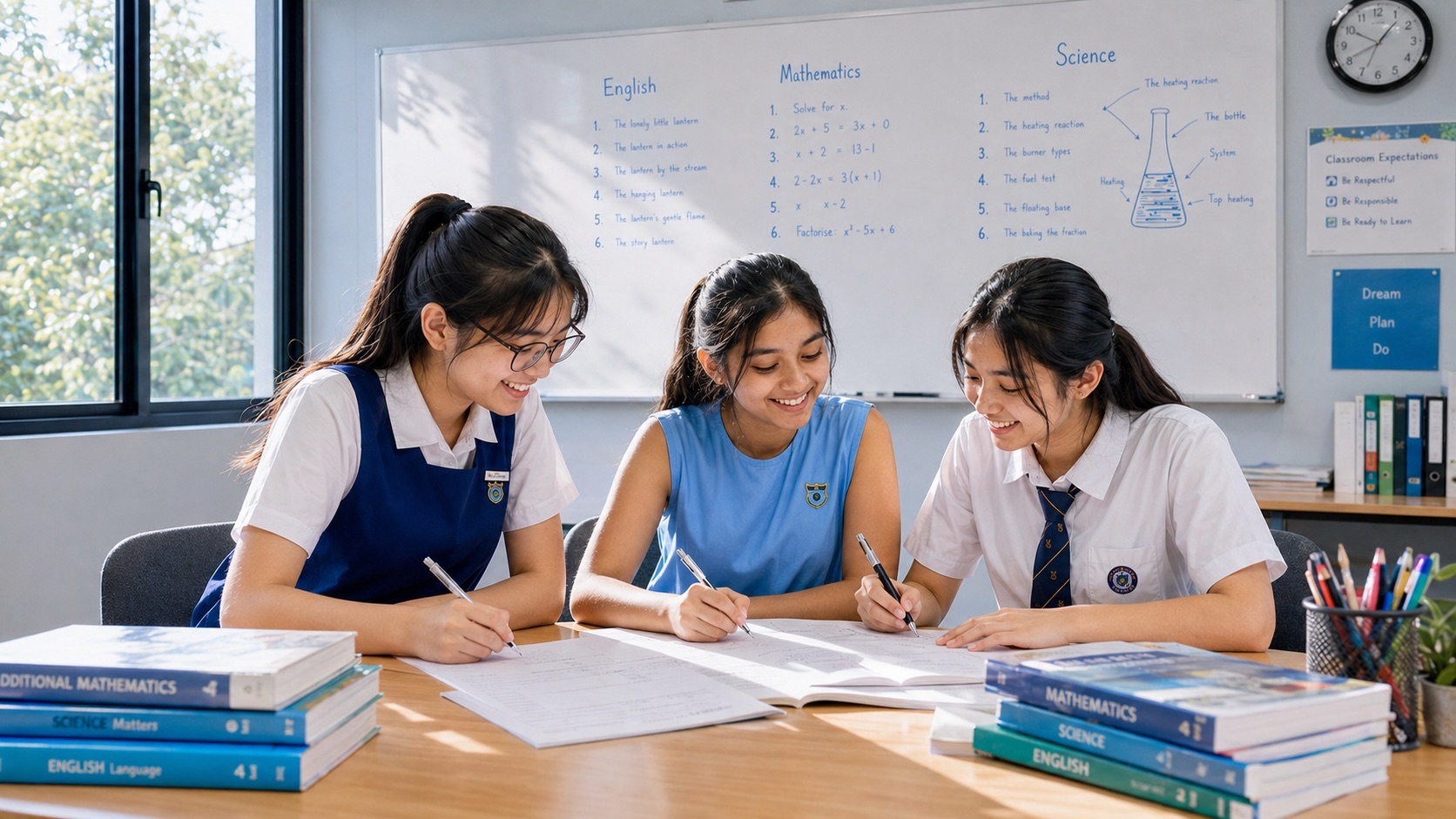
How to improve with tuition for Bukit Panjang students: use direct access to the Downtown Line as an opportunity to build a calm, repeatable learning routine rather than another rushed weekly appointment.
Bukit Panjang students have a practical rail connection into Bukit Timah through the Downtown Line. That convenience matters only if the academic structure is equally clear. Tuition should make the student’s week easier to understand, not more crowded.
At eduKateSG, we teach in premium 3-pax small-group tutorials near Sixth Avenue MRT. Lessons are typically 1.5 hours weekly, with clear explanations, carefully sequenced practice, error analysis, retrieval and independent application. The small group matters because the tutor can see how the student thinks, not merely whether the final answer is correct.
The point is not to create more academic activity. The point is to make each lesson change what the student can do next.
- repair one important weakness at a time
- build a consistent weekly study rhythm
- reduce dependence on notes and model answers
- make school and tuition work reinforce one another
- use retrieval so earlier learning stays available
Arrange a parent–student consultation with eduKate Singapore.
The Important Transition Is From Weekly Attendance to Weekly Accumulation
A student can attend tuition every week and still begin each lesson from almost the same point. This happens when the previous lesson was understood but not retrieved, corrected but not repeated independently, or practised only in the original format.
Real improvement should accumulate. The student should arrive with something more stable than last week: a method that is easier to recall, an error that is less frequent, or a question type that no longer requires the first hint.
For Bukit Panjang families, this accumulation is especially important because the transport connection makes a regular routine possible. The class should use that regularity to build continuity.
The goal is not to cover more chapters simply because another week has passed. The goal is to make the current layer dependable enough to support the next one.
The Hidden Problem: A Regular Schedule Can Hide Irregular Learning
Attendance is easy to count. Retention is harder to see.
A student may sit through four consecutive lessons while still forgetting the same rule between classes.
The tutor should therefore check what remains before adding new material.
Consider a Mathematics example: 3(x + 4) = 24. Dividing by three gives x + 4 = 8, so x = 4.
A week later, ask 5(x + 2) = 35 without showing the first example. If the student can identify the bracketed factor and solve independently, the method is becoming portable.
Then contrast 5x + 2 = 35. The student must recognise that the structure has changed. Subtracting two first gives 5x = 33, so x = 33/5.
The lesson therefore checks both retention and discrimination. Remembering the old answer is not enough; the student must know when the method applies.
Why a 3-Pax Tutorial Can Help Bukit Panjang Students Improve
A 3-pax tutorial allows the tutor to begin with a short cold-start set and inspect all three students’ responses closely.
One may remember the method, another may remember only after a cue and a third may confuse two neighbouring structures. That information should shape the next ten minutes differently for each learner.
- the tutor can inspect working rather than only final answers
- students answer often enough to remain cognitively active
- pace can change when a hidden gap appears
- students can compare different valid approaches
- mistakes can be corrected while the reasoning is still fresh
- independent work can be tested before the lesson ends
The class can still share the same conceptual discussion while each student receives a more precise next task.
The Three Improvement Pathways
1. Repair
Repair is for students whose current schoolwork is being blocked by an earlier foundation.
- fraction fluency affecting algebra
- limited vocabulary affecting comprehension
- weak grammar affecting writing
- partial Science concepts affecting application
- poor question-reading habits
Repair is successful when the earlier weakness stops interfering with current schoolwork.
2. Stabilise
Stabilisation is for students who understand during class but cannot reproduce the skill reliably later.
- spaced retrieval
- mixed-topic practice
- repeat correction
- independent starts
- short cumulative quizzes
Stabilisation turns one successful lesson into something the student can reproduce across ordinary school weeks.
3. Extend
Extension is for students who can retain and apply the core skill securely.
- unfamiliar applications
- stronger explanations
- alternative methods
- more demanding evidence selection
- controlled time pressure
Extension should increase range and depth without sacrificing clarity or independence.
A First-Principles Improvement Method
1. Diagnose the first unstable point
We ask what disappears between lessons.
If one broad cue restores the method, retrieval may be the issue. If the student still cannot explain the relationship, the concept needs deeper repair.
2. Rebuild only what is actually missing
When a prerequisite is missing, we return only to the part that is affecting current work.
The repair is quickly reconnected to school so the student sees why the earlier skill matters now.
3. Fence the task before adding complexity
The first practice boundary should be simple enough that the student can see the relationship. Once the method is secure, change one feature deliberately: wording, numbers, representation, topic mixture or time pressure.
This makes the source of failure visible. If several new difficulties arrive together, the tutor may know the answer is wrong without knowing why.
4. Make the student explain
Students are asked to describe what changed between two similar questions and why the chosen method belongs.
This turns recall into usable knowledge instead of isolated memory.
5. Retrieve after a delay
Immediate success is encouraging but incomplete evidence. A later cold-start question shows what the student can bring back without the original explanation sitting beside the page.
6. Interleave and transfer
Older and newer ideas are mixed once the individual methods are stable.
The student learns to recognise the signal for each method rather than relying on worksheet headings.
7. Add speed only after control
Timed work appears only after the method survives ordinary untimed practice. The clock should test a stable routine, not create one.
What Happens During a 90-Minute Improvement Lesson
Warm-up retrieval
A short retrieval set from earlier weeks checks whether the student is accumulating knowledge rather than repeatedly restarting.
Current-school diagnosis
Recent schoolwork is checked for patterns. One or two high-value weaknesses are selected rather than trying to repair every marked error in the same lesson.
Concept instruction
New teaching connects directly to the last stable idea so the student sees continuity between topics.
Guided practice
The student attempts carefully selected questions while the tutor monitors the decision points. Prompts are reduced as control improves.
Independent application
A fresh task follows without step-by-step help. This is the point at which teaching is tested.
Mixed or timed practice
The lesson includes one changed question or short interleaved set to test whether the method survives variation.
Error review
Mistakes are classified rather than simply crossed out. Reading, recall, concept, arithmetic, notation, language, organisation, timing and checking errors require different repairs.
Focused continuation work
Continuation work is kept small and explicit: one cold redo, one changed question and one note about where help became necessary.
How Tuition Should Improve English
English accumulates when vocabulary, inference and sentence control are reused across different tasks.
A word learned in reading should later help the student understand or write something new.
If a student learns that “reluctant” describes unwillingness or hesitation, a later task should require recognising that idea in a different action rather than recalling the original example sentence.
Repeated use with changed contexts turns vocabulary into working language.
How Tuition Should Improve Mathematics
Mathematics accumulates when earlier methods remain available after the chapter changes.
A student should not have to rebuild the same algebra or fraction rule from zero each term.
A short mixed set might place a percentage question beside a ratio question and an equation. The learner first names the relationship, then calculates.
This trains both retrieval and method selection.
How Tuition Should Improve Science
Science accumulates through connected concepts rather than isolated model answers.
Students revisit mechanisms in changed situations so the concept becomes easier to reconstruct.
A heat-transfer idea first learned with cups can later appear with containers, clothing or building materials. The objects change; the reasoning relationship remains.
The student should connect the observation to the relevant concept rather than search memory for an identical worksheet.
A Bukit Panjang Weekly Rhythm
The Downtown Line makes regular travel toward Sixth Avenue comparatively straightforward for many Bukit Panjang families. The study routine should be just as straightforward.
- leave class knowing one exact target
- attempt one short retrieval task later
- redo one important error from a clean page
- bring unresolved schoolwork back
- keep the total workload manageable
A repeatable routine is more valuable than a heroic plan that works only during holidays.
The student should be able to explain what the week is trying to preserve.
How Parents Can See Improvement Before the Grade Moves
Parents may notice continuity before marks move.
- less reteaching each week
- more stable homework starts
- fewer topics described as completely forgotten
- more accurate corrections
- better use of earlier knowledge
- less pre-test panic
The useful question is whether the student is beginning each week from a stronger baseline.
Marks remain important, but they are usually lagging indicators. A responsible tuition programme should not promise a fixed grade after a fixed number of lessons. The size of the gap, attendance, school demands, practice quality and assessment timing all matter.
When Tuition Is Not Yet Working
Tuition is not yet working when every class feels productive but every new class begins as though the previous one never happened.
- the student cannot explain what is being repaired
- the same error returns without a change in method
- tuition examples do not transfer into schoolwork
- the tutor does most of the thinking
- homework volume rises while independence falls
- the student becomes more dependent on hints
In that situation, reduce new content temporarily and inspect retention, retrieval and independent continuation work.
Travelling From Bukit Panjang to Sixth Avenue
Bukit Panjang is on the Downtown Line, the same line as Sixth Avenue. For many families, this provides a direct rail connection into Bukit Timah.
Families should still consider the full door-to-door journey, school dismissal, meals and the return home. A good tuition arrangement fits the student’s week as well as the subject.
Location: eduKateSG, 8 Fourth Avenue, Singapore 268674
Nearest MRT: Sixth Avenue MRT, Downtown Line
Attendance: By appointment
Class Details
Format: Premium 3-pax small-group tutorials
Duration: Approximately 1.5 hours weekly
Teaching approach:
- first-principles explanation
- diagnosis before volume
- guided to independent practice
- retrieval and interleaving
- error analysis
- school-assessment alignment
- carefully paced pre-teaching when appropriate
Materials may include:
- curated lesson notes
- topic practice
- mixed revision
- assessment-style questions
- micro-tests
- focused continuation work
What Parents Can Bring to a Consultation
- recent school test papers
- marked assignments
- teacher comments
- the school’s current topic sequence
- examples of work completed with heavy help
- questions the student repeatedly avoids
- one example of a mistake that returned after correction
Bring recent work from different weeks. Comparing what the student knew immediately after teaching with what remained later helps distinguish understanding from retention.
Frequently Asked Questions
How quickly should a Bukit Panjang student improve with tuition?
Continuity can improve within several lesson cycles when the main issue is retrieval or routine. Larger foundation gaps take longer because the underlying knowledge must first be rebuilt.
Should tuition begin with full examination papers?
Not always. Full papers are useful for integration, timing and diagnosis, but a foundation gap may need a smaller teaching task first. Use the practice format that answers the current learning question.
Is more homework always better?
No. The amount should match the purpose. Fluency may need repetition. Concept repair may need fewer questions with slower reasoning and better correction.
What if my child understands during tuition but cannot work alone?
Then independent transfer has not yet been built. Prompts should be reduced, cold-start work added and the student required to choose and explain the method without the model answer beside it.
Can a strong student still benefit from tuition?
Yes. Strong students also need cumulative learning. Their review can be brief, leaving most lesson time for transfer, explanation and unfamiliar application.
How do you reduce careless mistakes?
We separate them into types. Reading errors, copying errors, sign errors, weak recall, poor layout, overfast calculation and time-pressure mistakes require different responses. “Be more careful” is rarely a sufficient teaching plan.
Do you teach ahead of school?
Yes, when the foundation is stable. A calm first encounter can make the later school lesson easier to follow. We do not rush into new chapters when earlier knowledge remains unreliable.
Is tuition necessary for every student?
No. A student who is learning confidently, completing work independently and progressing well may not need additional tuition. Tuition is useful when it solves a real learning problem, provides a structure the student cannot yet create alone or offers appropriate extension.
Helpful Reading
For the wider learning system, read How Independent Learning Works, How Error Correction Works and How Retrieval Practice Works.
How to Improve With Tuition | Bukit Panjang
For Bukit Panjang families, good tuition should accumulate.
Each week should make the next week easier to enter.
eduKateSG
8 Fourth Avenue
Singapore 268674
Near Sixth Avenue MRT
Premium 3-pax small-group tuition
By appointment
Properly taught kids shine a bright light into the future.