
How to Improve With Tuition | Chinatown
Chinatown students benefit when tuition teaches them to read context carefully. Words, quantities and evidence can change meaning depending on the relationship around them.
This matters across English, Mathematics and Science. A familiar word can have a specific contextual meaning, a familiar number can represent a different quantity, and a familiar fact can be irrelevant to the question being asked.
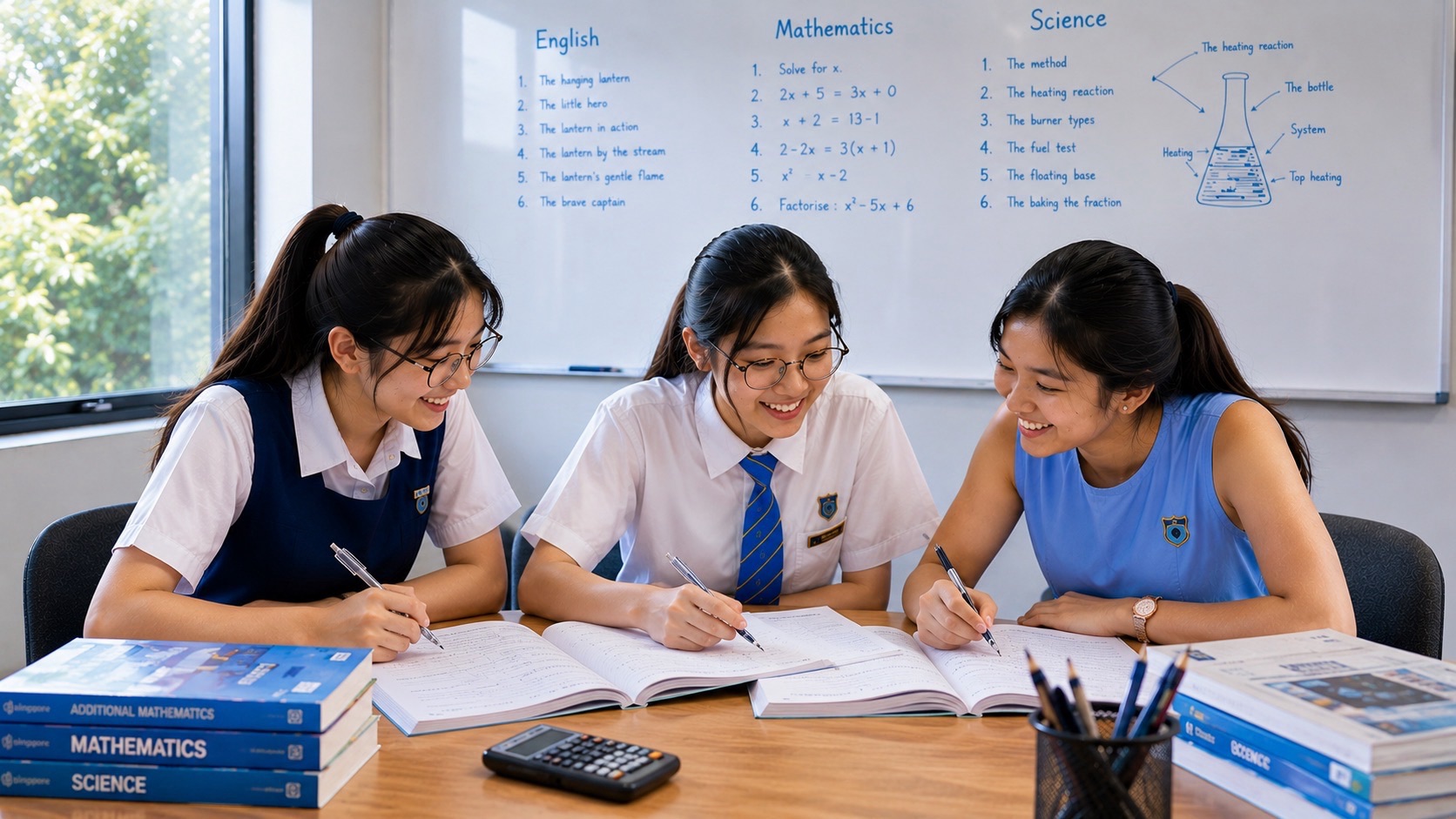
At eduKateSG, we provide premium 3-pax small-group tutorials near Sixth Avenue MRT. Lessons are typically 1.5 hours weekly, with clear explanation, closely observed practice, guided correction, independent application and focused continuation work.
The purpose is not simply to give a student more questions. It is to help the student understand what the question is asking, recognise the relationship, choose a method, carry the method through and check whether the answer still matches the original task.
For Chinatown families, tuition is most useful when it changes what the student can do after the lesson has ended.
- read context before applying a memorised rule
- improve evidence selection in English
- identify what a number represents in Mathematics
- separate observation from explanation in Science
- reduce overconfident guessing from familiar-looking cues
Arrange a parent–student consultation with eduKate Singapore.
A More Important Transition: From Recognition to Contextual Understanding
Recognition is fast. Understanding context is slower but more reliable.
Students often see a familiar word, formula or diagram and immediately activate the last method used.
That shortcut works when the new question is genuinely similar. It fails when one important condition has changed.
Tuition should teach students to notice those conditions before committing to an answer.
The Hidden Problem: Familiar Language Can Trigger the Wrong Meaning
A student may recognise every word in a question and still misunderstand the relationship.
Context determines how the parts fit together.
The tutor should therefore teach the student to restate the question in plain language before applying a memorised response.
Consider an English sentence: “The stallholder’s response was measured.”
A student who knows only the common meaning of measured as physically quantified may be confused.
In context, measured can describe a calm, controlled response.
A later sentence might say, “The table measured two metres long,” where the physical-measurement meaning is correct.
The same word requires different interpretation because the surrounding relationship changes.
Why Chinatown Parents May Prefer 3-Pax Small-Group Tuition
A 3-pax tutorial allows the tutor to ask students why a particular meaning or method fits the current context.
The explanation reveals whether the learner is reading the whole relationship or reacting to one familiar cue.
- Immediate feedback while the student is still thinking
- Frequent opportunities to answer and explain
- Less room to remain silently confused
- Closer inspection of working and language
- More targeted follow-up after mistakes
- Independent application before the lesson ends
- Calm peer momentum without large-class noise
A fresh example then checks whether the student can make the distinction without being told which meaning to use.
The class is small by design. The tutor should use that size to notice the exact decision that is creating difficulty, not simply repeat a large-class lecture to fewer students.
Our First-Principles Teaching Method
1. Diagnose the exact weakness
We ask what clue led the student to the chosen interpretation.
This helps distinguish a vocabulary gap from a context-reading problem.
2. Rebuild from the first unstable point
If the underlying word, concept or mathematical relationship is not understood, we repair it directly.
If the knowledge exists, the lesson focuses on recognising when one version applies instead of another.
3. Use the Fencing Method
We begin within a clear boundary before increasing complexity. The first version of a task is simple enough for the student to see the relationship clearly. Once the method is secure, one new difficulty is added deliberately.
That new difficulty may be unfamiliar wording, a changed representation, an extra reasoning step, mixed topics or mild time pressure. Adding one demand at a time makes the cause of an error easier to see.
4. Move between visible and abstract forms
Representations can make context visible. A labelled diagram, a paraphrased sentence or a short table can show how the information is related.
The student should be able to move back to the original wording without losing that relationship.
5. Ask the student to think aloud
Students explain which part of the context changed their interpretation.
That habit is especially useful in comprehension, word problems and experimental questions.
6. Retrieve and interleave
Topics should return after the original explanation is no longer fresh. A later attempt shows what the student can retrieve without the model answer nearby.
Older and newer concepts can then be mixed so the student has to recognise which method belongs. This is different from completing twenty questions under one chapter heading.
7. Build exam discipline after the method is stable
Under assessment pressure, students are encouraged to pause briefly at ambiguous or easily misread instructions rather than answer the familiar-looking version of the question.
What Happens During a 90-Minute Lesson
Warm-up retrieval
A short set of near-neighbour questions checks whether the student reads the context before choosing an answer.
Current-school check
Recent schoolwork helps the tutor identify whether the current topic is exposing an earlier gap or a new demand. One or two high-value weaknesses are selected rather than trying to fix every mark on the page.
Concept instruction
The tutor contrasts two similar-looking cases and makes the discriminating feature explicit.
Guided practice
Students attempt carefully selected questions with the tutor nearby. Prompts are reduced as control improves. The tutor should not supply the next step automatically when the student is ready to decide it.
Independent application
A fresh question follows from a clean start. This is where the lesson checks whether teaching has become usable capability.
Mixed or timed practice
Later practice mixes the cases so the student must identify the relevant meaning or relationship independently.
Error review
Mistakes are classified rather than simply called careless. Reading, recall, concept, arithmetic, notation, evidence, organisation, timing and checking errors require different repairs.
Focused continuation work
Continuation work contains a few changed-context examples rather than a large block of identical questions.
Three Student Pathways
The repair pathway
The repair pathway is for students who do not yet understand the core word, relationship or concept.
- core vocabulary
- ratio and percentage meaning
- sentence structure
- Science concept language
- question command words
The stabilisation pathway
The stabilisation pathway is for students who understand each case separately but confuse them when mixed.
- contrastive examples
- mixed retrieval
- context restatement
- error comparison
- independent explanation
The extension pathway
The extension pathway increases subtlety.
- ambiguous-looking wording
- multiple plausible interpretations
- stronger evidence selection
- less obvious mathematical representations
- more demanding Science evaluation
How Tuition Should Improve English
English improvement depends heavily on context.
A student should distinguish literal meaning, contextual meaning, evidence and inference.
For example, “She gave a sharp reply” does not mean the reply had a physical edge. The surrounding sentence tells us that sharp describes tone or manner.
A later passage should require the student to infer the meaning from different clues rather than memorise one definition.
How Tuition Should Improve Mathematics
Mathematics context determines what a number represents.
The same number may be a total, a part, a difference or a final amount.
In reverse-percentage questions, identifying whether the given quantity represents 100% or a reduced percentage is more important than recognising the word percent alone.
The tutor trains the student to label the quantity before calculating.
How Tuition Should Improve Science
Science context determines whether a fact is relevant.
A student may know that insulation reduces heat transfer but still need to decide whether the experimental setup actually tests insulation.
The answer should connect the stated conditions and observed data to the concept rather than insert a memorised paragraph.
Changed apparatus provides a good transfer check because the student must recognise the concept beneath a new surface.
How We Reduce Careless-Looking Mistakes
Many context errors look careless because the student knew the relevant content.
- reading the wrong quantity or command word
- remembering the right idea but choosing it in the wrong situation
- making a correct setup and then calculating inaccurately
- copying a sign, exponent, unit or value incorrectly
- writing an answer that is true but not sufficiently supported
- rushing because an earlier question consumed too much time
The repair is to identify the cue that was overused or ignored, then compare two neighbouring cases until the distinction becomes easier to see.
The correction should match the error. “Be more careful” is not a complete teaching plan because it does not tell the student what to inspect next time.
Teaching Ahead Without Rushing
Pre-teaching can introduce important vocabulary before school uses it.
The goal is not to memorise long lists. It is to give the student enough contextual understanding to follow the later lesson more easily.
Pre-teaching should reduce surprise, not create a second syllabus that races ahead while current foundations remain unstable.
What Progress Should Look Like
Progress appears when the student stops reacting to one cue and starts reading the whole relationship.
- fewer literal misreadings
- better evidence selection
- more accurate method choice
- less overgeneralisation
- more precise explanations
- better handling of unfamiliar wording
These changes can make previously intimidating questions feel more structured.
Marks remain important, but responsible tuition does not promise an instant grade after one or two lessons. Progress depends on the size of the gap, attendance, school demands, practice between lessons and the time available before an assessment.
A Chinatown Weekly Routine That Can Survive School Pressure
A useful Chinatown continuation routine uses contrast.
- choose one word or method with two possible contexts
- write what changes between the cases
- attempt one fresh example
- explain the clue that determined the choice
- bring back any ambiguous case
A small contrast often teaches more than a long list of repeated examples.
The student learns to ask, “What does this mean here?”
Travelling From Chinatown to Sixth Avenue
Chinatown is served by the Downtown and North East Lines. The LTA rail map shows the current network, and the Downtown Line provides a direct rail connection between Chinatown and Sixth Avenue.
Families should still plan the full journey from school or home, including the final walk and return.
This article serves Chinatown families considering the Fourth Avenue programme. It does not describe a tuition branch in Chinatown.
Location: eduKateSG, 8 Fourth Avenue, Singapore 268674
Nearest MRT: Sixth Avenue MRT, Downtown Line
Attendance: By appointment
Class Details
Format: Premium 3-pax small-group tutorials
Duration: Approximately 1.5 hours weekly
Teaching approach:
- first-principles explanation
- diagnosis before volume
- guided and independent practice
- retrieval and interleaving
- error analysis
- school-assessment alignment
- carefully paced pre-teaching
Materials may include:
- curated lesson notes
- topic practice
- mixed revision
- assessment-style questions
- micro-tests
- focused continuation work
What Parents Can Bring to the Consultation
- recent school test papers
- marked assignments
- the school’s current topic sequence
- teacher comments
- work completed only with heavy help
- questions the student repeatedly avoids
- examples of mistakes that returned after correction
Bring questions the student says were “tricky” despite knowing the topic. Those often reveal whether the problem is vocabulary, context, method selection or overgeneralisation.
Frequently Asked Questions
How quickly should a Chinatown student improve with tuition?
Context reading can improve within several lesson cycles when the underlying knowledge is already present. Missing vocabulary or concepts need separate repair.
Should tuition begin with full examination papers?
Not always. Full papers are useful for integration, timing and diagnosis, but a missing foundation may need a smaller teaching task first. The practice format should answer the current learning question.
Is more homework always better?
No. Practice volume should match the purpose. Fluency may need repetition. Concept repair may need fewer questions with slower reasoning and better correction.
What if my child understands in tuition but cannot do the work alone?
Then independent transfer has not yet been built. Prompts should be reduced, cold-start work added and the student required to choose and explain the method without the model answer beside it.
Can a strong student still benefit from tuition?
Yes. Strong students often benefit from subtler contextual distinctions, tighter evidence use and more demanding transfer.
How do you reduce repeated careless mistakes?
We identify the error type and teach a matching check. Reading, sign, copying, recall, layout and time-pressure errors require different responses.
Do you teach ahead of school?
Yes, when the foundation is stable. A calm first encounter can make the later school lesson easier to follow. We do not rush ahead when earlier concepts remain insecure.
Is tuition necessary for every student?
No. A student who is learning confidently, completing work independently and progressing well may not need additional tuition. Tuition should solve an identifiable learning problem or provide meaningful extension.
Helpful Reading
Read How Independent Learning Works, How Error Correction Works and How Retrieval Practice Works for the wider learning system.
How to Improve With Tuition | Chinatown
For Chinatown students, familiar-looking questions should become less deceptive.
Read the context, identify the relationship and choose the answer that belongs here.
eduKateSG
8 Fourth Avenue
Singapore 268674
Near Sixth Avenue MRT
Premium 3-pax small-group tuition
By appointment
Properly taught kids shine a bright light into the future.