
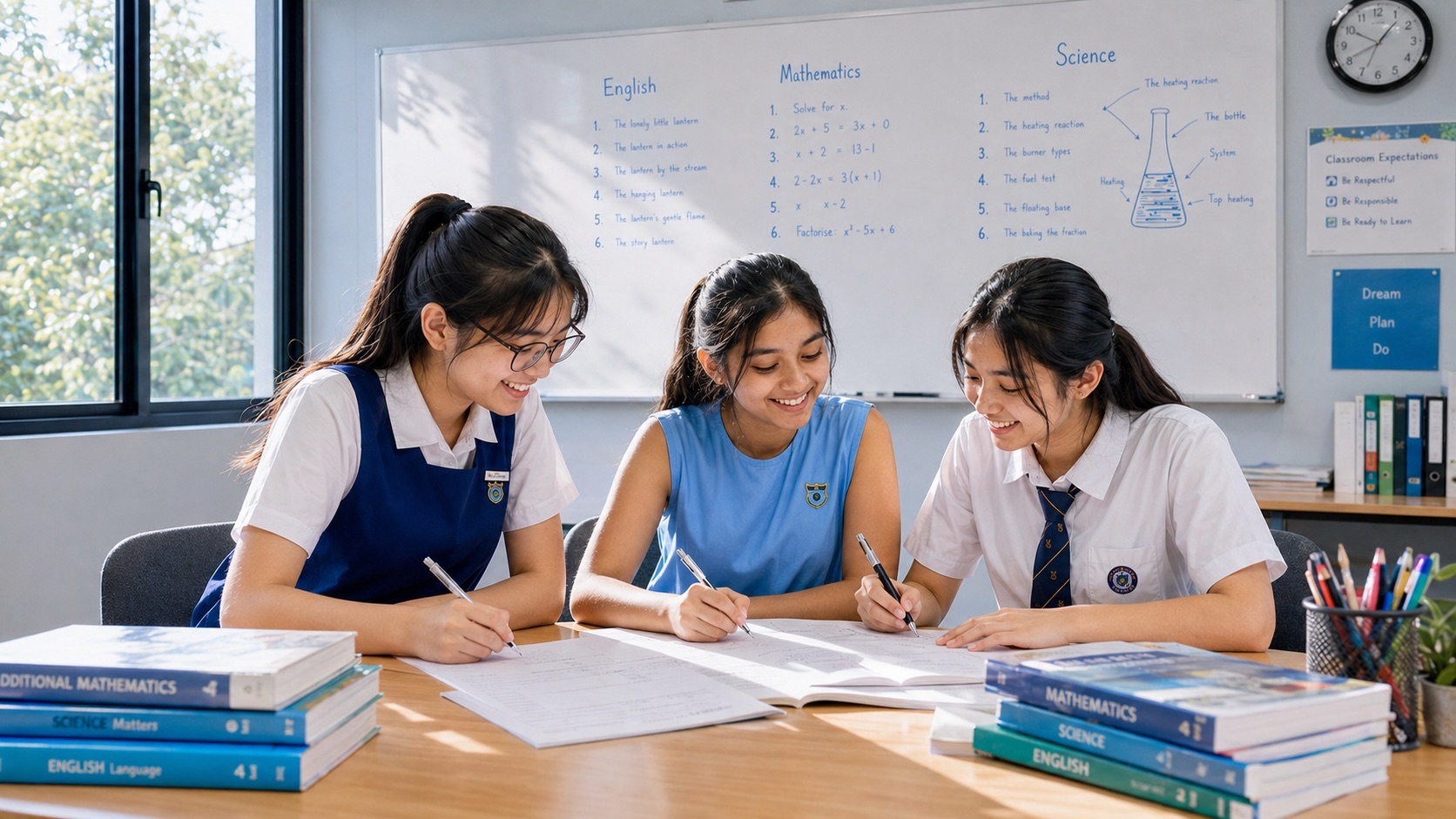
How to Improve With Tuition | Stevens
Stevens students can improve when tuition teaches self-questioning. Strong learners do not only answer questions; they learn to ask themselves the small questions that keep reasoning on track.
The goal is to replace some tutor prompts with an internal checklist the student can use independently.
At eduKateSG, we teach in premium 3-pax small-group tutorials near Sixth Avenue MRT. Lessons are typically 1.5 hours weekly, with clear explanation, closely observed practice, retrieval, error analysis, independent application and focused continuation work.
The purpose is not simply to add another academic session. It is to make the student more capable outside the lesson: better at identifying what a question requires, retrieving the right knowledge, choosing a method, checking the result and recovering when the first attempt goes wrong.
- build stronger self-questioning
- reduce dependence on tutor prompts
- improve first-step decisions
- strengthen checking
- make unfamiliar questions more manageable
Arrange a parent–student consultation with eduKate Singapore.
The Important Transition Is From Tutor Questions to Student Questions
Tutors often guide students with questions such as: What is being asked? What does this number represent? Which evidence supports that answer?
Those questions are useful because they direct attention.
They become even more valuable when the student begins asking them internally.
For Stevens students, improvement means carrying the tutor’s best prompts into independent work.
The Hidden Problem: The Student May Need the Question More Than the Answer
A student can often solve a task after one well-chosen prompt.
That prompt may be doing the most important cognitive work.
The tutor should therefore identify which prompt needs to become self-generated.
Consider an original percentage question: a jacket costs $96 after a 20% discount.
The useful self-question is: What percentage does $96 represent?
It represents 80% of the original price.
The original price is therefore $96 ÷ 0.8 = $120.
The learning target is not the number 120; it is remembering to ask what the given quantity represents.
Why a 3-Pax Tutorial Can Help Stevens Students Improve
In a 3-pax tutorial, the tutor can notice which Stevens student repeatedly needs which prompt.
One learner may need help identifying the target; another may need help choosing evidence or checking the final answer.
- close inspection of individual working
- frequent opportunities to answer and explain
- pacing that can change when a hidden gap appears
- independent application after guided teaching
- comparison of different valid approaches
- clearer tracking of recurring error patterns
- more precise adjustment before school assessments
The prompt can then be faded until the student generates it independently.
The class is small by design. Its value comes from better information about how each student is thinking, not merely from reducing the number of seats in the room.
Three Improvement Pathways
1. Repair
Repair is needed when self-questioning cannot compensate for missing knowledge.
- percentage meaning
- fraction relationships
- core vocabulary
- Science concept gaps
- sentence interpretation
2. Stabilise
Stabilisation turns useful tutor prompts into repeatable internal prompts.
- cold starts
- prompt fading
- delayed retrieval
- mixed practice
- self-check questions
3. Extend
Extension develops flexible self-questioning under more complex work.
- multi-step problems
- ambiguous-looking questions
- method comparison
- evidence limits
- controlled timing
A First-Principles Improvement Method
1. Diagnose the first unstable point
We identify the exact prompt that unlocks the student’s thinking.
That prompt often reveals the decision the student is not yet making independently.
2. Rebuild only what is actually missing
If the underlying concept is missing, the tutor teaches it directly.
If the concept is present, the lesson focuses on transferring the prompt into the student’s own routine.
3. Fence the task before adding complexity
The first practice boundary should be simple enough that the student can see the relationship. Once the method is secure, one source of difficulty is changed deliberately: wording, numbers, representation, topic mixture or time pressure.
This makes failure informative. If several new difficulties arrive at once, the tutor may know the answer is wrong without knowing which part of the thinking failed first.
4. Make the student explain
Students explain which question they should ask themselves before beginning.
A compact self-question becomes a reusable control point.
5. Retrieve after a delay
Immediate success is useful but incomplete evidence. A later cold-start question shows what the student can bring back without the original explanation sitting beside the page.
6. Interleave and transfer
The prompt is then tested across different formats and subjects.
The student learns to adapt the wording while keeping the underlying function.
7. Add speed only after control
Timing is added only after the self-question can be used quickly without disrupting flow.
What Happens During a 90-Minute Improvement Lesson
Warm-up retrieval
A cold-start task lets the tutor observe whether the student generates the useful prompt without help.
Current-school diagnosis
Recent schoolwork is checked for patterns. One or two high-value weaknesses are selected rather than trying to repair every marked error in the same lesson.
Concept instruction
The tutor makes the hidden question behind the method explicit.
Guided practice
The student attempts carefully selected questions while the tutor monitors the decision points. Prompts are reduced as control improves. A useful prompt directs attention; it does not replace the student’s reasoning.
Independent application
A fresh task follows without step-by-step help. This is where teaching is tested.
Mixed or timed application
A changed task checks whether the student knows when to use that self-question.
Error review
Mistakes are classified rather than simply crossed out. Reading, recall, concept, arithmetic, notation, language, organisation, timing and checking errors require different repairs.
Focused continuation work
Home practice includes one small note: what question did I need to ask myself to get started?
How Tuition Should Improve English
English self-questioning may include: What does the question ask? Which line supports my inference? Am I adding something the passage never states?
Those questions improve comprehension discipline.
For writing, the student can ask: What changed in this paragraph, and can the reader see why?
The aim is not a long checklist but a small number of high-value prompts.
How Tuition Should Improve Mathematics
Mathematics self-questioning makes method selection more independent.
Questions such as What is the whole? What does x represent? What quantity is being requested? can prevent long wrong routes.
As the habit stabilises, the questions become faster and increasingly internal.
The tutor checks whether the student can use them without being reminded.
How Tuition Should Improve Science
Science self-questioning may include: What was observed? What variable changed? What concept explains this? Does the evidence support my claim?
These prompts help students separate data from explanation.
A changed experiment later tests whether the reasoning routine transfers.
The tutor gradually removes the external prompts.
How We Reduce Careless-Looking Mistakes
Many careless-looking errors happen because the student never asked the question that would have exposed the risk.
- reading the wrong quantity or command word
- remembering the right idea but choosing it in the wrong situation
- making a correct setup and then calculating inaccurately
- copying a sign, exponent, unit or value incorrectly
- writing an answer that is true but insufficiently supported
- rushing because an earlier question consumed too much time
A targeted internal prompt is often more useful than another generic reminder to be careful.
Teaching Ahead Without Rushing
Pre-teaching can include the self-questions that organise a future topic.
The student then meets school work with a ready-made way to enter the task.
Pre-teaching should reduce surprise, not create a second syllabus that races ahead while current foundations remain unstable.
What Progress Should Look Like
Parents may notice less dependence on adult prompting.
- better independent starts
- more precise help-seeking
- fewer wrong-method starts
- stronger checking
- better evidence use
- less waiting for confirmation
The student begins to carry the tutor’s reasoning prompts into everyday schoolwork.
Marks remain important, but responsible tuition does not promise a fixed grade after a fixed number of lessons. The size of the gap, attendance, school demands, practice quality and assessment timing all matter.
A Stevens Self-Questioning Routine
A useful weekly routine keeps the number of prompts small.
- choose one recurring difficulty
- write one self-question that addresses it
- use it on a fresh task
- record whether it helped
- remove or replace it once the habit becomes automatic
The prompt should guide a decision, not add another burden.
The goal is internal control.
Travelling From Stevens to Sixth Avenue
Stevens families can plan travel toward Sixth Avenue using current central-area rail and bus connections from the student’s actual starting point.
The weekly arrangement should include school dismissal, meals, the lesson and the return home.
This guide serves Stevens families considering the Fourth Avenue programme. It does not describe a Stevens branch.
Location: eduKateSG, 8 Fourth Avenue, Singapore 268674
Nearest MRT: Sixth Avenue MRT, Downtown Line
Attendance: By appointment
Class Details
Format: Premium 3-pax small-group tutorials
Duration: Approximately 1.5 hours weekly
Teaching approach:
- first-principles explanation
- diagnosis before volume
- guided and independent practice
- retrieval and interleaving
- error analysis
- school-assessment alignment
- carefully paced pre-teaching
Materials may include:
- curated lesson notes
- topic practice
- mixed revision
- assessment-style questions
- micro-tests
- focused continuation work
What Parents Can Bring to the Consultation
- recent school test papers
- marked assignments
- the school’s current topic sequence
- teacher comments
- work completed only with heavy help
- questions the student repeatedly avoids
- examples of mistakes that returned after correction
Bring questions where one small hint unlocks the whole solution. Those examples help identify the prompt the student needs to internalise.
Frequently Asked Questions
How quickly should a Stevens student improve with tuition?
Self-questioning habits can improve within several lesson cycles when the underlying knowledge is secure. Missing concepts still require direct teaching.
Should tuition begin with full examination papers?
Not always. Full papers are useful for integration, timing and diagnosis, but a missing foundation may need a smaller teaching task first. The practice format should answer the current learning question.
Is more homework always better?
No. Practice volume should match the purpose. Fluency may need repetition. Concept repair may need fewer questions with slower reasoning and better correction.
What if my child understands during tuition but cannot work alone?
Then independent transfer has not yet been built. Prompts should be reduced, cold-start work added and the student required to choose and explain the method without the model answer beside it.
Can a strong student still benefit from tuition?
Yes. Strong students often benefit from higher-quality internal prompts because advanced work offers fewer obvious cues.
How do you reduce repeated careless mistakes?
We identify the error type and teach a matching check. Reading, sign, copying, recall, layout and time-pressure errors require different responses.
Do you teach ahead of school?
Yes, when the foundation is stable. A calm first encounter can make the later school lesson easier to follow. We do not rush ahead when earlier concepts remain insecure.
Is tuition necessary for every student?
No. A student who is learning confidently, completing work independently and progressing well may not need additional tuition. Tuition should solve an identifiable learning problem or provide meaningful extension.
Helpful Reading
Read How Independent Learning Works, How Error Correction Works and How Retrieval Practice Works for the wider learning system.
How to Improve With Tuition | Stevens
For Stevens students, good tuition should move the best tutor questions into the learner’s own head.
Ask the right question early, and the rest of the reasoning often becomes easier to control.
eduKateSG
8 Fourth Avenue
Singapore 268674
Near Sixth Avenue MRT
Premium 3-pax small-group tuition
By appointment
Properly taught kids shine a bright light into the future.